

The DOI matches its Crossref record; 82 of the 82 references it cites were found in a registry or an index.
Survival of atraumatic restorative treatment (ART) sealants and restorations: a meta-analysis
Open accessAbstract
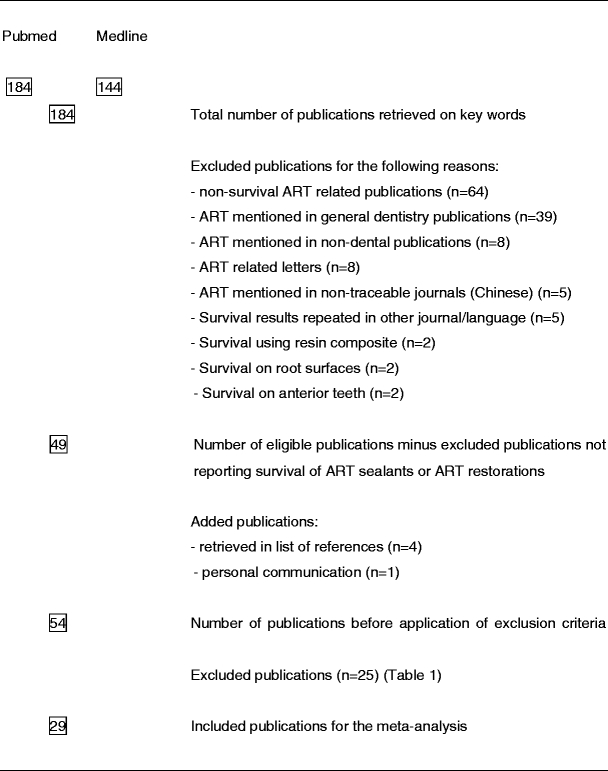
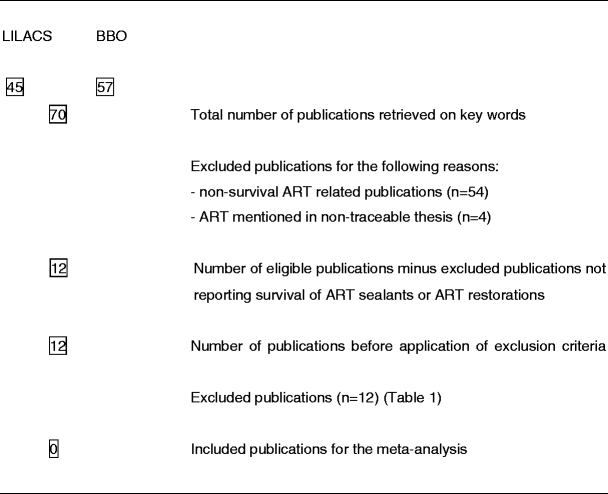
UNLABELLED: The purpose of this study is to perform a systematic investigation plus meta-analysis into survival of atraumatic restorative treatment (ART) sealants and restorations using high-viscosity glass ionomers and to compare the results with those from the 2005 ART meta-analysis. Until February 2010, four databases were searched. Two hundred four publications were found, and 66 reported on ART restorations or sealant survival. Based on five exclusion criteria, two independent reviewers selected the 29 publications that accounted for the meta-analysis. Confidence intervals (CI) and or standard errors were calculated and the heterogeneity variance of the survival rates was estimated. Location (school/clinic) was an independent variable. The survival rates of single-surface and multiple-surface ART restorations in primary teeth over the first 2 years were 93% (CI, 91-94%) and 62% (CI, 51-73%), respectively; for single-surface ART restorations in permanent teeth over the first 3 and 5 years it was 85% (CI, 77-91%) and 80% (CI, 76-83%), respectively and for multiple-surface ART restorations in permanent teeth over 1 year it was 86% (CI, 59-98%). The mean annual dentine lesion incidence rate, in pits and fissures previously sealed using ART, over the first 3 years was 1%. No location effect and no differences between the 2005 and 2010 survival rates of ART restorations and sealants were observed. The short-term survival rates of single-surface ART restorations in primary and permanent teeth, and the caries-preventive effect of ART sealants were high. CLINICAL RELEVANCE: ART can safely be used in single-surface cavities in both primary and permanent teeth. ART sealants have a high caries preventive effect.
Overview
The claims and statistics of this paper haven’t been checked yet.
Run the check — free, no account needed. It reads the open-access text and checks the sources it cites.
Integrity signals
Registry
Cites
Statistics
Figures
Verification
Claims the paper makes
The claims and statistics of this paper haven’t been checked yet.
Run the check — free, no account needed. It reads the open-access text and checks the sources it cites.
Claims other papers make about this one
Each is checked against this paper’s own text: does it say what the citing paper says it does?
The source backs part of the claim, not all of it — or backs it for a different population, condition or comparison.
In the citing paper
“This limitation makes it more susceptible to premature deterioration, particularly in individuals who apply considerable masticatory forces [44].”
From Minimally Invasive Techniques for Managing Dental Caries in Children: Efficacy, Applications, and Future Directions (2025) · cites this paper as [44]
Experimental — accuracy not yet measuredThe source backs part of the claim, not all of it — or backs it for a different population, condition or comparison.
In the citing paper
“ART is particularly sensitive to technique, requiring optimal moisture control during application to ensure optimal bonding and longevity of restorations [44].”
From Minimally Invasive Techniques for Managing Dental Caries in Children: Efficacy, Applications, and Future Directions (2025) · cites this paper as [44]
Experimental — accuracy not yet measuredThe source backs part of the claim, not all of it — or backs it for a different population, condition or comparison.
In the citing paper
“A primary challenge is the decreased success rate noted in multi-surface lesions, where increased mechanical stress on restorations can lead to premature failure [44].”
From Minimally Invasive Techniques for Managing Dental Caries in Children: Efficacy, Applications, and Future Directions (2025) · cites this paper as [44]
Experimental — accuracy not yet measuredThe source backs part of the claim, not all of it — or backs it for a different population, condition or comparison.
In the citing paper
“success rate noted in multi-surface lesions, where increased mechanical stress on restorations can lead to premature failure [44].”
From Minimally Invasive Techniques for Managing Dental Caries in Children: Efficacy, Applications, and Future Directions (2025) · cites this paper as [44]
Experimental — accuracy not yet measuredThe source backs part of the claim, not all of it — or backs it for a different population, condition or comparison.
In the citing paper
“However, factors such as patient compliance, the operator's expertise, and environmental conditions, including moisture control during placement, are acknowledged as critical elements influencing the longevity of restorations [44].”
From Minimally Invasive Techniques for Managing Dental Caries in Children: Efficacy, Applications, and Future Directions (2025) · cites this paper as [44]
Experimental — accuracy not yet measured
The source backs part of the claim, not all of it — or backs it for a different population, condition or comparison.
In the citing paper
“while glass ionomer cement (GIC) provides the advantage of fluoride release that contributes to ongoing caries prevention”
From Minimally Invasive Techniques for Managing Dental Caries in Children: Efficacy, Applications, and Future Directions (2025) · cites this paper as [44]
Experimental — accuracy not yet measuredThe check wasn’t confident either way, so it gives no verdict — never disputed.
In the citing paper
“it lacks the wear resistance found in composite or amalgam restorations”
From Minimally Invasive Techniques for Managing Dental Caries in Children: Efficacy, Applications, and Future Directions (2025) · cites this paper as [44]
Experimental — accuracy not yet measured
Self-check
Percentages, sums and reported differences re-computed from the paper’s own numbers.
The self-check needs the paper’s full text.
Citations
Cites
Systematic Reviews: Rationale for systematic reviews
Mulrow, C. D. (1994) · BMJ · doi:10.1136/bmj.309.6954.597 · Cited by 1,677
Recommendations for conducting controlled clinical studies of dental restorative materials
Hickel, R., Roulet, J., Bayne, S. C., Heintze, S. D., Mjör, I. A., Peters, M. C., Rousson, V., Randall, R., Schmalz, G., Tyas, M. J., et al. (2007) · Clinical Oral Investigations · doi:10.1007/s00784-006-0095-7 · Cited by 409
The Atraumatic Restorative Treatment (ART) approach for managing dental caries: a meta-analysis
van’t Hof, M. A., Frencken, J. E., Helderman, W. H. V. P., & Holmgren, C. J. (2006) · International Dental Journal · doi:10.1111/j.1875-595x.2006.tb00339.x · Cited by 207
Self-citationPhantumvanit, P., Songpaisan, Y., Pilot, T., & Frencken, J. E. (1996) · Journal of Public Health Dentistry · doi:10.1111/j.1752-7325.1996.tb02424.x · Cited by 179
Self-citationGlass ionomer and resin‐based fissure sealants: a clinical study
MEJÀRE, I., & Mjör, I. A. (1990) · European Journal Of Oral Sciences · doi:10.1111/j.1600-0722.1990.tb00983.x · Cited by 172
ART restorations and glass ionomer sealants in Zimbabwe: survival after 3 years
Frencken, J. E., Makoni, F., & Sithole, W. D. (1998) · Community Dentistry And Oral Epidemiology · doi:10.1111/j.1600-0528.1998.tb01975.x · Cited by 160
Self-citationFrencken, J. E., Makoni, F., Sithole, W. D., & Hackenitz, E. (1998) · Caries Research · doi:10.1159/000016441 · Cited by 152
Self-citationAn atraumatic restorative treatment (ART) technique: evaluation after one year.
Frencken, J. E., Songpaisan, Y., Phantumvanit, P., & Pilot, T. (1994) · PubMed · Cited by 150
Self-citationART restorations and sealants placed in Chinese school children – results after three years
Holmgren, C. J., Lo, E. C. M., Hu, D., & Wan, H. (2000) · Community Dentistry And Oral Epidemiology · doi:10.1034/j.1600-0528.2000.280410.x · Cited by 127
Lo, E. C. M., & Holmgren, C. J. (2001) · International Journal of Paediatric Dentistry · doi:10.1046/j.1365-263x.2001.00232.x · Cited by 126
Research works printed but not linked: 11
- Loh KH (2003) An ART technique in the mobile dental squad in Malaysia: a four-year review. Malaysian Dent J 24:95–101
- Pan American Health Organization (2006) Oral health of low income children. Procedures for atraumatic restorative treatment. Final report. PAHO, Washington
- van Den Dungen GM, Huddleston Slater AE, van Amerongen WE (2004) ART of conventioneel? Onderzoeksresultaten van proximale restauraties in tijdelijke molaren. Ned Tijdschr Tandheelk 111:345–349
- Falbo S, Grisoski M, Vivone G, Zac L (2002) Dos años de atención comunitária con tecnica atraumática en ninõs escolares. Rev Asoc Odontol Argent 90:171–174
- Oliveira MT, Bittencourt ST, Oliveira MDS, Roberta H, Pereira JR (2009) Avaliação clínica do desempenho de TRA (tratamento restaurador atraumático) associado a um agente químico de remoção de cárie. Rev Odontol Ciênc 24:190–193
- Silva JJS, Carvalho RB, Batittucci MHG, Silva KRS (2005) Tratamento restaurador atraumático (TRA) em escolares do Morro São Benedito, município de Vitória, ES. J Bras Clín Odontol Integr 9:24–30
- Bresciani E, Nogueira DA, Henostroza Quintans N, Barata TJE, Lauris JRP, Navarro MFL (2002) Influência do isolamento absoluto sobre o sucesso do tratamento restaurador atraumático (ART) em cavidades classe II, em dentes decíduos. Rev Fac Odontol Bauru 10:231–237
- Peres SHCS, Hussne R, Peres AS (2005) Tratamento restaurador atraumático (ART) em crianças de 4 a 7 anos: avaliação clínica após 6 meses. Rev Inst Ciênc Saúde 23:275–280
- Oliveira LMC (2000) Avaliação de um programa de tratamento restaurador atraumático em crianças institucionalizadas. PhD Thesis, Rio de Janeiro, p 168
- Bustamante C, Edelberg MH (2004) Tratamiento restaurador atraumático (TRA) em dientes permanentes jóvenes. Resultados de 3 años: un procedimiento válido para la prevención e inactivación de caries en el marco de un programa comunitario de atención primaria. Rev Asoc Odontol Argent 92:155–159
- Figueiredo MC, Froner AM, Rosito DB, Gallarreta FWM, Sampaio MS (1999) A utilização da técnica de Tratamento Restaurador Atraumático (ART) em bebês: avaliação clínica de um ano. J Bras Odontopediatr Odontol Bebê 2:362–368
Cited by
Sorted by citations
Minimal intervention dentistry for managing dental caries – a review
Frencken, J. E., Peters, M. C., Manton, D. J., Leal, S. C., Gordan, V. V., & Eden, E. (2012) · International Dental Journal · doi:10.1111/idj.12007 · Cited by 531
Self-citationTwenty-five-year atraumatic restorative treatment (ART) approach: a comprehensive overview
Frencken, J. E., Leal, S. C., & Navarro, M. F. (2012) · Clinical Oral Investigations · doi:10.1007/s00784-012-0783-4 · Cited by 237
Self-citationModifications in Glass Ionomer Cements: Nano-Sized Fillers and Bioactive Nanoceramics
Najeeb, S., Khurshid, Z., Zafar, M., Khan, A., Zohaib, S., Martí, J., Sauro, S., Matinlinna, J., & Rehman, I. (2016) · International Journal of Molecular Sciences · doi:10.3390/ijms17071134 · Cited by 226
“Due to their high fluoride release and white color, dental applications of GICs include restoration of deciduous teeth [20], anterior class III and V restorations [21,22], cementation (luting) of crowns, bridges, and orthodontic appliances [23–25], restorations of non-carious teeth with minimal preparation [26,27], te…”
BackgroundThe Use of Pit and Fissure Sealants—A Literature Review
Naaman, R., El‐Housseiny, A. A., & Alamoudi, N. (2017) · Dentistry Journal · doi:10.3390/dj5040034 · Cited by 169
Fluorides and Other Preventive Strategies for Tooth Decay
Horst, J. A., Tanzer, J. M., & Milgrom, P. (2018) · Dental Clinics of North America · doi:10.1016/j.cden.2017.11.003 · Cited by 173
Metadata
- Authors
- de Amorim, R. G., Leal, S. C., & Frencken, J. E.
- Affiliations
- Universidade de Brasília (BR)
- Radboud University Medical Center (NL)
- Corresponding author
- Frencken, Jo E.
- Venue
- Clinical Oral Investigations
- Published
- 2011-01-28
- Volume
- 16
- Issue
- 2
- Pages
- 429-441
- ISSN
- 1432-6981 (ISSN-L)
- 1436-3771
- PMC
- PMC3308010
- OpenAlex
- W2114683488
- Cited by
- 213
- References
- 82
- Citations by year
- 2026: 3 · 2025: 3 · 2024: 6 · 2023: 8 · 2022: 13 · 2021: 20 · 2020: 31 · 2019: 23 · 2018: 20 · 2017: 15 · 2016: 16 · 2015: 15 · 2014: 14 · 2013: 16 · 2012: 8
- FWCI
- 2.26
- Type
- journal article
- Language
- en
- Open access
- hybrid
- doi.org
- Licence
- cc-by-nc
- Locations
- Clinical Oral Investigations (publishedVersion, cc-by-nc)
- PubMed Central (publishedVersion, cc-by-nc)
- PubMed (publishedVersion)
- Radboud Repository (Radboud University) (submittedVersion)
- Topics
- Health Sciences › Dentistry › General Dentistry › Dental materials and restorations
- Health Sciences › Dentistry › Oral Surgery › Endodontics and Root Canal Treatments
- Health Sciences › Dentistry › General Dentistry › Dental Health and Care Utilization
- Keywords
- atraumatic restorative treatment, restoration, high-viscosity glass ionomer, primary teeth, permanent teeth, dental caries prevention, pit and fissure sealants
- MeSH terms
- Dental Caries, Dental Clinics, Dental Fissures, Dentin, Glass Ionomer Cements, Humans, Schools, Dental, Tooth, Deciduous, Survival Analysis, Dental Restoration Failure, Dental Atraumatic Restorative Treatment
About these checks
Registry, retraction, Cites and statistics results are computed, not judged, with one exception: a printed reference that no index lists is read once by a model before it counts as a citation error. Claims are extracted by a model and kept only when their quote appears verbatim in the text; each cited source is then checked, with a model’s help, for whether it says what the claim relies on. Those verdicts can be wrong — read the claim’s quote and the cited source before relying on one.
Statistics and arithmetic are recomputed, not judged.
Confidence bands are shown only for fields calibrated on our annotated test set. None is calibrated yet, so no band is shown.
What counts as a claim ›How we measure confidence ›How we check this ›
Are you an author, or do you see a problem with this page? Request a review
