

European clinical guidelines for Tourette Syndrome and other tic disorders. Part III: behavioural and psychosocial interventions
Open accessThe DOI matches its Crossref record; 57 of the 57 references it cites were found in a registry or an index.
Abstract
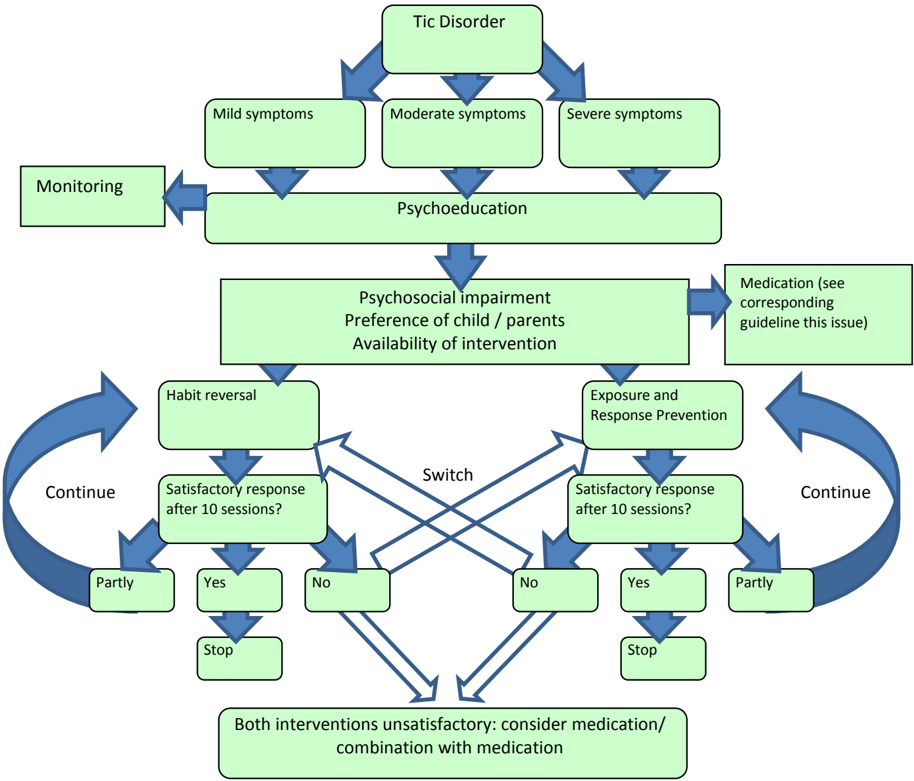
This clinical guideline provides recommendations for the behavioural and psychosocial interventions (BPI) of children and adolescents with tic disorders prepared by a working group of the European Society for the Study of Tourette Syndrome (ESSTS). A systematic literature search was conducted to obtain an update on the efficacy of BPI for tics. Relevant studies were identified using computerised searches of the Medline and PsycINFO databases and the Cochrane Library for the years 1950-2010. The search identified no meta-analyses, yet twelve (systematic) reviews and eight randomised controlled trials provided evidence for the current review. Most evidence was found for habit reversal training (HRT) and the available but smaller evidence also supports the efficacy of exposure with response prevention (ERP). Both interventions are considered first line behavioural treatments for tics for both children and adults and should be offered to a patient, taking into account his preference. Treatments that are considered second line or add-on behavioural treatments are contingency management, function based interventions and relaxation training. Neurofeedback is still experimental. Almost no research was identified that examined the efficacy of psychosocial interventions, e.g., psychoeducation and group work. Based on clinical practice, this guideline recommends behavioural treatment as first line offer to patients in most cases. It should be embedded within a psychoeducational and supp…
Overview
The claims and statistics of this paper haven’t been checked yet.
Free: it reads the open-access text and checks the first 5 claims that cite a source we can check. Create a free account to check every claim.
Integrity signals
Registry
Cites
Statistics
Figures
Verification
Claims the paper makes
The claims and statistics of this paper haven’t been checked yet.
Free: it reads the open-access text and checks the first 5 claims that cite a source we can check. Create a free account to check every claim.
Claims other papers make about this one
Each is checked against this paper’s own text: does it say what the citing paper says it does?
The source backs part of the claim, not all of it — or backs it for a different population, condition or comparison.
In the citing paper
“Despite psychoeducation being described in clinical guidelines as a first important step of any treatment for TS [5, 11], evidence on what specific elements should be addressed is lacking.”
From European clinical guidelines for Tourette syndrome and other tic disorders—version 2.0. Part II: psychological interventions (2022) · cites this paper as [5]
Experimental — accuracy not yet measuredIn the citing paper
“In the 2011 European clinical guidelines, behavior therapy (BT) was recommended as a first-line intervention for tic disorders in children and adults [5, 6].”
From European clinical guidelines for Tourette syndrome and other tic disorders—version 2.0. Part II: psychological interventions (2022) · cites this paper as [5]
In the citing paper
“Behavioral treatment for tics is recommended as first-line intervention according to European clinical guidelines [15].”
From Tackle your Tics: pilot findings of a brief, intensive group-based exposure therapy program for children with tic disorders (2021) · cites this paper as [15]
In the citing paper
“professional organizations have recommended behavior therapy as the first-line intervention for youth with PTD who have mild-to-moderate tic severity [37–39]”
From Behavior Therapy for Tic Disorders: An Evidenced-based Review and New Directions for Treatment Research (2015) · cites this paper as [38]
Self-check
Percentages, sums and reported differences re-computed from the paper’s own numbers.
The self-check needs the paper’s full text.
Citations
Cites
Habit-reversal: a method of eliminating nervous habits and tics
Azrin, N. H., & Nunn, R. G. (1973) · Behaviour Research and Therapy · doi:10.1016/0005-7967(73)90119-8 · Cited by 967 · cited 1×
“It offers a set of techniques that help the patient become aware of the occurrence of a tic, followed by a so-called competing response training to interrupt or inhibit the tic [7–9].”
BackgroundBehavior Therapy for Children With Tourette Disorder: A Randomized Controlled Trial
Piacentini, J., Woods, D. W., Scahill, L., Wilhelm, S., Peterson, A. L., Chang, S., Ginsburg, G. S., Deckersbach, T., Dziura, J., Levi-Pearl, S., et al. (2010) · JAMA · doi:10.1001/jama.2010.607 · Cited by 790
Premonitory urges in Tourette's syndrome
(1993) · American Journal of Psychiatry · doi:10.1176/ajp.150.1.98 · Cited by 628
Is neurofeedback an efficacious treatment for ADHD? A randomised controlled clinical trial
Gevensleben, H., Holl, B., Albrecht, B., Vogel, C., Schlamp, D., Kratz, O., Studer, P., Rothenberger, A., Moll, G. H., & Heinrich, H. (2009) · Journal of Child Psychology and Psychiatry · doi:10.1111/j.1469-7610.2008.02033.x · Cited by 398
The prevalence and epidemiology of Gilles de la Tourette syndrome
Robertson, M. M. (2008) · Journal of Psychosomatic Research · doi:10.1016/j.jpsychores.2008.03.006 · Cited by 369
Annotation: Neurofeedback – train your brain to train behaviour
Heinrich, H., Gevensleben, H., & Strehl, U. (2007) · Journal of Child Psychology and Psychiatry · doi:10.1111/j.1469-7610.2006.01665.x · Cited by 293
Exposure with response prevention versus habit reversal in Tourettes’s syndrome: a controlled study
Verdellen, C. W. J., Keijsers, G. P. J., Cath, D. C., & Hoogduin, C. A. L. (2004) · Behaviour Research and Therapy · doi:10.1016/s0005-7967(03)00154-2 · Cited by 280
Self-citationWilhelm, S., Deckersbach, T., Coffey, B. J., Bohne, A., Peterson, A. L., & Baer, L. (2003) · American Journal of Psychiatry · doi:10.1176/appi.ajp.160.6.1175 · Cited by 252
Banaschewski, T., Woerner, W., & Rothenberger, A. (2003) · Developmental Medicine & Child Neurology · doi:10.1017/s0012162203001294 · Cited by 250
The influence of contextual factors on tic expression in Tourette's syndrome: A review
Conelea, C. A., & Woods, D. W. (2008) · Journal of Psychosomatic Research · doi:10.1016/j.jpsychores.2008.04.010 · Cited by 249
Research works printed but not linked: 2
- 1. Robertson MM (2008) The prevalence and epidemiology of Gilles de la Tourette syndrome. Part 1: the epidemiological and prevalence studies. J Psychosom Res 65 (5):461472. doi:S0022-3999(08)00111-6 [pii]
- Peterson BS, Cohen DJ (1998) The treatment of Tourette’s syndrome: multimodal, developmental intervention. J Clin Psychiatry 59(Suppl 1):62–72 discussion 73–64
Cited by
Items 201–300 of 362
Tourette syndrome in children and adolescents: aetiology, presentation and treatment
Robertson, M. M. (2016) · BJPsych Advances · doi:10.1192/apt.bp.114.014092 · Cited by 4
Edwards, K. R., & Specht, M. W. (2016) · Current Developmental Disorders Reports · doi:10.1007/s40474-016-0100-z · Cited by 4
Treatment decisions for chronic tic disorders
Selles, R. R., Murphy, T. K., Obregon, D. F., Storch, E. A., & Lewin, A. B. (2013) · Clinical Practice · doi:10.2217/cpr.13.71 · Cited by 4
Self-citationTomskiy, A. A., Poddubskaya, A. A., Gamaleya, A. A., & Зайцев, О. С. (2022) · Progress in brain research · doi:10.1016/bs.pbr.2022.03.005 · Cited by 4
Roessner, V., & Rothenberger, A. (2014) · Springer eBooks · doi:10.1007/978-3-7091-1501-5_27 · Cited by 4
Behavior therapy for a 75-year-old woman with chronic motor tic disorder
McGuire, J. F., & Storch, E. A. (2013) · Neuropsychiatry · doi:10.2217/npy.13.66 · Cited by 4
Xu, X., Zhu, K., Wang, W., Zhao, T., & Fu, C. (2025) · Frontiers in Psychiatry · doi:10.3389/fpsyt.2025.1521947 · Cited by 3
Liu, H., Wang, C., Zhang, H., & Rezaei, M. J. (2025) · Frontiers in Neurology · doi:10.3389/fneur.2025.1447818 · Cited by 3
Rothenberger, A. (2012) · Behavioral and Brain Sciences · doi:10.1017/s0140525x11001580 · Cited by 3
Critical aspects in the legal defence of patients with Tourette's Syndrome: An Italian case series
Porta, M., Servello, D., Dell’Osso, B. M., Dina, C. Z., Bona, A. R., & Alleva, G. C. (2018) · International Journal of Law and Psychiatry · doi:10.1016/j.ijlp.2018.08.003 · Cited by 3
Behavioral Therapy for Tourette Disorder: An Update
Himle, M. B., & Capriotti, M. R. (2016) · Current Behavioral Neuroscience Reports · doi:10.1007/s40473-016-0085-2 · Cited by 3
Psychiatric Treatment and Management of Psychiatric Comorbidities of Movement Disorders
Walsh, K. H., Soe, K. C., & Sarawgi, S. (2017) · Seminars in Pediatric Neurology · doi:10.1016/j.spen.2017.12.002 · Cited by 3
Macías‐García, D. (2019) · Medicine - Programa de Formación Médica Continuada Acreditado · doi:10.1016/j.med.2019.03.003 · Cited by 3
Gilles de la Tourette-Syndrom: Klinik, Ursachen, Therapie
Jakubovski, E., & Müller‐Vahl, K. (2017) · PPmP - Psychotherapie · Psychosomatik · Medizinische Psychologie · doi:10.1055/s-0043-103269 · Cited by 3
Brandt, V. C., & Münchau, A. M. (2017) · Springer eBooks · doi:10.1007/978-3-7091-1628-9_28 · Cited by 3
You, X.-R., Cai, W.-H., Yang, Y.-T., Li, Y., & Ni, X. (2026) · Journal of Affective Disorders · doi:10.1016/j.jad.2026.121677 · Cited by 3
Kognitivno-vedenjska terapija otrok in madostnikov z motnjami tikov
Kodrič, J. (2020) · Psihološka obzorja · doi:10.20419/2020.29.511 · Cited by 3
Tic-Störungen im Kindes- und Jugendalter
Gloor, F. T. (2015) · PSYCH up2date · doi:10.1055/s-0041-100491 · Cited by 3
Yu, J., Ye, Y., Li, S., Liu, J. H., Zhai, Y., Zhang, M., & Liu, Z. (2015) · Trials · doi:10.1186/s13063-015-0873-0 · Cited by 3
AlHarthi, M. S. (2025) · Medicine · doi:10.1097/md.0000000000042760 · Cited by 3
Atypical antipsychotics for treatment of Tourette syndrome
Kalari, V. K., Morrison, P. E., & Budman, C. L. (2022) · International review of movement disorders · doi:10.1016/bs.irmvd.2021.12.002 · Cited by 3
Cannabinoids and the Tourette syndrome
Müller‐Vahl, K. (2015) · Elsevier eBooks · doi:10.1016/b978-0-12-417041-4.00010-2 · Cited by 3
Paschou, P., & Müller‐Vahl, K. (2017) · Frontiers in Psychiatry · doi:10.3389/fpsyt.2017.00197 · Cited by 3
Bamigbade, S.-E. (2021) · University of Hertfordshire Research Archive (University of Hertfordshire) · doi:10.18745/th.25345 · Cited by 3
Cannabinoid-Based Medicines for the Treatment of Gilles de la Tourette Syndrome
Kanaan, A. S., & Müller‐Vahl, K. (2017) · Elsevier eBooks · doi:10.1016/b978-0-12-800756-3.00107-1 · Cited by 3
Development of a self-help digital intervention for young people with Tourette syndrome
Babbage, C. M. (2021) · Nottingham ePrints (University of Nottingham) · Cited by 3
Kwon, O. S., Lee, S. M., Choi, K., Lee, Y. J., & Jung, J. Y. (2018) · Integrative Medicine Research · doi:10.1016/j.imr.2018.06.003 · Cited by 3
Ritter, M., Vangkilde, S., Maigaard, K., Pagsberg, A. K., Plessen, K. J., & Hagstrøm, J. (2022) · Journal of Clinical Medicine · doi:10.3390/jcm11020309 · Cited by 2
Neurodevelopmental Disorders and Psychosocial Issues Later in Life
Zoccante, L., Antolini, G., Passarella, L., Puttini, E., Rizzo, V., & Colizzi, M. (2022) · Springer eBooks · doi:10.1007/978-3-030-97906-5_7 · Cited by 2
Gilles de la Tourette syndrome: An overview
Cavanna, A., & Nani, A. (2019) · Archives of Medicine and Health Sciences · doi:10.4103/amhs.amhs_122_19 · Cited by 2
Development of a tic service model for children and young people in England: a Delphi study
Hall, S. S., Rattu, N. R., Hall, C. L., Kilgariff, J., Murphy, T. L., James, N., McNally, E., Rimmer, S., Thomson, L., Kramer, J., et al. (2026) · BMJ Open · doi:10.1136/bmjopen-2025-107534 · Cited by 2
Self-citationImmune dysregulation in pediatric tic disorders: mechanisms, biomarkers, and therapeutic frontiers
Sun, X., & Bai, X. (2026) · Frontiers in Immunology · doi:10.3389/fimmu.2026.1708940 · Cited by 2
Behavior Therapy for Childhood Tic Disorders
Woods, D. W., & Houghton, D. C. (2015) · Elsevier eBooks · doi:10.1016/b978-0-12-420249-8.00009-5 · Cited by 2
Conelea, C. A., Bennett, S. M., Capriotti, M. R., Hamilton, S., Himle, M. B., Hunt, C., Mathews, C. A., & Shineman, D. W. (2020) · PsyArXiv (OSF Preprints) · doi:10.31234/osf.io/qhb2z · Cited by 2
Hyperkinesia, dystonia, and tics
Elia, A. E., Garraux, G., & Albanese, A. (2014) · Cambridge University Press eBooks · doi:10.1017/cbo9781139565653.019 · Cited by 2
Non-Psychopharmacologic Therapy of Tic or Tourette's Disorder
Lim, M. H., Lee, Y. L., & Kim, B.-N. (2014) · Journal of korean Academy of Child and Adolescent Psychiatry · doi:10.5765/jkacap.2014.25.2.53 · Cited by 2
Gilles de la Tourette's syndrome in a patient with 47(XXX) syndrome: a case report
Chiappedi, M. A., de Vincenzi, S., Dolci, R., Luca, S. D., & Bejor, M. (2011) · Journal of Medical Case Reports · doi:10.1186/1752-1947-5-542 · Cited by 2
Movement disorders and tremors
Khalil, A., & Mallik, S. (2013) · InnovAiT Education and inspiration for general practice · doi:10.1177/1755738012472670 · Cited by 2
Patienten mit Tic-Störungen: weit bekannt, doch unterversorgt
Schnell, J. M. L., Weidinger, E., & Musil, R. (2019) · Fortschritte der Neurologie · Psychiatrie · doi:10.1055/a-0996-0944 · Cited by 2
Varadharajan, N., Chakrabarti, S., Sahoo, S., & Balachander, S. (2020) · Indian Journal of Psychological Medicine · doi:10.1177/0253717620927932 · Cited by 2
Postępowanie w tikach i zespole Gillesa de la Tourette’a — rekomendacje grupy ekspertów
Janik, P., Wolańczyk, T., Bryńska, A., Żarowski, M., Szamburska-Lewandowska, K., & Szejko, N. (2018) · Polski Przegląd Neurologiczny · Cited by 2
Executive Control and Emerging Behavior in Youth With Tourette’s Syndrome
Hovik, K. T. (2017) · Elsevier eBooks · doi:10.1016/b978-0-12-803676-1.00014-3 · Cited by 1
Verhaltens- und emotionale Störungen mit Beginn in der Kindheit und Jugend
Romanos, M., Banaschewski, T., Egberts, K. M., von Gontard, A., Renner, T., Roessner, V., Melfsen, S., Walitza, S., Wewetzer, C., & Warnke, A. (2016) · Springer eBooks · doi:10.1007/978-3-642-45028-0_84-1 · Cited by 1
Hovik, K. T. (2016) · NVA (Nasjonalt vitenarkiv) · Cited by 1
10 Cognitieve gedragstherapie en farmacotherapie
Gunning, B. W. (2011) · Bohn Stafleu van Loghum eBooks · doi:10.1007/978-90-313-8975-9_10 · Cited by 1
Introduction: The Long and Winding Road to Tourette Syndrome
Cavanna, A. E. (2020) · Cambridge University Press eBooks · doi:10.1017/9781108186599.001 · Cited by 1
Evaluation and Differential Diagnosis of Tics and Related Disorders
Cavanna, A. E. (2020) · Cambridge University Press eBooks · doi:10.1017/9781108186599.002 · Cited by 1
Le syndrome de Gilles de la Tourette en tant que trouble neurodéveloppemental
Leclerc, J. B., Gaudet, I., Gauthier, B., & St-Denis-Turcotte, J. (2016) · Revue québécoise de psychologie · doi:10.7202/1040039ar · Cited by 1
Yan, J., Wen, F., Yu, L., Wang, F., Liu, J., Wang, M., Cui, Y., & Li, Y. (2020) · Research Square · doi:10.21203/rs.3.rs-37399/v1 · Cited by 1
Behavioral Treatment of Tourette Disorder
Stiede, J. T., Pitts, B. X., Barber, K. E., & Ricketts, E. J. (2023) · Advances in Psychiatry and Behavioral Health · doi:10.1016/j.ypsc.2023.03.012 · Cited by 1
Hastings, O., Brown, B. J., Prentice, K.-M., Babbage, C. M., Davies, E. B., Kilgariff, J., Murphy, T. L., McGarry, G., Guo, B., Greenhalgh, C., et al. (2026) · BMJ Open · doi:10.1136/bmjopen-2025-110121 · Cited by 1
Self-citationLavoie, M. E., Aardema, F., & Leclerc, J. (2024) · Santé mentale au Québec · doi:10.7202/1114409ar · Cited by 1
Behavioral and Cognitive–Behavioral Therapy for Tourette Disorder
Mcguire, J. F., Capriotti, M. R., Woods, D. W., & Piacentini, J. C. (2022) · Oxford University Press eBooks · doi:10.1093/med/9780197543214.003.0025 · Cited by 1
Psychotropic Drug Treatment in Childhood and Adolescence
Coghill, D., & Adamo, N. (2020) · Cambridge University Press eBooks · doi:10.1017/9781911623465.019 · Cited by 1
Conelea, C. A., Bennett, S. M., Capriotti, M. R., Hamilton, S., Himle, M. B., Hunt, C., Mathews, C. A., & Shineman, D. W. (2020) · PsyArXiv (OSF Preprints) · doi:10.31234/osf.io/kd2cz · Cited by 1
Rothenberger, A. (2012) · European Child & Adolescent Psychiatry · doi:10.1007/s00787-012-0302-9 · Cited by 1
Döpfner, M. (2018) · Springer eBooks · doi:10.1007/978-3-662-57369-3_37 · Cited by 1
Tourette’s Syndrome: What We Know, What We Don’t Know, and What We Still Haven’t Asked
Malli, M. A., & Forrester‐Jones, R. (2025) · Sustainable development goals series · doi:10.1007/978-3-031-83368-7_2 · Cited by 1
Sørensen Camilla, B., Liselotte, S., Aaslet, L., Helle, N., Mette, M., Theis, L., Debes, N. M., & Miranda Maria, J. (2021) · Journal of Pediatric Neurology and Neuroscience · doi:10.36959/595/414 · Cited by 1
Process evaluation of Online Remote Behavioural Intervention for Tics (ORBIT)
Khan, K. (2021) · Nottingham ePrints (University of Nottingham) · Cited by 1
Zhu, P., Wu, M., Ma, B., & Wang, S. (2020) · Experimental and Therapeutic Medicine · doi:10.3892/etm.2020.9483 · Cited by 1
Diepe hersenstimulatie bij het syndroom van Gilles de la Tourette
Ackermans, L. P. C. M., & Leentjens, A. F. G. (2016) · Bohn Stafleu van Loghum eBooks · doi:10.1007/978-90-368-0959-7_16 · Cited by 1
Ivanova, E. N., Birovecz, A., Andrén, P., Flygare, O., Mataix‐Cols, D., de la Cruz, L. F., Ivanov, V. Z., Andersson, E., & Rück, C. (2026) · BMC Digital Health · doi:10.1186/s44247-026-00284-7 · Cited by 1
Robertson, M. M. (2015) · The Lancet Psychiatry · doi:10.1016/s2215-0366(15)00131-5 · Cited by 1
Schnell, J. M. L., Weidinger, E., & Musil, R. (2018) · MMW - Fortschritte der Medizin · doi:10.1007/s15006-018-0886-1 · Cited by 1
A parent-mediated habit reversal intervention for chronic tic disorders in children
Henning, E., Gerken, K. C., O’Brien, M. J., Ehly, S., Hua, Y., & Kuperman, S. (2017) · doi:10.17077/etd.vep72lzb · Cited by 1
Comparing Fixed-Amount and Progressive-Amount Schedules of Reinforcement for Tic Suppression
Capriotti, M. R. (2015) · UWM Digital Commons (University of Wisconsin–Milwaukee) · Cited by 1
Abi‐Jaoude, E. (2020) · TSpace (University of Toronto)
Grundlagen der Diagnostik und Therapie
(2024) · Elsevier eBooks · doi:10.1016/b978-3-437-22487-4.16001-0
Verhaltens- und emotionale Störungen mit Beginn in der Kindheit und Jugend
Romanos, M., Banaschewski, T., Egberts, K. M., von Gontard, A., Renner, T., Roessner, V., Melfsen, S., Walitza, S., Wewetzer, C., & Warnke, A. (2017) · Springer eBooks · doi:10.1007/978-3-662-49295-6_84
The Neural Substrates of Tics vs. Obsessive-compulsive Behaviours in Tourette Syndrome
Bhikram, T. (2020) · TSpace (University of Toronto)
A Case Report of Tic Disorder Children Treated by Kuibiondam-tang Gami
Kang, K. H., & Park, E. J. (2014) · The Journal of Pediatrics of Korean Medicine · doi:10.7778/jpkm.2014.28.4.0118
Needham, A. C. (2013) · TSpace (University of Toronto)
Mancini, A., & Fabbo, A. (2023) · Springer eBooks · doi:10.1007/978-3-031-27968-3_33
Neuropsychiatry for the Twenty-First Century
Cavanna, A. E. (2018) · Springer eBooks · doi:10.1007/978-3-319-89330-3_17
Tic disorders and trichotillomania
Miltenberger, R. G., Stiede, J. T., Woods, D. W., & Himle, M. B. (2020) · Elsevier eBooks · doi:10.1016/b978-0-12-805469-7.00008-5
Tics und Tourette-Störung für die Praxis
Ganos, C., & Djodari-Irani, A. (2020) · Nervenheilkunde · doi:10.1055/a-1133-6915
Tourette’s and Other Tic Disorders
Cavanna, A. E. (2018) · Cambridge University Press eBooks · doi:10.1017/9781108164313.028
Guidelines Based on Systematic Literature Review and Meta-analysis
Cavanna, A. E. (2020) · Cambridge University Press eBooks · doi:10.1017/9781108186599.008
Second-Generation Anti-dopaminergic Medications
Cavanna, A. E. (2020) · Cambridge University Press eBooks · doi:10.1017/9781108186599.005
First-Generation Anti-dopaminergic Medications
Cavanna, A. E. (2020) · Cambridge University Press eBooks · doi:10.1017/9781108186599.004
Other Tic-Suppressing Medications
Cavanna, A. E. (2020) · Cambridge University Press eBooks · doi:10.1017/9781108186599.007
Cavanna, A. E. (2020) · Cambridge University Press eBooks · doi:10.1017/9781108186599.003
Alpha-2 Adrenergic Medications
Cavanna, A. E. (2020) · Cambridge University Press eBooks · doi:10.1017/9781108186599.006
Guidelines Based on Expert Survey and Consensus
Cavanna, A. E. (2020) · Cambridge University Press eBooks · doi:10.1017/9781108186599.009
Cavanna, A. E. (2020) · Cambridge University Press eBooks · doi:10.1017/9781108186599.010
Cavanna, A. E. (2020) · Cambridge University Press eBooks · doi:10.1017/9781108186599.011
(2012) · Current Opinion in Psychiatry · doi:10.1097/yco.0b013e3283514a53
Ticstörungen und Tourette-Syndrom
Neuner, I., & Schneider, F. W. (2015) · Springer eBooks · doi:10.1007/978-3-642-54571-9_25
Neuromentale Entwicklungsstörungen
Vogel, M., Ilic, M., Schneider, I., Habel, U., Schneider, F., Paulzen, M., Neuner, I., & Gaebler, A. J. (2026) · Springer eBooks · doi:10.1007/978-3-662-70668-8_19
Li, G., & Li, Y. (2026) · Brain Structure and Function · doi:10.1007/s00429-026-03132-6
Essential Child and Adolescent Psychiatry and Substance Use Disorders for the Nonpsychiatrist
Weidle, B. (2018) · Springer eBooks · doi:10.1007/978-3-319-89488-1_3
Andrén, P., de la Cruz, L. F., Isomura, K., Lenhard, F., Hall, C. L., Davies, E. B., Murphy, T. L., Hollis, C., Sampaio, F., Feldman, I., et al. (2021) · Figshare · doi:10.6084/m9.figshare.16714142
Self-citationAndrén, P., de la Cruz, L. F., Isomura, K., Lenhard, F., Hall, C. L., Davies, E. B., Murphy, T. L., Hollis, C., Sampaio, F., Feldman, I., et al. (2021) · Figshare · doi:10.6084/m9.figshare.16714139
Self-citationAndrén, P., de la Cruz, L. F., Isomura, K., Lenhard, F., Hall, C. L., Davies, E. B., Murphy, T. L., Hollis, C., Sampaio, F., Feldman, I., et al. (2021) · Figshare · doi:10.6084/m9.figshare.16714148
Self-citationAndrén, P., de la Cruz, L. F., Isomura, K., Lenhard, F., Hall, C. L., Davies, E. B., Murphy, T. L., Hollis, C., Sampaio, F., Feldman, I., et al. (2021) · Figshare · doi:10.6084/m9.figshare.16714145
Self-citationAndrén, P., de la Cruz, L. F., Isomura, K., Lenhard, F., Hall, C. L., Davies, E. B., Murphy, T. L., Hollis, C., Sampaio, F., Feldman, I., et al. (2021) · Figshare · doi:10.6084/m9.figshare.16714136
Self-citation
Metadata
- Authors
- the ESSTS Guidelines Group, Verdellen, C., van de Griendt, J., Hartmann, A., & Murphy, T.
- Venue
- European Child & Adolescent Psychiatry
- Published
- 2011-03-29
- Volume
- 20
- Issue
- 4
- Pages
- 197-207
- ISSN
- 1018-8827 (ISSN-L)
- 1435-165X
- OpenAlex
- W2110931780
- Cited by
- 328
- References
- 57
- FWCI
- 23.79
- Type
- journal article
- Language
- en
- Open access
- green
- Licence
- www.springer.com/tdm (tdm)
About these checks
Registry, retraction, Cites and statistics results are computed, not judged, with one exception: a printed reference that no index lists is read once by a model before it counts as a citation error. Claims are extracted by a model and kept only when their quote appears verbatim in the text; each cited source is then checked, with a model’s help, for whether it says what the claim relies on. Those verdicts can be wrong — read the claim’s quote and the cited source before relying on one.
Statistics and arithmetic are recomputed, not judged.
Confidence bands are shown only for fields calibrated on our annotated test set. None is calibrated yet, so no band is shown.
What counts as a claim ›How we measure confidence ›How we check this ›
Are you an author, or do you see a problem with this page? Request a review
Data sources
Bibliographic data: Semantic Scholar, OpenAlex, Crossref.
Contains information from the Semantic Scholar Academic Graph Datasets, made available under the ODC Attribution License (ODC-BY 1.0).
Semantic Scholar’s data is described in: Kinney, R., et al. (2023). The Semantic Scholar Open Data Platform. arXiv:2301.10140.
