

European clinical guidelines for Tourette Syndrome and other tic disorders. Part III: behavioural and psychosocial interventions
Open accessThe DOI matches its Crossref record; 57 of the 57 references it cites were found in a registry or an index.
Abstract
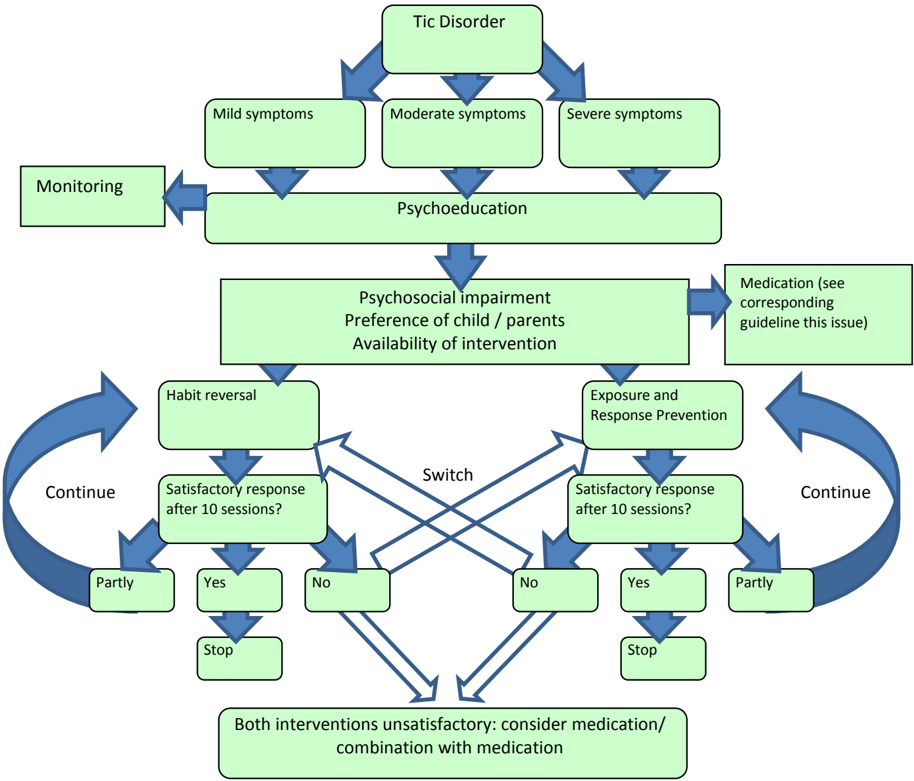
This clinical guideline provides recommendations for the behavioural and psychosocial interventions (BPI) of children and adolescents with tic disorders prepared by a working group of the European Society for the Study of Tourette Syndrome (ESSTS). A systematic literature search was conducted to obtain an update on the efficacy of BPI for tics. Relevant studies were identified using computerised searches of the Medline and PsycINFO databases and the Cochrane Library for the years 1950-2010. The search identified no meta-analyses, yet twelve (systematic) reviews and eight randomised controlled trials provided evidence for the current review. Most evidence was found for habit reversal training (HRT) and the available but smaller evidence also supports the efficacy of exposure with response prevention (ERP). Both interventions are considered first line behavioural treatments for tics for both children and adults and should be offered to a patient, taking into account his preference. Treatments that are considered second line or add-on behavioural treatments are contingency management, function based interventions and relaxation training. Neurofeedback is still experimental. Almost no research was identified that examined the efficacy of psychosocial interventions, e.g., psychoeducation and group work. Based on clinical practice, this guideline recommends behavioural treatment as first line offer to patients in most cases. It should be embedded within a psychoeducational and supp…
Overview
The claims and statistics of this paper haven’t been checked yet.
Free: it reads the open-access text and checks the first 5 claims that cite a source we can check. Create a free account to check every claim.
Integrity signals
Registry
Cites
Statistics
Figures
Verification
Claims the paper makes
The claims and statistics of this paper haven’t been checked yet.
Free: it reads the open-access text and checks the first 5 claims that cite a source we can check. Create a free account to check every claim.
Claims other papers make about this one
Each is checked against this paper’s own text: does it say what the citing paper says it does?
The source backs part of the claim, not all of it — or backs it for a different population, condition or comparison.
In the citing paper
“Despite psychoeducation being described in clinical guidelines as a first important step of any treatment for TS [5, 11], evidence on what specific elements should be addressed is lacking.”
From European clinical guidelines for Tourette syndrome and other tic disorders—version 2.0. Part II: psychological interventions (2022) · cites this paper as [5]
Experimental — accuracy not yet measuredIn the citing paper
“In the 2011 European clinical guidelines, behavior therapy (BT) was recommended as a first-line intervention for tic disorders in children and adults [5, 6].”
From European clinical guidelines for Tourette syndrome and other tic disorders—version 2.0. Part II: psychological interventions (2022) · cites this paper as [5]
In the citing paper
“Behavioral treatment for tics is recommended as first-line intervention according to European clinical guidelines [15].”
From Tackle your Tics: pilot findings of a brief, intensive group-based exposure therapy program for children with tic disorders (2021) · cites this paper as [15]
In the citing paper
“professional organizations have recommended behavior therapy as the first-line intervention for youth with PTD who have mild-to-moderate tic severity [37–39]”
From Behavior Therapy for Tic Disorders: An Evidenced-based Review and New Directions for Treatment Research (2015) · cites this paper as [38]
Self-check
Percentages, sums and reported differences re-computed from the paper’s own numbers.
The self-check needs the paper’s full text.
Citations
Cites
Habit-reversal: a method of eliminating nervous habits and tics
Azrin, N. H., & Nunn, R. G. (1973) · Behaviour Research and Therapy · doi:10.1016/0005-7967(73)90119-8 · Cited by 967 · cited 1×
“It offers a set of techniques that help the patient become aware of the occurrence of a tic, followed by a so-called competing response training to interrupt or inhibit the tic [7–9].”
BackgroundBehavior Therapy for Children With Tourette Disorder: A Randomized Controlled Trial
Piacentini, J., Woods, D. W., Scahill, L., Wilhelm, S., Peterson, A. L., Chang, S., Ginsburg, G. S., Deckersbach, T., Dziura, J., Levi-Pearl, S., et al. (2010) · JAMA · doi:10.1001/jama.2010.607 · Cited by 790
Premonitory urges in Tourette's syndrome
(1993) · American Journal of Psychiatry · doi:10.1176/ajp.150.1.98 · Cited by 628
Is neurofeedback an efficacious treatment for ADHD? A randomised controlled clinical trial
Gevensleben, H., Holl, B., Albrecht, B., Vogel, C., Schlamp, D., Kratz, O., Studer, P., Rothenberger, A., Moll, G. H., & Heinrich, H. (2009) · Journal of Child Psychology and Psychiatry · doi:10.1111/j.1469-7610.2008.02033.x · Cited by 398
The prevalence and epidemiology of Gilles de la Tourette syndrome
Robertson, M. M. (2008) · Journal of Psychosomatic Research · doi:10.1016/j.jpsychores.2008.03.006 · Cited by 369
Annotation: Neurofeedback – train your brain to train behaviour
Heinrich, H., Gevensleben, H., & Strehl, U. (2007) · Journal of Child Psychology and Psychiatry · doi:10.1111/j.1469-7610.2006.01665.x · Cited by 293
Exposure with response prevention versus habit reversal in Tourettes’s syndrome: a controlled study
Verdellen, C. W. J., Keijsers, G. P. J., Cath, D. C., & Hoogduin, C. A. L. (2004) · Behaviour Research and Therapy · doi:10.1016/s0005-7967(03)00154-2 · Cited by 280
Self-citationWilhelm, S., Deckersbach, T., Coffey, B. J., Bohne, A., Peterson, A. L., & Baer, L. (2003) · American Journal of Psychiatry · doi:10.1176/appi.ajp.160.6.1175 · Cited by 252
Banaschewski, T., Woerner, W., & Rothenberger, A. (2003) · Developmental Medicine & Child Neurology · doi:10.1017/s0012162203001294 · Cited by 250
The influence of contextual factors on tic expression in Tourette's syndrome: A review
Conelea, C. A., & Woods, D. W. (2008) · Journal of Psychosomatic Research · doi:10.1016/j.jpsychores.2008.04.010 · Cited by 249
Research works printed but not linked: 2
- 1. Robertson MM (2008) The prevalence and epidemiology of Gilles de la Tourette syndrome. Part 1: the epidemiological and prevalence studies. J Psychosom Res 65 (5):461472. doi:S0022-3999(08)00111-6 [pii]
- Peterson BS, Cohen DJ (1998) The treatment of Tourette’s syndrome: multimodal, developmental intervention. J Clin Psychiatry 59(Suppl 1):62–72 discussion 73–64
Cited by
The brain basis of emotion: a meta-analytic review
Lindquist, K. A., Wager, T. D., Kober, H., Bliss-Moreau, E., & Barrett, L. F. (2012) · Behavioral and Brain Sciences · doi:10.1017/s0140525x11000446 · Cited by 2,320
“Rats avoid the location of uncertain threat when they are free to move around, such as in a testing chamber with several arms (e.g., Vazdarjanova & McGaugh 1998).”
BackgroundGilles de la Tourette syndrome
Robertson, M. M., Eapen, V., Singer, H. S., Martino, D., Scharf, J. M., Paschou, P., Roessner, V., Woods, D. W., Hariz, M., Mathews, C. A., et al. (2017) · Nature Reviews Disease Primers · doi:10.1038/nrdp.2016.97 · Cited by 347
A meta-analysis of behavior therapy for Tourette Syndrome
McGuire, J. F., Piacentini, J., Brennan, E. A., Lewin, A. B., Murphy, T. K., Small, B. J., & Storch, E. A. (2014) · Journal of Psychiatric Research · doi:10.1016/j.jpsychires.2013.12.009 · Cited by 334
“treatment for TS (Steeves et al., 2012; Verdellen et al., 2011).”
BackgroundSelf-citationAndrén, P., Jakubovski, E., Murphy, T. L., Woitecki, K., Tarnok, Z., Zimmerman-Brenner, S., van de Griendt, J., Debes, N. M., Viefhaus, P., Robinson, S., et al. (2022) · European Child & Adolescent Psychiatry · doi:10.1007/s00787-021-01845-z · Cited by 225
Self-citationRoessner, V., Eichele, H., Stern, J. S., Skov, L., Rizzo, R., Debes, N. M., Nagy, P., Cavanna, A. E., Termine, C., Ganos, C., et al. (2022) · European Child & Adolescent Psychiatry · doi:10.1007/s00787-021-01899-z · Cited by 197
“Behavioral therapy approaches are recommended as first line treatment, based on assumed better tolerability of behavioral therapy, because behavioral approaches might strengthen the patients’ self-regulatory control [3, 188] (see Part V of this issue).”
BackgroundSelf-citationSzejko, N., Robinson, S. J., Hartmann, A., Ganos, C., Debes, N. M., Skov, L., Haas, M., Rizzo, R., Stern, J. S., Münchau, A. M., et al. (2021) · European Child & Adolescent Psychiatry · doi:10.1007/s00787-021-01842-2 · Cited by 190
Self-citationWhittington, C. J., Pennant, M. E., Kendall, T., Glazebrook, C., Trayner, P., Groom, M. J., Hedderly, T. J., Heyman, I., Jackson, G. M., Jackson, S. R., et al. (2016) · Journal of Child Psychology and Psychiatry · doi:10.1111/jcpp.12556 · Cited by 187
Self-citationthe ESSTS Guidelines Group, Müller‐Vahl, K., Cath, D. C., Cavanna, A. E., Dehning, S., Porta, M., Robertson, M. M., & Visser-Vandewalle, V. E. R. M. (2011) · European Child & Adolescent Psychiatry · doi:10.1007/s00787-011-0166-4 · Cited by 176
Self-citationCuenca, J., Glazebrook, C., Kendall, T., Hedderly, T. J., Heyman, I., Jackson, G. M., Murphy, T. L., Rickards, H. E., Robertson, M. M., Stern, J. S., et al. (2015) · BMC Psychiatry · doi:10.1186/s12888-015-0430-0 · Cited by 175
Self-citationThe Gilles De La Tourette syndrome: the current status
Robertson, M. M. (2012) · Archives of disease in childhood - Education & practice edition · doi:10.1136/archdischild-2011-300585 · Cited by 167
The psychopathological spectrum of Gilles de la Tourette syndrome
Cavanna, A. E., & Rickards, H. E. (2012) · Neuroscience & Biobehavioral Reviews · doi:10.1016/j.neubiorev.2012.10.011 · Cited by 156
Pharmacological treatment of tic disorders and Tourette Syndrome
Roessner, V., Schoenefeld, K., Buse, J., Bender, S., Ehrlich, S., & Münchau, A. M. (2012) · Neuropharmacology · doi:10.1016/j.neuropharm.2012.05.043 · Cited by 152
Sallee, F. R., Kohegyi, E., Zhao, J. L., McQuade, R. D., Cox, K., Sanchez, R., van Beek, A., Nyilas, M., Carson, W. H., & Kurlan, R. (2017) · Journal of Child and Adolescent Psychopharmacology · doi:10.1089/cap.2016.0026 · Cited by 146
European clinical guidelines for Tourette syndrome and other tic disorders: summary statement
Müller‐Vahl, K., Szejko, N., Verdellen, C. W. J., Roessner, V., Hoekstra, P. J., Hartmann, A., & Cath, D. C. (2021) · European Child & Adolescent Psychiatry · doi:10.1007/s00787-021-01832-4 · Cited by 142
Self-citationSinger, H. S. (2019) · CONTINUUM Lifelong Learning in Neurology · doi:10.1212/con.0000000000000752 · Cited by 140
Cavanna, A. E., & Seri, S. (2013) · BMJ · doi:10.1136/bmj.f4964 · Cited by 123
Ganos, C., & Martino, D. (2015) · Neurologic Clinics · doi:10.1016/j.ncl.2014.09.008 · Cited by 119
Welter, M., Houéto, J., Thobois, S., Bataille, B., Guénot, M., Worbe, Y., Hartmann, A., Czernecki, V., Bardinet, É., Yelnik, J., et al. (2017) · The Lancet Neurology · doi:10.1016/s1474-4422(17)30160-6 · Cited by 119
Self-citationHollis, C., Pennant, M., Cuenca, J., Glazebrook, C., Kendall, T., Whittington, C., Stockton, S., Larsson, L., Bunton, P., Dobson, S., et al. (2016) · Health Technology Assessment · doi:10.3310/hta20040 · Cited by 119
Self-citationAutism spectrum disorders and psychiatric comorbidities: a narrative review
Barlattani, T., D’Amelio, C., Cavatassi, A., Luca, D. D., Stefano, R. D., Berardo, A. D., Mantenuto, S., Minutillo, F., Leonardi, V., Renzi, G., et al. (2023) · Giornale italiano di psicopatologia/Journal of psychopathology/Italian journal of psychopathology · doi:10.36148/2284-0249-n281 · Cited by 119
A multicenter examination and strategic revisions of the Yale Global Tic Severity Scale
Mcguire, J. F., Piacentini, J. C., Storch, E. A., Murphy, T. K., Ricketts, E. J., Woods, D. W., Walkup, J., Peterson, A. L., Wilhelm, S., Lewin, A. B., et al. (2018) · Neurology · doi:10.1212/wnl.0000000000005474 · Cited by 117
Self-citationAndrén, P., Aspvall, K., de la Cruz, L. F., Wiktor, P., Romano, S., Andersson, E., Murphy, T. L., Isomura, K., Serlachius, E., & Mataix‐Cols, D. (2019) · BMJ Open · doi:10.1136/bmjopen-2018-024685 · Cited by 113
Self-citationDutta, N., & Cavanna, A. E. (2013) · Europe PMC (PubMed Central) · Cited by 112
Johnson, K. A., Fletcher, P. T., Servello, D., Bona, A. R., Porta, M., Ostrem, J. L., Bardinet, É., Welter, M., Lozano, A. M., Baldermann, J. C., et al. (2019) · Journal of Neurology Neurosurgery & Psychiatry · doi:10.1136/jnnp-2019-320379 · Cited by 110
Current Status, Diagnosis, and Treatment Recommendation for Tic Disorders in China
Liu, Z., Cui, Y., Sun, D., Lu, Q. L., Jiang, Y.-W., Jiang, L., Wang, J.-Q., Luo, R., Fang, F., Zhou, S., et al. (2020) · Frontiers in Psychiatry · doi:10.3389/fpsyt.2020.00774 · Cited by 104
Tics and Tourette's: update on pathophysiology and tic control
Ganos, C. (2016) · Current Opinion in Neurology · doi:10.1097/wco.0000000000000356 · Cited by 104
Tourette syndrome and other neurodevelopmental disorders: a comprehensive review
Cravedi, E., Deniau, E., Giannitelli, M., Xavier, J., Hartmann, A., & Cohen, D. (2017) · Child and Adolescent Psychiatry and Mental Health · doi:10.1186/s13034-017-0196-x · Cited by 102
Self-citationRicketts, E. J., Goetz, A. R., Capriotti, M. R., Bauer, C. C., Brei, N. G., Himle, M. B., Espil, F. M., Snorrason, Í., Ran, D., & Woods, D. W. (2016) · Journal of Telemedicine and Telecare · doi:10.1177/1357633x15593192 · Cited by 100
The neural correlates of tic inhibition in Gilles de la Tourette syndrome
Ganos, C., Kahl, U., Brandt, V., Schunke, O., Bäumer, T., Thomalla, G., Roessner, V., Haggard, P., Münchau, A., & Kühn, S. (2014) · Neuropsychologia · doi:10.1016/j.neuropsychologia.2014.08.007 · Cited by 97
An Introduction to the Clinical Phenomenology of Tourette Syndrome
Martino, D., Madhusudan, N., Zis, P., & Cavanna, A. E. (2013) · International review of neurobiology · doi:10.1016/b978-0-12-411546-0.00001-9 · Cited by 95
McGuire, J. F., Ricketts, E. J., Piacentini, J., Murphy, T. K., Storch, E. A., & Lewin, A. B. (2015) · Current developmental disorders reports · doi:10.1007/s40474-015-0063-5 · Cited by 92
Self-citationCognitive Behavioral Therapy in Movement Disorders: A Review
Berardelli, I., Pasquini, M., Roselli, V., Biondi, M., Berardelli, A., & Fabbrini, G. (2015) · Movement Disorders Clinical Practice · doi:10.1002/mdc3.12160 · Cited by 91
Behavior Therapy for Tourette Syndrome: A Systematic Review and Meta-analysis
Wile, D. J., & Pringsheim, T. M. (2013) · Current Treatment Options in Neurology · doi:10.1007/s11940-013-0238-5 · Cited by 91
Thalamocortical network activity enables chronic tic detection in humans with Tourette syndrome
Shute, J. B., Okun, M. S., Opri, E., Molina, R., Rossi, P. J., Martínez-Ramírez, D., Foote, K. D., & Gunduz, A. (2016) · NeuroImage Clinical · doi:10.1016/j.nicl.2016.06.015 · Cited by 89
Trials of Pharmacological Interventions for Tourette Syndrome: A Systematic Review
Waldon, K., Hill, J., Termine, C., Balottin, U., & Cavanna, A. E. (2013) · Behavioural Neurology · doi:10.1155/2013/626410 · Cited by 88
Tourette Syndrome and Other Tic Disorders in Childhood, Adolescence and Adulthood
Ludolph, A. G., Roessner, V., Münchau, A. M., & Müller‐Vahl, K. (2012) · Deutsches Ärzteblatt international · doi:10.3238/arztebl.2012.0821 · Cited by 87
Nussey, C., Pistrang, N., & Murphy, T. (2013) · Child: Care, Health and Development · doi:10.1111/cch.12039 · Cited by 86
Self-citationHashemiyoon, R., Kuhn, J., & Visser-Vandewalle, V. E. R. M. (2016) · Brain Topography · doi:10.1007/s10548-016-0525-z · Cited by 86
Current controversies on the role of behavior therapy in Tourette syndrome
Scahill, L., Woods, D. W., Himle, M. B., Peterson, A. L., Wilhelm, S., Piacentini, J. C., McNaught, K., Walkup, J. T., & Mink, J. W. (2013) · Movement Disorders · doi:10.1002/mds.25488 · Cited by 84
Szejko, N., Worbe, Y., Hartmann, A., Visser-Vandewalle, V. E. R. M., Ackermans, L. P. C. M., Ganos, C., Porta, M., Leentjens, A. F. G., Mehrkens, J., Huys, D., et al. (2021) · European Child & Adolescent Psychiatry · doi:10.1007/s00787-021-01881-9 · Cited by 80
Self-citationNeural correlates of behavior therapy for Tourette׳s disorder
Deckersbach, T., Chou, T., Britton, J. C., Carlson, L. E., Reese, H. E., Siev, J., Scahill, L., Piacentini, J. C., Woods, D. W., Walkup, J. T., et al. (2014) · Psychiatry Research: Neuroimaging · doi:10.1016/j.pscychresns.2014.09.003 · Cited by 78
The Modulating Role of Stress in the Onset and Course of Tourette’s Syndrome: A Review
Buse, J., Kirschbaum, C., Leckman, J. F., Münchau, A. M., & Roessner, V. (2014) · Behavior Modification · doi:10.1177/0145445514522056 · Cited by 77
Behavioural treatment of tics: habit reversal and exposure with response prevention
van de Griendt, J. M. T. M., Verdellen, C. W. J., van Dijk, M. K., & Verbraak, M. J. P. M. (2013) · Neuroscience & Biobehavioral Reviews · doi:10.1016/j.neubiorev.2012.10.007 · Cited by 75
Self-citationTics in the Pediatric Population: Pragmatic Management
Ganos, C., Martino, D., & Pringsheim, T. M. (2016) · Movement Disorders Clinical Practice · doi:10.1002/mdc3.12428 · Cited by 75
Behavioral therapy for Tourette syndrome and chronic tic disorders
Fründt, O., Woods, D. W., & Ganos, C. (2017) · Neurology Clinical Practice · doi:10.1212/cpj.0000000000000348 · Cited by 75
Voluntary inhibitory motor control over involuntary tic movements
Ganos, C., Rothwell, J. C., & Haggard, P. (2018) · Movement Disorders · doi:10.1002/mds.27346 · Cited by 73
Deep brain electrophysiological recordings provide clues to the pathophysiology of Tourette syndrome
Priori, A., Giannicola, G., Rosa, M., Marceglia, S. R. F., Servello, D., Sassi, M., & Porta, M. (2013) · Neuroscience & Biobehavioral Reviews · doi:10.1016/j.neubiorev.2013.01.011 · Cited by 72
Group behavioral interventions for tics and comorbid symptoms in children with chronic tic disorders
Zimmerman‐Brenner, S., Pilowsky-Peleg, T., Rachamim, L., Ben-Zvi, A., Gur, N., Murphy, T. L., Fattal‐Valevski, A., & Rotstein, M. S. (2021) · European Child & Adolescent Psychiatry · doi:10.1007/s00787-020-01702-5 · Cited by 71
Self-citationTreatment-refractory Tourette Syndrome
Kious, B. M., Shahed, J. J., & Shprecher, D. (2016) · Progress in Neuro-Psychopharmacology and Biological Psychiatry · doi:10.1016/j.pnpbp.2016.02.003 · Cited by 71
Wadman, R., Glazebrook, C., Beer, C., & Jackson, G. M. (2016) · BMC Psychiatry · doi:10.1186/s12888-016-0717-9 · Cited by 70
Rizzo, R., Pellico, A., Silvestri, P. R., Chiarotti, F., & Cardona, F. (2018) · Frontiers in Psychiatry · doi:10.3389/fpsyt.2018.00100 · Cited by 70
Robertson, M. M. (2015) · The Lancet Psychiatry · doi:10.1016/s2215-0366(14)00133-3 · Cited by 70
The Role of Atypical Antipsychotics for Treatment of Tourette’s Syndrome: An Overview
Budman, C. L. (2014) · Drugs · doi:10.1007/s40265-014-0254-0 · Cited by 68
Tic disorders and Tourette’s syndrome
Plessen, K. J. (2012) · European Child & Adolescent Psychiatry · doi:10.1007/s00787-012-0362-x · Cited by 66
Szejko, N., & Müller‐Vahl, K. (2021) · Neuropsychiatric Disease and Treatment · doi:10.2147/ndt.s251499 · Cited by 63
Evaluation of a cognitive psychophysiological model for management of tic disorders: an open trial
O’Connor, K. P., Lavoie, M. E., Blanchet, P. J., & St-Pierre-Delorme, M.-È. (2016) · The British Journal of Psychiatry · doi:10.1192/bjp.bp.114.154518 · Cited by 62
Nissen, J. B., Kaergaard, M., Laursen, L., Parner, E., & Thomsen, P. H. (2019) · European Child & Adolescent Psychiatry · doi:10.1007/s00787-018-1187-z · Cited by 61
Yates, R., Edwards, K., King, J., Luzon, O., Evangeli, M., Stark, D., McFarlane, F., Heyman, I., İnce, B., Kodric, J., et al. (2016) · Behaviour Research and Therapy · doi:10.1016/j.brat.2016.03.003 · Cited by 60
Self-citationWalitza, S., & Gloor, F. T. (2016) · Neuropediatrics · doi:10.1055/s-0035-1570492 · Cited by 59
Pathophysiology of ADHD and associated problems—starting points for NF interventions?
Albrecht, B., Uebel, H., Gevensleben, H., & Rothenberger, A. (2015) · Frontiers in Human Neuroscience · doi:10.3389/fnhum.2015.00359 · Cited by 58
the TIC Genetics Collaborative Group, Dietrich, A., Fernandez, T. V., King, R. A., State, M. W., Tischfield, J. A., Hoekstra, P. J., & Heiman, G. A. (2014) · European Child & Adolescent Psychiatry · doi:10.1007/s00787-014-0543-x · Cited by 56
Self-citationMechanisms Underlying Behavior Therapy for Tourette’s Disorder
Essoe, J. K.-Y., Ramsey, K. A., Singer, H. S., Grados, M. A., & Mcguire, J. F. (2021) · Current Developmental Disorders Reports · doi:10.1007/s40474-021-00225-1 · Cited by 53
Long-term Outcomes of Behavior Therapy for Youth With Tourette Disorder
Espil, F. M., Woods, D. W., Specht, M. W., Bennett, S. M., Walkup, J. T., Ricketts, E. J., Mcguire, J. F., Stiede, J. T., Schild, J. S., Chang, S. W., et al. (2021) · Journal of the American Academy of Child & Adolescent Psychiatry · doi:10.1016/j.jaac.2021.08.022 · Cited by 53
Tourette Syndrome: A Mini-Review
Novotný, M., Vališ, M., & Klímová, B. (2018) · Frontiers in Neurology · doi:10.3389/fneur.2018.00139 · Cited by 53
Malli, M. A., & Forrester‐Jones, R. (2021) · Journal of Developmental and Physical Disabilities · doi:10.1007/s10882-021-09829-2 · Cited by 52
Scherer, K. R. (2012) · Behavioral and Brain Sciences · doi:10.1017/s0140525x11001750 · Cited by 52
Deep TMS add-on treatment for intractable Tourette syndrome: A feasibility study
Bloch, Y., Arad, S., & Levkovitz, Y. (2014) · The World Journal of Biological Psychiatry · doi:10.3109/15622975.2014.964767 · Cited by 51
Hall, C. L., Davies, E. B., Andrén, P., Murphy, T., Bennett, S., Brown, B. J., Brown, S., Chamberlain, L., Craven, M. P., Evans, A., et al. (2019) · BMJ Open · doi:10.1136/bmjopen-2018-027583 · Cited by 47
Self-citationDoes it help to talk about tics? An evaluation of a classroom presentation about Tourette syndrome
Nussey, C., Pistrang, N., & Murphy, T. L. (2012) · Child and Adolescent Mental Health · doi:10.1111/camh.12000 · Cited by 47
Self-citationThe pharmacology of Tourette syndrome
Thomas, R., & Cavanna, A. E. (2013) · Journal of Neural Transmission · doi:10.1007/s00702-013-0979-z · Cited by 46
Evidence-based treatment of Tourette’s disorder and chronic tic disorders
Essoe, J. K.-Y., Grados, M. A., Singer, H. S., Myers, N. S., & Mcguire, J. F. (2019) · Expert Review of Neurotherapeutics · doi:10.1080/14737175.2019.1643236 · Cited by 46
McGuire, J. F., Piacentini, J., Scahill, L., Woods, D. W., Villarreal, R., Wilhelm, S., Walkup, J. T., & Peterson, A. L. (2015) · Behaviour Research and Therapy · doi:10.1016/j.brat.2015.05.006 · Cited by 45
Interventions for tic disorders: An overview of systematic reviews and meta analyses
Yang, C., Hao, Z., Zhu, C., Guo, Q., Mu, D., & Zhang, L. (2016) · Neuroscience & Biobehavioral Reviews · doi:10.1016/j.neubiorev.2015.12.013 · Cited by 45
Jakubovski, E., & Müller‐Vahl, K. (2017) · International Journal of Molecular Sciences · doi:10.3390/ijms18081739 · Cited by 45
Behavioral treatments for Tourette syndrome
Capriotti, M. R., Himle, M. B., & Woods, D. W. (2014) · Journal of Obsessive-Compulsive and Related Disorders · doi:10.1016/j.jocrd.2014.03.007 · Cited by 43
Gulisano, M., Calì, P. V., Palermo, F., Robertson, M. M., & Rizzo, R. (2015) · Journal of Child and Adolescent Psychopharmacology · doi:10.1089/cap.2014.0154 · Cited by 43
Efficacy of Parent-Delivered, Home-Based Therapy for Tics
Singer, H. S., McDermott, S. M., Ferenc, L. M., Specht, M., & Mahone, E. M. (2020) · Pediatric Neurology · doi:10.1016/j.pediatrneurol.2019.12.015 · Cited by 43
Cannabis-based medicine in treatment of patients with Gilles de la Tourette syndrome
Szejko, N., Saramak, K., Lombroso, A., & Müller-Vahl, K. (2022) · Neurologia i Neurochirurgia Polska · doi:10.5603/pjnns.a2021.0081 · Cited by 42
Preliminary Study of Behavioral Therapy for Tourette Syndrome Patients in Japan
Nonaka, M., Matsuda, N., Kono, T., Fujio, M., Scahill, L. D., & Kano, Y. (2014) · Children s Health Care · doi:10.1080/02739615.2014.979922 · Cited by 41
Defining tic severity and tic impairment in Tourette Disorder
Mcguire, J. F., Piacentini, J. C., Storch, E. A., Ricketts, E. J., Woods, D. W., Peterson, A. L., Walkup, J. T., Wilhelm, S., Ramsey, K. A., Essoe, J. K.-Y., et al. (2020) · Journal of Psychiatric Research · doi:10.1016/j.jpsychires.2020.12.040 · Cited by 41
Self-citationAn exploratory study into an adapted use of the Alert Program for tic disorder in children
Soler, N., Hardwick, C., Perkes, I. E., Dossetor, D. R., Bray, P., & Dale, R. C. (2018) · Australasian Psychiatry · doi:10.1177/1039856218815750 · Cited by 39
Cingulate role in Tourette syndrome
O’Neill, J., Piacentini, J. C., & Peterson, B. S. (2019) · Handbook of clinical neurology · doi:10.1016/b978-0-444-64196-0.00011-x · Cited by 39
Ricketts, E. J., Bauer, C. C., Ran, D., Himle, M. B., & Woods, D. W. (2014) · Cognitive and Behavioral Practice · doi:10.1016/j.cbpra.2014.09.003 · Cited by 38
Wadman, R., Tischler, V., & Jackson, G. M. (2013) · Child: Care, Health and Development · doi:10.1111/cch.12033 · Cited by 37
A Review of Cognitive and Behavioral Interventions for Tic Disorder
Kim, K. M., Bae, E. J., Lee, J., Park, T. W., & Lim, M. H. (2021) · Journal of korean Academy of Child and Adolescent Psychiatry · doi:10.5765/jkacap.200042 · Cited by 34
Heijerman-Holtgrefe, A. P., Verdellen, C. W. J., van de Griendt, J. M. T. M., Beljaars, L. P. L., Kan, K. J., Cath, D., Hoekstra, P. J., Huyser, C., & Utens, E. M. W. J. (2021) · European Child & Adolescent Psychiatry · doi:10.1007/s00787-020-01532-5 · Cited by 33
Self-citationBesag, F., Vasey, M. J., Lao, K. S. J., Chowdhury, U., & Stern, J. S. (2021) · Journal of Psychopharmacology · doi:10.1177/02698811211032445 · Cited by 33
The neuropsychiatry of Gilles de la Tourette syndrome: The état de l’art
Cavanna, A. E. (2018) · Revue Neurologique · doi:10.1016/j.neurol.2018.06.006 · Cited by 33
Trends in psychopharmacologic treatment of tic disorders in children and adolescents in Germany
Bachmann, C., Roessner, V., Glaeske, G., & Hoffmann, F. (2014) · European Child & Adolescent Psychiatry · doi:10.1007/s00787-014-0563-6 · Cited by 33
An International Survey of Health Care Services Available to Patients With Tourette Syndrome
Bhikram, T., Elmaghraby, R., Abi-Jaoude, E., & Sandor, P. (2021) · Frontiers in Psychiatry · doi:10.3389/fpsyt.2021.621874 · Cited by 33
Mills, S. M., & Hedderly, T. J. (2014) · PubMed Central · Cited by 33
Shaw, Z. A., & Coffey, B. J. (2014) · Psychiatric Clinics of North America · doi:10.1016/j.psc.2014.05.001 · Cited by 32
Jakubovski, E., Reichert, C., Karch, A., Buddensiek, N., Breuer, D., & Müller-Vahl, K. (2016) · Frontiers in Psychiatry · doi:10.3389/fpsyt.2016.00119 · Cited by 32
Fits, Tantrums, and Rages in TS and Related Disorders
Budman, C. L., Rosen, M., & Shad, S. (2015) · Current Developmental Disorders Reports · doi:10.1007/s40474-015-0059-1 · Cited by 32
Parenting interventions in tic disorders: an exploration of parents' perspectives
Evans, G. A. L., Wittkowski, A., Butler, H., Hedderly, T. J., & Bunton, P. (2014) · Child Care Health and Development · doi:10.1111/cch.12212 · Cited by 32
Gilles de la Tourette syndrome – A treatable condition?
Hartmann, A., Martino, D., & Murphy, T. L. (2016) · Revue Neurologique · doi:10.1016/j.neurol.2016.07.004 · Cited by 31
Self-citationViefhaus, P., Adam, J., Goletz, H., Woitecki, K., & Döpfner, M. (2021) · Frontiers in Psychology · doi:10.3389/fpsyg.2021.780539 · Cited by 31
Dabrowski, J., King, J., Edwards, K., Yates, R., Heyman, I., Zimmerman-Brenner, S., & Murphy, T. (2018) · Behavior Therapy · doi:10.1016/j.beth.2017.10.005 · Cited by 31
Self-citationLeclerc, J. B., O’Connor, K. P., J.-Nolin, G., Valois, P., & Lavoie, M. E. (2016) · Frontiers in Psychiatry · doi:10.3389/fpsyt.2016.00135 · Cited by 31
Intensive outpatient comprehensive behavioral intervention for tics: A case series
Blount, T. H. (2014) · World Journal of Clinical Cases · doi:10.12998/wjcc.v2.i10.569 · Cited by 30
Metadata
- Authors
- the ESSTS Guidelines Group, Verdellen, C., van de Griendt, J., Hartmann, A., & Murphy, T.
- Venue
- European Child & Adolescent Psychiatry
- Published
- 2011-03-29
- Volume
- 20
- Issue
- 4
- Pages
- 197-207
- ISSN
- 1018-8827 (ISSN-L)
- 1435-165X
- OpenAlex
- W2110931780
- Cited by
- 328
- References
- 57
- FWCI
- 23.79
- Type
- journal article
- Language
- en
- Open access
- green
- Licence
- www.springer.com/tdm (tdm)
About these checks
Registry, retraction, Cites and statistics results are computed, not judged, with one exception: a printed reference that no index lists is read once by a model before it counts as a citation error. Claims are extracted by a model and kept only when their quote appears verbatim in the text; each cited source is then checked, with a model’s help, for whether it says what the claim relies on. Those verdicts can be wrong — read the claim’s quote and the cited source before relying on one.
Statistics and arithmetic are recomputed, not judged.
Confidence bands are shown only for fields calibrated on our annotated test set. None is calibrated yet, so no band is shown.
What counts as a claim ›How we measure confidence ›How we check this ›
Are you an author, or do you see a problem with this page? Request a review
Data sources
Bibliographic data: Semantic Scholar, OpenAlex, Crossref.
Contains information from the Semantic Scholar Academic Graph Datasets, made available under the ODC Attribution License (ODC-BY 1.0).
Semantic Scholar’s data is described in: Kinney, R., et al. (2023). The Semantic Scholar Open Data Platform. arXiv:2301.10140.
