

The respiratory control of carbon dioxide in children and adolescents referred for treatment of psychogenic non-epileptic seizures
Open accessThe DOI matches its Crossref record; 68 of the 68 references it cites were found in a registry or an index.
Abstract
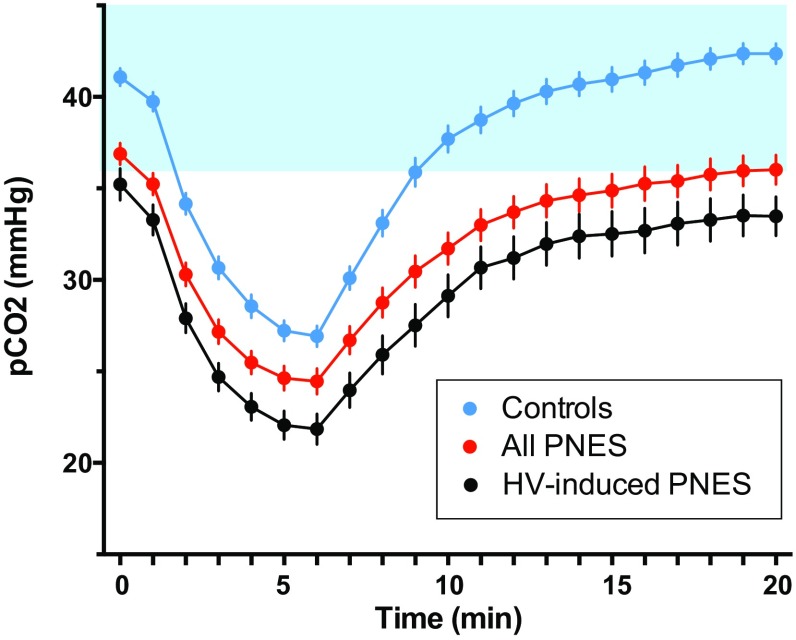
Psychogenic non-epileptic seizures (PNES) are a common problem in paediatric neurology and psychiatry that can best be understood as atypical responses to threat. Threats activate the body for action by mediating increases in arousal, respiration, and motor readiness. In previous studies, a range of cardiac, endocrine, brain-based, attention-bias, and behavioral measures have been used to demonstrate increases in arousal, vigilance, and motor readiness in patients with PNES. The current study uses respiratory measures to assess both the motor readiness of the respiratory system and the respiratory regulation of CO2. Baseline respiratory rates during clinical assessment and arterial CO2 levels during the hyperventilation component of routine video electroencephalogram were documented in 60 children and adolescents referred for treatment of PNES and in 50 controls. Patients showed elevated baseline respiratory rates [t(78) = 3.34, p = .001], with 36/52 (69%) of patients [vs. 11/28 (39%) controls] falling above the 75th percentile (χ 2 = 6.7343; df = 1; p = .009). Twenty-eight (47%) of patients [vs. 4/50 (8%) controls] showed a skewed hyperventilation-challenge profile—baseline PCO2 <36 mmHg, a trough PCO2 ≤ 20 mmHg, or a final PCO2 <36 mmHg after 15 min of recovery—signaling difficulties with CO2 regulation (χ 2 = 19.77; df = 1; p < .001). Children and adolescents with PNES present in a state of readiness-for-action characterized by high arousal coupled with activation of the respiratory motor system, increases in ventilation, and a hyperventilation-challenge profile shifted downward from homeostatic range. Breathing interventions that target arousal, decrease respiratory rate, and normalize ventilation and arterial CO2 may help patients shift brain–body state and avert PNES episodes.
Overview
The claims and statistics of this paper haven’t been checked yet.
Free: it reads the open-access text and checks the first 5 claims that cite a source we can check. Create a free account to check every claim.
Integrity signals
Registry
Cites
Statistics
Figures
Verification
Claims the paper makes
The claims and statistics of this paper haven’t been checked yet.
Free: it reads the open-access text and checks the first 5 claims that cite a source we can check. Create a free account to check every claim.
Claims other papers make about this one
Each is checked against this paper’s own text: does it say what the citing paper says it does?
The cited source says what the claim attributes to it.
In the citing paper
“It is common in children and adolescents with functional seizures [101,102].”
From Illness-Promoting Psychological Processes in Children and Adolescents with Functional Neurological Disorder (2023) · cites this paper as [101]
Self-check
Percentages, sums and reported differences re-computed from the paper’s own numbers.
The self-check needs the paper’s full text.
Citations
Cites
Diagnostic and Statistical Manual of Mental Disorders
American Psychiatric Association (2013) · doi:10.1176/appi.books.9780890425596 · Cited by 116,369
Diagnostic and Statistical Manual of Mental Disorders
Williams, J. B. W., & First, M. (2013) · Encyclopedia of Social Work · doi:10.1093/acrefore/9780199975839.013.104 · Cited by 109,519
Selye, H. (1956) · Medical Entomology and Zoology · Cited by 10,069
Insel, T., Cuthbert, B., Garvey, M., Heinssen, R., Pine, D. S., Quinn, K., Sanislow, C., & Wang, P. (2010) · American Journal of Psychiatry · doi:10.1176/appi.ajp.2010.09091379 · Cited by 7,067
Diagnostic and Statistical Manual of Mental Disorders ( DSM ‐ IV ‐ TR )
Segal, D. L. (2010) · The Corsini Encyclopedia of Psychology · doi:10.1002/9780470479216.corpsy0271 · Cited by 4,666
Stress and disorders of the stress system
Chrousos, G. P. (2009) · Nature Reviews Endocrinology · doi:10.1038/nrendo.2009.106 · Cited by 3,215
Fleming, S., Thompson, M., Stevens, R., Heneghan, C., Plüddemann, A., Maconochie, I., Tarassenko, L., & Mant, D. (2011) · The Lancet · doi:10.1016/s0140-6736(10)62226-x · Cited by 1,282 · cited 1×
“These values for respiratory rate and HR were derived from normative reference ranges [53].”
MethodStress weakens prefrontal networks: molecular insults to higher cognition
Arnsten, A. F. T. (2015) · Nature Neuroscience · doi:10.1038/nn.4087 · Cited by 752
Stress-related noradrenergic activity prompts large-scale neural network reconfiguration
Hermans, E. J., van Marle, H. J. F., Ossewaarde, L., Henckens, M. J. A. G., Qin, S., van Kesteren, M. T. R., Schoots, V. C., Cousijn, H., Rijpkema, M., Oostenveld, R., et al. (2011) · Science · doi:10.1126/science.1209603 · Cited by 627
Broadband criticality of human brain network synchronization
Kitzbichler, M. G., Smith, M. L., Christensen, S. R., & Bullmore, E. (2009) · PLoS Computational Biology · doi:10.1371/journal.pcbi.1000314 · Cited by 527
Research works printed but not linked: 5
- Kozlowska K Melkonian D Spooner CJ Scher S Meares R Cortical arousal in children and adolescents with functional neurological symptoms during the auditory oddball task Neuroimage Clin 2017 13 228 236 10.1016/j.nicl.2016.10.016 28003962 PMC5157791 · DOI · Paper page
- Evans DW Lum MB Hyperventilation as a cause of chest pain mimicking angina Pract Cardiol 1981 7 7 131 139
- Lafleur J Reiher J Pseudoabsences Electroencephalogr Clin 1977 43 279 280
- Reiher J Lafleur J Hyperventilation induced cyclic absences Electroencephalogr Clin 1977 42 717
- Gastaut H Magnus O Lorentz de Hoos AM Syncopes: generalised anoxic cerebral seizures The Epilepsies. Handbook of clinical neurology, vol 15 1974 Amsterdam New Holland 815 835
Cited by
A new science of emotion: implications for functional neurological disorder
Jungilligens, J., Paredes-Echeverri, S., Popkirov, S., Barrett, L. F., & Perez, D. L. (2022) · Brain · doi:10.1093/brain/awac204 · Cited by 164
Kozlowska, K., Chudleigh, C., Cruz, C., Lim, M., McClure, G., Savage, B., Shah, U., Cook, A., Scher, S., Carrive, P., et al. (2018) · Clinical Child Psychology and Psychiatry · doi:10.1177/1359104517730116 · Cited by 77
“…eyes-open, resting state-condition, we also found that our patients (vs controls) showed increased heart rates and increased respiratory rates (Kozlowska, Rampersad, et al., 2017), consistent with the coupling between sympathetic arousal (which innervates the cardiac motor system) and the…”
Self-citationGrey matter abnormalities in children and adolescents with functional neurological symptom disorder
Kozlowska, K., Griffiths, K. R., Foster, S. L., Linton, J., Williams, L. M., & Korgaonkar, M. S. (2017) · NeuroImage: Clinical · doi:10.1016/j.nicl.2017.04.028 · Cited by 71
“An additional finding in paediatric patients who have PNES is that higher arousal is coupled with excessive activation and reactivity of the motor-respiratory system (Kozlowska et al., 2017b).”
Self-citationTreatment approaches for functional neurological disorders in children
Vassilopoulos, A., Mohammad, S., Dure, L., Kozlowska, K., & Fobian, A. D. (2022) · Current Treatment Options in Neurology · doi:10.1007/s11940-022-00708-5 · Cited by 70
“These findings build on an earlier study finding that children with FS showed dysregulation of their respiratory motor systems and that half the children in the study triggered their FS by hyperventilation [28].”
ResultSelf-citationHingray, C., Popkirov, S., Kozlowska, K., Pretorius, C., Sarudiansky, M., El‐Hage, W., Zhou, D., Ertan, D., LaFrance, W. C., Jr., Reuber, M., et al. (2025) · Epilepsia · doi:10.1111/epi.18574 · Cited by 67
“22 The second term, “nonepileptic,” is a negative wording that distinguishes these seizures from epilepsy but does not define the disorder itself.”
Self-citationChanging the culture of care for children and adolescents with functional neurological disorder
Kozlowska, K., Sawchuk, T., Waugh, J. L., Helgeland, H., Baker, J., Scher, S., & Fobian, A. D. (2021) · Epilepsy & Behavior Reports · doi:10.1016/j.ebr.2021.100486 · Cited by 63
Self-citationParedes-Echeverri, S., Maggio, J., Bègue, I., Pick, S., Nicholson, T. R., & Perez, D. L. (2022) · The Journal of Neuropsychiatry and Clinical Neurosciences · doi:10.1176/appi.neuropsych.21010025 · Cited by 62
Psychogenic non-epileptic seizures in children and adolescents: Part I – Diagnostic formulations
Kozlowska, K., Chudleigh, C., Cruz, C., Lim, M., McClure, G., Savage, B., Shah, U., Cook, A., Scher, S., Carrive, P., et al. (2018) · Clinical Child Psychology and Psychiatry · doi:10.1177/1359104517732118 · Cited by 61
Self-citationKim, Y.-N., Gray, N., Jones, A., Scher, S., & Kozlowska, K. (2022) · Seminars in Pediatric Neurology · doi:10.1016/j.spen.2021.100947 · Cited by 52
Self-citationSawchuk, T., Buchhalter, J., & Senft, B. (2020) · Epilepsy & Behavior · doi:10.1016/j.yebeh.2020.106971 · Cited by 43
Reilly, C. J., Jetté, N., Johnson, E. C., Kariuki, S. M., Meredith, F., Wirrell, E. C., Mula, M., Smith, M. L., Walsh, S., Fong, C. Y., et al. (2023) · Epilepsia · doi:10.1111/epi.17768 · Cited by 41
Predictive Processing and the Pathophysiology of Functional Neurological Disorder
Jungilligens, J., & Perez, D. L. (2024) · Current topics in behavioral neurosciences · doi:10.1007/7854_2024_473 · Cited by 41
A stress-system model for functional neurological symptoms
Kozlowska, K. (2017) · Journal of the Neurological Sciences · doi:10.1016/j.jns.2017.10.044 · Cited by 37
“We documented high rates of physical events (49%–60%) preceding the onset of functional neurological symptoms [6-8], with ACCEPTED MANUSCRIPT”
Self-citationChudleigh, C., Savage, B., Cruz, C., Lim, M., McClure, G., Palmer, D. M., Spooner, C. J., & Kozlowska, K. (2018) · Clinical Child Psychology and Psychiatry · doi:10.1177/1359104518807742 · Cited by 38
Self-citationAutism spectrum disorder in children and young people with non-epileptic seizures
McWilliams, A., Reilly, C., Gupta, J., Hadji-Michael, M., Srinivasan, R., & Heyman, I. (2019) · Seizure · doi:10.1016/j.seizure.2019.10.022 · Cited by 36
“Non-specific neurological abnormalities have previously been discussed in children with NES, including an important connection between NES and a predisposition to hyperventilation [18].”
BackgroundActivation of Functional Brain Networks in Children With Psychogenic Non-epileptic Seizures
Radmanesh, M., Jalili, M., & Kozlowska, K. (2020) · Frontiers in Human Neuroscience · doi:10.3389/fnhum.2020.00339 · Cited by 35
Self-citationKozlowska, K., Gray, N., Scher, S., & Savage, B. (2020) · Journal of Paediatrics and Child Health · doi:10.1111/jpc.15122 · Cited by 35
Self-citationKozlowska, K., Chudleigh, C., Savage, B., Hawkes, C., Scher, S., & Nunn, K. P. (2023) · Harvard Review of Psychiatry · doi:10.1097/hrp.0000000000000358 · Cited by 31
Self-citationKozlowska, K., Chung, J. Z. Y., Cruickshank, B., McLean, L., Scher, S., Dale, R. C., Mohammad, S. S., Singh‐Grewal, D., Prabhuswamy, M., & Patrick, E. (2018) · European Child & Adolescent Psychiatry · doi:10.1007/s00787-018-1212-2 · Cited by 31
Self-citationRecent advances in understanding the neurobiology of pediatric functional neurological disorder
Kozlowska, K., & Scher, S. (2024) · Expert Review of Neurotherapeutics · doi:10.1080/14737175.2024.2333390 · Cited by 30
“The child may also present with comorbid functional somatic symptoms that reflect activation or dysregulation of the autonomic nervous system (see Figure 2) [82].”
BackgroundSelf-citationChung, J., Mukerji, S., & Kozlowska, K. (2023) · Australian & New Zealand Journal of Psychiatry · doi:10.1177/00048674221082520 · Cited by 27
“The potential implication, when read together with recent studies of patients with FND (Diez et al., 2020; Kozlowska et al., 2017a; Spagnolo et al., 2020) or chronic fatigue (Nguyen et al., 2017) (see Table 1), is that the resulting changes in the brain may increase the risk of developing…”
BackgroundSelf-citationPsychogenic non-epileptic seizures in children – psychophysiology & dissociative characteristics
Sawchuk, T., Buchhalter, J., & Senft, B. (2020) · Psychiatry Research · doi:10.1016/j.psychres.2020.113544 · Cited by 19
Velani, H., & Gledhill, J. (2021) · Seizure · doi:10.1016/j.seizure.2021.09.006 · Cited by 17
Neurometabolic alterations in children and adolescents with functional neurological disorder
Charney, M. F., Foster, S., Shukla, V., Zhao, W., Jiang, S. H., Kozlowska, K., & Lin, A. P. (2023) · NeuroImage Clinical · doi:10.1016/j.nicl.2023.103557 · Cited by 17
Self-citation« Troubles à symptomatologie somatique » chez les adolescents. Une revue systématique
Ludot, M., Merlo, M., Ibrahim, N., Piot, M., Lefèvre, H., Carles, M.-E., Harf, A., & Moro, M. R. (2021) · L Encéphale · doi:10.1016/j.encep.2021.04.007 · Cited by 15
Kozlowska, K., Schollar-Root, O., Savage, B., Hawkes, C., Chudleigh, C., Raghunandan, J., Scher, S., & Helgeland, H. (2023) · Children · doi:10.3390/children10111724 · Cited by 14
“It is common in children and adolescents with functional seizures [101,102].”
BackgroundSelf-citationFunctional Neurological Disorder: Historical Trends and Urgent Directions
Velazquez-Rodriguez, Y., & Fehily, B. (2023) · Journal of Neurology Research · doi:10.14740/jnr754 · Cited by 14
Chandra, P., Kozlowska, K., Cruz, C., Baslet, G. C., Perez, D. L., & Garralda, M. E. (2017) · Harvard Review of Psychiatry · doi:10.1097/hrp.0000000000000131 · Cited by 15
“This result was consistent with the team’s clinical observations that M was in a state of chronic hyperventilation and also with emerging findings from the team’s study of hyperventilation in children and adolescents with psychogenic non-epileptic seizures.(9) With five minutes of hyperventilation, M’s pCO2 dropped to…”
ResultSelf-citationStress-system activation in children with chronic pain: A focus for clinical intervention
McInnis, P., Braund, T. A., Chua, Z. K., & Kozlowska, K. (2019) · Clinical Child Psychology and Psychiatry · doi:10.1177/1359104519864994 · Cited by 13
“These findings are in stark contrast to children presenting with nonepileptic seizures, many of whom show an increase in resting RR (Kozlowska et al., 2017), and to patients with functional neurological symptoms in general, who as a group show faster reaction times to emotion stimuli, suggesting…”
ResultSelf-citationDemirci, O. O., & Sağaltıcı, E. (2021) · Clinical Child Psychology and Psychiatry · doi:10.1177/13591045211037276 · Cited by 12
“The diagnosis of FND in the absence of detailed medical examination can be damaging (APA, 2013; Fobian & Elliott, 2019; Kozlowska et al., 2017).”
BackgroundRajabalee, N., Kozlowska, K., Lee, S. Y., Savage, B., Hawkes, C., Siciliano, D., Porges, S. W., Pick, S., & Torbey, S. (2022) · Harvard Review of Psychiatry · doi:10.1097/hrp.0000000000000341 · Cited by 10
Self-citationRatnamohan, L., MacKinnon, L. K., Lim, M., Webster, R., Waters, K. A., Kozlowska, K., Silberg, J. L., Greenwald, R., & Ribeiro, M. (2018) · Harvard Review of Psychiatry · doi:10.1097/hrp.0000000000000195 · Cited by 10
Self-citationHyperventilation in functional seizures: Evidence for subtypes
Kanaan, R., Mullen, S. A., D'Souza, W. J., Castro-de-Araujo, L. F. S., Sharma, A., & Indranada, A. M. (2022) · Seizure · doi:10.1016/j.seizure.2022.04.012 · Cited by 8
COVID-19 Vaccination in Young People with Functional Neurological Disorder: A Case-Control Study
Lim, N., Wood, N., Prasad, A., Waters, K. A., Singh‐Grewal, D., Dale, R. C., Elkadi, J., Scher, S., & Kozlowska, K. (2022) · Vaccines · doi:10.3390/vaccines10122031 · Cited by 8
“In this way “top-down” cognitive factors—in this case, beliefs—coupled with stress-system activation (and activation of the motor respiratory system), can set the stage for triggering an FND illness or other functional somatic symptoms (see Supplementary Text Box S2 and Figure 3).”
BackgroundSelf-citationCummins, R., Hawkes, C., Longworth, J., Scher, S., & Kozlowska, K. (2025) · Frontiers in Psychiatry · doi:10.3389/fpsyt.2025.1560873 · Cited by 7
Self-citationDifferentiation of epilepsy and psychogenic nonepileptic events based on body fluid characteristics
Xia, Y., Lai, W., Li, S., Wen, Z., & Chen, L. (2023) · Epilepsia Open · doi:10.1002/epi4.12775 · Cited by 6
Functional Neurological Disorder in Children and Adolescents
Kozlowska, K., & Mohammad, S. S. (2022) · Springer eBooks · doi:10.1007/978-3-031-10494-7_37 · Cited by 6
Self-citationAre Functional (Psychogenic Nonepileptic) Seizures the Sole Expression of Psychological Processes?
Sojka, P., Paredes-Echeverri, S., & Perez, D. L. (2021) · Current topics in behavioral neurosciences · doi:10.1007/7854_2021_225 · Cited by 5
Coppola, G., Pastorino, G. M. G., Morcaldi, L., D’Onofrio, F., & Operto, F. F. (2020) · Medicina · doi:10.3390/medicina56100508 · Cited by 5
“Less favourable outcomes were found in children/adolescents who presented with chronic PNES and in those with a chronic comorbid mental health disorder that failed to resolve with treatment [25].”
BackgroundBleier, C., Guthrie, A. J., Ranford, J., MacLean, J., Godena, E. J., Maggio, J., Finkelstein, S. A., Diez, I. P., Westlin, C., Quigley, K. S., et al. (2026) · NeuroImage Clinical · doi:10.1016/j.nicl.2026.103996 · Cited by 2
The therapeutic effect of breathing interventions for functional seizures: A scoping review
Zouki, J., Ye, H., Lo, A. P.-K., Bondarenko, J., George, C., Berlowitz, D. J., Duncan, R., Mihalopoulos, C., Braat, S., O'Brien, T. J., et al. (2026) · Epilepsy & Behavior · doi:10.1016/j.yebeh.2026.110919 · Cited by 1
Management Considerations for Pediatric Functional Movement Disorder
Kozlowska, K. (2022) · Current clinical neurology · doi:10.1007/978-3-030-86495-8_31 · Cited by 1
Self-citationGégoire, M. L. (2022) · theses.fr (ABES) · doi:10.70675/50b26098ze8c5z4924z9daazb7e9d7eb6eda · Cited by 1
The Impact of Comorbidities and Expectations on Functional Neurological Disorder Symptoms (FND)
Artigas, H., & del Pilar, D. (2020) · Minerva Access (University of Melbourne)
The Skeletomotor System and Functional Somatic Symptoms
Kozlowska, K., Scher, S., & Helgeland, H. (2020) · Palgrave texts in counselling and psychotherapy · doi:10.1007/978-3-030-46184-3_7
Self-citationStandardization and quality assurance in clinical electroencephalography
Craciun, L. (2020) · SZTE Repository of Dissertations (University of Szeged) · doi:10.14232/phd.10667
Ogrizek, A., Ros, T., Ludot, M., Moro, M. R., Hatchuel, Y., Gómez, N. G., Radjack, R., & Felix, A. M. (2023) · Children · doi:10.3390/children10101601
“These include (but are not limited to) experience of trauma (mostly sexual or emotional) [15], adverse social or family environment (school bullying or family neglect) [16], or neurological predisposition [17–19].”
Background2020_Book_FunctionalSomaticSymptomsInChi.pdf
Kozlowska, K., Scher, S., & Helgeland, H. (2020) · OAPEN (The OAPEN Foundation)
Self-citationCharacterization of asthma comorbidity in patients with functional/dissociative seizures
Fox, J., & Hegde, P. (2026) · Epilepsy & Behavior · doi:10.1016/j.yebeh.2026.111066
Higson, L. (2026) · Frontiers in Neurology · doi:10.3389/fneur.2026.1865708
“Further, symptoms of cerebral hypoxia were almost five times more frequent in FDS patients than controls during a hyperventilation challenge (52), providing direct empirical support for cerebral oxygen insufficiency as a mechanism in FDS.”
Metadata
- Authors
- Kozlowska, K., Rampersad, R., Cruz, C., Shah, U., Chudleigh, C., Soe, S., Gill, D., Scher, S., & Carrive, P.
- Affiliations
- The University of Sydney (AU)
- Children's Hospital at Westmead (AU)
- UNSW Sydney (AU)
- Corresponding author
- Kozlowska, Kasia
- Venue
- European Child & Adolescent Psychiatry
- Published
- 2017-03-24
- Volume
- 26
- Issue
- 10
- Pages
- 1207-1217
- ISSN
- 1018-8827 (ISSN-L)
- 1435-165X
- PMC
- PMC5610228
- OpenAlex
- W2601561130
- Cited by
- 48
- References
- 68
- Citations by year
- 2026: 4 · 2025: 2 · 2024: 2 · 2023: 7 · 2022: 9 · 2021: 7 · 2020: 7 · 2019: 2 · 2018: 3 · 2017: 5
- FWCI
- 3.82
- Type
- journal article
- Language
- en
- Open access
- hybrid
- doi.org
- Locations
- European Child & Adolescent Psychiatry (publishedVersion, cc-by)
- Europe PMC (PubMed Central) (publishedVersion, cc-by)
- PubMed Central (publishedVersion, cc-by)
- PubMed (publishedVersion)
- Digital Access to Scholarship at Harvard (DASH) (Harvard University) (submittedVersion, cc-by)
- Topics
- Health Sciences › Medicine › Psychiatry and Mental health › Psychosomatic Disorders and Their Treatments
- Life Sciences › Neuroscience › Endocrine and Autonomic Systems › Neuroscience of respiration and sleep
- Health Sciences › Medicine › Clinical Neurology › Epilepsy research and treatment
- Keywords
- psychogenic non-epileptic seizures, carbon dioxide regulation, respiratory rate, arterial carbon dioxide, motor readiness, threat response, arousal, children and adolescents, breathing interventions
- MeSH terms
- Adolescent, Brain, Carbon Dioxide, Child, Electroencephalography, Female, Humans, Male, Seizures
About these checks
Registry, retraction, Cites and statistics results are computed, not judged, with one exception: a printed reference that no index lists is read once by a model before it counts as a citation error. Claims are extracted by a model and kept only when their quote appears verbatim in the text; each cited source is then checked, with a model’s help, for whether it says what the claim relies on. Those verdicts can be wrong — read the claim’s quote and the cited source before relying on one.
Statistics and arithmetic are recomputed, not judged.
Confidence bands are shown only for fields calibrated on our annotated test set. None is calibrated yet, so no band is shown.
What counts as a claim ›How we measure confidence ›How we check this ›
Are you an author, or do you see a problem with this page? Request a review
Data sources
Bibliographic data: Semantic Scholar, OpenAlex, Crossref.
Contains information from the Semantic Scholar Academic Graph Datasets, made available under the ODC Attribution License (ODC-BY 1.0).
Semantic Scholar’s data is described in: Kinney, R., et al. (2023). The Semantic Scholar Open Data Platform. arXiv:2301.10140.
