

The DOI matches its Crossref record; 61 of the 61 references it cites were found in a registry or an index.
Enhanced oxidative stress resistance in Ustilago maydis and its implications on the virulence
Open accessPublished version of a preprint
Abstract
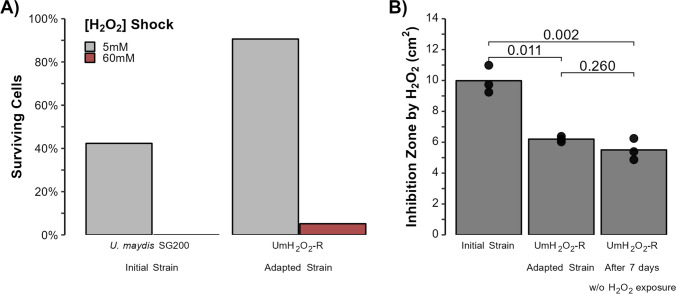
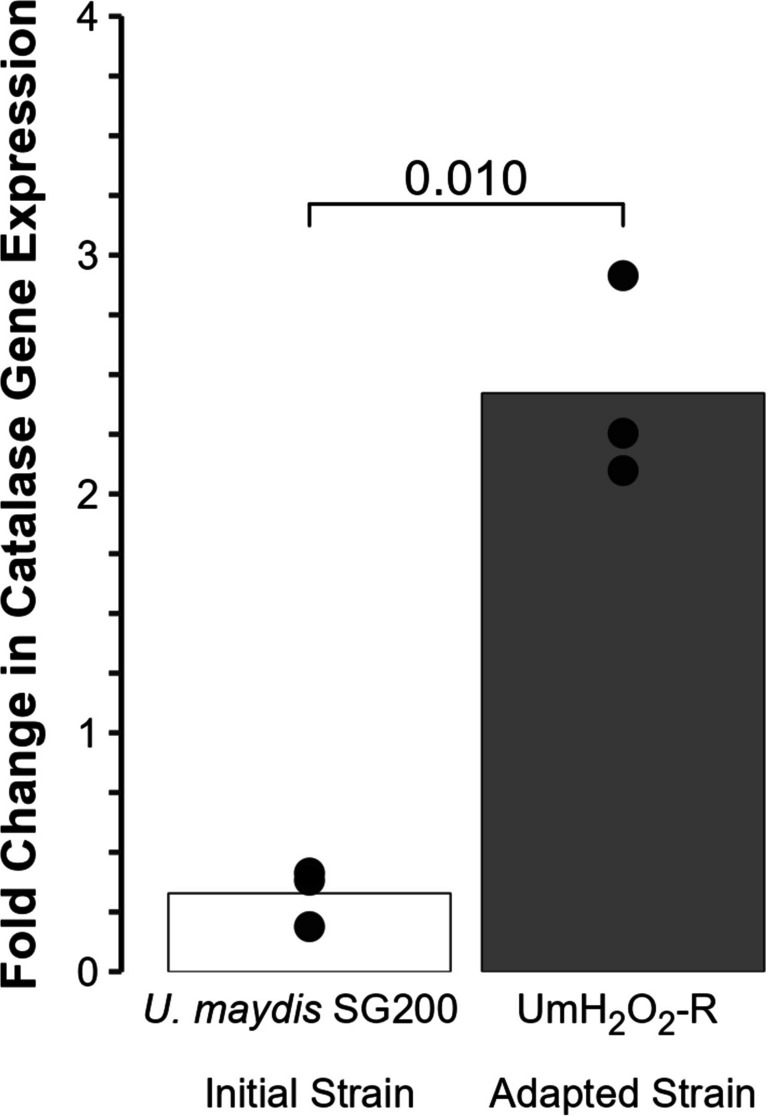
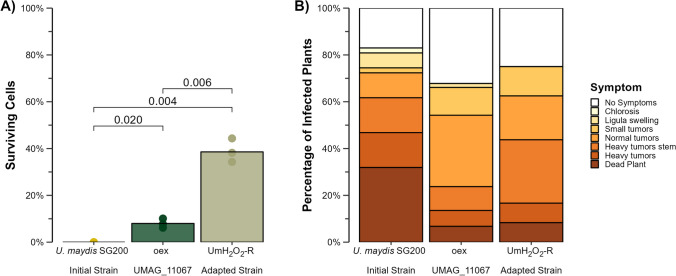
The phytopathogenic fungus Ustilago maydis causes corn smut by suppressing host plant defenses, including the oxidative burst response. While many studies have investigated how U. maydis responds to oxidative stress during infection, the consequences of heightened resistance to oxidative stress on virulence remain understudied. This study aimed to identify the effects on virulence in U. maydis strains exhibiting enhanced resistance to hydrogen peroxide (H 2 O 2 ). To achieve this, we exposed U. maydis SG200 to 20 escalating H 2 O 2 shocks, resulting in an adapted strain resistant to concentrations as high as 60 mM of H 2 O 2 , a lethal dose for the initial strain. Genetic analysis of the adapted strain revealed five nucleotide substitutions, two minor copy number variants, and a large amplification event on chromosome nine (1–149 kb) encompassing the sole catalase gene. Overexpressing catalase increased resistance to H 2 O 2 ; however, this resistance was lower than that observed in the adapted strain. Additionally, virulence was reduced in both strains with enhanced H 2 O 2 resistance. In summary, enhanced H 2 O 2 resistance, achieved through either continuous exposure to the oxidative agent or through catalase overexpression, decreased virulence. This suggests that the response to the oxidative stress burst in U. maydis is optimal and that increasing the resistance to H 2 O 2 does not translate into increased virulence. These findings illuminate the intricate relationship between oxidative stress resistance and virulence in U. maydis , offering insights into its infection mechanisms.
Overview
The claims and statistics of this paper haven’t been checked yet.
Run the check — free, no account needed. It reads the open-access text and checks the sources it cites.
Integrity signals
Registry
Cites
Statistics
Figures
Verification
Claims the paper makes
The claims and statistics of this paper haven’t been checked yet.
Run the check — free, no account needed. It reads the open-access text and checks the sources it cites.
Self-check
Percentages, sums and reported differences re-computed from the paper’s own numbers.
The self-check needs the paper’s full text.
Citations
Cites
R: A Language and Environment for Statistical Computing
R Core Team (2025) · doi:10.32614/r.manuals · Cited by 352,181
The Sequence Alignment/Map format and SAMtools
Li, H., Handsaker, B., Wysoker, A., Fennell, T., Ruan, J., Homer, N., Marth, G., Abecasis, G., Durbin, R., & 1000 Genome Project Data Processing Subgroup (2009) · Bioinformatics · doi:10.1093/bioinformatics/btp352 · Cited by 62,041
Fast and accurate short read alignment with Burrows-Wheeler transform
Li, H., & Durbin, R. (2009) · Bioinformatics · doi:10.1093/bioinformatics/btp324 · Cited by 58,607
Highly accurate protein structure prediction with AlphaFold
Jumper, J., Evans, R., Pritzel, A., Green, T., Figurnov, M., Ronneberger, O., Tunyasuvunakool, K., Bates, R., Žídek, A., Potapenko, A., et al. (2021) · Nature · doi:10.1038/s41586-021-03819-2 · Cited by 43,764
A new mathematical model for relative quantification in real-time RT-PCR
Pfaffl, M. W. (2001) · Nucleic Acids Research · doi:10.1093/nar/29.9.e45 · Cited by 34,610
fastp: an ultra-fast all-in-one FASTQ preprocessor
Chen, S., Zhou, Y., Chen, Y., & Gu, J. (2018) · Bioinformatics · doi:10.1093/bioinformatics/bty560 · Cited by 29,721
Wickham, H. (2016) · Use R! · doi:10.1007/978-3-319-24277-4_9 · Cited by 12,516
Fast and accurate long-read alignment with Burrows-Wheeler transform.
Li, H., & Durbin, R. (2010) · Bioinformatics · doi:10.1093/bioinformatics/btp698 · Cited by 12,063
Data Structures for Statistical Computing in Python
McKinney, W. (2010) · Proceedings of the Python in Science Conference · doi:10.25080/majora-92bf1922-00a · Cited by 11,032
rstatix: Pipe-Friendly Framework for Basic Statistical Tests
Kassambara, A. (2019) · doi:10.32614/cran.package.rstatix · Cited by 1,888
Abyzov, A., Urban, A. E., Snyder, M., & Gerstein, M. (2011) · Genome Research · doi:10.1101/gr.114876.110 · Cited by 1,658
Insights from the genome of the biotrophic fungal plant pathogen Ustilago maydis
Kämper, J., Kahmann, R., Bölker, M., Ma, L.-J., Brefort, T., Saville, B. J., Banuett, F., Kronstad, J. W., Gold, S. E., Müller, O., et al. (2006) · Nature · doi:10.1038/nature05248 · Cited by 1,208
vcfr: a package to manipulate and visualize variant call format data in R
Knaus, B. J., & Grünwald, N. J. (2017) · Molecular Ecology Resources · doi:10.1111/1755-0998.12549 · Cited by 1,075
Aneuploidy Affects Proliferation and Spontaneous Immortalization in Mammalian Cells
Williams, B. R., Prabhu, V. R., Hunter, K. E., Glazier, C. M., Whittaker, C. A., Housman, D. E., & Amon, A. (2008) · Science · doi:10.1126/science.1160058 · Cited by 666
Ng, H. H., Feng, Q., Wang, H., Erdjument‐Bromage, H., Tempst, P., Zhang, Y., & Struhl, K. (2002) · Genes & Development · doi:10.1101/gad.1001502 · Cited by 547
Evolution and genome architecture in fungal plant pathogens
Möller, M., & Stukenbrock, E. H. (2017) · Nature Reviews Microbiology · doi:10.1038/nrmicro.2017.76 · Cited by 432
Min, J., Feng, Q., Li, Z., Zhang, Y., & Xu, R.-M. (2003) · Cell · doi:10.1016/s0092-8674(03)00114-4 · Cited by 428
Selmecki, A. M., Dulmage, K., Cowen, L. E., Anderson, J. B., & Berman, J. (2009) · PLoS Genetics · doi:10.1371/journal.pgen.1000705 · Cited by 319
AnUstilago maydisGene Involved in H2O2 Detoxification Is Required for Virulence
Molina, L., & Kahmann, R. (2007) · The Plant Cell · doi:10.1105/tpc.107.052332 · Cited by 247
The genetics ofUstilago maydis
Holliday, R. (1961) · Genetics Research · doi:10.1017/s0016672300000719 · Cited by 231
Genome editing in Ustilago maydis using the CRISPR–Cas system
Schuster, M., Schweizer, G., Reissmann, S., & Kahmann, R. (2016) · Fungal Genetics and Biology · doi:10.1016/j.fgb.2015.09.001 · Cited by 225
Histone modifications and chromatin dynamics: a focus on filamentous fungi
Brosch, G., Loidl, P., & Graessle, S. (2008) · FEMS Microbiology Reviews · doi:10.1111/j.1574-6976.2007.00100.x · Cited by 181
Erratum: Evolution and genome architecture in fungal plant pathogens
Möller, M., & Stukenbrock, E. H. (2017) · Nature Reviews Microbiology · doi:10.1038/nrmicro.2017.143 · Cited by 171
A Ferroxidation/Permeation Iron Uptake System Is Required for Virulence inUstilago maydis
Eichhorn, H., Leßing, F., Winterberg, B., Schirawski, J., Kämper, J., Müller, P., & Kahmann, R. (2006) · The Plant Cell · doi:10.1105/tpc.106.043588 · Cited by 167
The fungal threat to global food security
Avery, S. V., Singleton, I., Magan, N., & Goldman, G. H. (2019) · Fungal Biology · doi:10.1016/j.funbio.2019.03.006 · Cited by 152
Ustilago maydis: how its biology relates to pathogenic development
Kahmann, R., & Kämper, J. (2004) · New Phytologist · doi:10.1111/j.1469-8137.2004.01156.x · Cited by 146
Aneuploidy in yeast: Segregation error or adaptation mechanism?
Gilchrist, C., & Stelkens, R. (2019) · Yeast · doi:10.1002/yea.3427 · Cited by 104
Elevated catalase expression in a fungal pathogen is a double-edged sword of iron
Pradhan, A., Herrero-de-Dios, C. M., Belmonte, R. C., Budge, S., López, A., Kolmogorova, A., Lee, K. K., Martin, B. D., Ribeiro, A., Bebes, A., et al. (2017) · PLoS Pathogens · doi:10.1371/journal.ppat.1006405 · Cited by 95
Epigenetic modifications affect the rate of spontaneous mutations in a pathogenic fungus
Habig, M., Lorrain, C., Feurtey, A., Komluski, J., & Stukenbrock, E. H. (2021) · Nature Communications · doi:10.1038/s41467-021-26108-y · Cited by 88
Stukenbrock, E. H., & Croll, D. (2014) · Fungal Biology Reviews · doi:10.1016/j.fbr.2014.02.001 · Cited by 85
Whole chromosome aneuploidy: Big mutations drive adaptation by phenotypic leap
Chen, G., RUBINSTEIN, B. Y., & Li, R. (2012) · BioEssays · doi:10.1002/bies.201200069 · Cited by 80
The genomic determinants of adaptive evolution in a fungal pathogen
Grandaubert, J., Dutheil, J. Y., & Stukenbrock, E. H. (2019) · Evolution Letters · doi:10.1002/evl3.117 · Cited by 78
Fungal transposable elements: Generators of diversity and genetic tools
Daboussi, M. (1996) · Journal of Genetics · doi:10.1007/bf02966312 · Cited by 76
The Dynamic Fungal Genome: Polyploidy, Aneuploidy and Copy Number Variation in Response to Stress
Vande Zande, P., Zhou, X., & Selmecki, A. (2023) · Annual Review of Microbiology · doi:10.1146/annurev-micro-041320-112443 · Cited by 70
Wang, S., Wu, X., Liu, C.-H., Shang, J.-Y., Gao, F., & Guo, H. (2020) · PLoS Pathogens · doi:10.1371/journal.ppat.1008481 · Cited by 65
Ustilago maydispopulations tracked maize through domestication and cultivation in the Americas
Munkacsi, A. B., Stoxen, S., & May, G. (2008) · Proceedings of the Royal Society B Biological Sciences · doi:10.1098/rspb.2007.1636 · Cited by 61
Dot1 regulates nucleosome dynamics by its inherent histone chaperone activity in yeast
Lee, S., Oh, S., Jeong, K., Jo, H., Choi, Y., Seo, H. D., Kim, M., Choe, J., Kwon, C. S., & Lee, D. (2018) · Nature Communications · doi:10.1038/s41467-017-02759-8 · Cited by 51
Möller, M., Habig, M., Lorrain, C., Feurtey, A., Haueisen, J., Fagundes, W. C., Alizadeh, A., Freitag, M., & Stukenbrock, E. H. (2021) · PLoS Genetics · doi:10.1371/journal.pgen.1009448 · Cited by 48
Yeast Chronological Lifespan: Longevity Regulatory Genes and Mechanisms
Mirisola, M. G., & Longo, V. D. (2022) · Cells · doi:10.3390/cells11101714 · Cited by 48
Genome-wide analysis of genomic alterations induced by oxidative DNA damage in yeast
Zhang, K., Zheng, D., Sui, Y., Qi, L., & Petes, T. D. (2019) · Nucleic Acids Research · doi:10.1093/nar/gkz027 · Cited by 47
Tralamazza, S. M., Gluck‐Thaler, E., Feurtey, A., & Croll, D. (2024) · Nature Communications · doi:10.1038/s41467-024-49913-7 · Cited by 47
Gu, Q., Ji, T., Sun, X., Huang, H., Zhang, H., Lu, X., Wu, L., Huo, R., Wu, H., & Gao, X. (2017) · FEMS Microbiology Letters · doi:10.1093/femsle/fnx184 · Cited by 40
Wang, Q., Sun, M., Zhang, Y., Song, Z., Zhang, S., Zhang, Q., Xu, J., & Liu, H. (2020) · Molecular Plant Pathology · doi:10.1111/mpp.12899 · Cited by 32
Chávez, J. A. C., Valdés‐Santiago, L., Bakkeren, G., Hurtado-Santiago, E., León-Ramírez, C. G., Naranjo, E. U. E., Landeros, F., Rodríguez-Aza, Y., & Ruíz-Herrera, J. (2016) · Microbiology · doi:10.1099/mic.0.000287 · Cited by 30
Liang, L., Liu, Y., Yang, K., Lin, G., Xu, Z., Lan, H., Wang, X., & Wang, S. (2017) · Toxins · doi:10.3390/toxins9070232 · Cited by 29
New Insights of Ustilago maydis as Yeast Model for Genetic and Biotechnological Research: A Review
Olicón-Hernández, D. R., Araiza-Villanueva, M. G., Pardo, J. P., Aranda, E., & Guerra‐Sánchez, G. (2019) · Current Microbiology · doi:10.1007/s00284-019-01629-4 · Cited by 27
Mouse models of aneuploidy to understand chromosome disorders
Tosh, J., Tybulewicz, V., & Fisher, E. M. C. (2022) · Mammalian Genome · doi:10.1007/s00335-021-09930-z · Cited by 24
Linder, R. A., Greco, J. P., Seidl, F., Matsui, T., & Ehrenreich, I. M. (2017) · G3 Genes Genomes Genetics · doi:10.1534/g3.117.300069 · Cited by 22
Epigenetic regulation of nuclear processes in fungal plant pathogens
Kramer, H. M., Cook, D. E., Seidl, M. F., & Thomma, B. P. H. J. (2023) · PLoS Pathogens · doi:10.1371/journal.ppat.1011525 · Cited by 22
Li, Y., Hu, Y., Zhao, K., Pan, Y., Qu, Y., Zhao, J., & Qin, Y. (2019) · Frontiers in Microbiology · doi:10.3389/fmicb.2019.02566 · Cited by 21
Bioactive ingredients of huitlacoche (Ustilago maydis), a potential food raw material
López-Martínez, L. X., Aguirre-Delgado, A., Sáenz-Hidalgo, H. K., Buenrostro-Figueroa, J. J., Garcia, H. S., & Baeza‐Jiménez, R. (2022) · Food Chemistry Molecular Sciences · doi:10.1016/j.fochms.2022.100076 · Cited by 19
Hydrogen peroxide, a potent inducer of global genomic instability
Qi, L., Wu, X., & Zheng, D. (2019) · Current Genetics · doi:10.1007/s00294-019-00969-9 · Cited by 18
Villagrán, Z., Martínez‐Reyes, M., Rodríguez, H. G., Ríos-García, U., Montalvo‐González, E., Ortiz‐Basurto, R. I., Esparza, L. M. A., & Pérez‐Moreno, J. (2023) · Molecules · doi:10.3390/molecules28114415 · Cited by 18
Depotter, J. R. L., Zuo, W., Hansen, M., Zhang, B., Xu, M., & Doehlemann, G. (2020) · Journal of Fungi · doi:10.3390/jof7010016 · Cited by 17
Huang, M., & Kao, K. C. (2018) · Yeast · doi:10.1002/yea.3352 · Cited by 16
Schweizer, G., Haider, M. B., Barroso, G. V., Rössel, N., Münch, K., Kahmann, R., & Dutheil, J. Y. (2021) · Genome Biology and Evolution · doi:10.1093/gbe/evab073 · Cited by 14
Aneuploidy Is Associated with Azole Resistance in Aspergillus fumigatus
Khateb, A., Gago, S., Bromley, M., Richardson, M., & Bowyer, P. (2023) · Antimicrobial Agents and Chemotherapy · doi:10.1128/aac.01253-22 · Cited by 14
Nuclear status and leaf tumor formation in the Ustilago maydis–maize pathosystem
Lin, J., Happel, P., & Kahmann, R. (2021) · New Phytologist · doi:10.1111/nph.17377 · Cited by 9
The insertion of a mitochondrial selfish element into the nuclear genome and its consequences
Dutheil, J. Y., Münch, K., Schotanus, K., Stukenbrock, E. H., & Kahmann, R. (2020) · Ecology and Evolution · doi:10.1002/ece3.6749 · Cited by 8
Tralamazza, S. M., Gluck‐Thaler, E., Feurtey, A., & Croll, D. (2023) · bioRxiv (Cold Spring Harbor Laboratory) · doi:10.1101/2023.09.22.559077 · Cited by 6
Munkacsi, A. B., KAWAKAMI, S., Pan, J. J., LEE, K., Stoxen, S., HANG, J., & May, G. (2005) · Molecular Ecology Notes · doi:10.1111/j.1471-8286.2005.01199.x · Cited by 5
Research works printed but not linked: 1
- Momeni H, Nazari F (2022) Population genetic structure of Ustilago maydis in Iran. J Crop Prot 12(4):485–497
Metadata
- Authors
- Cuamatzi-Flores, J., Colón-González, M., Requena-Romo, F., Quiñones-Galeana, S., Cervantes-Chávez, J. A., & Morales, L.
- Affiliations
- Autonomous University of Queretaro (MX)
- Universidad Nacional Autónoma de México (MX)
- Corresponding author
- Cuamatzi-Flores, Jorge
- ORCID
- Venue
- International Microbiology
- Published
- 2024-02-24
- Volume
- 27
- Issue
- 5
- Pages
- 1501-1511
- ISSN
- 1139-6709 (ISSN-L)
- 1618-1905
- PMC
- PMC11452521
- OpenAlex
- W4392135996
- Cited by
- 3
- References
- 61
- Citations by year
- 2026: 2 · 2025: 1
- FWCI
- 0.41
- Type
- journal article
- Language
- en
- Open access
- hybrid
- doi.org
- Licence
- cc-by
- creativecommons.org/licenses/by/4.0 (tdm)
- creativecommons.org/licenses/by/4.0 (vor)
- Locations
- International Microbiology (publishedVersion, cc-by)
- Research Square (acceptedVersion, cc-by)
- PubMed Central (publishedVersion, cc-by)
- PubMed (publishedVersion)
- Funders
- UAQ-FOPER (FCN02469)
- CONCYTEQ (NT/21/2022)
- CONAHCYT (Doctoral fellowship 735110, CF-103000)
- DAAD (91835730)
- UNAM-PAPIIT (IN209021)
- Topics
- Life Sciences › Biochemistry, Genetics and Molecular Biology › Molecular Biology › Fungal and yeast genetics research
- Life Sciences › Agricultural and Biological Sciences › Plant Science › Plant-Microbe Interactions and Immunity
- Life Sciences › Agricultural and Biological Sciences › Plant Science › Plant Pathogens and Fungal Diseases
- Keywords
- Ustilago maydis, corn smut, oxidative stress resistance, hydrogen peroxide resistance, fungal virulence, catalase overexpression, respiratory burst, host defense suppression, copy number variation, adaptive evolution
- MeSH terms
- Basidiomycota, Catalase, Zea mays, Fungal Proteins, Hydrogen Peroxide, Plant Diseases, Ustilago, Virulence, Oxidative Stress
About these checks
Registry, retraction, Cites and statistics results are computed, not judged, with one exception: a printed reference that no index lists is read once by a model before it counts as a citation error. Claims are extracted by a model and kept only when their quote appears verbatim in the text; each cited source is then checked, with a model’s help, for whether it says what the claim relies on. Those verdicts can be wrong — read the claim’s quote and the cited source before relying on one.
Statistics and arithmetic are recomputed, not judged.
Confidence bands are shown only for fields calibrated on our annotated test set. None is calibrated yet, so no band is shown.
What counts as a claim ›How we measure confidence ›How we check this ›
Are you an author, or do you see a problem with this page? Request a review
Data sources
Bibliographic data: Semantic Scholar, OpenAlex, Crossref.
Contains information from the Semantic Scholar Academic Graph Datasets, made available under the ODC Attribution License (ODC-BY 1.0).
Semantic Scholar’s data is described in: Kinney, R., et al. (2023). The Semantic Scholar Open Data Platform. arXiv:2301.10140.
