

Modulation of pain perception by transcranial magnetic stimulation of left prefrontal cortex
Open accessThe DOI matches its Crossref record; 41 of the 42 references it cites were found in a registry or an index, and 1 are not checked yet.
Abstract
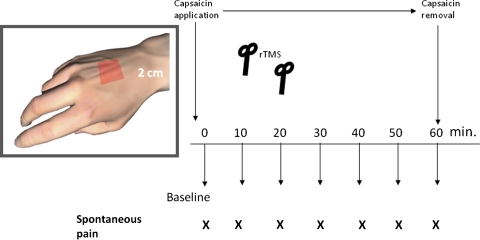
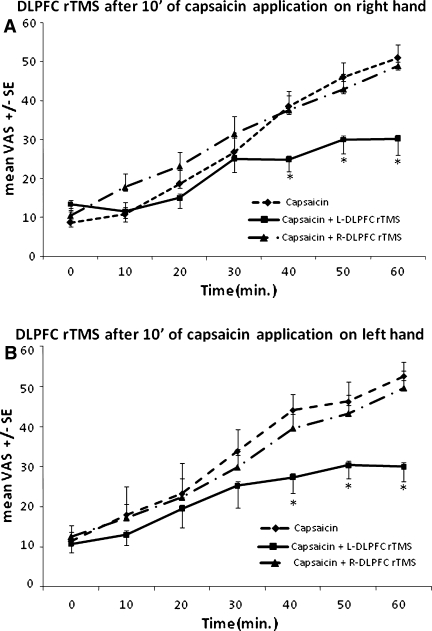
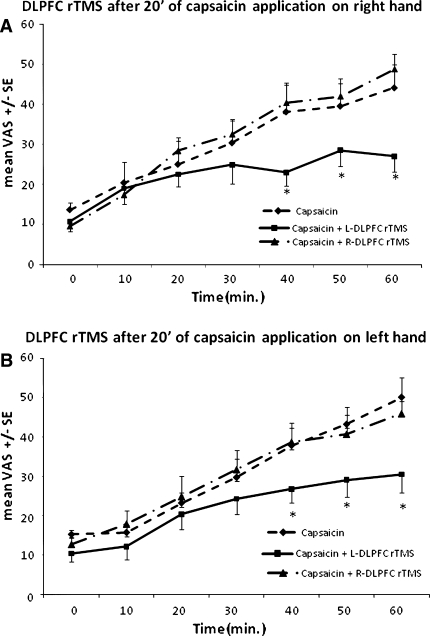
Evidence by functional imaging studies suggests the role of left dorsolateral prefrontal cortex (DLPFC) in the inhibitory control of nociceptive transmission system. Repetitive transcranial magnetic stimulation (rTMS) is able to modulate pain response to capsaicin. In the present study, we evaluated the effect of DLPFC activation (through rTMS) on nociceptive control in a model of capsaicin-induced pain. The study was performed on healthy subjects that underwent capsaicin application on right or left hand. Subjects judged the pain induced by capsaicin through a 0-100 VAS scale before and after 5 Hz rTMS over left and right DLPFC at 10 or 20 min after capsaicin application in two separate groups (8 subjects each). Left DLPFC-rTMS delivered either at 10 and 20 min after capsaicin application significantly decreased spontaneous pain in both hands. Right DLPFC rTMS showed no significant effect on pain measures. According to these results, stimulation of left DLPFC seems able to exert a bilateral control on pain system, supporting the critical antinociceptive role of such area. This could open new perspectives to non-invasive brain stimulation protocols of alternative target area for pain treatment.
Overview
The claims and statistics of this paper haven’t been checked yet.
Free: it reads the open-access text and checks the first 5 claims that cite a source we can check. Create a free account to check every claim.
Integrity signals
Registry
Cites
Statistics
Figures
Verification
Claims the paper makes
The claims and statistics of this paper haven’t been checked yet.
Free: it reads the open-access text and checks the first 5 claims that cite a source we can check. Create a free account to check every claim.
Claims other papers make about this one
Each is checked against this paper’s own text: does it say what the citing paper says it does?
In the citing paper
“In healthy participants, rTMS of the left DLPFC reduces spontaneous pain from capsaicin application13”
From The dorsolateral prefrontal cortex in acute and chronic pain (2017) · cites this paper as [13]
Self-check
Percentages, sums and reported differences re-computed from the paper’s own numbers.
The self-check needs the paper’s full text.
Citations
Cites
An Integrative Theory of Prefrontal Cortex Function
Miller, E. K., & Cohen, J. D. (2001) · Annual Review of Neuroscience · doi:10.1146/annurev.neuro.24.1.167 · Cited by 12,803 · cited 1×
“Indeed, DLPFC appears to be a potential candidate region to modulate the experience of pain given that it is a critical structure for working memory and attention functions [32, 33].”
BackgroundFuster, J. M. (1997) · Cited by 2,253
Placebo-Induced Changes in fMRI in the Anticipation and Experience of Pain
Wager, T. D., Rilling, J. K., Smith, E. E., Sokolik, A., Casey, K. L., Davidson, R. J., Kosslyn, S. M., Rose, R. M., & Cohen, J. D. (2004) · Science · doi:10.1126/science.1093065 · Cited by 1,992 · cited 1×
“In this regard, DNIC has also been shown to be modulable by cortical structures such as DLPFC, which is involved in pain control and in phenomena of pain expectation and placebo [36, 38, 39 ].”
BackgroundTranscranial magnetic stimulation in neurology
Kobayashi, M., & Pascual-Leone, A. (2003) · The Lancet Neurology · doi:10.1016/s1474-4422(03)00321-1 · Cited by 1,297
Pascual-Leone, A., Rubio, B., Pallardó, F., & Catalá, M. D. (1996) · The Lancet · doi:10.1016/s0140-6736(96)01219-6 · Cited by 1,229 · cited 2×
“According to Pascual Leone et al. [ 17 ], DLPFC was localized on the scalp 5-cm anterior to the hot spot for the contralateral abductor pollicis brevis (APB) muscle.”
BackgroundMethodDaily repetitive transcranial magnetic stimulation (rTMS) improves mood in depression
George, M. S., Wassermann, E. M., Williams, W. A., Callahan, A., Ketter, T. A., Basser, P., Hallett, M., & Post, R. M. (1995) · NeuroReport · doi:10.1097/00001756-199510020-00008 · Cited by 954 · cited 1×
“First indicated as a valid stimulation area for the treatment of depressive states [16, 17], recently the DLPFC has also been considered a potential target for nociceptive control [18].”
BackgroundKeeping pain out of mind: The role of the dorsolateral prefrontal cortex in pain modulation
Lorenz, J., Minoshima, S., & Casey, K. L. (2003) · Brain · doi:10.1093/brain/awg102 · Cited by 952 · cited 5×
“Nahmias et al. [25] were not able to induce DNIC activity, as they recorded no changes in RIII (a measure of DNIC activation); whereas cold pressor test [24] that give a more intense pain, and capsaicin that induce continuous painful stimulation, are more likely to activate DNIC [20, 37].”
BackgroundInfluentialEFNS guidelines on neurostimulation therapy for neuropathic pain
Cruccu, G., Aziz, T. Z., Garcia‐Larrea, L., Hansson, P., Jensen, T. S., Lefaucheur, J. ‐., Simpson, B. A., & Taylor, R. S. (2007) · European Journal of Neurology · doi:10.1111/j.1468-1331.2007.01916.x · Cited by 690 · cited 1×
“The great majority of TMS studies [7–10] focused on motor cortex and this site has been considered the optimal area for control of neuropathic pain also by the EFNS Guidelines on Neurostimulation Therapy [14].”
BackgroundChronic Motor Cortex Stimulation for the Treatment of Central Pain
Tsubokawa, T., Katayama, Y., Yamamoto, T., Hirayama, T., & Koyama, S. (1991) · Acta Neurochirurgica Supplementum · doi:10.1007/978-3-7091-9160-6_37 · Cited by 623 · cited 1×
“[1] reported efficacy of motor cortex stimulation (MCS) by dural implanted electrodes for treatment of chronic, central, drug-resistant neuropathic pain on 12 patients.”
BackgroundGarcía-Larrea, L., Peyron, R., Mertens, P., Gregoire, C. M., Lavenne, F., Le Bars, D., Convers, P., Mauguière, F., Sindou, M., & Laurent, B. (1999) · Pain · doi:10.1016/s0304-3959(99)00114-1 · Cited by 572 · cited 1×
“Since then, a consistent bulk of evidence showed this approach as being effective for pain control in several patients [2–4].”
Background
Cited by
Role of the Prefrontal Cortex in Pain Processing
Ong, W.-Y., Stohler, C. S., & Herr, D. R. (2019) · Molecular Neurobiology · doi:10.1007/s12035-018-1130-9 · Cited by 766
The dorsolateral prefrontal cortex in acute and chronic pain
Seminowicz, D. A., & Moayedi, M. (2017) · The Journal of Pain · doi:10.1016/j.jpain.2017.03.008 · Cited by 502
Frangos, E., & Komisaruk, B. R. (2017) · Brain Stimulation · doi:10.1016/j.brs.2016.10.008 · Cited by 205
“Analgesic effects other than headache attenuation may occur in response to nVNS-evoked activation of the dorsolateral prefrontal cortex, as this region is implicated in antinociceptive responses against experimental and chronic pain [41,42].”
BackgroundFrom pulses to pain relief: an update on the mechanisms of rTMS‐induced analgesic effects
Moisset, X., de Andrade, D. C., & Bouhassira, D. (2016) · European Journal of Pain · doi:10.1002/ejp.811 · Cited by 169
“In addition, studies in healthy volunteers (Nahmias et al., 2009; Fierro et al., 2010; de Andrade et al., 2011; Brighina et al., 2011; Taylor et al., 2012, 2013; Ciampi de Andrade et al., 2014) and in patients with acute (Borckardt et al., 2006, 2014) or chronic pain (Borckardt et al., 2009; Short…”
BackgroundSelf‐other resonance, its control and prosocial inclinations: Brain–behavior relationships
Christov‐Moore, L., & Iacoboni, M. (2016) · Human Brain Mapping · doi:10.1002/hbm.23119 · Cited by 142
Leung, A., Shirvalkar, P. R., Chen, R. E., Kuluva, J. E., Vaninetti, M., Bermudes, R. A., Poree, L. R., Wassermann, E. M., Kopell, B. H., & Levy, R. M. (2020) · Neuromodulation Technology at the Neural Interface · doi:10.1111/ner.13094 · Cited by 132
“A second study (class II) demonstrated (42) that only left hemisphere 5 Hz DLPFC rTMS stimulation provided bilateral analgesic effects.”
Noninvasive cortical modulation of experimental pain
Mylius, V., Borckardt, J. J., & Lefaucheur, J. (2012) · Pain · doi:10.1016/j.pain.2012.04.009 · Cited by 136
“Similar to these observations, capsaicin-induced pain was found to be reduced by 5 Hz rTMS applied to the left dl-PFC, but not to the right dl-PFC [16,30].”
BackgroundInfluentialRapid treatment-induced brain changes in pediatric CRPS
Erpelding, N., Simons, L., Lebel, A., Serrano, P., Pielech, M., Prabhu, S., Becerra, L., & Borsook, D. (2016) · Brain Structure and Function · doi:10.1007/s00429-014-0957-8 · Cited by 108
“…in George 2010), elicits analgesic effects in both experimental pain (Graff-Guerrero et al. 2005; Boggio et al. 2008; Nahmias et al. 2009; Fierro et al. 2010; Brighina et al. 2011) and clinical pain (Reid and Pridmore 2001; Brighina et al. 2004; Arul-Anandam et al. 2009; Borckardt et al. 2009).”
Caumo, W., Deitos, A., Carvalho, S., Leite, J., Carvalho, F., Dussán-Sarria, J. A., Lopes Tarragó, M. D. G., Souza, A., Torres, I. L. D. S., & Fregni, F. (2016) · Frontiers in Human Neuroscience · doi:10.3389/fnhum.2016.00357 · Cited by 105
“, 2010) and induced a significant anti-nociceptive effect in the capsaicin pain model (Brighina et al., 2011).”
BackgroundEffects of transcranial direct current stimulation on pain perception and working memory
Mylius, V., Jung, M., Menzler, K., Haag, A., Khader, P. H., Oertel, W. H., Rosenow, F., & Lefaucheur, J. ‐. (2012) · European Journal of Pain · doi:10.1002/j.1532-2149.2011.00105.x · Cited by 103
“Besides these studies, in which provoked pain thresholds were measured, high-frequency (5 Hz) rTMS of the left DLPFC was also found to reduce capsaicin-induced tonic pain, whereas right DLPFC stimulation was ineffective (Fierro et al., 2010; Brighina et al., 2011).”
BackgroundRole of the Anterior Cingulate Cortex in Translational Pain Research
Xiao, X., Ding, M. L., & Zhang, Y. (2021) · Neuroscience Bulletin · doi:10.1007/s12264-020-00615-2 · Cited by 127
Altered structure and functional connection in patients with classical trigeminal neuralgia
Tsai, Y., Yuan, R., Patel, D., Chandrasekaran, S., Weng, H., Yang, J., Lin, C., & Biswal, B. B. (2017) · Human Brain Mapping · doi:10.1002/hbm.23696 · Cited by 103
“On the other hand, the dorsolateral PFC is a target of repetitive transcranial magnetic stimulation (rTMS) for pain control [Brighina et al., 2011; Mariano et al., 2015].”
Backgroundde Oliveira, R. A. A., de Andrade, D. C., Mendonça, M., Barros, R. Q., Luvisotto, T. B., Myczkowski, M. L., Marcolin, M. A., & Teixeira, M. J. (2014) · Journal of Pain · doi:10.1016/j.jpain.2014.09.009 · Cited by 109
Nardone, R., Höller, Y., Langthaler, P. B., Lochner, P., Golaszewski, S. M., Schwenker, K., Brigo, F., & Trinka, E. (2016) · Spinal Cord · doi:10.1038/sc.2016.87 · Cited by 100
Hanlon, C. A., Dowdle, L. T., & Henderson, J. S. (2018) · Pharmacological Reviews · doi:10.1124/pr.116.013649 · Cited by 92
“Althoughmany of these studies have focused on using the motor cortex as a target for stimulation, there is evidence that the DLPFC is also an effective target for pain reduction (Borckardt et al., 2007, 2008; Brighina et al., 2011; Taylor et al., 2013).”
BackgroundBrain Stimulation in the Treatment of Chronic Neuropathic and Non-Cancerous Pain
Plow, E. B., Pascual-Leone, A., & Machado, A. (2012) · The Journal of Pain · doi:10.1016/j.jpain.2012.02.001 · Cited by 92
“In clinical populations, such as fibromyalgia, long-term application of tDCS lasting 10 days shows favorable results for pain as well as quality of life,139 though in short-term trials, tDCS delivered to DLPFC, unlike M1, does not appear to exert antinociception.38 Irrespective of the promise witnessed with longer tre…”
BackgroundMethodInfluentialHou, W.-H., Wang, T.-Y., & Kang, J.-H. (2016) · Rheumatology · doi:10.1093/rheumatology/kew205 · Cited by 86
Andrade, S. M., Aranha, R. E. L. D. B., de Oliveira, E. A., de Mendonça, C. T. P. L., Martins, W. K. N., Alves, N. T., & Fernández‐Calvo, B. (2017) · Journal of the Neurological Sciences · doi:10.1016/j.jns.2017.05.007 · Cited by 89
Fitzgibbon, B. M., Hoy, K. E., Knox, L. A., Guymer, E. K., Littlejohn, G., Elliot, D., Wambeek, L. E., McQueen, S., Elford, K. A., Lee, S. J., et al. (2018) · European Journal of Pain · doi:10.1002/ejp.1213 · Cited by 72
“…European Pain Federation - EFIC Eur J Pain 22 (2018) 1255--1267 1257 Treatment stimulation site was the left-hemisphere DLPFC (studies have shown left DLPFC stimulation demonstrates bilateral effects on the pain system (Brighina et al., 2011)) identified as ‘F3’ using the EEG 10:20 system method.”
MethodIs β endorphin related to migraine headache and its relief?
Misra, U. K., Kalita, J., Tripathi, G. M., & Bhoi, S. K. (2013) · Cephalalgia · doi:10.1177/0333102412473372 · Cited by 72
“Left dorsolateral prefrontal cortex has specific nociceptive effect as it relieved both right- and left-hand capsaicin-induced pain, whereas right homologous stimulation was ineffective at relieving pain (16).”
BackgroundNIRS measures in pain and analgesia: Fundamentals, features, and function
Karunakaran, K. D., Peng, K., Berry, D., Green, S. A., Labadie, R. F., Kussman, B. D., & Borsook, D. (2020) · Neuroscience & Biobehavioral Reviews · doi:10.1016/j.neubiorev.2020.10.023 · Cited by 71
Sankarasubramanian, V., Cunningham, D. A., Potter–Baker, K. A., Beall, E. B., Roelle, S. M., Varnerin, N. M., Machado, A. G., Jones, S. E., Lowe, M. J., & Plow, E. B. (2017) · Brain Connectivity · doi:10.1089/brain.2016.0440 · Cited by 75
“Indeed, recent studies have suggested that targeting structures, such as the DLPFC, associated with emotional-affective information processing may be more effective in modulating the overall experience of pain (Brighina et al., 2011; Graff-Guerrero et al., 2005; Plow et al., 2012).”
BackgroundMethodLenoir, C., Algoet, M., & Mouraux, A. (2018) · The Journal of Physiology · doi:10.1113/jp276359 · Cited by 69
“, 2013), the dorsal-lateral prefrontal cortex (DLPFC) (Nahmias et al., 2009; Fierro et al., 2010; Borckardt et al., 2011; Brighina et al., 2011; de Andrade et al., 2011; Taylor et al., 2012; Taylor et al., 2013; Ciampi de Andrade et al., 2014), ACC (Fan et al.”
BackgroundEgorova, N., Yu, R., Kaur, N., Vangel, M., Gollub, R. L., Dougherty, D. D., Kong, J., & Camprodon, J. A. (2015) · Pain · doi:10.1097/j.pain.0000000000000163 · Cited by 63
“One study showed that stimulating the left but not the rDLPFC with high-frequency rTMS produces a placebo response decreasing the effect of the capsaicin cream.(8) Another study suggested no”
BackgroundKalita, J., Laskar, S., Bhoi, S. K., & Misra, U. K. (2016) · Journal of Neurology · doi:10.1007/s00415-016-8257-2 · Cited by 65
“Capsaicin induced pain on dorsum of hands in the volunteers was relieved by stimulating left dorsolateral frontal cortex, whereas this effect was not observed by right side stimulation [19].”
BackgroundCrone, L. J., & Teddlie, C. B. (1995) · The Journal of classroom interaction · Cited by 73
Sevel, L. S., Letzen, J. E., Staud, R., & Robinson, M. E. (2016) · Brain Connectivity · doi:10.1089/brain.2015.0405 · Cited by 56
“Investigations utilizing transcranial direct current stimulation (tDCS) and repetitive transcranial magnetic stimulation (rTMS) provided initial evidence that DLPFC stimulation may have a role in decreasing pain reports (Boggio et al., 2009; Borckardt et al., 2006; Brighina et al., 2011) and increasing pain tolerance…”
BackgroundCognitive profile and mild cognitive impairment in people with chronic lower back pain
Corti, E. J., Gasson, N., & Loftus, A. M. (2021) · Brain and Cognition · doi:10.1016/j.bandc.2021.105737 · Cited by 67
Misra, U. K., Kalita, J., & Bhoi, S. K. (2012) · Neurological Research · doi:10.1179/1743132812y.0000000045 · Cited by 54
Coulombe, M.-A., Lawrence, K. S., Moulin, D. E., Morley-Forster, P., Shokouhi, M., Nielson, W. R., & Davis, K. D. (2017) · Frontiers in Neuroanatomy · doi:10.3389/fnana.2017.00047 · Cited by 53
“Indeed, left dlPFC stimulation using repetitive transcranial magnetic stimulation (rTMS) decreased pain rating (Brighina et al., 2011).”
BackgroundGranato, A., Fantini, J., Monti, F., Furlanis, G., Ilbeh, S. M., Semenic, M., & Manganotti, P. (2018) · Journal of Clinical Neuroscience · doi:10.1016/j.jocn.2018.09.021 · Cited by 54
Seminowicz, D. A., Martino, E. D., Schabrun, S. M., & Graven‐Nielsen, T. (2018) · Pain · doi:10.1097/j.pain.0000000000001350 · Cited by 54
“Left–but not right– DLPFC rTMS reduced bilateral capsaicin pain intensity when delivered 10 to 20 minutes after capsaicin application, and the analgesic effects was found after 20 to 30minutes.(10,45,46) In line”
BackgroundStructural network differences in chronic musculoskeletal pain: Beyond fractional anisotropy
Bishop, J. H., Shpaner, M., Kubicki, A., Clements, S., Watts, R., & Naylor, M. R. (2017) · NeuroImage · doi:10.1016/j.neuroimage.2017.12.021 · Cited by 55
“Compared to controls, we observed decreased left DLPFC volume, a region involved in cognitive, affective, and sensory processing of pain, and implicated in top-down pain modulation (Ayache et al., 2016; Brighina et al., 2011; Tracey and Mantyh, 2007).”
To, W. T., James, E., Ost, J., Hart, J., Ridder, D. D., & Vanneste, S. (2017) · Journal of Neural Transmission · doi:10.1007/s00702-017-1714-y · Cited by 52
“They suggested that the DLPFC may exert a ‘top-down’ inhibition on neuronal coupling along the ascending midbrain-thalamic-cingulate pathway through descending fibers from the prefrontal cortex (Lorenz et al. 2003; Brighina et al. 2011).”
Predictors for rTMS response in chronic tinnitus
Lehner, A., Schecklmann, M., Landgrebe, M., Kreuzer, P. M., Poeppl, T. B., Frank, E., Vielsmeier, V., Kleinjung, T., Rupprecht, R., & Langguth, B. (2012) · Frontiers in Systems Neuroscience · doi:10.3389/fnsys.2012.00011 · Cited by 49
“Theoretically, left frontal rTMS might have had a beneficial effect on temporomandibular complaints, similar like on experimental pain (Fierro et al., 2010; Brighina et al., 2011).”
BackgroundSacco, P., Prior, M., Poole, H. M., & Nurmikko, T. J. (2014) · BMC Neurology · doi:10.1186/s12883-014-0166-3 · Cited by 45
“[17] compared rTMS of the left and right DLFPC on pain responses to topical capsaicin application to both hands and found significant bilateral pain reductions after stimulating the left hemisphere only.”
BackgroundPredicting Empathy From Resting State Brain Connectivity: A Multivariate Approach
Christov‐Moore, L., Reggente, N., Douglas, P. K., Feusner, J. D., & Iacoboni, M. (2020) · Frontiers in Integrative Neuroscience · doi:10.3389/fnint.2020.00003 · Cited by 44
Mariano, T. Y., Wout‐Frank, M. V. ‘., Garnaat, S. L., Rasmussen, S. A., & Greenberg, B. D. (2015) · Pain Medicine · doi:10.1093/pm/pnv042 · Cited by 40
Li, J., Huang, X., Sang, K., Bodner, M., Ma, K., & Dong, X.-W. (2018) · Journal of Pain Research · doi:10.2147/jpr.s166571 · Cited by 32
“It also plays an important role in the perception and modulation of pain.(9,10) Recent studies have demonstrated that the left PFC is involved in both sensory and affective dimensions of painful experience.”
Greenwald, J. D., & Shafritz, K. M. (2018) · Frontiers in Integrative Neuroscience · doi:10.3389/fnint.2018.00018 · Cited by 39
“…that the dorsolateral prefrontal cortex (dlPFC)—long known for its role in working memory, attention and inhibition—is also critical for emotional information processing (Etkin et al., 2006; Shafritz et al., 2006; Urry et al., 2006) and pain perception (Lorenz et al., 2003; Brighina et al., 2011).”
BackgroundWang, T. I., Wang, Z., Chen, Q., Chen, N., Zhang, J., Liu, Q., He, L., Zhang, J., Huang, H., & Gong, Q. (2016) · Neuroreport · doi:10.1097/wnr.0000000000000529 · Cited by 34
Deng, X., Jian, C., Yang, Q., Jiang, N., Huang, Z., & Zhao, S. (2022) · Frontiers in Neuroscience · doi:10.3389/fnins.2022.1033155 · Cited by 32
“It was found that noninvasive stimulation of the LDLPFC appears to exhibit an antinociceptive effect, thus increasing pain tolerance (Brighina et al., 2011).”
BackgroundRepetitive transcranial magnetic stimulation in chronic tension-type headache: A pilot study
Mattoo, B., Tanwar, S., Bhatia, R., Tripathi, M., & Bhatia, R. (2019) · The Indian Journal of Medical Research · doi:10.4103/ijmr.ijmr_97_18 · Cited by 31
探索生态系统论的学习观 —— 从心理学史看如何“以学生为中心”
中国人民大学心理学系, & 王, 明. (2023) · 教育研究前沿进展 · doi:10.55375/jerp.2023.3.12 · Cited by 29
Dubois, P. E., Ossemann, M., de Fays, K., Bue, P. D., Gourdin, M. J., Jamart, J., & Vandermeeren, Y. (2012) · Clinical Journal of Pain · doi:10.1097/ajp.0b013e31826fb302 · Cited by 31
Sahu, A. K., Sinha, V. K., & Goyal, N. (2019) · Indian Journal of Psychiatry · doi:10.4103/psychiatry.indianjpsychiatry_472_18 · Cited by 34
“This favors the role of the left DLPFC in bilateral pain control mechanism.[9]”
Hu, Y., Zhu, Y., Xin, W., Zeng, F., Feng, Y., Xu, Z., Xu, F., & Wang, J. (2022) · European Journal of Neuroscience · doi:10.1111/ejn.15779 · Cited by 29
“Although both targets have shown efficacy on pain, more evidence is needed to evaluate the role of the left DLPFC in different experimental pain conditions (Brighina et al., 2011).”
BackgroundInfluentialNeural Correlates of Clinical Scores in Patients with Anterior Shoulder Apprehension
Cunningham, G. J., Zanchi, D., Emmert, K., Kopel, R., Ville, D. V. D., Lädermann, A., Haller, S., & Hoffmeyer, P. J. (2015) · Medicine & Science in Sports & Exercise · doi:10.1249/mss.0000000000000726 · Cited by 33
“(1) Specifically, medial and dorsolateral prefrontal areas are involved in pain modulation,(6,27) expectancy of pain (16,38) and interaction between pain and anxiety,(35) while the connectivity between ACC and PCC is involved in pain stimulation processing.”
Sex differences in somatomotor representations of others’ pain: a permutation-based analysis
Christov‐Moore, L., & Iacoboni, M. (2018) · Brain Structure and Function · doi:10.1007/s00429-018-1814-y · Cited by 37
Ansari, A. H., Pal, A., Ramamurthy, A., Kabat, M., Jain, S., & Kumar, S. (2021) · ACS Chemical Neuroscience · doi:10.1021/acschemneuro.0c00785 · Cited by 35
Motor cortex excitability in chronic low back pain
Corti, E. J., Marinovic, W., Nguyen, A. T., Gasson, N., & Loftus, A. M. (2022) · Experimental Brain Research · doi:10.1007/s00221-022-06492-7 · Cited by 26
“Studies in induced pain have reported changes in SICI and ICF during pain and after the removal of pain, suggesting that modulation of intracortical excitability is affected by pain perception (Brighina et al., 2011; Fierro et al., 2010).”
BackgroundDo patients with fibromyalgia show abnormal neural responses to the observation of pain in others?
Lee, S. J., Song, H., Decety, J., Seo, J., Kim, S.-H., Kim, S.-H., Nam, E. J., Kim, S.-K., Han, S. W., Lee, H. J., et al. (2013) · Neuroscience Research · doi:10.1016/j.neures.2013.01.013 · Cited by 27
Brain effect of transcutaneous vagal nerve stimulation: A m eta‐analysis of neuroimaging evidence
Rajiah, R., Takahashi, K., Aziz, Q., & Ruffle, J. K. (2022) · Neurogastroenterology & Motility · doi:10.1111/nmo.14484 · Cited by 24
Sharini, H., Fooladi, M., Masjoodi, S., Jalalvandi, M., & Pour, M. Y. (2019) · IRBM · doi:10.1016/j.irbm.2018.11.006 · Cited by 25
Weissman‐Fogel, I., & Granovsky, Y. (2019) · PAIN Reports · doi:10.1097/pr9.0000000000000760 · Cited by 24
“categorized (ie, painful vs nonpainful; medium vs high).(4,5,10,16,24,31,35,41,42,50,51,67,68,73,75) Three of these studies included pain unpleasantness as an additional quantitative pain testing parameter.”
BackgroundMethodInfluentialEmerging targets and uses of neuromodulation for pain
Costa, B. P., Ferreira, I. S., Trevizol, A. P., Thibaut, A., & Fregni, F. (2019) · Expert Review of Neurotherapeutics · doi:10.1080/14737175.2019.1567332 · Cited by 23
“Alike tDCS, low-frequency TMS to the right DLPFC is also believed to induce pain modulation, especially by increasing pain threshold and increasing connectivity between the dorsolateral and ventromedial prefrontal cortex, thalamus and anterior cingulate cortex [50,51].”
BackgroundFreigang, S., Lehner, C., Fresnoza, S. M., Ali, K. M., Hlavka, E., Eitler, A., Szilagyi, I.-S., Bornemann‐Cimenti, H., Deutschmann, H., Reishofer, G., et al. (2021) · Brain Sciences · doi:10.3390/brainsci11080961 · Cited by 23
“RMT was determined by electromyographic recording over the abductor pollicis brevis muscle and defined as the minimum stimulator output that elicits a 50 uV motor-evoked potential (MEPs) in 5 out of 10 single-pulse TMS stimu- lation of M1 at rest.”
MethodInfluentialRitter, A., Franz, M., Puta, C., Dietrich, C., Miltner, W. H. R., & Weiß, T. (2016) · Healthcare · doi:10.3390/healthcare4030054 · Cited by 23
“The DLPFC is known to mediate the cognitive dimension of pain [18,59–62].”
BackgroundThe role of left prefrontal transcranial magnetic stimulation in episodic migraine prophylaxis
Amin, R. M., Emara, T., Ashour, S., Hemeda, M., Eldin, N. S., Hamed, S., Shouman, S., & Shouman, M. G. (2020) · The Egyptian Journal of Neurology Psychiatry and Neurosurgery · doi:10.1186/s41983-019-0140-5 · Cited by 21
Zhou, X., Tan, Y., Chen, J., Wang, C., Tang, Y. R., Liu, J., Lan, X., Yu, H. L., Lai, Y., Hu, Y., et al. (2022) · Disease Markers · doi:10.1155/2022/3044186 · Cited by 19
“Moreover, DLPFC stimulation by repetitive transcranialmagnetic stimulation (rTMS) has a potential analgesic effect on chronic pain [30, 31].”
BackgroundAnodal-TDCS over Left-DLPFC Modulates Motor Cortex Excitability in Chronic Lower Back Pain
Corti, E. J., Nguyen, A. T., Marinovic, W., Gasson, N., & Loftus, A. M. (2022) · Brain Sciences · doi:10.3390/brainsci12121654 · Cited by 21
“The prefrontal cortex plays a key role in pain modulation synergistically through descending inhibition and cognitive-attentional mechanisms [31,32].”
BackgroundTran, H., Feng, Y., Chao, D., Liu, Q., Hogan, Q. H., & Pan, B. (2023) · Pain · doi:10.1097/j.pain.0000000000002992 · Cited by 18
Andrade, D. C., Borges, I. C., Bravo, G. L., Bolognini, N., & Fregni, F. (2013) · Expert Review of Medical Devices · doi:10.1586/erd.12.90 · Cited by 17
Liu, Y., Yu, L., Che, X., & Yan, M. (2022) · Frontiers in Aging Neuroscience · doi:10.3389/fnagi.2021.804362 · Cited by 17
“This time point falls in the middle of the pain ascending phase which in general lasts for 40 min (Farina et al., 2001; Brighina et al., 2011; Mavromatis et al., 2016).”
BackgroundBrain Functional Changes before, during, and after Clinical Pain
Hu, X., Racek, A. J., Bellile, E. L., Nascimento, T. D., Bender, M. C., Toback, R. L., Burnett, D., Khatib, L., McMahan, R., Kovelman, I., et al. (2018) · Journal of Dental Research · doi:10.1177/0022034517750136 · Cited by 17
Pérocheau, D., Laroche, F., & Perrot, S. (2013) · Joint Bone Spine · doi:10.1016/j.jbspin.2013.04.015 · Cited by 15
Fitzgibbon, B. M., Kirkovski, M., Bailey, N. W., Thomson, R. H., Eisenberger, N. I., Enticott, P. G., & Fitzgerald, P. B. (2016) · Social Neuroscience · doi:10.1080/17470919.2016.1166154 · Cited by 17
“We chose the L-DLPFC due to evidence of L-DLPFC stimulation exerting bilateral effects on pain perception (Brighina et al., 2011).”
MethodAbdelkader, A. A., Fahmy, E. M., Ahmad, A. A. F., Labib, A. A., Elmekkawy, L., & Mohammed, S. S. (2021) · The Egyptian Journal of Neurology Psychiatry and Neurosurgery · doi:10.1186/s41983-021-00278-4 · Cited by 13
“This finding went in agreement with Brighina and colleagues [23]who reported that 5 Hz rTMS stimulation at the left DLPFC at 10 or 20min after capsaicin application over the dorsal surface of the right or left hands on a square area of 2 × 2 cm lead to a significant decrease in spontaneous pain in both hands [22].”
ResultJain, S., Armstrong, M., Luna, J., Thakkar, R. K., Fabia, R. B., Groner, J. I., Noffsinger, D. L., Ni, A., Nelson, E. E., & Xiang, H. (2024) · PLOS Digital Health · doi:10.1371/journal.pdig.0000440 · Cited by 19
“Noninvasive transcranial magnetic stimulation stimulated the prefrontal cortex (PFC) [24] or primary somatosensory cortex (S1) and the second somatosensory cortex (S2) to control pain [25].”
BackgroundDu, J., Shi, P., Fang, F., & Yu, H. (2023) · Frontiers in Neuroscience · doi:10.3389/fnins.2023.1136820 · Cited by 12
“Studies have demonstrated that the introduction of unpleasant stimuli/pain to both healthy individuals and those with headaches is associated with an increase in prefrontal cortical activity (Brighina et al., 2011; Berger et al., 2019).”
BackgroundDomínguez-Arriola, M. E., Olalde-Mathieu, V. E., Garza‐Villarreal, E. A., & Barrios, F. A. (2022) · Brain Topography · doi:10.1007/s10548-022-00910-3 · Cited by 16
“What is more, the left dlPFC has been consistently found to have a central role in downregulation of pain perception (Brighina et al. 2011; Lorenz et al. 2003; Nahmias et al. 2009; Seminowicz & Moayedi 2017) and indirect pain responses (pain empathy) (Travassos et al.”
BackgroundDu, J., Shi, P., Liu, J., Yu, H., & Fang, F. (2022) · Pain Medicine · doi:10.1093/pm/pnac141 · Cited by 13
Li, X., Yao, J., Lin, X., Chen, S., Jin, R., & Peng, W. (2022) · Clinical Neurophysiology · doi:10.1016/j.clinph.2022.12.009 · Cited by 14
Approximation to pain‐signaling network in humans by means of migraine
Hosp, J. A., Reisert, M., von Kageneck, C., Rijntjes, M., & Weiller, C. (2020) · Human Brain Mapping · doi:10.1002/hbm.25261 · Cited by 14
“Prefrontal regions are known to be involved in emotional regulation and pain control (Brighina et al., 2011), and are targeted by noninvasive brain stimulation strategies that aim to reduce the intensity and frequency of”
BackgroundHuang, M., Luo, X., Zhang, C., Xie, Y., Wang, L., Wan, T., Chen, R., Xu, F., & Wang, J. (2022) · BMJ Open · doi:10.1136/bmjopen-2021-053476 · Cited by 10
White matter microstructure predicts measures of clinical symptoms in chronic back pain patients
Robertson, J. W., Aristi, G., & Hashmi, J. A. (2022) · NeuroImage Clinical · doi:10.1016/j.nicl.2022.103309 · Cited by 16
“There is ample evidence tying dlPFC to pain processing (Seminowicz and Moayedi, 2017), with both structural and functional analyses demonstrating roles in pain inhibition and control (Brighina et al., 2011; Brighina et al., 2004; Moens et al., 2012; Sampson et al., 2006; Wang et al., 2016).”
BackgroundPazzaglia, C., Vollono, C., Testani, E., Coraci, D., Granata, G., Padua, L., & Valeriani, M. (2018) · Frontiers in Neuroscience · doi:10.3389/fnins.2018.00878 · Cited by 11
Yang, J., Jiang, X., Gu, L., Li, J., Wu, Y., Li, L., Xiong, J., Lv, H., Kuang, H., & Jiang, J. P. (2023) · Brain Sciences · doi:10.3390/brainsci13101357 · Cited by 9
Ikarashi, H., Otsuru, N., Gomez-Tames, J. D., Hirata, A., Nagasaka, K., Miyaguchi, S., Sakurai, N., Ohno, K., Kodama, N., & Onishi, H. (2024) · European Journal of Pain · doi:10.1002/ejp.2249 · Cited by 10
“Previous studies have demonstrated that both repetitive transcranial magnetic and transcranial direct current stimulations can attenuate pain perception via the modulation of cortical excitability and activity in the left DLPFC of healthy individuals (Brighina et al., 2011; Mariano et al., 2016).”
BackgroundSignificance of Non-phase Locked Oscillatory Brain Activity in Response to Noxious Stimuli
Rouleau, R. D., Lagrandeur, L., Daigle, K., Lorrain, D., Léonard, G., Whittingstall, K., & Goffaux, P. (2015) · Canadian Journal of Neurological Sciences / Journal Canadien des Sciences Neurologiques · doi:10.1017/cjn.2015.294 · Cited by 9
Judge, M., Hopker, J., & Mauger, A. R. (2020) · Neuroscience Letters · doi:10.1016/j.neulet.2020.135584 · Cited by 12
Bharath, M. M., Paliwal, V. K., Batra, S., Mishra, P., Mishra, N., & Saini, R. (2024) · The Journal of Headache and Pain · doi:10.1186/s10194-024-01866-4 · Cited by 9
“The dorsolateral pre-frontal cortex, on stimulation, seems to exert a bilateral control of pain and has a critical antinociceptive role [25].”
Song, P., Li, S., Shao, Y., Zhu, S., Wang, Y., Xu, P., & Lin, H. (2025) · Clinical Neurophysiology · doi:10.1016/j.clinph.2025.03.019 · Cited by 12
Qi, X., Jia, T., Zhang, C., Su, W., Pan, Z., Wang, C., Yang, H., & Liu, J. (2024) · Brain stimulation · doi:10.1016/j.brs.2024.03.019 · Cited by 8
“The primary sensorimotor cortex (SM1) and the left dorsolateral prefrontal cortex (DLPFC) are classic targets in non-invasive brain stimulation analgesia research [5,6].”
BackgroundSawada, M., Nakae, T., Munemitsu, T., & Hojo, M. (2020) · World Neurosurgery · doi:10.1016/j.wneu.2020.03.200 · Cited by 8
Functional brain activity during motor control and pain processing in chronic jaw pain
Roy, A., Wang, W., Ho, R. L. M., Ribeiro-Dasilva, M., Fillingim, R. B., & Coombes, S. A. (2018) · Pain · doi:10.1097/j.pain.0000000000001366 · Cited by 10
Kumar, N., Singal, P., & Chakladar, A. (2023) · Indian Journal of Psychiatry · doi:10.4103/indianjpsychiatry.indianjpsychiatry_65_23 · Cited by 9
Steyaert, A., Lenoir, C., Lavand'homme, P. M., van den Broeke, E. N., & Mouraux, A. (2022) · PLoS ONE · doi:10.1371/journal.pone.0270047 · Cited by 7
Wu, Q., Li, X., Zhang, Y., Chen, S., Jin, R., & Peng, W. (2024) · Journal of Psychosomatic Research · doi:10.1016/j.jpsychores.2024.111868 · Cited by 6
Silva, T. D. S. F., Galdino, M. K. C., Andrade, S. M. M. D. S., de Lucena, L. B. S., Aranha, R. E. L. D. B., & Rodrigues, E. T. D. A. (2019) · Brazilian Journal Of Pain · doi:10.5935/2595-0118.20190027 · Cited by 5
Neuroimaging investigation of memory changes in migraine: a systematic review
David, M. C. M. M., dos Santos, B. S., Barros, W. M. A., da Silva, T. R. L., Franco, C. I. F., & de Matos, R. J. B. (2020) · Arquivos de Neuro-Psiquiatria · doi:10.1590/0004-282x20200025 · Cited by 8
Graeff, P., Ruscheweyh, R., & Flanagin, V. (2023) · NeuroImage · doi:10.1016/j.neuroimage.2023.120432 · Cited by 4
“Activation of the DlPFC via tDCS exerts an analgesic effect presumably via activation of descending pathways (Fierro et al., 2010, Mylius et al., 2012, Fierro et al., 2011).”
BackgroundBrain stimulation as an emerging treatment for addiction
Hanlon, C. A., Dowdle, L. T., Lench, D. H., & Kearney-Ramos, T. E. (2019) · Elsevier eBooks · doi:10.1016/b978-0-12-815298-0.00022-8 · Cited by 3
Pain Lateralization in Cluster Headache and Associated Clinical Factors
Cho, S., Lee, M. J., Chu, M. K., Park, J. W., Moon, H., Chung, P., Sohn, J., Kim, B., Kim, D., Oh, K., et al. (2025) · Journal of Clinical Neurology · doi:10.3988/jcn.2024.0457 · Cited by 3
“The results from neuroimaging studies suggest that lat-eralized cortical and subcortical structures (including the hypothalamus and trigeminal pathways) could play roles in pain lateralization in CH. 5,7,22,23 A recent study also found that CH had a greater impact in younger patients and those with longer individual a…”
InfluentialTranscranial magnetic stimulation as a new tool to control pain perception
Onesti, E., Gori, M. C., Frasca, V., & Inghilleri, M. (2016) · World Journal of Anesthesiology · doi:10.5313/wja.v5.i1.15 · Cited by 3
Predicting Empathy from Resting Brain ConnectivityPreprint
Christov‐Moore, L., Reggente, N., Douglas, P. K., Feusner, J. D., & Iacoboni, M. (2019) · bioRxiv (Cold Spring Harbor Laboratory) · doi:10.1101/539551 · Cited by 3
Wakode, S. L., Gour, R., Krishnan, S., Puri, V., Wakode, A., Thakare, A. E., Chouhan, S., & Hulke, S. (2025) · Cureus · doi:10.7759/cureus.93103 · Cited by 4
“The intensity was then decreased in steps of 1% until the evoked potentials disappeared (step-down), and increased again in steps of 1% (step-up) until 5 out of 10 trials yielded evoked potentials with an amplitude of at least 50 μ V [7,8].”
Derakhshan, I. (2016) · Canadian Journal of Neurological Sciences / Journal Canadien des Sciences Neurologiques · doi:10.1017/cjn.2016.39 · Cited by 2
Noninvasive transcranial brain stimulation to treat addiction
Hanlon, C. A., Soleimani, G., Fecteau, S., Honari, S., Kearney-Ramos, T., McCalley, D. M., Padula, C. B., Souki, A., Steele, V. R., & Ekhtiari, H. (2025) · Handbook of behavioral neuroscience · doi:10.1016/b978-0-443-26602-7.00014-2 · Cited by 1
Pérocheau, D., Laroche, F., & Perrot, S. (2013) · Revue du Rhumatisme · doi:10.1016/j.rhum.2013.04.006 · Cited by 1
Metadata
- Authors
- Brighina, F., De Tommaso, M., Giglia, F., Scalia, S., Cosentino, G., Puma, A., Panetta, M., Giglia, G., & Fierro, B.
- Affiliations
- University of Palermo (IT)
- Corresponding author
- Fierro, Brigida
- Venue
- The Journal of Headache and Pain
- Published
- 2011-02-25
- Volume
- 12
- Issue
- 2
- Pages
- 185-191
- ISSN
- 1129-2369 (ISSN-L)
- 1129-2377
- PMC
- PMC3072504
- OpenAlex
- W2077891011
- Cited by
- 115
- References
- 41
- Citations by year
- 2026: 6 · 2025: 5 · 2024: 6 · 2023: 9 · 2022: 16 · 2021: 5 · 2020: 8 · 2019: 8 · 2018: 12 · 2017: 7 · 2016: 12 · 2015: 6 · 2014: 3 · 2013: 5 · 2012: 6
- FWCI
- 2.48
- Type
- journal article
- Language
- en
- Open access
- gold
- doi.org
- Locations
- The Journal of Headache and Pain (publishedVersion, cc-by)
- Europe PMC (PubMed Central) (publishedVersion, cc-by)
- PubMed Central (publishedVersion, cc-by)
- PubMed (publishedVersion)
- Nova Science Publishers (Nova Science Publishers, Inc.) (submittedVersion, other-oa)
- Topics
- Life Sciences › Neuroscience › Neurology › Transcranial Magnetic Stimulation Studies
- Health Sciences › Medicine › Physiology (medical) › Pain Mechanisms and Treatments
- Health Sciences › Medicine › Anesthesiology and Pain Medicine › Pain Management and Treatment
- Keywords
- pain perception, left dorsolateral prefrontal cortex, repetitive transcranial magnetic stimulation, capsaicin-induced pain, antinociception, spontaneous pain, non-invasive brain stimulation, pain management
- MeSH terms
- Adult, Capsaicin, Female, Humans, Functional Laterality, Male, Middle Aged, Neural Inhibition, Pain, Pain Measurement, Prefrontal Cortex, Transcranial Magnetic Stimulation, Pain Management
About these checks
Registry, retraction, Cites and statistics results are computed, not judged, with one exception: a printed reference that no index lists is read once by a model before it counts as a citation error. Claims are extracted by a model and kept only when their quote appears verbatim in the text; each cited source is then checked, with a model’s help, for whether it says what the claim relies on. Those verdicts can be wrong — read the claim’s quote and the cited source before relying on one.
Statistics and arithmetic are recomputed, not judged.
Confidence bands are shown only for fields calibrated on our annotated test set. None is calibrated yet, so no band is shown.
What counts as a claim ›How we measure confidence ›How we check this ›
Are you an author, or do you see a problem with this page? Request a review
Data sources
Bibliographic data: Semantic Scholar, OpenAlex, Crossref.
Contains information from the Semantic Scholar Academic Graph Datasets, made available under the ODC Attribution License (ODC-BY 1.0).
Semantic Scholar’s data is described in: Kinney, R., et al. (2023). The Semantic Scholar Open Data Platform. arXiv:2301.10140.
