

Modulation of pain perception by transcranial magnetic stimulation of left prefrontal cortex
Open accessThe DOI matches its Crossref record; 41 of the 42 references it cites were found in a registry or an index, and 1 are not checked yet.
Abstract
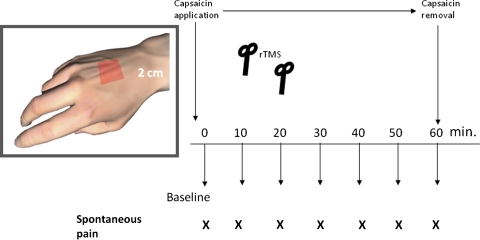
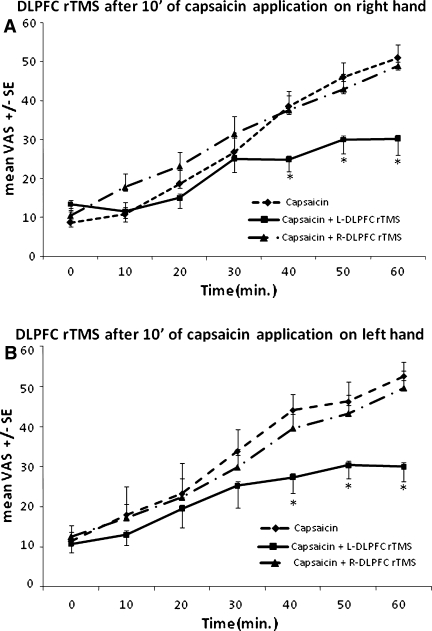
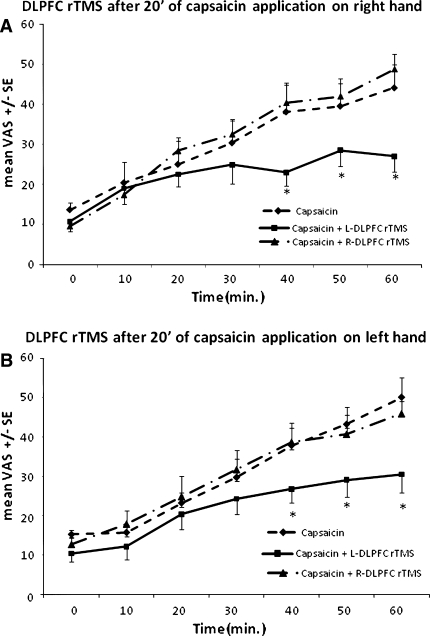
Evidence by functional imaging studies suggests the role of left dorsolateral prefrontal cortex (DLPFC) in the inhibitory control of nociceptive transmission system. Repetitive transcranial magnetic stimulation (rTMS) is able to modulate pain response to capsaicin. In the present study, we evaluated the effect of DLPFC activation (through rTMS) on nociceptive control in a model of capsaicin-induced pain. The study was performed on healthy subjects that underwent capsaicin application on right or left hand. Subjects judged the pain induced by capsaicin through a 0-100 VAS scale before and after 5 Hz rTMS over left and right DLPFC at 10 or 20 min after capsaicin application in two separate groups (8 subjects each). Left DLPFC-rTMS delivered either at 10 and 20 min after capsaicin application significantly decreased spontaneous pain in both hands. Right DLPFC rTMS showed no significant effect on pain measures. According to these results, stimulation of left DLPFC seems able to exert a bilateral control on pain system, supporting the critical antinociceptive role of such area. This could open new perspectives to non-invasive brain stimulation protocols of alternative target area for pain treatment.
Overview
The claims and statistics of this paper haven’t been checked yet.
Free: it reads the open-access text and checks the first 5 claims that cite a source we can check. Create a free account to check every claim.
Integrity signals
Registry
Cites
Statistics
Figures
Verification
Claims the paper makes
The claims and statistics of this paper haven’t been checked yet.
Free: it reads the open-access text and checks the first 5 claims that cite a source we can check. Create a free account to check every claim.
Claims other papers make about this one
Each is checked against this paper’s own text: does it say what the citing paper says it does?
In the citing paper
“In healthy participants, rTMS of the left DLPFC reduces spontaneous pain from capsaicin application13”
From The dorsolateral prefrontal cortex in acute and chronic pain (2017) · cites this paper as [13]
Self-check
Percentages, sums and reported differences re-computed from the paper’s own numbers.
The self-check needs the paper’s full text.
Citations
Cites
An Integrative Theory of Prefrontal Cortex Function
Miller, E. K., & Cohen, J. D. (2001) · Annual Review of Neuroscience · doi:10.1146/annurev.neuro.24.1.167 · Cited by 12,803 · cited 1×
“Indeed, DLPFC appears to be a potential candidate region to modulate the experience of pain given that it is a critical structure for working memory and attention functions [32, 33].”
BackgroundFuster, J. M. (1997) · Cited by 2,253
Placebo-Induced Changes in fMRI in the Anticipation and Experience of Pain
Wager, T. D., Rilling, J. K., Smith, E. E., Sokolik, A., Casey, K. L., Davidson, R. J., Kosslyn, S. M., Rose, R. M., & Cohen, J. D. (2004) · Science · doi:10.1126/science.1093065 · Cited by 1,992 · cited 1×
“In this regard, DNIC has also been shown to be modulable by cortical structures such as DLPFC, which is involved in pain control and in phenomena of pain expectation and placebo [36, 38, 39 ].”
BackgroundTranscranial magnetic stimulation in neurology
Kobayashi, M., & Pascual-Leone, A. (2003) · The Lancet Neurology · doi:10.1016/s1474-4422(03)00321-1 · Cited by 1,297
Pascual-Leone, A., Rubio, B., Pallardó, F., & Catalá, M. D. (1996) · The Lancet · doi:10.1016/s0140-6736(96)01219-6 · Cited by 1,229 · cited 2×
“According to Pascual Leone et al. [ 17 ], DLPFC was localized on the scalp 5-cm anterior to the hot spot for the contralateral abductor pollicis brevis (APB) muscle.”
BackgroundMethodDaily repetitive transcranial magnetic stimulation (rTMS) improves mood in depression
George, M. S., Wassermann, E. M., Williams, W. A., Callahan, A., Ketter, T. A., Basser, P., Hallett, M., & Post, R. M. (1995) · NeuroReport · doi:10.1097/00001756-199510020-00008 · Cited by 954 · cited 1×
“First indicated as a valid stimulation area for the treatment of depressive states [16, 17], recently the DLPFC has also been considered a potential target for nociceptive control [18].”
BackgroundKeeping pain out of mind: The role of the dorsolateral prefrontal cortex in pain modulation
Lorenz, J., Minoshima, S., & Casey, K. L. (2003) · Brain · doi:10.1093/brain/awg102 · Cited by 952 · cited 5×
“Nahmias et al. [25] were not able to induce DNIC activity, as they recorded no changes in RIII (a measure of DNIC activation); whereas cold pressor test [24] that give a more intense pain, and capsaicin that induce continuous painful stimulation, are more likely to activate DNIC [20, 37].”
BackgroundInfluentialEFNS guidelines on neurostimulation therapy for neuropathic pain
Cruccu, G., Aziz, T. Z., Garcia‐Larrea, L., Hansson, P., Jensen, T. S., Lefaucheur, J. ‐., Simpson, B. A., & Taylor, R. S. (2007) · European Journal of Neurology · doi:10.1111/j.1468-1331.2007.01916.x · Cited by 690 · cited 1×
“The great majority of TMS studies [7–10] focused on motor cortex and this site has been considered the optimal area for control of neuropathic pain also by the EFNS Guidelines on Neurostimulation Therapy [14].”
BackgroundChronic Motor Cortex Stimulation for the Treatment of Central Pain
Tsubokawa, T., Katayama, Y., Yamamoto, T., Hirayama, T., & Koyama, S. (1991) · Acta Neurochirurgica Supplementum · doi:10.1007/978-3-7091-9160-6_37 · Cited by 623 · cited 1×
“[1] reported efficacy of motor cortex stimulation (MCS) by dural implanted electrodes for treatment of chronic, central, drug-resistant neuropathic pain on 12 patients.”
BackgroundGarcía-Larrea, L., Peyron, R., Mertens, P., Gregoire, C. M., Lavenne, F., Le Bars, D., Convers, P., Mauguière, F., Sindou, M., & Laurent, B. (1999) · Pain · doi:10.1016/s0304-3959(99)00114-1 · Cited by 572 · cited 1×
“Since then, a consistent bulk of evidence showed this approach as being effective for pain control in several patients [2–4].”
BackgroundFregni, F., Gimenes, R., Valle, A. C., Ferreira, M. J. L., Rocha, R. R., Natalle, L., Bravo, R., Rigonatti, S. P., Freedman, S. D., Nitsche, M. A., et al. (2006) · Arthritis & Rheumatism · doi:10.1002/art.22195 · Cited by 568 · cited 1×
“cranial direct current stimulation (tDCS) in healthy subjects [28] and in patients with fibromyalgia [29].”
BackgroundNovel classes of responsive and unresponsive C nociceptors in human skin
Schmidt, R., Schmelz, M., Forster, C., Ringkamp, M., Torebjork, E., & Handwerker, H. (1995) · The Journal of Neuroscience · doi:10.1523/jneurosci.15-01-00333.1995 · Cited by 504
Baumann, T. K., Simone, D. A., Shain, C. N., & LaMotte, R. H. (1991) · Journal of Neurophysiology · doi:10.1152/jn.1991.66.1.212 · Cited by 455 · cited 1×
“On such grounds, the aim of our study was to explore the analgesic effect of DLPFC rTMS in healthy subjects, using a model of acute pain induced by topical application of capsaicin that is known to activate nociceptive primary afferent C-fibers with minimal contributions from other somatosensory modalities [30, 31].”
BackgroundDescending analgesia – When the spine echoes what the brain expects
Goffaux, P., Redmond, W. J., Rainville, P., & Marchand, S. (2007) · Pain · doi:10.1016/j.pain.2006.11.011 · Cited by 344 · cited 1×
“pain control and in phenomena of pain expectation and placebo [36, 38, 39].”
Kulkarni, B., Bentley, D. E., Elliott, R., Youell, P., Watson, A., Derbyshire, S. W. G., Frackowiak, R. S. J., Friston, K. J., & Jones, A. K. P. (2005) · European Journal of Neuroscience · doi:10.1111/j.1460-9568.2005.04098.x · Cited by 337 · cited 1×
“Neurosurgical observations and functional imaging studies have identified a matrix of structures in the brain ‘‘pain matrix’’ that responds to noxious stimuli in which authors identified a clear division of functions between sensory-discriminative and affective responses [15].”
BackgroundPrefrontal cortex modulates placebo analgesia
Krummenacher, P., Candia, V., Folkers, G., Schedlowski, M., & Schönbächler, G. (2010) · Pain · doi:10.1016/j.pain.2009.09.033 · Cited by 337 · cited 1×
“pain control and in phenomena of pain expectation and placebo [36, 38, 39].”
Pain relief induced by repetitive transcranial magnetic stimulation of precentral cortex
Lefaucheur, J.-P., Drouot, X., Keravel, Y., & Nguyen, J.-P. (2001) · Neuroreport · doi:10.1097/00001756-200109170-00041 · Cited by 319 · cited 3×
“The great majority of TMS studies [7–10] focused on motor cortex and this site has been considered the optimal area for control of neuropathic pain also by”
BackgroundRecent advances in the treatment of chronic pain with non-invasive brain stimulation techniques
Fregni, F., Freedman, S., & Pascual-Leone, A. (2007) · The Lancet Neurology · doi:10.1016/s1474-4422(07)70032-7 · Cited by 299
Boggio, P. S., Zaghi, S., Lopes, M., & Fregni, F. (2008) · European Journal of Neurology · doi:10.1111/j.1468-1331.2008.02270.x · Cited by 275 · cited 2×
“cranial direct current stimulation (tDCS) in healthy subjects [28] and in patients with fibromyalgia [29].”
BackgroundrTMS of the prefrontal cortex in the treatment of chronic migraine: A pilot study
Brighina, F., Piazza, A., Vitello, G., Aloisio, A., Palermo, A., Daniele, O., & Fierro, B. (2004) · Journal of the Neurological Sciences · doi:10.1016/j.jns.2004.08.008 · Cited by 269 · cited 1×
“Since then DLPFC rTMS has been found effective for the treatment of pain conditions such as chronic migraine [21] and fibromyalgia [22].”
BackgroundSelf-citationKatayama, Y., Fukaya, C., & Yamamoto, T. (1998) · Journal of Neurosurgery · doi:10.3171/jns.1998.89.4.0585 · Cited by 263 · cited 1×
“Since then, a consistent bulk of evidence showed this approach as being effective for pain control in several patients [2–4].”
BackgroundrTMS for Suppressing Neuropathic Pain: A Meta-Analysis
Leung, A., Donohue, M., Xu, R., Lee, R., Lefaucheur, J.-P., Khedr, E. M., Saitoh, Y., André-Obadia, N., Rollnik, J., Wallace, M., et al. (2009) · The Journal of Pain · doi:10.1016/j.jpain.2009.03.010 · Cited by 239 · cited 3×
“The great majority of TMS studies [7–10] focused on motor cortex and this site has been considered the optimal area for control of neuropathic pain also by”
BackgroundA unique representation of heat allodynia in the human brain
Lorenz, J., Cross, D. J., Minoshima, S., Morrow, T. J., Paulson, P. E., & Casey, K. L. (2002) · Neuron · doi:10.1016/s0896-6273(02)00767-5 · Cited by 233 · cited 1×
“Functional imaging studies [19, 20] showed that DLPFC activation is temporally related to amelioration of pain sensation in a model of acute pain induced by capsaicin.”
BackgroundHadjipavlou, G., Dunckley, P., Behrens, T. E., & Tracey, I. (2006) · Pain · doi:10.1016/j.pain.2006.02.027 · Cited by 204 · cited 1×
“Recently, this hypothesis received experimental support by MRI studies of neural connection with the technique of diffuse tensor imaging that revealed anatomical connections between prefrontal cortices and brainstem structures known for their role in pain modulation like periaqueductal gray and nucleus cuneiformis [34…”
ResultNguyen, J. P., Keravel, Y., Feve, A., Uchiyama, T., Cesaro, P., Guerinel, C., & Pollin, B. (1997) · Advances in Stereotactic and Functional Neurosurgery 12 · doi:10.1007/978-3-7091-6513-3_10 · Cited by 159 · cited 1×
“Since then, a consistent bulk of evidence showed this approach as being effective for pain control in several patients [2–4].”
BackgroundGraff-Guerrero, A., González-Olvera, J., Fresán, A., Gómez-Martín, D., Carlos Méndez-Núñez, J., & Pellicer, F. (2005) · Cognitive Brain Research · doi:10.1016/j.cogbrainres.2005.05.002 · Cited by 154 · cited 3×
“[24] compared the effect of DLPFC and M1 stimulation and found that differently from DLPFC, motor cor-”
BackgroundFierro, B., de Tommaso, M., Giglia, F., Giglia, G., Palermo, A., & Brighina, F. (2010) · Experimental Brain Research · doi:10.1007/s00221-010-2206-6 · Cited by 153 · cited 1×
“Moreover, as we showed in a recent paper, left DLPFC activation was also able to exert control over motor cortical excitability restoring intracortical inhibition that had been reduced by capsaicin application [35].”
BackgroundSelf-citationTranscranial Magnetic Coil Stimulation of Motor Cortex in Patients with Central Pain
Migita, K., Uozumi, T., Arita, K., & Monden, S. (1995) · Neurosurgery · doi:10.1097/00006123-199505000-00025 · Cited by 144
Transcranial Magnetic Coil Stimulation of Motor Cortex in Patients with Central Pain
Migita, K., Uozumi, T., Arita, K., & Monden, S. (1995) · Neurosurgery · doi:10.1227/00006123-199505000-00025 · Cited by 126 · cited 1×
“[6] that showed pain reduction in two patients treated by low-frequency (\0.”
BackgroundLeo, R. J., & Latif, T. (2007) · Journal of Pain · doi:10.1016/j.jpain.2007.01.009 · Cited by 125 · cited 3×
“The great majority of TMS studies [7–10] focused on motor cortex and this site has been considered the optimal area for control of neuropathic pain also by”
BackgroundNahmias, F., Debes, C., de Andrade, D. C., Mhalla, A., & Bouhassira, D. (2009) · Pain · doi:10.1016/j.pain.2009.09.016 · Cited by 125 · cited 5×
“[25] that found bilateral analgesic effects not only by DLPFC,”
BackgroundMethodInfluentialEffects of 1-Hz repetitive transcranial magnetic stimulation on acute pain induced by capsaicin
Tamura, Y., Okabe, S., Ohnishi, T., N. Saito, D., Arai, N., Mochio, S., Inoue, K., & Ugawa, Y. (2004) · Pain · doi:10.1016/j.pain.2003.10.011 · Cited by 116 · cited 4×
“[12] in a study that explored antinoceptive effect of rTMS on capsaicin-induced pain.”
BackgroundMethodInfluentialSlow-Frequency rTMS Reduces Fibromyalgia Pain: Table 1
Sampson, S. M., Rome, J. D., & Rummans, T. A. (2006) · Pain Medicine · doi:10.1111/j.1526-4637.2006.00106.x · Cited by 111 · cited 1×
“Since then DLPFC rTMS has been found effective for the treatment of pain conditions such as chronic migraine [21] and fibromyalgia [22].”
BackgroundEffects of 1-Hz repetitive transcranial magnetic stimulation on acute pain induced by capsaicin
田村, 洋. (2005) · Medical Entomology and Zoology · Cited by 106
Borckardt, J. J., Smith, A. R., Reeves, S. T., Weinstein, M., Kozel, F. A., Nahas, Z., Shelley, N., Branham, R. K., Thomas, K. J., & George, M. S. (2007) · Pain Research and Management · doi:10.1155/2007/741897 · Cited by 99 · cited 2×
“showed that antinociceptive ability of hf rTMS on this area in healthy subjects [23] and in patients Fig.”
BackgroundMethodSummers, J., Johnson, S., Pridmore, S., & Oberoi, G. (2004) · Neuroscience Letters · doi:10.1016/j.neulet.2004.07.008 · Cited by 94 · cited 2×
“The majority of the reports on modulation of pain neural network have principally targeted motor cortex [7–13].”
BackgroundBorckardt, J. J., Weinstein, M., Reeves, S. T., Kozel, F. A., Nahas, Z., Smith, A. R., Byrne, T. K., Morgan, K., & George, M. S. (2006) · Anesthesiology · doi:10.1097/00000542-200609000-00020 · Cited by 92 · cited 2×
“with post-operative [ 26 ] and neuropathic pain [27].”
BackgroundResultA Pilot Study Investigating the Effects of Fast Left Prefrontal rTMS on Chronic Neuropathic Pain
Borckardt, J. J., Smith, A. R., Reeves, S. T., Madan, A., Shelley, N., Branham, R., Nahas, Z., & George, M. S. (2009) · Pain Medicine · doi:10.1111/j.1526-4637.2009.00657.x · Cited by 89 · cited 2×
“with post-operative [26] and neuropathic pain [27].”
ResultCapsaicin-induced central facilitation of a nociceptive flexion reflex in humans
Grönroos, M., & Pertovaara, A. (1993) · Neuroscience Letters · doi:10.1016/0304-3940(93)90837-b · Cited by 87 · cited 4×
“Other important methodological aspects that could affect the response to rTMS could concern the intensity and duration of pain stimulation and its ability to activate the descending nociceptive inhibitory control system (DNIC).”
BackgroundInfluentialFacilitation of Aδ-fiber-mediated acute pain by repetitive transcranial magnetic stimulation
Tamura, Y., Hoshiyama, M., Inui, K., Nakata, H., Qiu, Y., Ugawa, Y., Inoue, K., & Kakigi, R. (2004) · Neurology · doi:10.1212/01.wnl.0000130081.96533.85 · Cited by 65
O'Reardon, J. P., Fontecha, J. F., Cristancho, M. A., & Newman, S. (2007) · CNS Spectrums · doi:10.1017/s1092852900015716 · Cited by 40
RTMS in neuropathic pain management-a meta-analysis
Leung, A., Lefaucheur, J. P., Rollnik, J. D., et al. (2009) · Journal of Pain · doi:10.1016/j.jpain.2009.01.161 · Cited by 7
Cited by
Role of the Prefrontal Cortex in Pain Processing
Ong, W.-Y., Stohler, C. S., & Herr, D. R. (2019) · Molecular Neurobiology · doi:10.1007/s12035-018-1130-9 · Cited by 766
The dorsolateral prefrontal cortex in acute and chronic pain
Seminowicz, D. A., & Moayedi, M. (2017) · The Journal of Pain · doi:10.1016/j.jpain.2017.03.008 · Cited by 502
Frangos, E., & Komisaruk, B. R. (2017) · Brain Stimulation · doi:10.1016/j.brs.2016.10.008 · Cited by 205
“Analgesic effects other than headache attenuation may occur in response to nVNS-evoked activation of the dorsolateral prefrontal cortex, as this region is implicated in antinociceptive responses against experimental and chronic pain [41,42].”
BackgroundFrom pulses to pain relief: an update on the mechanisms of rTMS‐induced analgesic effects
Moisset, X., de Andrade, D. C., & Bouhassira, D. (2016) · European Journal of Pain · doi:10.1002/ejp.811 · Cited by 169
“In addition, studies in healthy volunteers (Nahmias et al., 2009; Fierro et al., 2010; de Andrade et al., 2011; Brighina et al., 2011; Taylor et al., 2012, 2013; Ciampi de Andrade et al., 2014) and in patients with acute (Borckardt et al., 2006, 2014) or chronic pain (Borckardt et al., 2009; Short…”
BackgroundSelf‐other resonance, its control and prosocial inclinations: Brain–behavior relationships
Christov‐Moore, L., & Iacoboni, M. (2016) · Human Brain Mapping · doi:10.1002/hbm.23119 · Cited by 142
Metadata
- Authors
- Brighina, F., De Tommaso, M., Giglia, F., Scalia, S., Cosentino, G., Puma, A., Panetta, M., Giglia, G., & Fierro, B.
- Affiliations
- University of Palermo (IT)
- Corresponding author
- Fierro, Brigida
- Venue
- The Journal of Headache and Pain
- Published
- 2011-02-25
- Volume
- 12
- Issue
- 2
- Pages
- 185-191
- ISSN
- 1129-2369 (ISSN-L)
- 1129-2377
- PMC
- PMC3072504
- OpenAlex
- W2077891011
- Cited by
- 115
- References
- 41
- Citations by year
- 2026: 6 · 2025: 5 · 2024: 6 · 2023: 9 · 2022: 16 · 2021: 5 · 2020: 8 · 2019: 8 · 2018: 12 · 2017: 7 · 2016: 12 · 2015: 6 · 2014: 3 · 2013: 5 · 2012: 6
- FWCI
- 2.48
- Type
- journal article
- Language
- en
- Open access
- gold
- doi.org
- Locations
- The Journal of Headache and Pain (publishedVersion, cc-by)
- Europe PMC (PubMed Central) (publishedVersion, cc-by)
- PubMed Central (publishedVersion, cc-by)
- PubMed (publishedVersion)
- Nova Science Publishers (Nova Science Publishers, Inc.) (submittedVersion, other-oa)
- Topics
- Life Sciences › Neuroscience › Neurology › Transcranial Magnetic Stimulation Studies
- Health Sciences › Medicine › Physiology (medical) › Pain Mechanisms and Treatments
- Health Sciences › Medicine › Anesthesiology and Pain Medicine › Pain Management and Treatment
- Keywords
- pain perception, left dorsolateral prefrontal cortex, repetitive transcranial magnetic stimulation, capsaicin-induced pain, antinociception, spontaneous pain, non-invasive brain stimulation, pain management
- MeSH terms
- Adult, Capsaicin, Female, Humans, Functional Laterality, Male, Middle Aged, Neural Inhibition, Pain, Pain Measurement, Prefrontal Cortex, Transcranial Magnetic Stimulation, Pain Management
About these checks
Registry, retraction, Cites and statistics results are computed, not judged, with one exception: a printed reference that no index lists is read once by a model before it counts as a citation error. Claims are extracted by a model and kept only when their quote appears verbatim in the text; each cited source is then checked, with a model’s help, for whether it says what the claim relies on. Those verdicts can be wrong — read the claim’s quote and the cited source before relying on one.
Statistics and arithmetic are recomputed, not judged.
Confidence bands are shown only for fields calibrated on our annotated test set. None is calibrated yet, so no band is shown.
What counts as a claim ›How we measure confidence ›How we check this ›
Are you an author, or do you see a problem with this page? Request a review
Data sources
Bibliographic data: Semantic Scholar, OpenAlex, Crossref.
Contains information from the Semantic Scholar Academic Graph Datasets, made available under the ODC Attribution License (ODC-BY 1.0).
Semantic Scholar’s data is described in: Kinney, R., et al. (2023). The Semantic Scholar Open Data Platform. arXiv:2301.10140.
