

The DOI matches its Crossref record; 30 of the 30 references it cites were found in a registry or an index.
Clinical outcome of a headache-specific multidisciplinary treatment program and adherence to treatment recommendations in a tertiary headache center: an observational study
Open accessAbstract
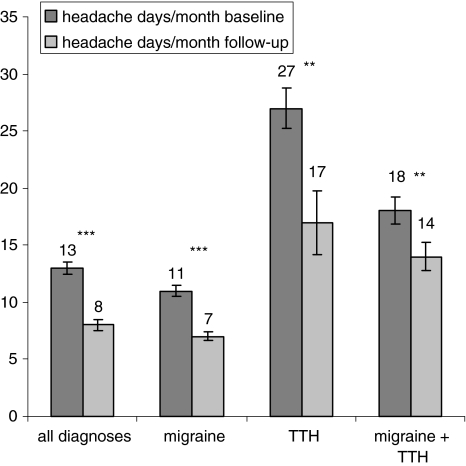
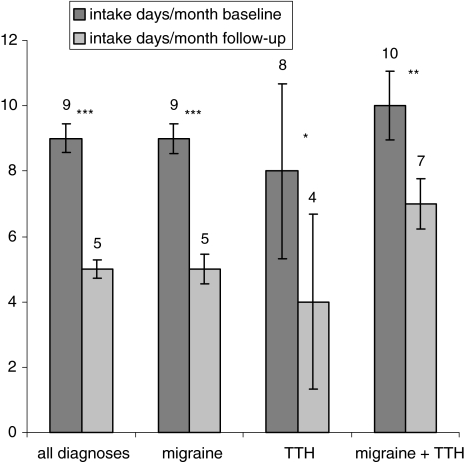
This study investigated the outcome of a 5-day headache-specific multidisciplinary treatment program (MTP) and the adherence to treatment recommendations in 295 prospectively recruited consecutive headache patients [210 migraine, 17 tension-type headache (TTH), 68 combination headache, including 56 medication-overuse headache (MOH)]. Headache frequency decreased from 13.4 (±8.8) to 8.8 (±8.0) days per month after 12-18 months. Forty-three percent of the participants fulfilled the primary outcome (reduction of headache frequency of ≥50%), which was less likely in patients with combination of migraine and TTH compared to migraine (OR = 3.136, p = 0.002) or TTH (OR = 1.029, n.s.). Increasing number of headache days per month (OR = 1.092, p ≤ 0.0001) and adherence to lifestyle modifications (OR = 1.269, p = 0.004) predicted primary outcome. 51 of 56 MOH patients were treated successfully. Thirty-five percent of the patients were adherent to pharmacological prophylaxis, 61% to relaxation therapy, and 72% to aerobic endurance sports. MTP is effective in headache treatment. Adherence to therapy was associated with better outcome.
Overview
The claims and statistics of this paper haven’t been checked yet.
Run the check — free, no account needed. It reads the open-access text and checks the sources it cites.
Integrity signals
Registry
Cites
Statistics
Figures
Verification
Claims the paper makes
The claims and statistics of this paper haven’t been checked yet.
Run the check — free, no account needed. It reads the open-access text and checks the sources it cites.
Claims other papers make about this one
Each is checked against this paper’s own text: does it say what the citing paper says it does?
The source backs part of the claim, not all of it — or backs it for a different population, condition or comparison.
In the citing paper
“A person-centered approach that integrates various intervention components is more effective [28,29] and may enhance personal control and efficacy in headache management [14].”
From Development and Evaluation of a Smartphone-Based Chatbot Coach to Facilitate a Balanced Lifestyle in Individuals With Headaches (BalanceUP App): Randomized Controlled Trial (2024) · cites this paper as [28]
Experimental — accuracy not yet measured
Self-check
Percentages, sums and reported differences re-computed from the paper’s own numbers.
The self-check needs the paper’s full text.
Citations
Cites
The International Classification of Headache Disorders: 2nd edition
Olesen, J., Goadsby, P. J., & Steiner, T. (2003) · The Lancet Neurology · doi:10.1016/s1474-4422(03)00590-8 · Cited by 5,046
The global burden of headache: A documentation of headache prevalence and disability worldwide
Stovner, L., Hagen, K., Jensen, R., Katsarava, Z., Lipton, R., Scher, A., Steiner, T., & Zwart, J.-A. (2007) · Cephalalgia · doi:10.1111/j.1468-2982.2007.01288.x · Cited by 2,444 · cited 1×
“Primary headaches, in particular migraine and tensiontype headache (TTH) cause severe burden of disease and create high costs in the health care system [1, 2].”
BackgroundSelf-citationOlesen, J. (2004) · Cephalalgia · doi:10.1111/j.1468-2982.2003.00824.x · Cited by 2,056
Interventions for enhancing medication adherence
Haynes, R. B., Ackloo, E., Sahota, N., McDonald, H. P., & Yao, X. (2008) · Cochrane Database of Systematic Reviews · doi:10.1002/14651858.cd000011.pub3 · Cited by 1,244 · cited 1×
“Increasing the effectiveness of adherence might have more substantial impact on clinical outcome than improvement in specific medical treatments [27].”
Guidelines for Controlled Trials of Prophylactic Treatment of Chronic Migraine in Adults
Silberstein, S. D., Tfelt‐Hansen, P. C., Dodick, D., Limmroth, V., Lipton, R. B., Pascual, J., & Wang, S. J. (2008) · Cephalalgia · doi:10.1111/j.1468-2982.2008.01555.x · Cited by 303
Bigal, M., Rapoport, A., Sheftell, F., Tepper, S., & Lipton, R. (2004) · Cephalalgia · doi:10.1111/j.1468-2982.2004.00691.x · Cited by 275 · cited 1×
“Overuse of acute medication is responsible for the development or maintenance of chronic daily headache (CDH) and successful detoxification results in a 70% return to an episodic pattern of migraine [19].”
BackgroundClinical features, pathophysiology, and treatment of medication-overuse headache
Evers, S., & Marziniak, M. (2010) · The Lancet Neurology · doi:10.1016/s1474-4422(10)70008-9 · Cited by 233 · cited 2×
“Longitudinal studies in academic headache clinics reported relapse rates from 30 to 41% 1 year after initial outpatient withdrawal treatment in MOH [5–8].”
BackgroundMedication Overuse Headache: Rates and Predictors for Relapse in a 4-year Prospective Study
Katsarava, Z., Muessig, M., Dzagnidze, A., Fritsche, G., Diener, H., & Limmroth, V. (2004) · Cephalalgia · doi:10.1111/j.1468-2982.2004.00789.x · Cited by 226 · cited 2×
“Longitudinal studies in academic headache clinics reported relapse rates from 30 to 41% 1 year after initial outpatient withdrawal treatment in MOH [5–8].”
BackgroundSelf-citationHolroyd, K. A., & Penzien, D. B. (1990) · Pain · doi:10.1016/0304-3959(90)91085-w · Cited by 223
Behavioral Management of Recurrent Headache: Three Decades of Experience and Empiricism
Penzien, D. B., Rains, J. C., & Andrasik, F. (2002) · Applied Psychophysiology and Biofeedback · doi:10.1023/a:1016247811416 · Cited by 162 · cited 1×
“The prophylactic effect of relaxation training in headache treatment is already proven in several studies [21–23].”
Result
Cited by
Sorted by citations
Items 101–155 of 155
Grazzi, L., Prunesti, A., & Bussone, G. (2015) · Neurological Sciences · doi:10.1007/s10072-015-2177-2 · Cited by 4
Deutsche Migräne- und Kopfschmerzgesellschaft e., V., Marziniak, M., Malzacher, V., Förderreuther, S., Jürgens, T. P., Kropp, P. A., May, A., & Straube, A. M. (2014) · Der Schmerz · doi:10.1007/s00482-014-1417-3 · Cited by 4
Integrated headache care at the outpatient headache center of the University Hospital of Munich
Rohling, S., Funk, A., Ruscheweyh, R., Schankin, C. J., Straube, A. M., & Kamm, K. (2018) · Clinical and Translational Neuroscience · doi:10.1177/2514183x18786844 · Cited by 4
“These results demonstrate that our multimodal and multidisciplinary approach is efficient for headache patients similar to the outcome of other German integrated headache care programs.(22,38,39)”
Ormond, A., Faux, B. M., Zickefoose, B. A., Aden, J. K., Kapunan, P. E., & Roberts, T. A. (2018) · Headache The Journal of Head and Face Pain · doi:10.1111/head.13274 · Cited by 3
“Another study found that adherence to prescribed lifestyle modifications was the only positive predictor of good outcome in adult patients with chronic primary headache.(12) Despite the importance of these nonpharmacologic interventions, many providers have difficulty implementing these interventions during a busy cli…”
BackgroundMedication-Overuse Headache (MOH)
Katsarava, Z. (2015) · Headache · doi:10.1007/978-3-319-19911-5_19 · Cited by 3
Self-citationFaizi, F., Tavallaee, A., Rahimi, A., & Saghafinia, M. (2017) · PubMed Central · Cited by 3
Patients’ expectations and experiences of physiotherapy management of migraine
Kelley, S., Treleaven, J. M., Thomas, L. C., & Liang, Z. (2025) · Musculoskeletal Science and Practice · doi:10.1016/j.msksp.2025.103418 · Cited by 2
Machado, L., Fiedler, L. S., Costa, Y. M., Bonjardim, L. R., & Paulo, P. (2020) · Journal of Oral & Facial Pain and Headache · doi:10.11607/ofph.2559 · Cited by 4
“19 Therefore, three groups were established based on the IPAQ criteria according to level of activity in the last 3 months: (1) low-level activity group (less than 30 minutes of physical activity per day less than 2 days per week, except for walking at a normal speed) (G1); (2) moderate-level activity group (at least…”
MethodMultidisciplinary team approach to headache care
Jensen, R., & Rasmussen, A. (2012) · Clinical Practice · doi:10.2217/cpr.11.136 · Cited by 2
Tension-type headache – most prevalent, still unknown
Sobieski, M., & Korzeniewska, A. (2019) · World Scientific News · Cited by 2
Fritsche, G., & Gaul, C. (2017) · Schmerzpsychotherapie · doi:10.1007/978-3-662-50512-0_25 · Cited by 1
Self-citation[Tension type headaches : Quo vadis?]
Straube, A. M., Förderreuther, S., & Eren, O. E. (2020) · PubMed · doi:10.1007/s00482-020-00495-5 · Cited by 1
Lysk, S., Pach, D., Tissen‐Diabaté, T., Scholler, S., & Witt, C. M. (2025) · Headache The Journal of Head and Face Pain · doi:10.1111/head.70009 · Cited by 1
Pharmacologic Treatment for Migraine Prevention in Adults Practice Guideline Recommendations
Potrebic, S., Tanveer, S., Becker, W. J., Burch, R., Cooke, L., Fenton, T., Fletcher, J. J., Perue, G. G., Hershey, A. D., Jackson, J. L., et al. (2026) · Headache The Journal of Head and Face Pain · doi:10.1111/head.70199 · Cited by 1
Fájdalomcsillapító-túlhasználathoz társuló fejfájás
Magyar, M., Hajnal, B., Gyüre, T., & Ertsey, C. (2015) · Orvosi Hetilap · doi:10.1556/650.2015.30209 · Cited by 1
Specialty Payment Model Opportunities and Design
McClellan, M., Patel, K., Botts, C., Presser, E., Grimes, C., Crim, C., & Tobin, J. (2014) · Cited by 1
Integrierte Versorgung Kopfschmerz
Diener, H., Gaul, C., Göbel, H., Holle, D., Liesering‐Latta, E., Nägel, S., Schäfer, B., Sorgenfrei, V., Storch, P., Straube, A., et al. (2017) · Aktuelle Neurologie · doi:10.1055/s-0043-107775 · Cited by 1
“Insgesamt war für alle nicht-medikamentösen Maßnahmen die Compliance deutlich höher als für die medikamentöse Therapie [25].”
BackgroundSelf-citationBritton, C. B. (2013) · Cambridge University Press eBooks · doi:10.1017/cbo9781139206952.007 · Cited by 1
Diagnose und Therapie des Kopfschmerzes vom Spannungstyp
Straube, A. (2014) · Bundesgesundheitsblatt - Gesundheitsforschung - Gesundheitsschutz · doi:10.1007/s00103-014-2001-9 · Cited by 1
“Entspannungsmaßnahmen), aber auch Ausdauersport vorsehen, wirken effektiver als einzelne Behandlungsverfahren und sollten deshalb primär eingesetzt werden [37].”
BackgroundThe Effect of Bariatric Surgery on Migraine Headache in Morbid Obese Patients
Hatami, M., & Farsani, G. M. (2017) · Journal of Minimally Invasive Surgical Sciences · doi:10.5812/minsurgery.57116 · Cited by 1
Rehabilitation strategies and neurological consequences in patients with COVID-19: part I
Cetisli-Korkmaz, N., Bilek, F., Akman, T. C., Baskan, E., Keser, İ., Hüzmeli, E. D., Duray, M., Aras, B., & Kılınç, B. (2021) · Physical Therapy Reviews · doi:10.1080/10833196.2021.1908729 · Cited by 1
“might be put into practice with headache rehabilitation [51,52].”
BackgroundCowan, R. P. (2013) · Cambridge University Press eBooks · doi:10.1017/cbo9781139206952.010
Life-course-Betrachtung der häufigsten Kopfschmerzformen
Förderreuther, S. (2014) · Bundesgesundheitsblatt - Gesundheitsforschung - Gesundheitsschutz · doi:10.1007/s00103-014-1995-3
Pathophysiologie und Therapie der chronischen Migräne
Eren, O. E., & Straube, A. (2014) · NeuroTransmitter · doi:10.1007/s15016-014-0568-x
Kopfschmerztherapie – Schmerztherapie
Förderreuther, S., & Straube, A. (2014) · Der Schmerz · doi:10.1007/s00482-014-1418-2
Fallstricke in der Kopfschmerztherapie vermeiden
Butz, M., & Böger, A. (2016) · MMW - Fortschritte der Medizin · doi:10.1007/s15006-016-8727-6
Augenschmerzen aus neurologischer Sicht
Essen, N. U. (2011)
Kopfschmerz bei Medikamentenübergebrauch
Katsarava, Z., & Nägel, S. (2018) · Nervenheilkunde · doi:10.1055/s-0038-1631175
Self-citationPhysiotherapeutic interventions in patients with migraines
Piejko, L. (2017) · Physiotherapy and Health Activity · doi:10.1515/pha-2017-0004
Monitoring of Chronic Daily Headaches
Hooshmand, S., & Schloemer, F. C. (2018) · Springer eBooks · doi:10.1007/978-3-319-91491-6_13
Influência do nível de atividade física no perfil somatossensorial mecânico orofacial
Machado, L. A. (2018) · Digital Library of Theses and Dissertations (Universidade de São Paulo) · doi:10.11606/d.25.2018.tde-01102018-174257
Fritsche, G., & Gaul, C. (2016) · Elsevier eBooks · doi:10.1016/b978-3-437-21833-0.00071-1
Self-citationKopfschmerzen durch Übergebrauch von Schmerz- und Migränemitteln
Diener, H., Gaul, C., Holle, D., & Katsarava, Z. (2021) · Schmerzmedizin · doi:10.1007/s00940-020-3020-2
“Durch die korrekte Einnahme der Akutmedikation und einen rechtzeitigen Beginn einer nicht medikamentösen und medikamentenösen Prophylaxe kann das Chronifizierungsrisiko wahrscheinlich reduziert werden.”
BackgroundInfluentialSelf-citationKopfschmerzen durch Übergebrauch von Schmerz- und Migränemitteln
Diener, H., Gaul, C., Holle, D., & Katsarava, Z. (2020) · InFo Neurologie + Psychiatrie · doi:10.1007/s15005-020-1410-6
“Durch die korrekte Einnahme der Akutmedikation und einen rechtzeitigen Beginn einer nicht medikamentösen und medikamentenösen Prophylaxe kann das Chronifizierungsrisiko wahrscheinlich reduziert werden.”
BackgroundInfluentialSelf-citationMcClellan, M., Patel, K., O'Shea, J. S., Botts, C., Presser, E., Grimes, C., Crim, C., & Tobin, J. (2014)
Kopfschmerz vom Spannungstyp – Diagnostik und Therapie
Neeb, L., & Laumeier, I. (2021) · Neurologie up2date · doi:10.1055/a-1163-6595
Weniger Schmerz durch gute Funktion – „functional restoration“
Nagel, B. (2022) · Manuelle Medizin · doi:10.1007/s00337-022-00864-4
(2016) · Elsevier eBooks · doi:10.1016/b978-3-437-21833-0.16001-2
Denk, A., Gaul, C., Neeb, L., & Wieser, T. (2023) · Elsevier eBooks · doi:10.1016/b978-3-437-23642-6.00004-8
Self-citationComplex Psychological Comorbidity and Chronic Pain
Schweizerhof, M. (2023) · Science International Empirical Review · doi:10.52514/sier.v2i1.37
Profitieren Schmerztherapiepatienten von ihren Mitpatienten?
Lindenberg, N., Bundscherer, A., Wiese, C. H. R., & Lassen, C. L. (2023) · Der Schmerz · doi:10.1007/s00482-023-00774-x
(2025) · Elsevier eBooks · doi:10.1016/b978-3-437-21835-4.00116-5
Migrenli Adölesanlarda Anksiyete, Uyku Kalitesi ve Yaşam Kalitesinin İncelenmesi: Kontrollü Çalışma
Korkmaz, N., Arslan, E. A., Erden, A., & Coşkun, G. (2025) · Hacettepe Üniversitesi Sağlık Bilimleri Fakültesi Dergisi · doi:10.21020/husbfd.1571269
Sobe, H., Richter, M., Berner, R., von der Hagen, M., Hähner, A., Röder, I., Koch, T., Sabatowski, R., Klimova, A., & Goßrau, G. (2022) · Figshare · doi:10.6084/m9.figshare.20652251
Donath, C., Luttenberger, K., Geiß, C., Albert, P., & Fraunberger, B. (2022) · Figshare · doi:10.6084/m9.figshare.19635103
La Touche, R., Fierro‐Marrero, J., Sánchez-Ruíz, I., de Rivera-Romero, B. R., Cabrera-López, C. D., Lara, S. L., Requejo-Salinas, N., de Asís-Fernández, F., Elizagaray-García, I., Fernández-Carnero, J., et al. (2024) · Figshare · doi:10.6084/m9.figshare.26595110
Bartsch, L., Fiebig, N., Klötzer, C., Strauß, S., Reuter, U., & Fleischmann, R. (2026) · Scientific Reports · doi:10.1038/s41598-026-47295-y
Atypical Cause of Headache: A Potential Diagnostic Pitfall in Acute Medicine
Karumannan, V., Nauman, K., & Zachariah, S. (2026) · Cureus · doi:10.7759/cureus.108412
Ruiz-Castrillo, M. J., Portocarrero-Sánchez, L., Zaballa-Pérez, L., Sánchez-Huertas, A., & de Terán, J. D. (2026) · Nursing Reports · doi:10.3390/nursrep16100359
“As migraine has come to be understood as a multidimensional condition, dedicated multidisciplinary headache units have grown up around it, and specialist nurses have taken on a steadily larger role within them [19–21].”
Trenz, M. E., Addanki, R. N. D., Raad, J. H., Kaniecki, R. G., Hanmer, J., Jhamb, M., Kerr, W. T., & Thirumala, P. D. (2026) · Headache The Journal of Head and Face Pain · doi:10.1111/head.70220
Metadata
- Authors
- Gaul, C., van Doorn, C., Webering, N., Dlugaj, M., Katsarava, Z., Diener, H.-C., & Fritsche, G.
- Affiliations
- Essen University Hospital (DE)
- Corresponding author
- Gaul, Charly
- Venue
- The Journal of Headache and Pain
- Published
- 2011-05-05
- Volume
- 12
- Issue
- 4
- Pages
- 475-483
- ISSN
- 1129-2369 (ISSN-L)
- 1129-2377
- PMC
- PMC3139052
- OpenAlex
- W2017444456
- Cited by
- 156
- References
- 30
- Citations by year
- 2026: 6 · 2025: 5 · 2024: 8 · 2023: 10 · 2022: 14 · 2021: 7 · 2020: 8 · 2019: 13 · 2018: 13 · 2017: 12 · 2016: 6 · 2015: 13 · 2014: 17 · 2013: 8 · 2012: 10
- FWCI
- 8.97
- Type
- journal article
- Language
- en
- Open access
- gold
- doi.org
- Locations
- The Journal of Headache and Pain (publishedVersion, cc-by)
- Europe PMC (PubMed Central) (publishedVersion, cc-by)
- PubMed Central (publishedVersion, cc-by)
- PubMed (publishedVersion)
- Topics
- Health Sciences › Medicine › Clinical Neurology › Migraine and Headache Studies
- Health Sciences › Dentistry › Oral Surgery › Temporomandibular Joint Disorders
- Health Sciences › Health Professions › Physical Therapy, Sports Therapy and Rehabilitation › Musculoskeletal pain and rehabilitation
- Keywords
- migraine, tension-type headache, medication overuse headache, medication adherence, headache frequency, lifestyle modification, pharmacological prophylaxis, relaxation training, headache centers
- MeSH terms
- Adolescent, Adult, Aged, Exercise Therapy, Female, Headache, Humans, Male, Middle Aged, Patient Compliance, Relaxation Therapy, Treatment Outcome, Pain Clinics, Young Adult
About these checks
Registry, retraction, Cites and statistics results are computed, not judged, with one exception: a printed reference that no index lists is read once by a model before it counts as a citation error. Claims are extracted by a model and kept only when their quote appears verbatim in the text; each cited source is then checked, with a model’s help, for whether it says what the claim relies on. Those verdicts can be wrong — read the claim’s quote and the cited source before relying on one.
Statistics and arithmetic are recomputed, not judged.
Confidence bands are shown only for fields calibrated on our annotated test set. None is calibrated yet, so no band is shown.
What counts as a claim ›How we measure confidence ›How we check this ›
Are you an author, or do you see a problem with this page? Request a review
