

AI-driven multi-omics integration in precision oncology: bridging the data deluge to clinical decisions
Open accessThe DOI matches its Crossref record; 75 of the 76 references it cites were found in a registry or an index.
Abstract
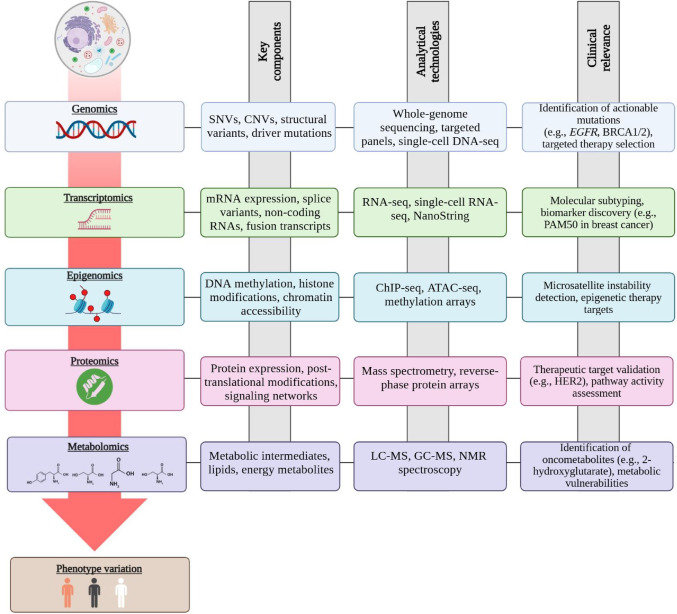
Cancer's staggering molecular heterogeneity demands innovative approaches beyond traditional single-omics methods. The integration of multi-omics data, spanning genomics, transcriptomics, proteomics, metabolomics and radiomics, can improve diagnostic and prognostic accuracy when accompanied by rigorous preprocessing and external validation; for example, recent integrated classifiers report AUCs around 0.81-0.87 for difficult early-detection tasks. This review synthesizes how artificial intelligence (AI), particularly deep learning and machine learning, bridges this gap by enabling scalable, non-linear integration of disparate omics layers into clinically actionable insights. We explore cutting-edge AI methodologies, including graph neural networks for biological network modeling, transformers for cross-modal fusion, and explainable AI (XAI) for transparent clinical decision support. Critical applications are highlighted, such as AI-driven therapy selection (e.g., predicting targeted therapy resistance), proteogenomic early detection, and radiogenomic non-invasive diagnostics. We further address translational challenges: data harmonization, batch correction, missing data imputation, and computational scalability. Emerging trends, federated learning for privacy-preserving collaboration, spatial/single-cell omics for microenvironment decoding, quantum computing, and patient-centric "N-of-1" models, signal a paradigm shift toward dynamic, personalized cancer management. Despite persistent hurdles in model generalizability, ethical equity, and regulatory alignment, AI-powered multi-omics integration promises to transform precision oncology from reactive population-based approaches to proactive, individualized care.
Overview
The claims and statistics of this paper haven’t been checked yet.
Free: it reads the open-access text and checks the first 5 claims that cite a source we can check. Create a free account to check every claim.
Integrity signals
Registry
Cites
Statistics
Figures
Verification
Claims the paper makes
The claims and statistics of this paper haven’t been checked yet.
Free: it reads the open-access text and checks the first 5 claims that cite a source we can check. Create a free account to check every claim.
Claims other papers make about this one
Each is checked against this paper’s own text: does it say what the citing paper says it does?
The source backs part of the claim, not all of it — or backs it for a different population, condition or comparison.
In the citing paper
“Integrated multi-omics classifiers consistently outperform single-modality models, with recent analyses reporting AUCs of 0.81–0.87 for early cancer detection using cross-omics feature integration”
From A generative AI multi-agent framework with integrated XAI governance for cancer diagnostics: from multi-omics interpretation to lifestyle risk stratification (2026) · cites this paper as Hsu et al., 2026
Experimental — accuracy not yet measuredThe source backs part of the claim, not all of it — or backs it for a different population, condition or comparison.
In the citing paper
“The Cancer Genome Atlas provides the most accessible resource for MO-XAI Agent validation, with comprehensive genomic and transcriptomic data for 33 cancer types linked to clinical outcomes (Hsu et al., 2026).”
From A generative AI multi-agent framework with integrated XAI governance for cancer diagnostics: from multi-omics interpretation to lifestyle risk stratification (2026) · cites this paper as Hsu et al., 2026
Experimental — accuracy not yet measured
Self-check
Percentages, sums and reported differences re-computed from the paper’s own numbers.
The self-check needs the paper’s full text.
Citations
Cites
The FAIR Guiding Principles for scientific data management and stewardship
Wilkinson, M. D., Dumontier, M., Aalbersberg, I. J., Appleton, G., Axton, M., Baak, A., Blomberg, N., Boiten, J.-W., da Silva Santos, L. B., Bourne, P. E., et al. (2016) · Scientific Data · doi:10.1038/sdata.2016.18 · Cited by 18,423 · cited 2×
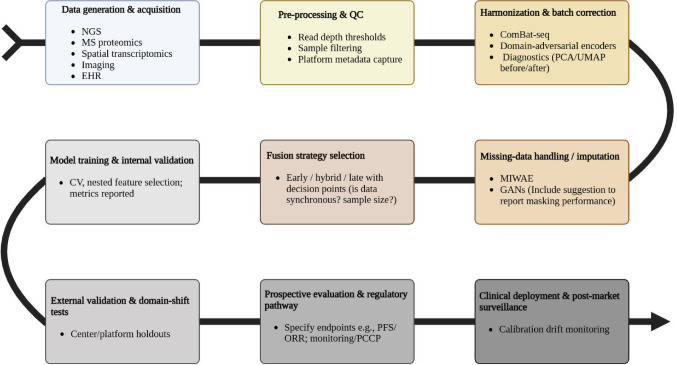
“…directly affect whether AI-multiomics systems reach patients: (a) Interoperability & provenance: Use machine-readable metadata and standard schemas (FAIR; HL7 FHIR Genomics profiles) plus immu - table provenance logs so that data lineage and pre-analytical differences are auditable [ 61 , 62 ].”
Adjusting batch effects in microarray expression data using empirical Bayes methods
Johnson, W. E., Li, C., & Rabinovic, A. (2007) · Biostatistics · doi:10.1093/biostatistics/kxj037 · Cited by 8,658 · cited 1×
“…(e.g., proteomics vs. tran - scriptomics, spatial vs. bulk), consider domain-adversarial encoders or conditional VAEs for domain-invariant repre - sentation learning, but also quantify residual batch signal (e.g., silhouette score by batch, variance explained by batch pre/post) [ 47 , 48].”
ComBat-seq: batch effect adjustment for RNA-seq count data
Zhang, Y., Parmigiani, G., & Johnson, W. E. (2020) · NAR Genomics and Bioinformatics · doi:10.1093/nargab/lqaa078 · Cited by 1,566 · cited 1×
“…(e.g., proteomics vs. tran - scriptomics, spatial vs. bulk), consider domain-adversarial encoders or conditional VAEs for domain-invariant repre - sentation learning, but also quantify residual batch signal (e.g., silhouette score by batch, variance explained by batch pre/post) [ 47 , 48].”
Deep learning-based multi-omics integration robustly predicts survival in liver cancer
Chaudhary, K., Poirion, O. B., Lu, L., & Garmire, L. X. (2018) · Clinical Cancer Research · doi:10.1158/1078-0432.ccr-17-0853 · Cited by 1,091 · cited 1×
“…and provide candidate biomarkers, but they do not by themselves prove clinical utility, prospective interventional testing is still required [ 52]. steps, the federated model update schedule, and privacy-preserving mechanisms (e.g., differential privacy budget, homomorphic encryption)…”
Marrero, J. A., Feng, Z., Wang, Y., Nguyen, M. H., Befeler, A. S., Roberts, L. R., Reddy, K. R., Harnois, D., Llovet, J. M., Normolle, D., et al. (2009) · Gastroenterology · doi:10.1053/j.gastro.2009.04.005 · Cited by 745 · cited 2×
“Recent HCC reviews and meta-analyses highlight the het - erogeneity of treatment response and the need for immune-aware stratification when selecting second-line therapies [ 51].”
Wang, T., Shao, W., Huang, Z., Tang, H., Zhang, J., Ding, Z., & Huang, K. (2021) · Nature Communications · doi:10.1038/s41467-021-23774-w · Cited by 671 · cited 3×
“…cohort studies, models like moGAT use atten - tion mechanisms to weight features from genomic, epig - enomic, and transcriptomic graphs, achieving an AUC of 0.92 in classifying cancer subtypes by effectively capturing the topological dependencies between molecular features [30, 32 , 33 ].”
InfluentialGenomic and transcriptomic profiling expands precision cancer medicine: the WINTHER trial
Rodon, J., Soria, J.-C., Berger, R., Miller, W. H., Rubin, E., Kugel, A., Tsimberidou, A., Saintigny, P., Ackerstein, A., Braña, I., et al. (2019) · Nature Medicine · doi:10.1038/s41591-019-0424-4 · Cited by 578 · cited 2×
“…should state (a) whether the model produced an actionable recommendation or was used only for stratification, (b) the prospective endpoint (e.g., ORR, PFS ratio, OS), (c) whether the decision was autonomous or MTB-mediated, and (d) performance on pre - specified fairness/subgroup metrics [ 53].”
Artificial intelligence-based multi-omics analysis fuels cancer precision medicine
He, X., Liu, X., Zuo, F., Shi, H., & Jing, J. (2023) · Seminars in Cancer Biology · doi:10.1016/j.semcancer.2022.12.009 · Cited by 445 · cited 6×
“Similarly, integrated omics classifiers have demonstrated robust diagnostic capabilities (AUC 0.81–0.87) for malignancies such as pancreatic can - cer where early detection remains challenging [ 17 , 22 ].”
InfluentialNavigating Challenges and Opportunities in Multi-Omics Integration for Personalized Healthcare
Mohr, A. E., Ortega-Santos, C. P., Whisner, C. M., Klein-Seetharaman, J., & Jasbi, P. (2024) · Biomedicines · doi:10.3390/biomedicines12071496 · Cited by 311 · cited 5×
“Recent implementa - tions leverage GNNs to model molecular interactions within tumor ecosystems, creating in silico simulations that predict individual responses to combination therapies [ 6 , 43].”
InfluentialDeep learning-based approaches for multi-omics data integration and analysis
Ballard, J. L., Wang, Z., Li, W., Shen, L., & Long, Q. (2024) · BioData Mining · doi:10.1186/s13040-024-00391-z · Cited by 258 · cited 6×
“The major trade-off for this enhanced power is their hunger for large sample sizes and substantial com - putational resources, making them prone to overfitting on rare cancer datasets without careful regularization [ 27 , 31].”
Influential
Research works printed but not linked: 9
- Camps J, et al. Artificial intelligence-driven integration of multi-omics and radiomics: A new hope for precision cancer diagnosis and prognosis. Biochim Biophys Acta Mol Basis Dis. 2025;1871(6):167841. 40216368 · DOI
- Ahmad S et al. The Role Artif Intell Diagnosing Malignant Tumors EJMO, 2024. 8(3). · DOI
- Mohr AE, et al. Navigating challenges and opportunities in Multi-Omics integration for personalized healthcare. Biomedicines. 2024;12(7):1496. 39062068 PMC11274472 · DOI · Paper page
- Sartori F et al. A comprehensive review of deep learning applications with Multi-Omics data in cancer research. Genes (Basel), 2025. 16(6). PMC12191839 40565540 · DOI
- Shao Y, et al. Artificial Intelligence-Driven precision medicine: Multi-Omics and Spatial Multi-Omics approaches in diffuse large B-Cell lymphoma (DLBCL). Front Biosci (Landmark Ed). 2024;29(12):404. 39735973 · DOI
- Mattei P-A, Frellsen J. MIWAE: Deep Generative Modelling and Imputation of Incomplete Data Sets. in International Conference on Machine Learning. 2019.
- Palmer DC, et al. GEMINI-NSCLC study: integrated longitudinal multi-omic biomarker profiling study of non-small cell lung cancer (NSCLC) patients. J Clin Oncol. 2025;43(16suppl):TPS8114–8114.
- Srivastava R. Advancing precision oncology with AI-powered genomic analysis. Front Pharmacol. 2025;16:1591696. 40371349 PMC12075946 · DOI
- Ferber D, et al. Development and validation of an autonomous artificial intelligence agent for clinical decision-making in oncology. Nat Cancer. 2025;6(8):1337–49. 40481323 PMC12380607 · DOI · Paper page
Cited by
Items 101–140 of 140
Benidovskaya, E., Huyghe, N. D., Giolito, M. V., Coulie, P. G., & den Eynde, M. V. (2026) · Cancers · doi:10.3390/cancers18162651
Khatun, M. M., Sarker, M. A., Podder, M. K., Biswas, M. S., Hasan, M. M., Tamannaa, Z., Hossain, M. N., Badhon, R. S., & Akter, M. A. (2026) · Health Science Reports · doi:10.1002/hsr2.73070
“Merging single‐cell and spatial metabolomics with transcriptomics, proteomics, and AI‐driven multi‐omics can uncover trustworthy biomarkers, map metabolic diversity, and streamline patient stratification [134].”
Near-real-time whole-genome sequencing in hospital infection control: a narrative review
Singh, T., Taufiq, A., Jawed, A., Akhter, N., & Dar, S. A. (2026) · Infection · doi:10.1007/s15010-026-02937-1
Fakoya, J. T., Falayi, C. F., & Ajinaja, M. O. (2026) · Cureus Journal of Computer Science. · doi:10.7759/s44389-026-00234-4
“Subtype-aware multi-omics models have also shown promise [6].”
AlRamadneh, T. N., Kholmurodov, I., Boboyeva, N., Hanumanthayya, M., Alhady, N. A., Singhal, D., Panigrahi, R., & Tailor, N. K. (2026) · Clinical Immunology · doi:10.1016/j.clim.2026.110765 · Cited by 1
Suresh, S., Parvathy, A. S., Raj, M., S., K. G., Priya, M. L., Biswas, R., Ramaiah, S., & Anbarasu, A. (2026) · Frontiers in Digital Health · doi:10.3389/fdgth.2026.1872286 · Cited by 1
“(113).”
Das, P. R., Rahman, M. J., Nirob, S. R., Patwary, M. O., Islam, M. R., Islam, M. S., Ahmed, N., & Ahmed, F. (2026) · Frontiers in Oncology · doi:10.3389/fonc.2026.1929697
“Increasing evidence from multi omics studies demonstrates that resistance is driven by interconnected biological networks rather than isolated molecular alterations, highlighting the need for systems level approaches capable of integrating diverse molecular data Ran et al. (2) Hsu et al. (11).”
InfluentialExplainable AI for multi-omics in precision medicine: a systematic review
Hasnain, M., Hameed, S., Azim, K., & Waseem, M. (2026) · Exploration of Digital Health Technologies · doi:10.37349/edht.2026.1011102
Shi, Y., Li, T., Li, X., & Wang, F. (2026) · Tissue and Cell · doi:10.1016/j.tice.2026.103896
Bartolini, M., Battaglin, F., Soni, S., Algaze, S. D., Ashouri, K., Torres-González, L., Mittal, P., Shah, U., Zhang, W., Millstein, J., et al. (2026) · Nature Reviews Gastroenterology & Hepatology · doi:10.1038/s41575-026-01243-3 · Cited by 1
“When coupled with artificial intelligence and machine learning approaches, these datasets could enable the mapping of lncRNA programmes onto tumour architecture and clinical trajectories with much greater precision than conventional bulk analyses alone 154 .”
Zhang, Q., Fang, W., & Liu, Y. (2026) · European Journal Of Haematology · doi:10.1111/ejh.70313
Consolidated Evidence and New Frontiers of Liquid Biopsy in Lung Cancer: A Narrative Review
Cantale, O., Nepote, A., Lombardi, E., Benso, F., Trisciuoglio, T., Listì, A., Bersani, F., Taulli, R., Righi, L., & Passiglia, F. (2026) · Cells · doi:10.3390/cells15181641
“Graph neural networks (GNNs) now model protein–protein interaction networks to identify druggable molecular hubs in NSCLC, while multimodal transformers enable the cross-fusion of histopathology, radiology, and omics data for subtyping and therapy selection [80].”
InfluentialAbuhassan, Q., Al‐Khreisat, M. J., Roopashree, R., Chanania, K., Sudhakar, T., Sharma, V., Chauhan, A. S., & Shermatov, K. (2026) · Progress in Biophysics and Molecular Biology · doi:10.1016/j.pbiomolbio.2026.101949 · Cited by 1
Qu, A., Gray, K., Fattani, S., Ansari, S., Hamed, H., El-Halawany, M. S., Mondal, D., Makhlouf, M. M., & Elmageed, Z. Y. A. (2026) · Cancers · doi:10.3390/cancers18182992
“Multi-omics similarity profiling and AI-enabled phenotypic screening further refine the identification of antipsychotic scaffolds that mimic or reverse oncogenic transcriptional programs [120].”
Chen, X., Huang, Q., Li, R., Cao, L.-Q., Gong, K., Wang, N., Ashby, C. R., Gu, J., & Chen, Z. (2026) · Pharmacology & Therapeutics · doi:10.1016/j.pharmthera.2026.109126
Almazari, R., Abu‐El‐Rub, E., & Alzu’bi, A. (2026) · Cell Biochemistry and Biophysics · doi:10.1007/s12013-026-02171-4
Chromosomal instability in cancer: sources, consequences and new therapeutic opportunities
Serpico, A. F., & Grieco, D. (2026) · Signal Transduction and Targeted Therapy · doi:10.1038/s41392-026-02940-w
“408 Unlocking the clinical and therapeutic potential of CIN From a therapeutic perspective, CIN is increasingly recognized not only as a driver of malignancy but also as a context-dependent vulnerability that can be selectively exploited.”
Jan, A., Waheed, B., Akbar, R., & Dubwa, D. (2026) · Precision Medical Sciences · doi:10.1002/prm2.70050
GPCR signaling systems facilitate precision interventions for multi-oncology therapy
Pozo, A. D., Pardo, M., Boeringer, T., Craig, C. J., Sorathia, R., Millican, M., & Maudsley, S. R. (2026) · Frontiers in Systems Biology · doi:10.3389/fsysb.2026.1940022
“Complementary therapeutic modalities—biased ligands, PROTACs, CRISPR-based screening, RNA therapeutics, and digital twin-guided adaptive regimens—collectively expand the actionable GPCR target space beyond the reach of conventional oncology pharmacology (Hsu et al., 2025; Jiang et al., 2025).”
Wang, Z.-Y., Liu, N., & Chen, M. (2026) · Frontiers in Molecular Biosciences · doi:10.3389/fmolb.2026.1875788
“Emerging AI approaches, including ComBat-seq for RNA-seq count data and generative adversarial network (GAN)-based denoising algorithms, are increasingly used to preserve biological signals more effectively (Hsu et al., 2026).”
InfluentialNanotheragnosis: an emerging frontier review in personalized cancer medicine
Dastanpour, L., Bagherzadeh, M. A., Rezaeian, S., Hasanzadeh, A., Safikhani, A., Moghaddam, N. H., Moeendarbary, E., Beyzavi, A., Saeedi, S., Jahromi, M. A. M., et al. (2026) · Therapeutic Delivery · doi:10.1080/20415990.2026.2731778
Malik, G., Bashir, S., Javeed, S., Dhanawat, M., & Girdhar, J. (2026) · Elsevier eBooks · doi:10.1016/b978-0-443-33206-7.00008-x
Nowsheena, & Qureshi, S. (2026) · Computational Biology and Chemistry · doi:10.1016/j.compbiolchem.2026.109441
Stylianakis, D., Sánchez-Bayona, R., Denaro, N., & Solinas, C. (2026) · Frontiers in Pharmacology · doi:10.3389/fphar.2026.1953714
Negi, P., Upreti, A., Budhlakoti, P., Sen, A. K., Danu, M., Tewari, S., Joshi, N., & Joshi, D. C. (2026) · Frontiers in Molecular Biosciences · doi:10.3389/fmolb.2026.1924197
“New developments in this area will most profit from this combination and help patients with new, better, and more effective therapies (Hsu et al., 2025).”
Magetanapuang, B. M., Hibau, E. L., Tjuatja, P. P., & Jabar, B. A. (2026) · Conference on Bioinformatics, Biomedical Engineering, and Biotechnology Exploring New Frontiers in Healthcare (BIOXPLORE) · doi:10.1109/bioxplore68070.2026.11709962
“Therefore, cancer treatment frequently relies on trial-and-error methods, which can cause unnecessary toxicity, healthcare expenses, and minimal therapeutic gain [4].”
Antal, S., Anshu, T., Goswami, P., Kumar, D., Choudhary, N., & Kadam, A. (2026) · APOPTOSIS · doi:10.1007/s10495-026-02451-7
Maheshwari, T., Bhattacharya, S., & Singh, D. (2026) · Journal of Biomaterials Science Polymer Edition · doi:10.1080/09205063.2026.2736154
Priyadarshini, M., Narayan, M., & Satyam, K. (2026) · International Conference on Smart Systems for Electrical, Electronics, Communication and Computer Engineering (ICSSEECC) · doi:10.1109/icsseecc69062.2026.11722107
From adjuvant therapy to molecular interception: MRD-guided immunotherapy in solid tumors
Zhou, J., Zheng, W., Zhang, B., 孙力超, & Shi, R. (2026) · Science China Life Sciences · doi:10.1007/s11427-026-3365-1
Lv, J., Guo, J., Wang, Y., Wang, J., Guo, L., & Zhang, H. (2026) · Frontiers in Pharmacology · doi:10.3389/fphar.2026.1980359
“However, navigating the translational “valley of death”—the precarious gap between computational predictions and approved diagnostics—remains the most critical challenge of the variant-to-biomarker pipeline (Hsu et al., 2025; Lin M. et al., 2025).”
Wu, J., Liu, X., & Wu, G. (2026) · Journal of Holistic Integrative Pharmacy · doi:10.1016/j.jhip.2026.09.001
Multi-Omics, Environmental Toxicology, and AI Integration
Harini, S., Lokeshwari, B., Anusuya, G., Kanshiya, S., Manisha, K., & Manigandan, M. (2026) · Advances in computational intelligence and robotics book series · doi:10.4018/979-8-3373-8562-4.ch019
Yang, J., Tang, J., & He, J. (2026) · iScience · doi:10.1016/j.isci.2026.117725
“57 Accordingly, high-resolution omics should currently be viewed as a biologic discovery and feature-distillation layer, rather than as a standalone clinical predictor.”
Bridging theory and practice in breast cancer: case studies and clinical insights
Sharma, C., Goyal, R., Chopra, S., Chopra, H., & Gupta, S. (2026) · Elsevier eBooks · doi:10.1016/b978-0-443-49074-3.00003-0
Artificial intelligence in cancer detection: From whole-body screening to breast and brain imaging
Meo, S. A. (2026) · Elsevier eBooks · doi:10.1016/b978-0-443-45973-3.00013-0
Jyoti, T. P., Sharma, M., Sidana, K., Choudhary, S., Choudhary, N., Kumar, D., & Shivappa, P. (2026) · Advances in Cancer Biology - Metastasis · doi:10.1016/j.adcanc.2026.100222
Self-citationMir, R., Aljammaz, M., Alsufyani, A. A., Khubrani, Y. A., Albalawi, A. D., Alsubaie, S. S., Albalawi, W., Algehainy, N. A., Jalal, M. M., Altayar, M. A., et al. (2026) · Frontiers in Oncology · doi:10.3389/fonc.2026.1972698
Alajmi, A. M., Alshehri, A. A., Fayez, N. A., Almughem, F. A., Alnassar, H. M., Alghamdi, H. A., Alshabibi, M. A., Alshehri, A. A., Alghannam, S. F., Aldkheil, E. A., et al. (2026) · Biomolecules · doi:10.3390/biom16111573
Goswami, P., & Patel, A. K. (2026) · SN Comprehensive Clinical Medicine · doi:10.1007/s42399-026-02845-3
“Risk stratification markers Therapy personalization Clinical decision support [70] Omics-based AI platforms Proteomics, metabolomics”
Metadata
- Authors
- Hsu, C.-Y., Askar, S., Alshkarchy, S. S., Nayak, P. P., Attabi, K. A. L., Khan, M. A., Mayan, J. A., Sharma, M. K., Islomov, S., & Soleimani Samarkhazan, H.
- Affiliations
- Chia Nan University of Pharmacy and Science (TW)
- Erbil Polytechnic University (IQ)
- Al-Qasim Green University (IQ)
- Siksha O Anusandhan University (IN)
- Islamic University of Najaf (IQ)
- Dhofar University (OM)
- Sathyabama Institute of Science and Technology (IN)
- Chaudhary Charan Singh University (IN)
- ORCID
- Venue
- Clinical and Experimental Medicine
- Published
- 2025-11-21
- Volume
- 26
- Issue
- 1
- Pages
- 29-29
- ISSN
- 1591-8890 (ISSN-L)
- 1591-9528
- PMC
- PMC12634751
- OpenAlex
- W4416442660
- Cited by
- 140
- References
- 74
- Citations by year
- 2026: 136 · 2025: 4
- FWCI
- 12.39
- Type
- journal article
- Language
- en
- Open access
- hybrid
- doi.org
- Licence
- cc-by-nc-nd
- creativecommons.org/licenses/by-nc-nd/4.0 (tdm)
- creativecommons.org/licenses/by-nc-nd/4.0 (vor)
- Locations
- Clinical and Experimental Medicine (publishedVersion, cc-by-nc-nd)
- Europe PMC (PubMed Central) (publishedVersion, cc-by-nc-nd)
- PubMed (publishedVersion)
- Topics
- Life Sciences › Biochemistry, Genetics and Molecular Biology › Molecular Biology › Bioinformatics and Genomic Networks
- Health Sciences › Medicine › Health Informatics › Artificial Intelligence in Healthcare and Education
- Life Sciences › Biochemistry, Genetics and Molecular Biology › Cancer Research › Cancer Genomics and Diagnostics
- Keywords
- multi-omics integration, precision oncology, artificial intelligence in oncology, deep learning, graph neural networks, transformer models, cross-modal fusion, explainable AI, clinical decision support, radiogenomics, non-invasive cancer diagnosis, data harmonization, batch effect correction, missing data imputation, federated learning, single-cell omics, tumor microenvironment, quantum computing, model generalization
- MeSH terms
- Clinical Decision-Making, Machine Learning, Deep Learning, Multiomics, Artificial Intelligence, Humans, Medical Oncology, Neoplasms, Genomics, Proteomics, Metabolomics, Precision Medicine
About these checks
Registry, retraction, Cites and statistics results are computed, not judged, with one exception: a printed reference that no index lists is read once by a model before it counts as a citation error. Claims are extracted by a model and kept only when their quote appears verbatim in the text; each cited source is then checked, with a model’s help, for whether it says what the claim relies on. Those verdicts can be wrong — read the claim’s quote and the cited source before relying on one.
Statistics and arithmetic are recomputed, not judged.
Confidence bands are shown only for fields calibrated on our annotated test set. None is calibrated yet, so no band is shown.
What counts as a claim ›How we measure confidence ›How we check this ›
Are you an author, or do you see a problem with this page? Request a review
Data sources
Bibliographic data: Semantic Scholar, OpenAlex, Crossref.
Contains information from the Semantic Scholar Academic Graph Datasets, made available under the ODC Attribution License (ODC-BY 1.0).
Semantic Scholar’s data is described in: Kinney, R., et al. (2023). The Semantic Scholar Open Data Platform. arXiv:2301.10140.
