

eHealth literacy, internet and eHealth service usage: a survey among a German municipality
Open accessThe DOI matches its Crossref record, with a small difference in title or year; 36 of the 36 references it cites were found in a registry or an index.
Abstract
Aim: The aim of our study was to investigate health literacy and digital skills, as well as the Internet usage of a representative small town in the federal state of Thuringia in Germany. Subject and methods: We asked the citizens to fill out a standardized questionnaire concerning digital health literacy. Results: We received 488 questionnaires, and 76.4% of the population are willing to use digital media for health purposes in the future. There was no significant association between age and eHealth related services. Several factors showed an association between low education levels and understanding digital health information, as well as finding digital health information trustworthy. Almost everyone with a higher educational qualification generally understands Internet content on health topics quite well. Conclusion: In order for the population as well as the health system to benefit from the digital transformation, the focus should be on equipping citizens with sufficient digital skills.
Overview
The claims and statistics of this paper haven’t been checked yet.
Free: it reads the open-access text and checks the first 5 claims that cite a source we can check. Create a free account to check every claim.
Integrity signals
Registry
Cites
Statistics
Figures
Verification
Claims the paper makes
The claims and statistics of this paper haven’t been checked yet.
Free: it reads the open-access text and checks the first 5 claims that cite a source we can check. Create a free account to check every claim.
Claims other papers make about this one
Each is checked against this paper’s own text: does it say what the citing paper says it does?
The source backs part of the claim, not all of it — or backs it for a different population, condition or comparison.
In the citing paper
“Lack of discernment can lead to poor decision-making and health outcomes (71, 72).”
From Improving health literacy using the power of digital communications to achieve better health outcomes for patients and practitioners. (2023) · cites this paper as [72]
Experimental — accuracy not yet measuredThe source backs part of the claim, not all of it — or backs it for a different population, condition or comparison.
In the citing paper
“Vulnerable populations, including those with lower health literacy, limited digital skills or language barriers, may face additional challenges in navigating and utilising digital health resources (61, 72, 73).”
From Improving health literacy using the power of digital communications to achieve better health outcomes for patients and practitioners. (2023) · cites this paper as [72]
Experimental — accuracy not yet measured
Self-check
Percentages, sums and reported differences re-computed from the paper’s own numbers.
The self-check needs the paper’s full text.
Citations
Cites
Health literacy and public health: A systematic review and integration of definitions and models
Sørensen, K., Van den Broucke, S., Fullam, J., Doyle, G., Pelikan, J., Slonska, Z., Brand, H., & (HLS-EU) Consortium Health Literacy Project European (2012) · BMC Public Health · doi:10.1186/1471-2458-12-80 · Cited by 6,213 · cited 1×
“The term health literacy is the sum of the skills needed to access health-related information in everyday life (Sørensen et al. 2012).”
Greenhalgh, T., Wherton, J., Papoutsi, C., Lynch, J., Hughes, G., A'Court, C., Hinder, S., Fahy, N., Procter, R., & Shaw, S. (2017) · Journal of Medical Internet Research · doi:10.2196/jmir.8775 · Cited by 2,887 · cited 1×
“The NASS study also recognized that communities play a central role in the implementation of digital health applications (Greenhalgh et al. 2017).”
eHealth Literacy: Essential Skills for Consumer Health in a Networked World.
Norman, C. D., & Skinner, H. A. (2006) · Journal of Medical Internet Research · doi:10.2196/jmir.8.2.e9 · Cited by 2,643 · cited 1×
“Distinguishing between relevant and unhelpful health information requires a diverse skillset (Bittlingmayer 2020) and applying that information to their own life situation, especially concerning prevention and care requires even more skills (Norman and Skinner 2006).”
Literacy and health outcomes: A systematic review of the literature
DeWalt, D. A., Berkman, N. D., Sheridan, S., Lohr, K. N., & Pignone, M. P. (2004) · Journal of General Internal Medicine · doi:10.1111/j.1525-1497.2004.40153.x · Cited by 2,309
Kontos, E., Blake, K. D., Chou, W.-Y. S., & Prestin, A. (2014) · Journal of Medical Internet Research · doi:10.2196/jmir.3117 · Cited by 917 · cited 1×
“From a societal perspective, higher education is linked to higher digital health literacy (Kontos 2014), while lower income is often associated with lower digital health literacy (Kolpatzik and Zeeb 2020).”
Basch, E., Schrag, D., Henson, S., Jansen, J., Ginos, B., Stover, A. M., Carr, P., Spears, P. A., Jonsson, M., Deal, A. M., et al. (2022) · JAMA · doi:10.1001/jama.2022.9265 · Cited by 413 · cited 1×
“However, digital devices are not solely useful for diagnostic purposes; the use of digital tools can also be beneficial for therapy, as has been shown in the treatment of cancer patients, for example (Basch et al. 2022).”
Impact of health literacy on socioeconomic and racial differences in health in an elderly population
Howard, D. H., Sentell, T., & Gazmararian, J. A. (2006) · Journal of General Internal Medicine · doi:10.1111/j.1525-1497.2006.00530.x · Cited by 332 · cited 2×
“As many studies confirm, a high level of education correlates with high eHealth literacy (Howard et al. 2006).”
Privacy, Confidentiality, and Electronic Medical Records
Barrows, R. C., & Clayton, P. D. (1996) · Journal of the American Medical Informatics Association · doi:10.1136/jamia.1996.96236282 · Cited by 306 · cited 1×
“This can also be confirmed by numerous studies (Barrows Jr and Clayton 1996; Reyes and Vance-Chalcraft 2022; Geukes et al. 2022).”
A systematic review of eHealth interventions to improve health literacy
Jacobs, R. J., Lou, J. Q., Ownby, R. L., & Caballero, J. (2016) · Health Informatics Journal · doi:10.1177/1460458214534092 · Cited by 249 · cited 1×
“It has also been associated with a higher use of screening examinations and a reduction in the risk of suffering from a chronic disease (Jacobs et al. 2016).”
Graves, J. M., Abshire, D. A., Amiri, S., & Mackelprang, J. L. (2021) · Family & Community Health · doi:10.1097/fch.0000000000000306 · Cited by 230 · cited 1×
“Also, Internet speed has a strong impact on the usage of the Internet regarding health services (Graves et al. 2021).”
Jordan, J. E., Buchbinder, R., Briggs, A. M., Elsworth, G. R., Busija, L., Batterham, R., & Osborne, R. H. (2013) · Patient Education and Counseling · doi:10.1016/j.pec.2013.01.013 · Cited by 193 · cited 1×
“However, dealing with these digital helpers requires digital skills as well (Jordan et al. 2013).”
Assessment Tools for Health Literacy among the General Population: A Systematic Review
Liu, H., Zeng, H., Shen, Y., Zhang, F., Sharma, M., Lai, W., Zhao, Y., Tao, G., Yuan, J., & Zhao, Y. (2018) · International Journal of Environmental Research and Public Health · doi:10.3390/ijerph15081711 · Cited by 164 · cited 1×
“The health literacy management scale) (Liu et al. 2018).”
Karnoe, A., Furstrand, D., Christensen, K. B., Norgaard, O., & Kayser, L. (2018) · Journal of Medical Internet Research · doi:10.2196/jmir.8347 · Cited by 151 · cited 1×
“Although a variety of different websites on health topics can be found, assessing and understanding the data poses a complex task for many (Karnoe et al. 2018).”
Dahlhausen, F., Zinner, M., Bieske, L., Ehlers, J. P., Boehme, P., & Fehring, L. (2021) · JMIR mHealth and uHealth · doi:10.2196/33012 · Cited by 136 · cited 1×
“However, there seems to be a problem with the doctor’s knowledge of how to integrate data from health tracking apps into their health practice as studies found (Dahlhausen et al. 2021).”
Electronic Health Behaviors Among US Adults With Chronic Disease: Cross-Sectional Survey
Madrigal, L., & Escoffery, C. (2019) · Journal of Medical Internet Research · doi:10.2196/11240 · Cited by 120 · cited 1×
“However, especially chronic and elderly patients can benefit from health tracking apps (Madrigal and Escoffery 2019).”
A study of a rural community's readiness for telehealth
Jennett, P., Jackson, A., Healy, T., Ho, K., Kazanjian, A., Woollard, R., Haydt, S., & Bates, J. (2003) · Journal of Telemedicine and Telecare · doi:10.1258/135763303769211265 · Cited by 114 · cited 1×
“A meta-analysis found that there are four types of community readiness for healthcare digitalization (Jennett et al. 2003).”
Bittlingmayer, U. H., Dadaczynski, K., Sahrai, D., van den Broucke, S., & Okan, O. (2020) · Bundesgesundheitsblatt - Gesundheitsforschung - Gesundheitsschutz · doi:10.1007/s00103-019-03087-6 · Cited by 103
Digitale Gesundheitskompetenz der Bevölkerung in Deutschland: Ergebnisse des HLS-GER 2
Schaeffer, D., Gille, S., Berens, E.-M., Griese, L., Klinger, J., Vogt, D., & Hurrelmann, K. (2023) · Das Gesundheitswesen · doi:10.1055/a-1670-7636 · Cited by 103
Digitization and Health in Germany: Cross-sectional Nationwide Survey
De Santis, K. K., Jahnel, T., Sina, E., Wienert, J., & Zeeb, H. (2021) · JMIR Public Health and Surveillance · doi:10.2196/32951 · Cited by 94 · cited 1×
“Comparing these results with other research outcomes, there are approximately 20% more in Dingelstädt who feel insecure about deciding health matters based on digital information (De Santis et al. 2021).”
Digitization and Health in Germany: Cross-sectional Nationwide Survey (Preprint)
De Santis, K. K., Jahnel, T., Sina, E., Wienert, J., & Zeeb, H. (2021) · doi:10.2196/preprints.32951 · Cited by 94
Exploring digital health care: eHealth, mHealth, and librarian opportunities
Chan, J. (2021) · Journal of the Medical Library Association JMLA · doi:10.5195/jmla.2021.1180 · Cited by 88 · cited 1×
“This was also reported by Chan and colleagues (Chan 2021).”
Lee, E. W. J., McCloud, R. F., & Viswanath, K. (2022) · Journal of Medical Internet Research · doi:10.2196/25419 · Cited by 86 · cited 1×
“The presence of adequate basic digital equipment is an important requirement for a population with a high level of digital health literacy (Lee et al. 2022).”
Ernsting, C., Stühmann, L. M., Dombrowski, S. U., Voigt-Antons, J.-N., Kuhlmey, A., & Gellert, P. (2019) · JMIR mHealth and uHealth · doi:10.2196/12179 · Cited by 83 · cited 1×
“The findings tend to confirm the results of previous surveys, as around 40% of respondents have difficulties finding suitable apps and general information on the Internet that may help with their health situation (Ernsting et al. 2019).”
Thapa, S., Nielsen, J. B., Aldahmash, A. M., Qadri, F. R., & Leppin, A. (2021) · JMIR Medical Education · doi:10.2196/18590 · Cited by 83 · cited 1×
“Other studies also came to a similar conclusion that most patients would be willing to use more digital apps to improve their health status if access to these services was more adequate (Vanagas 2011; Thapa et al. 2021).”
Bevilacqua, R., Strano, S., Rosa, M. D., Giammarchi, C., Černá, K., Mueller, C., & Maranesi, E. (2021) · International Journal of Environmental Research and Public Health · doi:10.3390/ijerph182211800 · Cited by 83 · cited 1×
“Bevilacqua et al. have clearly demonstrated that interventions such as a digital skills course significantly improve the eHealth literacy of participants (Bevilacqua et al. 2021).”
Halwas, N., Griebel, L., & Hübner, J. (2017) · Journal of Cancer Research and Clinical Oncology · doi:10.1007/s00432-017-2475-6 · Cited by 77 · cited 2×
“This study adopts the concepts and methods of a study by the University of Jena on ‘eHealth literacy among cancer patients and their relatives’ (Halwas et al. 2017).”
Self-citationHeterogeneity of Cancer Patient Information-Seeking Behaviors
Protière, C., Moumjid, N., Bouhnik, A., Corroller, A. L., & Moatti, J. P. (2011) · Medical Decision Making · doi:10.1177/0272989x11415114 · Cited by 58 · cited 1×
“Being female was a consistent predictor of eHealth in many previous studies (Dewalt et al. 2004; Protière et al. 2012).”
Choudhary, P., Bellido, V., Graner, M., Altpeter, B., Cicchetti, A., Durand‐Zaleski, I., & Kristensen, F. B. (2021) · Diabetes Therapy · doi:10.1007/s13300-021-01132-9 · Cited by 47 · cited 1×
“This allows for better assessment of treatment success, as digital values can be more easily compared and statistically evaluated as diverse studies found (Choudhary et al. 2021).”
The telemedicine community readiness model—successful telemedicine implementation and scale-up
Otto, L., Schlieter, H., Harst, L., Whitehouse, D., & Maeder, A. (2023) · Frontiers in Digital Health · doi:10.3389/fdgth.2023.1057347 · Cited by 32 · cited 1×
“For example, the TCRM (Telemedicine Community Readiness Model) is a valuable tool for assessing the readiness of communities to embrace digital health (Otto et al. 2023).”
Gesundheitskompetenz der Bevölkerung in Deutschland im Zeitvergleich der Jahre 2014 und 2020
Hurrelmann, K., Klinger, J., & Schaeffer, D. (2022) · Das Gesundheitswesen · doi:10.1055/a-1709-1011 · Cited by 28
e-Health Tools for Targeting and Improving Melanoma Screening: A Review
Tyagi, A., Miller, K., & Cockburn, M. (2012) · Journal of Skin Cancer · doi:10.1155/2012/437502 · Cited by 26 · cited 1×
“For example, apps are already being used for the diagnosis of melanoma, as the success of therapy for this disease depends decisively on the time of diagnosis (Tyagi et al. 2012).”
Geukes, C., Stark, A. L., & Dockweiler, C. (2021) · Prävention und Gesundheitsförderung · doi:10.1007/s11553-021-00858-5 · Cited by 18
Keinki, C., Rudolph, I., Ruetters, D., Kuenzel, U., Lobitz, J., Schaefer, M., Hanaya, H., & Hübner, J. (2017) · Journal of Cancer Education · doi:10.1007/s13187-017-1224-5 · Cited by 16 · cited 1×
“The variety of information has also increased the complexity, as the quality of the information is very heterogenous (Harms 2018; Keinki et al. 2018).”
Self-citationBreil, B., Dederichs, M., Kremer, L., Richter, D., Angerer, P., & Apolinário-Hagen, J. (2021) · Das Gesundheitswesen · doi:10.1055/a-1335-4245 · Cited by 14 · cited 2×
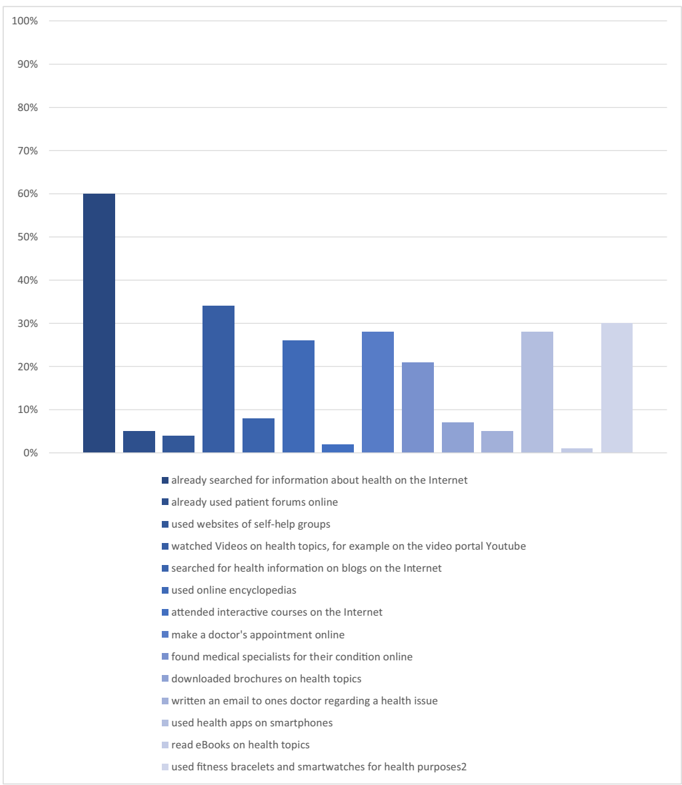
“Another study also showed a similar result: Fifty-five percent of the sample searched for health information on the Internet to be able to answer personal health questions or make decisions regarding their own health (Breil et al. 2021).”
Understanding undergraduate students’ eHealth usage and views of the patient-provider relationship
Reyes, M. A. C., & Vance‐Chalcraft, H. D. (2022) · PLoS ONE · doi:10.1371/journal.pone.0266802 · Cited by 6 · cited 1×
“This can also be confirmed by numerous studies (Barrows Jr and Clayton 1996; Reyes and Vance-Chalcraft 2022; Geukes et al. 2022).”
Willingness to use eHealth services in Lithuanian healthcare institutions. Countrywide survey
Vanagas, G. (2011) · Biomedizinische Technik/Biomedical Engineering · doi:10.1515/bmt.2011.009 · Cited by 4 · cited 1×
“Other studies also came to a similar conclusion that most patients would be willing to use more digital apps to improve their health status if access to these services was more adequate (Vanagas 2011; Thapa et al. 2021).”
Research works printed but not linked: 3
- Krüger-Brand H (2019) Digitale Gesundheitskompetenz: Dat- ensouveränität als Ziel. Deutsches Ärzteblatt. International 116(10):A-468
- Nutbeam D (1996) Health outcomes and health promotion: Defin- ing success in health promotion. Health Promotion J Australia 6:58-60
- Schaeffer D et al (2020) Der Nationale Aktionsplan Gesundheit- skompetenz. Gesundheitswesen 82(11):818-820
Cited by
Fitzpatrick, P. J. (2023) · Frontiers in Digital Health · doi:10.3389/fdgth.2023.1264780 · Cited by 416
Yoo, S., Sung, J. H., Lee, K., Hong, B., Oh, E. G., Kim, S. H., & Lee, J. (2024) · European Journal of Oncology Nursing · doi:10.1016/j.ejon.2024.102581 · Cited by 24
Muellmann, S., Wiersing, R., Zeeb, H., & Brand, T. (2025) · JMIR Human Factors · doi:10.2196/65345 · Cited by 19
“…in Germany [4,7,15] and various subgroups such as students [16], school children [17], teachers [18], physicians [19], or community inhabitants [20], very little is known about the digital health literacy of adults with low reading and writing skills and their use of digital tools for health…”
Jiang, J., Zhou, M., Yin, Z., Cui, Y., & Liu, S. (2025) · DIGITAL HEALTH · doi:10.1177/20552076251346006 · Cited by 15
“80 This multifaceted approach can provide equitable access to digital health education and support for all students, regardless of their geographic location.”
Self-care and associated factors of patients with permanent colostomies: A structural equation model
Bian, L.-Y., Jullamate, P., Toonsiri, C., & Suksawang, P. (2025) · Asia-Pacific Journal of Oncology Nursing · doi:10.1016/j.apjon.2025.100666 · Cited by 12
“41 Due to its accessibility and affordability, eHealth literacy is a valuable tool for patients to obtain health knowledge and skills and actively manage their health.”
Metadata
- Authors
- Cramer, A., Keinki, C., Saur, F., Walter, S., & Hübner, J.
- Affiliations
- Friedrich Schiller University Jena (DE)
- Jena University Hospital (DE)
- Corresponding author
- Cramer, Alin
- Venue
- Journal of Public Health
- Published
- 2023-07-05
- Volume
- 33
- Issue
- 1
- Pages
- 237-248
- ISSN
- 0943-1853 (ISSN-L)
- 2198-1833
- 1613-2238
- OpenAlex
- W4383263650
- Semantic Scholar
- 989d5b2bdf8bd3aa57f53e257c57f31a58c10eb3
- Cited by
- 13
- References
- 35
- Citations by year
- 2026: 4 · 2025: 7 · 2024: 1 · 2023: 1
- FWCI
- 4.63
- Type
- journal article
- Language
- en
- Update notices
- correction (2023-12-15)
- Open access
- hybrid
- doi.org
- Licence
- cc-by
- creativecommons.org/licenses/by/4.0 (tdm)
- creativecommons.org/licenses/by/4.0 (vor)
- Locations
- Journal of Public Health (publishedVersion, cc-by)
- PUBLISSO (German National Library of Medicine) (submittedVersion, cc-by)
- Common Library Network (Der Gemeinsame Bibliotheksverbund) (submittedVersion, cc-by)
- Funders
- Friedrich-Schiller-Universität Jena
- Topics
- Health Sciences › Health Professions › General Health Professions › Health Literacy and Information Accessibility
- Health Sciences › Medicine › Geriatrics and Gerontology › Technology Use by Older Adults
- Health Sciences › Health Professions › Health Information Management › Health, Technology, Consumer Behavior
- Keywords
- digital health literacy, digital skills, internet use, health information credibility, educational attainment, age differences, digital transformation
About these checks
Registry, retraction, Cites and statistics results are computed, not judged, with one exception: a printed reference that no index lists is read once by a model before it counts as a citation error. Claims are extracted by a model and kept only when their quote appears verbatim in the text; each cited source is then checked, with a model’s help, for whether it says what the claim relies on. Those verdicts can be wrong — read the claim’s quote and the cited source before relying on one.
Statistics and arithmetic are recomputed, not judged.
Confidence bands are shown only for fields calibrated on our annotated test set. None is calibrated yet, so no band is shown.
What counts as a claim ›How we measure confidence ›How we check this ›
Are you an author, or do you see a problem with this page? Request a review
Data sources
Bibliographic data: Semantic Scholar, OpenAlex, Crossref.
Contains information from the Semantic Scholar Academic Graph Datasets, made available under the ODC Attribution License (ODC-BY 1.0).
Semantic Scholar’s data is described in: Kinney, R., et al. (2023). The Semantic Scholar Open Data Platform. arXiv:2301.10140.
