

Towards bridging the grey digital divide: changes in internet access and its predictors from 2002 to 2014 in Germany
Open accessThe DOI matches its Crossref record; 44 of the 45 references it cites were found in a registry or an index.
Abstract
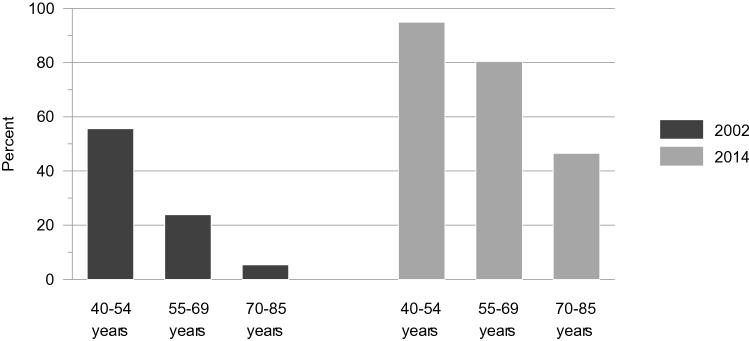
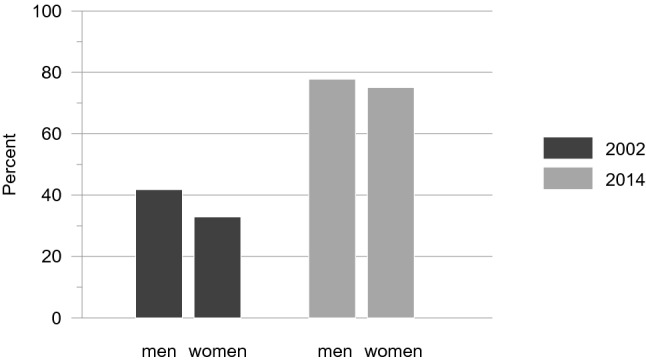
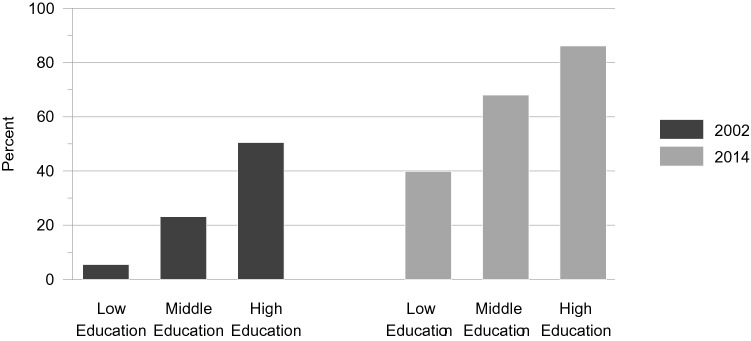
The internet is an indispensable aspect of modern society. It facilitates long distance communication, access to information, health care interventions, as well as multiple opportunities for social participation. Despite increasing pervasiveness of this technology, persistent inequalities exist in who has access to the internet. In particular, older adults lag behind in having internet access, thus putting them at risk for social exclusion. In order to gain a better understanding about the determinants of this grey digital divide, the current study contrasts influencing factors of internet access, comparing samples from 2002 to 2014 across age groups (40 to 54 years, 55 to 69 years and 70 to 85 years) using data from the German Ageing Survey (DEAS). Logistic regression confirmed that the likelihood of having internet access was lower with higher age at both time points. However, the percentages of people with internet access grew primarily in the middle and older age groups between 2002 and 2014. Furthermore, being male and having a higher education were both associated with greater odds of internet access. However, gender and education differences in internet access were significantly less pronounced in 2014 in contrast to 2002. Finally, both greater income and cognitive ability were associated with greater odds of internet access, while providing care for a grandchild was significantly associated with internet access only among the oldest age group. In an attempt towards bridging the grey digital divide, the current study serves as a basis for identifying groups mostly affected by this increasingly important form of social inequality.
Overview
The claims and statistics of this paper haven’t been checked yet.
Free: it reads the open-access text and checks the first 5 claims that cite a source we can check. Create a free account to check every claim.
Integrity signals
Registry
Cites
Statistics
Figures
Verification
Claims the paper makes
The claims and statistics of this paper haven’t been checked yet.
Free: it reads the open-access text and checks the first 5 claims that cite a source we can check. Create a free account to check every claim.
Self-check
Percentages, sums and reported differences re-computed from the paper’s own numbers.
The self-check needs the paper’s full text.
Citations
Cites
Missing data analysis: making it work in the real world
Graham, J. W. (2009) · Annual Review of Psychology · doi:10.1146/annurev.psych.58.110405.085530 · Cited by 6,163 · cited 1×
“Monte Carlo simulation studies have shown that FIML significantly reduces parameter bias due to data missingness as long as the models contain predictors that are associated with the patterns of missing data (Graham 2009).”
BackgroundInternational Standard Classification of Education, ISCED 1997
UNESCO United Nations Educational, S. A. C. O. (2003) · Advances in Cross-National Comparison · doi:10.1007/978-1-4419-9186-7_10 · Cited by 2,351 · cited 1×
“Educational attainment was based on the internationally comparable ISCED classification (United Nations 2006).”
MethodSocial contagion theory: examining dynamic social networks and human behavior
Christakis, N. A., & Fowler, J. H. (2013) · Statistics in Medicine · doi:10.1002/sim.5408 · Cited by 1,303
Digital inequalities and why they matter
Robinson, L., Cotten, S. R., Ono, H., Quan-Haase, A., Mesch, G., Chen, W., Schulz, J., Hale, T. M., & Stern, M. J. (2015) · Information, Communication & Society · doi:10.1080/1369118x.2015.1012532 · Cited by 1,216
Effectiveness of telemedicine: A systematic review of reviews
Ekeland, A. G., Bowes, A., & Flottorp, S. (2010) · International Journal of Medical Informatics · doi:10.1016/j.ijmedinf.2010.08.006 · Cited by 1,162
The digital divide has grown old: Determinants of a digital divide among seniors
Friemel, T. N. (2016) · New Media & Society · doi:10.1177/1461444814538648 · Cited by 1,136 · cited 6×
“This suggestion also matches the significance of encouragement on internet use by individual social networks as discovered by Friemel (2016).”
BackgroundInfluentialTech Adoption Climbs Among Older Adults
Perrin, M. A. A. A. (2017) · Cited by 1,069
Innovation diffusion and new product growth models: A critical review and research directions
Peres, R., Muller, E., & Mahajan, V. (2010) · International Journal of Research in Marketing · doi:10.1016/j.ijresmar.2009.12.012 · Cited by 982
A review of Internet use among older adults
Hunsaker, A., & Hargittai, E. (2018) · New Media & Society · doi:10.1177/1461444818787348 · Cited by 770
The Internet and Knowledge Gaps: A Theoretical and Empirical Investigation
Bonfadelli, H. (2002) · European Journal of Communication · doi:10.1177/0267323102017001607 · Cited by 644 · cited 1×
“…divide to several negative outcomes including poor health (e.g. Dobransky and Hargittai 2012; Hong and Cho 2016; Hong et al. 2017; Levy et al. 2015) and well-being (e.g. Ihm and Hsieh 2015; Shapira et al. 2007), as well as reduced political knowledge (e.g. Bonfadelli 2002; Wei and Hindman 2011).”
Background
Cited by
Items 101–140 of 140
The Lawton and Brody a half century later: A case for contemporary revision
Benge, J. F., Werry, A. E., Hromas, G., Aguirre, A., Zúñiga, C., Hilsabeck, R. C., & González, D. A. (2026) · The Clinical Neuropsychologist · doi:10.1080/13854046.2026.2670535 · Cited by 2
Bolin, G., Figueiras, R., & Калмус, В. (2023) · AoIR Selected Papers of Internet Research · doi:10.5210/spir.v2022i0.12977 · Cited by 1
“Considering the various aspects of the gray digital divide (Huxhold et al. 2020), researchers should reflect on the ways in which age and online methods intersect.”
BackgroundAccess and Uses of ICTs: Can Virtual Learning Be an Alternative Mode of Education in India?
Padhi, B., Ray, S., & Lalhriatchiani (2023) · Indian Journal of Human Development · doi:10.1177/09737030231194858 · Cited by 1
“A study by Huxhold and Webster (2020) shows that greater income and cognitive ability were associated with greater odds of internet access.”
BackgroundOlder People in Chinese and German e- and m-Health Sector (2000–2022)
Bogen, C. (2023) · Springer eBooks · doi:10.1007/978-3-030-68127-2_406-1 · Cited by 1
Innovative Uses of Technology to Benefit Older Adults
Kahana, E. F. (2023) · Journal of Elder Policy · doi:10.18278/jep.2.3.1 · Cited by 1
Gaikwad, A., Mathur, A. S., Mehta, V., Tripathy, S., & Thomas, V. (2024) · Eastern Ukrainian Medical Journal · doi:10.21272/eumj.2024;12(3):721-729 · Cited by 1
Zhao, X., Han, X. J., LOU, V. W. Q., & Zhang, Z. (2024) · Journal of Gerontological Social Work · doi:10.1080/01634372.2024.2428254 · Cited by 2
“Prior research has demonstrated that advantageous socioeconomic status (SES) is associated with higher odds of internet use among older adults (Huxhold et al., 2020), and it has also been found that internet use could benefit old people’s psychological well-being (Lifshitz et al., 2018; Sims et…”
Gender Inequality on the Uses of the Internet: A Study of Dhaka City of Bangladesh
Alam, J. (2020) · European Scientific Journal ESJ · doi:10.19044/esj.2020.v16n23p151 · Cited by 1
“The higher income and cognitive ability have a positive association in the case of internet access (Oliver Huxhold, 2020).”
BackgroundDigital Participation and Disability Digital Divide
Glumbić, N., Đorđević, M., & Brojčin, B. (2022) · Autism and child psychopathology series · doi:10.1007/978-3-031-12037-4_1 · Cited by 2
Kohlmann, S., Stielow, L., & Löwe, B. (2023) · Journal of Affective Disorders Reports · doi:10.1016/j.jadr.2023.100587 · Cited by 2
Ma, J., Song, Y., & Suo, L. (2023) · Communications in computer and information science · doi:10.1007/978-981-99-3925-1_12 · Cited by 1
Sung, H. (2022) · SSRN Electronic Journal · doi:10.2139/ssrn.4093986
Health information seeking on social media: the diversification approach
Rosenberg, D., Mano, R. S., & Mesch, G. S. (2022) · Equality Diversity and Inclusion An International Journal · doi:10.1108/edi-12-2021-0309 · Cited by 3
Quialheiro, A., Rech, C. R., Silvestre, M. M., Boing, A. F., & d ́Orsi, E. (2022) · Gerontology & Geriatrics Research · doi:10.26420/gerontolgeriatrres.2022.1078
Physical activity and health during the SARS-CoV2 pandemic
Wilke, J. (2022) · Publication Server of Goethe University Frankfurt am Main (Goethe University Frankfurt) · doi:10.21248/gups.71408
Ismail, K. A., & Wahid, N. A. (2023) · Journal of Governance and Integrity · doi:10.15282/jgi.6.2.2023.9727
Zhang, L. (2024) · Advances in studies of aging and health · doi:10.1007/978-3-031-69773-9_1
Lee, Y. R., & Jin, H. (2024) · Asia-pacific Journal of Convergent Research Interchange · doi:10.47116/apjcri.2024.09.22
“이때 필요한 디지털 러시는 디지털 기술과 역량을 포함하여 사용자가 인식하는 수준과 태도 , 적응 및 이해 능력 , 평가 등으로 광범위하고 포괄적인 개념이며 , 디지털을 사용하는 숙련성과 대응능력을 말한다 [18].”
Digitale Teilhabe und digitale Kluft bei Behinderungen
Glumbić, N., Đorđević, M., & Brojčin, B. (2025) · Springer eBooks · doi:10.1007/978-3-031-77414-0_1
Digitálna priepasť a jej ekonomické konzekvencie v krajinách EÚ
Chyláková, V., & Huňady, J. (2025) · Acta aerarii publici. · doi:10.24040/aap.2025.22.1.57-72
Einfluss der COVID-19-Pandemie auf gesundheitsbedingte digitale Ungleichheiten
Grates, M. (2025) · Zeitschrift für Gerontologie und Geriatrie · doi:10.1007/s00391-025-02476-8
Nearing Old Age: Technological Aging
Genç, F. Z., & Uslu, A. (2025) · Online Türk Sağlık Bilimleri Dergisi · doi:10.26453/otjhs.1683996
Tseng, J. T. (2025) · Educational Gerontology · doi:10.1080/03601277.2025.2564389 · Cited by 1
“Research has indicated that in-person interactions and reciprocal social engagement play a more significant role in life satisfaction among older adults than digital communication (Chopik, 2016; Huxhold et al., 2014).”
Kawasaki, Y., Yoshii, E., Fujisaki, K., Shimpo, M., Nagao-Sato, S., Böhnke, J., Akamatsu, R., & Warschburger, P. (2025) · Nutrition and Health · doi:10.1177/02601060251381870 · Cited by 3
“…between the Japanese and German samples may have contributed to differences in attitudes toward sustainability, digital literacy, or lifestyles, in addition to cultural differences between countries (Huxhold et al., 2020; Makowska et al., 2024; Poortinga et al., 2023; Yamane and Kaneko, 2021).”
Dequanter, S., Fobelets, M., Steenhout, I., Gagnon, M.-P., Bourbonnais, A., Rahimi, S., Buyl, R., & Gorus, E. (2022) · Figshare · doi:10.6084/m9.figshare.19681768
Digitisation as a Strategy for the Inclusion and Empowerment of Older Adults
Llorente-Barroso, C., Sánchez-Valle, M., & Viñarás-Abad, M. (2026) · Springer eBooks · doi:10.1007/978-3-032-13373-1_9
Kitamura, S. (2025) · Institutional Repositories DataBase (IRDB)
スマートフォン利用に関するシニア世代への社会的支援の内容と苦労についての基礎的検討 : 研究ノート
KITAMURA, S. (2024) · Institutional Repositories DataBase (IRDB)
Aschauer, W., Nemetz, F., Etter, C., Osterbrink, J., & Kutschar, P. (2026) · Technology in Society · doi:10.1016/j.techsoc.2026.103332
Svensson, G. L., Stjernborg, V., & Hiselius, L. W. (2026) · Sustainable Transport and Livability · doi:10.1080/29941849.2026.2660409
Zenarolla, A. (2026) · Journal of Social Work Practice · doi:10.1080/02650533.2026.2657965
“…digital autonomy, confirming that gender differences — as well as those related to age, education, and income — intersect with digital exclusion, resulting in a ‘double jeopardy’ where the challenges of digital access are compounded by broader socio-demographic inequalities (Huxhold et al., 2020).”
ICT use and well-being in the oldest-old: Evidence from the representative German D80+ study
Schlomann, A., Seifert, A., & Rietz, C. (2026) · Educational Gerontology · doi:10.1080/03601277.2026.2682506
Pavlidis, G. T. (2026) · Human Rights Education Review · doi:10.1080/25355406.2026.2696515
Akkaya, A., Ulum, Ö. G., & TOPDEMİR, R. (2026) · SN Social Sciences · doi:10.1007/s43545-026-01552-z
“Presently, research on the digital divide is varied, with a predominant focus on developed nations (Ahmmed et al. 2022; Gonzales 2016; Huxhold et al. 2020; James 2005 ; Serafino 2019).”
Liu, S. (2026) · Journal of Multilingual and Multicultural Development · doi:10.1080/01434632.2026.2691244
Fu, H., Fei, M., He, R., Wu, S., & Wang, F. (2026) · Frontiers in Public Health · doi:10.3389/fpubh.2026.1873982 · Cited by 1
Bridging or Widening the Gap: A Study of Artificial Intelligence and the Digital Divide in Jamaica
Waller, L., & Johnson, S. (2026) · Emerald Group Publishing Limited eBooks · doi:10.1108/978-1-83708-376-320261009
Lai, M., Yan, K., Chen, Y., Chen, D., Xiang, S., Xu, A., & Wang, Y. (2026) · Journal of Medical Internet Research · doi:10.2196/97679
“For older adults, this reflects a classic gray digital divide [36].”
Older People in Chinese and German e- and m-Health Sector (2000–2022)
Bogen, C. (2026) · Springer eBooks · doi:10.1007/978-3-032-35691-8_406
Linfang, H., Sun, S., Chen, Z., & Liu, L. (2026) · Frontiers in Public Health · doi:10.3389/fpubh.2026.2004517
Metadata
- Authors
- Huxhold, O., Hees, E., & Webster, N. J.
- Affiliations
- German Centre of Gerontology (DE)
- University of Michigan (US)
- Corresponding author
- Huxhold, Oliver
- Venue
- European Journal of Ageing
- Published
- 2020-03-10
- Volume
- 17
- Issue
- 3
- Pages
- 271-280
- ISSN
- 1613-9372 (ISSN-L)
- 1613-9380
- PMC
- PMC7459052
- OpenAlex
- W3010873173
- Semantic Scholar
- 0fc0a999fdbcdd29a123f8a9f8cac36c63961f37
- Cited by
- 135
- References
- 45
- Citations by year
- 2026: 19 · 2025: 23 · 2024: 23 · 2023: 31 · 2022: 19 · 2021: 17 · 2020: 3
- FWCI
- 26.38
- Type
- journal article
- Language
- en
- Open access
- hybrid
- doi.org
- Licence
- cc-by
- creativecommons.org/licenses/by/4.0 (tdm)
- creativecommons.org/licenses/by/4.0 (vor)
- Locations
- European Journal of Ageing (publishedVersion, cc-by)
- PubMed Central (publishedVersion, cc-by)
- PubMed (publishedVersion)
- RePEc: Research Papers in Economics (submittedVersion)
- Topics
- Health Sciences › Medicine › Geriatrics and Gerontology › Technology Use by Older Adults
- Social Sciences › Economics, Econometrics and Finance › Economics and Econometrics › ICT Impact and Policies
- Social Sciences › General Social Sciences › Information Society and Technology Trends
- Keywords
- internet access, older adults, digital inequality, social exclusion, age differences, gender differences, educational attainment, income, cognitive ability, grandparenting, determinants of internet use, Germany
About these checks
Registry, retraction, Cites and statistics results are computed, not judged, with one exception: a printed reference that no index lists is read once by a model before it counts as a citation error. Claims are extracted by a model and kept only when their quote appears verbatim in the text; each cited source is then checked, with a model’s help, for whether it says what the claim relies on. Those verdicts can be wrong — read the claim’s quote and the cited source before relying on one.
Statistics and arithmetic are recomputed, not judged.
Confidence bands are shown only for fields calibrated on our annotated test set. None is calibrated yet, so no band is shown.
What counts as a claim ›How we measure confidence ›How we check this ›
Are you an author, or do you see a problem with this page? Request a review
Data sources
Bibliographic data: Semantic Scholar, OpenAlex, Crossref.
Contains information from the Semantic Scholar Academic Graph Datasets, made available under the ODC Attribution License (ODC-BY 1.0).
Semantic Scholar’s data is described in: Kinney, R., et al. (2023). The Semantic Scholar Open Data Platform. arXiv:2301.10140.
