

Towards bridging the grey digital divide: changes in internet access and its predictors from 2002 to 2014 in Germany
Open accessThe DOI matches its Crossref record; 44 of the 45 references it cites were found in a registry or an index.
Abstract
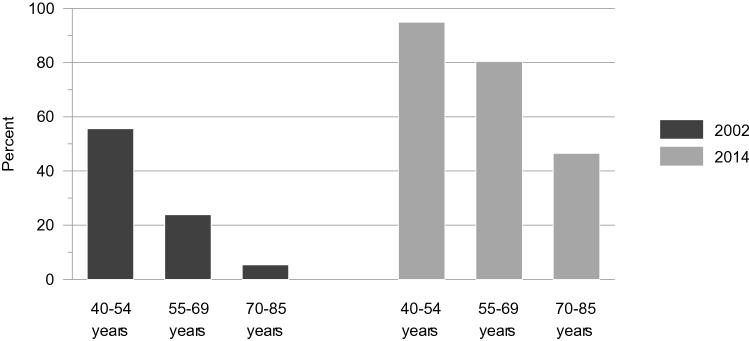
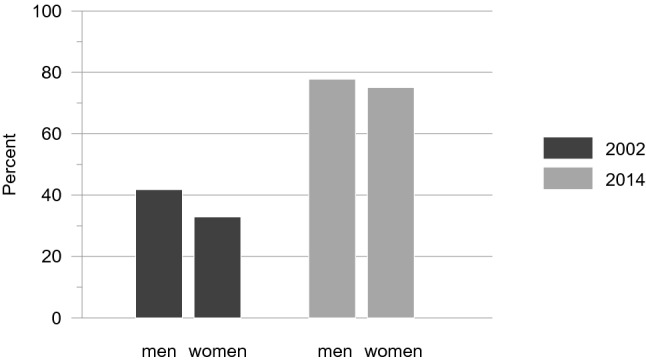
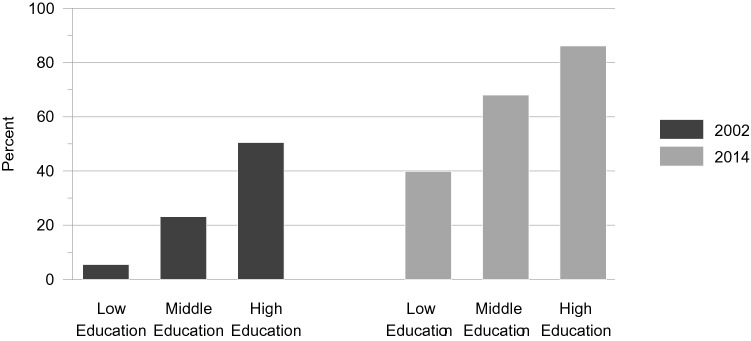
The internet is an indispensable aspect of modern society. It facilitates long distance communication, access to information, health care interventions, as well as multiple opportunities for social participation. Despite increasing pervasiveness of this technology, persistent inequalities exist in who has access to the internet. In particular, older adults lag behind in having internet access, thus putting them at risk for social exclusion. In order to gain a better understanding about the determinants of this grey digital divide, the current study contrasts influencing factors of internet access, comparing samples from 2002 to 2014 across age groups (40 to 54 years, 55 to 69 years and 70 to 85 years) using data from the German Ageing Survey (DEAS). Logistic regression confirmed that the likelihood of having internet access was lower with higher age at both time points. However, the percentages of people with internet access grew primarily in the middle and older age groups between 2002 and 2014. Furthermore, being male and having a higher education were both associated with greater odds of internet access. However, gender and education differences in internet access were significantly less pronounced in 2014 in contrast to 2002. Finally, both greater income and cognitive ability were associated with greater odds of internet access, while providing care for a grandchild was significantly associated with internet access only among the oldest age group. In an attempt towards bridging the grey digital divide, the current study serves as a basis for identifying groups mostly affected by this increasingly important form of social inequality.
Overview
The claims and statistics of this paper haven’t been checked yet.
Free: it reads the open-access text and checks the first 5 claims that cite a source we can check. Create a free account to check every claim.
Integrity signals
Registry
Cites
Statistics
Figures
Verification
Claims the paper makes
The claims and statistics of this paper haven’t been checked yet.
Free: it reads the open-access text and checks the first 5 claims that cite a source we can check. Create a free account to check every claim.
Self-check
Percentages, sums and reported differences re-computed from the paper’s own numbers.
The self-check needs the paper’s full text.
Citations
Cites
Missing data analysis: making it work in the real world
Graham, J. W. (2009) · Annual Review of Psychology · doi:10.1146/annurev.psych.58.110405.085530 · Cited by 6,163 · cited 1×
“Monte Carlo simulation studies have shown that FIML significantly reduces parameter bias due to data missingness as long as the models contain predictors that are associated with the patterns of missing data (Graham 2009).”
BackgroundInternational Standard Classification of Education, ISCED 1997
UNESCO United Nations Educational, S. A. C. O. (2003) · Advances in Cross-National Comparison · doi:10.1007/978-1-4419-9186-7_10 · Cited by 2,351 · cited 1×
“Educational attainment was based on the internationally comparable ISCED classification (United Nations 2006).”
MethodSocial contagion theory: examining dynamic social networks and human behavior
Christakis, N. A., & Fowler, J. H. (2013) · Statistics in Medicine · doi:10.1002/sim.5408 · Cited by 1,303
Digital inequalities and why they matter
Robinson, L., Cotten, S. R., Ono, H., Quan-Haase, A., Mesch, G., Chen, W., Schulz, J., Hale, T. M., & Stern, M. J. (2015) · Information, Communication & Society · doi:10.1080/1369118x.2015.1012532 · Cited by 1,216
Effectiveness of telemedicine: A systematic review of reviews
Ekeland, A. G., Bowes, A., & Flottorp, S. (2010) · International Journal of Medical Informatics · doi:10.1016/j.ijmedinf.2010.08.006 · Cited by 1,162
The digital divide has grown old: Determinants of a digital divide among seniors
Friemel, T. N. (2016) · New Media & Society · doi:10.1177/1461444814538648 · Cited by 1,136 · cited 6×
“This suggestion also matches the significance of encouragement on internet use by individual social networks as discovered by Friemel (2016).”
BackgroundInfluentialTech Adoption Climbs Among Older Adults
Perrin, M. A. A. A. (2017) · Cited by 1,069
Innovation diffusion and new product growth models: A critical review and research directions
Peres, R., Muller, E., & Mahajan, V. (2010) · International Journal of Research in Marketing · doi:10.1016/j.ijresmar.2009.12.012 · Cited by 982
A review of Internet use among older adults
Hunsaker, A., & Hargittai, E. (2018) · New Media & Society · doi:10.1177/1461444818787348 · Cited by 770
The Internet and Knowledge Gaps: A Theoretical and Empirical Investigation
Bonfadelli, H. (2002) · European Journal of Communication · doi:10.1177/0267323102017001607 · Cited by 644 · cited 1×
“…divide to several negative outcomes including poor health (e.g. Dobransky and Hargittai 2012; Hong and Cho 2016; Hong et al. 2017; Levy et al. 2015) and well-being (e.g. Ihm and Hsieh 2015; Shapira et al. 2007), as well as reduced political knowledge (e.g. Bonfadelli 2002; Wei and Hindman 2011).”
BackgroundPromoting older adults’ well-being through Internet training and use
Shapira, N., Barak, A., & Gal, I. (2007) · Aging & Mental Health · doi:10.1080/13607860601086546 · Cited by 501
Chapter 8 New-product diffusion models
Mahajan, V., Muller, E., & Bass, F. M. (1993) · Handbooks in Operations Research and Management Science · doi:10.1016/s0927-0507(05)80031-3 · Cited by 482
Compaine, B. M. (2001) · Medical Entomology and Zoology · Cited by 402
van Deursen, A. J. A. M., & van Dijk, J. A. G. M. (2015) · The Information Society · doi:10.1080/01972243.2015.1069770 · Cited by 353
The Digital Divide: Facing a Crisis or Creating a Myth?
(2001) · The MIT Press eBooks · doi:10.7551/mitpress/2419.001.0001 · Cited by 345
Speed and intelligence in old age.
Lindenberger, U., Mayr, U., & Kliegl, R. (1993) · Psychology and Aging · doi:10.1037//0882-7974.8.2.207 · Cited by 344
Wei, L., & Hindman, D. B. (2011) · Mass Communication and Society · doi:10.1080/15205431003642707 · Cited by 317
The digital vicious cycle: Links between social disadvantage and digital exclusion in rural areas
Warren, M. (2007) · Telecommunications Policy · doi:10.1016/j.telpol.2007.04.001 · Cited by 314 · cited 1×
“Furthermore, considering the growing omnipresence of the internet, inequalities in access to and use of internet technologies have become one of the most prominent forms of social inequality with a major influence on life opportunities (Robinson et al. 2015; Warren 2007).”
BackgroundHealth Literacy and the Digital Divide Among Older Americans
Levy, H., Janke, A. T., & Langa, K. M. (2015) · Journal of General Internal Medicine · doi:10.1007/s11606-014-3069-5 · Cited by 280
Plasticity of memory for new learning in very old age: A story of major loss?
Singer, T., Lindenberger, U., & Baltes, P. B. (2003) · Psychology and Aging · doi:10.1037/0882-7974.18.2.306 · Cited by 240
Digital innovation and the fourth industrial revolution: epochal social changes?
Caruso, L. (2018) · AI & SOCIETY · doi:10.1007/s00146-017-0736-1 · Cited by 239 · cited 1×
“Moreover, considering the prevalence of internet access, a growing number of private and public services are now offered online (Caruso 2018).”
BackgroundInternet use and non-use: views of older users
Morris, A., Goodman, J., & Brading, H. (2007) · Universal Access in the Information Society · doi:10.1007/s10209-006-0057-5 · Cited by 234 · cited 1×
“This inequality has been referred to as the grey digital divide (Morris 2007; Morris et al. 2007).”
BackgroundHong, Y. A., Zhou, Z., Fang, Y., & Shi, L. (2017) · Journal of Medical Internet Research · doi:10.2196/jmir.7786 · Cited by 215 · cited 2×
“A number of studies have linked this divide to several negative outcomes including poor health (e.g. Dobransky and Hargittai 2012; Hong and Cho 2016; Hong et al. 2017; Levy et al. 2015) and well-being (e.g. Ihm and Hsieh 2015; Shapira et al. 2007), as well as reduced political knowledge (e.g.…”
BackgroundIhm, J., & Hsieh, Y. P. (2015) · Information, Communication & Society · doi:10.1080/1369118x.2015.1019912 · Cited by 183
Hong, Y. A., & Cho, J. (2016) · The Journals of Gerontology Series B: Psychological Sciences and Social Sciences · doi:10.1093/geronb/gbw100 · Cited by 181
An International Standard Classification of Education (ISCED)
Goldstone, L. (1973) · Prospects · doi:10.1007/bf02198536 · Cited by 163
Socioeconomic status and health in the second half of life: findings from the German Ageing Survey
Schöllgen, I., Huxhold, O., & Tesch-Römer, C. (2010) · European Journal of Ageing · doi:10.1007/s10433-010-0140-x · Cited by 141
Self-citationInquiring Minds Acquiring Wellness: Uses of Online and Offline Sources for Health Information
Dobransky, K., & Hargittai, E. (2012) · Health Communication · doi:10.1080/10410236.2011.585451 · Cited by 138
Age associated memory impairment.
O'Brien, J. T., & Levy, R. (1992) · BMJ · doi:10.1136/bmj.304.6818.5 · Cited by 138 · cited 1×
“This may be especially true given the comparatively high possibility of mild cognitive impairments at older ages (Hänninen and Soininen 1997).”
BackgroundE-commerce user behavior model: an empirical study
Jiang, J. J., Hsu, M. K., Klein, G., & Lin, B. (2000) · Human Systems Management · doi:10.3233/hsm-2000-19406 · Cited by 134 · cited 1×
“There have been a number of initiatives working towards increasing the user friendliness of various technologies used to access the internet (de Jong and Lentz 2006; Jiang et al. 2000; Nykanen 2008; Wimmer and Holler 2002).”
BackgroundInternet use and the digital divide in the English longitudinal study of ageing
Gilleard, C. J., & HIGGS, P. F. D. (2008) · European Journal of Ageing · doi:10.1007/s10433-008-0083-7 · Cited by 132
E-literacy and the grey digital divide: review with recommendations
Morris, A., & Brading, H. (2007) · Journal of Information Literacy · doi:10.11645/1.3.14 · Cited by 115 · cited 1×
“This inequality has been referred to as the grey digital divide (Morris 2007; Morris et al. 2007).”
BackgroundFacets of the digital divide in Europe: Determination and extent of internet use
Demoussis, M., & Giannakopoulos, N. (2006) · Economics of Innovation and New Technology · doi:10.1080/10438590500216016 · Cited by 115
Marshall, M., Shah, R., & Stokes-Lampard, H. (2018) · BMJ · doi:10.1136/bmj.k1195 · Cited by 58
Goldman, A. W., & Cornwell, B. T. (2015) · Social Science & Medicine · doi:10.1016/j.socscimed.2015.07.003 · Cited by 56
E-Government as a Quality Improvement Tool for Citizens’ Services
Gasova, K., & Stofkova, K. (2017) · Procedia Engineering · doi:10.1016/j.proeng.2017.06.039 · Cited by 50
Age-Associated Memory Impairment: Normal Aging or Warning of Dementia?
Hänninen, T., & Soininen, H. S. (1997) · Drugs & Aging · doi:10.2165/00002512-199711060-00007 · Cited by 50
Wimmer, M. A., & Holler, U. (2003) · Lecture notes in computer science · doi:10.1007/3-540-36572-9_13 · Cited by 29 · cited 1×
“There have been a number of initiatives working towards increasing the user friendliness of various technologies used to access the internet (de Jong and Lentz 2006; Jiang et al. 2000; Nykanen 2008; Wimmer and Holler 2002).”
BackgroundEngstler, H., & Schmiade, N. (2013) · Journal of Contextual Economics – Schmollers Jahrbuch · doi:10.3790/schm.133.1.97 · Cited by 28
(2014) · doi:10.1787/dd50eddd-en · Cited by 18
Municipalities on the Web: User-Friendliness of Government Information on the Internet
de Jong, M. D. T., & Lentz, L. R. (2006) · Lecture notes in computer science · doi:10.1007/11823100_16 · Cited by 16 · cited 1×
“There have been a number of initiatives working towards increasing the user friendliness of various technologies used to access the internet (de Jong and Lentz 2006; Jiang et al. 2000; Nykanen 2008; Wimmer and Holler 2002).”
BackgroundInternet Issues: Blogging, the Digital Divide and Digital Libraries
Evans, C. M. (2010) · Cited by 15
Requirements for user-friendly personal health information systems.
Nykänen, P. (2008) · PubMed · Cited by 8
Einkommensungleichheiten in Westdeutschland vor und nach dem Renteneintritt
Strauß, S., & Ebert, A. (2012) · Springer eBooks · doi:10.1007/978-3-531-18714-3_13 · Cited by 6
(1981) · Medical Entomology and Zoology
Cited by
Bridging the digital divide: the smart TV as a platform for digital literacy among the elderly
Wang, C.-H., & Wu, C.-L. (2022) · Behaviour & Information Technology · doi:10.1080/0144929x.2021.1934732 · Cited by 104
“According to the survey report, the ‘ Individual Household Digital Divide ’ published by the National Development Council in Taiwan in 2018, Changhua was below the national average in both the percentage of households with Internet connections and individual Internet access.”
BackgroundInfluentialLi, J., & Zhou, X. (2021) · Computers in Human Behavior · doi:10.1016/j.chb.2021.106725 · Cited by 123
Older adults’ self-perception, technology anxiety, and intention to use digital public services
An, J., Zhu, X., Wan, K., Xiang, Z., Shi, Z., An, J., & Huang, W. (2024) · BMC Public Health · doi:10.1186/s12889-024-21088-2 · Cited by 138
Age-Related Digital Divide during the COVID-19 Pandemic in China
Song, Y., Qian, C., & Pickard, S. (2021) · International Journal of Environmental Research and Public Health · doi:10.3390/ijerph182111285 · Cited by 135
Tomczyk, Ł., Mascia, M. L., Gierszewski, D., & Walker, C. (2023) · Innoeduca International Journal of Technology and Educational Innovation · doi:10.24310/innoeduca.2023.v9i1.16433 · Cited by 116
“…advantages and benefits, and has become increasingly important for accessing services (for instance digital health and mental health), circulating information, and building and maintaining social relationships (Bonfiglio et al., 2021; Chen et al., 2022; Huxhold et al., 2020; Stara et al., 2022).”
Background
Metadata
- Authors
- Huxhold, O., Hees, E., & Webster, N. J.
- Affiliations
- German Centre of Gerontology (DE)
- University of Michigan (US)
- Corresponding author
- Huxhold, Oliver
- Venue
- European Journal of Ageing
- Published
- 2020-03-10
- Volume
- 17
- Issue
- 3
- Pages
- 271-280
- ISSN
- 1613-9372 (ISSN-L)
- 1613-9380
- PMC
- PMC7459052
- OpenAlex
- W3010873173
- Cited by
- 135
- References
- 45
- Citations by year
- 2026: 19 · 2025: 23 · 2024: 23 · 2023: 31 · 2022: 19 · 2021: 17 · 2020: 3
- FWCI
- 26.38
- Type
- journal article
- Language
- en
- Open access
- hybrid
- doi.org
- Licence
- cc-by
- creativecommons.org/licenses/by/4.0 (tdm)
- creativecommons.org/licenses/by/4.0 (vor)
- Locations
- European Journal of Ageing (publishedVersion, cc-by)
- PubMed Central (publishedVersion, cc-by)
- PubMed (publishedVersion)
- RePEc: Research Papers in Economics (submittedVersion)
- Topics
- Health Sciences › Medicine › Geriatrics and Gerontology › Technology Use by Older Adults
- Social Sciences › Economics, Econometrics and Finance › Economics and Econometrics › ICT Impact and Policies
- Social Sciences › General Social Sciences › Information Society and Technology Trends
- Keywords
- internet access, older adults, digital inequality, social exclusion, age differences, gender differences, educational attainment, income, cognitive ability, grandparenting, determinants of internet use, Germany
About these checks
Registry, retraction, Cites and statistics results are computed, not judged, with one exception: a printed reference that no index lists is read once by a model before it counts as a citation error. Claims are extracted by a model and kept only when their quote appears verbatim in the text; each cited source is then checked, with a model’s help, for whether it says what the claim relies on. Those verdicts can be wrong — read the claim’s quote and the cited source before relying on one.
Statistics and arithmetic are recomputed, not judged.
Confidence bands are shown only for fields calibrated on our annotated test set. None is calibrated yet, so no band is shown.
What counts as a claim ›How we measure confidence ›How we check this ›
Are you an author, or do you see a problem with this page? Request a review
Data sources
Bibliographic data: Semantic Scholar, OpenAlex, Crossref.
Contains information from the Semantic Scholar Academic Graph Datasets, made available under the ODC Attribution License (ODC-BY 1.0).
Semantic Scholar’s data is described in: Kinney, R., et al. (2023). The Semantic Scholar Open Data Platform. arXiv:2301.10140.
