

The agroecological transition in Senegal: transnational links and uneven empowerment
Open accessThe DOI matches its Crossref record; 97 of the 99 references it cites were found in a registry or an index, and 2 are not checked yet; 9 of the 44 sources its claims cite were checked for support.
Abstract
Senegal is among the few African countries that counts with an important agroecological movement. This movement is strongly backed up by a network of transnational partnerships and has recently matured into an advocacy coalition that promotes an agroecological transition at national scale. In this article, we investigate the role of transnational links on the empowerment potential of agroecology. Combining the multi-level perspective of socio-technical transitions and Bourdieu's theory of practices, we conceptualize the agroecological network as a niche shaped by the circulation of different types of capital. Using social network analysis, we investigate the existing flows of resources and knowledge, as well as membership and advocacy links to critically address within-niche empowerment processes. We show that transnational ties play a key role in building the niche protective space, showing a financial dependency of the agroecological niche on NGOs and international cooperation programmes based in Europe and North America. This configuration tends to favor the empowerment of NGOs instead of farmer unions, which only play a peripheral role in the network. However, the multiple innovations focus of agroecology may open up prospects for more gradual but potentially radical change. Based on our findings, we suggest to include more explicitly core-periphery dynamics in transition studies involving North-South relations, including circulation of capital, ideas and norms. Supplementary Information: The online version contains supplementary material available at 10.1007/s10460-021-10247-5.
Verified 2026-11-22 · 2 references not checked yet
Overview
CoChat Summary
TL;DR
The paper studies Senegal’s agroecological transition as a transnational network and finds that it is real but unevenly empowering: NGOs and research organizations are much more central than farmer unions, and the niche depends heavily on foreign aid from Europe and North America. The authors argue this dependency may support only a partially transformative, often reformist transition, although alliances with national NGOs and farmer organizations could still enable more radical change over time.
Key findings
- The analyzed network included 257 nodes (organizations) and 1,948 edges (flows/links); among the assessed organizations, the sample covered 20 zero-order nodes and 237 first- and second-order nodes.
- The agroecological niche in Senegal is strongly transnational: the network shows strong ties to organizations based in Europe and North America, while links with other African countries are described as scarce.
- In the resource network, national NGOs occupy a central role, while farmer organizations play only a peripheral role; in the knowledge network, national NGOs again play a central role, with ISRA as the most central first-order organization.
- Experience and position are linked: organizations with more years of agroecology experience have higher betweenness centrality in the knowledge network (R = 0.631, p < 0.01), and centrality in resource and knowledge networks is positively correlated (R = 0.577, p < 0.05); this pattern is not significant for farmer unions.
Methods
- The study uses a case study of agroecology in Senegal, combining the multi-level perspective with Bourdieu’s theory of practices and using social network analysis as the main method.
- The sample was built from TAFAE and DyTAES organizational lists; the authors restricted the analysis to organizations promoting agroecology in Senegal and working in Dakar, Thiès, and Diourbel, and they interviewed leaders of 20 organizations between February and November 2019.
- Respondents completed table-based network assessments of resource, knowledge, membership, and advocacy ties; the authors analyzed these with Gephi, using betweenness centrality and PageRank as proxies for capital/control positions.
Limitations
- The paper states that the analysis is restricted to “intentional” agroecology and does not include “traditional” agroecology; this limits the scope of the findings.
- The study is restricted to organizations based in Senegal and active in three western regions, so its findings may not capture the full national or regional agroecological landscape.
- Evident from the text: the network boundary depends on self-reported organizational lists and interview recall, so missing or unrecognized ties may remain outside the mapped network.
Model-written summary. Check it against the paper before relying on it.
Integrity signals
Registry
Cites
Statistics
Figures
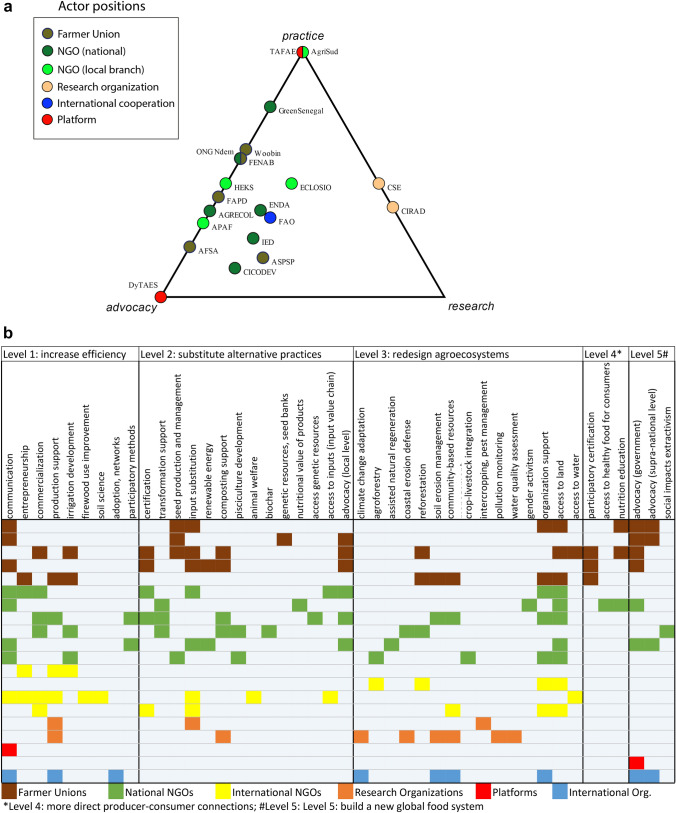
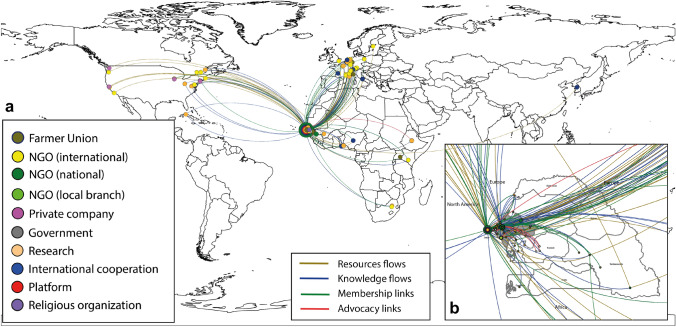
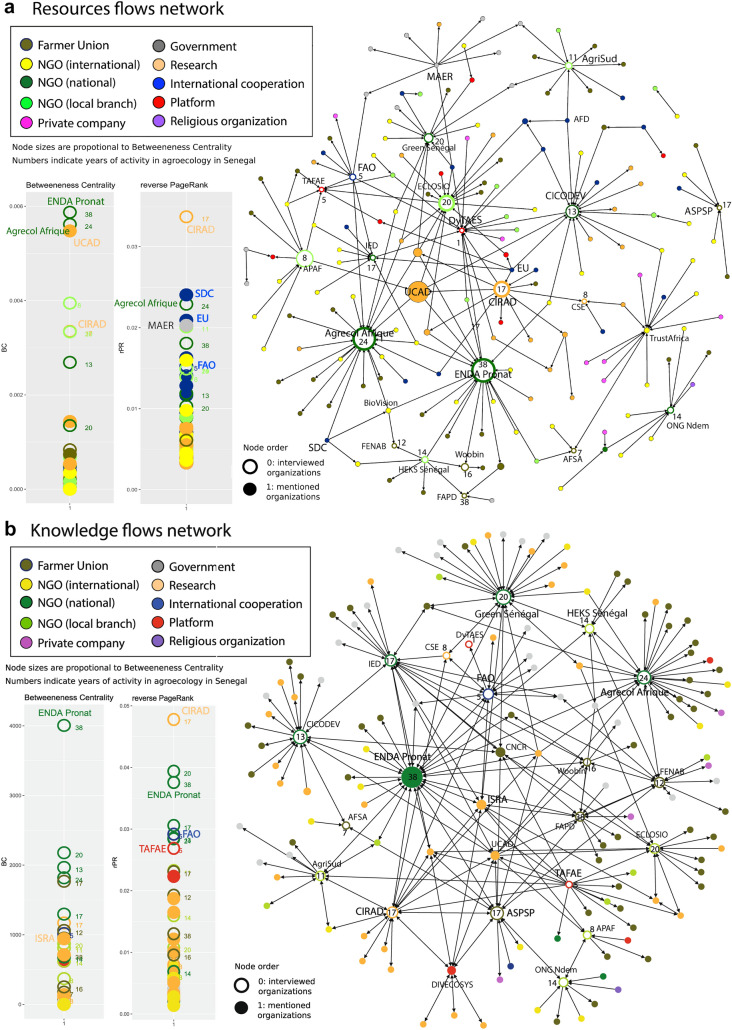
Verification
Claims the paper makes
9 Valid · 0 Not valid · 25 Not checked · 59 Own results and interpretations
The cited sources support only part of this claim — read each source’s verdict below.
In the paper
“Contemporary agroecology in SSA tends to be dominated by NGOs backed up by international networks, cooperation agencies and other international donors (Isgren and Ness 2017).”
§ The agroecological transition in Senegal: transnational links and uneven empowerment > Theory, approach and objectives > Agroecology between reformist and radical trends: the case of Sub-Saharan Africa
What the sources say
- Partly supportedcites Isgren and Ness 2017 matched to “Agroecology to Promote Just Sustainability Transitions: Analysis of a Civil Society Network in the Rwenzori Region, Western Uganda” (2017) sourceExperimental — accuracy not yet measured
The “Specialized Industrial Agriculture Agroecology” section says NGOs have promoted agroecology projects in Africa. Section 3.1 describes a Ugandan NGO network linked to national networks and funded mainly by European NGOs. These passages do not establish that NGOs dominate contemporary agroecology across sub-Saharan Africa or that cooperation agencies generally back them; page numbers are unavailable in our copy. (LLM, conf=0.84)
plainstates an association- Asserted: passes — The authors put it forward as true.
- Checkable: passes — It can be checked against evidence.
- Load-bearing: passes — The paper’s conclusions depend on it.
- Based: passes — The paper gives a reason why it holds.
- Partly supported
The cited sources support only part of this claim — read each source’s verdict below.
In the paper
“The MLP has however brought less attention to empowerment processes that occur within niches, despite their potentially crucial influence on niche-regime empowerment processes (Raven et al. 2016).”
§ The agroecological transition in Senegal: transnational links and uneven empowerment > Theory, approach and objectives > Agroecology as a transition process: the multi-level perspective The multi-level perspective (MLP) of socio-technical transitions is a general framework to understand the interplay of social and technological change in systemic transformations (Geels 2002). It postulates that radically new technologies initially have no established markets and lack support of policies, institutions and infrastructures. Technological change thus requires political empowerment as much as technology development. The MLP is grounded on the notions of niche, regime and landscape: niches are spaces of radical innovation development, which are protected from a dominant context called regime, defined as a set of rules that create dynamic stability by guiding incremental improvements along linear innovation trajectories (Geels 2002). Regimes are in turn embedded in wider socio-technical landscapes, which are the exogenous environments that are beyond the direct influence of niche and regime actors. To persist and thrive, niches need a protective space that includes (a) shielding, namely holding the niche from regime pressures, (b) nurturing, which enhances niche development through knowledge exchange and network building, and (c) the empowerment of the niche through socio-technical change (Smith and Raven 2012). The literature on agroecological transitions makes a wide use of the MLP, conceptualizing agroecology as a niche where radical innovations are developed under protection from the dominant productivist and high input agri-food regime (Lamine 2012; Darnhofer 2015; Magrini et al. 2016; Ollivier et al. 2018; Anderson et al. 2019). MLP literature distinguishes between “fit-and-conform” and “stretch-and-transform” niche empowerment. In conforming empowerment, niche innovations become more competitive in unchanged environments, while in transformative empowerment, selection environment in regimes change to favor niche innovations (Smith and Raven 2012). This framing resonates with the debate on whether agroeocology should offer incremental tools and conform to conventional food systems based on monocultures, high inputs and structures of power, or more radically transform them (Giraldo and Rosset 2018). Though the MLP is sometimes criticized for overlooking agency, power and politics (Meadowcroft 2011; Ollivier et al. 2018), it is particularly explicit on regime-niche power relationships, showing how regime actors resist to change by exerting instrumental, discursive, material and institutional forms of power (Geels 2014). The MLP has however brought less attention to empowerment processes that occur within niches, despite their potentially crucial influence on niche-regime empowerment processes (Raven et al. 2016). Examining within-niche empowerment requires a fine conceptualization of actors. Earlier MLP studies tended to focus on elite actors (Lawhon and Murphy 2011) and generalize and assimilate broad categories of actors, such as civil society with niches or the State with regimes (Avelino and Wittmayer 2016). A finer categorization of actors can include their level or aggregation (sectors, organizations and individuals) or their sectoral position such as formal/informal; profit/non-profit, public/private (Avelino and Wittmayer 2016). It can also include the resources that actors mobilize, such as strategies, networks, relations, decision-making, discourses and governmentality aspects (Lawhon and Murphy 2011). Actors can have similar goals but unequal power, and sometimes compete; some actors who attempt to empower others can paradoxically disempower them by creating dependency relations (Avelino and Wittmayer 2016). They can also build advocacy coalitions (Sabatier and Weible 2007) to support niches or regimes who share and confront different beliefs about innovations and enabling policies (Markard et al. 2016). The spatiality of actors also matters. Earlier MLP studies tended to misinterpret regimes with national governments and niches with regional centers of innovation (Smith and Raven 2012). Raven et al. (2012) show that socio-technical transitions rely on networks that involve transnational flows of knowledge and resources. Transnational linkages enhance niche performance and sustainability through flows of people, knowledge, technologies, capital and standards (Wieczorek et al. 2015). In developing countries, niches may also face weaker resistance due to less consolidated regimes. This can enable “leapfrogging” processes, in which innovations such as cell phone communications develop faster in absence of established landline networks (Berkhout et al. 2010). However, foreign donor interventions and related flows of resources that enable niche protection can simultaneously support regimes (Hansen and Nygaard 2013) or encourage incremental rather than radical regime change (Isgren and Ness 2017). Spatial unevenness and power relationships across borders and scales are therefore key to understand power aspects in socio-technical transitions (Lawhon and Murphy 2011). However, MLP and sustainability transitions literature usually address spatiality and power separately. On the one hand, the literature on the “geography of sustainability transitions” brings attention to scales, spatialities and context-specific factors that shape transitions (Köhler et al. 2019). On the other hand, the “just transitions” literature seeks to identify winners, losers and the mechanisms that creates them in sustainability transitions (Newell and Mulvaney 2013; Swilling et al. 2016). Bridging these perspectives requires to investigate unequal decision-making processes in transitions, spill-overs that transcend national borders (Newell and Mulvaney 2013) and broader global political economy aspects, such as core-periphery dynamics (Munro 2019; Newell 2020). The relations between transnational linkages, protective space and uneven within-niche empowerment processes play therefore a key role on the transformative power of sustainability transitions as well as their outcomes in terms of social justice.
What the sources say
- Partly supportedcites Raven et al. 2016 matched to “Niche construction and empowerment through socio-political work. A meta-analysis of six low-carbon technology cases” (2016) sourceExperimental — accuracy not yet measured
Our copy does carry the gap statement the citation rests on: Section 2.3 opens 'The way shielding and nurturing processes are complemented by empowerment of low-carbon technology advocates is least developed in the literature', and Section 2 repeats it via Smith and Raven's (2012) review ('A third function, that of empowering the niche innovation, was less developed in the literature'). However, the source attributes the inattention to the niche/protective-space literature and strategic niche management broadly (the Introduction only notes the niche concept is 'most prominent in the Multi-Level Perspective'), not specifically to the MLP, and the paper's own framing runs the other way from 'empowerment processes that occur within niches': the Conclusions (Section 5) urge broadening the analytical focus away from 'niche-internal processes' toward the 'more outward-oriented processes' by which protective space is made and unmade, with stretch-and-transform empowerment aimed at changing regime selection environments. So the 'less attention to empowerment' part is supported, while the 'within niches ... influence on niche-regime empowerment' characterisation is the citing authors' gloss rather than this paper's claim. (LLM, conf=0.72)
plain- Asserted: passes — The authors put it forward as true.
- Checkable: passes — It can be checked against evidence.
- Load-bearing: passes — The paper’s conclusions depend on it.
- Based: passes — The paper gives a reason why it holds.
- Partly supported
The cited sources support only part of this claim — read each source’s verdict below.
In the paper
“This is the case in Sub-Saharan Africa (SSA), where the promotion and development of agroecology tends to be strongly steered by transnational actors, particularly international NGOs, but also bilateral and multilateral agencies of cooperation and research (Isgren and Ness 2017).”
§ The agroecological transition in Senegal: transnational links and uneven empowerment > Introduction
What the sources say
- Partly supportedcites Isgren and Ness 2017 matched to “Agroecology to Promote Just Sustainability Transitions: Analysis of a Civil Society Network in the Rwenzori Region, Western Uganda” (2017) sourceExperimental — accuracy not yet measured
The background discussion says NGOs have promoted agroecology projects in Africa, and §3.1 says the Ugandan network studied is funded mainly by European NGOs. These passages support international NGO involvement, but they do not establish that transnational actors strongly steer agroecology across Sub-Saharan Africa or that bilateral and multilateral agencies steer it. (LLM, conf=0.85)
boostedstates a cause- Asserted: passes — The authors put it forward as true.
- Checkable: passes — It can be checked against evidence.
- Load-bearing: passes — The paper’s conclusions depend on it.
- Based: passes — The paper gives a reason why it holds.
- Partly supported
The cited sources support only part of this claim — read each source’s verdict below.
In the paper
“MLP studies have separately used both SNA (Lopolito et al. 2011; Giurca and Metz 2018) and the sociology of Bourdieu (Geels 2004; Hess 2014).”
§ The agroecological transition in Senegal: transnational links and uneven empowerment > Theory, approach and objectives > Approach chosen
What the sources say
- Not checked — no full text of the sourcecites Lopolito et al. 2011 matched to “Innovation niches and socio-technical transition: A case study of bio-refinery production” (2011) source
- Not checked — no full text of the sourcecites Giurca and Metz 2018 matched to “A social network analysis of Germany’s wood-based bioeconomy: Social capital and shared beliefs” (2018) source
- Partly supportedcites Geels 2004 matched to “From sectoral systems of innovation to socio-technical systems” (2004) sourceExperimental — accuracy not yet measured
Section 4.1 cites Bourdieu’s concepts of ‘habitus’ and ‘field’ in its discussion of structure and agency, supporting a connection to his sociology. But it then says it will develop Burns and Flam’s approach, so this passage does not establish that the paper uses Bourdieu’s sociology as its MLP framework. The SNA part of the sentence is attributed to other citations. (LLM, conf=0.79)
plain- Asserted: passes — The authors put it forward as true.
- Checkable: passes — It can be checked against evidence.
- Load-bearing: unclear — It is unclear whether the paper’s conclusions depend on it.
- Based: passes — The paper gives a reason why it holds.
A result the paper states — it cites no source for it, so there is none to check. The quote shows it is in the paper.
In the paper
“has recently matured into an advocacy coalition that promotes an agroecological transition at national scale.”
§ The agroecological transition in Senegal: transnational links and uneven empowerment > Abstract Senegal is among the few African countries that counts with an important agroecological movement. This movement is strongly backed up by a network of transnational partnerships and has recently matured into an advocacy coalition that promotes an agroecological transition at national scale. In this article, we investigate the role of transnational links on the empowerment potential of agroecology. Combining the multi-level perspective of socio-technical transitions and Bourdieu’s theory of practices, we conceptualize the agroecological network as a niche shaped by the circulation of different types of capital. Using social network analysis, we investigate the existing flows of resources and knowledge, as well as membership and advocacy links to critically address within-niche empowerment processes. We show that transnational ties play a key role in building the niche protective space, showing a financial dependency of the agroecological niche on NGOs and international cooperation programmes based in Europe and North America. This configuration tends to favor the empowerment of NGOs instead of farmer unions, which only play a peripheral role in the network. However, the multiple innovations focus of agroecology may open up prospects for more gradual but potentially radical change. Based on our findings, we suggest to include more explicitly core-periphery dynamics in transition studies involving North–South relations, including circulation of capital, ideas and norms.
plain- Asserted: passes — The authors put it forward as true.
- Checkable: passes — It can be checked against evidence.
- Load-bearing: passes — The paper’s conclusions depend on it.
- Based: passes — The paper gives a reason why it holds.
- Rests on an assumption not shown here.
37 more claims
Create a free account to see all 93 claims and to verify the 14 references still open.
- It may state two separate claims as one. 34
- Probably not a substantial claim. 25
Citations
Cites
The anatomy of a large-scale hypertextual Web search engine
Brin, S., & Page, L. (1998) · Computer Networks and ISDN Systems · doi:10.1016/s0169-7552(98)00110-x · Cited by 16,004
Handbook of Theory and Research for the Sociology of Education.
O'Shea, D. W., & Richardson, J. G. (1987) · Contemporary Sociology · doi:10.2307/2069964 · Cited by 15,142
Bourdieu, P. (2002) · Readings in Economic Sociology · doi:10.1002/9780470755679.ch15 · Cited by 13,906
Gephi: An Open Source Software for Exploring and Manipulating Networks
Bastian, M., Heymann, S., & Jacomy, M. (2009) · Proceedings of the International AAAI Conference on Web and Social Media · doi:10.1609/icwsm.v3i1.13937 · Cited by 11,675 · cited 2×
“We used the software Gephi (Bastian et al. 2009) to visualize and analyze networks.”
MethodA Set of Measures of Centrality Based on Betweenness
Freeman, L. C. (1977) · Sociometry · doi:10.2307/3033543 · Cited by 10,295
Geels, F. W. (2002) · Research Policy · doi:10.1016/s0048-7333(02)00062-8 · Cited by 7,275 · cited 3×
“We use an innovative approach that combines the multi-level perspective (MLP) of socio-technical transitions (Geels 2002) with Bourdieu’s theory of practices (Bourdieu 1998) as an analytical framework, and social network analysis (SNA) as main method of data collection and analysis.”
BackgroundMethodFrom sectoral systems of innovation to socio-technical systems
Geels, F. W. (2004) · Research Policy · doi:10.1016/j.respol.2004.01.015 · Cited by 4,098 · cited 9×
“To do this, we rely on Bourdieu’s theory of practices (Bourdieu 1998) centered on “social fields”, which are defined spaces of structured social positions around a specific target.”
BackgroundInfluentialJacomy, M., Venturini, T., Heymann, S., & Bastian, M. (2014) · PLoS ONE · doi:10.1371/journal.pone.0098679 · Cited by 2,909
An agenda for sustainability transitions research: State of the art and future directions
Köhler, J., Geels, F. W., Kern, F., Markard, J., Onsongo, E., Wieczorek, A., Alkemade, F., Avelino, F., Bergek, A., Boons, F., et al. (2019) · Environmental Innovation and Societal Transitions · doi:10.1016/j.eist.2019.01.004 · Cited by 2,800
What is protective space? Reconsidering niches in transitions to sustainability
Smith, A., & Raven, R. (2012) · Research Policy · doi:10.1016/j.respol.2011.12.012 · Cited by 1,712
Research works printed but not linked: 6
- Bourdieu P Practical reason 1998 Stanford Stanford University Press
- Diop AM Sénégal: Dynamiques paysannes et souveraineté alimentaire-Le procès de production, la tenue foncère et la naissance d’un mouvement paysan 2016 Dakar L’Harmattan Sénégal
- ENDA-PRONAT Et si on écoutait la terre? Pour une agriculture paysanne durable 2015 Dakar ENDA-PRONAT
- German P Thiam A Les Pesticides au Sénégal: Une menace ? 1993 Dakar ENDA-PRONAT
- Oya C Ba CO Diop M-C Les politiques agricoles 2000–2012: entre volontarisme et incohérence Sénégal 2000–2012. Les institutions et politiques publiques à l’épreuve d’une gouvernance libérale 2013 Paris Karthala 149 178
- Software VERBI MAXQDA 2020 2019 Berlin VERBI Software
Cited by
Levers for the agroecological transition of tropical agriculture
Côté, F., Rapidel, B., Sourisseau, J.-M., Affholder, F., Andrieu, N., Bessou, C., Caron, P., Deguine, J., Faure, G. O., Hainzelin, E. M., et al. (2022) · Agronomy for Sustainable Development · doi:10.1007/s13593-022-00799-z · Cited by 74
Elsner, F., Herzig, C., & Strassner, C. (2023) · Frontiers in Sustainable Food Systems · doi:10.3389/fsufs.2023.1207476 · Cited by 64
Moving beyond pesticides: Exploring alternatives for a changing food system
Goulet, F., Aulagnier, A., & Fouilleux, È. (2023) · Environmental Science & Policy · doi:10.1016/j.envsci.2023.06.007 · Cited by 65
Porcuna-Ferrer, A., Calvet‐Mir, L., Faye, N. F., Klappoth, B., Reyes‐García, V., & Labeyrie, V. (2023) · Journal of Rural Studies · doi:10.1016/j.jrurstud.2023.103163 · Cited by 65
Ecological Management of the Nitrogen Cycle in Organic Farms
Valenzuela, H. R. (2023) · Nitrogen · doi:10.3390/nitrogen4010006 · Cited by 47
Exploring national trajectories of organic agriculture in Africa. Comparing Benin and Uganda
Bendjebbar, P., & Fouilleux, È. (2021) · Journal of Rural Studies · doi:10.1016/j.jrurstud.2021.11.012 · Cited by 43
Gaitán‐Cremaschi, D., Valbuena, D., & Klerkx, L. (2024) · Agriculture and Human Values · doi:10.1007/s10460-024-10562-7 · Cited by 32
Kerr, R. B., & Wynberg, R. (2024) · Elementa Science of the Anthropocene · doi:10.1525/elementa.2023.00051 · Cited by 23
Agroecologically-conducive policies: A review of recent advances and remaining challenges
Place, F., & Niederle, P. A. (2022) · Center for International Forestry Research (CIFOR) eBooks · doi:10.17528/cifor-icraf/008593 · Cited by 26
Tomai, M., Papachristos, G., & Ramani, S. V. (2024) · Environmental Innovation and Societal Transitions · doi:10.1016/j.eist.2024.100928 · Cited by 28
Exploring indicators for monitoring sociotechnical system transitions through portfolio networks
Penna, C., Romero‐Goyeneche, O. Y., & Matti, C. (2023) · Science and Public Policy · doi:10.1093/scipol/scad015 · Cited by 18
Ouko, K. O., Yugi, C. L., Oketch, M. O., Mboya, J. B., Ogola, R. J. O., Muthoka, M., & Midamba, D. C. (2024) · Cogent Social Sciences · doi:10.1080/23311886.2024.2363491 · Cited by 19
Andrieu, N., Dedieu, B., Girard, P., Scopel, E., Magaju, C., Dembele, C., Mekuria, W., & Coe, R. (2025) · Agronomy for Sustainable Development · doi:10.1007/s13593-025-01010-9 · Cited by 9
“However, in many African contexts, agroecological transitions aim to improve low-input, low-productivity farming systems, while avoiding or reversing the degradation of the natural resource base and being equitable and empowering for farmers (Boillat et al. 2022; Tittonell et al. 2012).”
Gayo, L., Lwankomezi, E. B., & Katonge, J. H. (2025) · Discover Agriculture · doi:10.1007/s44279-025-00432-z · Cited by 9
Participatory guarantee systems in Senegal: shifting labour dynamics in agroecology
Marfurt, F., Haller, T., & Bottazzi, P. (2023) · The Journal of Peasant Studies · doi:10.1080/03066150.2023.2246384 · Cited by 10
Self-citationVilas-Boas, J., Klerkx, L., & Lie, R. (2024) · Agricultural Systems · doi:10.1016/j.agsy.2024.103880 · Cited by 7
Boillat, S., Bottazzi, P., & Sabaly, I. K. (2023) · Frontiers in Sustainable Food Systems · doi:10.3389/fsufs.2023.1127593 · Cited by 8
Self-citationBelmin, R., Turnheim, B., Gaillard, B., Boillat, S., Bottazzi, P., Mbodj, A., & Loconto, A. M. (2026) · Environmental Innovation and Societal Transitions · doi:10.1016/j.eist.2025.101095 · Cited by 5
Self-citationFaye, B., Faye, H. V. M. T., Du, G., et al. (2025) · World · doi:10.3390/world6020076 · Cited by 4
Graeuwe, M. D., & Maréchal, K. (2024) · Agroecology and Sustainable Food Systems · doi:10.1080/21683565.2024.2344716 · Cited by 3
Les soutiens publics à l’agriculture et à l’alimentation
Tapsoba, A. F., & Brun, M. (2024) · Revue internationale des études du développement · doi:10.4000/ried.10379 · Cited by 3
Tryphone, G. M., & Thomas, S. P. (2023) · East African Journal of Science Technology and Innovation · doi:10.37425/eajsti.v4i3.676 · Cited by 7
Yang, Y., Ge, S., Cao, X., & Gang, Z. (2022) · Land · doi:10.3390/land11111909 · Cited by 4
Boutroue, B., Hrabanski, M., & Camara, A. D. (2022) · Gouvernement et action publique · doi:10.3917/gap.223.0099 · Cited by 7
Guézohouèzon, M. (2026) · International Journal of Humanities and Social Science · doi:10.30845/ijhss.v15p59 · Cited by 1
Existing Sustainability Interventions are Insufficient to Scale Up Cocoa Agroforestry in West Africa
Kouakou, K. M., Lyons-White, J. P., Thompson, W. J., Addoah, T., Cammelli, F., Blaser, W. J., Maguire-Rajpaul, V. A., Dawoe, E., & Garrett, R. D. (2025) · Sustainable Development · doi:10.1002/sd.70266 · Cited by 14
ElDidi, H., Cruz, A. P. N., Piraux, M., Vall, É., Tristán, M. C., Chimonyo, V. G. P., Fuchs, L. E., Singh, S., & Frija, A. (2025) · Agroecology and Sustainable Food Systems · doi:10.1080/21683565.2025.2556433 · Cited by 5
Environmental Governance in Africa: The Challenge of Food Security
Abourabi, Y. (2025) · Springer eBooks · doi:10.1007/978-3-032-04431-0_5 · Cited by 1
Tomai, M., Papachristos, G., & Ramani, S. V. (2024) · SSRN Electronic Journal · doi:10.2139/ssrn.4760639 · Cited by 1
Growing agroecology in Nicaragua : Towards a multi-scale perspective on agroecological transitions
Schiller, K. (2023) · doi:10.18174/585945 · Cited by 1
Kerr, R. B., Séye, M., Alpha, A., & Sirdey, N. (2026) · Current Developments in Nutrition · doi:10.1016/j.cdnut.2026.107719
Séne, M.-T. (2026) · Marché et organisations · doi:10.3917/maorg.056.0113
Ka, D.-Y., Loconto, A. M., Gaye, E. H. K., Diouf, L. E., & Belmin, R. (2026) · Agroecology and Sustainable Food Systems · doi:10.1080/21683565.2026.2635084
Self-citationWhat drives agroecological transitions in Africa? A systematic reviewPreprint
Tumuhe, C. L., Katusiime, D., Ssekamatte, D., Muloi, J. M., Bwambale, B. B., Taddeo, S. B., Nuwasasira, R., Kaire, S., Mkindi, A. G., Owot, R., et al. (2025) · Research Square · doi:10.21203/rs.3.rs-6886777/v1
Ceddia, M. G., Sene, M. T. D., Munda, G., & Ostlaender, N. (2025) · Elementa Science of the Anthropocene · doi:10.1525/elementa.2025.00019 · Cited by 1
Murray, G. (2022) · Aotearoa New Zealand Journal of Social Issues · doi:10.24135/anzjsi.v2i1.73
Metadata
- Authors
- Boillat, S., Belmin, R., & Bottazzi, P.
- Affiliations
- University of Bern (CH)
- Centre de Coopération Internationale en Recherche Agronomique pour le Développement (FR)
- Corresponding author
- Boillat, Sébastien
- Venue
- Agriculture and Human Values
- Published
- 2021-07-22
- Volume
- 39
- Issue
- 1
- Pages
- 281-300
- ISSN
- 0889-048X (ISSN-L)
- 1572-8366
- PMC
- PMC8894199
- OpenAlex
- W3185586164
- Semantic Scholar
- 0305d01ba10ca8c1664c227130b66dd7f9715d41
- Cited by
- 37
- References
- 98
- Citations by year
- 2026: 5 · 2025: 8 · 2024: 7 · 2023: 10 · 2022: 6 · 2021: 1
- FWCI
- 8.22
- Type
- journal article
- Language
- en
- Open access
- hybrid
- doi.org
- Licence
- cc-by
- creativecommons.org/licenses/by/4.0 (tdm)
- creativecommons.org/licenses/by/4.0 (vor)
- Locations
- Agriculture and Human Values (publishedVersion, cc-by)
- PubMed Central (publishedVersion, cc-by)
- PubMed (publishedVersion)
- HAL (submittedVersion, cc-by)
- RePEc: Research Papers in Economics (submittedVersion)
- Agritrop (Cirad) (submittedVersion, cc-by)
- BORIS (University Library Bern) (submittedVersion, cc-by)
- Funders
- Schweizerischer Nationalfonds zur Förderung der Wissenschaftlichen Forschung (176736)
- Universität Bern
- Topics
- Social Sciences › Development › Agriculture, Land Use, Rural Development
- Life Sciences › Agricultural and Biological Sciences › General Agricultural and Biological Sciences › Agricultural Innovations and Practices
- Physical Sciences › Environmental Science › Global and Planetary Change › Sustainability and Climate Change Governance
- Keywords
- agroecological transition, agroecological movement, transnational networks, socio-technical transitions, Bourdieu's theory of practice, multi-level perspective, niche, core-periphery dynamics, North-South relations, knowledge flows, advocacy coalitions, Senegal
About these checks
Registry, retraction, Cites and statistics results are computed, not judged, with one exception: a printed reference that no index lists is read once by a model before it counts as a citation error. Claims are extracted by a model and kept only when their quote appears verbatim in the text; each cited source is then checked, with a model’s help, for whether it says what the claim relies on. Those verdicts can be wrong — read the claim’s quote and the cited source before relying on one.
The claim verdicts this report counts are experimental: their accuracy is not yet measured.
A language model drew the claims from the paper on 2026-10-10, under version 3 of the claim definition (model deepseek-v4.1-flash, prompt extract-v3).
A second model labelled each claim on 2026-10-10 (model jev-1.13-20260917, definition revision gold-guideline-v0.2).
Cited sources are checked with a language model’s help (gpt-6-sol and qwen3.8-omni-flash).
Statistics and arithmetic are recomputed, not judged.
Confidence bands are shown only for fields calibrated on our annotated test set. None is calibrated yet, so no band is shown.
What counts as a claim ›How we measure confidence ›How we check this ›
Are you an author, or do you see a problem with this page? Request a review
Data sources
Bibliographic data: Semantic Scholar, OpenAlex, Crossref.
Contains information from the Semantic Scholar Academic Graph Datasets, made available under the ODC Attribution License (ODC-BY 1.0).
Semantic Scholar’s data is described in: Kinney, R., et al. (2023). The Semantic Scholar Open Data Platform. arXiv:2301.10140.
