

Deepfake video detection: challenges and opportunities
Open accessThe DOI matches its Crossref record; 122 of the 132 references it cites were found in a registry or an index, and 9 are not checked yet; 43 of the 163 sources its claims cite were checked for support.
Abstract
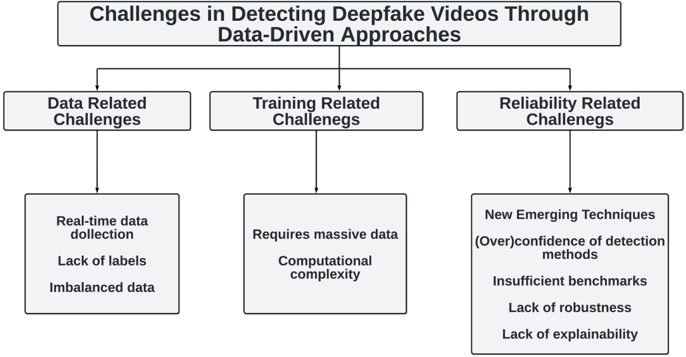
Abstract Deepfake videos are a growing social issue. These videos are manipulated by artificial intelligence (AI) techniques (especially deep learning), an emerging societal issue. Malicious individuals misuse deepfake technologies to spread false information, such as fake images, videos, and audio. The development of convincing fake content threatens politics, security, and privacy. The majority of deepfake video detection methods are data-driven. This survey paper aims to thoroughly analyse deepfake video generation and detection. The paper’s main contribution is the classification of the many challenges encountered while detecting deepfake videos. The paper discusses data challenges such as unbalanced datasets and inadequate labelled training data. Training challenges include the need for many computational resources. It also addresses reliability challenges, including overconfidence in detection methods and emerging manipulation approaches. The research emphasises the dominance of deep learning-based methods in detecting deepfakes despite their computational efficiency and generalisation limitations. However, it also acknowledges the drawbacks of these approaches, such as their limited computing efficiency and generalisation. The research also critically evaluates deepfake datasets, emphasising the necessity for good-quality datasets to improve detection methods. The study also indicates major research gaps, guiding future deepfake detection research. This entails developing robust models for real-time detection.
Verified 2026-11-22 · 9 references not checked yet
Overview
CoChat Summary
## TL;DR
This is a survey of deepfake video detection that argues the field is dominated by data-driven deep learning methods but still struggles with limited labeled data, imbalance, computational cost, generalization, and adversarial robustness. The paper’s main contribution is a taxonomy of deepfake-video-detection challenges, along with datasets, methods, open issues, and future opportunities grounded in a systematic review of 132 papers.
## Key findings
- The systematic literature review extracted data from 132 papers and found a strong emphasis on deep learning methods, especially CNNs and RNNs, for deepfake video detection.
- The paper highlights several recurring problems: limited data availability, unbalanced datasets, the need for large computational resources, and the dominance of methods that are strong on accuracy but weak on real-time use and robustness.
- Reported detector results in the survey’s summary table include XceptionNet AUC-ROC 0.9965 on the DFDC challenge, EfficientNet AUC-ROC 0.9974, and some detectors with accuracy above 90%; however, the paper notes these do not capture real-world performance well.
- In the 2020 DFDC benchmark, the top-performing model achieved 82.56% accuracy on the public dataset, but only 65.18% accuracy on the black-box dataset, illustrating the gap between benchmark and harder unseen data.
## Methods
- This is a systematic literature review (SLR) focused on data-driven deepfake video detection; the paper says its main objective is to explore and analyze existing research on deepfake video detection.
- Search sources included IEEE Xplore, Google Scholar, ACM Digital Library, SpringerLink, PubMed, arXiv, CVPR, Scopus, ScienceDirect, and Web of Science; inclusion criteria restricted the review to peer-reviewed, English-language works on deepfake detection, challenges, and future research.
- The analysis synthesizes prior work into taxonomies of generation techniques, datasets, detection methods, challenges, open issues, and future opportunities rather than running a new experimental model.
## Limitations
- The paper explicitly notes that many existing detectors are evaluated mainly by accuracy, while time and cost complexity are often neglected; this is presented as a limitation of the field, not just this review.
- It states that many methods have not been evaluated on unseen deepfakes or perturbation/adversarial attacks, limiting claims of robustness and generalization.
- Evident from the text: this is a survey, so it does not provide a new unified benchmark or new experimental comparison under a common protocol; instead, it relies on the heterogeneity of the reviewed studies and datasets.
Model-written summary. Check it against the paper before relying on it.
Integrity signals
Registry
Cites
Statistics
Figures
Verification
Claims the paper makes
34 Valid · 70 Not valid · 109 Not checked · 117 Own results and interpretations
The cited sources support only part of this claim — read each source’s verdict below.
In the paper
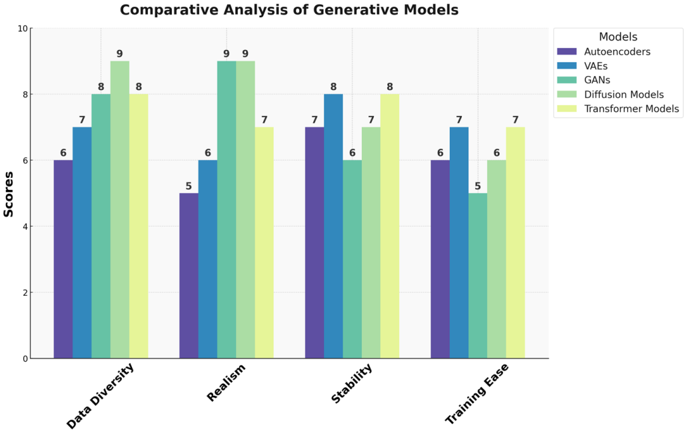
“It has been demonstrated that GANbased synthesis approaches may create unexpectedly high-quality false videos (Karras et al. 2019).”
What the sources say
- Partly supportedcites Karras et al. 2019 matched to “A Style-Based Generator Architecture for Generative Adversarial Networks” (2019) sourceExperimental — accuracy not yet measured
Section 2.1 (pp. 2–3) reports that the GAN generator produces high-quality synthetic images. It does not demonstrate the creation of false videos; the video mentioned on p. 3 accompanies the image results. (LLM, conf=0.87)
states a possible cause- Asserted: passes — The authors put it forward as true.
- Checkable: passes — It can be checked against evidence.
- Load-bearing: passes — The paper’s conclusions depend on it.
- Based: passes — The paper gives a reason why it holds.
- Partly supported
The cited sources support only part of this claim — read each source’s verdict below.
In the paper
“Diffusion models can produce more realistic images compared to GANs and VAEs (Aghasanli etal. 2023; Dhariwal and Nichol 2021).”
What the sources say
- Not checked — no full text of the sourcecites Aghasanli et al. 2023 matched to “Interpretable-through-prototypes deepfake detection for diffusion models” (2023) source
- Partly supportedcites Dhariwal and Nichol 2021 matched to “Diffusion Models Beat GANs on Image Synthesis” (2021) sourceExperimental — accuracy not yet measured
The Conclusion states that the authors’ diffusion models achieve better sample quality than state-of-the-art GANs, supporting the GAN comparison. The Introduction discusses VAEs among likelihood-based models but does not establish a direct diffusion-versus-VAE image-quality comparison, so that part of the claim is not supported by our copy. (LLM, conf=0.85)
plain- Asserted: passes — The authors put it forward as true.
- Checkable: passes — It can be checked against evidence.
- Load-bearing: unclear — It is unclear whether the paper’s conclusions depend on it.
- Based: passes — The paper gives a reason why it holds.
The cited sources support only part of this claim — read each source’s verdict below.
In the paper
“It is becoming increasingly simple to use pretrained GAN to instantly replace one person's face in an image or video with the face of another person (Liu etal. 2021b).”
What the sources say
- Partly supportedcites Liu et al. 2021b matched to “Generative Adversarial Networks for Image and Video Synthesis: Algorithms and Applications” (2021) sourceExperimental — accuracy not yet measured
Section 6.1 (page unavailable) describes face swapping as placing one person's face region onto another, supporting the replacement part of the claim. The Subject-agnostic section says some methods need only one image to synthesize a person's video, but it discusses reenactment rather than instant face swapping. The paper does not establish that pretrained GANs can be used to do this instantly or that doing so is becoming increasingly simple. (LLM, conf=0.88)
plainstates a cause- Asserted: passes — The authors put it forward as true.
- Checkable: passes — It can be checked against evidence.
- Load-bearing: unclear — It is unclear whether the paper’s conclusions depend on it.
- Based: passes — The paper gives a reason why it holds.
- Partly supported
Every source the paper cites for this claim was checked and supports it.
In the paper
“The dataset contains videos with various visual artefacts and modifications, making it appropriate for testing deepfake detection algorithms (Korshunov and Marcel 2018).”
What the sources say
- Supportedcites Korshunov and Marcel 2018 matched to “DeepFakes: a New Threat to Face Recognition? Assessment and Detection” (2018) source
The Deepfake Database section (pp. 2–3) describes face-swapped videos made in low- and high-quality versions using different blending techniques. The Introduction (p. 1) and Detection section (pp. 3–4) report using the dataset to evaluate deepfake detection methods, including methods based on image quality. Together, these support the claim that its visual variations make it suitable for testing detection algorithms. (LLM, conf=0.90)
plainstates an association- Asserted: passes — The authors put it forward as true.
- Checkable: passes — It can be checked against evidence.
- Load-bearing: unclear — It is unclear whether the paper’s conclusions depend on it.
- Based: passes — The paper gives a reason why it holds.
- Supported
The cited sources support only part of this claim — read each source’s verdict below.
In the paper
“Most existing deepfake detection algorithms are based on DNN because of their capability in feature extraction and selection processes (Afchar et al. 2018; Li et al. 2018; Rossler etal. 2019).”
What the sources say
- Partly supportedcites Afchar et al. 2018 matched to “MesoNet: a Compact Facial Video Forgery Detection Network” (2018) sourceExperimental — accuracy not yet measured
The Proposed method (p. 3) describes this paper's deep neural network for detecting forged videos and its convolutional and pooling layers for feature extraction. It does not establish that most existing deepfake detectors use DNNs or attribute their use to feature-selection capabilities; the introduction (p. 1) says the authors knew of no other method dedicated to Deepfake detection. (LLM, conf=0.86)
- Not matchedcites Li et al. 2018
This doesn’t read as a citation we can look up.
- Partly supportedcites Rossler et al. 2019 matched to “FaceForensics++: Learning to Detect Manipulated Facial Images” (2019) sourceExperimental — accuracy not yet measured
The Face Manipulation Methods section says more recent forensic literature concentrates on CNN-based solutions, and the Introduction credits CNNs with learning powerful image features. These passages support the prevalence of neural-network detectors and the feature-learning rationale, but they do not establish a capability in feature selection processes. (LLM, conf=0.84)
plainstates a cause- Asserted: passes — The authors put it forward as true.
- Checkable: passes — It can be checked against evidence.
- Load-bearing: unclear — It is unclear whether the paper’s conclusions depend on it.
- Based: passes — The paper gives a reason why it holds.
- Partly supported
74 more claims · 10 with their cited sources checked
Create a free account to see all 330 claims and to verify the 12 references still open.
- Probably not a substantial claim. 212
- It may state two separate claims as one. 87
Claims other papers make about this one
Each is checked against this paper’s own text: does it say what the citing paper says it does?
The source backs part of the claim, not all of it — or backs it for a different population, condition or comparison.
In the citing paper
“these models often overfit to dataset-specific artifacts and exhibit poor generalization to unseen datasets or novel manipulation methods [13].”
From Cross-dataset video deepfake detection using Transformer and CNN architectures (2026) · cites this paper as [13]
Experimental — accuracy not yet measuredThe source backs part of the claim, not all of it — or backs it for a different population, condition or comparison.
In the citing paper
“Current survey papers [5-9, 15, 15, 16] primarily focus on reviewing detection methods based on their accuracy performance within the same dataset (within-domain evaluation), which achieves high accuracy (often exceeding 95%).”
From Deepfake detection across image, video, and audio: a comprehensive survey with empirical evaluation of generalization and robustness (2026) · cites this paper as [5]
Experimental — accuracy not yet measuredThe source backs part of the claim, not all of it — or backs it for a different population, condition or comparison.
In the citing paper
“While current survey papers [5, 7, 9, 15] provide extensive taxonomies and theoretical discussions, they lack empirical evaluations that would enable researchers to understand the relative strengths and limitations of different approaches.”
From Deepfake detection across image, video, and audio: a comprehensive survey with empirical evaluation of generalization and robustness (2026) · cites this paper as [5]
Experimental — accuracy not yet measuredThe source backs part of the claim, not all of it — or backs it for a different population, condition or comparison.
In the citing paper
“While surveys report impressive within-domain accuracies, they fail to examine how these same detectors perform when facing new data types, unseen manipulation techniques, or emerging generator architectures [5, 7, 9, 15].”
From Deepfake detection across image, video, and audio: a comprehensive survey with empirical evaluation of generalization and robustness (2026) · cites this paper as [5]
Experimental — accuracy not yet measuredThe cited source says what the claim attributes to it.
In the citing paper
“While there are several surveys of passive DF detection that examine specific modalities in isolation [5-9], the field requires a holistic analysis that transcends these single approaches.”
From Deepfake detection across image, video, and audio: a comprehensive survey with empirical evaluation of generalization and robustness (2026) · cites this paper as [5]
1 more claim about this paper
Create a free account to see every claim other papers make about this one.
Citations
Cites
Deep Residual Learning for Image Recognition
He, K., Zhang, X., Ren, S., & Sun, J. (2016) · 2016 IEEE Conference on Computer Vision and Pattern Recognition (CVPR) · doi:10.1109/cvpr.2016.90 · Cited by 235,474 · cited 1×
“It has also been used in deepfake detection and achieved high accuracy (He et al. 2016).”
Language Models are Few-Shot Learners
Brown, T. B., Mann, B., Ryder, N., Subbiah, M., Kaplan, J., Dhariwal, P., Neelakantan, A., Shyam, P., Sastry, G., Askell, A., et al. (2020) · arXiv · doi:10.48550/arxiv.2005.14165 · Cited by 23,372
Generative adversarial networks
Goodfellow, I., Pouget-Abadie, J., Mirza, M., Xu, B., Warde-Farley, D., Ozair, S., Courville, A., & Bengio, Y. (2020) · Communications of the ACM · doi:10.1145/3422622 · Cited by 18,384
EfficientNet: Rethinking Model Scaling for Convolutional Neural Networks
Tan, M., & Le, Q. V. (2019) · arXiv · doi:10.48550/arxiv.1905.11946 · Cited by 17,072
Mastering the game of Go with deep neural networks and tree search
Silver, D., Huang, A., Maddison, C. J., Guez, A., Sifre, L., van den Driessche, G., Schrittwieser, J., Antonoglou, I., Panneershelvam, V., Lanctot, M., et al. (2016) · Nature · doi:10.1038/nature16961 · Cited by 15,612 · cited 1×
“I m p r ov e d e xp l a i n a b ilit y o f d e t ec ti on r e s u l t s (Silver et al. 2016).”
A survey on deep learning in medical image analysis
Litjens, G., Kooi, T., Bejnordi, B. E., Setio, A. A. A., Ciompi, F., Ghafoorian, M., van der Laak, J. A. W. M., van Ginneken, B., & Sánchez, C. I. (2017) · Medical Image Analysis · doi:10.1016/j.media.2017.07.005 · Cited by 15,332 · cited 1×
“However, Litjens et al. (2017) mentioned that a lack of labelled data is a common issue when applying machine learning to medical images, even when enormous volumes of unlabelled data are available (Zhang et al. 2020).”
A Style-Based Generator Architecture for Generative Adversarial Networks
Karras, T., Laine, S., & Aila, T. (2019) · 2019 IEEE/CVF Conference on Computer Vision and Pattern Recognition (CVPR) · doi:10.1109/cvpr.2019.00453 · Cited by 11,714 · cited 2×
“Deepfake technology has made it possible to make these videos look real; therefore, it is necessary to assess the videos’ authenticity (Westerlund 2019; Karras et al. 2019).”
Denoising Diffusion Probabilistic Models
Ho, J., Jain, A., & Abbeel, P. (2020) · arXiv · doi:10.48550/arxiv.2006.11239 · Cited by 8,712
3D Convolutional Neural Networks for Human Action Recognition
Ji, S., Xu, W., Yang, M., & Yu, K. (2013) · IEEE Transactions on Pattern Analysis and Machine Intelligence · doi:10.1109/tpami.2012.59 · Cited by 6,235
Deep Residual Learning for Image Recognition
He, K., Zhang, X., Ren, S., & Sun, J. (2015) · arXiv · doi:10.48550/arxiv.1512.03385 · Cited by 4,196
Research works printed but not linked: 7
- Agarwal S, Farid H, Gu Y etal (2019) Protecting world leaders against deep fakes. In: CVPR workshops. pp 38-45
- Cheng S, Dong Y, Pang T et al (2019) Improving black-box adversarial attacks with a transfer-based prior. In: Advances in neural information processing systems, vol 32
- Dufour N, Gully A (2019) Contributing data to deepfake detection research. Google AI Blog 1(2):3
- George AS, George AH (2023) Deepfakes: the evolution of hyper realistic media manipulation. Partn Univers Innov Res Publ 1(2):58-74
- Koopman M, Rodriguez AM, Geradts Z (2018) Detection of deepfake video manipulation. In: The 20th Irish machine vision and image processing conference (IMVIP). pp 133-136
- Le TN, Nguyen HH, Yamagishi J etal (2021) OpenForensics: large-scale challenging dataset for multi-face forgery detection and segmentation in-the-wild. In: Proceedings of the IEEE/CVF international conference on computer vision. pp 10117-10127
- Malik MH, Ghous H, Qadri S etal (2023) Frequency-based deep-fake video detection using deep learning methods. J Comput Biomed Inform 4(02):41-48 <!-- image -->
Cited by
Digital deception: generative artificial intelligence in social engineering and phishing
Schmitt, M., & Flechais, I. (2024) · Artificial Intelligence Review · doi:10.1007/s10462-024-10973-2 · Cited by 198
“Kaur et al. (2024) have published a comprehensive study on deepfake video detection, highlighting significant threats posed by false content created using generative AI.”
Enhanced deepfake detection with densenet and cross-vit
Siddiqui, F., Yang, J., Xiao, S., & Fahad, M. (2025) · Expert Systems with Applications · doi:10.1016/j.eswa.2024.126150 · Cited by 62
Babaei, R., Cheng, S. S. M., Duan, R., & Zhao, S. (2025) · Journal of Sensor and Actuator Networks · doi:10.3390/jsan14010017 · Cited by 106
“For Alzheimer’s patients, animated representations of loved ones can provide comfort and emotional connection [58].”
Deepfake video detection methods, approaches, and challenges
Alrashoud, M. (2025) · Alexandria Engineering Journal · doi:10.1016/j.aej.2025.04.007 · Cited by 49
Maheshwari, R. U., & Paulchamy, B. (2024) · Automatika · doi:10.1080/00051144.2024.2400640 · Cited by 66
Kumar, A., Singh, D., Jain, R., Jain, D. K., Gan, C., & Zhao, X. (2025) · Information Fusion · doi:10.1016/j.inffus.2025.102993 · Cited by 59
Managing deepfakes with artificial intelligence: Introducing the business privacy calculus
Vecchietti, G., Liyanaarachchi, G., & Viglia, G. (2024) · Journal of Business Research · doi:10.1016/j.jbusres.2024.115010 · Cited by 72
Jabir, R. M., Le, J., & Nguyen, C. (2025) · AI · doi:10.3390/ai6080174 · Cited by 89
The Evolution of Generative AI: Trends and Applications
Τρίγκα, Μ., & Dritsas, E. (2025) · IEEE Access · doi:10.1109/access.2025.3574660 · Cited by 65
“In national security and political arenas, these technologies assist in identifying influence campaigns and cyberattacks involving fabricated audio-visual content [152], [153].”
Zhang, Y., Pang, Z., Huang, S., Wang, C., & Zhou, X. (2025) · Journal of King Saud University - Computer and Information Sciences · doi:10.1007/s44443-025-00154-8 · Cited by 47
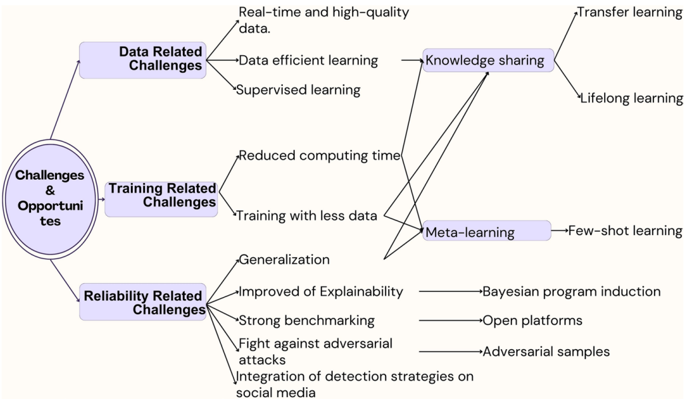
“Kaur et al. (2024) provided a detailed classification of detection methods while discussing some challenges in the field, which are summarized into three categories: data challenges, training challenges, and reliability challenges.”
Singh, S., & Dhumane, A. (2025) · MethodsX · doi:10.1016/j.mex.2025.103632 · Cited by 24
“Research on artificial intelligence is rapidly expanding, focusing on deepfake detection systems [101] and bringing ethical concerns about synthetic media into the mix.”
DeepFake video detection: Insights into model generalisation — A Systematic review
Ramanaharan, R., Guruge, D. B., & Agbinya, J. I. (2025) · Data and Information Management · doi:10.1016/j.dim.2025.100099 · Cited by 52
Samuel-Okon, A. D., Akinola, O. I., Olaniyi, O. O., Olateju, O. O., & Ajayi, S. A. (2024) · Archives of Current Research International · doi:10.9734/acri/2024/v24i6794 · Cited by 36
Consumer Engagement: Exploring Deepfake Applications in Consumer Marketing Communication
Salam, M. A., Rayun, S. M. N., Islam, W., Hasan, R., Firmansyah, E. A., & Kalinaki, K. (2024) · Advances in information security, privacy, and ethics book series · doi:10.4018/979-8-3693-5298-4.ch020 · Cited by 23
International AI Safety Report
Bengio, Y., Mindermann, S., Privitera, D., Besiroglu, T., Bommasani, R., Casper, S., Choi, Y., Fox, P., Garfinkel, B., Goldfarb, D., et al. (2025) · arXiv · doi:10.48550/arxiv.2501.17805 · Cited by 16
AI-deepfake scams and the importance of a holistic communication security strategy
Muhly, F., Chizzonic, E., & Leo, P. (2025) · International Cybersecurity Law Review · doi:10.1365/s43439-025-00143-7 · Cited by 23
Alkrisheh, M. A., & Gourari, F. M. (2025) · Access to Justice in Eastern Europe · doi:10.33327/ajee-18-8.2-r000110 · Cited by 14
Xie, W., Hu, A., Xie, Q., Chen, J., Wan, R., & Liu, Y. (2025) · Discover Computing · doi:10.1007/s10791-025-09628-9 · Cited by 25
Deepfake defense: Combining spatial and temporal cues with CNN–BiLSTM–transformer architecture
Yadav, S., & Mangalampalli, S. S. (2025) · PLoS ONE · doi:10.1371/journal.pone.0334980 · Cited by 17
UAM‐Net : Robust Deepfake Detection Through Hybrid Attention Into Scalable Convolutional Network
Sudarshana, K., & Yendapalli, V. (2025) · Expert Systems · doi:10.1111/exsy.70009 · Cited by 21
Deepfake detection: critical review of state-of-the-art approaches and future perspectives
Soundarya, B. C., & Gururaj, H. L. (2026) · Discover Applied Sciences · doi:10.1007/s42452-025-08174-9 · Cited by 27
“VAEs belong to a category of generative models designed to encode and decode high-dimensional data [53, 55].”
Sharma, S., & Selwal, A. (2025) · Computer Science Review · doi:10.1016/j.cosrev.2025.100866 · Cited by 21
Raza, A., Basit, A., Amin, A., Arfeen, Z. A., Masud, M. I., Fayyaz, U., & Jumani, T. A. (2026) · AI · doi:10.3390/ai7020068 · Cited by 23
Nasution, A. V. A., Suteki, S., & Lumbanraja, A. D. (2025) · International Journal for the Semiotics of Law - Revue internationale de Sémiotique juridique · doi:10.1007/s11196-025-10265-0 · Cited by 37
A Dual-Branch Fusion Model for Deepfake Detection Using Video Frames and Microexpression Features
Petmezas, G., Vanian, V., Rufete, M. P., Almaloglou, E. E. I., & Zarpalas, D. (2025) · Journal of Imaging · doi:10.3390/jimaging11070231 · Cited by 8
“However, as deepfake technology continues to improve, generating increasingly realistic facial appearances and expressions, existing approaches struggle to detect subtle manipulations [3].”
Advancements in Deepfake Detection : A Review of Emerging Techniques and Technologies
Degadwala, S., & Patel, V. M. (2024) · International Journal of Scientific Research in Computer Science Engineering and Information Technology · doi:10.32628/cseit24105811 · Cited by 15
Beyond Deception: Exploiting Deepfake Technology for Ethical Innovation in Healthcare
Kaur, A., Hoshyar, A. N., Wang, X., & Xia, F. (2024) · International Workshop on Multimedia Computing for Health and Medicine (MCHM) · doi:10.1145/3688868.3689196 · Cited by 15
Self-citationCross-dataset video deepfake detection using Transformer and CNN architectures
Petmezas, G. (2026) · Machine Vision and Applications · doi:10.1007/s00138-026-01809-w · Cited by 6
X3A: Efficient Multimodal Deepfake Detection with Score-Level Fusion
Park, C. S., Moon, B., Jeon, M., Jung, J.-W., & Woo, S. S. (2025) · ACM Symposium on Applied Computing · doi:10.1145/3672608.3707934 · Cited by 13
Alkhatib, M. (2025) · Computers · doi:10.3390/computers14110488 · Cited by 11
Secure Comparative Evaluation of Alzheimer MRI Classification Models Using Blockchain
Dash, A., Amin, F., Sahoo, S. K., & Mishra, S. K. (2025) · International Conference on Intelligent Systems and Embedded Design (ISED) · doi:10.1109/ised67359.2025.11405347 · Cited by 15
Pintelas, E. G., Livieris, I. E., Tampakas, B., & Pintelas, P. (2024) · Big Data and Cognitive Computing · doi:10.3390/bdcc9010002 · Cited by 7
Framework for Quantum‐Based Deepfake Video Detection (Without Audio)
Pandey, A., Rudra, B., & Krishnan, R. K. (2025) · International Journal of Intelligent Systems · doi:10.1155/int/3990069 · Cited by 7
“…learning models such as convolutional neural networks (CNNs), pre-trained models such as ResNet, EfcientNet, Xception, etc., and then trained the classifers such as artifcial neural networks (ANNs), recurrent neural networks (RNNs), long short-term memory (LSTM), etc., on extracted features [9].”
InfluentialDeepfake Technologies in Financial Fraud: Generation, Detection, and Mitigation Strategies
Shetye, A., Jain, N., Borade, S., & Rai, V. K. (2025) · Global Conference in Emerging Technology (GINOTECH) · doi:10.1109/ginotech63460.2025.11076798 · Cited by 7
Deepfakes and the crisis of digital authenticity: ethical challenges in the age of synthetic media
Verma, A. (2025) · Journal of Information Communication and Ethics in Society · doi:10.1108/jices-04-2025-0083 · Cited by 21
Face Swap Detection: A Systematic Literature Review
Hriez, S. (2025) · IEEE Access · doi:10.1109/access.2025.3598980 · Cited by 9
“In [9], they provides a comprehensive analysis of deepfake video generation and detection, emphasizing the growing societal concerns posed by AI-generated fake media.”
Jugade, Y., Syed, Z., Dcosta, C., Panicker, A., & Vora, D. R. (2026) · Discover Applied Sciences · doi:10.1007/s42452-025-08014-w · Cited by 13
“Kaur et al. [12] offered a thorough review of feature extraction techniques, emphasizing how CNNs, such as XceptionNet, MesoNet, and EfficientNet, effectively detect deepfake artifacts with high efficiency.”
MSER-Net: Multi-stage edge refinement network for deepfake detection
Zhang, Y., Wang, C., & Zhou, X. (2025) · Knowledge-Based Systems · doi:10.1016/j.knosys.2025.114280 · Cited by 8
Javiya, D., Jethava, G., Parmar, H., & Jethava, S. (2025) · Discover Applied Sciences · doi:10.1007/s42452-025-07690-y · Cited by 7
An adaptive dual-domain feature representation method for enhanced deep forgery detection
Li, M., Qin, Y., Zhang, H., & Shi, Z. (2025) · Journal of Automation and Intelligence · doi:10.1016/j.jai.2025.11.003 · Cited by 6
CCFormer: A cascaded transformer framework for precise temporal audio-visual deepfake localization
Li, P., & Ren, J. (2025) · Alexandria Engineering Journal · doi:10.1016/j.aej.2025.12.001 · Cited by 5
Deepfake-as-a-Service: The Next Challenge for Enterprise Cybersecurity
Suleiman, N. A. (2025) · Journal of Technology and Systems · doi:10.47941/jts.2752 · Cited by 4
“Kaur et al. (2024) defines deepfakes as digitally altered media predominantly video, audio, or images created using generative adversarial networks (GANs) or similar machine learning architectures.”
Compression-Aware Hybrid Framework for Deep Fake Detection in Low-Quality Video
Lagsoun, A. M., Mustapha, O., & Hedabou, M. (2025) · IEEE Access · doi:10.1109/access.2025.3592358 · Cited by 8
Addressing Misinformation and Disinformation
Meese, J., & Tan, C. C. T. (2026) · Cambridge University Press eBooks · doi:10.1017/9781009768177 · Cited by 4
Explainable multi-granularity attribution reasoning framework for fake news detection
Ji, W., Lv, H., Zhao, H., & Zimmermann, R. (2026) · npj Artificial Intelligence · doi:10.1038/s44387-026-00093-3 · Cited by 6
Ngo, T. T. A., NGUYEN, N. Q. H., & Nguyen, N. A. (2026) · Telematics and Informatics Reports · doi:10.1016/j.teler.2026.100327 · Cited by 6
Development of Enhanced Video Manipulation Detection Using Hybrid CNN-LSTM Method for Object Forgery
Gaashan, S. M., Kamarudin, N. H., Abdullah, S. N. H. S., et al. (2025) · doi:10.1109/icoact63339.2025.11004790 · Cited by 3
LiteFat: Lightweight Spatio-Temporal Graph Learning for Real-Time Driver Fatigue Detection
Ren, J. F., Ma, S., Jia, H., Xu, X., Lee, I., Fayek, H. M., Li, X., & Xia, F. (2025) · IEEE/RSJ International Conference on Intelligent Robots and Systems (IROS) · doi:10.1109/iros60139.2025.11247563 · Cited by 3
“Despite significant advancements in vision-based fatigue detection, numerous practical challenges remain [8], [9], [10].”
Self-citationS., C., Surendran, R., & Madhusundar., N. (2025) · International Conference on Multi-Agent Systems for Collaborative Intelligence (ICMSCI) · doi:10.1109/icmsci62561.2025.10894352 · Cited by 3
Bhattacharjee, A., Islam, K., Anan, K., Intesher, A., Fuad, A. A., Saha, U., & Imtiaz, H. (2025) · Journal of Visual Communication and Image Representation · doi:10.1016/j.jvcir.2025.104679 · Cited by 24
“As such, the major issues in the existing detection approaches are i) the lack of generalizability of extracted features, and ii) the inability to be up to date with new fake image generation techniques [25].”
Hierarchical risk assessment of digital financial fraud: a multi-criteria analysis
Puri, L., & Singh, R. (2025) · Journal of Enterprise Information Management · doi:10.1108/jeim-05-2025-0423 · Cited by 7
Li, P., Huang, Q., Shuang, F., Cai, Y., Cheng, H., & Li, Q. (2026) · IEEE Transactions on Information Forensics and Security · doi:10.1109/tifs.2026.3658995 · Cited by 2
“Video classification [20] is a fundamental task that classifies videos into class labels, and it has many applications in fields such as deepfake classification [21], [22], action recognition [23], and multimedia analysis [24], [25].”
Zhu, G., Li, H.-S., Xia, H., & Song, S. (2026) · Neurocomputing · doi:10.1016/j.neucom.2026.133067 · Cited by 2
TalkingHeadBench: A Multi-Modal Benchmark & Analysis of Talking-Head DeepFake Detection
Xiong, X., Patel, P., Fan, Q., Wadhwa, A., Selvam, S., Guo, X., Qi, L., Liu, X., & Sengupta, R. (2026) · IEEE Winter Conference on Applications of Computer Vision · doi:10.1109/wacv61042.2026.00403 · Cited by 18
“Deepfake technology, known for its ability to manipulate facial features and produce highly realistic synthetic videos, has seen rapid adoption in entertainment [1, 22], marketing [20], and personalized content creation [29, 30, 46].”
Evaluating Models for Deepfake Detection: A Comparative Study
Krishna, V., Neha, P. S., Vyshnavi, P., & Vidyasekaran, H. (2024) · International Conference on IoT Based Control Networks and Intelligent Systems (ICICNIS) · doi:10.1109/icicnis64247.2024.10823264 · Cited by 3
“It means that the prospect of producing deepfakes is now opened up to anyone who may want to do so, in threatening ways, increasing the possibilities of abuse [4].”
Digital Narratives and AI in Modern Media: A Systematic Literature Review
Harahap, K., Muhtar, Sakarina, S., Shofwani, S. A., & Hariyadi, A. (2025) · Studies in systems, decision and control · doi:10.1007/978-3-031-84636-6_16 · Cited by 2
Comparative Evaluation of Xception and DenseNet121 for Robust Deepfake Detection
Yesugade, K. D., & Jadhav, R. (2025) · International Conference on Computing for Sustainable Global Development · doi:10.23919/indiacom66777.2025.11115841 · Cited by 3
“Additionally, there have been improvement on deepfake detection accuracy by hybrid architectures (XceptionNet combined with frequency domain techniques or transformer based models) [4], [5].”
Uncovering Critical Features for Deepfake Detection through the Lottery Ticket Hypothesis
Amin, L. A., Hossain, M. I., Nguyen, T. T., -, T. J., Islam, M. N., & Quader, F. (2025) · Conference proceedings/Conference proceedings - IEEE International Conference on Systems, Man, and Cybernetics · doi:10.1109/smc58881.2025.11342662 · Cited by 6
“…deepfake detection introduces speci fi c challenges related to feature preservation and pruning biases: 1) Preserving Rare Feature Sensitivity: Deepfake detection critically depends on recognizing subtle manipulation artifacts [20], often represented by a limited number of parameters in the network.”
Seeing, Hearing, and Knowing Together: Multimodal Strategies in Deepfake Videos Detection
Chen, C., & Goh, D. H. (2026) · CHI Conference on Human Factors in Computing Systems · doi:10.1145/3772318.3790480 · Cited by 2
Nguyen-Le, H.-H., Tran, V.-T., Nguyen, D.-T., & Le-Khac, N.-A. (2026) · Artificial Intelligence Review · doi:10.1007/s10462-026-11608-4 · Cited by 28
Detection and Prevention from Deepfake Images Videos Using Increasing Frame Method
Chauhan, S. S., Goel, A., Singh, A. K., Jain, N., Vishwakarma, P. K., & Kaushik, A. (2025) · International Conference on Automation and Computation (AUTOCOM) · doi:10.1109/autocom64127.2025.10956354 · Cited by 1
“This research seeks to address the challenges [13] and implications associated with such practices.”
Devi, M., & Gangwar, V. P. (2025) · Information systems engineering and management · doi:10.1007/978-3-031-90742-5_11 · Cited by 1
Vanian, V., Πετμεζάς, Γ., Konstantoudakis, K., & Zarpalas, D. (2025) · ACM International Workshop on Multimedia AI against Disinformation (MAD) · doi:10.1145/3733567.3735569 · Cited by 2
“The rise of AI has dramatically transformed digital content creation giving rise to deepfake technology, which generates highly convincing manipulated videos [10].”
Deepfake Content Detection using Deep Learning Techniques
Devarajan, H., Palli, I. S. V., Ahammed, A., & Kolagatla, H. R. (2025) · International Conference on Self Sustainable Artificial Intelligence Systems (ICSSAS) · doi:10.1109/icssas66150.2025.11081378 · Cited by 1
“Considering the image classifications for accurate findings on deepfakes vs. originals, face manipulations have been seriously hampered by the lack of adequate datasets [14].”
A Spatio-Temporal Deep Learning Approach for Efficient Deepfake Video Detection
Khudhur, R. Z., & Mohammed, M. A. (2025) · ARO-The Scientific Journal of Koya University · doi:10.14500/aro.12190 · Cited by 1
Pokharel, B. P., Kshetri, N., Sharma, S. R., Paudel, S., & Baral, S. (2025) · Advances in computational intelligence and robotics book series · doi:10.4018/979-8-3373-6481-0.ch004 · Cited by 1
Khan, M. S. (2025) · Applied Cybersecurity & Internet Governance · doi:10.60097/acig/213864 · Cited by 5
“Most current approaches are either technological, which are focused on detection, watermarking, or content moderation, or psychological, involving inoculation theory and media literacy programs [3, 4, 10].”
DEEPFAKE ART THREAT OR INNOVATION IN DIGITAL CREATIVITY
Pandey, A. K., Minhas, D., Goyal, E., Bhowmik, M., Khajanchi, Y., & Dhawan, A. (2025) · ShodhKosh Journal of Visual and Performing Arts · doi:10.29121/shodhkosh.v6.i1s.2025.6619 · Cited by 1
AI-Enhanced Phishing Attacks: Understanding the Threat Landscape and Defense Strategies
Aydın, E. E., & Bahtıyar, Ş. (2025) · IEEE Global Conference on Artificial Intelligence and Internet of Things (GCAIoT) · doi:10.1109/gcaiot68269.2025.11275533 · Cited by 1
“For example, recent studies propose deception identification tools that leverage LLMs or forensic AI to assess content authenticity [2], [22].”
A Survey of Talking Head Synthesis Techniques: Portrait Generation, Driving Mechanisms, and Editing
Meng, M., Zhao, Y., Zhang, B., Zhu, Y., Shi, W., Wen, Z., & Fan, Z. (2026) · ACM Computing Surveys · doi:10.1145/3785656 · Cited by 13
Han, M., Jiaxuan, L., Ou, S., Xu, L., & Tao, L. (2025) · Applied Soft Computing · doi:10.1016/j.asoc.2025.114392 · Cited by 3
Lavanya, T., Pandeeswaran, C., & Morin, L. S. (2025) · International Conference on Sustainable Communication Networks and Application (ICSCNA) · doi:10.1109/icscn67106.2025.11308255 · Cited by 1
“The warping artifacts also created by face replacement techniques were analyzed also [2] with a CNN based classifier to see the discrepancies between facial areas and their immediate surroundings (i.e relating to body and object).”
DeepFake Detection Through Deep Learning: A Comprehensive Review
Vishal, P., Dr. Padiya Swity, R., & Ketankumar, P. P. (2026) · International Journal of Scientific Research in Computer Science Engineering and Information Technology · doi:10.32628/cseit26128 · Cited by 3
Optimal transport-guided framework for adversarial robust deepfake detection
Chatterjee, S. (2026) · Discover Computing · doi:10.1007/s10791-026-09904-2 · Cited by 3
Bayram, F. (2026) · IEEE Access · doi:10.1109/access.2026.3665315 · Cited by 1
DeepFake detection in images and videos: a survey on models, datasets, and evaluation metrics
Bhat, N. A., & Giri, K. J. (2026) · Multimedia Tools and Applications · doi:10.1007/s11042-026-21365-9 · Cited by 2
Behind the Pixels: Unveiling Deepfake Videos
Agrawal, P. K., Lohani, S., Durge, P., & Kushwaha, R. K. (2025) · IEEE International Conference on Recent Advances in Computing and Systems (REACS) · doi:10.1109/reacs67479.2025.11413478 · Cited by 1
“[4][5] Performance on DFDCUsing a variety of face-swap methods on the DFDC dataset, the model demonstrated resilience to different kinds of adjustments.”
Deepfake detection using deep convolutional neural network and long short-term memory
Bahadure, S., & Mane, V. M. (2026) · Multimedia Tools and Applications · doi:10.1007/s11042-026-21375-7 · Cited by 3
Singh, S., Chand, N., Singh, A. K., Dwivedi, R. K., Kumar, D., Prakash, S., & Gupta, M. K. (2025) · International Conference on IoT, Communication and Automation Technology (ICICAT) · doi:10.1109/icicat68430.2025.11414686 · Cited by 1
“Kaur et al. [3] proposed in This paper, the author focuses on comprehensive systematic literature review (SLR) focusing on deepfake video detection.”
Deepfake Detection Using Deep Learning
Singh, A., Grover, D., Ambastha, A., & Devi, D. (2026) · International Conference on Innovative Practices in Technology and Management (ICIPTM) · doi:10.1109/iciptm69057.2026.11465497 · Cited by 1
Future-Proofing Deepfake Detection by Integrating Audio, Video, and Text
Lisena, P., Lee, K. A., Wang, Y., Todisco, M., Galdi, C., Troncy, R., Evans, N., Lin, W., Chau, L., & Mak, M. (2026) · ACM AI Letters · doi:10.1145/3797958 · Cited by 2
Yang, H., Xiong, Y., Zhao, N., Yan, X., Zhang, D., Zhang, Y., & Wang, H. (2026) · Signal Processing · doi:10.1016/j.sigpro.2026.110668 · Cited by 3
Mahto, D. K., Singh, R., Dwivedi, R., & Kumar, A. (2026) · Signal Image and Video Processing · doi:10.1007/s11760-026-05328-z · Cited by 1
“The recent forensic report indicate a rapid year growth on prevalence of deepfake videos across digital platform, which signifying serious escalation in misinformation threats and fraud identity [2].”
Armağan, S., Gündoğan, E., Kaya, M., & Alhajj, R. (2026) · Ain Shams Engineering Journal · doi:10.1016/j.asej.2026.104233 · Cited by 3
Deception Detection Using Facial and Audio Transcript Features : A Review
Degadwala, S., & Thakkar, R. (2024) · International Journal of Scientific Research in Computer Science Engineering and Information Technology · doi:10.32628/cseit2410584 · Cited by 1
Truth vs. Fabrication: Exploring AI’s Role in the Detection of Deepfakes
Mirkute, D. A. (2025) · International Journal Of Informative and Futuristic Research · doi:10.64672/ijifr/25.06.12.10.008
Data Security and Privacy for AI-Enabled Smart Manufacturing
Wang, X., Quevedo, D. E., Li, D., Cheng, P., Chen, J., & Sun, Y. (2025) · Engineering · doi:10.1016/j.eng.2025.08.008 · Cited by 3
Deepfake Manipulation and Ethical Dilemmas: A Comprehensive Risk Assessment
Kubanek, M., & Szymoniak, S. (2025) · Lecture notes in computer science · doi:10.1007/978-3-032-01429-0_46 · Cited by 3
AI Techniques for Deepfake DetectionPreprint
Alonge, M. (2025) · SSRN Electronic Journal · doi:10.2139/ssrn.5389575 · Cited by 1
Video Deepfake Detection: Current Trends, Methodologies, and Future Directions
Ansar, H. S., & Kumar, M. (2025) · International Conference on Machine Learning and Autonomous Systems (ICMLAS) · doi:10.1109/icmlas64557.2025.10968409
“Kaur et al. [13] conducted a thorough analysis of deepfake video detection, emphasizing the difficulties in spotting faked information.”
Hybrid Deep Learning for Detecting Fake Medical Images and Heart Sounds.
Soundarya, P., Vijayalakshmi, R., & Dharshini, P. (2025) · International Conference on Bio Signals, Images, and Instrumentation (ICBSII) · doi:10.1109/icbsii65145.2025.11013282
“[7] Deepfake Generating Deepfake technology generally involves creating synthetic medical images that replicate real ones, often through the modification or enhancement of images for purposes like data augmentation or ensuring privacy.”
A Systematic Literature Review of Deepfake Face Image Detection with Transfer Learning Techniques
Wimalasena, W., Herath, H., & Hewapathirana, I. U. (2025) · International Research Conference on Smart Computing and Systems Engineering (SCSE) · doi:10.1109/scse65633.2025.11031009 · Cited by 1
“[14] Challenges include adapting to rapidly evolving deepfake generation techniques, inconsistent evaluation metrics across studies, and poor model transferability across datasets and algorithms.”
Enhancing Digital Integrity with Hybrid Deepfake Detection for Images and Videos
Mahalakshmi, P. P., Mahalakshmi, S. B., & Suganthi, P. (2025) · International Conference on Data Science and Business Systems (ICDSBS) · doi:10.1109/icdsbs63635.2025.11031967
“[11] Some challenges they face are data inadequacies, computational cost, and continuing evolution of deepfake realism.”
A Hybrid Method For Effective Detection of Deep fake Videos: Literature Review
Narsimha, G., Varchas, V. S., Sarim, M., & Muddasir, N. M. (2025) · International Conference on Knowledge Engineering and Communication Systems (ICKECS) · doi:10.1109/ickecs65700.2025.11034965 · Cited by 1
“[ 9] Such systems are constrained through limited availability of good quality and diversity in datasets that permit the training and testing of those systems.”
Forward Thinking of Detecting Indiscernible Video CounterfeitsPreprint
Kalyan, C. V., Kaaurthik, M. K. B., & Jagadiswary, D. (2025) · Research Square · doi:10.21203/rs.3.rs-6929463/v1
Deepfake Manipulation on Social Media: A Case Study of Fraudulent Activities in Türkiye
Söğütlüler, T. (2025) · Intermedia International e-journal · doi:10.56133/intermedia.1614843 · Cited by 1
Bhandare, S. S., & Shirsath, K. (2025) · Lecture notes in networks and systems · doi:10.1007/978-981-96-3102-5_37
Video Forensic Analysis Using Deep Learning Models
Vinay, T., Ajina, A., Dongare, H., Joshi, S., Varma, G. L. S., & Rathod, R. D. (2025) · International Conference on Emerging Technologies in Computing and Communication (ETCC) · doi:10.1109/etcc65847.2025.11108521
Safeguarding Authenticity: Tackling the Cybersecurity Implications of Deepfake AI
Ajalkar, D. A., Patle, A., Dhend, P. S., Hande, V. A., Gosavi, K., & Shukla, A. (2025) · Engineering cyber-physical systems and critical infrastructures · doi:10.1007/978-3-031-91798-1_6 · Cited by 1
AI/ML-Based Solution for Detecting Face-Swap Deepfakes
Patil, S. S., Archana, M., Padmashree, M. S., & Pradeep Paul, C. (2025) · International Conference on Emerging Trends in Industry 4.0 Technologies (ICETI4T) · doi:10.1109/iceti4t63625.2025.11132146 · Cited by 1
“[6] II.”
Metadata
- Authors
- Kaur, A., Noori Hoshyar, A., Saikrishna, V., Firmin, S., & Xia, F.
- Affiliations
- Federation University (AU)
- RMIT University (AU)
- Corresponding author
- Kaur, Achhardeep
- Venue
- Artificial Intelligence Review
- Published
- 2024-05-29
- Volume
- 57
- Issue
- 6
- ISSN
- 0269-2821 (ISSN-L)
- 1573-7462
- OpenAlex
- W4399138486
- Cited by
- 214
- References
- 118
- Citations by year
- 2026: 93 · 2025: 109 · 2024: 12
- FWCI
- 29.81
- Type
- journal article
- Language
- en
- Open access
- hybrid
- doi.org
- Licence
- cc-by
- creativecommons.org/licenses/by/4.0 (tdm)
- creativecommons.org/licenses/by/4.0 (vor)
- Locations
- Artificial Intelligence Review (publishedVersion, cc-by)
- FedUni ResearchOnline (Federation University Australia) (submittedVersion, cc-by)
- Funders
- Federation University Australia
- Topics
- Physical Sciences › Computer Science › Computer Vision and Pattern Recognition › Digital Media Forensic Detection
- Social Sciences › Sociology and Political Science › Misinformation and Its Impacts
- Physical Sciences › Computer Science › Computer Vision and Pattern Recognition › Generative Adversarial Networks and Image Synthesis
- Keywords
- deepfake video detection, deep learning, misinformation, fake content, class imbalance, labeled training data, computational requirements, deepfake datasets, real-time detection
About these checks
Registry, retraction, Cites and statistics results are computed, not judged, with one exception: a printed reference that no index lists is read once by a model before it counts as a citation error. Claims are extracted by a model and kept only when their quote appears verbatim in the text; each cited source is then checked, with a model’s help, for whether it says what the claim relies on. Those verdicts can be wrong — read the claim’s quote and the cited source before relying on one.
The claim verdicts this report counts are experimental: their accuracy is not yet measured.
A language model drew the claims from the paper on 2026-10-10, under version 3 of the claim definition (model deepseek-v4.1-flash, prompt extract-v3).
A second model labelled each claim on 2026-10-10 (model jev-1.13-20260917, definition revision gold-guideline-v0.2).
Cited sources are checked with a language model’s help (gpt-6-sol).
Statistics and arithmetic are recomputed, not judged.
Confidence bands are shown only for fields calibrated on our annotated test set. None is calibrated yet, so no band is shown.
What counts as a claim ›How we measure confidence ›How we check this ›
Are you an author, or do you see a problem with this page? Request a review
Data sources
Bibliographic data: Semantic Scholar, OpenAlex, Crossref.
Contains information from the Semantic Scholar Academic Graph Datasets, made available under the ODC Attribution License (ODC-BY 1.0).
Semantic Scholar’s data is described in: Kinney, R., et al. (2023). The Semantic Scholar Open Data Platform. arXiv:2301.10140.
