

Deepfake video detection: challenges and opportunities
Open accessThe DOI matches its Crossref record; 122 of the 132 references it cites were found in a registry or an index, and 9 are not checked yet; 43 of the 163 sources its claims cite were checked for support.
Abstract
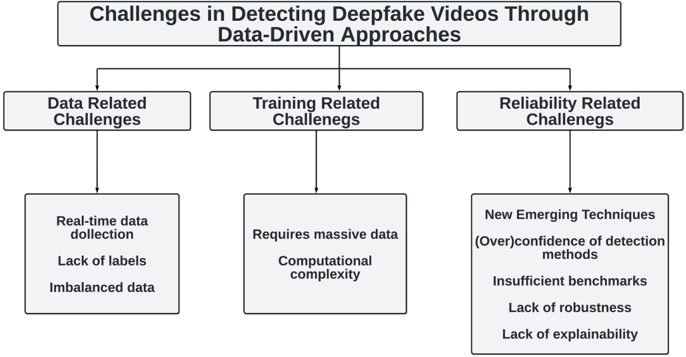
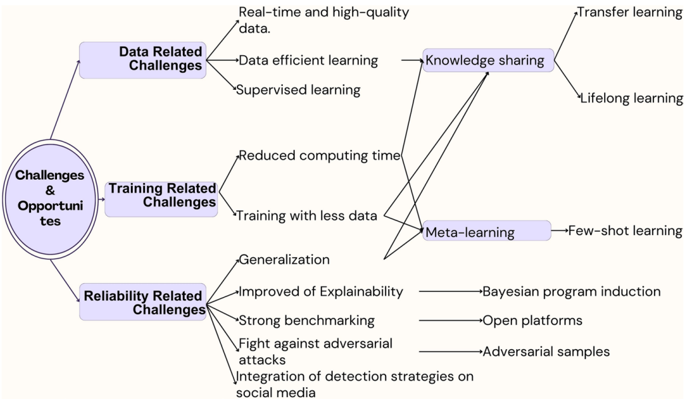
Abstract Deepfake videos are a growing social issue. These videos are manipulated by artificial intelligence (AI) techniques (especially deep learning), an emerging societal issue. Malicious individuals misuse deepfake technologies to spread false information, such as fake images, videos, and audio. The development of convincing fake content threatens politics, security, and privacy. The majority of deepfake video detection methods are data-driven. This survey paper aims to thoroughly analyse deepfake video generation and detection. The paper’s main contribution is the classification of the many challenges encountered while detecting deepfake videos. The paper discusses data challenges such as unbalanced datasets and inadequate labelled training data. Training challenges include the need for many computational resources. It also addresses reliability challenges, including overconfidence in detection methods and emerging manipulation approaches. The research emphasises the dominance of deep learning-based methods in detecting deepfakes despite their computational efficiency and generalisation limitations. However, it also acknowledges the drawbacks of these approaches, such as their limited computing efficiency and generalisation. The research also critically evaluates deepfake datasets, emphasising the necessity for good-quality datasets to improve detection methods. The study also indicates major research gaps, guiding future deepfake detection research. This entails developing robust models for real-time detection.
Verified 2026-11-22 · 9 references not checked yet
Overview
CoChat Summary
## TL;DR
This is a survey of deepfake video detection that argues the field is dominated by data-driven deep learning methods but still struggles with limited labeled data, imbalance, computational cost, generalization, and adversarial robustness. The paper’s main contribution is a taxonomy of deepfake-video-detection challenges, along with datasets, methods, open issues, and future opportunities grounded in a systematic review of 132 papers.
## Key findings
- The systematic literature review extracted data from 132 papers and found a strong emphasis on deep learning methods, especially CNNs and RNNs, for deepfake video detection.
- The paper highlights several recurring problems: limited data availability, unbalanced datasets, the need for large computational resources, and the dominance of methods that are strong on accuracy but weak on real-time use and robustness.
- Reported detector results in the survey’s summary table include XceptionNet AUC-ROC 0.9965 on the DFDC challenge, EfficientNet AUC-ROC 0.9974, and some detectors with accuracy above 90%; however, the paper notes these do not capture real-world performance well.
- In the 2020 DFDC benchmark, the top-performing model achieved 82.56% accuracy on the public dataset, but only 65.18% accuracy on the black-box dataset, illustrating the gap between benchmark and harder unseen data.
## Methods
- This is a systematic literature review (SLR) focused on data-driven deepfake video detection; the paper says its main objective is to explore and analyze existing research on deepfake video detection.
- Search sources included IEEE Xplore, Google Scholar, ACM Digital Library, SpringerLink, PubMed, arXiv, CVPR, Scopus, ScienceDirect, and Web of Science; inclusion criteria restricted the review to peer-reviewed, English-language works on deepfake detection, challenges, and future research.
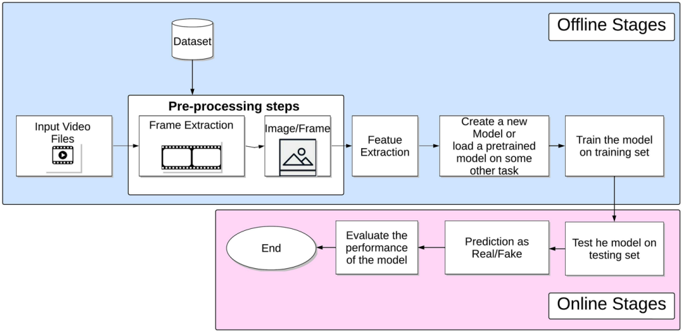
- The analysis synthesizes prior work into taxonomies of generation techniques, datasets, detection methods, challenges, open issues, and future opportunities rather than running a new experimental model.
## Limitations
- The paper explicitly notes that many existing detectors are evaluated mainly by accuracy, while time and cost complexity are often neglected; this is presented as a limitation of the field, not just this review.
- It states that many methods have not been evaluated on unseen deepfakes or perturbation/adversarial attacks, limiting claims of robustness and generalization.
- Evident from the text: this is a survey, so it does not provide a new unified benchmark or new experimental comparison under a common protocol; instead, it relies on the heterogeneity of the reviewed studies and datasets.
Model-written summary. Check it against the paper before relying on it.
Integrity signals
Registry
Cites
Statistics
Figures
Verification
Claims the paper makes
34 Valid · 70 Not valid · 109 Not checked · 117 Own results and interpretations
The cited sources support only part of this claim — read each source’s verdict below.
In the paper
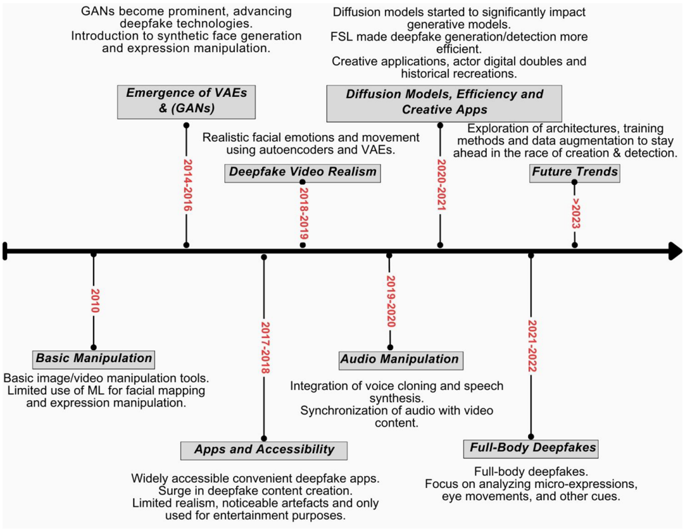
“It has been demonstrated that GANbased synthesis approaches may create unexpectedly high-quality false videos (Karras et al. 2019).”
What the sources say
- Partly supportedcites Karras et al. 2019 matched to “A Style-Based Generator Architecture for Generative Adversarial Networks” (2019) sourceExperimental — accuracy not yet measured
Section 2.1 (pp. 2–3) reports that the GAN generator produces high-quality synthetic images. It does not demonstrate the creation of false videos; the video mentioned on p. 3 accompanies the image results. (LLM, conf=0.87)
states a possible cause- Asserted: passes — The authors put it forward as true.
- Checkable: passes — It can be checked against evidence.
- Load-bearing: passes — The paper’s conclusions depend on it.
- Based: passes — The paper gives a reason why it holds.
- Partly supported
The cited sources support only part of this claim — read each source’s verdict below.
In the paper
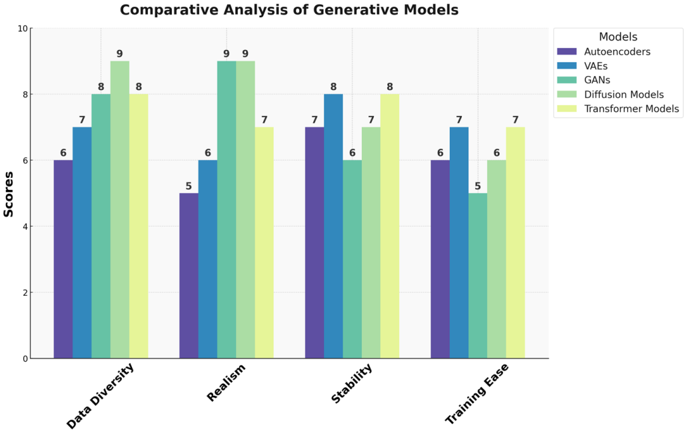
“Diffusion models can produce more realistic images compared to GANs and VAEs (Aghasanli etal. 2023; Dhariwal and Nichol 2021).”
What the sources say
- Not checked — no full text of the sourcecites Aghasanli et al. 2023 matched to “Interpretable-through-prototypes deepfake detection for diffusion models” (2023) source
- Partly supportedcites Dhariwal and Nichol 2021 matched to “Diffusion Models Beat GANs on Image Synthesis” (2021) sourceExperimental — accuracy not yet measured
The Conclusion states that the authors’ diffusion models achieve better sample quality than state-of-the-art GANs, supporting the GAN comparison. The Introduction discusses VAEs among likelihood-based models but does not establish a direct diffusion-versus-VAE image-quality comparison, so that part of the claim is not supported by our copy. (LLM, conf=0.85)
plain- Asserted: passes — The authors put it forward as true.
- Checkable: passes — It can be checked against evidence.
- Load-bearing: unclear — It is unclear whether the paper’s conclusions depend on it.
- Based: passes — The paper gives a reason why it holds.
The cited sources support only part of this claim — read each source’s verdict below.
In the paper
“It is becoming increasingly simple to use pretrained GAN to instantly replace one person's face in an image or video with the face of another person (Liu etal. 2021b).”
What the sources say
- Partly supportedcites Liu et al. 2021b matched to “Generative Adversarial Networks for Image and Video Synthesis: Algorithms and Applications” (2021) sourceExperimental — accuracy not yet measured
Section 6.1 (page unavailable) describes face swapping as placing one person's face region onto another, supporting the replacement part of the claim. The Subject-agnostic section says some methods need only one image to synthesize a person's video, but it discusses reenactment rather than instant face swapping. The paper does not establish that pretrained GANs can be used to do this instantly or that doing so is becoming increasingly simple. (LLM, conf=0.88)
plainstates a cause- Asserted: passes — The authors put it forward as true.
- Checkable: passes — It can be checked against evidence.
- Load-bearing: unclear — It is unclear whether the paper’s conclusions depend on it.
- Based: passes — The paper gives a reason why it holds.
- Partly supported
Every source the paper cites for this claim was checked and supports it.
In the paper
“The dataset contains videos with various visual artefacts and modifications, making it appropriate for testing deepfake detection algorithms (Korshunov and Marcel 2018).”
What the sources say
- Supportedcites Korshunov and Marcel 2018 matched to “DeepFakes: a New Threat to Face Recognition? Assessment and Detection” (2018) source
The Deepfake Database section (pp. 2–3) describes face-swapped videos made in low- and high-quality versions using different blending techniques. The Introduction (p. 1) and Detection section (pp. 3–4) report using the dataset to evaluate deepfake detection methods, including methods based on image quality. Together, these support the claim that its visual variations make it suitable for testing detection algorithms. (LLM, conf=0.90)
plainstates an association- Asserted: passes — The authors put it forward as true.
- Checkable: passes — It can be checked against evidence.
- Load-bearing: unclear — It is unclear whether the paper’s conclusions depend on it.
- Based: passes — The paper gives a reason why it holds.
- Supported
The cited sources support only part of this claim — read each source’s verdict below.
In the paper
“Most existing deepfake detection algorithms are based on DNN because of their capability in feature extraction and selection processes (Afchar et al. 2018; Li et al. 2018; Rossler etal. 2019).”
What the sources say
- Partly supportedcites Afchar et al. 2018 matched to “MesoNet: a Compact Facial Video Forgery Detection Network” (2018) sourceExperimental — accuracy not yet measured
The Proposed method (p. 3) describes this paper's deep neural network for detecting forged videos and its convolutional and pooling layers for feature extraction. It does not establish that most existing deepfake detectors use DNNs or attribute their use to feature-selection capabilities; the introduction (p. 1) says the authors knew of no other method dedicated to Deepfake detection. (LLM, conf=0.86)
- Not matchedcites Li et al. 2018
This doesn’t read as a citation we can look up.
- Partly supportedcites Rossler et al. 2019 matched to “FaceForensics++: Learning to Detect Manipulated Facial Images” (2019) sourceExperimental — accuracy not yet measured
The Face Manipulation Methods section says more recent forensic literature concentrates on CNN-based solutions, and the Introduction credits CNNs with learning powerful image features. These passages support the prevalence of neural-network detectors and the feature-learning rationale, but they do not establish a capability in feature selection processes. (LLM, conf=0.84)
plainstates a cause- Asserted: passes — The authors put it forward as true.
- Checkable: passes — It can be checked against evidence.
- Load-bearing: unclear — It is unclear whether the paper’s conclusions depend on it.
- Based: passes — The paper gives a reason why it holds.
- Partly supported
74 more claims · 10 with their cited sources checked
Create a free account to see all 330 claims and to verify the 12 references still open.
- Probably not a substantial claim. 212
- It may state two separate claims as one. 87
Claims other papers make about this one
Each is checked against this paper’s own text: does it say what the citing paper says it does?
The source backs part of the claim, not all of it — or backs it for a different population, condition or comparison.
In the citing paper
“these models often overfit to dataset-specific artifacts and exhibit poor generalization to unseen datasets or novel manipulation methods [13].”
From Cross-dataset video deepfake detection using Transformer and CNN architectures (2026) · cites this paper as [13]
Experimental — accuracy not yet measuredThe source backs part of the claim, not all of it — or backs it for a different population, condition or comparison.
In the citing paper
“Current survey papers [5-9, 15, 15, 16] primarily focus on reviewing detection methods based on their accuracy performance within the same dataset (within-domain evaluation), which achieves high accuracy (often exceeding 95%).”
From Deepfake detection across image, video, and audio: a comprehensive survey with empirical evaluation of generalization and robustness (2026) · cites this paper as [5]
Experimental — accuracy not yet measuredThe source backs part of the claim, not all of it — or backs it for a different population, condition or comparison.
In the citing paper
“While current survey papers [5, 7, 9, 15] provide extensive taxonomies and theoretical discussions, they lack empirical evaluations that would enable researchers to understand the relative strengths and limitations of different approaches.”
From Deepfake detection across image, video, and audio: a comprehensive survey with empirical evaluation of generalization and robustness (2026) · cites this paper as [5]
Experimental — accuracy not yet measuredThe source backs part of the claim, not all of it — or backs it for a different population, condition or comparison.
In the citing paper
“While surveys report impressive within-domain accuracies, they fail to examine how these same detectors perform when facing new data types, unseen manipulation techniques, or emerging generator architectures [5, 7, 9, 15].”
From Deepfake detection across image, video, and audio: a comprehensive survey with empirical evaluation of generalization and robustness (2026) · cites this paper as [5]
Experimental — accuracy not yet measuredThe cited source says what the claim attributes to it.
In the citing paper
“While there are several surveys of passive DF detection that examine specific modalities in isolation [5-9], the field requires a holistic analysis that transcends these single approaches.”
From Deepfake detection across image, video, and audio: a comprehensive survey with empirical evaluation of generalization and robustness (2026) · cites this paper as [5]
1 more claim about this paper
Create a free account to see every claim other papers make about this one.
Citations
Cites
Deep Residual Learning for Image Recognition
He, K., Zhang, X., Ren, S., & Sun, J. (2016) · 2016 IEEE Conference on Computer Vision and Pattern Recognition (CVPR) · doi:10.1109/cvpr.2016.90 · Cited by 235,474 · cited 1×
“It has also been used in deepfake detection and achieved high accuracy (He et al. 2016).”
Language Models are Few-Shot Learners
Brown, T. B., Mann, B., Ryder, N., Subbiah, M., Kaplan, J., Dhariwal, P., Neelakantan, A., Shyam, P., Sastry, G., Askell, A., et al. (2020) · arXiv · doi:10.48550/arxiv.2005.14165 · Cited by 23,372
Generative adversarial networks
Goodfellow, I., Pouget-Abadie, J., Mirza, M., Xu, B., Warde-Farley, D., Ozair, S., Courville, A., & Bengio, Y. (2020) · Communications of the ACM · doi:10.1145/3422622 · Cited by 18,384
EfficientNet: Rethinking Model Scaling for Convolutional Neural Networks
Tan, M., & Le, Q. V. (2019) · arXiv · doi:10.48550/arxiv.1905.11946 · Cited by 17,072
Mastering the game of Go with deep neural networks and tree search
Silver, D., Huang, A., Maddison, C. J., Guez, A., Sifre, L., van den Driessche, G., Schrittwieser, J., Antonoglou, I., Panneershelvam, V., Lanctot, M., et al. (2016) · Nature · doi:10.1038/nature16961 · Cited by 15,612 · cited 1×
“I m p r ov e d e xp l a i n a b ilit y o f d e t ec ti on r e s u l t s (Silver et al. 2016).”
A survey on deep learning in medical image analysis
Litjens, G., Kooi, T., Bejnordi, B. E., Setio, A. A. A., Ciompi, F., Ghafoorian, M., van der Laak, J. A. W. M., van Ginneken, B., & Sánchez, C. I. (2017) · Medical Image Analysis · doi:10.1016/j.media.2017.07.005 · Cited by 15,332 · cited 1×
“However, Litjens et al. (2017) mentioned that a lack of labelled data is a common issue when applying machine learning to medical images, even when enormous volumes of unlabelled data are available (Zhang et al. 2020).”
A Style-Based Generator Architecture for Generative Adversarial Networks
Karras, T., Laine, S., & Aila, T. (2019) · 2019 IEEE/CVF Conference on Computer Vision and Pattern Recognition (CVPR) · doi:10.1109/cvpr.2019.00453 · Cited by 11,714 · cited 2×
“Deepfake technology has made it possible to make these videos look real; therefore, it is necessary to assess the videos’ authenticity (Westerlund 2019; Karras et al. 2019).”
Denoising Diffusion Probabilistic Models
Ho, J., Jain, A., & Abbeel, P. (2020) · arXiv · doi:10.48550/arxiv.2006.11239 · Cited by 8,712
3D Convolutional Neural Networks for Human Action Recognition
Ji, S., Xu, W., Yang, M., & Yu, K. (2013) · IEEE Transactions on Pattern Analysis and Machine Intelligence · doi:10.1109/tpami.2012.59 · Cited by 6,235
Deep Residual Learning for Image Recognition
He, K., Zhang, X., Ren, S., & Sun, J. (2015) · arXiv · doi:10.48550/arxiv.1512.03385 · Cited by 4,196
Research works printed but not linked: 7
- Agarwal S, Farid H, Gu Y etal (2019) Protecting world leaders against deep fakes. In: CVPR workshops. pp 38-45
- Cheng S, Dong Y, Pang T et al (2019) Improving black-box adversarial attacks with a transfer-based prior. In: Advances in neural information processing systems, vol 32
- Dufour N, Gully A (2019) Contributing data to deepfake detection research. Google AI Blog 1(2):3
- George AS, George AH (2023) Deepfakes: the evolution of hyper realistic media manipulation. Partn Univers Innov Res Publ 1(2):58-74
- Koopman M, Rodriguez AM, Geradts Z (2018) Detection of deepfake video manipulation. In: The 20th Irish machine vision and image processing conference (IMVIP). pp 133-136
- Le TN, Nguyen HH, Yamagishi J etal (2021) OpenForensics: large-scale challenging dataset for multi-face forgery detection and segmentation in-the-wild. In: Proceedings of the IEEE/CVF international conference on computer vision. pp 10117-10127
- Malik MH, Ghous H, Qadri S etal (2023) Frequency-based deep-fake video detection using deep learning methods. J Comput Biomed Inform 4(02):41-48 <!-- image -->
Cited by
Items 101–200 of 207
Study on Deepfake Detection Techniques: Challenges, Limitations and Future Directions
Kaushal, A., Parihar, Y., Tomar, V., & Yadav, U. K. (2025) · International Conference on Data Intelligence and Cognitive Informatics (ICDICI) · doi:10.1109/icdici66477.2025.11135143
Khalid, O., Saad, F., Safdar, A., Jamıl, A., Hameed, A. A., & Muñoz, C. Q. G. (2025) · IEEE International Conference on Computing and Machine Intelligence (ICMI) · doi:10.1109/icmi65310.2025.11141063
“[2 ] This research focuses on real-time deepfake detection to ensure that any visual manipulation can be promptly identified and flagged during live video conferences, thereby maintaining the integrity of the interaction.”
A Research on Deepfake Face Detection Techniques Based on Multimodal Biometric Cross – Verification
Wu, H. (2025) · ITM Web of Conferences · doi:10.1051/itmconf/20257802017 · Cited by 1
An Effective Technique for Deepfake Video Detection
Mahdi, B. M., & Sahan, A. M. (2025) · INTERNATIONAL JOURNAL OF PROFESSIONAL STUDIES · doi:10.37648/ijps.v20i01.014
AI-Driven Identity Manipulation
Anjum, S., & Sahu, D. (2025) · BENTHAM SCIENCE PUBLISHERS eBooks · doi:10.2174/9798898810030125040006
Detecting Deep Fake Images using Deep Learning and Generative Adversarial Networks
Priya, V. S., Laharisha, S., Akshit, S., Reddy, S. S. S. S., & Inala, Y. (2025) · International Conference on Soft Computing for Security Applications (ICSCSA) · doi:10.1109/icscsa66339.2025.11171414
“These techniques improve model robustness, enabling them to detect manipulated content even after it has passed through standard social media processing [3] [4].”
Deepfake Detection Using ResneXt Deep Learning Architecture
Tene, R., Kalyani, D., Yadav, N. S., et al. (2025) · Lecture notes in networks and systems · doi:10.1007/978-981-96-7496-1_17
Enhanced security through face recognition and deepfake prevention
Ramteke, N. S., & Ramteke, S. P. (2025) · Information Security Journal A Global Perspective · doi:10.1080/19393555.2025.2557856 · Cited by 1
“Deepfake technology, while often misused, has potential benefits in various fields, including entertainment, education, healthcare, and commercial applications (Kaur et al., 2024).”
Deepfaceguard: A Lightweight CNN Framework for Robust Face Manipulation Detection
Tauseef, M., Viji, L. S., & Fenwick, J. (2025) · International Conference on Networks, Multimedia and Information Technology (NMITCON) · doi:10.1109/nmitcon65824.2025.11188219 · Cited by 3
“Many existing methods show strong performance on curated benchmark datasets but fail to generalize to compressed, low-resolution, or previously unseen deepfake formats common on social media [3].”
GAN and ResNet based Combination Deep Learning Model for Recognizing Fake Faces
Gowsic, K., Hariprasath, R., Guruprasad, M., Kabirajan, M., & Sojan, J. K. (2025) · International Conference on Innovative Mechanisms for Industry Applications · doi:10.1109/icimia67127.2025.11200763
“[9] Reviewed the overall challenges and future opportunities in deepfake video detection.”
Singh, G., Rangra, A., Kaur, M., Kaur, S., & Prashar, N. (2025) · AIP conference proceedings · doi:10.1063/5.0292658
Fraudlens: Deepfake Intelligence with ML
Kalyankar, M., Gajra, O. P., Sagvekar, P. V., Sharma, M. L., & Shaikh, Z. S. (2025) · Lecture notes in networks and systems · doi:10.1007/978-3-032-06697-8_22
Devgaonkar, G., Dudhane, A., Haralkar, G., et al. (2025) · International Journal of Advanced Research in Science Communication and Technology · doi:10.48175/ijarsct-29837
Technological and Policy Approaches to Combatting Disinformation Online
Wanjari, U., Kadam, S. K., Raj, C., Anawade, P. A., & Sharma, D. (2025) · Lecture notes in networks and systems · doi:10.1007/978-981-96-8750-3_2
FALSIFYX: Guarding Truth in the Age of Synthetic Media
Prof.Jenifer, A. (2025) · International Journal of Innovative Research in Information Security · doi:10.26562/ijiris.2025.v1108.02
Opportunities and Security Issues in Communication Engineering Using Generative AI
Charvi, Sharma, A., & Gulzar, Y. (2025) · BENTHAM SCIENCE PUBLISHERS eBooks · doi:10.2174/9789815324693125040011
(Art)ificial Reminiscence of Cultural Heritage in the Service of Marketing Communication
Štosel, M., Spálová, L., & Kapsová, E. (2025) · European Journal Of Media Art & Photography · doi:10.34135/ejmap-25-02-07
Deepfake Video Detection based on Scatter Wavelet Transform and Deep Learning
Mahdi, B. M., & Sahan, A. M. (2025) · IEEE International Conference on Artificial Intelligence in Engineering and Technology (IICAIET) · doi:10.1109/iicaiet67254.2025.11265021
Rana, P., Bansal, S., Nagar, S., & Malik, A. (2025) · International Conference on Sustainability, Innovation & Technology (ICSIT) · doi:10.1109/icsit65336.2025.11294796 · Cited by 1
“In this work, four recent studies [24][25][26][27][28] selected from the existing literature were reviewed and compared to determine the most effective detection method.”
The Future of Deepfakes: Emerging Trends and Potential Applications
Sharma, A., Paserlanka, D. B., Lankadasu, N. V. Y., Sharma, S., & Malik, A. (2025) · IGI Global eBooks · doi:10.4018/979-8-3373-0877-7.ch010
Javiya, D., Jethava, G., & Parmar, H. (2025) · Lecture notes in electrical engineering · doi:10.1007/978-981-96-8283-6_6
Deepfake: A Master of Digital Illusion or Disruptor of Objective Reality?
Štosel, M. (2025) · Communication Today · doi:10.34135/communicationtoday.2025.vol.16.no.2.9
Deepfake detection using MobileNetV2 integrated with a support vector machine classifier
Satoto, B. D., Yasid, A., Rahmadhani, A. P., Khotimah, B. K., Irmawati, B., & Hamid, S. B. A. (2025) · EPJ Web of Conferences · doi:10.1051/epjconf/202534401019 · Cited by 2
Deepfake Detection: State-of-the-Art Techniques and Emerging Trends
Pandey, R., & Pandey, R. (2025) · International Conference on Electronic Circuits and Signaling Technologies (ICECST) · doi:10.1109/icecst66106.2025.11307586 · Cited by 1
“Kaur et al. (2024) [15] conduct a complete survey to study current challenges and recent developments in deepfake video detection while highlighting deep learning methods as the leading approach.”
Shah, K., Shah, S., & Ajwalia, M. (2025) · International Conference on IoT Based Control Networks and Intelligent Systems (ICICNIS) · doi:10.1109/icicnis66685.2025.11315573
“Research [2] extend these observations to video-specific issues and benchmarking inconsistencies.”
InfluentialEffect of Compression on the Detection of Deepfake Videos with Facial Features
Jadhav, C., Ratnaparkhe, V. R., & Kumar, R. (2026) · Lecture notes in networks and systems · doi:10.1007/978-981-96-9932-2_39
A Comprehensive Review on Popular CNN-Based Deepfake Detection Models, Performances, and Challenges
Paul, S., Rangababu, P., & Devi, B. P. (2026) · Lecture notes in networks and systems · doi:10.1007/978-981-96-9932-2_18
Deepfakes AI Meets Social Science
Zaman, M. S., Khurana, P., Elchouemi, A., Prasad, P. W. C., Seher, I., & Maag, A. (2026) · Lecture notes in electrical engineering · doi:10.1007/978-3-032-10898-2_8
Unveiling Trends in Deepfake and Detection Techniques: A Bibliometric Analysis of Emerging Research
Samta, R., & Singh, A. J. (2026) · Lecture notes in networks and systems · doi:10.1007/978-981-96-8350-5_42
Deepfakes: Ethical and Legal Implications Across Business, Politics, and Society
Khanal, K., & Koirala, A. (2026) · Advances in computational intelligence and robotics book series · doi:10.4018/979-8-3373-2960-4.ch009 · Cited by 1
A Hybrid Deep Learning Model for Deepfake Video Detection
Devi, N. M., Louis, N. J., Parveen, S., et al. (2025) · International Conference on Automation, Computing and Renewable Systems (ICACRS) · doi:10.1109/icacrs67045.2025.11324229
“Kaur et al. discussed the main challenges and future directions in deepfake video detection [8].”
A Hybrid Model for Identifying Manipulated Videos using Advanced Computing Techniques
Pramila, S., Sasikala, T., Raj, J., Roja, R., Usha Rani, N., & Kalai Selvi, N. (2025) · International Conference on Cognitive, Green and Ubiquitous Computing (IC-CGU) · doi:10.1109/ic-cgu67042.2025.11338001
“The grouped convolution structure allows to learn effectively complex patterns in facial features and makes it a good for Deep fake video detection [13].”
Next-Generation AI Framework for Advanced Deepfake Detection and Prevention Systems
Jebaraj, B. S., Akhil, K., V, Pradeep, G., Arasan, R. K., Patel, C. K., & Vivekrabinson, K. (2025) · International Conference on Communication and Smart Devices (ICCoSD) · doi:10.1109/iccosd66074.2025.11348427
Hybrid Deep Learning for Robust Deepfake Video Detection with Enhanced Generalization and Fairness
Garg, P., & Dave, M. (2025) · International Conference for Advancement in Technology (ICONAT) · doi:10.1109/iconat66879.2025.11362687
“Diffusion models allow modern artists to create images and videos that are so lifelike they seem like photographs [1].”
A Frequency Aware Attention Driven Deepfake Detection Framework Using YOLOv8
Sunil, R., Mer, P., & Parmar, P. (2025) · International Conference for Advancement in Technology (ICONAT) · doi:10.1109/iconat66879.2025.11362738
“Finally, Kaur et al. [10] looked at how deepfake video recognition is changing over time and suggested that the best way to stop deepfakes from getting smarter is to use mixed frameworks that combine texture analysis with temporal coherence.”
Teaching People to Spot Deepfakes: Investigating User Acceptance of LLM-Powered Chatbots
Chen, C., Goh, D. H., & Tang, Z. (2026) · International Journal of Human-Computer Interaction · doi:10.1080/10447318.2026.2622583 · Cited by 2
“While machine learning models have made notable progress in detecting manipulated content, they often struggle when encountering unfamiliar datasets or novel manipulations due to limitations in generalization (Kaur et al., 2024).”
M., A. M. F. L., Myla, K. S., & Vanamala, H. R. (2025) · International Conference on Computational Intelligence and Communication Networks (CICN) · doi:10.1109/cicn67655.2025.11368087
“Surveys [11]–[14] found remaining challenges such as dataset bias, low generalization, and real-world robustness.”
Social Media as a Battlefield for Information Warfare
Szybowska, S., Chochowski, K., & Chochowska, A. (2026) · Communications in computer and information science · doi:10.1007/978-3-032-17020-0_20
Towards Tamper-Resistant Digital Media: An AI and Blockchain Approach for Deepfake Detection
Sakthivel, K., Harine, N., & Chandra Mohan, G. (2025) · International Conference on Electronics, Communication and Aerospace Technology (ICECA) · doi:10.1109/iceca66444.2025.11382545 · Cited by 1
Hybrid Approach for Video Deepfake Detection Using ResNeXt-50, ViT, and Optical Flow
Yesugade, K. D., Jadhav, R. S., Khaire, M., Nagane, S., Desai, P., & Algude, S. (2025) · International Conference on Electronics and Computing, Communication Networking Automation Technologies (ICEC2NT) · doi:10.1109/icec2nt65402.2025.11379931
“As deepfake technology advances, detection systems must also evolve to recognize new manipulation techniques [14].”
DeepFake Analysis : A Review of Recent Studies, Detection Methods and Trends in Deepfake Detection
Kaur, P., & Sharma, C. (2025) · International Conference on Innovations and Emerging Technologies in AI & Communication Systems (IETACS) · doi:10.1109/ietacs68750.2025.11385353
Multimodal Semantic-Similarity Gate for Real-Time Optimized Deepfake Detection
Yeon, Y., Yoon, J., & Choi, C. (2026) · IEEE Transactions on Consumer Electronics · doi:10.1109/tce.2026.3666953 · Cited by 1
“Accordingly, substantial research has been conducted to detect deepfakes by analyzing the characteristics of video and audio content using AI [2].”
Preserving the Evidence: Artifact-Aware Preprocessing for Robust Deepfake Detection
Lie, A. A., Susanto, R., Mackenzie, G., & Prabowo, A. S. (2025) · Beyond Technology Summit on Informatics International Conference (BTS-I2C) · doi:10.1109/bts-i2c67944.2025.11399355
“EfficientNetV2 is better in training technique, meanwhile ViTs are more proficient in generalization [8].”
Detecting Hyper-Realistic Videos Generated by Diffusion Models via Text-Guided Semantic Enhancement
Ling, S. H., Zhou, Z., & Kumar, A. (2025) · IEEE International Joint Conference on Biometrics (IJCB) · doi:10.1109/ijcb65343.2025.11410820 · Cited by 1
“More-over, the video-level forgery detection task also has been explored in the literature [9, 6, 22, 26, 53].”
Mandal, U., Setua, S. K., & Sarma, S. S. (2026) · Journal of Visual Communication and Image Representation · doi:10.1016/j.jvcir.2026.104748 · Cited by 7
Yang, H.-C., Chou, H., Huang, L.-C., & Chung, Y.-W. (2025) · IEEE Annual Congress on Artificial Intelligence of Things (AIoT) · doi:10.1109/aiot66900.2025.00137
“However, most prior methods emphasize facial regions, specific manipulations such as face-swapping, or static images [12].”
A General Framework For Deepfake Video Detection
Al-Thani, D. M. (2025) · International Conference on Computer and Applications (ICCA) · doi:10.1109/icca66035.2025.11431060
“Despite advances, significant challenges persist [4].”
InfluentialZachowania i postawy użytkowników bankowości elektronicznej wobec cyberzagrożeń
Żurek, J., & Pitera, R. (2026) · Bank i Kredyt · doi:10.5604/01.3001.0055.6917
A Systematic Literature Review on How Cybercriminals Are Utilizing Deepfakes to Conduct Cyberattacks
James, E. C., Bongiovanni, I., Glencross, M., & Brace, L. (2026) · Digital Threats Research and Practice · doi:10.1145/3801545 · Cited by 4
A Multimodal Deep Learning Framework for Real-Time Deepfake Detection in Images, Videos, and Audio
Rajalakshmi, P., Mahefuz, S. M., & Reddy, G. V. S. K. (2025) · International Conference on Advancement in Futuristic Technologies (ICAFT) · doi:10.1109/icaft66710.2025.11452914
Deepfake Detection Using RestNext50 and LSTM for Media Verification and Security
Tripathi, J., Mishra, A. D., Kumar, V., & Singh, R. (2026) · Lecture notes in networks and systems · doi:10.1007/978-981-95-3498-2_9
Temporal Artifact Analysis for AI-Generated Video Detection Using Hybrid CNN-LSTM Architecture
Vijayakumar, D., Karunakaran, P., Balasubramaniam, C., Chethanand, V., Dinesh Kumar, B., & Manoj, V. (2026) · International Conference on Multi-Agent Systems for Collaborative Intelligence (ICMSCI) · doi:10.1109/icmsci67830.2026.11469605
Deepfake Video Detection Using Artificial Intelligence: A Comprehensive Review
Yadav, M., Alam, S., Saha, P. K., Utkarsh, & Yadav, R. (2026) · Lecture notes in networks and systems · doi:10.1007/978-3-032-15395-1_20
Kumar, K. G., Balamurugan, K., Rajalakshmi, S., & Keerthana, N. V. (2026) · Advances in computational intelligence and robotics book series · doi:10.4018/979-8-3373-5228-2.ch010
Feature-Based Deepfake Detection Using LBP and HOG with Machine Learning Approaches
Bahadure, S., & Mane, V. M. (2026) · Lecture notes in networks and systems · doi:10.1007/978-3-032-19678-1_42
Combating Digital Deception: A Taxonomical and Systematic Review of Deepfake Detection Approaches
Gupta, P., Narwal, B., & Mohapatra, A. K. (2026) · Wiley Interdisciplinary Reviews Data Mining and Knowledge Discovery · doi:10.1002/widm.70087
Srinivas, V., Reddy, L. Y., Chandu, G., & Vijayarani, J. (2026) · International Conference on Machine Learning and Autonomous Systems (ICMLAS) · doi:10.1109/icmlas67792.2026.11483887
“Despite the valid uses of such developments in entertainment and generating virtual content, they also have enormous capabilities of misinformation, identity theft, political meddling, and loss of reputation through the digital media [3], [5], [18].”
Методы обнаружения дипфейков в видеоконференциях в реальном времени
Кузьменко, И. Д., Намиот, Д. Е., & Васенин, В. А. (2025) · Sovremennye informacionnye tehnologii i IT-obrazovanie. · doi:10.25559/sitito.021.202502.204-220 · Cited by 3
Abak, F. F., Rahman, M. M., & Hasan, S. M. M. (2025) · International Conference on Computer and Information Technology (ICCIT) · doi:10.1109/iccit68739.2025.11491257
“By leveraging extensive databases of facial expressions and body movements, these manipulated images and videos can convinc-ingly depict individuals in fabricated contexts [1].”
Gancitano, M., & Colamedici, A. (2026) · doi:10.3390/proceedings2026139018
Multi-Modal Deepfake Detection for Improved Cross-Modal Consistency and Synchronization
Padmanandam, K., Aitha, S., Ambeer, S., Nidiganti, P., & Ragala, V. (2025) · International Conference on Sustainable Computing and Smart Systems (ICSCSS) · doi:10.1109/icscss64956.2025.11501070
Enhancing Deepfake Detection with an Ensemble of Specialized Neural Networks
Rajesh, B., Tamilkodi, R., Suryakala, K., Sruthi, P. L., Anusha, B., & Pradeep, K. M. D. S. (2026) · IEEE International Conference for Convergence in Computing Technology (I3CTCON) · doi:10.1109/i3ctcon68242.2026.11507158
“They highlighted the issue of data, training, and generalization in deepfake detection [2].”
Hybrid Multimodal DeepFake Detection using Spatial–Temporal Feature Learning
Sharma, N., & Gupta, A. (2026) · International Conference on Smart Electronic Devices and Intelligent Systems (ICSEDIS) · doi:10.1109/icsedis68157.2026.11517985
Collaborative governance of AIGC disinformation: key factors and strategic dynamics
Zhang, T., Qiu, J., & Xu, Z. (2026) · Aslib Journal of Information Management · doi:10.1108/ajim-07-2025-0535
Deepfake Forensics: Threats and Detection of AI-Manipulated Media
Cardoso, P. M. C., Oliveira, R. S., Gomes, T. F. N., Bastos, E. S., & Lopes, S. F. S. F. (2026) · Advances in computational intelligence and robotics book series · doi:10.4018/979-8-3373-7660-8.ch015 · Cited by 1
Progressive Gated Co-Teaching for Weakly Supervised Deepfake Detection
Lang, R., Yu, G., Wang, Q., & Wang, X. (2026) · International Workshop on Agentic Engineering · doi:10.1145/3786167.3788421
Svetha, B. S., Seraphine, T., & Rahman, A. A. (2026) · Lecture notes in networks and systems · doi:10.1007/978-3-032-22292-3_35
Context-Aware Silhouette-Based Age Estimation for Child Sexual Abuse Material (CSAM) Detection
Koźbiał, M., & Bartuzi-Trokielewicz, E. (2026) · International World Wide Web Conference (WWW) · doi:10.1145/3774905.3796485
Channel-Aware Local–Global Representation Learning for Generalizable Deepfake Detection
Kuang, L., Chen, B., & Shi, P. (2026) · Mathematics · doi:10.3390/math14111913
Ebadinezhad, S., & Modupeola, T. (2026) · International Congress on Human-Computer Interaction, Optimization and Robotic Applications (ICHORA) · doi:10.1109/ichora69329.2026.11537114
“Shortcut Learning: Findings suggest that models often learn "shortcuts" or dataset-specific biases rather than robust forensic features [25, 26].”
A YOLO - MViT Based Hybrid Approach for Deepfake Videos Detection Using Facial Features
Kaur, P., & Sharma, C. (2026) · International Conference Big Data and Machine Learning · doi:10.1109/icbdml68582.2026.11544639
Deepfakes in Synthetic Medical Imaging: Opportunities, Challenges, and Safeguards
Mandal, U., Setua, S. K., & Sarma, S. S. (2026) · Smart innovation, systems and technologies · doi:10.1007/978-3-032-21164-4_10
Interpol review of detection of AI-generated image and video deepfakes, 2022-2025
van Lierop, S., Najdenkoska, I., Worring, M., & Geradts, Z. (2026) · Forensic Science International Synergy · doi:10.1016/j.fsisyn.2026.100704 · Cited by 2
HQSwap: A Challenging High-Resolution Face-Swap Dataset for Improved Manipulation Detection
Srock, P., Tapia, J. E., & Busch, C. (2026) · International Workshop on Biometrics and Forensics (IWBF) · doi:10.1109/iwbf68042.2026.11558177
“This is nowadays done with a data-driven and AI-based method, although there are issues such as lack of generalization [3].”
DeepFakeNet: A Cross-Temporal CNN–RNN Model for Generative Media Detection
Aggarwal, M., Singh, P., Tiwari, R., Rawat, R., & Sharma, S. K. (2026) · International Conference on Innovations in Computational Intelligence (ICICI) · doi:10.1109/icici68867.2026.11564995
“Strict experimentation was employed to test the accuracy, robustness and computational capacity of the proposed hybrid CNN-RNN framework in respect to several benchmarks [7], [10].”
InfluentialEmotion-Audio-Visual Alignment for Deepfake Detection: A Multimodal Semantic Inconsistency ApproachPreprint
Gupta, P., Pundir, A. K. S., & Srivastava, R. (2026) · Research Square · doi:10.21203/rs.3.rs-9202918/v1
Deepfake Detection: A Taxonomy with Structured Analysis ofvarious Approaches and Research ChallengesPreprint
Kaushik, T., & Singh, S. N. (2026) · SSRN Electronic Journal · doi:10.2139/ssrn.6981436
Spatio-Temporal Deep Learning Framework for Deepfake Video Detection
Kaur, N., Choudhary, V., Thakur, M., Guleria, A., Kaur, A., & Parmar, K. (2026) · International Conference on Inventive Research in Computing Applications (ICIRCA) · doi:10.1109/icirca69024.2026.11570374
Self-citationBalcı, Ş., & Özben, K. (2026) · Kritik İletişim Çalışmaları Dergisi · doi:10.53281/kritik.1877790
Chakraborty, S., & Verma, M. K. (2026) · Scientometrics · doi:10.1007/s11192-026-05709-8 · Cited by 1
“Although deepfake has the potential to be used in several productive applications, including multimedia, digital communications, gaming, entertainment, and social media (Kaur et al., 2024; Laishram et al., 2021).”
DeepGuard: A Lightweight Dual-CNN Ensemble for Practical Deepfake Video Detection
Dombale, A., Sahu, N., Sahuji, P., Rana, A., & Sali, M. (2026) · International Conference on Inventive Computing and Informatics (ICICI) · doi:10.1109/icici68773.2026.11581015
Leveraging Channel Attention for Improved Deepfake Detection in CNN Architecture
Vishal, P., Dr. Padiya Swity, R., & Ketankumar, P. P. (2026) · International conference Computer Networks and Inventive Communication Technologies · doi:10.1109/iccnct68477.2026.11590327
Khan, M. A., Madhusudhan, H. S., & Gupta, P. (2026) · Procedia Computer Science · doi:10.1016/j.procs.2026.06.045
Guessoum, D., Benblidia, N., Boumahdi, F., Remmide, M. A., Nouri, T. A., & Bataouche, A. L. (2026) · Multimedia Tools and Applications · doi:10.1007/s11042-026-21775-9
Unmasking the Fake: Detection of Deepfakes Using CNNs
Dongare, G., Bhamkar, A., & Puri, C. (2025) · International Conference on I-SMAC (IoT in Social, Mobile, Analytics and Cloud) (I-SMAC) · doi:10.1109/i-smac65734.2025.11597711
“Other more recent work was undertaken by specifically in benchmarking Deepfake detection methods across CNN Architectures, whereby the authors discussed the trade-offs of false positives and false negative detection [5] .”
SachAI: The Deep Fake Video Detection Model
Sharma, N., Srivastava, K., Srivastava, P., Pandey, P., & Sharma, S. (2026) · IEEE International Conference on Intelligent Technologies for a Sustainable and Inclusive Future (ICITSIF) · doi:10.1109/icitsif69060.2026.11608562
“The computational expense of deep models, which limits real-time deployment in forensic and security applications, was also highlighted by Kaur et al. (2024).”
Hybrid CNN and Transformer-Based Temporal Modeling for Deepfake Video Detection
Kulkarni, A., Patil, R., Yakkundi, S., & Salake, S. V. (2026) · International Conference on Intelligent Technologies (CONIT) · doi:10.1109/conit69683.2026.11621386
“This metric indicates how many of the real and fake videos in the provided classification data are classified accurately by the trained model[23].”
Is Visual Realism Enough? Evaluating Gait Biometric Fidelity in Generative AI Human Animation
DeAndres-Tame, I., Ye, C., Tolosana, R., Vera-Rodríguez, R., & Yu, S. (2026) · Lecture notes in computer science · doi:10.1007/978-3-032-31666-0_14 · Cited by 1
DEEPVERIFY: Advanced AI Framework for Deepfake Detection and Media Authenticity Validation
Krishnammal, P. M., Kumar, K. H. K., & Girinath, S. (2026) · Lecture notes in networks and systems · doi:10.1007/978-3-032-28304-7_38
Nguyen, T., Stamm, M. C., Crisman, J., Hostetler, J., Cassano, L., Davinroy, M., & Bautista, P. (2026) · IEEE/CVF Winter Conference on Applications of Computer Vision Workshops (WACVW) · doi:10.1109/wacvw68408.2026.00103 · Cited by 1
“This gap is a fundamental obstacle preventing current forensic approaches from being operationally viable in real-world conditions [31,38,45,71,92].”
Rethinking Deepfake Detection Evaluation: APrincipled Multi-Dimensional Relative AssessmentPreprint
Pandey, P. K., Solanki, A., Sharma, S. K., et al. (2026) · SSRN Electronic Journal · doi:10.2139/ssrn.7228983
The Role of AI in Crime Detection and Prevention
Thaware, A., Sakhare, A. D., & Agarmore, S. B. (2026) · Lecture notes in networks and systems · doi:10.1007/978-3-032-27163-1_2
Wu, Y., Yuan, X., & An, D. (2026) · Journal of King Saud University - Computer and Information Sciences · doi:10.1007/s44443-026-01174-8 · Cited by 1
“Whilethesecapabilitiesbroadenapp-lication prospects, they also lower the barriers to synthetic-B media manipulation, heightening risks of disinformation, evidentiary fabrication, and identity fraud (Kaur et al. 2024; Tiwari et al. 2024).”
Yapay Zekâ ve Sosyal Medyadaki Paradigma Kayması: Bibliyometrik Bir Analiz
Apaydin, C. (2026) · Selçuk Üniversitesi Sosyal Bilimler Enstitüsü Dergisi · doi:10.52642/susbed.1946896
Rapid and Accurate Quantification of Microplastics in Surface Water using Improved YOLO ModelPreprint
Yang, H., Wang, H., Tao, F., Fu, H., Yu, J., Ouyang, J., Zhang, B., Chen, H., Abdallah, M. A., & Harrad, S. (2026) · Research Square · doi:10.21203/rs.3.rs-10353433/v1
Adu, K. K. (2026) · Records Management Journal · doi:10.1108/rmj-10-2025-0086
Deepfake-Driven Cybercrimes: A Governance Framework from Criminology, Law, and Computer Science
Xu, R., & Liu, J. (2026) · Guangdong-Hong Kong-Macao Greater Bay Area International Conference on Digital Economy and Artificial Intelligence (DEAI) · doi:10.1145/3837873.3838037
Beyond Face Forgery: A Multimodal Deep Learning System for Detecting Synthetic Media
Basha, M. J., & Sandhiya, B. (2026) · International Conference on Trends in Quantum Computing and Emerging Business Technologies (TQCEBT) · doi:10.1109/tqcebt67648.2026.11681335
“[4] The obtained features are further passed on to the deep learning model for the purpose of learning features from the data.”
$$\mu $$Flow: Leveraging Average Images for Improving Generalisation of Deepfake Faces Detectors
Pontorno, O., Litrico, M., Guarnera, L., Giuffrida, M. V., & Battiato, S. (2026) · Lecture notes in computer science · doi:10.1007/978-3-032-37422-6_20 · Cited by 1
Explainable Spatio-Temporal Attention Framework for GAN-Based Deepfake Detection
Alhejaili, A., & Binsawad, M. H. (2026) · Electronics · doi:10.3390/electronics15184343 · Cited by 1
Metadata
- Authors
- Kaur, A., Noori Hoshyar, A., Saikrishna, V., Firmin, S., & Xia, F.
- Affiliations
- Federation University (AU)
- RMIT University (AU)
- Corresponding author
- Kaur, Achhardeep
- Venue
- Artificial Intelligence Review
- Published
- 2024-05-29
- Volume
- 57
- Issue
- 6
- ISSN
- 0269-2821 (ISSN-L)
- 1573-7462
- OpenAlex
- W4399138486
- Cited by
- 214
- References
- 118
- Citations by year
- 2026: 93 · 2025: 109 · 2024: 12
- FWCI
- 29.81
- Type
- journal article
- Language
- en
- Open access
- hybrid
- doi.org
- Licence
- cc-by
- creativecommons.org/licenses/by/4.0 (tdm)
- creativecommons.org/licenses/by/4.0 (vor)
- Locations
- Artificial Intelligence Review (publishedVersion, cc-by)
- FedUni ResearchOnline (Federation University Australia) (submittedVersion, cc-by)
- Funders
- Federation University Australia
- Topics
- Physical Sciences › Computer Science › Computer Vision and Pattern Recognition › Digital Media Forensic Detection
- Social Sciences › Sociology and Political Science › Misinformation and Its Impacts
- Physical Sciences › Computer Science › Computer Vision and Pattern Recognition › Generative Adversarial Networks and Image Synthesis
- Keywords
- deepfake video detection, deep learning, misinformation, fake content, class imbalance, labeled training data, computational requirements, deepfake datasets, real-time detection
About these checks
Registry, retraction, Cites and statistics results are computed, not judged, with one exception: a printed reference that no index lists is read once by a model before it counts as a citation error. Claims are extracted by a model and kept only when their quote appears verbatim in the text; each cited source is then checked, with a model’s help, for whether it says what the claim relies on. Those verdicts can be wrong — read the claim’s quote and the cited source before relying on one.
The claim verdicts this report counts are experimental: their accuracy is not yet measured.
A language model drew the claims from the paper on 2026-10-10, under version 3 of the claim definition (model deepseek-v4.1-flash, prompt extract-v3).
A second model labelled each claim on 2026-10-10 (model jev-1.13-20260917, definition revision gold-guideline-v0.2).
Cited sources are checked with a language model’s help (gpt-6-sol).
Statistics and arithmetic are recomputed, not judged.
Confidence bands are shown only for fields calibrated on our annotated test set. None is calibrated yet, so no band is shown.
What counts as a claim ›How we measure confidence ›How we check this ›
Are you an author, or do you see a problem with this page? Request a review
Data sources
Bibliographic data: Semantic Scholar, OpenAlex, Crossref.
Contains information from the Semantic Scholar Academic Graph Datasets, made available under the ODC Attribution License (ODC-BY 1.0).
Semantic Scholar’s data is described in: Kinney, R., et al. (2023). The Semantic Scholar Open Data Platform. arXiv:2301.10140.
