

A review of LLMs and their applications in the architecture, engineering and construction industry
Open accessThe DOI matches its Crossref record; 161 of the 165 references it cites were found in a registry or an index; 61 of the 115 sources its claims cite were checked for support.
Abstract
During the past decade, there has been rapid emergence, continuous development and advancements in the field of Artificial Intelligence (AI), and a broad adaptation ofLarge Language Models (LLMs) in a wide variety of application domains transforming and streamlining industry practices. However, the construction industry has yet to fully incorporate these technologies, delaying their wide-scale adaptation. Only a limited number of recent studies have explored the opportunities, capabilities and potential of current LLM implementations in the broad domain of Architecture Engineering and Construction (AEC) industry, leaving a significant gap in this field of research. This study aims to address this gap and provide an extensive review of already established state-of-the-art applications and use case scenarios of LLMs in the AEC industry. Apart from that, by exploring the key contributions and limitations of these applications, and by considering relative reviews on this subject, it was possible to categorize them, to extract the emerging challenges and future directions of the field and propose actionable recommendations for industry stakeholders. This study also includes an introduction to important concepts and recent advancements of LLM technologies, focusing on transformer-based architectures and providing an extensive list of LLM families.
Overview
CoChat Summary
TL;DR
This review surveys LLM applications in the architecture, engineering, and construction (AEC) industry, categorizing 28 established use cases from 2021–2024 literature and outlining challenges and recommendations. It finds adoption is still limited by domain-specific knowledge gaps, prompt sensitivity, computational costs, interoperability, and ethical/regulatory concerns.
Key findings
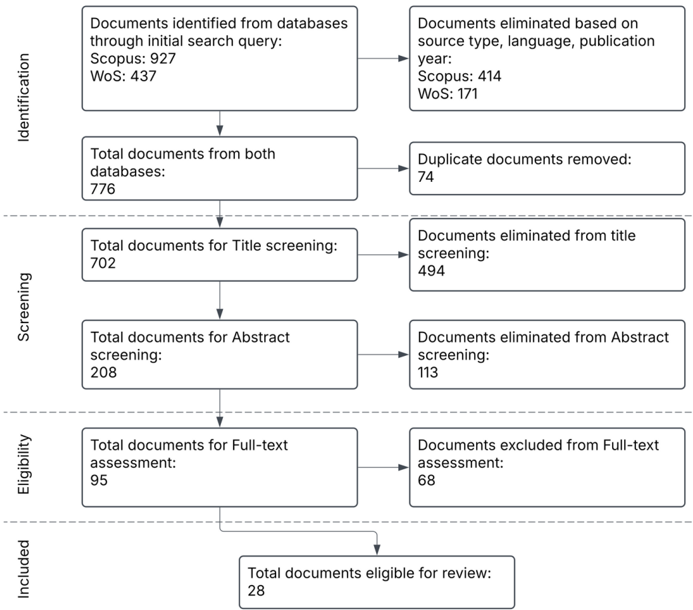
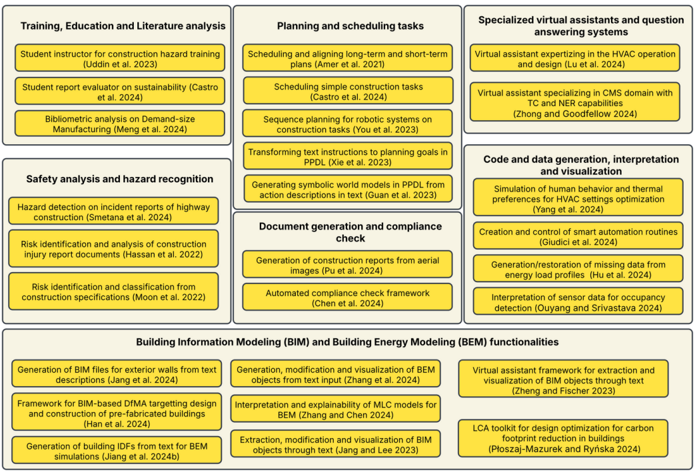
- From 927 Scopus and 437 Web of Science records, after filtering, merging, and screening, 28 studies presenting AEC LLM applications were reviewed; use cases span seven categories: training/education/literature analysis; planning/scheduling; safety/hazard recognition; document generation/compliance; virtual assistants/QA; code/data generation/interpretation/visualization; and BIM/BEM.
- Case studies report both promise and reliability issues: Uddin et al. found over 25% increase in hazards detected with ChatGPT but almost 40% remained undetected; Hassan et al. used 5,845 OSHA injury cases; Moon et al. used 2,807 clauses from 56 documents; Jang et al. reported 83% accuracy for exterior wall detailing; Ouyang and Srivastava’s LLMSense achieved over 80% on occupancy tracking.
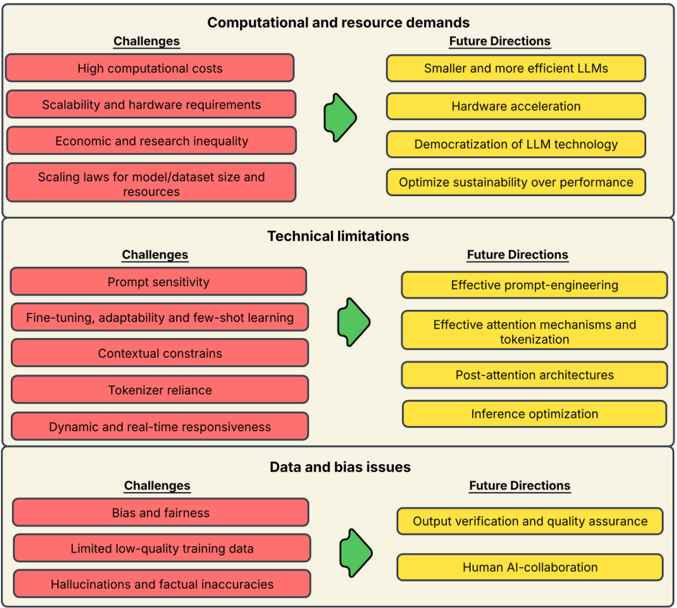
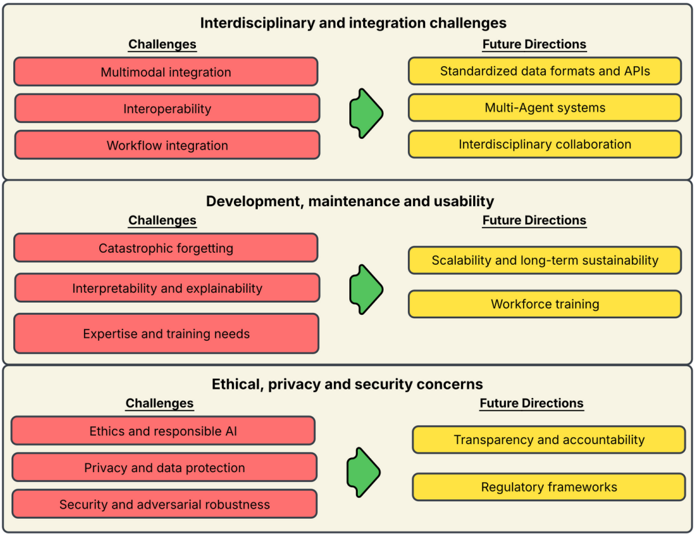
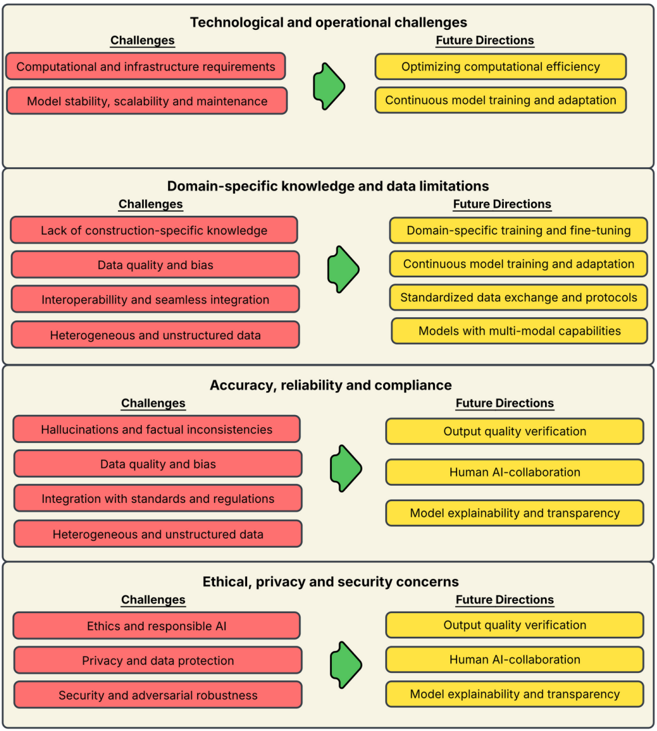
- Recurring limitations across applications include lack of construction-specific knowledge, prompt sensitivity, computational/resource demands, data interoperability, need for human oversight, and ethical/privacy/security concerns.
- Recommendations for stakeholders include selecting appropriate LLM variants, domain-specific fine-tuning, integrating with BIM/digital tools via standardized APIs, improving computational efficiency, and implementing validation frameworks with human oversight.
Methods
- Literature review using Scopus and Web of Science; search combined LLM-related and AEC-related keyword sets, limited to English research articles and conference papers published 2021–2024.
- Identification yielded 927 Scopus and 437 WoS records; after filtering: 510 Scopus and 266 WoS; after duplicate removal: 776; title screening eliminated 494 and abstract screening 113, leaving 95; full-text eligibility selected 28 studies with use cases/applications.
- Relevant review articles were also considered to establish challenges, limitations, future directions, recommendations, and categorization of use cases.
Limitations
- Stated: the review focuses on transformer-based architectures mainly for text generation, not audio, image, or video generation; because the focus is AEC, the analysis of LLM state-of-the-art implementations and techniques is not extensive and is limited to basic concepts and trends.
- Stated/evident: the final review set is only 28 studies, and the search is restricted to Scopus/WoS, English, and 2021–2024, so it may miss other databases, languages, or pre-2021 work.
- Evident: as a literature review, it does not generate or analyze new datasets (the paper states “No datasets were generated or analysed during the current study”) and does not quantitatively meta-analyze the reviewed applications.
Model-written summary. Check it against the paper before relying on it.
Integrity signals
Registry
Cites
Statistics
Figures
Verification
Claims the paper makes
55 Valid · 4 Not valid · 48 Not checked · 14 Own results and interpretations
The cited sources support only part of this claim — read each source’s verdict below.
In the paper
“While their work is comprehensive and a significant contribution to the field, they present only six already established applications of LLMs in construction, not addressing the recent adoption of this technology.”
What the sources say
- Partly supportedcites Taiwo et al. 2024 matched to “Generative AI in the Construction Industry: A State-of-the-art Analysis” (2024) sourceExperimental — accuracy not yet measured
Section 4.1 (page unavailable) says the review identified six peer-reviewed articles on LLM uses in construction, not that there are only six established applications; it describes the applications as emerging. It also discusses adoption, stating that it remains in the very early stages, while Section 4.3 (page unavailable) says adoption is growing. Thus the claim's numerical basis is present, but its characterization of the applications and assertion that the paper does not address adoption are not supported. (LLM, conf=0.88)
plain- Asserted: passes — The authors put it forward as true.
- Checkable: passes — It can be checked against evidence.
- Load-bearing: unclear — It is unclear whether the paper’s conclusions depend on it.
- Based: passes — The paper gives a reason why it holds.
- Partly supported
Every source the paper cites for this claim was checked and supports it.
In the paper
“Saka et al. ( 2023a ) did a holistic review of GPT models in the construction industry, focusing on opportunities and limitations in all stages of construction.”
What the sources say
- Supportedcites Saka et al. 2023a matched to “GPT models in construction industry: Opportunities, limitations, and a use case validation” (2024) source
The Introduction states that the study critically reviews opportunities and limitations of GPT models in the AEC industry. The Abstract says it finds opportunities throughout the project lifecycle, and Section 4.2 organizes them by lifecycle phase. This supports the citing sentence’s description of a broad review covering construction stages. (LLM, conf=0.91)
plain- Asserted: passes — The authors put it forward as true.
- Checkable: passes — It can be checked against evidence.
- Load-bearing: unclear — It is unclear whether the paper’s conclusions depend on it.
- Based: passes — The paper gives a reason why it holds.
- Supported
The cited sources support only part of this claim — read each source’s verdict below.
In the paper
“the lack of construction-specific knowledge of the models often resulted in inaccuracies or incomplete domain specifications.”
What the sources say
- Partly supportedcites Guan et al. (2023) matched to “Leveraging Pre-trained Large Language Models to Construct and Utilize World Models for Model-based Task Planning” (2023) sourceExperimental — accuracy not yet measured
Section 5.1 reports factual errors in generated PDDL domain models, including missing preconditions and effects, and suggests GPT-4 may have an inaccurate understanding of actions. It does not identify a lack of construction-specific knowledge as the cause or report findings about the construction industry; here, “construction” refers to constructing PDDL models. Page numbers are unavailable in our copy. (LLM, conf=0.85)
plainstates a cause- Asserted: passes — The authors put it forward as true.
- Checkable: passes — It can be checked against evidence.
- Load-bearing: unclear — It is unclear whether the paper’s conclusions depend on it.
- Based: passes — The paper gives a reason why it holds.
- Partly supported
Every source the paper cites for this claim was checked and supports it.
In the paper
“The results demonstrated an over 25% increase in the detected hazards when students utilized ChatGPT.”
What the sources say
- Supportedcites Uddin et al. (2023) matched to “Leveraging ChatGPT to Aid Construction Hazard Recognition and Support Safety Education and Training” (2023) source
The Conclusions (p. 17) state that using ChatGPT as an intervention yielded hazard-recognition gains exceeding 25%. The same section describes a pre-intervention assessment and a subsequent assessment of construction students, matching the claimed comparison. (LLM, conf=0.94)
boostedstates a cause- Asserted: passes — The authors put it forward as true.
- Checkable: passes — It can be checked against evidence.
- Load-bearing: unclear — It is unclear whether the paper’s conclusions depend on it.
- Based: passes — The paper gives a reason why it holds.
- Supported
The cited sources support only part of this claim — read each source’s verdict below.
In the paper
“Prompt sensitivity is another limitation”
What the sources say
- Partly supportedcites Prieto et al. (2023) matched to “Investigating the Use of ChatGPT for the Scheduling of Construction Projects” (2023) sourceExperimental — accuracy not yet measured
The Methodology (Section 3) says the study evaluated consistency under slight prompt modifications. The Results and discussion (Section 5) show that ChatGPT changed its schedule when the prompt added electrical work, but present this as adaptability, not as a limitation caused by prompt sensitivity. (LLM, conf=0.78)
plainstates an association- Asserted: passes — The authors put it forward as true.
- Checkable: passes — It can be checked against evidence.
- Load-bearing: unclear — It is unclear whether the paper’s conclusions depend on it.
- Based: passes — The paper gives a reason why it holds.
- Partly supported
25 more claims · 8 with their cited sources checked
Create a free account to see all 121 claims and to verify the 2 references still open.
- Probably not a substantial claim. 43
- It may state two separate claims as one. 70
Self-check
Percentages, sums and reported differences re-computed from the paper’s own numbers.
Each contradiction between two passages listed here was confirmed by an independent check.
Rated minor: it would not touch a result — a value no result rests on, a p-value that stays on the same side of the significance level, or a conflict that is clerical, resolved elsewhere in the paper, or outside its own findings.
In the paper
§ 3.3 Current LLM families
“117M in GPT-2”
§ 3.3 Current LLM families
“175B in GPT-2 and GPT-3.”
Citations
Cites
Vaswani, A., Shazeer, N., Parmar, N., Uszkoreit, J., Jones, L., Gomez, A. N., Kaiser, L., & Polosukhin, I. (2017) · arXiv · doi:10.48550/arxiv.1706.03762 · Cited by 120,404
Exploiting Generative AI to Scale up Intelligent Tutoring Systems
Jakubův, J., Chvalovský, K., Goertzel, Z., Kaliszyk, C., Olšák, M., Piotrowski, B., Schulz, S., Suda, M., & Urban, J. (2023) · DROPS (Schloss Dagstuhl – Leibniz Center for Informatics) · doi:10.4230/lipics.itp.2023.19 · Cited by 76,658
BERT: Pre-training of Deep Bidirectional Transformers for Language Understanding
Devlin, J., Chang, M.-W., Lee, K., & Toutanova, K. (2018) · arXiv · doi:10.48550/arxiv.1810.04805 · Cited by 73,173
A New Approach to Linear Filtering and Prediction Problems
Kalman, R. E. (1960) · Journal of Basic Engineering · doi:10.1115/1.3662552 · Cited by 31,751 · cited 1×
“Another promising architecture that is related to transformers is the State Space Models (SSM), a configuration that can be interpreted as a combination of RNNs and CNNs that drew inspiration from classical state space models (Kalman 1960 ).”
Language Models are Few-Shot Learners
Brown, T. B., Mann, B., Ryder, N., Subbiah, M., Kaplan, J., Dhariwal, P., Neelakantan, A., Shyam, P., Sastry, G., Askell, A., et al. (2020) · arXiv · doi:10.48550/arxiv.2005.14165 · Cited by 23,372 · cited 9×
“Their framework was tested in three scenarios: a household robot, Tyreworld and Logistics, and exhibited better performance with fewer errors than GPT-3.”
InfluentialRoBERTa: A Robustly Optimized BERT Pretraining Approach
Liu, Y., Ott, M., Goyal, N., Du, J., Joshi, M., Chen, D., Levy, O., Lewis, M., Zettlemoyer, L., & Stoyanov, V. (2019) · arXiv · doi:10.48550/arxiv.1907.11692 · Cited by 16,515
Kaugeranna, R., Kaugeranna, E., & Aion, (. S. 4. 6. (2023) · DROPS (Schloss Dagstuhl – Leibniz Center for Informatics) · doi:10.4230/lipics.giscience.2023.43 · Cited by 13,690
LoRA: Low-Rank Adaptation of Large Language Models
Hu, E. J., Shen, Y., Wallis, P., Allen-Zhu, Z., Li, Y., Wang, S., Wang, L., & Chen, W. (2021) · arXiv · doi:10.48550/arxiv.2106.09685 · Cited by 13,453 · cited 1×
“…involves decomposing weight matrices into smaller, lower dimension ones, requiring again the adjustment of a small number of parameters for tuning (Hu et al. 2021 ), and Retrieval-Augmented Generation (RAG), a post-training approach that involves requesting additional data related to the input…”
Exploring the Limits of Transfer Learning with a Unified Text-to-Text Transformer
Raffel, C., Shazeer, N., Roberts, A., Lee, K., Narang, S., Matena, M., Zhou, Y., Li, W., & Liu, P. J. (2019) · arXiv · doi:10.48550/arxiv.1910.10683 · Cited by 10,929
Scaling Laws for Neural Language Models
Kaplan, J., McCandlish, S., Henighan, T., Brown, T. B., Chess, B., Child, R., Gray, S., Radford, A., Wu, J., & Amodei, D. (2020) · arXiv · doi:10.48550/arxiv.2001.08361 · Cited by 9,550 · cited 1×
“…exponentially more computational resources with performance improving at a gradually decreasing rate when dataset and model size remain fixed (Kaplan et al. 2020 ), with Sorscher et al. ( 2022 ) highlighting that for a reduction of 2% in error, orders of magni - tude more energy consumption…”
Research works printed but not linked: 1
- OpenAI (2023b) GPT-4V(ision) system card. OpenAI, San Francisco. ht t p s : / / o p e n a i . c o m / i n d e x / g p t - 4 v - s y s t e m - c a r d /
Cited by
Hallucination to truth: a review of fact-checking and factuality evaluation in large language models
Rahman, S. S., Islam, M. A., Alam, M. M., Zeba, M., Rahman, M. A., Chowa, S. S., Raiaan, M. A. K., & Azam, S. (2026) · Artificial Intelligence Review · doi:10.1007/s10462-025-11454-w · Cited by 39
Yu, G., Wang, Y., Wang, Z., Chen, L., Zheng, Y., & Liu, Y. (2026) · Advanced Engineering Informatics · doi:10.1016/j.aei.2026.104655 · Cited by 23
Ten questions concerning Large Language Models (LLMs) for building applications
Ma, N., Labib, R., Amor, R., Chong, A., Fan, C., Forth, K., Fu, X., Fuchs, S., Hong, T., Klimenkova, N., et al. (2026) · Building and Environment · doi:10.1016/j.buildenv.2026.114260 · Cited by 31
Xu, Y., Li, A., Guo, X., Chan, J. C. F., Gong, X., Kwok, H., & Cheng, J. C. P. (2026) · Automation in Construction · doi:10.1016/j.autcon.2025.106611 · Cited by 13
Automatic classification of construction accident reports using BERTopic-GLDA approach
Wang, J., Qu, Z., Wu, S., Skitmore, M., & Ma, L. (2025) · Engineering Construction & Architectural Management · doi:10.1108/ecam-04-2025-0692 · Cited by 11
Lee, J. H., Ostwald, M. J., & Arasteh, S. (2026) · International Journal of Technology and Design Education · doi:10.1007/s10798-026-10080-z · Cited by 18
Zhong, J., Li, P., Luo, R., Yin, J., Ding, Y., Bai, J., Hong, C., Xiang, D., Ma, X., & Lu, S. (2025) · Energies · doi:10.3390/en18225921 · Cited by 9
Evaluating large language models (LLMs) for semantic interpretation of IFC-based BIM data
Jin, S., Kim, D., Lee, J., & Lee, D. (2026) · Automation in Construction · doi:10.1016/j.autcon.2026.106879 · Cited by 9
Zheng, J., Huang, Z., Wang, X., Qi, X., & Chen, X. (2025) · Ocean Engineering · doi:10.1016/j.oceaneng.2025.122559 · Cited by 10
Reliable LLM-driven BIM automation through capability-based multi-dimensional evaluation
Alwashah, Z., Xiao, B., Liu, H., Mueller, S. T., & Shao, X. (2026) · Automation in Construction · doi:10.1016/j.autcon.2026.106910 · Cited by 6
Youwai, S., Phim, D., Murcia, V. G., & Onas, R. C. (2026) · AI in Civil Engineering · doi:10.1007/s43503-026-00088-8 · Cited by 13
Tam, N. V. (2026) · Journal of Construction Engineering and Management · doi:10.1061/jcemd4.coeng-17998 · Cited by 5
Poudel, A., & Surface, T. (2026) · Discover Civil Engineering · doi:10.1007/s44290-026-00474-2 · Cited by 3
Qin, S. J. (2026) · Computers and Education Artificial Intelligence · doi:10.1016/j.caeai.2026.100592 · Cited by 7
Park, S. (2026) · Architectural research · doi:10.1007/s44515-026-00006-0 · Cited by 5
Wang, L., Yuan, J., Su, S., Ding, H., Bai, Y., & Skibniewski, M. J. (2026) · Automation in Construction · doi:10.1016/j.autcon.2026.106823 · Cited by 4
Xia, Z., Zhong, B., Zhang, S., Zhao, T., & Skibniewski, M. J. (2026) · Automation in Construction · doi:10.1016/j.autcon.2026.106816 · Cited by 9
Chaudhary, N., Uddin, S. M. J., & Jin, Z. (2026) · Computer Applications in Engineering Education · doi:10.1002/cae.70231 · Cited by 1
BIM–LLM integration in AECO workflows: Applications, validation, and future directions
Park, I., Kim, Y., Kim, K., & Chin, S. (2026) · Automation in Construction · doi:10.1016/j.autcon.2026.106905 · Cited by 9
Choi, K., Jeong, M., Shin, Y., Ma, J. W., Kim, K., & Kim, H. (2026) · Automation in Construction · doi:10.1016/j.autcon.2025.106749 · Cited by 1
Knowledge assessment and enhancement pathways for large language model in architectural design
Yan, S.-R., Wang, X., & Liu, N.-X. (2025) · Journal of Asian Architecture and Building Engineering · doi:10.1080/13467581.2025.2605783 · Cited by 2
Human languaging and large language models
Gahrn-Andersen, R. (2025) · AI & Society · doi:10.1007/s00146-025-02599-x · Cited by 5
MFEGPT: A PID controller-inspired multimodal feature enhancement for MLLMs
Li, H., Jia, Z., Zhang, X., Leng, C., Li, H., Gao, H., Liu, J., & Liu, Q. (2025) · Neurocomputing · doi:10.1016/j.neucom.2025.131114 · Cited by 2
Chen, L., Huang, Z., Wang, H., Chai, F., Yu, C., Wei, H., Liu, Z., Li, Y., Wang, H., Luo, R., et al. (2026) · Advanced Engineering Informatics · doi:10.1016/j.aei.2026.104314 · Cited by 25
Park, A. B., Poudel, O., Wu, Z., Awada, M., & Assaad, R. H. (2026) · Construction Management and Economics · doi:10.1080/01446193.2026.2732229
Więckowski, J., Paradowski, B., Kizielewicz, B., & Bouraima, M. B. (2026) · Applied Soft Computing · doi:10.1016/j.asoc.2026.116417 · Cited by 1
Liu, Z., Zhou, H., Li, Y., Zhu, M., Mo, Y., & Sun, H. (2026) · Engineering Construction & Architectural Management · doi:10.1108/ecam-04-2026-0595
Wang, J., Zhang, R., Gu, Q., et al. (2026) · Buildings · doi:10.3390/buildings16173496
Bench of Euler: A Benchmark for Evaluating the Problem-Solving Abilities of Large Language Models
Dutta, A., Priya, S., Ramamoorthy, A., & Kumar, P. K. (2026) · AppliedMath · doi:10.3390/appliedmath6090143
Wang, Y., Wang, J., & Fang, W. (2026) · Journal of Construction Engineering and Management · doi:10.1061/jcemd4.coeng-18087
Liu, R., Xu, Z., Zayed, T. M., Liu, H., Zhao, Y., & Chang, Z. (2026) · Water Research X · doi:10.1016/j.wroa.2026.100610 · Cited by 1
AI-Augmented Cost Estimation in Highway Projects: A Proof of Concept for State DOTs
Shaheen, Q. H., Zhou, H., & Cui, Q. (2026) · doi:10.1061/9780784486962.021
Error Taxonomy and Failure Analysis of Large Language Models for BIM Scripting
Alwashah, Z., Xiao, B., Liu, H., Mueller, S. T., & Shao, X. (2026) · ASCE Construction Research Congress (CRC) · doi:10.1061/9780784486979.036
Panahi, R., Baldwin, A. J., Choi, J., & Badr, M. (2026) · ASCE Construction Research Congress (CRC) · doi:10.1061/9780784486962.048
FireSeek-Sci: A large language model with fire science knowledge for smart building safety
Ding, Y., Zheng, H., Lu, T., Zeng, Y., Deng, R., Zhang, Y., & Huang, X. (2026) · Journal of Infrastructure Intelligence and Resilience · doi:10.1016/j.iintel.2026.100233
Lin, X., Zhu, X., & Yu, G. (2026) · Buildings · doi:10.3390/buildings16163259
Wang, Z., Feng, F., & Pang, Z. (2026) · Building and Environment · doi:10.1016/j.buildenv.2026.115106
Automated compliance checking in AEC in the era of AI and LLMs: A review (2022–2025)
Senousy, Y., Cheung, F. K. T., Beach, T., Elezaj, O., & Vakaj, E. (2026) · Automation in Construction · doi:10.1016/j.autcon.2026.107165 · Cited by 1
Hu, Z., Li, M., Han, X., et al. (2026) · Energy and Buildings · doi:10.1016/j.enbuild.2026.118025
Wu, J., Fuchs, S., Pauwels, P., & Borrmann, A. (2026) · Automation in Construction · doi:10.1016/j.autcon.2026.107148 · Cited by 2
Towards trustworthy LLM-assisted EPD comparability assessment for circular construction materials
Chen, Y., Sun, N., & Xue, J. (2026) · Environmental Impact Assessment Review · doi:10.1016/j.eiar.2026.108606 · Cited by 1
Pham, D. H., Nguyen, H. A. T., Lee, S., Ahn, Y., & Lee, J. (2026) · Applied Soft Computing · doi:10.1016/j.asoc.2026.115895 · Cited by 1
AI-Driven Trajectory Optimization for Large-Scale Construction 3D Printing
Garashchenko, Y. N., Dasic, P. V., Fedorovich, V., & Ostroverkh, Y. V. (2026) · Lecture notes in networks and systems · doi:10.1007/978-3-032-30110-9_30
An Agentic AI and LLM-Based Framework for Probabilistic Cost Estimation from Fragmented BIM Data
Wu, L., Zhang, Q., Xu, R., Zhang, Y., Ghansah, F. A., & Chen, X. (2026) · Intelligent infrastructure and construction · doi:10.3390/iic2030008 · Cited by 1
Azimi, S., Hakiminejad, Y., Shevade, D. J., & Tavakoli, A. (2026) · Results in Engineering · doi:10.1016/j.rineng.2026.111444 · Cited by 5
Wang, Y., Zhang, Y., & Liu, P. (2026) · doi:10.1109/caibda70336.2026.11621653
A Multimodal Model- and Retrieval-Guided Framework for BIM Model Cost Estimation
Al-Derham, H. R., Chaudhari, R. J., Gao, L., & Senouci, A. (2026) · Buildings · doi:10.3390/buildings16112103
Li, Z., Zhao, Q., Dong, L., & Sun, M. (2026) · Frontiers in Built Environment · doi:10.3389/fbuil.2026.1825552 · Cited by 1
Tam, N. V., & Phong, V. V. (2026) · Energy and Buildings · doi:10.1016/j.enbuild.2026.117560 · Cited by 2
Lu, Z., Wang, H., Song, J., Tian, X., & Lin, A. (2026) · Expert Systems with Applications · doi:10.1016/j.eswa.2026.132589 · Cited by 1
Eshun, I., Odai, R. N. A., & Alao, G. U. (2026) · doi:10.69739/jtr.v1i1.1601 · Cited by 2
Method for Constructing a Knowledge Graph of Main Substation Equipment Based on LLM
Ge, C., Fu, Y., Pan, J., et al. (2026) · doi:10.1109/eeicai68535.2026.11441697
Dede, G., Kinnane, O., & Raffoul, S. (2026) · SSRN Electronic Journal · doi:10.2139/ssrn.6636644
Vision-language model applications in structural health monitoring
Zhang, Y., & Liu, C. (2026) · Elsevier eBooks · doi:10.1016/b978-0-443-45022-8.00009-7
Xu, C., Wang, Y., Chen, Y., Zhang, M., Gan, Y., & Chen, Y. (2026) · SSRN Electronic Journal · doi:10.2139/ssrn.6993288
Simson, R., Kiil, M., Võsa, K.-V., & Kurnitski, J. (2026) · SSRN Electronic Journal · doi:10.2139/ssrn.7300707
Explicit Cognitive Allocation: A Principle for Governed and Reviewable LLM-Assisted Inquiry
Manzanilla-Granados, H. M., Cazales, Z. N., Pescador‐Rojas, M., & Ramírez-Romero, T. A. (2026) · IEEE Access · doi:10.1109/access.2026.3725913
Myung, J.-H., Chang, S., & Lee, J. (2026) · SSRN Electronic Journal · doi:10.2139/ssrn.7380663
A multi-agent debate workflow for construction projects: A cross-stage decision framework
Yin, H. (2025) · Journal of Building Design and Environment · doi:10.70401/jbde.2025.0018 · Cited by 1
Faria, P., Qin, Y., Marques, T. N., et al. (2025) · doi:10.1145/3786484.3786516
Metadata
- Authors
- Kampelopoulos, D., Tsanousa, A., Vrochidis, S., & Kompatsiaris, I.
- Affiliations
- Centre for Research and Technology Hellas (GR)
- Corresponding author
- Kampelopoulos, Dimitrios
- Tsanousa, Athina
- Vrochidis, Stefanos
- Kompatsiaris, Ioannis
- Venue
- Artificial Intelligence Review
- Published
- 2025-05-16
- Volume
- 58
- Issue
- 8
- ISSN
- 0269-2821 (ISSN-L)
- 1573-7462
- OpenAlex
- W4410453424
- Cited by
- 69
- References
- 134
- Citations by year
- 2026: 60 · 2025: 9
- FWCI
- 28.59
- Type
- journal article
- Language
- en
- Open access
- hybrid
- doi.org
- Licence
- cc-by
- creativecommons.org/licenses/by/4.0 (tdm)
- creativecommons.org/licenses/by/4.0 (vor)
- Locations
- Artificial Intelligence Review (publishedVersion, cc-by)
- Funders
- Centre for Research & Technology Hellas
- Topics
- Physical Sciences › Engineering › Building and Construction › BIM and Construction Integration
- Physical Sciences › Computer Science › Artificial Intelligence › Artificial Intelligence Applications
- Physical Sciences › Computer Science › Artificial Intelligence › Topic Modeling
- Keywords
- large language models, architecture, engineering and construction, construction industry, transformer models
About these checks
Registry, retraction, Cites and statistics results are computed, not judged, with one exception: a printed reference that no index lists is read once by a model before it counts as a citation error. Claims are extracted by a model and kept only when their quote appears verbatim in the text; each cited source is then checked, with a model’s help, for whether it says what the claim relies on. Those verdicts can be wrong — read the claim’s quote and the cited source before relying on one.
The claim verdicts this report counts are experimental: their accuracy is not yet measured.
A language model drew the claims from the paper on 2026-09-28, under version 3 of the claim definition (prompt extract-v3).
A second model labelled each claim on 2026-09-28 (model jev-1.13-20260917, definition revision gold-guideline-v0.2).
Cited sources are checked with a language model’s help (gpt-6-sol).
Statistics and arithmetic are recomputed, not judged.
Confidence bands are shown only for fields calibrated on our annotated test set. None is calibrated yet, so no band is shown.
What counts as a claim ›How we measure confidence ›How we check this ›
Are you an author, or do you see a problem with this page? Request a review
Data sources
Bibliographic data: Semantic Scholar, OpenAlex, Crossref.
Contains information from the Semantic Scholar Academic Graph Datasets, made available under the ODC Attribution License (ODC-BY 1.0).
Semantic Scholar’s data is described in: Kinney, R., et al. (2023). The Semantic Scholar Open Data Platform. arXiv:2301.10140.
