

The DOI matches its Crossref record; 230 of the 230 references it cites were found in a registry or an index.
Agreement of self-reported and genital measures of sexual arousal in men and women: a meta-analysis.
Open accessAbstract
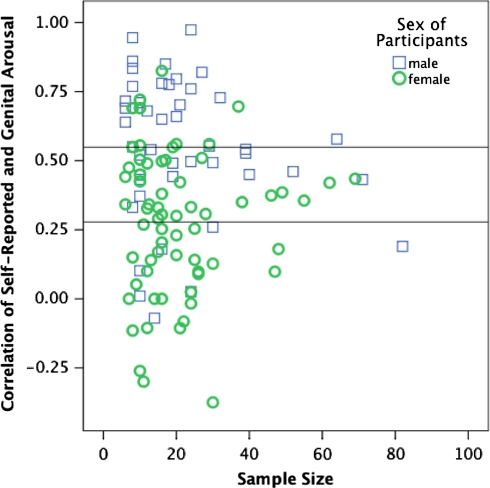
The assessment of sexual arousal in men and women informs theoretical studies of human sexuality and provides a method to assess and evaluate the treatment of sexual dysfunctions and paraphilias. Understanding measures of arousal is, therefore, paramount to further theoretical and practical advances in the study of human sexuality. In this meta-analysis, we review research to quantify the extent of agreement between self-reported and genital measures of sexual arousal, to determine if there is a gender difference in this agreement, and to identify theoretical and methodological moderators of subjective-genital agreement. We identified 132 peer- or academically-reviewed laboratory studies published between 1969 and 2007 reporting a correlation between self-reported and genital measures of sexual arousal, with total sample sizes of 2,505 women and 1,918 men. There was a statistically significant gender difference in the agreement between self-reported and genital measures, with men (r = .66) showing a greater degree of agreement than women (r = .26). Two methodological moderators of the gender difference in subjective-genital agreement were identified: stimulus variability and timing of the assessment of self-reported sexual arousal. The results have implications for assessment of sexual arousal, the nature of gender differences in sexual arousal, and models of sexual response.
Overview
The claims and statistics of this paper haven’t been checked yet.
Run the check — free, no account needed. It reads the open-access text and checks the sources it cites.
Integrity signals
Registry
Cites
Statistics
Figures
Verification
Claims the paper makes
The claims and statistics of this paper haven’t been checked yet.
Run the check — free, no account needed. It reads the open-access text and checks the sources it cites.
Claims other papers make about this one
Each is checked against this paper’s own text: does it say what the citing paper says it does?
The cited source says what the claim attributes to it.
In the citing paper
“Compared with men, women experience a higher level of discordance between their physiological arousal and their subjective experience of arousal when presented with sexual stimuli (6).”
From Effects of Mindfulness Training on Body Awareness to Sexual Stimuli: Implications for Female Sexual Dysfunction (2011) · cites this paper as [6]
Self-check
Percentages, sums and reported differences re-computed from the paper’s own numbers.
The self-check needs the paper’s full text.
Citations
Cites
(2001) · doi:10.1017/cbo9780511546396 · Cited by 4,482
Neural systems supporting interoceptive awareness
Critchley, H. D., Wiens, S., Rotshtein, P., Öhman, A., & Dolan, R. J. (2004) · Nature Neuroscience · doi:10.1038/nn1176 · Cited by 3,406
(1971) · The Medical Journal of Australia · doi:10.5694/j.1326-5377.1971.tb87410.x · Cited by 3,030
(1979) · Cited by 2,524
The evolution of human sexuality
Wilson, G. (1980) · Personality and Individual Differences · doi:10.1016/0191-8869(80)90074-4 · Cited by 2,505
The characteristics of persistent sexual offenders: a meta-analysis of recidivism studies
Hanson, R. K., & Morton-Bourgon, K. E. (2005) · Journal of Consulting and Clinical Psychology · doi:10.1037/0022-006x.73.6.1154 · Cited by 1,795 · cited 1×
“Regarding predictive validity, phallometrically-assessed sexual arousal to stimuli depicting children or sexual violence is an important predictor of sexual reoffending among sex offenders (Hanson & Morton-Bourgon, 2005).”
Gender differences in sexuality: A meta-analysis.
Oliver, M. B., & Hyde, J. S. (1993) · Psychological Bulletin · doi:10.1037/0033-2909.114.1.29 · Cited by 1,134 · cited 2×
“Formen,genitalmeasures of sexual arousal included circumferential assessments using mercury-in-rubber, indium-gallium, or mechanical (Barlow) strain gauges, volumetric devices, or thermography.”
Calculating correlation coefficients with repeated observations: Part 2—correlation between subjects
Bland, J. M., & Altman, D. G. (1995) · BMJ · doi:10.1136/bmj.310.6980.633 · Cited by 1,083 · cited 2×
“Each participant produces a set of data points that is used to calculate a within-subjects correlation for that participant, which can then be averaged across the participants in a group (Bland & Altman, 1995a).”
Bland, J. M., & Altman, D. G. (1995) · BMJ · doi:10.1136/bmj.310.6977.446 · Cited by 1,036 · cited 2×
“Each participant produces a set of data points that is used to calculate a within-subjects correlation for that participant, which can then be averaged across the participants in a group (Bland & Altman, 1995a).”
Causes of sexual dysfunction: The role of anxiety and cognitive interference.
Barlow, D. H. (1986) · Journal of Consulting and Clinical Psychology · doi:10.1037/0022-006x.54.2.140 · Cited by 896 · cited 3×
“Cognitive models of sexual response and dysfunction propose that positive affect directs attention to erotic stimuli, thereby increasing sexual response, whereas negative affect interferes in the processing of sexual cues, resulting in lower sexual response (see Barlow, 1986).”
Research works printed but not linked: 4
- *Chivers, M. L. (2003). A sex difference in the specificity of sexual arousal. Unpublished doctoral dissertation, Northwestern University, Evanston, IL.
- *Gaither, G. K. (2001). The reliability and validity of three new measures of male sexual preferences. Dissertation Abstracts International: Section B: The Sciences & Engineering, 61(9-B), 4981.
- Jones, G. E. (1995). Constitutional and physiological factors in heartbeat perception. In D. Vaitl & R. Schandry (Eds.), From the heart to the brain: The psychophysiology of circulation-brain interaction (pp. 173–192). Frankfurt/Main: Peter Lang.
- *Stock, W. E. (1983). The effects of violent pornography on the sexual responsiveness and attitudes of women. Unpublished doctoral dissertation, State University of New York at Stony Brook, Stony Brook, NY.
Cited by
Sorted by citations
van Anders, S. M. (2015) · Archives of Sexual Behavior · doi:10.1007/s10508-015-0490-8 · Cited by 651
Sex differences in brain activation to emotional stimuli: A meta-analysis of neuroimaging studies
Stevens, J. S., & Hamann, S. (2012) · Neuropsychologia · doi:10.1016/j.neuropsychologia.2012.03.011 · Cited by 588
The human sexual response cycle: Brain imaging evidence linking sex to other pleasures
Georgiadis, J. R., & Kringelbach, M. L. (2012) · Progress in Neurobiology · doi:10.1016/j.pneurobio.2012.05.004 · Cited by 422
Petersen, J. L., & Hyde, J. S. (2011) · The Journal of Sex Research · doi:10.1080/00224499.2011.551851 · Cited by 345
Harshaw, C. (2015) · Psychological Bulletin · doi:10.1037/a0038101 · Cited by 302
Metadata
- Authors
- Chivers, M. L., Seto, M. C., Lalumière, M. L., Laan, E., & Grimbos, T.
- Affiliations
- Queen's University (CA)
- Royal Ottawa Mental Health Centre (CA)
- University of Lethbridge (CA)
- Amsterdam UMC Location University of Amsterdam (NL)
- University of Toronto (CA)
- Corresponding author
- Chivers, Meredith L.
- Venue
- Archives of Sexual Behavior
- Published
- 2010-01-05
- Volume
- 39
- Issue
- 1
- Pages
- 5-56
- ISSN
- 0004-0002 (ISSN-L)
- 1573-2800
- PMC
- PMC2811244
- OpenAlex
- W2054026797
- Cited by
- 584
- References
- 225
- Citations by year
- 2026: 12 · 2025: 17 · 2024: 29 · 2023: 26 · 2022: 40 · 2021: 40 · 2020: 42 · 2019: 46 · 2018: 29 · 2017: 45 · 2016: 42 · 2015: 41 · 2014: 38 · 2013: 52 · 2012: 34
- FWCI
- 5.76
- Type
- journal article
- Language
- en
- Open access
- hybrid
- doi.org
- Licence
- cc-by-nc
- Locations
- Archives of Sexual Behavior (publishedVersion, cc-by-nc)
- PubMed Central (publishedVersion, cc-by-nc)
- PubMed (publishedVersion)
- UvA-DARE (University of Amsterdam) (publishedVersion)
- Pure Amsterdam UMC (publishedVersion)
- Data Archiving and Networked Services (DANS) (submittedVersion, other-oa)
- Data Archiving and Networked Services (DANS) (submittedVersion)
- Funders
- Canadian Institutes of Health Research
- Social Sciences and Humanities Research Council of Canada
- Topics
- Health Sciences › Medicine › Psychiatry and Mental health › Sexual function and dysfunction studies
- Social Sciences › Psychology › Clinical Psychology › Sexuality, Behavior, and Technology
- Social Sciences › Psychology › Experimental and Cognitive Psychology › Evolutionary Psychology and Human Behavior
- Keywords
- sexual arousal, gender differences, stimulus variability, sexual dysfunction assessment, paraphilias
- MeSH terms
- Female, Humans, Male, Self-Assessment, Sexual Behavior, Sex Characteristics
About these checks
Registry, retraction, Cites and statistics results are computed, not judged, with one exception: a printed reference that no index lists is read once by a model before it counts as a citation error. Claims are extracted by a model and kept only when their quote appears verbatim in the text; each cited source is then checked, with a model’s help, for whether it says what the claim relies on. Those verdicts can be wrong — read the claim’s quote and the cited source before relying on one.
Statistics and arithmetic are recomputed, not judged.
Confidence bands are shown only for fields calibrated on our annotated test set. None is calibrated yet, so no band is shown.
What counts as a claim ›How we measure confidence ›How we check this ›
Are you an author, or do you see a problem with this page? Request a review
