

The DOI matches its Crossref record; 32 of the 32 references it cites were found in a registry or an index.
More than “100 worst” alien species in Europe
Open accessAbstract
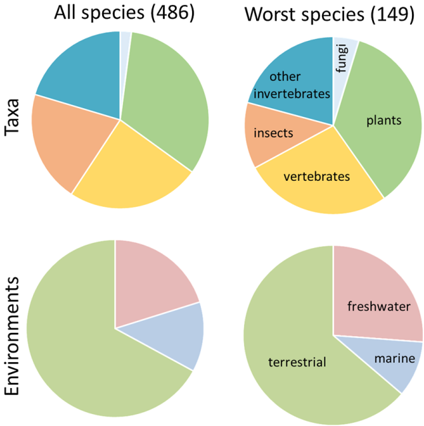
“One hundred worst” lists of alien species of the greatest concern proved useful for raising awareness of the risks and impacts of biological invasions amongst the general public, politicians and stakeholders. All lists so far have been based on expert opinion and primarily aimed at representativeness of the taxonomic and habitat diversity rather than at quantifying the harm the alien species cause. We used the generic impact scoring system (GISS) to rank 486 alien species established in Europe from a wide range of taxonomic groups to identify those with the highest environmental and socioeconomic impact. GISS assigns 12 categories of impact, each quantified on a scale from 0 (no impact detectable) to 5 (the highest impact possible). We ranked species by their total sum of scores and by the number of the highest impact scores. We also compared the listing based on GISS with other expert-based lists of the “worst” invaders. We propose a list of 149 alien species, comprising 54 plants, 49 invertebrates, 40 vertebrates and 6 fungi. Among the highest ranking species are one bird ( Branta canadensis ), four mammals ( Rattus norvegicus, Ondatra zibethicus, Cervus nippon, Muntiacus reevesi ), one crayfish ( Procambarus clarkii ), one mite ( Varroa destructor ), and four plants ( Acacia dealbata, Lantana camara, Pueraria lobata, Eichhornia crassipes ). In contrast to other existing expert-based “worst” lists, the GISS-based list given here highlights some alien species with high impacts that are not represented on any other list. The GISS provides an objective and transparent method to aid prioritization of alien species for management according to their impacts, applicable across taxa and habitats. Our ranking can also be used for justifying inclusion on lists such as the alien species of Union concern of the European Commission, and to fulfill Aichi target 9.
Overview
The claims and statistics of this paper haven’t been checked yet.
Run the check — free, no account needed. It reads the open-access text and checks the sources it cites.
Integrity signals
Registry
Cites
Statistics
Figures
Verification
Claims the paper makes
The claims and statistics of this paper haven’t been checked yet.
Run the check — free, no account needed. It reads the open-access text and checks the sources it cites.
Claims other papers make about this one
Each is checked against this paper’s own text: does it say what the citing paper says it does?
The cited source says what the claim attributes to it.
In the citing paper
“The IAS with the greatest impacts emerge from all taxonomic groups, as illustrated by the example of Europe.”
From Scientists' warning on invasive alien species (2020) · cites this paper as Nentwig et al., 2018
The cited source says what the claim attributes to it.
In the citing paper
“The European list of aliens with highest impacts includes 149 species: 54 plants, 49 invertebrates, 40 vertebrates, and six fungi.”
From Scientists' warning on invasive alien species (2020) · cites this paper as Nentwig et al., 2018
Self-check
Percentages, sums and reported differences re-computed from the paper’s own numbers.
The self-check needs the paper’s full text.
Citations
Cites
Global pollinator declines: trends, impacts and drivers
Potts, S. G., Biesmeijer, J. C., Kremen, C., Neumann, P., Schweiger, O., & Kunin, W. E. (2010) · Trends in Ecology & Evolution · doi:10.1016/j.tree.2010.01.007 · Cited by 6,458
The Ecology of Invasions by Animals and Plants
Elton, C. (1958) · Springer eBooks · doi:10.1007/978-1-4899-7214-9 · Cited by 4,331
The Ecology of Invasions by Animals and Plants.
Richards, P. W., & Elton, C. (1959) · Journal of Ecology · doi:10.2307/2257385 · Cited by 3,907
Pyšek, P., Jaros̆ı́k, V., Hulme, P. E., Pergl, J., Hejda, M., Schaffner, U., & Vilà, M. (2011) · Global Change Biology · doi:10.1111/j.1365-2486.2011.02636.x · Cited by 1,521
Self-citation100 of the world's worst invasive alien species : A selection from global invasive species database
Issg (2000) · Medical Entomology and Zoology · Cited by 1,364
Impact of invasive plants on the species richness, diversity and composition of invaded communities
Hejda, M., Pyšek, P., & Jarošík, V. (2009) · Journal of Ecology · doi:10.1111/j.1365-2745.2009.01480.x · Cited by 1,172
Self-citationA Unified Classification of Alien Species Based on the Magnitude of their Environmental Impacts
Blackburn, T. M., Essl, F., Evans, T., Hulme, P. E., Jeschke, J. M., Kühn, I., Kumschick, S., Marková, Z., Mrugała, A., Nentwig, W., et al. (2014) · PLoS Biology · doi:10.1371/journal.pbio.1001850 · Cited by 959
Self-citationVilà, M., Basnou, C., Pyšek, P., Josefsson, M., Genovesi, P., Gollasch, S., Nentwig, W., Olenin, S., Roques, A., Roy, D., et al. (2010) · Frontiers in Ecology and the Environment · doi:10.1890/080083 · Cited by 934
Self-citationHandbook of Alien Species in Europe
Drake, J. A. (2008) · Springer eBooks · doi:10.1007/978-1-4020-8280-1 · Cited by 593
Kats, L. B., & Ferrer, R. P. (2003) · Diversity and Distributions · doi:10.1046/j.1472-4642.2003.00013.x · Cited by 579
Socio‐economic impact classification of alien taxa (SEICAT)
Bacher, S., Blackburn, T. M., Essl, F., Genovesi, P., Heikkilä, J., Jeschke, J. M., Jones, G., Keller, R., Kenis, M., Kueffer, C., et al. (2018) · Methods in Ecology and Evolution · doi:10.1111/2041-210x.12844 · Cited by 378
Self-citationImpact of Biological Invasions on Ecosystem Services
(2017) · doi:10.1007/978-3-319-45121-3 · Cited by 348
Self-citationH ymenoscyphus pseudoalbidus , the causal agent of E uropean ash dieback
Gross, A., Holdenrieder, O., Pautasso, M., Queloz, V., & Sieber, T. N. (2013) · Molecular Plant Pathology · doi:10.1111/mpp.12073 · Cited by 340
A Generic Impact‐Scoring System Applied to Alien Mammals in Europe
Nentwig, W., Kühnel, E., & Bacher, S. (2009) · Conservation Biology · doi:10.1111/j.1523-1739.2009.01289.x · Cited by 175
Self-citationComparing impacts of alien plants and animals in E urope using a standard scoring system
Kumschick, S., Bacher, S., Evans, T., Marková, Z., Pergl, J., Pyšek, P., Vaes‐Petignat, S., van der Veer, G., Vilà, M., & Nentwig, W. (2015) · Journal of Applied Ecology · doi:10.1111/1365-2664.12427 · Cited by 146
Self-citationSome alien birds have as severe an impact as the most effectual alien mammals in Europe
Kumschick, S., & Nentwig, W. (2010) · Biological Conservation · doi:10.1016/j.biocon.2010.07.023 · Cited by 133
Self-citationCameron, E. K., Vilà, M., & Cabeza, M. (2016) · Global Ecology and Biogeography · doi:10.1111/geb.12436 · Cited by 123
Self-citationECDC guidelines for the surveillance of invasive mosquitoes in Europe.
Rakotoarivony, L., & Schaffner, F. (2012) · PubMed · Cited by 119
Nentwig, W., Bacher, S., Pyšek, P., Vilà, M., & Kumschick, S. (2016) · Environmental Monitoring and Assessment · doi:10.1007/s10661-016-5321-4 · Cited by 119
Self-citationScoring environmental and socioeconomic impacts of alien plants invasive in Europe
Rumlerová, Z., Vilà, M., Pergl, J., Nentwig, W., & Pyšek, P. (2016) · Biological Invasions · doi:10.1007/s10530-016-1259-2 · Cited by 108
Self-citationA global assessment of alien amphibian impacts in a formal framework
Measey, J. G., Vimercati, G., de Villiers, F. A., Mokhatla, M., Davies, S. J., Thorp, C. J., Rebelo, A. D., & Kumschick, S. (2016) · Diversity and Distributions · doi:10.1111/ddi.12462 · Cited by 102
Self-citationvan der Veer, G., & Nentwig, W. (2014) · Ecology Of Freshwater Fish · doi:10.1111/eff.12181 · Cited by 102
Self-citationNon-native Species, Ecosystem Services, and Human Well-Being
Vilà, M., & Hulme, P. E. (2017) · Impact of Biological Invasions on Ecosystem Services · doi:10.1007/978-3-319-45121-3_1 · Cited by 99
Self-citationIntroduction, establishment rate, pathways and impact of spiders alien to Europe
Nentwig, W. (2015) · Biological Invasions · doi:10.1007/s10530-015-0912-5 · Cited by 98
Self-citationPopulation History and Pathways of Spread of the Plant Pathogen Phytophthora plurivora
Schoebel, C. N., Stewart, J. E., Grünwald, N. J., Rigling, D., & Prospero, S. (2014) · PLoS ONE · doi:10.1371/journal.pone.0085368 · Cited by 81
One Hundred of the Most Invasive Alien Species in Europe
Vilà, M., Başnou, C., Gollasch, S., Josefsson, M., Pergl, J., & Scalerà, R. (2008) · Springer eBooks · doi:10.1007/978-1-4020-8280-1_12 · Cited by 78
Self-citationAssessing the assessments: evaluation of four impact assessment protocols for invasive alien species
Turbé, A., Strubbe, D., Mori, E., Carrete, M., Chiron, F., Clergeau, P., González‐Moreno, P., Louarn, M. L., Luna, Á., Menchetti, M., et al. (2017) · Diversity and Distributions · doi:10.1111/ddi.12528 · Cited by 59
Self-citationEnvironmental and economic impact of alien terrestrial arthropods in Europe
Nentwig, W., & Vaes‐Petignat, S. (2014) · NeoBiota · doi:10.3897/neobiota.22.6620 · Cited by 50
Self-citationLaverty, C., Nentwig, W., Dick, J. T. A., & Lucy, F. (2015) · Management of Biological Invasions · doi:10.3391/mbi.2015.6.4.03 · Cited by 45
Self-citationInvasive alien species – framework for the identification of invasive alien species of EU concern
Roy, H. E., Schönrogge, K., Dean, H., Peyton, J., Branquart, É., Vanderhoeven, S., Copp, G. H., Stebbing, P., Kenis, M., Rabitsch, W. B., et al. (2014) · NERC Open Research Archive (Natural Environment Research Council) · Cited by 27
Managing alien bird species: Time to move beyond “100 of the worst” lists?
Kumschick, S., Blackburn, T. M., & Richardson, D. M. (2015) · Bird Conservation International · doi:10.1017/s0959270915000167 · Cited by 25
Self-citationSpecies Accounts of 100 of the Most Invasive Alien Species in Europe
Devin, S., & Beisel, J. (2008) · Springer eBooks · doi:10.1007/978-1-4020-8280-1_13 · Cited by 15
Research works printed but not linked: 1
- EU (2010) Commission Regulation (EU) No 206/2010 of 12 March 2010 laying down lists of third countries, territories or parts thereof authorised for the introduction into the European Union of certain animals and fresh meat and the veterinary certification requirements (Text with EEA relevance). Official Journal of the European Union L 73/1. http://eur-lex.europa.eu/legal-content/EN/ALL/?uri=CELEX%3A32010R0206
Cited by
Sorted by citations
Scientists' warning on invasive alien species
Pyšek, P., Hulme, P. E., Simberloff, D., Bacher, S., Blackburn, T. M., Carlton, J. T., Dawson, W., Essl, F., Foxcroft, L. C., Genovesi, P., et al. (2020) · Biological Reviews · doi:10.1111/brv.12627 · Cited by 2,234
Self-citationPuchałka, R., Dyderski, M. K., Vítková, M., Sádlo, J., Klisz, M., Netsvetov, M., Prokopuk, Y., Matisons, R., Mionskowski, M., Wojda, T., et al. (2020) · Global Change Biology · doi:10.1111/gcb.15486 · Cited by 148
Linking traits of invasive plants with ecosystem services and disservices
Milanović, M., Knapp, S., Pyšek, P., & Kühn, I. (2020) · Ecosystem Services · doi:10.1016/j.ecoser.2020.101072 · Cited by 125
Self-citationGrasslands of the Palaearctic Biogeographic Realm: Introduction and Synthesis
Dengler, J., Biurrun, I., Boch, S., Dembicz, I., & Török, P. (2020) · Elsevier eBooks · doi:10.1016/b978-0-12-409548-9.12432-7 · Cited by 112
The importance of assessing positive and beneficial impacts of alien species
Vimercati, G., Kumschick, S., Probert, A. F., Volery, L., & Bacher, S. (2020) · NeoBiota · doi:10.3897/neobiota.62.52793 · Cited by 101
Self-citation
Metadata
- Authors
- Nentwig, W., Bacher, S., Kumschick, S., Pyšek, P., & Vilà, M.
- Affiliations
- University of Bern (CH)
- University of Fribourg (CH)
- Stellenbosch University (ZA)
- Czech Academy of Sciences (CZ)
- Consejo Superior de Investigaciones Científicas (ES)
- Corresponding author
- Nentwig, Wolfgang
- Venue
- Biological Invasions
- Published
- 2017-12-18
- Volume
- 20
- Issue
- 6
- Pages
- 1611-1621
- ISSN
- 1387-3547 (ISSN-L)
- 1573-1464
- OpenAlex
- W2771159618
- Cited by
- 316
- References
- 31
- Citations by year
- 2026: 29 · 2025: 32 · 2024: 34 · 2023: 30 · 2022: 49 · 2021: 44 · 2020: 52 · 2019: 27 · 2018: 19
- FWCI
- 22.09
- Type
- journal article
- Language
- en
- Update notices
- correction (2018-02-02)
- Open access
- hybrid
- doi.org
- Locations
- Biological Invasions (publishedVersion, cc-by)
- RERO DOC (Universität Bern) (submittedVersion)
- SUNScholar (Stellenbosch University) (submittedVersion)
- BORIS (University Library Bern) (submittedVersion, cc-by)
- DIGITAL.CSIC (Spanish National Research Council (CSIC)) (submittedVersion, other-oa)
- Open Access CRIS of the University of Bern
- Funders
- COST Action TD1209 Alien Challenge (TD1209)
- Ministerio de Economía y Competitividad (CGL2015-65346R)
- Severo Ochoa Program for Centres of Excellence (SEV-2012-0262)
- Akademie Věd České Republiky (RVO 67985939)
- Czech Science Foundation (14-36079G)
- South African National Department of Environmental Affairs
- DST-NRF Centre of Excellence for Invasion Biology
- Topics
- Physical Sciences › Environmental Science › Nature and Landscape Conservation › Ecology and Vegetation Dynamics Studies
- Physical Sciences › Environmental Science › Global and Planetary Change › Marine Ecology and Invasive Species
- Physical Sciences › Environmental Science › Ecology › Animal Ecology and Behavior Studies
- Keywords
- introduced species, species ranking, environmental impact, socio-economic impacts, invasive plants, invasive invertebrates, invasive vertebrates, invasive fungi, Procambarus clarkii, Varroa destructor, Lantana camara, water hyacinth, Rattus norvegicus, Ondatra zibethicus, sika deer, Reeves's muntjac, Canada goose, invasive crayfish, invasive birds, invasive mammals, Europe
About these checks
Registry, retraction, Cites and statistics results are computed, not judged, with one exception: a printed reference that no index lists is read once by a model before it counts as a citation error. Claims are extracted by a model and kept only when their quote appears verbatim in the text; each cited source is then checked, with a model’s help, for whether it says what the claim relies on. Those verdicts can be wrong — read the claim’s quote and the cited source before relying on one.
Statistics and arithmetic are recomputed, not judged.
Confidence bands are shown only for fields calibrated on our annotated test set. None is calibrated yet, so no band is shown.
What counts as a claim ›How we measure confidence ›How we check this ›
Are you an author, or do you see a problem with this page? Request a review
