

The DOI matches its Crossref record; 32 of the 32 references it cites were found in a registry or an index.
More than “100 worst” alien species in Europe
Open accessAbstract
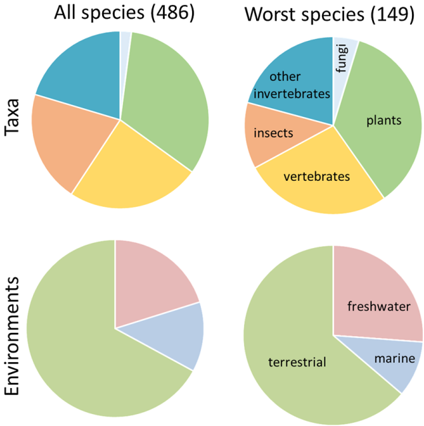
“One hundred worst” lists of alien species of the greatest concern proved useful for raising awareness of the risks and impacts of biological invasions amongst the general public, politicians and stakeholders. All lists so far have been based on expert opinion and primarily aimed at representativeness of the taxonomic and habitat diversity rather than at quantifying the harm the alien species cause. We used the generic impact scoring system (GISS) to rank 486 alien species established in Europe from a wide range of taxonomic groups to identify those with the highest environmental and socioeconomic impact. GISS assigns 12 categories of impact, each quantified on a scale from 0 (no impact detectable) to 5 (the highest impact possible). We ranked species by their total sum of scores and by the number of the highest impact scores. We also compared the listing based on GISS with other expert-based lists of the “worst” invaders. We propose a list of 149 alien species, comprising 54 plants, 49 invertebrates, 40 vertebrates and 6 fungi. Among the highest ranking species are one bird ( Branta canadensis ), four mammals ( Rattus norvegicus, Ondatra zibethicus, Cervus nippon, Muntiacus reevesi ), one crayfish ( Procambarus clarkii ), one mite ( Varroa destructor ), and four plants ( Acacia dealbata, Lantana camara, Pueraria lobata, Eichhornia crassipes ). In contrast to other existing expert-based “worst” lists, the GISS-based list given here highlights some alien species with high impacts that are not represented on any other list. The GISS provides an objective and transparent method to aid prioritization of alien species for management according to their impacts, applicable across taxa and habitats. Our ranking can also be used for justifying inclusion on lists such as the alien species of Union concern of the European Commission, and to fulfill Aichi target 9.
Overview
The claims and statistics of this paper haven’t been checked yet.
Run the check — free, no account needed. It reads the open-access text and checks the sources it cites.
Integrity signals
Registry
Cites
Statistics
Figures
Verification
Claims the paper makes
The claims and statistics of this paper haven’t been checked yet.
Run the check — free, no account needed. It reads the open-access text and checks the sources it cites.
Claims other papers make about this one
Each is checked against this paper’s own text: does it say what the citing paper says it does?
The cited source says what the claim attributes to it.
In the citing paper
“The IAS with the greatest impacts emerge from all taxonomic groups, as illustrated by the example of Europe.”
From Scientists' warning on invasive alien species (2020) · cites this paper as Nentwig et al., 2018
The cited source says what the claim attributes to it.
In the citing paper
“The European list of aliens with highest impacts includes 149 species: 54 plants, 49 invertebrates, 40 vertebrates, and six fungi.”
From Scientists' warning on invasive alien species (2020) · cites this paper as Nentwig et al., 2018
Self-check
Percentages, sums and reported differences re-computed from the paper’s own numbers.
The self-check needs the paper’s full text.
Citations
Cites
Global pollinator declines: trends, impacts and drivers
Potts, S. G., Biesmeijer, J. C., Kremen, C., Neumann, P., Schweiger, O., & Kunin, W. E. (2010) · Trends in Ecology & Evolution · doi:10.1016/j.tree.2010.01.007 · Cited by 6,458
The Ecology of Invasions by Animals and Plants
Elton, C. (1958) · Springer eBooks · doi:10.1007/978-1-4899-7214-9 · Cited by 4,331
The Ecology of Invasions by Animals and Plants.
Richards, P. W., & Elton, C. (1959) · Journal of Ecology · doi:10.2307/2257385 · Cited by 3,907
Pyšek, P., Jaros̆ı́k, V., Hulme, P. E., Pergl, J., Hejda, M., Schaffner, U., & Vilà, M. (2011) · Global Change Biology · doi:10.1111/j.1365-2486.2011.02636.x · Cited by 1,521
Self-citation100 of the world's worst invasive alien species : A selection from global invasive species database
Issg (2000) · Medical Entomology and Zoology · Cited by 1,364
Impact of invasive plants on the species richness, diversity and composition of invaded communities
Hejda, M., Pyšek, P., & Jarošík, V. (2009) · Journal of Ecology · doi:10.1111/j.1365-2745.2009.01480.x · Cited by 1,172
Self-citationA Unified Classification of Alien Species Based on the Magnitude of their Environmental Impacts
Blackburn, T. M., Essl, F., Evans, T., Hulme, P. E., Jeschke, J. M., Kühn, I., Kumschick, S., Marková, Z., Mrugała, A., Nentwig, W., et al. (2014) · PLoS Biology · doi:10.1371/journal.pbio.1001850 · Cited by 959
Self-citationVilà, M., Basnou, C., Pyšek, P., Josefsson, M., Genovesi, P., Gollasch, S., Nentwig, W., Olenin, S., Roques, A., Roy, D., et al. (2010) · Frontiers in Ecology and the Environment · doi:10.1890/080083 · Cited by 934
Self-citationHandbook of Alien Species in Europe
Drake, J. A. (2008) · Springer eBooks · doi:10.1007/978-1-4020-8280-1 · Cited by 593
Kats, L. B., & Ferrer, R. P. (2003) · Diversity and Distributions · doi:10.1046/j.1472-4642.2003.00013.x · Cited by 579
Research works printed but not linked: 1
- EU (2010) Commission Regulation (EU) No 206/2010 of 12 March 2010 laying down lists of third countries, territories or parts thereof authorised for the introduction into the European Union of certain animals and fresh meat and the veterinary certification requirements (Text with EEA relevance). Official Journal of the European Union L 73/1. http://eur-lex.europa.eu/legal-content/EN/ALL/?uri=CELEX%3A32010R0206
Cited by
Sorted by citations
Scientists' warning on invasive alien species
Pyšek, P., Hulme, P. E., Simberloff, D., Bacher, S., Blackburn, T. M., Carlton, J. T., Dawson, W., Essl, F., Foxcroft, L. C., Genovesi, P., et al. (2020) · Biological Reviews · doi:10.1111/brv.12627 · Cited by 2,234
Self-citationPuchałka, R., Dyderski, M. K., Vítková, M., Sádlo, J., Klisz, M., Netsvetov, M., Prokopuk, Y., Matisons, R., Mionskowski, M., Wojda, T., et al. (2020) · Global Change Biology · doi:10.1111/gcb.15486 · Cited by 148
Linking traits of invasive plants with ecosystem services and disservices
Milanović, M., Knapp, S., Pyšek, P., & Kühn, I. (2020) · Ecosystem Services · doi:10.1016/j.ecoser.2020.101072 · Cited by 125
Self-citationGrasslands of the Palaearctic Biogeographic Realm: Introduction and Synthesis
Dengler, J., Biurrun, I., Boch, S., Dembicz, I., & Török, P. (2020) · Elsevier eBooks · doi:10.1016/b978-0-12-409548-9.12432-7 · Cited by 112
The importance of assessing positive and beneficial impacts of alien species
Vimercati, G., Kumschick, S., Probert, A. F., Volery, L., & Bacher, S. (2020) · NeoBiota · doi:10.3897/neobiota.62.52793 · Cited by 101
Self-citationLeaving the fish bowl: the ornamental trade as a global vector for freshwater fish invasions
Chan, F. T., Beatty, S. J., Gilles, A. S., Hill, J. E., Kozic, S., Luo, D., Morgan, D. L., Pavia, R. T. B., Therriault, T. W., Verreycken, H., et al. (2019) · Aquatic Ecosystem Health & Management · doi:10.1080/14634988.2019.1685849 · Cited by 87
Invasion impacts and dynamics of a European‐wide introduced species
Haubrock, P. J., Ahmed, D. A., Cuthbert, R. N., Stubbington, R., Domisch, S., Marquez, J. R. G., Beidas, A., Amatulli, G., Kiesel, J., Shen, L. Q., et al. (2022) · Global Change Biology · doi:10.1111/gcb.16207 · Cited by 82
Febbraro, M. D., Menchetti, M., Russo, D., Ancillotto, L., Aloise, G., Roscioni, F., Preatoni, D. G., Loy, A., Martinoli, A., Bertolino, S., et al. (2019) · Diversity and Distributions · doi:10.1111/ddi.12890 · Cited by 85
Vítková, M., Sádlo, J., Roleček, J., Petřík, P., Sitzia, T., Müllerová, J., & Pyšek, P. (2019) · The Science of The Total Environment · doi:10.1016/j.scitotenv.2019.134857 · Cited by 87
Self-citationCelesti‐Grapow, L., & Ricotta, C. (2020) · Biological Invasions · doi:10.1007/s10530-020-02429-9 · Cited by 79
Bertolino, S., Sciandra, C., Bosso, L., Russo, D., Lurz, P. W. W., & Febbraro, M. D. (2020) · Mammal Review · doi:10.1111/mam.12185 · Cited by 80
Seebens, H., Meyerson, L. A., Richardson, D. M., Lenzner, B., Tricarico, E., Courchamp, F., Aleksanyan, A. S., Keskin, E., Saeedi, H., Akite, P., et al. (2025) · Biological reviews/Biological reviews of the Cambridge Philosophical Society · doi:10.1111/brv.70058 · Cited by 96
Self-citationShorebirds as important vectors for plant dispersal in Europe
Lovas‐Kiss, Á., Sánchez, M. I., Wilkinson, D. M., Coughlan, N. E., Alves, J. A., & Green, A. J. (2018) · Ecography · doi:10.1111/ecog.04065 · Cited by 69
Uncovering the genomic basis of an extraordinary plant invasion
Bieker, V. C., Battlay, P., Petersen, B., Sun, X., Wilson, J., Brealey, J. C., Bretagnolle, F., Nurkowski, K. A., Lee, C., Sánchez-Barreiro, F., et al. (2022) · Science Advances · doi:10.1126/sciadv.abo5115 · Cited by 64
Appropriate uses of EICAT protocol, data and classifications
Kumschick, S., Bacher, S., Bertolino, S., Blackburn, T. M., Evans, T., Roy, H. E., & Smith, K. G. (2020) · NeoBiota · doi:10.3897/neobiota.62.51574 · Cited by 60
Self-citationInvasive species denialism: Sorting out facts, beliefs, and definitions
Boltovskoy, D., Sylvester, F. A., & Paolucci, E. M. (2018) · Ecology and Evolution · doi:10.1002/ece3.4588 · Cited by 62
Liu, Z., Hu, B., Bell, T. L., Flemetakis, E., & Rennenberg, H. (2020) · Soil Biology and Biochemistry · doi:10.1016/j.soilbio.2020.107776 · Cited by 56
Foxcroft, L. C., Spear, D., van Wilgen, N. J., & McGeoch, M. A. (2019) · NeoBiota · doi:10.3897/neobiota.43.29644 · Cited by 65
A review of impact assessment protocols of non-native plants
Vilà, M., Gallardo, B., Preda, C., García‐Berthou, E., Essl, F., Kenis, M., Roy, H. E., & González‐Moreno, P. (2018) · Biological Invasions · doi:10.1007/s10530-018-1872-3 · Cited by 55
Self-citationMetal accumulation in relation to size and body condition in an all-alien species community
Balzani, P., Kouba, A., Tricarico, E., Kourantidou, M., & Haubrock, P. J. (2021) · Environmental Science and Pollution Research · doi:10.1007/s11356-021-17621-0 · Cited by 51
Recent advances in availability and synthesis of the economic costs of biological invasions
Ahmed, D. A., Haubrock, P. J., Cuthbert, R. N., Bang, A., Soto, I., Balzani, P., Tarkan, A. S., Macêdo, R. L., Carneiro, L., Bodey, T. W., et al. (2023) · BioScience · doi:10.1093/biosci/biad060 · Cited by 52
Rapid adaptation to invasive predators overwhelms natural gradients of intraspecific variation
Melotto, A., Manenti, R., & Ficetola, G. F. (2020) · Nature Communications · doi:10.1038/s41467-020-17406-y · Cited by 51
Ecological adaptability of invasive weeds under environmental pollutants: A review
Sun, J., Khattak, W. A., Abbas, A., Nawaz, M., Hameed, R., Javed, Q., Bo, Y., Khan, K. A., & Du, D. (2023) · Environmental and Experimental Botany · doi:10.1016/j.envexpbot.2023.105492 · Cited by 52
Living with floating vegetation invasions
Kleinschroth, F., Winton, R. S., Calamita, E., Niggemann, F., Botter, M., Wehrli, B., & Ghazoul, J. (2020) · AMBIO · doi:10.1007/s13280-020-01360-6 · Cited by 54
The non-native woody species of the flora of Ukraine: Introduction, naturalization and invasion
Burda, R., & Koniakin, S. M. (2019) · Biosystems Diversity · doi:10.15421/011937 · Cited by 59
The New Zealand mud snail (Potamopyrgus antipodarum): autecology and management of a global invader
Geist, J. A., Mancuso, J. L., Morin, M. M., Bommarito, K. P., Bovee, E. N., Wendell, D., Burroughs, B. A., Luttenton, M. R., Strayer, D. L., & Tiegs, S. D. (2022) · Biological Invasions · doi:10.1007/s10530-021-02681-7 · Cited by 49
Tracking a killer shrimp: Dikerogammarus villosus invasion dynamics across Europe
Soto, I., Cuthbert, R. N., Ahmed, D. A., Kouba, A., Domisch, S., Marquez, J. R. G., Beidas, A., Amatulli, G., Kiesel, J., Shen, L. Q., et al. (2022) · Diversity and Distributions · doi:10.1111/ddi.13649 · Cited by 46
Morinha, F., Carrete, M., Tella, J. L., & Blanco, G. (2020) · Diversity · doi:10.3390/d12050192 · Cited by 45
Montagnani, C., Gentili, R., Brundu, G., Caronni, S., & Citterio, S. (2022) · Agronomy · doi:10.3390/agronomy12020423 · Cited by 46
Petrosyan, V. G., Алексеевич, О. Ф., Feniova, I. Y., Dergunova, N. N., WARSHAVSKY, A. A., Khlyap, L. A., & Dzialowski, A. R. (2023) · NeoBiota · doi:10.3897/neobiota.82.96282 · Cited by 43
The relevance of using various scoring schemes revealed by an impact assessment of feral mammals
Hagen, B. L., & Kumschick, S. (2018) · NeoBiota · doi:10.3897/neobiota.38.23509 · Cited by 43
Self-citationPolce, C., Cardoso, A. C., Deriu, I., Gervasini, E., Tsiamis, K., Vigiak, O., Zulian, G., & Maes, J. (2023) · Scientific Reports · doi:10.1038/s41598-023-32993-8 · Cited by 51
Rodríguez, J., Thompson, V., Rubido-Bará, M., Cordero‐Rivera, A., & González, L. (2019) · Biological Invasions · doi:10.1007/s10530-019-01913-1 · Cited by 44
White, R. L., Strubbe, D., Dallimer, M., Davies, Z. G., Davis, A. J. S., Edelaar, P., Groombridge, J. J., Jackson, H. A., Menchetti, M., Mori, E., et al. (2019) · NeoBiota · doi:10.3897/neobiota.48.34222 · Cited by 39
Long-term trends in crayfish invasions across European rivers
Soto, I., Ahmed, D. A., Beidas, A., Oficialdegui, F. J., Tricarico, E., Angeler, D. G., Amatulli, G., Briski, E., Datry, T., Dohet, A., et al. (2023) · The Science of The Total Environment · doi:10.1016/j.scitotenv.2023.161537 · Cited by 42
Trophic role of marbled crayfish in a lentic freshwater ecosystem
Lipták, B. (2019) · Aquatic Invasions · doi:10.3391/ai.2019.14.2.09 · Cited by 39
A horizon scan exercise for aquatic invasive alien species in Iberian inland waters
Oficialdegui, F. J., Zamora‐Marín, J. M., Guareschi, S., Anastácio, P., Murillo, P. G., Ribeiro, F., Miranda, R., Cobo, F., Gallardo, B., García‐Berthou, E., et al. (2023) · The Science of The Total Environment · doi:10.1016/j.scitotenv.2023.161798 · Cited by 42
Haubrock, P. J., Balzani, P., Azzini, M., Inghilesi, A. F., Veselý, L., Guo, W. H., & Tricarico, E. (2019) · Frontiers in Ecology and Evolution · doi:10.3389/fevo.2019.00355 · Cited by 36
Rai, P. K., & Singh, J. S. (2021) · Proceedings of the Indian National Science Academy · doi:10.1007/s43538-021-00013-w · Cited by 39
Cucu, A.-A., Baci, G.-M., Dezsi, Ş., Nap, M.-E., Beteg, F. I., Bonta, V., Bobiş, O., Caprio, E., & Dezmirean, D. S. (2021) · Plants · doi:10.3390/plants10122621 · Cited by 40
Granata, M. U., Bracco, F., & Catoni, R. (2019) · Journal of Sustainable Forestry · doi:10.1080/10549811.2019.1670678 · Cited by 35
Volery, L., Jatavallabhula, D., Scillitani, L., Bertolino, S., & Bacher, S. (2020) · Global Change Biology · doi:10.1111/gcb.15467 · Cited by 38
Self-citationPostigo, J., Strubbe, D., Mori, E., Ancillotto, L., Carneiro, I., Latsoudis, P., Menchetti, M., Pârâu, L. G., Parrott, D., Reino, L., et al. (2019) · Pest Management Science · doi:10.1002/ps.5320 · Cited by 35
Fennell, M., Wade, M., & Bacon, K. L. (2018) · PeerJ · doi:10.7717/peerj.5246 · Cited by 34
Nunes, L. J. R., Raposo, M. A. M., Meireles, C. I. R., Pinto-Gomes, C. J., & Ribeiro, N. (2020) · Environments · doi:10.3390/environments7050039 · Cited by 37
Geist, J. P., Benedict, A., Dobler, A. H., Hoess, R., & Hoos, P. (2023) · Hydrobiologia · doi:10.1007/s10750-022-05121-2 · Cited by 33
Biological flora of Central Europe – Lupinus polyphyllus Lindley
Eckstein, R. L., Welk, E., Klinger, Y. P., Lennartsson, T., Wissman, J., Ludewig, K., Hansen, W., & Ramula, S. (2022) · Perspectives in Plant Ecology Evolution and Systematics · doi:10.1016/j.ppees.2022.125715 · Cited by 32
Population growth lags in introduced species
Kelly, C. L., Schwarzkopf, L., Gordon, I. J., & Hirsch, B. T. (2021) · Ecology and Evolution · doi:10.1002/ece3.7352 · Cited by 32
Mori, E., Menchetti, M., Zozzoli, R., & Milanesi, P. (2018) · Journal of Zoology · doi:10.1111/jzo.12616 · Cited by 31
Comparing environmental impacts of alien plants, insects and pathogens in protected riparian forests
Lapin, K., Bacher, S., Cech, T. L., Damjanić, R., Essl, F., Georges, F.-I., Hoch, G., Kavčič, A., Koltay, A., Kostić, S., et al. (2021) · NeoBiota · doi:10.3897/neobiota.69.71651 · Cited by 31
Self-citationVerhaegen, G., von Jungmeister, K., & Haase, M. (2020) · Hydrobiologia · doi:10.1007/s10750-020-04333-8 · Cited by 30
Time is running out! Rapid range expansion of the invasive northern raccoon in central Italy
Boscherini, A., Mazza, G., Menchetti, M., Laurenzi, A., & Mori, E. (2019) · Mammalia · doi:10.1515/mammalia-2018-0151 · Cited by 29
Visual recognition and coevolutionary history drive responses of amphibians to an invasive predator
Melotto, A., Ficetola, G. F., Alari, E., Romagnoli, S., & Manenti, R. (2021) · Behavioral Ecology · doi:10.1093/beheco/arab101 · Cited by 29
Invasive alien plants in Polish national parks—threats to species diversity
Bomanowska, A., Adamowski, W., Kirpluk, I., Otręba, A., & Rewicz, A. (2019) · PeerJ · doi:10.7717/peerj.8034 · Cited by 29
Mortality of native and invasive ladybirds co-infected by ectoparasitic and entomopathogenic fungi
Haelewaters, D., Hiller, T., Kemp, E. A., van Wielink, P. S., Shapiro‐Ilan, D. I., Aime, M. C., Nedvěd, O., Pfister, D. H., & Cottrell, T. E. (2020) · PeerJ · doi:10.7717/peerj.10110 · Cited by 28
Taybi, A. F., Mabrouki, Y., & Glöer, P. (2021) · Graellsia · doi:10.3989/graellsia.2021.v77.303 · Cited by 28
Ectoparasite sharing among native and invasive birds in a metropolitan area
Mori, E., Sala, J. P., Fattorini, N., Menchetti, M., Montalvo, T., & Señar, J. C. (2018) · Parasitology Research · doi:10.1007/s00436-018-6174-2 · Cited by 27
Kowarik, I., Straka, T. M., Lehmann, M., Studnitzky, R., & Fischer, L. K. (2021) · NeoBiota · doi:10.3897/neobiota.66.63460 · Cited by 26
Boncompagni, L., Molfini, M., Ciampelli, P., Fazzi, P., Lucchesi, M., Mori, E., Petralia, L., & Mazza, G. (2021) · Ethology Ecology & Evolution · doi:10.1080/03949370.2021.1872710 · Cited by 25
Patzelt, A., Pyšek, P., Pergl, J., & van Kleunen, M. (2022) · Biological Invasions · doi:10.1007/s10530-021-02711-4 · Cited by 30
Self-citationPresent Status of Non-Native Amphibians and Reptiles Traded in Korean Online Pet Shop
Koo, K. S., Park, H. R., Choi, J. H., & Sung, H. (2020) · Korean Journal of Environment and Ecology · doi:10.13047/kjee.2020.34.2.106 · Cited by 25
What are we talking about? Sika deer (Cervus nippon): A bibliometric network analysis
Saggiomo, L., Esattore, B., & Picone, F. (2020) · Ecological Informatics · doi:10.1016/j.ecoinf.2020.101146 · Cited by 25
Tools for a multiproduct biorefinery of Acacia dealbata biomass
López‐Hortas, L., Rodríguez-González, I., Díaz-Reinoso, B., Torres, M. D., Moure, A., & Domı́nguez, H. (2021) · Industrial Crops and Products · doi:10.1016/j.indcrop.2021.113655 · Cited by 24
Impact of alien plants in Turkey assessed by the Generic Impact Scoring System
Yazlık, A., Pergl, J., & Pyšek, P. (2018) · NeoBiota · doi:10.3897/neobiota.39.23598 · Cited by 27
Self-citationTrophic ecology of invasive marbled and spiny-cheek crayfish populations
Linzmaier, S. M., Musseau, C. L., Matern, S., & Jeschke, J. M. (2020) · Biological Invasions · doi:10.1007/s10530-020-02328-z · Cited by 27
Impacts of the invasive plant Carpobrotus edulis on herbivore communities on the Iberian Peninsula
Rodríguez, J., Cordero‐Rivera, A., & González, L. (2021) · Biological Invasions · doi:10.1007/s10530-020-02449-5 · Cited by 28
Radočaj, T., Špelić, I., Vilizzi, L., Povž, M., & Piria, M. (2021) · Global Ecology and Conservation · doi:10.1016/j.gecco.2021.e01520 · Cited by 24
Loud callings limit human tolerance towards invasive parakeets in urban areas
Mori, E., Onorati, G., & Giuntini, S. (2020) · Urban Ecosystems · doi:10.1007/s11252-020-00954-y · Cited by 23
Seed bank offers potential for active restoration of mountain meadows
Ludewig, K., Hansen, W., Klinger, Y. P., Eckstein, R. L., & Otte, A. (2020) · Restoration Ecology · doi:10.1111/rec.13311 · Cited by 24
Humphries, T. S., Campbell, S., & Florentine, S. K. (2022) · Plants · doi:10.3390/plants11233334 · Cited by 23
da Silva, M. V. A., de Souza, J. V. N., de Souza, J. R. B., & Vieira, L. M. (2019) · Freshwater Biology · doi:10.1111/fwb.13323 · Cited by 23
Riveiro, S. F., Cruz, Ó., Casal, M., & Reyes, O. (2020) · Annals of Forest Science · doi:10.1007/s13595-020-00965-x · Cited by 22
Arthropods and associated pathogens from native and introduced rodents in Northeastern Italy
Mori, E., Pisanu, B., Zozzoli, R., Solano, E., Olivieri, E., Sassera, D., & Montagna, M. (2018) · Parasitology Research · doi:10.1007/s00436-018-6022-4 · Cited by 22
A freshwater symbiosis as sensitive bioindicator of cadmium
Campoy-Diaz, A. D., Escobar‐Correas, S., Canizo, B. V., Wuilloud, R. G., & Vega, I. A. (2019) · Environmental Science and Pollution Research · doi:10.1007/s11356-019-07082-x · Cited by 21
Characterizing arthropod communities and trophic diversity in areas invaded by Australian acacias
Rodríguez, J., Cordero‐Rivera, A., & González, L. (2020) · Arthropod-Plant Interactions · doi:10.1007/s11829-020-09758-5 · Cited by 21
Cordeiro, P. F., Goulart, F. F., Macedo, D. R., Campos, M. D. C. S., & Castro, S. R. (2020) · Ambiente e Agua - An Interdisciplinary Journal of Applied Science · doi:10.4136/ambi-agua.2421 · Cited by 21
Sohrabi, S., Pergl, J., Pyšek, P., Foxcroft, L. C., & Gherekhloo, J. (2021) · Biological Invasions · doi:10.1007/s10530-021-02515-6 · Cited by 23
Self-citationA global impact assessment of Acacia species introduced to South Africa
Jansen, C., & Kumschick, S. (2021) · Biological Invasions · doi:10.1007/s10530-021-02642-0 · Cited by 23
Self-citationKudzu in Europe: niche conservatism for a highly invasive plant
Montagnani, C., Casazza, G., Gentili, R., Caronni, S., & Citterio, S. (2022) · Biological Invasions · doi:10.1007/s10530-021-02706-1 · Cited by 21
Pisuttu, C., Piccolo, E. L., Paoli, L., Cotrozzi, L., Nali, C., Pellegrini, E., & Lorenzini, G. (2022) · Biological Invasions · doi:10.1007/s10530-022-02891-7 · Cited by 21
Marco, A. D., Napoletano, P., Panico, S. C., Memoli, V., Santorufo, L., Ruggiero, A. G., Colombo, C., Barile, R., & Maisto, G. (2022) · CATENA · doi:10.1016/j.catena.2022.106656 · Cited by 21
Rodríguez, J., Novoa, A., Cordero‐Rivera, A., Richardson, D. M., & González, L. (2020) · NeoBiota · doi:10.3897/neobiota.56.49087 · Cited by 24
Escobar‐Correas, S., Mendoza‐Porras, O., Dellagnola, F. A., Colgrave, M. L., & Vega, I. A. (2019) · Journal of Proteome Research · doi:10.1021/acs.jproteome.9b00282 · Cited by 20
Mori, E., Zozzoli, R., & Mazza, G. (2018) · Urban Ecosystems · doi:10.1007/s11252-018-0775-5 · Cited by 20
Ercoli, F. (2019) · BioInvasions Records · doi:10.3391/bir.2019.8.3.25 · Cited by 20
Donne, C., Neiman, M., Woodell, J. D., Haase, M., & Verhaegen, G. (2020) · Molecular Ecology · doi:10.1111/mec.15569 · Cited by 20
Occurrence and management of invasive alien species in Hungarian protected areas compared to Europe
Csiszár, Á., Kézdy, P., Korda, M., & Bartha, D. (2020) · Folia oecologica · doi:10.2478/foecol-2020-0021 · Cited by 23
Sołtysiak, J. (2020) · Journal of Ecological Engineering · doi:10.12911/22998993/125447 · Cited by 19
Pardo-Primoy, D., & Fagúndez, J. (2019) · Flora · doi:10.1016/j.flora.2019.151465 · Cited by 21
Risks of giant hogweed (Heracleum mantegazzianum) range increase in North America
Cuddington, K. M., Sobek, S., Drake, J., Lee, W., & Brook, M. E. (2021) · Biological Invasions · doi:10.1007/s10530-021-02645-x · Cited by 19
Non‐Native Species in Aquaculture: Burgeoning Production and Environmental Sustainability Risks
Oficialdegui, F. J., Soto, I., Balzani, P., Cuthbert, R. N., Haubrock, P. J., Kourantidou, M., Manfrini, E., Tarkan, A. S., Kurtul, I., Macêdo, R. L., et al. (2025) · Reviews in Aquaculture · doi:10.1111/raq.70037 · Cited by 23
Carosi, A., Ghetti, L., & Lorenzoni, M. (2021) · Water · doi:10.3390/w13030347 · Cited by 18
Haubrock, P. J., Soto, I., Kourantidou, M., Ahmed, D. A., Tarkan, A. S., Balzani, P., Bego, K., Kouba, A., Aksu, S., Briski, E., et al. (2024) · Oikos · doi:10.1111/oik.10283 · Cited by 19
Prohibiting pet crayfish does not consistently reduce their availability online
Faulkes, Z. (2018) · Nauplius · doi:10.1590/2358-2936e2018023 · Cited by 18
First detection of the non-indigenous gastropod Rapana venosa in the southernmost coast of Brazil
Spotorno-Oliveira, P., Lopes, R. P., Larroque, A., Monteiro, D. S., Dentzien‐Dias, P., & Tâmega, F. T. D. S. (2020) · Continental Shelf Research · doi:10.1016/j.csr.2020.104047 · Cited by 18
Alien species in Norway: Results from quantitative ecological impact assessments
Sandvik, H., Hilmo, O., Henriksen, S., Elven, R., Åsen, P. A., Hegre, H., Pedersen, O., Pedersen, P. A., Solstad, H., Vandvik, V., et al. (2020) · Ecological Solutions and Evidence · doi:10.1002/2688-8319.12006 · Cited by 18
Núñez-González, N., Rodríguez, J., & González, L. (2021) · Journal of Environmental Management · doi:10.1016/j.jenvman.2021.113554 · Cited by 17
Pepe, M., Gratani, L., Fabrini, G., & Varone, L. (2020) · Plant Species Biology · doi:10.1111/1442-1984.12286 · Cited by 17
The spreading of the invasive sacred ibis in Italy
Cucco, M., Alessandria, G., Bissacco, M., Carpegna, F., Fasola, M., Gagliardi, A., Gola, L., Volponi, S., & Pellegrino, I. (2021) · Scientific Reports · doi:10.1038/s41598-020-79137-w · Cited by 17
Panitsa, M., Trigas, P., Κοντάκος, Δ., Valli, A., & Iatroú, G. (2021) · Plant Biosystems - An International Journal Dealing with all Aspects of Plant Biology · doi:10.1080/11263504.2021.1889701 · Cited by 17
Metadata
- Authors
- Nentwig, W., Bacher, S., Kumschick, S., Pyšek, P., & Vilà, M.
- Affiliations
- University of Bern (CH)
- University of Fribourg (CH)
- Stellenbosch University (ZA)
- Czech Academy of Sciences (CZ)
- Consejo Superior de Investigaciones Científicas (ES)
- Corresponding author
- Nentwig, Wolfgang
- Venue
- Biological Invasions
- Published
- 2017-12-18
- Volume
- 20
- Issue
- 6
- Pages
- 1611-1621
- ISSN
- 1387-3547 (ISSN-L)
- 1573-1464
- OpenAlex
- W2771159618
- Cited by
- 316
- References
- 31
- Citations by year
- 2026: 29 · 2025: 32 · 2024: 34 · 2023: 30 · 2022: 49 · 2021: 44 · 2020: 52 · 2019: 27 · 2018: 19
- FWCI
- 22.09
- Type
- journal article
- Language
- en
- Update notices
- correction (2018-02-02)
- Open access
- hybrid
- doi.org
- Locations
- Biological Invasions (publishedVersion, cc-by)
- RERO DOC (Universität Bern) (submittedVersion)
- SUNScholar (Stellenbosch University) (submittedVersion)
- BORIS (University Library Bern) (submittedVersion, cc-by)
- DIGITAL.CSIC (Spanish National Research Council (CSIC)) (submittedVersion, other-oa)
- Open Access CRIS of the University of Bern
- Funders
- COST Action TD1209 Alien Challenge (TD1209)
- Ministerio de Economía y Competitividad (CGL2015-65346R)
- Severo Ochoa Program for Centres of Excellence (SEV-2012-0262)
- Akademie Věd České Republiky (RVO 67985939)
- Czech Science Foundation (14-36079G)
- South African National Department of Environmental Affairs
- DST-NRF Centre of Excellence for Invasion Biology
- Topics
- Physical Sciences › Environmental Science › Nature and Landscape Conservation › Ecology and Vegetation Dynamics Studies
- Physical Sciences › Environmental Science › Global and Planetary Change › Marine Ecology and Invasive Species
- Physical Sciences › Environmental Science › Ecology › Animal Ecology and Behavior Studies
- Keywords
- introduced species, species ranking, environmental impact, socio-economic impacts, invasive plants, invasive invertebrates, invasive vertebrates, invasive fungi, Procambarus clarkii, Varroa destructor, Lantana camara, water hyacinth, Rattus norvegicus, Ondatra zibethicus, sika deer, Reeves's muntjac, Canada goose, invasive crayfish, invasive birds, invasive mammals, Europe
About these checks
Registry, retraction, Cites and statistics results are computed, not judged, with one exception: a printed reference that no index lists is read once by a model before it counts as a citation error. Claims are extracted by a model and kept only when their quote appears verbatim in the text; each cited source is then checked, with a model’s help, for whether it says what the claim relies on. Those verdicts can be wrong — read the claim’s quote and the cited source before relying on one.
Statistics and arithmetic are recomputed, not judged.
Confidence bands are shown only for fields calibrated on our annotated test set. None is calibrated yet, so no band is shown.
What counts as a claim ›How we measure confidence ›How we check this ›
Are you an author, or do you see a problem with this page? Request a review
