

Atypical Sensory Processing Profiles and Their Associations With Motor Problems In Preschoolers With Developmental Coordination Disorder
Open accessThe DOI matches its Crossref record; 49 of the 49 references it cites were found in a registry or an index.
Abstract
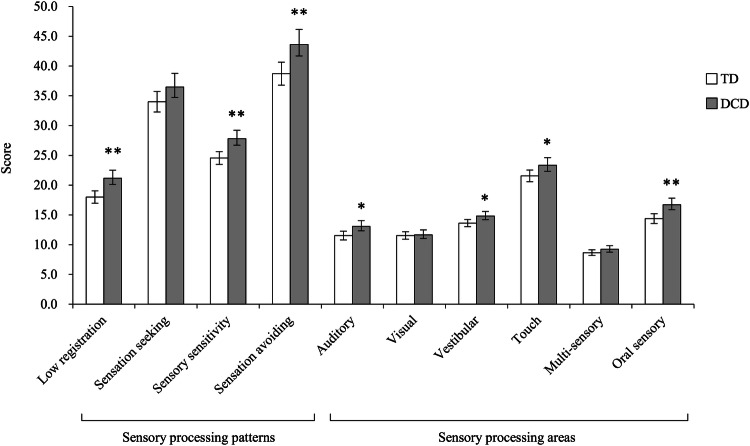
The aims of this study were to identify sensory processing profiles specific to preschoolers with DCD in a community sample and examine the association of sensory processing problems with motor coordination difficulties in these children. Sixty-three 5-year-old children with DCD and without other neurodevelopmental disorders and 106 age-matched typically developing children participated in this study. Sensory processing problems were assessed using the Sensory Profile. Our results demonstrated problems in wide sensory processing patterns (low registration, sensitivity and avoiding) and areas (auditory, vestibular, touch and oral) in children with DCD compared with typically developing children. Additionally, the association of problems in sensory processing patterns (sensitivity and avoiding) and areas (touch and auditory) with motor coordination difficulties were identified in children with DCD alone. Our findings indicate that sensory processing abnormalities may contribute to the pathophysiology of DCD, suggesting the importance of assessing sensory processing functions in children with DCD.
Overview
The claims and statistics of this paper haven’t been checked yet.
Free: it reads the open-access text and checks the first 5 claims that cite a source we can check. Create a free account to check every claim.
Integrity signals
Registry
Cites
Statistics
Figures
Verification
Claims the paper makes
The claims and statistics of this paper haven’t been checked yet.
Free: it reads the open-access text and checks the first 5 claims that cite a source we can check. Create a free account to check every claim.
Claims other papers make about this one
Each is checked against this paper’s own text: does it say what the citing paper says it does?
The source backs part of the claim, not all of it — or backs it for a different population, condition or comparison.
In the citing paper
“The possible link between motor and sensory problems is supported in literature both in children with ASD and other developmental conditions [31,32,33], but the modalities of interconnection and the neurological substrates to these clinical features are not yet clear.”
From Sensory Profile of Children and Adolescents with Autism Spectrum Disorder and Tip-Toe Behavior: Results of an Observational Pilot Study (2022) · cites this paper as [32]
Experimental — accuracy not yet measured
Self-check
Percentages, sums and reported differences re-computed from the paper’s own numbers.
The self-check needs the paper’s full text.
Citations
Cites
Diagnostic and Statistical Manual of Mental Disorders
American Psychiatric Association (2013) · doi:10.1176/appi.books.9780890425596 · Cited by 116,369
Diagnostic and Statistical Manual of Mental Disorders(DSM)
(2008) · Encyclopedia of Counseling · doi:10.4135/9781412963978.n182 · Cited by 10,830
Wechsler Intelligence Scale for Children
(2018) · The SAGE Encyclopedia of Intellectual and Developmental Disorders · doi:10.4135/9781483392271.n537 · Cited by 4,109
Movement Assessment Battery for Children-2
Henderson, S. E., Sugden, D., & Barnett, A. L. (2019) · PsycTESTS Dataset · doi:10.1037/t55281-000 · Cited by 1,619
Wechsler Intelligence Scale for Children
Park, S. E., & Demakis, G. J. (2017) · Encyclopedia of Personality and Individual Differences · doi:10.1007/978-3-319-28099-8_1035-1 · Cited by 1,309
Constantino, J. N. (2013) · Encyclopedia of Autism Spectrum Disorders · doi:10.1007/978-1-4419-1698-3_296 · Cited by 908 · cited 4×
“We also performed a t-test to examine the differences in age, full-scale IQ, SRS2 total score, and the Conners3 global index score between two groups.”
MethodInfluentialBlank, R., Barnett, A. L., Cairney, J., Green, D., Kirby, A., Polatajko, H., Rosenblum, S., Smits‐Engelsman, B., Sugden, D., Wilson, P., et al. (2019) · Developmental Medicine & Child Neurology · doi:10.1111/dmcn.14132 · Cited by 836 · cited 3×
“2% in our sample, and it was comparable to that in the previous reports [2].”
BackgroundResultInfluentialTest Review: Social Responsiveness Scale–Second Edition (SRS-2)
Bruni, T. P. (2014) · Journal of Psychoeducational Assessment · doi:10.1177/0734282913517525 · Cited by 701
BLANK, R., SMITS‐ENGELSMAN, B., POLATAJKO, H., & WILSON, P. (2012) · Developmental Medicine & Child Neurology · doi:10.1111/j.1469-8749.2011.04171.x · Cited by 605
Psychometric Properties of the Revised Developmental Coordination Disorder Questionnaire
Wilson, B. N., Crawford, S. G., Green, D., Roberts, G., Aylott, A., & Kaplan, B. J. (2009) · Physical & Occupational Therapy In Pediatrics · doi:10.1080/01942630902784761 · Cited by 557
Research works printed but not linked: 3
- Dunn W Sensory profile: user’s manual 1999 San Antonio, TX The Psychological Corporation
- Conners KC Conners 3 2008 Toronto, Canada Multi-Health Systems Inc
- Conners KC Conners 3 Japanese version manual (Tanaka Y, Sakamoto R Trans) 2011 Tokyo, Japan (in Japanese) Kaneko Shobo
Cited by
Physical workplace adjustments to support neurodivergent workers: A systematic review
Weber, C., Krieger, B., Häne, E., Yarker, J., & McDowall, A. (2024) · Applied Psychology · doi:10.1111/apps.12431 · Cited by 86
Sensory Processing Impairments in Children with Developmental Coordination Disorder
Tran, H.-T., Li, Y., Lin, H., Lee, S., & Wang, P.-J. (2022) · Children · doi:10.3390/children9101443 · Cited by 61
Early-Life Digital Media Experiences and Development of Atypical Sensory Processing
Heffler, K. F., Acharya, B., Subedi, K., & Bennett, D. S. (2024) · Archives of Pediatrics and Adolescent Medicine · doi:10.1001/jamapediatrics.2023.5923 · Cited by 45
Ringold, S. M., McGuire, R. W., Jayashankar, A., Kilroy, E., Butera, C. D., Harrison, L., Cermak, S. A., & Aziz‐Zadeh, L. (2022) · Brain Sciences · doi:10.3390/brainsci12091171 · Cited by 32
“There is evidence that children with DCD display different sensory processing patterns when compared with other clinical populations or TD children [42,43].”
BackgroundResultInfluentialLyons-Warren, A. M., McCormack, M. C., & Holder, J. L. (2022) · Brain Sciences · doi:10.3390/brainsci12020137 · Cited by 29
“Finally, many neurodevelopmental disorders have similar or overlapping presentations, and subtle clinical differences, such as sensory features, can be helpful in making a diagnosis or guiding genetic testing [3,4,15].”
BackgroundChen, Y., Sideris, J. H., Watson, L. R., Crais, E. R., & Baranek, G. T. (2022) · Development and Psychopathology · doi:10.1017/s0954579422001195 · Cited by 27
“Previous research has reported positive associations between sensory repetitions/seeking behaviors and adaptive and motor skills in autistic children and those with other developmental disabilities (Mikami et al., 2021; Williams et al., 2018).”
Valagussa, G., Purpura, G., Nale, A., Pirovano, R., Mazzucchelli, M., Grossi, E., & Perin, C. (2022) · Children · doi:10.3390/children9091336 · Cited by 20
Cheung, H. Y. L., Brown, T., Yu, M., & Cheung, P. P. (2023) · Journal of Occupational Therapy Schools & Early Intervention · doi:10.1080/19411243.2023.2215764 · Cited by 23
“For example, sensory sensitivity is commonly reported by children with developmental coordination disorder (DCD) (Delgado-Lobete et al., 2020; Mikami et al., 2020), a pattern of sensory processing characterized by heightened sensitivity and passive response to sensory stimulation (Dunn, 2001, 2007).”
Pranjić, M., Hashemi, N., Arnett, A. B., & Thaut, M. H. (2023) · Brain Sciences · doi:10.3390/brainsci13050729 · Cited by 19
Brugnaro, B. H., Oliveira, M. F. P., de Lima, C. R. G., Verdério, B. N., Fonseca-Angulo, R., Romão‐Silva, B., de Campos, A. C., Rosenbaum, P., & Rocha, N. A. C. F. (2024) · Journal of Intellectual Disability Research · doi:10.1111/jir.13118 · Cited by 15
Parental report of early features of developmental coordination disorder: A qualitative study
Roubaix, A. D., VELDE, D. V. D., & Waelvelde, H. V. (2023) · Research in Developmental Disabilities · doi:10.1016/j.ridd.2023.104636 · Cited by 12
Weber, M. D., Draghi, T. T. G., Maia, A. C. S., Cairney, J., Neto, J. L. C., & Tudella, E. (2025) · Research in Developmental Disabilities · doi:10.1016/j.ridd.2025.104917 · Cited by 11
Dannenbaum, E., Bégin, C.-L., Daigneault-Bourgeois, É., Yin, N. K. P., Laferrière-Trudeau, C., Mazer, B. L., Moreau, V., Salvo, L., Villeneuve, M., & Lamontagne, A. (2021) · Physical & Occupational Therapy In Pediatrics · doi:10.1080/01942638.2021.1925800 · Cited by 11
Erskine, N., Barratt, J., & Cairney, J. (2024) · Frontiers in Pediatrics · doi:10.3389/fped.2024.1320338 · Cited by 11
Relationship Between Childhood Sensory Processing Differences and Quality of Life as Adults
May-Benson, T. A., Teasdale, A., & Easterbrooks-Dick, O. (2022) · Frontiers in Psychology · doi:10.3389/fpsyg.2022.886833 · Cited by 11
Keating, J., Purcell, C., Gerson, S. A., Vanderwert, R. E., & Jones, C. R. G. (2024) · Research in Developmental Disabilities · doi:10.1016/j.ridd.2024.104714 · Cited by 9
Relationship between play skills and sensory processing in children with autism
Kars, S., & Akı, E. (2023) · Applied Neuropsychology Child · doi:10.1080/21622965.2023.2266539 · Cited by 8
“Moreover, studies about sensory integration and motor skills in children with developmental coordination disorder (DCD) have found a correlation between sensory processing and fine and gross motor problems (Elbasan et al., 2012; Hen-Herbst et al., 2020; Mikami et al., 2021; Tran et al., 2022).”
Social responsiveness in children with developmental coordination disorder
Roubaix, A. D., Roeyers, H., Waelvelde, H. V., & Bar‐On, L. (2024) · Brazilian Journal of Physical Therapy · doi:10.1016/j.bjpt.2024.100591 · Cited by 8
Yamanishi, Y., Orita, Y., Nagayoshi, M., Nishimura, R., Shinjyo, T., Masuda, K., Hayashi, Y., Nakai, A., Imamura, A., Parham, L. D., et al. (2025) · Cureus · doi:10.7759/cureus.76971 · Cited by 8
Weber, M. D., Neto, J. L. C., Jelsma, D., & Tudella, E. (2025) · European Child & Adolescent Psychiatry · doi:10.1007/s00787-025-02811-9 · Cited by 4
“Although controversial, this association may be explained by shared difficulties within the same neural networks, particularly those involving cerebellar mechanisms (for an in-depth discussion see [10, 11]).”
Previtali, G., Lai, C. Y. Y., Bolgè, M. V., Cavallini, A. R., Nacinovich, R., Piscitelli, D., & Purpura, G. (2023) · Biomedicines · doi:10.3390/biomedicines11082319 · Cited by 4
“This aspect is crucial if we think that sensory processing dysfunctions are present in many neurodevelopmental disorders, such as autism spectrum disorders or others [10,12,14,15,30,31], but also that PT children have a higher risk of different neurodevelopmental disorders, also in the absence of brain damage [19,32–3…”
BackgroundButler, E., Spirtos, M., O’Keeffe, L. M., & Clarke, M. C. (2024) · Early Human Development · doi:10.1016/j.earlhumdev.2024.106166 · Cited by 4
Miyahara, M. (2022) · International Journal of Environmental Research and Public Health · doi:10.3390/ijerph19020744 · Cited by 5
“Participants comprised 68 parents whose children attended the second phase of the Hirosaki Five-Year-Old Developmental Check-up (HFC) Study (See Mikami et al., 2020 [19] and Saito et al., 2020 [20] for details) in 2020.”
BackgroundTseng, Y., Chen, Y., Lin, Y., Tsai, C., & Chuang, C. (2024) · Brain and Cognition · doi:10.1016/j.bandc.2024.106224 · Cited by 3
Kechagia, O., Katartzi, E., FOTIADOU, E. G., & Giagazoglou, P. (2024) · Alberta Journal of Educational Research · doi:10.55016/ojs/ajer.v70i2.78379 · Cited by 2
“Considering the secondary consequences (Alesi et al., 2019; Kennedy-Behr et al., 2013; Mikami et al., 2020; Piek et al., 2008; Rodriguez et al., 2019; Rosenblum et al., 2017) and the long-term effects of low motor skill development (Cantell & Crawford, 2008; Cairney & King-Dowling, 2016; Causgrove…”
The sensory profile of students with probable developmental coordination disorder (DCD)
Tal‐Saban, M., Yochman, A., Weintraub, N., & Magen, H. (2025) · Scientific Reports · doi:10.1038/s41598-025-18361-8 · Cited by 2
“…DCD. Existing research utilizing the Sensory Profile questionnaire - an assessment based on Dunn’s model of sensory processing - indicate that children with DCD show differences in three or four of the sensory quadrants: registration 18,20,21 , sensitivity 20–22 , avoiding 20,22 and seeking 22 .”
InfluentialJussila, K. K., Korkiakoski, A., Jussila, A., Kuusikko‐Gauffin, S., Joskitt, L., Mäntymaa, M., Moilanen, I. K., & Mattila, M. (2025) · Nordic Journal of Psychiatry · doi:10.1080/08039488.2025.2572330 · Cited by 3
“Early challenges in motor and sensory systems may compromise a child’s ability to filter and regulate sensory input, increasing sensitivity to environmental demands [61,62].”
Purpura, G., Lai, C. Y. Y., Previtali, G., Gomez, I. N., Yung, T. W. K., Tagliabue, L., Cerroni, F., Carotenuto, M., & Nacinovich, R. (2022) · Healthcare · doi:10.3390/healthcare11010092 · Cited by 2
Lane, S. J., Schoen, S. A., Schaaf, R. C., Bundy, A. C., Mailloux, Z., Roley, S. S., May-Benson, T. A., & Parham, L. D. (2025) · Brain Sciences · doi:10.3390/brainsci15111184 · Cited by 1
“Coupling the identified literature with author knowledge, we document that these challenges often co-occur in children with a multitude of diagnoses, as well as in conjunction with concerns across behavioral [15], emotional [80], and developmental realms [81].”
Screen habits and effects on sensory profiles in 6- to 36-month-old toddlers
Gillioz, E., Gentaz, É., & Lejeune, F. (2025) · Pediatric Research · doi:10.1038/s41390-025-04024-x · Cited by 2
National Identity and White Supremacy in Wendy Lill’s The Occupation of Heather Rose
Wang, Z. (2022) · Cultural Arts Research and Development · doi:10.55121/card.v2i4.68
National Identity and White Supremacy in Wendy Lill’s The Occupation of Heather Rose
Wang, Z. (2022) · Cultural Arts Research and Development · doi:10.55121/card.v2i2.68
Hidden in Plain Sight: Early Signs of Developmental Coordination Disorder
Roubaix, A. D. (2025) · Current Developmental Disorders Reports · doi:10.1007/s40474-025-00332-3
“Young children with DCD often seem to have sensory processing issues [67, 68] and are often described as highly sensitive by both teachers and parents [27, 30].”
Marqueurs de développement de l'attention exécutive chez l'enfant d'âge préscolaire
Anquetil, M. (2023) · theses.fr (ABES) · doi:10.70675/25e00a02z4bd8z433dzbaabzf50530808cab · Cited by 1
Asher, M., Hochner, H., Bar-Shalita, T., & Agmon, M. (2026) · Frontiers in Psychology · doi:10.3389/fpsyg.2026.1779854
Rosinda, S. J., Hoekstra, P. J., Hadders‐Algra, M., Heineman, K. R., & de Bildt, A. A. (2026) · European Child & Adolescent Psychiatry · doi:10.1007/s00787-026-03110-7
“For example, they found that children with ASD, ADHD and DCD more often missed, sought, avoided and/ or were sensitive to sensory stimuli than typically developing children [7, 8].”
Chakravarthy, M. K., & Haslan, R. H. (2026) · Human Resource Development International · doi:10.1080/13678868.2026.2734746
Maia, A. C. S., Weber, M. D., & Tudella, E. (2026) · Developmental Neurorehabilitation · doi:10.1080/17518423.2026.2747706
Metadata
- Authors
- Mikami, M., Hirota, T., Takahashi, M., Adachi, M., Saito, M., Koeda, S., Yoshida, K., Sakamoto, Y., Kato, S., Nakamura, K., & Yamada, J.
- Affiliations
- Hirosaki University (JP)
- Aomori Chuo Gakuin University (JP)
- Corresponding author
- Yamada, Junko
- ORCID
- Venue
- Child Psychiatry & Human Development
- Published
- 2020-06-11
- Volume
- 52
- Issue
- 2
- Pages
- 311-320
- ISSN
- 0009-398X (ISSN-L)
- 1573-3327
- PMC
- PMC7973923
- OpenAlex
- W3034785417
- Cited by
- 37
- References
- 49
- Citations by year
- 2026: 4 · 2025: 8 · 2024: 7 · 2023: 6 · 2022: 11 · 2021: 1
- FWCI
- 6.79
- Type
- journal article
- Language
- en
- Open access
- hybrid
- doi.org
- Licence
- cc-by
- creativecommons.org/licenses/by/4.0 (tdm)
- creativecommons.org/licenses/by/4.0 (vor)
- Locations
- Child Psychiatry & Human Development (publishedVersion, cc-by)
- PubMed Central (publishedVersion, cc-by)
- PubMed (publishedVersion)
- Funders
- Japan Society for the Promotion of Science (16K10239, 18K07546, 19K08062, Research Fellowships for Young Scientists)
- Hirosaki City
- Hirosaki Institute of Neuroscience in Japan
- Topics
- Social Sciences › Psychology › Developmental and Educational Psychology › Children's Physical and Motor Development
- Social Sciences › Psychology › Neuropsychology and Physiological Psychology › Developmental and Educational Neuropsychology
- Health Sciences › Medicine › Rehabilitation › Cerebral Palsy and Movement Disorders
- Keywords
- developmental coordination disorder, sensory processing, motor coordination deficits, preschool children, sensory profile, sensory sensitivity, sensory avoidance, auditory processing, vestibular processing, touch, oral sensitivity
- MeSH terms
- Child, Preschool, Female, Humans, Male, Perception, Motor Skills Disorders, Neurodevelopmental Disorders
About these checks
Registry, retraction, Cites and statistics results are computed, not judged, with one exception: a printed reference that no index lists is read once by a model before it counts as a citation error. Claims are extracted by a model and kept only when their quote appears verbatim in the text; each cited source is then checked, with a model’s help, for whether it says what the claim relies on. Those verdicts can be wrong — read the claim’s quote and the cited source before relying on one.
Statistics and arithmetic are recomputed, not judged.
Confidence bands are shown only for fields calibrated on our annotated test set. None is calibrated yet, so no band is shown.
What counts as a claim ›How we measure confidence ›How we check this ›
Are you an author, or do you see a problem with this page? Request a review
Data sources
Bibliographic data: Semantic Scholar, OpenAlex, Crossref.
Contains information from the Semantic Scholar Academic Graph Datasets, made available under the ODC Attribution License (ODC-BY 1.0).
Semantic Scholar’s data is described in: Kinney, R., et al. (2023). The Semantic Scholar Open Data Platform. arXiv:2301.10140.
