

Atypical Sensory Processing Profiles and Their Associations With Motor Problems In Preschoolers With Developmental Coordination Disorder
Open accessThe DOI matches its Crossref record; 49 of the 49 references it cites were found in a registry or an index.
Abstract
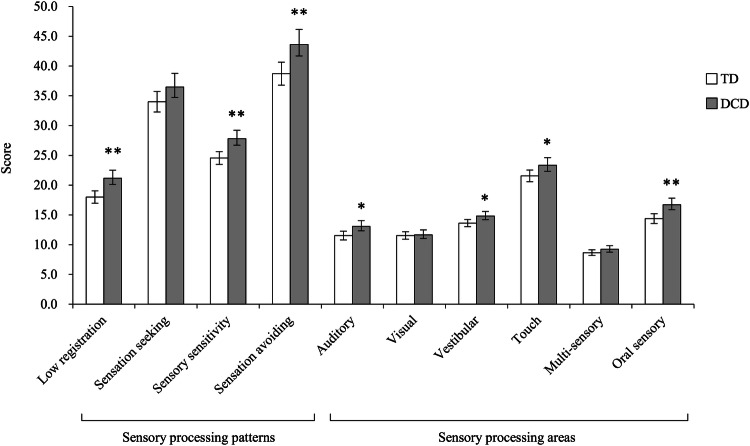
The aims of this study were to identify sensory processing profiles specific to preschoolers with DCD in a community sample and examine the association of sensory processing problems with motor coordination difficulties in these children. Sixty-three 5-year-old children with DCD and without other neurodevelopmental disorders and 106 age-matched typically developing children participated in this study. Sensory processing problems were assessed using the Sensory Profile. Our results demonstrated problems in wide sensory processing patterns (low registration, sensitivity and avoiding) and areas (auditory, vestibular, touch and oral) in children with DCD compared with typically developing children. Additionally, the association of problems in sensory processing patterns (sensitivity and avoiding) and areas (touch and auditory) with motor coordination difficulties were identified in children with DCD alone. Our findings indicate that sensory processing abnormalities may contribute to the pathophysiology of DCD, suggesting the importance of assessing sensory processing functions in children with DCD.
Overview
The claims and statistics of this paper haven’t been checked yet.
Free: it reads the open-access text and checks the first 5 claims that cite a source we can check. Create a free account to check every claim.
Integrity signals
Registry
Cites
Statistics
Figures
Verification
Claims the paper makes
The claims and statistics of this paper haven’t been checked yet.
Free: it reads the open-access text and checks the first 5 claims that cite a source we can check. Create a free account to check every claim.
Claims other papers make about this one
Each is checked against this paper’s own text: does it say what the citing paper says it does?
The source backs part of the claim, not all of it — or backs it for a different population, condition or comparison.
In the citing paper
“The possible link between motor and sensory problems is supported in literature both in children with ASD and other developmental conditions [31,32,33], but the modalities of interconnection and the neurological substrates to these clinical features are not yet clear.”
From Sensory Profile of Children and Adolescents with Autism Spectrum Disorder and Tip-Toe Behavior: Results of an Observational Pilot Study (2022) · cites this paper as [32]
Experimental — accuracy not yet measured
Self-check
Percentages, sums and reported differences re-computed from the paper’s own numbers.
The self-check needs the paper’s full text.
Citations
Cites
Diagnostic and Statistical Manual of Mental Disorders
American Psychiatric Association (2013) · doi:10.1176/appi.books.9780890425596 · Cited by 116,369
Diagnostic and Statistical Manual of Mental Disorders(DSM)
(2008) · Encyclopedia of Counseling · doi:10.4135/9781412963978.n182 · Cited by 10,830
Wechsler Intelligence Scale for Children
(2018) · The SAGE Encyclopedia of Intellectual and Developmental Disorders · doi:10.4135/9781483392271.n537 · Cited by 4,109
Movement Assessment Battery for Children-2
Henderson, S. E., Sugden, D., & Barnett, A. L. (2019) · PsycTESTS Dataset · doi:10.1037/t55281-000 · Cited by 1,619
Wechsler Intelligence Scale for Children
Park, S. E., & Demakis, G. J. (2017) · Encyclopedia of Personality and Individual Differences · doi:10.1007/978-3-319-28099-8_1035-1 · Cited by 1,309
Constantino, J. N. (2013) · Encyclopedia of Autism Spectrum Disorders · doi:10.1007/978-1-4419-1698-3_296 · Cited by 908 · cited 4×
“We also performed a t-test to examine the differences in age, full-scale IQ, SRS2 total score, and the Conners3 global index score between two groups.”
MethodInfluentialBlank, R., Barnett, A. L., Cairney, J., Green, D., Kirby, A., Polatajko, H., Rosenblum, S., Smits‐Engelsman, B., Sugden, D., Wilson, P., et al. (2019) · Developmental Medicine & Child Neurology · doi:10.1111/dmcn.14132 · Cited by 836 · cited 3×
“2% in our sample, and it was comparable to that in the previous reports [2].”
BackgroundResultInfluentialTest Review: Social Responsiveness Scale–Second Edition (SRS-2)
Bruni, T. P. (2014) · Journal of Psychoeducational Assessment · doi:10.1177/0734282913517525 · Cited by 701
BLANK, R., SMITS‐ENGELSMAN, B., POLATAJKO, H., & WILSON, P. (2012) · Developmental Medicine & Child Neurology · doi:10.1111/j.1469-8749.2011.04171.x · Cited by 605
Psychometric Properties of the Revised Developmental Coordination Disorder Questionnaire
Wilson, B. N., Crawford, S. G., Green, D., Roberts, G., Aylott, A., & Kaplan, B. J. (2009) · Physical & Occupational Therapy In Pediatrics · doi:10.1080/01942630902784761 · Cited by 557
Hill, E. L. (2001) · International Journal of Language & Communication Disorders · doi:10.1080/13682820010019874 · Cited by 527
Consensus Paper: The Role of the Cerebellum in Perceptual Processes
Baumann, O., Borra, R. J., Bower, J. M., Cullen, K. E., Habas, C., Ivry, R. B., Leggio, M., Mattingley, J. B., Molinari, M., Moulton, E. A., et al. (2015) · The Cerebellum · doi:10.1007/s12311-014-0627-7 · Cited by 462 · cited 1×
“Studies have revealed abnormalities of functional networks involving the cerebellum in DCD [36], and the cerebellum also plays an important role in auditory processing [37].”
BackgroundConstantino, J. N., Davis, S. A., Todd, R. D., Schindler, M. K., Gross, M. M., Brophy, S. L., Metzger, L. M., Shoushtari, C. S., Splinter, R., & Reich, W. (2021) · PsycTESTS Dataset · doi:10.1037/t17260-000 · Cited by 427
Tactile Perception in Adults with Autism: a Multidimensional Psychophysical Study
Cascio, C., McGlone, F., Folger, S., Tannan, V., Baranek, G., Pelphrey, K. A., & Essick, G. (2008) · Journal of Autism and Developmental Disorders · doi:10.1007/s10803-007-0370-8 · Cited by 380
Reliability and Validity of a Parent Questionnaire on Childhood Motor Skills
Wilson, B. N., Kaplan, B. J., Crawford, S. G., Campbell, A., & Dewey, D. (2000) · The American Journal of Occupational Therapy · doi:10.5014/ajot.54.5.484 · Cited by 358
Cairney, J., Hay, J. A., Faught, B. E., Wade, T. J., Corna, L., & Flouris, A. (2005) · The Journal of Pediatrics · doi:10.1016/j.jpeds.2005.05.013 · Cited by 327
Wilson, P. H., Smits‐Engelsman, B., Caeyenberghs, K., Steenbergen, B., Sugden, D., Clark, J., Mumford, N., & Blank, R. (2017) · Developmental Medicine & Child Neurology · doi:10.1111/dmcn.13530 · Cited by 308
Comparison of sensory profile scores of young children with and without autism spectrum disorders
Watling, R. L., Deitz, J., & White, O. (2001) · American Journal of Occupational Therapy · doi:10.5014/ajot.55.4.416 · Cited by 296
Somatosensory processing in neurodevelopmental disorders
Cascio, C. J. (2010) · Journal of Neurodevelopmental Disorders · doi:10.1007/s11689-010-9046-3 · Cited by 284
Little, L. M., Dean, E., Tomchek, S., & Dunn, W. (2018) · Physical & Occupational Therapy In Pediatrics · doi:10.1080/01942638.2017.1390809 · Cited by 278 · cited 16×
“Findings from other existing studies were consistent with those reported in Cascio’s study [35]; for example, a recent study has reported that children with ASD and ADHD have higher trends in all SP sensory processing patterns compared with TD children, respectively [16].”
BackgroundResultInfluentialSmyth, M. M., & Anderson, H. I. (2000) · British Journal of Developmental Psychology · doi:10.1348/026151000165760 · Cited by 274
Two distinct pathways for developmental coordination disorder: Persistence and resolution
Cantell, M. H., Smyth, M. M., & Ahonen, T. P. (2003) · Human Movement Science · doi:10.1016/j.humov.2003.09.002 · Cited by 269
Zwicker, J. G., Missiuna, C., Harris, S. R., & Boyd, L. A. (2011) · International Journal of Developmental Neuroscience · doi:10.1016/j.ijdevneu.2010.12.002 · Cited by 238
Summers, J., Larkin, D., & Dewey, D. (2008) · Human Movement Science · doi:10.1016/j.humov.2008.02.002 · Cited by 213
WUANG, Y., SU, J., & SU, C. (2012) · Developmental Medicine & Child Neurology · doi:10.1111/j.1469-8749.2011.04177.x · Cited by 205
Association of Sensory Processing and Eating Problems in Children with Autism Spectrum Disorders
Nadon, G., Feldman, D. E., Dunn, W., & Gisel, E. (2011) · Autism Research and Treatment · doi:10.1155/2011/541926 · Cited by 190 · cited 1×
“[40] indicated that eating difficulties in ASD likely reflect problems of oral sensory processing.”
BackgroundMovement assessment battery for children
Mombarg, R. (2019) · Data Archiving and Networked Services (DANS) · Cited by 188
Structural validity of the Movement ABC-2 test: Factor structure comparisons across three age groups
Schulz, J., Henderson, S. E., Sugden, D. A., & Barnett, A. L. (2011) · Research in Developmental Disabilities · doi:10.1016/j.ridd.2011.01.032 · Cited by 165
Saito, M., Hirota, T., Sakamoto, Y., Adachi, M., Takahashi, M., Osato-Kaneda, A., Kim, Y. S., Leventhal, B., Shui, A., Kato, S., et al. (2020) · Molecular Autism · doi:10.1186/s13229-020-00342-5 · Cited by 161 · cited 1×
“More details on the HFC study design was previously published [21].”
BackgroundSelf-citationQuantitative autistic traits ascertained in a national survey of 22 529 Japanese schoolchildren
Kamio, Y., Inada, N., Moriwaki, A., Kuroda, M., Koyama, T., Tsujii, H., Kawakubo, Y., Kuwabara, H., Tsuchiya, K. J., Uno, Y., et al. (2013) · Acta Psychiatrica Scandinavica · doi:10.1111/acps.12034 · Cited by 161 · cited 4×
“We also performed a t-test to examine the differences in age, full-scale IQ, SRS2 total score, and the Conners3 global index score between two groups.”
MethodInfluentialDevelopmental coordination disorder: core sensori-motor deficits, neurobiology and etiology
Gomez, A., & Sirigu, A. (2015) · Neuropsychologia · doi:10.1016/j.neuropsychologia.2015.09.032 · Cited by 153
Cairney, J., Hay, J., Faught, B., Mandigo, J., & Flouris, A. (2005) · Adapted Physical Activity Quarterly · doi:10.1123/apaq.22.1.67 · Cited by 148 · cited 1×
“In addition, children with DCD are less likely to participate in self-care, leisure or physical activity, especially team sports [5, 6].”
BackgroundCommon White Matter Microstructure Alterations in Pediatric Motor and Attention Disorders
Langevin, L. M., MacMaster, F. P., Crawford, S., Lebel, C., & Dewey, D. (2014) · The Journal of Pediatrics · doi:10.1016/j.jpeds.2014.01.018 · Cited by 134
Poulsen, A. A., Ziviani, J. M., Johnson, H., & Cuskelly, M. (2008) · Human Movement Science · doi:10.1016/j.humov.2008.02.004 · Cited by 131
CARLSON, C., Otto, T., & Wellman, P. J. (2007) · Cited by 117
Gaines, R., & Missiuna, C. A. (2006) · Child Care Health and Development · doi:10.1111/j.1365-2214.2006.00677.x · Cited by 108
Developmental Coordination Disorder: A Pilot Diffusion Tensor Imaging Study
Zwicker, J. G., Missiuna, C. A., Harris, S. R., & Boyd, L. A. (2012) · Pediatric Neurology · doi:10.1016/j.pediatrneurol.2011.12.007 · Cited by 100
Noise, variability, and motor performance in developmental coordination disorder
Smits-Engelsman, B. C. M., & Wilson, P. H. (2013) · Developmental Medicine & Child Neurology · doi:10.1111/dmcn.12311 · Cited by 97
Nakai, A., Miyachi, T., Okada, R., Tani, I., Nakajima, S., Onishi, M., Fujita, C., & Tsujii, M. (2011) · Research in Developmental Disabilities · doi:10.1016/j.ridd.2011.02.012 · Cited by 84
Brain Connectomics of Visual-Motor Deficits in Children with Developmental Coordination Disorder
Debrabant, J., Vingerhoets, G., Waelvelde, H. V., Leemans, A., Taymans, T., & Caeyenberghs, K. (2015) · The Journal of Pediatrics · doi:10.1016/j.jpeds.2015.09.069 · Cited by 80
Motor Proficiency in Children Reporting Low Levels of Participation in Physical Activity
Hay, J., & Missiuna, C. (1998) · Canadian Journal of Occupational Therapy · doi:10.1177/000841749806500203 · Cited by 76 · cited 1×
“A relationship has been reported between reduced physical activity and poor self-efficacy [7, 8] and lower life satisfaction [9] in children with DCD.”
BackgroundAllen, S., & Casey, J. (2017) · British Journal of Occupational Therapy · doi:10.1177/0308022617709183 · Cited by 75
White, B. P., Mulligan, S., Merrill, K., & Wright, J. (2007) · The American Journal of Occupational Therapy · doi:10.5014/ajot.61.2.154 · Cited by 70
Elbasan, B., Kayıhan, H., & Düzgün, İ. (2012) · The Italian Journal of Pediatrics/Italian journal of pediatrics · doi:10.1186/1824-7288-38-14 · Cited by 68
Altered tactile sensitivity in children with attention-deficit hyperactivity disorder
Puts, N. A. J., Harris, A. D., Mikkelsen, M. E., Tommerdahl, M., Edden, R. A. E., & Mostofsky, S. H. (2017) · Journal of Neurophysiology · doi:10.1152/jn.00087.2017 · Cited by 51
Developmental Coordination Disorder and its Consequences
(2015) · University of Toronto Press eBooks · doi:10.3138/9781442620117 · Cited by 38
Relations between temperament, sensory processing, and motor coordination in 3-year-old children
Nakagawa, A., Sukigara, M., Miyachi, T., & Nakai, A. (2016) · Frontiers in Psychology · doi:10.3389/fpsyg.2016.00623 · Cited by 36
伊藤, 大., 平島, 太., 萩原, 拓., Iwanaga, R., Tani, I., Yukihiro, R., Uchiyama, T., Ogasahara, K., Kuroda, M., Inada, N., et al. (2013) · 精神医学 · Cited by 12
Self-citation1 Developmental Coordination Disorder and Its Consequences: An Introduction to the Problem
Cairney, J. (2015) · University of Toronto Press eBooks · doi:10.3138/9781442620117-001 · Cited by 7
Research works printed but not linked: 3
- Dunn W Sensory profile: user’s manual 1999 San Antonio, TX The Psychological Corporation
- Conners KC Conners 3 2008 Toronto, Canada Multi-Health Systems Inc
- Conners KC Conners 3 Japanese version manual (Tanaka Y, Sakamoto R Trans) 2011 Tokyo, Japan (in Japanese) Kaneko Shobo
Cited by
Physical workplace adjustments to support neurodivergent workers: A systematic review
Weber, C., Krieger, B., Häne, E., Yarker, J., & McDowall, A. (2024) · Applied Psychology · doi:10.1111/apps.12431 · Cited by 86
Sensory Processing Impairments in Children with Developmental Coordination Disorder
Tran, H.-T., Li, Y., Lin, H., Lee, S., & Wang, P.-J. (2022) · Children · doi:10.3390/children9101443 · Cited by 61
Early-Life Digital Media Experiences and Development of Atypical Sensory Processing
Heffler, K. F., Acharya, B., Subedi, K., & Bennett, D. S. (2024) · Archives of Pediatrics and Adolescent Medicine · doi:10.1001/jamapediatrics.2023.5923 · Cited by 45
Ringold, S. M., McGuire, R. W., Jayashankar, A., Kilroy, E., Butera, C. D., Harrison, L., Cermak, S. A., & Aziz‐Zadeh, L. (2022) · Brain Sciences · doi:10.3390/brainsci12091171 · Cited by 32
“There is evidence that children with DCD display different sensory processing patterns when compared with other clinical populations or TD children [42,43].”
BackgroundResultInfluentialLyons-Warren, A. M., McCormack, M. C., & Holder, J. L. (2022) · Brain Sciences · doi:10.3390/brainsci12020137 · Cited by 29
“Finally, many neurodevelopmental disorders have similar or overlapping presentations, and subtle clinical differences, such as sensory features, can be helpful in making a diagnosis or guiding genetic testing [3,4,15].”
Background
Metadata
- Authors
- Mikami, M., Hirota, T., Takahashi, M., Adachi, M., Saito, M., Koeda, S., Yoshida, K., Sakamoto, Y., Kato, S., Nakamura, K., & Yamada, J.
- Affiliations
- Hirosaki University (JP)
- Aomori Chuo Gakuin University (JP)
- Corresponding author
- Yamada, Junko
- ORCID
- Venue
- Child Psychiatry & Human Development
- Published
- 2020-06-11
- Volume
- 52
- Issue
- 2
- Pages
- 311-320
- ISSN
- 0009-398X (ISSN-L)
- 1573-3327
- PMC
- PMC7973923
- OpenAlex
- W3034785417
- Cited by
- 37
- References
- 49
- Citations by year
- 2026: 4 · 2025: 8 · 2024: 7 · 2023: 6 · 2022: 11 · 2021: 1
- FWCI
- 6.79
- Type
- journal article
- Language
- en
- Open access
- hybrid
- doi.org
- Licence
- cc-by
- creativecommons.org/licenses/by/4.0 (tdm)
- creativecommons.org/licenses/by/4.0 (vor)
- Locations
- Child Psychiatry & Human Development (publishedVersion, cc-by)
- PubMed Central (publishedVersion, cc-by)
- PubMed (publishedVersion)
- Funders
- Japan Society for the Promotion of Science (16K10239, 18K07546, 19K08062, Research Fellowships for Young Scientists)
- Hirosaki City
- Hirosaki Institute of Neuroscience in Japan
- Topics
- Social Sciences › Psychology › Developmental and Educational Psychology › Children's Physical and Motor Development
- Social Sciences › Psychology › Neuropsychology and Physiological Psychology › Developmental and Educational Neuropsychology
- Health Sciences › Medicine › Rehabilitation › Cerebral Palsy and Movement Disorders
- Keywords
- developmental coordination disorder, sensory processing, motor coordination deficits, preschool children, sensory profile, sensory sensitivity, sensory avoidance, auditory processing, vestibular processing, touch, oral sensitivity
- MeSH terms
- Child, Preschool, Female, Humans, Male, Perception, Motor Skills Disorders, Neurodevelopmental Disorders
About these checks
Registry, retraction, Cites and statistics results are computed, not judged, with one exception: a printed reference that no index lists is read once by a model before it counts as a citation error. Claims are extracted by a model and kept only when their quote appears verbatim in the text; each cited source is then checked, with a model’s help, for whether it says what the claim relies on. Those verdicts can be wrong — read the claim’s quote and the cited source before relying on one.
Statistics and arithmetic are recomputed, not judged.
Confidence bands are shown only for fields calibrated on our annotated test set. None is calibrated yet, so no band is shown.
What counts as a claim ›How we measure confidence ›How we check this ›
Are you an author, or do you see a problem with this page? Request a review
Data sources
Bibliographic data: Semantic Scholar, OpenAlex, Crossref.
Contains information from the Semantic Scholar Academic Graph Datasets, made available under the ODC Attribution License (ODC-BY 1.0).
Semantic Scholar’s data is described in: Kinney, R., et al. (2023). The Semantic Scholar Open Data Platform. arXiv:2301.10140.
