

New climate and socio-economic scenarios for assessing global human health challenges due to heat risk
Open accessThe DOI matches its Crossref record; 62 of the 62 references it cites were found in a registry or an index.
Abstract
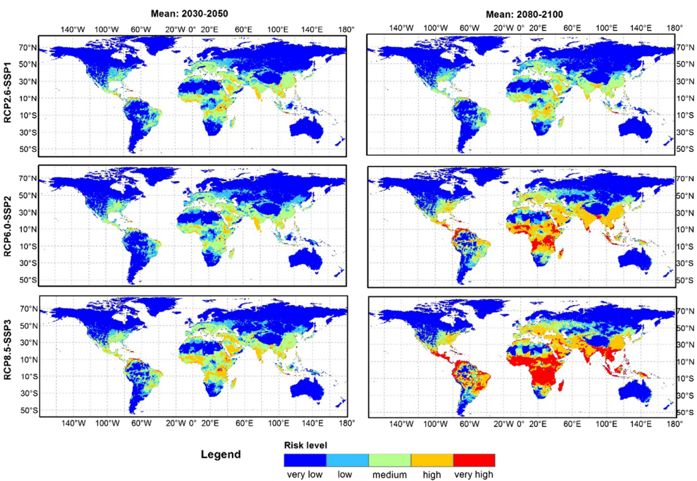
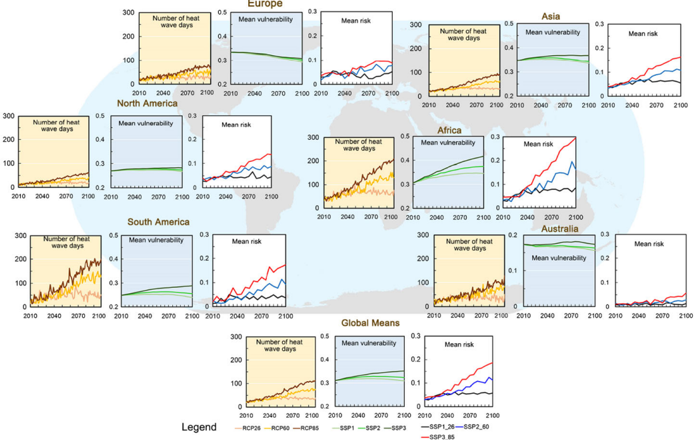
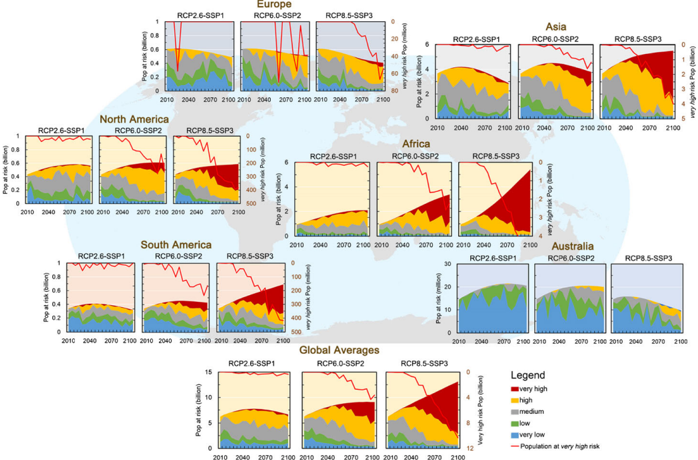
Motivated by growing heat-related morbidity and mortality in a warming climate, this paper assesses global heat health risk in order to understand the challenges to sustainability in the 21st century, using four Representative Concentration Pathways (RCPs) of the HadGEM2-ES climate model and five Shared Socio-Economic Pathways (SSPs). Factors influencing global heat health risk were reviewed and risks were estimated based on heat hazard and socio-economic vulnerability. Hazard, vulnerability, risk and in particular, populations at different risk levels, were analyzed quantitatively at both global and regional scales. The results show that under an RCP8.5-SSP3 scenario, the world will be subject to the highest heat health risk, with rapidly increasing hazard levels and vulnerability over the century. Less developed or developing regions, such as Africa and Southeast Asia, are at the highest risk. The heat risk under an RCP2.6-SSP1 scenario will first increase and then fall, resulting in the lowest heat-health-risk pattern. We found that heat health risk will increase during the century under all RCP-SSP scenarios, with a higher frequency, higher intensity, longer duration and expanding spatial reach. Significant differences were observed across regions. The results make clear that the increasing risk poses significant challenges to sustainable human health. To meet these challenges, more attention and effective actions are urgently needed from both policy makers and individuals.
Overview
The claims and statistics of this paper haven’t been checked yet.
Free: it reads the open-access text and checks the first 5 claims that cite a source we can check. Create a free account to check every claim.
Integrity signals
Registry
Cites
Statistics
Figures
Verification
Claims the paper makes
The claims and statistics of this paper haven’t been checked yet.
Free: it reads the open-access text and checks the first 5 claims that cite a source we can check. Create a free account to check every claim.
Claims other papers make about this one
Each is checked against this paper’s own text: does it say what the citing paper says it does?
The cited source says what the claim attributes to it.
In the citing paper
“Previous research [100,101] has highlighted the importance of heat vulnerability studies, particularly in developing nations.”
From Assessing the Spatial Mapping of Heat Vulnerability under Urban Heat Island (UHI) Effect in the Dhaka Metropolitan Area (2022) · cites this paper as [100]
Self-check
Percentages, sums and reported differences re-computed from the paper’s own numbers.
The self-check needs the paper’s full text.
Citations
Cites
Climate change 2007: the physical science basis
Solomon, S., Qin, D., Manning, M., Marquis, M. C., Averyt, K. B., Tignor, M., Miller, H. L., & Chen, Z. (2007) · Cited by 24,705
Climate Change 2007: The Physical Science Basis.
Schiavon, S., & Zecchin, R. (2007) · eScholarship (California Digital Library) · Cited by 16,994
(2014) · Cambridge University Press eBooks · doi:10.1017/cbo9781107415379 · Cited by 11,249
Barker, T., Bashmakov, I., Bernstein, L., Bogner, J., Bösch, P., Dave, R., Davidson, O. R., Fisher, B. S., Grubb, M. J., Gupta, S., et al. (2007) · Wageningen University & Research Publications · Cited by 9,211
Barker, T. J., Bashmakov, I., Bernstein, L., Bogner, J. R., Bosch, P. C., Dave, R., Davidson, O., Fisher, B. S., Grubb, M. J., Gupta, S. K., et al. (2007) · Socio-Environmental Systems Modeling · Cited by 9,160
Climate Change 2007: Impacts, Adaptation and Vulnerability
Parry, M. L., Canziani, O. F., Palutikof, J. P., van der Linden, P., & Hanson, C. (2007) · Centre for Environmental Data Analysis Digital Repository (Centre for Environmental Data Analysis) · doi:10.5281/zenodo.7356334 · Cited by 9,136
The representative concentration pathways: an overview
van Vuuren, D. P., Edmonds, J., Kainuma, M., Riahi, K., Thomson, A., Hibbard, K., Hurtt, G. C., Kram, T., Krey, V., Lamarque, J.-F., et al. (2011) · Climatic Change · doi:10.1007/s10584-011-0148-z · Cited by 7,741
The next generation of scenarios for climate change research and assessment
Moss, R. H., Edmonds, J. A., Hibbard, K. A., Manning, M. R., Rose, S. K., van Vuuren, D. P., Carter, T. R., Emori, S., Kainuma, M., Kram, T., et al. (2010) · Nature · doi:10.1038/nature08823 · Cited by 6,467 · cited 1×
“6 describes a very low GHGemission scenario, with radiative forcing at 2.6 W/m2 by 2100, and so on (Moss et al. 2010).”
BackgroundInfluentialAt Risk: Natural Hazards, People's Vulnerability and Disasters
Wisner, B., Blaikie, P. M., Cannon, T., & Davis, I. J. (1994) · Cited by 6,286
Social Vulnerability to Environmental Hazards*
Cutter, S. L., Boruff, B. J., & Shirley, W. L. (2003) · Social Science Quarterly · doi:10.1111/1540-6237.8402002 · Cited by 5,702
Research works printed but not linked: 2
- CDC (Centers for Disease Control and Prevention) (2002) Heat-related deaths--four states, July-August 2001, and United States, 1979–1999. MMWR Morb Mortal Wkly Rep 51:567
- UNDRO (United Nations Disaster Relief Organization) (1991) Mitigating natural disasters : phenomena, effects and options : a manual for policy makers and planners. United Nations, New York
Cited by
The Scenario Model Intercomparison Project (ScenarioMIP) for CMIP6
O'Neill, B. C., Tebaldi, C., van Vuuren, D. P., Eyring, V., Friedlingstein, P., Hurtt, G., Knutti, R., Kriegler, E., Lamarque, J.-F., Lowe, J., et al. (2016) · Geoscientific Model Development · doi:10.5194/gmd-9-3461-2016 · Cited by 6,189
“Integrated analyses drawing on the qualitative and quantitative elements of the SSPs and climate change information from the CMIP5 simulations of the RCPs have already begun to appear (e.g., Alfieri et al., 2015; Arnell et al., 2014; Biewald et al., 2015; Dong et al., 2015; Hejazi et al., 2015) and climate model simul…”
Spatially explicit global population scenarios consistent with the Shared Socioeconomic Pathways
Jones, B., & O’Neill, B. C. (2016) · Environmental Research Letters · doi:10.1088/1748-9326/11/8/084003 · Cited by 817
Extreme heat waves under 1.5 °C and 2 °C global warming
Dosio, A., Mentaschi, L., Fischer, E. M., & Wyser, K. (2018) · Environmental Research Letters · doi:10.1088/1748-9326/aab827 · Cited by 445
IPCC reasons for concern regarding climate change risks
O'Neill, B. C., Oppenheimer, M., Warren, R., Hallegatte, S., Kopp, R. E., Pörtner, H. O., Scholes, R., Birkmann, J., Foden, W., Licker, R., et al. (2017) · Nature Climate Change · doi:10.1038/nclimate3179 · Cited by 426
Unveiling hidden energy poverty using the energy equity gap
Cong, S., Nock, D., Qiu, Y. L., & Xing, B. (2022) · Nature Communications · doi:10.1038/s41467-022-30146-5 · Cited by 306
Poverty, Livelihoods and Sustainable Development
(IPCC), I. P. O. C. C. (2023) · Cambridge University Press eBooks · doi:10.1017/9781009325844.010 · Cited by 296
Seasonal soil moisture and drought occurrence in Europe in CMIP5 projections for the 21st century
Ruosteenoja, K., Markkanen, T., Venäläinen, A., Räisänen, P., & Peltola, H. (2018) · Climate Dynamics · doi:10.1007/s00382-017-3671-4 · Cited by 210
“This intensifies fluctuations in temperature and permits the occurrence of extremely high temperatures, thus increasing the risks of heat-related human morbidity and mortality (Dong et al. 2015).”
BackgroundAvoiding population exposure to heat-related extremes: demographic change vs climate change
Jones, B., Tebaldi, C., O’Neill, B. C., Oleson, K. W., & Gao, J. (2018) · Climatic Change · doi:10.1007/s10584-017-2133-7 · Cited by 171
Liu, Z., Anderson, B., Yan, K., Dong, W., Liao, H., & Shi, P. (2017) · Scientific Reports · doi:10.1038/srep43909 · Cited by 170
Self-citationHulley, G., Shivers, S., Wetherley, E., & Cudd, R. (2019) · Remote Sensing · doi:10.3390/rs11182136 · Cited by 164
“Temperature (exposure) variables are usually derived from either satellite-derived land surface temperature (LST) retrieved from thermal infrared (TIR) sensors, such as Landsat Thematic Mapper (TM) and Enhanced Thematic Mapper Plus (EMT+) [18–23] or MODIS [24–27], ground station air temperature observations [28–32], m…”
MethodRohat, G., Flacke, J., Dosio, A., Dao, H., & van Maarseveen, M. F. A. M. (2019) · Earth s Future · doi:10.1029/2018ef001020 · Cited by 151
Health risks of warming of 1.5 °C, 2 °C, and higher, above pre-industrial temperatures
Ebi, K. L., Hasegawa, T., Hayes, K., Monaghan, A., Paz, S., & Berry, P. (2018) · Environmental Research Letters · doi:10.1088/1748-9326/aac4bd · Cited by 102
Rohat, G., Flacke, J., Dosio, A., Pedde, S., Dao, H., & van Maarseveen, M. F. A. M. (2018) · Global and Planetary Change · doi:10.1016/j.gloplacha.2018.09.013 · Cited by 135
Projecting future populations of urban agglomerations around the world and through the 21st century
Kii, M. (2021) · npj Urban Sustainability · doi:10.1038/s42949-020-00007-5 · Cited by 123
Reducing urban heat wave risk in the 21st century
Milan, B. F., & Creutzig, F. (2015) · Current Opinion in Environmental Sustainability · doi:10.1016/j.cosust.2015.08.002 · Cited by 119
Asamoah, B., Kjellstrom, T., & Östergren, P.-O. (2018) · International Journal of Biometeorology · doi:10.1007/s00484-017-1402-5 · Cited by 97
Optimal allocation of local climate zones based on heat vulnerability perspective
Zhang, R., Yang, J., Ma, X., Xiao, X., & Xia, J. C. (2023) · Sustainable Cities and Society · doi:10.1016/j.scs.2023.104981 · Cited by 100
Projections of heat stress and associated work performance over India in response to global warming
Rao, K. K., Kumar, T. V. L., Kulkarni, A., Ho, C.-H., Mahendranath, B., Desamsetti, S., Patwardhan, S. K., Ramu, D. A., Barbosa, H. A., & Sabade, S. S. (2020) · Scientific Reports · doi:10.1038/s41598-020-73245-3 · Cited by 93
Projecting Drivers of Human Vulnerability under the Shared Socioeconomic Pathways
Rohat, G. (2018) · International Journal of Environmental Research and Public Health · doi:10.3390/ijerph15030554 · Cited by 90
Zheng, S., Huang, G., Zhou, X., & Zhu, X. (2019) · Applied Energy · doi:10.1016/j.apenergy.2019.114295 · Cited by 89
Abrar, R., Sarkar, S. K., Nishtha, K. T., Talukdar, S., Shahfahad, Rahman, A., Islam, A. R. M. T., & Mosavi, A. (2022) · Sustainability · doi:10.3390/su14094945 · Cited by 87
“Previous research [100,101] has highlighted the importance of heat vulnerability studies, particularly in developing nations.”
BackgroundGlobal Heat Wave Hazard Considering Humidity Effects during the 21st Century
Chen, X., Li, N., Liu, J., Zhang, Z., & Liu, Y. (2019) · International Journal of Environmental Research and Public Health · doi:10.3390/ijerph16091513 · Cited by 71
Monitoring and moderating extreme indoor temperatures in low-income urban communities
Wilby, R. L., Kasei, R. A., Gough, K. V., Amankwaa, E. F., Abarike, M. A., Anderson, N. J., Codjoe, S. N. A., Griffiths, P. L., Kaba, C., Abdullah, K., et al. (2021) · Environmental Research Letters · doi:10.1088/1748-9326/abdbf2 · Cited by 63
Characterizing the role of socioeconomic pathways in shaping future urban heat-related challenges
Rohat, G., Wilhelmi, O. V., Flacke, J., Monaghan, A. J., Gao, J., Dao, H., & van Maarseveen, M. F. A. M. (2019) · The Science of The Total Environment · doi:10.1016/j.scitotenv.2019.133941 · Cited by 56
The impact of 1.5 °C and 2.0 °C global warming on global maize production and trade
Li, K., Pan, J., Xiong, W., Xie, W., & Ali, T. (2022) · Scientific Reports · doi:10.1038/s41598-022-22228-7 · Cited by 56
Health and economic benefit of China’s greenhouse gas mitigation by 2050
Xie, Y., Wu, Y., Xie, M., Li, B., Zhang, H., Ma, T., & Zhang, Y. (2020) · Environmental Research Letters · doi:10.1088/1748-9326/aba97b · Cited by 53
Changes in Global and Regional Characteristics of Heat Stress Waves in the 21st Century
Chen, X., Li, N., Liu, J., Zhang, Z., Liu, Y., & Huang, C. (2020) · Earth s Future · doi:10.1029/2020ef001636 · Cited by 51
Bitencourt, D. P., Alves, L. M., Shibuya, E., da Cunha, I. D. Â., & de Souza, J. P. E. (2020) · International Journal of Climatology · doi:10.1002/joc.6877 · Cited by 51
Cole, R., Hajat, S., Murage, P., Heaviside, C., Macintyre, H. L., Davies, M., & Wilkinson, P. (2023) · Environment International · doi:10.1016/j.envint.2023.107836 · Cited by 50
Heatwave Definition and Impact on Cardiovascular Health: A Systematic Review
Nawaro, J., Gianquintieri, L. L., Pagliosa, A., Sechi, G. M., & Caiani, E. G. (2023) · Public health reviews · doi:10.3389/phrs.2023.1606266 · Cited by 43
Li, K., & Gyilbag, A. (2020) · Natural hazards and earth system sciences · doi:10.5194/nhess-20-1889-2020 · Cited by 39
Extreme heat vulnerability assessment in tropical region: a case study in Malaysia
Kamal, N. I. A., Ash’aari, Z. H., Abdullah, A. M., Kusin, F. M., Mohamat-Yusuff, F., Sharaai, A. H., Muharam, F. M., & Ariffin, N. A. M. (2021) · Climate and Development · doi:10.1080/17565529.2021.1937030 · Cited by 39
Chhetri, R., Pandey, V. P., Talchabhadel, R., & Thapa, B. R. (2021) · Theoretical and Applied Climatology · doi:10.1007/s00704-021-03698-7 · Cited by 39
Liu, Y., Zhang, Z., Chen, X., Huang, C., Han, F., & Li, N. (2021) · Earth s Future · doi:10.1029/2021ef002028 · Cited by 39
Co-use of existing scenario sets to extend and quantify the shared socioeconomic pathways
Rohat, G., Flacke, J., Dao, H., & van Maarseveen, M. F. A. M. (2018) · Climatic Change · doi:10.1007/s10584-018-2318-8 · Cited by 39
Spatial and temporal analysis of outdoor human thermal comfort during heat and cold waves in Iran
Roshan, G., Ghanghermeh, A., & Kong, Q. (2018) · Weather and Climate Extremes · doi:10.1016/j.wace.2018.01.005 · Cited by 38
Shared insights for heat health risk adaptation in metropolitan areas of developing countries
Wen-bo, Y., Yang, J., Sun, D., Xue, B., Sun, W., Ren, J., Yu, H., Xiao, X., Xia, J. C., & Li, X. (2024) · iScience · doi:10.1016/j.isci.2024.109728 · Cited by 37
Self-citationAmnuaylojaroen, T., Limsakul, A., Kirtsaeng, S., Parasin, N., & Surapipith, V. (2022) · Atmosphere · doi:10.3390/atmos13020325 · Cited by 32
Extreme hot summers in China in the CMIP5 climate models
Leng, G., Tang, Q., Huang, S., & Zhang, X. (2015) · Climatic Change · doi:10.1007/s10584-015-1576-y · Cited by 31
Self-citationZoraghein, H., & O’Neill, B. C. (2020) · Demographic Research · doi:10.4054/demres.2020.43.54 · Cited by 30
Spatially Explicit Assessments of Heat-Related Health Risks: A Literature Review
Yao, Y., Lu, L., Guo, J., Zhang, S., Cheng, J., Tariq, A., Liang, D., Hu, Y., & Li, Q. (2024) · Remote Sensing · doi:10.3390/rs16234500 · Cited by 28
Exploring the effect of heat on stated intentions to move
Zander, K. K., Surjan, A., & Garnett, S. T. (2016) · Climatic Change · doi:10.1007/s10584-016-1727-9 · Cited by 28
Extreme Heat Related Mortality: Spatial Patterns and Determinants in the United States, 1979–2011
Jones, B., Dunn, G., & Balk, D. L. (2021) · Spatial Demography · doi:10.1007/s40980-021-00079-6 · Cited by 26
The asymmetric impact of abundant preceding rainfall on heat stress in low latitudes
Liu, X., Tang, Q., Liu, W., Yang, H., Groisman, P., Leng, G., Ciais, P., Zhang, X., & Sun, S. (2019) · Environmental Research Letters · doi:10.1088/1748-9326/ab018a · Cited by 25
Self-citationStriessnig, E., Gao, J., O’Neill, B. C., & Jiang, L. (2019) · Environmental Research Letters · doi:10.1088/1748-9326/ab4a3a · Cited by 21
Ecological Vulnerability of Aquatic Ecosystems—A Review
Logez, M., Bouraï, L., Hette‐Tronquart, N., & Argillier, C. (2024) · Environmental Management · doi:10.1007/s00267-024-02076-z · Cited by 20
The heat exposure risk to outdoor workers in Brazil
Bitencourt, D. P., Maia, P. A., & Roscani, R. C. (2019) · Archives of Environmental & Occupational Health · doi:10.1080/19338244.2019.1633991 · Cited by 20
Jiang, Q., Yue, Y., & Gao, L. (2019) · Geomatics Natural Hazards and Risk · doi:10.1080/19475705.2019.1693435 · Cited by 20
Roberts, B. M., Beizaee, A., Onyenokporo, N. C., & Oyinlola, M. A. (2023) · Building and Environment · doi:10.1016/j.buildenv.2023.110183 · Cited by 20
Liu, J., Varghese, B. M., Hansen, A. L., Dear, K. B. G., Morgan, G. G., Driscoll, T., Zhang, Y., Gourley, M., Capon, A. G., & Bi, P. (2023) · The Lancet Regional Health - Western Pacific · doi:10.1016/j.lanwpc.2023.100916 · Cited by 16
Maximum wet‐bulb globe temperature mapping in central–south Brazil: a numerical study
Bitencourt, D. P. (2018) · Meteorological Applications · doi:10.1002/met.1769 · Cited by 15
Namaiti, A., & Zeng, S. (2025) · Sustainable Cities and Society · doi:10.1016/j.scs.2025.106760 · Cited by 14
Zhao, Z., Di, P., Chen, S., Avise, J. C., Kaduwela, A. P., & DaMassa, J. A. (2020) · Climate Dynamics · doi:10.1007/s00382-020-05200-x · Cited by 14
Increasing burden of poor mental health attributable to high temperature in Australia
Liu, J., Varghese, B. M., Hansen, A. L., Dear, K. B. G., Morgan, G. G., Driscoll, T., Zhang, Y., Prescott, V., Dolar, V., Gourley, M., et al. (2025) · Nature Climate Change · doi:10.1038/s41558-025-02309-x · Cited by 13
He, B. (2024) · Journal of Cleaner Production · doi:10.1016/j.jclepro.2024.143164 · Cited by 13
UTCI assessment of outdoor thermal comfort in Arid-Hot university campuses during summer
Su, Y., Sun, J., Li, S., Li, J., Wu, Z., Li, J., Li, X., Wang, D., & Wang, W. (2025) · Energy and Buildings · doi:10.1016/j.enbuild.2025.116683 · Cited by 12
Self-citationParasin, N., & Amnuaylojaroen, T. (2023) · Urban Science · doi:10.3390/urbansci7040124 · Cited by 11
Hulkkonen, M., Mielonen, T., Leppänen, S., Laakso, A., & Kokkola, H. (2024) · npj Climate Action · doi:10.1038/s44168-024-00136-y · Cited by 10
Heat projections and mortgage characteristics: evidence from the USA
Baranyai, E., & Banai, Á. (2022) · Climatic Change · doi:10.1007/s10584-022-03465-1 · Cited by 9
Assessment of climate damage in China based on integrated assessment framework
Liu, J., Shi, X.-Z., Yang, L., Liu, C.-Y., Wang, J., Zhu, R.-M., Shi, X., & Liu, Q.-F. (2024) · Advances in Climate Change Research · doi:10.1016/j.accre.2024.01.012 · Cited by 9
Temporal and spatial patterns of extreme heat on wheat in China under climate change scenarios
Chen, H., Yue, Y., & Jiang, Q. (2024) · Environmental and Experimental Botany · doi:10.1016/j.envexpbot.2024.105938 · Cited by 8
Preisser, M., & Passalacqua, P. (2025) · AGU Advances · doi:10.1029/2025av001667 · Cited by 7
TRIZ to Support Blue-design of Products
Brad, S., Mocan, B., Brad, E., & Fulea, M. (2016) · Procedia CIRP · doi:10.1016/j.procir.2016.01.177 · Cited by 6
Beating the Heat: Investing in Pro-Poor Solutions for Urban Resilience
Bank, A. D. (2022) · doi:10.22617/tcs220299-2 · Cited by 7
Nnadi, O. I., Lyimo, J. G., & Liwenga, E. T. (2019) · Journal of Agricultural Extension · doi:10.4314/jae.v23i2.13 · Cited by 5
Wei, H., & Bigg, G. R. (2017) · Social Sciences · doi:10.3390/socsci6040122 · Cited by 5
Forecasting extreme weather events and associated impacts: case studies
(2022) · Elsevier eBooks · doi:10.1016/b978-0-12-820124-4.00005-0 · Cited by 4
Rohat, G., Flacke, J., & Dao, H. (2017) · GI_Forum · doi:10.1553/giscience2017_01_s341 · Cited by 4
Liao, H., Dong, W., Liu, H., & Ge, Y. (2015) · ISPRS International Journal of Geo-Information · doi:10.3390/ijgi4031672 · Cited by 4
Self-citationClimate Change Projections in the Twenty-First Century
Wu, W., Xu, C., & Liu, X. (2017) · IHDP/Future earth-integrated risk governance project series · doi:10.1007/978-981-10-4199-0_2 · Cited by 4
The Effects of Climate Change on Maternal, Fetal and Neonatal Health: An in-Depth Review
Dalkıran, İ. Ö., & Keleş, N. Ç. (2024) · Eurasian Journal of Health Technology Assessment · doi:10.52148/ehta.1439406 · Cited by 3
Оценка реакции популяций Picea abies (L.) H. Karst. Московской области на изменения климата
Lebedev, A. V., & Gosteva, D. (2025) · Vestnik Burâtskoj gosudarstvennoj selʹskohozâjstvennoj akademii im. V.R. Fillipova. · doi:10.34655/bgsha.2025.80.3.009 · Cited by 2
Establishing Maximum Safe Indoor Temperatures for U.S. Residential Buildings
Huizenga, C., Zhang, H., Schiavon, S., Kwong, L. H., Brager, G. S., Arens, E., Duarte Roa, C., Exss, K., Lehrer, D., Luna-Navarro, A., et al. (2024) · eScholarship (California Digital Library) · Cited by 2
Spatial Distribution and Trends of Heat Stress in Vietnam
Vu, N., & Ngo‐Duc, T. (2024) · Environment and Natural Resources Journal · doi:10.32526/ennrj/22/20230227 · Cited by 2
Making urban policies sustainable
Milan, B. F. (2016) · DepositOnce · doi:10.14279/depositonce-5521 · Cited by 2
Bouraï, L. (2022) · theses.fr (ABES) · doi:10.70675/1384c6dbz528az423cz80d7zaa57eb9f3d72 · Cited by 2
González-Martínez, A., & Elizondo, P. A. I. (2023) · Biología y Sociedad · doi:10.29105/bys6.12-84 · Cited by 1
Do mortgage lenders offload climate-exposed loans to government-sponsored enterprises?
Baranyai, E. (2025) · Finance research letters · doi:10.1016/j.frl.2025.107749 · Cited by 1
Evaluating the Impact of Climate and Land-Use Change on Flood Susceptibility on a Global Scale
Rezaie, F., Janizadeh, S., Bateni, S. M., Jun, C., Kim, D., Kalantari, Z., & Heggy, E. (2026) · Water Resources Management · doi:10.1007/s11269-025-04404-2 · Cited by 1
Examining the Intersection of Sustainability and Resilience
Alibašić, H. (2018) · Sustainable development goals series · doi:10.1007/978-3-319-72568-0_6 · Cited by 1
Assessing the Intersection of Resilience and Sustainability
Alibašić, H. (2022) · Sustainable development goals series · doi:10.1007/978-3-030-91159-1_6 · Cited by 1
Anwar, A., Shah, M., Abid, Y., Qamar, Z. U., & Qamar, H. (2018) · Journal of Social Science Studies · doi:10.5296/jsss.v5i1.12264
Hoverter, S. P. (2018) · Cambridge University Press eBooks · doi:10.1017/9781108278010.008
ОСОБЛИВОСТІ МИСЛЕННЯ У ОСІБ З РІЗНОЮ ТЕПЛОЧУТЛИВІСТЮ
Ратинська, О., & Бідзюра, І. Г. (2024) · Перспективи та інновації науки · doi:10.52058/2786-4952-2024-3(37)-1470-1479
Climate Change and Residential Mortgage Lenders
Baranyai, E. (2024) · CUB Ph.D. Dissertations (Corvinus University of Budapest) · doi:10.14267/phd.2024062
Spatial mapping of heat vulnerability in Abuja, the capital city of Nigeria
JOSHUA, J. K. (2023) · Nottingham ePrints (University of Nottingham)
Anderson, C. C., & HASLER, N. (2026) · International Journal of Disaster Risk Reduction · doi:10.1016/j.ijdrr.2026.106299
多変量バイアス補正による力学的ダウンスケーリングの熱ストレスリスク評価への付加価値
Kelkar, S., & サウラブ, ケ. (2024) · Institutional Repositories DataBase (IRDB) · doi:10.15068/0002012987
Powering Cities in the Global South
Westphal, M., Zhou, L., Satterthwaite, D., & Martin, S. (2017) · doi:10.46830/wriwrr.17.00002
Nawaro, J., Gianquintieri, L., Pagliosa, A., Sechi, G. M., & Caiani, E. G. (2023) · doi:10.3389/phrs.2023.1606266.s002
Metadata
- Authors
- Dong, W., Liu, Z., Liao, H., Tang, Q., & Li, X.
- Affiliations
- Beijing Normal University (CN)
- Chinese Academy of Sciences (CN)
- Corresponding author
- Dong, Weihua
- Venue
- Climatic Change
- Published
- 2015-03-11
- Volume
- 130
- Issue
- 4
- Pages
- 505-518
- ISSN
- 0165-0009 (ISSN-L)
- 1573-1480
- OpenAlex
- W1966042706
- Cited by
- 84
- References
- 61
- Citations by year
- 2026: 2 · 2025: 5 · 2024: 11 · 2023: 9 · 2022: 9 · 2021: 6 · 2020: 7 · 2019: 10 · 2018: 11 · 2017: 7 · 2016: 4 · 2015: 3
- FWCI
- 5.22
- Type
- journal article
- Language
- en
- Open access
- hybrid
- doi.org
- Locations
- Climatic Change (publishedVersion, cc-by)
- RePEc: Research Papers in Economics (submittedVersion)
- Funders
- National Natural Science Foundation of China (973 Program, 41471382)
- National Key Research and Development Program of China (2012CB955403)
- Topics
- Physical Sciences › Environmental Science › Health, Toxicology and Mutagenesis › Climate Change and Health Impacts
- Health Sciences › Medicine › Physiology (medical) › Thermoregulation and physiological responses
- Physical Sciences › Environmental Science › Global and Planetary Change › Climate Change and Environmental Impact
- Keywords
- heat-related health risks, heat hazard, socioeconomic vulnerability, climate change scenarios, RCP scenarios, Shared Socioeconomic Pathways, heat-related mortality, heat-related morbidity, developing regions, HadGEM2-ES, climate change adaptation
About these checks
Registry, retraction, Cites and statistics results are computed, not judged, with one exception: a printed reference that no index lists is read once by a model before it counts as a citation error. Claims are extracted by a model and kept only when their quote appears verbatim in the text; each cited source is then checked, with a model’s help, for whether it says what the claim relies on. Those verdicts can be wrong — read the claim’s quote and the cited source before relying on one.
Statistics and arithmetic are recomputed, not judged.
Confidence bands are shown only for fields calibrated on our annotated test set. None is calibrated yet, so no band is shown.
What counts as a claim ›How we measure confidence ›How we check this ›
Are you an author, or do you see a problem with this page? Request a review
Data sources
Bibliographic data: Semantic Scholar, OpenAlex, Crossref.
Contains information from the Semantic Scholar Academic Graph Datasets, made available under the ODC Attribution License (ODC-BY 1.0).
Semantic Scholar’s data is described in: Kinney, R., et al. (2023). The Semantic Scholar Open Data Platform. arXiv:2301.10140.
