

Energy efficiency in cloud computing data centers: a survey on software technologies
Open accessThe DOI matches its Crossref record; 132 of the 134 references it cites were found in a registry or an index; 14 of the 109 sources its claims cite were checked for support.
Abstract
Cloud computing is a commercial and economic paradigm that has gained traction since 2006 and is presently the most significant technology in IT sector. From the notion of cloud computing to its energy efficiency, cloud has been the subject of much discussion. The energy consumption of data centres alone will rise from 200 TWh in 2016 to 2967 TWh in 2030. The data centres require a lot of power to provide services, which increases CO2 emissions. In this survey paper, software-based technologies that can be used for building green data centers and include power management at individual software level has been discussed. The paper discusses the energy efficiency in containers and problem-solving approaches used for reducing power consumption in data centers. Further, the paper also gives details about the impact of data centers on environment that includes the e-waste and the various standards opted by different countries for giving rating to the data centers. This article goes beyond just demonstrating new green cloud computing possibilities. Instead, it focuses the attention and resources of academia and society on a critical issue: long-term technological advancement. The article covers the new technologies that can be applied at the individual software level that includes techniques applied at virtualization level, operating system level and application level. It clearly defines different measures at each level to reduce the energy consumption that clearly adds value to the current environmental problem of pollution reduction. This article also addresses the difficulties, concerns, and needs that cloud data centres and cloud organisations must grasp, as well as some of the factors and case studies that influence green cloud usage.
Overview
CoChat Summary
TL;DR
This survey reviews software-level technologies for improving energy efficiency in cloud data centers, covering operating system, virtualization, application, container, and data-center-level approaches. It also discusses environmental impact, policies/standards, case studies, and open research challenges for green data centers.
Key findings
- Data center energy consumption is projected to rise from 200 TWh in 2016 to 2967 TWh in 2030; average annual data center PUE was 1.57 in 2021 versus 1.59 in 2020, with an ideal PUE of 1.0.
- Containerization can reduce energy use: Docker configured to a maximum latency of 3000 ms can operate up to 21% more services than KVM while consuming 11.33% less energy than KVM; a container placement method (MLSM) cut energy usage by an average of 12.8% compared with First Fit.
- Other reported software-level gains include VIP reducing power usage and improving CPU-intensive application completion time by up to 27% and 32%, respectively, without breaching latency-sensitive SLAs; a MapReduce configurator improved energy efficiency by up to 50% in two structurally distinct clusters.
- Data centers emitted 3.15 × 10^7 tons CO2-eq in 2018, about 0.5% of total U.S. GHG emissions; many corporate servers are utilized only 10–15%, and 30% are described as “zombies” that are inactive yet still consume electricity.
Methods
- Design: a survey of software-based energy-efficiency techniques in cloud data centers, organized by OS level, virtualization level, application level, operating-system virtualization/containers, data-center-level dynamic power management, problem-solving approaches, environment, and research challenges.
- Data sources: articles collected from IEEE, Springer, and Elsevier, using Web of Science and Scopus; included publications were peer reviewed, mostly published between 2015 and 2020, and focused on software-based methods for data center energy efficiency.
- Analysis: narrative synthesis and taxonomy; excluded non-peer-reviewed papers, pre-2015 publications, non-English studies, and studies without details on software innovations for data center energy savings. No datasets were generated or analyzed.
Limitations
- The paper does not state its own limitations explicitly; it states that prior survey articles are “either incomplete or having limitations,” especially regarding application, virtualization, and OS layers, data-center-level solutions, containers, environmental factors, and case studies.
- Evident from the text: this is a secondary literature survey with no primary experiments or datasets, and its scope is limited to software technologies, excluding hardware technologies covered in the authors’ earlier work.
- Evident from the text: the literature search is mostly limited to 2015–2020 and excludes non-English and non-peer-reviewed sources, so newer or non-indexed work may be missed.
Model-written summary. Check it against the paper before relying on it.
Integrity signals
Registry
Cites
Statistics
Figures


Verification
Claims the paper makes
13 Valid · 18 Not valid · 71 Not checked · 54 Own results and interpretations
Every source the paper cites for this claim was checked and supports it.
In the paper
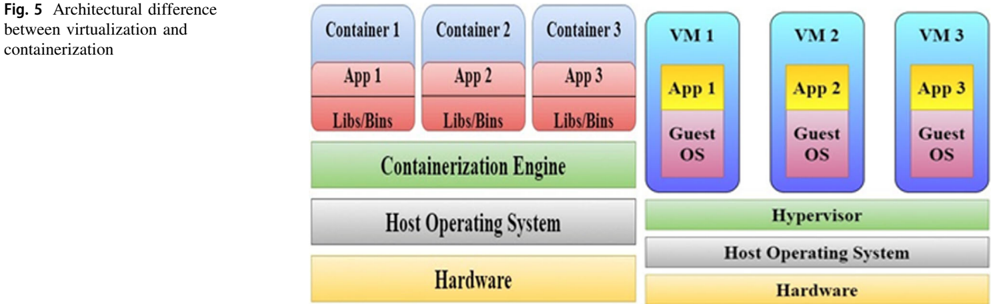
“Container-based systems returned unused memory to the host, resulting in more efficient memory utilisation.”
What the sources say
- Supportedcites [41] Ramchandra Desai, P.A. Survey of Performance Comparison between Virtual Machines and Containers. Int. J. Comput. Sci. Eng. (2016) source
The Memory Performance section (p. of our copy, §B) states directly that 'Container based systems have the ability to return unused memory to the host resulting in better usage,' which is exactly what the citing sentence attributes. The Discussion (§G) reinforces it, crediting container-based virtualization's better CPU and I/O performance to its ability to release unused resources. (LLM, conf=0.90)
plainstates a cause- Asserted: passes — The authors put it forward as true.
- Checkable: passes — It can be checked against evidence.
- Load-bearing: unclear — It is unclear whether the paper’s conclusions depend on it.
- Based: passes — The paper gives a reason why it holds.
- Supported
The cited sources support only part of this claim — read each source’s verdict below.
In the paper
“Virtualization systems suffered from double cache since the host and virtual computer used the same memory blocks.”
What the sources say
- Partly supportedcites [41] Ramchandra Desai, P.A. Survey of Performance Comparison between Virtual Machines and Containers. Int. J. Comput. Sci. Eng. (2016) sourceExperimental — accuracy not yet measured
The Memory Performance section (B) of our copy states the double-cache problem almost verbatim: 'Para virtualization systems suffer from double cache since the same memory blocks are used by the host and the virtual machine.' However, the source restricts this to para-virtualization specifically (the Introduction distinguishes full, partial and para virtualization, and KVM is described as full virtualization), whereas the citing sentence attributes the double-cache drawback to 'virtualization systems' generally. That generalization to all virtualization is the part the source does not support; the mechanism (host and VM sharing the same memory blocks) is confirmed. (LLM, conf=0.72)
plainstates a cause- Asserted: passes — The authors put it forward as true.
- Checkable: passes — It can be checked against evidence.
- Load-bearing: unclear — It is unclear whether the paper’s conclusions depend on it.
- Based: passes — The paper gives a reason why it holds.
- Partly supported
The cited sources support only part of this claim — read each source’s verdict below.
In the paper
“The energy consumption of data centres alone will rise from 200 TWh in 2016 to 2967 TWh in 2030.”
- Also stated in: § 1 Introduction · p. 2 · plain
“The energy consumption of data centres alone will rise from 200 TWh in 2016 to 2967 TWh in 2030 [2].”
What the sources say
- Partly supportedcites [2] Koot, M., Wijnhoven, F.: Usage impact on data center electricity needs: A system dynamic forecasting model. Appl. Energy. 291, 116798 (2021) sourceExperimental — accuracy not yet measured
The Literature review (section 2) reports the exact 200 TWh-to-2,967 TWh projection, but attributes it to Andrae and Edler and says it was highly uncertain and later revised. The paper’s own conclusion (section 7) instead projects 286 TWh in 2016 rising to 321 TWh in 2030 under unchanged trends, so the unqualified sentence should not be read as this paper’s forecast. (LLM, conf=0.88)
plainstates a cause- Asserted: passes — The authors put it forward as true.
- Checkable: passes — It can be checked against evidence.
- Load-bearing: unclear — It is unclear whether the paper’s conclusions depend on it.
- Based: passes — The paper gives a reason why it holds.
- Also stated in: § 1 Introduction · p. 2 · plain
Every source the paper cites for this claim was checked and supports it.
In the paper
“For achieving energy efficiency especially at the application level, Ho et al. [26] concentrated on batch applications executing on VMs in data centres.”
What the sources say
- Supportedcites [26] Ho, T.T.N., Gribaudo, M., Pernici, B.: Characterizing Energy per Job in Cloud Applications. Electron. 2016. 5, 90 (2016) source
The Abstract states that the paper focuses on batch applications running on virtual machines in data centers and analyzes their energy consumption and efficiency at the application level. Section 4, “Modeling Application Energy Efficiency,” confirms that focus. The source supports the citing sentence as a description of its research focus, rather than a claim that it achieved a measured efficiency improvement. (LLM, conf=0.94)
plain- Asserted: passes — The authors put it forward as true.
- Checkable: passes — It can be checked against evidence.
- Load-bearing: unclear — It is unclear whether the paper’s conclusions depend on it.
- Based: passes — The paper gives a reason why it holds.
- Supported
In the paper
“Docker, when configured to a maximum latency of 3000ms, can operate up to 21% more services than KVM.”
What the sources say
- Not checked — no full text of the sourcecites [39] Cuadrado-Cordero, I., Orgerie, A.C., Menaud, J.M. Comparative experimental analysis of the quality-of-service and energy-efficiency of VMs and containers’ consolidation for cloud applications. 25th International Conference on Software, Telecommunications and Computer Networks, SoftCOM 2017 (2017) https://doi.org/10.23919/SOFTCOM.2017.8115516 source
plainstates a cause- Asserted: passes — The authors put it forward as true.
- Checkable: passes — It can be checked against evidence.
- Load-bearing: unclear — It is unclear whether the paper’s conclusions depend on it.
- Based: passes — The paper gives a reason why it holds.
16 more claims
Create a free account to see all 156 claims and to verify the 9 references still open.
- Probably not a substantial claim. 118
- It may state two separate claims as one. 54
Claims other papers make about this one
Each is checked against this paper’s own text: does it say what the citing paper says it does?
The source backs part of the claim, not all of it — or backs it for a different population, condition or comparison.
In the citing paper
“Studies have shown that green computing initiatives can result in substantial cost savings for organizations through reduced energy bills, lower maintenance costs, and increased operational efficiency (Liu et al ., 2022; Katal et al ., 2023).”
From Advancing green computing: Practices, strategies, and impact in modern software development for environmental sustainability (2024) · cites this paper as Katal et al ., 2023
Experimental — accuracy not yet measuredThe cited source says what the claim attributes to it.
In the citing paper
“In addition to environmental benefits, adopting green computing practices can yield significant economic and societal benefits for organizations and society as a whole.”
From Advancing green computing: Practices, strategies, and impact in modern software development for environmental sustainability (2024) · cites this paper as Katal et al ., 2023
Self-check
Percentages, sums and reported differences re-computed from the paper’s own numbers.
Each contradiction between two passages listed here was confirmed by an independent check.
Rated minor: it would not touch a result — a value no result rests on, a p-value that stays on the same side of the significance level, or a conflict that is clerical, resolved elsewhere in the paper, or outside its own findings.
In the paper
§ Declarations · p. 26
“Ethical approval This paper does not contain any studies with human participants or animals performed by any of the authors.”
§ Declarations · p. 26
“Informed consent Informed consent was obtained from all individual participants included in the study.”
Citations
Cites
Beloglazov, A., & Buyya, R. (2012) · Concurrency and Computation: Practice and Experience · doi:10.1002/cpe.1867 · Cited by 1,864 · cited 1×
“The metric for SLA is calculated as the fraction of the difference among the allocated and the requested CPU for each VM [43].”
Power provisioning for a warehouse-sized computer
Fan, X., Weber, W.-D., & Barroso, L. A. (2007) · Proceedings of the 34th annual international symposium on Computer architecture · doi:10.1145/1250662.1250665 · Cited by 1,797 · cited 1×
“Fan’s [48] energy model of a PM (Eq.”
BackgroundData Center Energy Consumption Modeling: A Survey
Dayarathna, M., Wen, Y., & Fan, R. (2016) · IEEE Communications Surveys & Tutorials · doi:10.1109/comst.2015.2481183 · Cited by 1,165 · cited 1×
“The authors in [14] discussed the different mechanism and architectures for the design of energy efficient data centers.”
Background(2010) · doi:10.5555/1855711.1855728 · Cited by 970
Green Cloud Computing: Balancing Energy in Processing, Storage, and Transport
Baliga, J., Ayre, R. W. A., Hinton, K., & Tucker, R. S. (2011) · Proceedings of the IEEE · doi:10.1109/jproc.2010.2060451 · Cited by 840 · cited 1×
“The authors of [11] presented an analysis on cloud computing energy usage.”
BackgroundA Taxonomy and Survey of Energy-Efficient Data Centers and Cloud Computing Systems
Beloglazov, A., Buyya, R., Lee, Y. C., & Zomaya, A. (2011) · Advances in Computers · doi:10.1016/b978-0-12-385512-1.00003-7 · Cited by 777
Sustainable Computing: Informatics and Systems
Li, K. (2012) · Cited by 486
Post-copy based live virtual machine migration using adaptive pre-paging and dynamic self-ballooning
Hines, M. R., & Gopalan, K. (2009) · Proceedings of the 2009 ACM SIGPLAN/SIGOPS international conference on Virtual execution environments · doi:10.1145/1508293.1508301 · Cited by 409
Usage impact on data center electricity needs: A system dynamic forecasting model
Koot, M., & Wijnhoven, F. (2021) · Applied Energy · doi:10.1016/j.apenergy.2021.116798 · Cited by 403 · cited 1×
“The energy consumption of data centres alone will rise from 200 TWh in 2016 to 2967 TWh in 2030 [2].”
BackgroundUser-priority guided Min-Min scheduling algorithm for load balancing in cloud computing
Chen, H., Wang, F., Helian, N., & Akanmu, G. (2013) · 2013 National Conference on Parallel Computing Technologies (PARCOMPTECH) · doi:10.1109/parcomptech.2013.6621389 · Cited by 287 · cited 9×
“To address the issue of energy usage, the authors of [56] proposed the Energy and Performance-Efficient Task Scheduling Algorithm (EPETTS) in a heterogeneous virtualized cloud.”
MethodInfluential
Research works printed but not linked: 7
- Fiona, B., Ballarat, C.: International Review of Energy Efficiency in Data Centres Acknowledgements. (2021)
- SRCMap: Energy Proportional Storage Using Dynamic Consolidation. https://www.researchgate.net/publication/221353706_SRCMap_Energy_Proportional_Storage_Using_Dynamic_Consolidation
- Falisha, I.N., Purboyo, T.W., Latuconsina, R.: Experimental model for load balancing in cloud computing using equally spread current execution load algorithm. Int. J. Appl. Eng. Res. 13, 1134–1138 (2018)
- Patel, D., Rajawat, A. Efficient Throttled Load Balancing Algorithm in Cloud Environment.International Journal of Modern Trends in Engineering and Research (2015)
- Crow Search based Scheduling Algorithm for Load Balancing in Cloud Environment: Int. J. Innovative Technol. Exploring Eng. 8, 1058–1064 (2019)
- Derdus, K.M., Omwenga, V., Ogao, P. Statistical Techniques for Characterizing Cloud Workloads: A Survey.International Journal of Computer and Information Technology2279–0764(2019)
- Yousif, S.A., Al-Dulaimy, A. Clustering Cloud Workload Traces to Improve the Performance of Cloud Data Centers. Proceedings of the World Congress on Engineering (2017)
Cited by
Industrial Internet of Things Intelligence Empowering Smart Manufacturing: A Literature Review
Hu, Y., Jia, Q., Yao, Y., Lee, Y., Lee, M., Wang, C., Zhou, X., Xie, R., & Yu, F. R. (2024) · IEEE Internet of Things Journal · doi:10.1109/jiot.2024.3367692 · Cited by 256
“Current network is the product of the deep integration of the new generation of information, communication, and modern industrial technologies.”
BackgroundModern computing: Vision and challenges
Gill, S. S., Wu, H., Patros, P., Ottaviani, C., Arora, P., Pujol, V. C., Haunschild, D., Parlikad, A. K., Cetinkaya, O., Lutfiyya, H., et al. (2024) · Telematics and Informatics Reports · doi:10.1016/j.teler.2024.100116 · Cited by 197
“This pattern has been pushing cloud systems to the limits of their computational and, by extension, energy consumption capacities [302].”
BackgroundIslam, M. T., & Ali, A. (2024) · Next Energy · doi:10.1016/j.nxener.2024.100161 · Cited by 173
Meinhold, R., Wagner, C., & Dhar, B. K. (2024) · Sustainable Development · doi:10.1002/sd.3240 · Cited by 136
Goel, A., Masurkar, S., & Pathade, G. R. (2024) · Sustainability · doi:10.3390/su162411079 · Cited by 187
Metadata
- Authors
- Katal, A., Dahiya, S., & Choudhury, T.
- Affiliations
- University of Petroleum and Energy Studies (IN)
- Corresponding author
- Katal, Avita
- Choudhury, Tanupriya
- Venue
- Cluster Computing
- Published
- 2022-08-30
- Volume
- 26
- Issue
- 3
- Pages
- 1845-1875
- ISSN
- 1386-7857 (ISSN-L)
- 1573-7543
- PMC
- PMC9424070
- OpenAlex
- W4293770403
- Cited by
- 516
- References
- 126
- Citations by year
- 2026: 110 · 2025: 171 · 2024: 172 · 2023: 55 · 2022: 8
- FWCI
- 100.30
- Type
- journal article
- Language
- en
- Open access
- hybrid
- doi.org
- Licence
- cc-by
- www.springernature.com/gp/researchers/text-and-data-mining (tdm)
- www.springernature.com/gp/researchers/text-and-data-mining (vor)
- Locations
- Cluster Computing (publishedVersion, cc-by)
- PubMed Central (publishedVersion)
- PubMed (publishedVersion)
- Topics
- Physical Sciences › Computer Science › Information Systems › Cloud Computing and Resource Management
- Physical Sciences › Computer Science › Hardware and Architecture › Energy Efficiency in Computing
- Physical Sciences › Engineering › Electrical and Electronic Engineering › Green IT and Sustainability
- Keywords
- energy efficiency, cloud computing, data centers, green data centers, power management, containers, virtualization, operating systems, CO2 emissions, electronic waste, energy consumption
About these checks
Registry, retraction, Cites and statistics results are computed, not judged, with one exception: a printed reference that no index lists is read once by a model before it counts as a citation error. Claims are extracted by a model and kept only when their quote appears verbatim in the text; each cited source is then checked, with a model’s help, for whether it says what the claim relies on. Those verdicts can be wrong — read the claim’s quote and the cited source before relying on one.
The claim verdicts this report counts are experimental: their accuracy is not yet measured.
A language model drew the claims from the paper on 2026-10-10, under version 3 of the claim definition (model deepseek-v4.1-flash, prompt extract-v3).
A second model labelled each claim on 2026-10-10 (model jev-1.13-20260917, definition revision gold-guideline-v0.2).
Cited sources are checked with a language model’s help (qwen3.8-omni-flash and gpt-6-sol).
Statistics and arithmetic are recomputed, not judged.
Confidence bands are shown only for fields calibrated on our annotated test set. None is calibrated yet, so no band is shown.
What counts as a claim ›How we measure confidence ›How we check this ›
Are you an author, or do you see a problem with this page? Request a review
How to cite
Cite CoChat for the checks on this page, and the paper for its own findings.
- This page
- CoChat. (2026). Citation check: Energy efficiency in cloud computing data centers: a survey on software technologies. https://app.cochat.ai/papers/10.1007/s10586-022-03713-0
- The paper
- Katal, A., Dahiya, S., & Choudhury, T. (2023). Energy efficiency in cloud computing data centers: a survey on software technologies. Cluster Computing. https://doi.org/10.1007/s10586-022-03713-0
Data sources
Bibliographic data: Semantic Scholar, OpenAlex, Crossref.
Contains information from the Semantic Scholar Academic Graph Datasets, made available under the ODC Attribution License (ODC-BY 1.0).
Semantic Scholar’s data is described in: Kinney, R., et al. (2023). The Semantic Scholar Open Data Platform. arXiv:2301.10140.
