

Growing Out of the Experience: How Subjective Experiences of Effort and Learning Influence the Use of Interleaved Practice
Open accessThe DOI matches its Crossref record; 49 of the 49 references it cites were found in a registry or an index.
Abstract
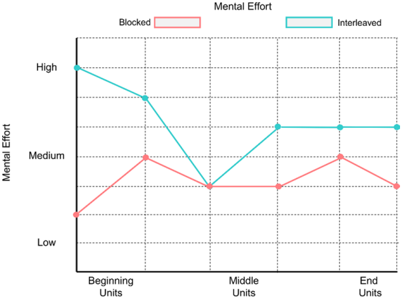
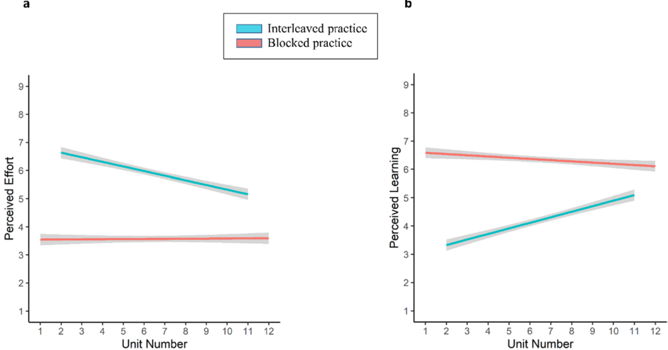
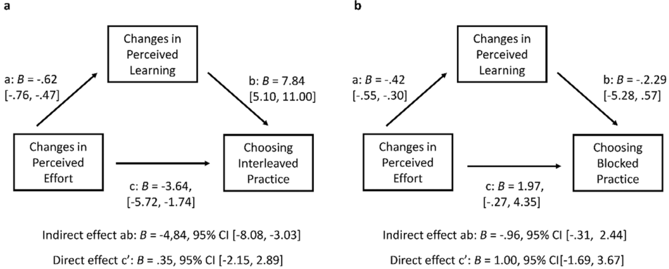
In higher education, many students make poor learning strategy decisions. This, in part, results from the counterintuitive nature of effective learning strategies: they enhance long-term learning but also cost high initial effort and appear to not improve learning (immediately). This mixed-method study investigated how students make learning strategy decisions in category learning, and whether students can be supported to make effective strategy decisions through a metacognitive prompt, designed to support accurate monitoring of effort and learning. Participants (N = 150) studied painting styles through blocked and interleaved practice, rated their perceived effort and perceived learning across time, and chose between either blocked or interleaved practice. Half of the participants (N = 74) were provided with a metacognitive prompt that showed them how their subjective experiences per strategy changed across time and required them to relate these experiences to the efficacy of learning strategies. Results indicated that subjective experiences with interleaved practice improved across time: students’ perceived learning increased as their perceived effort decreased. Mediation analysis revealed that the increased feeling of learning increased the likelihood to select interleaved practice. The percentage of students who chose interleaved practice increased from 13 to 40%. Students’ learning strategy decisions, however, did not benefit from the metacognitive prompt. Qualitative results revealed that students initially had inaccurate beliefs about the efficacy of learning strategies, but on-task experiences overrode the influence of prior beliefs in learning strategy decisions. This study suggests that repeated monitoring of effort and learning have the potential to improve the use of interleaved practice.
Overview
The claims and statistics of this paper haven’t been checked yet.
Free: it reads the open-access text and checks the first 5 claims that cite a source we can check. Create a free account to check every claim.
Integrity signals
Registry
Cites
Statistics
Figures
Verification
Claims the paper makes
The claims and statistics of this paper haven’t been checked yet.
Free: it reads the open-access text and checks the first 5 claims that cite a source we can check. Create a free account to check every claim.
Claims other papers make about this one
Each is checked against this paper’s own text: does it say what the citing paper says it does?
The source backs part of the claim, not all of it — or backs it for a different population, condition or comparison.
In the citing paper
“This was observed in a recent study by Onan and colleagues (2022). Students who reported ease of use or ease of retrieval as a basis for choosing a learning strategy indicated they chose the desirable difficulty of interleaving less often and were more inclined to use blocking as the preferred learning strategy.”
From Worth the Effort: the Start and Stick to Desirable Difficulties (S2D2) Framework (2023) · cites this paper as Onan et al., 2022
Experimental — accuracy not yet measuredThe cited source says what the claim attributes to it.
In the citing paper
“Note that some students reported higher fluency when using interleaving, stating that to them this desirable difficulty felt easier to use.”
From Worth the Effort: the Start and Stick to Desirable Difficulties (S2D2) Framework (2023) · cites this paper as Onan et al., 2022
The cited source says what the claim attributes to it.
In the citing paper
“Perceived effort was higher and perceived learning was lower for interleaving than for blocking.”
From Worth the Effort: the Start and Stick to Desirable Difficulties (S2D2) Framework (2023) · cites this paper as Onan et al., 2022
The cited source says what the claim attributes to it.
In the citing paper
“These differences between blocking and interleaving decreased after experience with the strategies.”
From Worth the Effort: the Start and Stick to Desirable Difficulties (S2D2) Framework (2023) · cites this paper as Onan et al., 2022
The cited source says what the claim attributes to it.
In the citing paper
“Moreover, the effect of this decrease in perceived effort on use of interleaving was mediated by the increase in perceived learning.”
From Worth the Effort: the Start and Stick to Desirable Difficulties (S2D2) Framework (2023) · cites this paper as Onan et al., 2022
2 more claims about this paper
Create a free account to see every claim other papers make about this one.
Self-check
Percentages, sums and reported differences re-computed from the paper’s own numbers.
The self-check needs the paper’s full text.
Citations
Cites
Fitting Linear Mixed-Effects Models Using lme4
Bates, D., Mächler, M., Bolker, B., & Walker, S. (2015) · Journal of Statistical Software · doi:10.18637/jss.v067.i01 · Cited by 86,835
Faul, F., Erdfelder, E., Lang, A.-G., & Buchner, A. (2007) · Behavior Research Methods · doi:10.3758/bf03193146 · Cited by 65,971
Dunlosky, J., Rawson, K. A., Marsh, E. J., Nathan, M. J., & Willingham, D. T. (2013) · Psychological Science in the Public Interest · doi:10.1177/1529100612453266 · Cited by 3,138
Misinformation and Its Correction: Continued Influence and Successful Debiasing
Lewandowsky, S., Ecker, U. K. H., Seifert, C. M., Schwarz, N., & Cook, J. (2012) · Psychological Science in the Public Interest · doi:10.1177/1529100612451018 · Cited by 2,920
Test-Enhanced Learning: Taking Memory Tests Improves Long-Term Retention
Roediger, H. L., & Karpicke, J. D. (2006) · Psychological Science · doi:10.1111/j.1467-9280.2006.01693.x · Cited by 2,867
Paas, F. G. W. C. (1992) · Journal of Educational Psychology · doi:10.1037/0022-0663.84.4.429 · Cited by 2,150 · cited 1×
“Perceived effort was measured by the single item “how much mental effort did this strategy cost you?” on a 9-point (1: very, very low to 9: very, very high) rating scale (Paas, 1992).”
MethodUsing Templates in the Thematic Analysis of Text
King, N. (2004) · Essential Guide to Qualitative Methods in Organizational Research · doi:10.4135/9781446280119.n21 · Cited by 2,137
The Utility of Template Analysis in Qualitative Psychology Research
Brooks, J., McCluskey, S., Turley, E., & King, N. (2015) · Qualitative Research in Psychology · doi:10.1080/14780887.2014.955224 · Cited by 1,923
Self-Regulated Learning: Beliefs, Techniques, and Illusions
Bjork, R. A., Dunlosky, J., & Kornell, N. (2013) · Annual Review of Psychology · doi:10.1146/annurev-psych-113011-143823 · Cited by 1,468 · cited 1×
“…learning strategies · Interleaved practice * Erdem Onan e.onan@maastrichtuniversity.nl Extended author information available on the last page of the article 1 3 In higher education, students have substantial freedom to monitor and control (i.e., self-regulate) their learning (Bjork et al., 2013).”
BackgroundMonitoring one’s own knowledge during study: A cue-utilization approach to judgments of learning
Koriat, A. (1997) · Journal of Experimental Psychology: General · doi:10.1037/0096-3445.126.4.349 · Cited by 1,363
Cited by
Worth the Effort: the Start and Stick to Desirable Difficulties (S2D2) Framework
de Bruin, A. B. H., Biwer, F., Hui, L., Onan, E., David, L., & Wiradhany, W. (2023) · Educational Psychology Review · doi:10.1007/s10648-023-09766-w · Cited by 109
“Effort put into desirable difficulties will often remain higher than effort put into ineffective strategies, even though this difference may become smaller after practice (Onan et al., 2022).”
BackgroundSelf-citationComplexity affects performance, cognitive load, and awareness
Zeitlhofer, I., Zumbach, J., & Schweppe, J. (2024) · Learning and Instruction · doi:10.1016/j.learninstruc.2024.102001 · Cited by 81
Grund, A., Fries, S., Nückles, M., Renkl, A., & Roelle, J. (2024) · Educational Psychology Review · doi:10.1007/s10648-024-09852-7 · Cited by 68
David, L., Biwer, F., Baars, M., Wijnia, L., PAAS, F. G. W. C., & de Bruin, A. B. H. (2024) · Educational Psychology Review · doi:10.1007/s10648-024-09903-z · Cited by 37
Self-citationJanssen, E. M., van Gog, T., van de Groep, L., de Lange, A. J., Knopper, R. L., Onan, E., Wiradhany, W., & de Bruin, A. B. H. (2023) · Educational Psychology Review · doi:10.1007/s10648-023-09797-3 · Cited by 26
Self-citationAbel, R., de Bruin, A. B. H., Onan, E., & Roelle, J. (2024) · Educational Psychology Review · doi:10.1007/s10648-024-09902-0 · Cited by 22
Self-citationAbel, R., Roelle, J., & Stadtler, M. (2024) · Discourse Processes · doi:10.1080/0163853x.2024.2339733 · Cited by 20
Akinsipo, O. B., & Anselm, O. H. (2025) · Sustainability & Circularity NOW · doi:10.1055/a-2534-1903 · Cited by 19
Onan, E., Biwer, F., Abel, R., Wiradhany, W., & de Bruin, A. B. H. (2024) · npj Science of Learning · doi:10.1038/s41539-024-00245-7 · Cited by 15
Self-citationOnan, E., Biwer, F., Wiradhany, W., & de Bruin, A. B. H. (2024) · Learning and Instruction · doi:10.1016/j.learninstruc.2024.101942 · Cited by 15
Self-citationThe Underappreciated Benefits of Interleaving for Category Learning
Do, L. A., & Thomas, A. K. (2023) · Journal of Intelligence · doi:10.3390/jintelligence11080153 · Cited by 15
Opting Out as an Untapped Resource in Instructional Design: Review and Implications
Sidi, Y., & Ackerman, R. (2024) · Educational Psychology Review · doi:10.1007/s10648-024-09879-w · Cited by 14
de Bruin, A. B. H., Janssen, E. M., Waldeyer, J., & Stebner, F. (2025) · Educational Psychology Review · doi:10.1007/s10648-025-10042-2 · Cited by 13
Self-citationPan, S. C., Flores, S. R., Kaku, M. E., & Lai, W. H. E. (2024) · Learning and Instruction · doi:10.1016/j.learninstruc.2024.102045 · Cited by 12
Dealing with Desirable Difficulties: Supporting Students to Accept, Reduce, or Silence Effort
de Bruin, A. B. H. (2023) · Medical Science Educator · doi:10.1007/s40670-023-01911-y · Cited by 10
Understanding Learning Strategy Use Through the Lens of Habit
Krause, A.-K., Breitwieser, J., & Brod, G. (2025) · Educational Psychology Review · doi:10.1007/s10648-025-10087-3 · Cited by 9
Pan, S. C., Yu, L., Hong, Y., Wong, M. J., Selvarajan, G., & Kaku, M. E. (2024) · Learning and Individual Differences · doi:10.1016/j.lindif.2024.102603 · Cited by 9
Biwer, F., Taban, G., & de Bruin, A. B. H. (2025) · European Journal of Engineering Education · doi:10.1080/03043797.2025.2458117 · Cited by 9
Self-citationSeban, P., Šikl, R., & Urban, K. (2025) · Education Inquiry · doi:10.1080/20004508.2025.2522529 · Cited by 9
Carpenter, S. K., & Sanchez, C. A. (2025) · Cognitive Research Principles and Implications · doi:10.1186/s41235-025-00693-8 · Cited by 8
Durable Learning Strategies in Nursing Education: State-of-the-Evidence Review
Mechtel, M., Kitt-Lewis, E. A., Reaves, C., Sinacori, B., O’Brien, T., Logan, P., Rimbey, P., Streiff, K., & Phillips, K. M. (2024) · Journal of Nursing Education · doi:10.3928/01484834-20231112-05 · Cited by 9
Interleaving Effects in Blindfolded Perceptual Learning Across Various Sensory Modalities
Abel, R. (2023) · Cognitive Science · doi:10.1111/cogs.13270 · Cited by 8
Using interleaved practice to foster spelling acquisition
Klimovich, M., & Richter, T. (2025) · Learning and Instruction · doi:10.1016/j.learninstruc.2025.102146 · Cited by 7
Pan, S. C., González‐Cabañes, E., Teo, A. Z. J., Zung, I., Sana, F., & Cooke, J. E. (2025) · Applied Cognitive Psychology · doi:10.1002/acp.70071 · Cited by 5
Tailoring interleaved practice: Does adaptive sequencing boost the interleaving effect?
Nemeth, L., Osterberg, J., & Lipowsky, F. (2025) · Learning and Individual Differences · doi:10.1016/j.lindif.2025.102804 · Cited by 5
Spacing effects in learning and memory
Carpenter, S. K., & Pan, S. C. (2024) · Elsevier eBooks · doi:10.1016/b978-0-443-15754-7.00020-1 · Cited by 5
Li, A., Hu, M., Xu, A., Zhao, W., Hu, X., Shanks, D. R., Luo, L., & Yang, C. (2025) · Journal of Educational Psychology · doi:10.1037/edu0000909 · Cited by 4
Germane processes moderate the effectiveness of complex desirable difficulty tasks
Zeitlhofer, I., & Zumbach, J. (2026) · Instructional Science · doi:10.1007/s11251-026-09807-1 · Cited by 3
Fralick, C. M., & Yan, V. X. (2025) · Metacognition and Learning · doi:10.1007/s11409-025-09446-w · Cited by 2
Onan, E., Onan, A., Özgün, E., Gündoğdu, S., Bektaş, H., & de Bruin, A. B. H. (2025) · Applied Cognitive Psychology · doi:10.1002/acp.70063 · Cited by 2
Self-citationSebopelo, P. (2025) · Review of Artificial Intelligence in Education · doi:10.37497/rev.artif.intell.educ.v6ii.36 · Cited by 1
PENGAJARAN SPEAKING DENGAN METODE SPACE REPETITION (SR) KEPADA PEMBELAJAR PEMULA DI KOTA BENGKULU
Maryansyah, Y., Nurcholis, I. A., & Safitri, W. (2024) · Jurnal Pengabdian Masyarakat Bumi Raflesia · doi:10.36085/jpmbr.v7i3.7518 · Cited by 1
Bianchi, S. (2025) · doi:10.59490/mg.116 · Cited by 1
David, L., Biwer, F., Crutzen, R., & de Bruin, A. B. H. (2026) · npj Science of Learning · doi:10.1038/s41539-026-00448-0 · Cited by 1
Self-citationThe Student Voice: Perceptions of Durable Learning
Reaves, C., Kitt-Lewis, E. A., Mechtel, M., & Logan, P. (2024) · Nurse Educator · doi:10.1097/nne.0000000000001653 · Cited by 1
David, L. (2026) · Research Publications (Maastricht University) · doi:10.26481/dis.20260518ld · Cited by 1
The Influence of Single-Channel Disfluency in Two-Channel Video Learning Materials
熊, 雪. (2024) · Advances in Social Sciences · doi:10.12677/ass.2024.136503
Pan, S. C., Yu, L., Yilin, H., Wong, M., Selvarajan, G., & Kaku, M. (2025) · PsyArXiv (OSF Preprints) · doi:10.31234/osf.io/hdpf2
Understanding Learning Strategy Use Through the Lens of HabitPreprint
Krause, A.-K., Breitwieser, J., & Brod, G. (2025) · PsyArXiv (OSF Preprints) · doi:10.31234/osf.io/cy72f_v1
Abel, R. (2026) · Topics in Cognitive Science · doi:10.1111/tops.70044
Moser, S., Neubauer, K., & Lewalter, D. (2026) · Education Sciences · doi:10.3390/educsci16030486
The PIPES System: An Observational Study of a Structured Learning Approach and STEM Exam Performance
Jarosiński, Ł., & Guguła, S. (2026) · Education Sciences · doi:10.3390/educsci16050674
Beyond metacognition: Strategy selection as strategic calculus in self-regulated learning
Liu, S., Yang, C., & Shanks, D. R. (2026) · The Psychology of learning and motivation/The psychology of learning and motivation · doi:10.1016/bs.plm.2026.06.001
Morales, L. G. (2026) · Jyväskylä University Digital Archive (University of Jyväskylä)
Hao, Y., Malmberg, L., & Stylianides, G. J. (2026) · Educational Psychology · doi:10.1080/01443410.2026.2742893
Metacognitive Illusions About Prequestioning Are Attenuated with Refutation Texts and Test Design
Pan, S. C., Chua, T. J. E., Rivers, M. L., & Teo, N. W. E. (2026) · Educational Psychology Review · doi:10.1007/s10648-026-10232-6
Metadata
- Authors
- Onan, E., Wiradhany, W., Biwer, F., Janssen, E. M., & de Bruin, A. B. H.
- Affiliations
- Maastricht University (NL)
- Binus University (ID)
- Utrecht University (NL)
- Corresponding author
- Onan, Erdem
- Venue
- Educational Psychology Review
- Published
- 2022-07-20
- Volume
- 34
- Issue
- 4
- Pages
- 2451-2484
- ISSN
- 1040-726X (ISSN-L)
- 1573-336X
- OpenAlex
- W4285988059
- Cited by
- 35
- References
- 49
- Citations by year
- 2026: 3 · 2025: 13 · 2024: 14 · 2023: 5
- FWCI
- 12.18
- Type
- journal article
- Language
- en
- Open access
- hybrid
- doi.org
- Licence
- cc-by
- creativecommons.org/licenses/by/4.0 (tdm)
- creativecommons.org/licenses/by/4.0 (vor)
- Locations
- Educational Psychology Review (publishedVersion, cc-by)
- Research Publications (Maastricht University) (publishedVersion, cc-by)
- Utrecht University Repository (Utrecht University) (submittedVersion, other-oa)
- Research Publications (Maastricht University) (submittedVersion, other-oa)
- Funders
- Nederlandse Organisatie voor Wetenschappelijk Onderzoek (VI.Vidi.195.135)
- Topics
- Social Sciences › Psychology › Developmental and Educational Psychology › Innovative Teaching and Learning Methods
- Life Sciences › Neuroscience › Cognitive Neuroscience › Memory Processes and Influences
- Social Sciences › Psychology › Experimental and Cognitive Psychology › Visual and Cognitive Learning Processes
- Keywords
- interleaving, blocked practice, metacognition, perceived effort, perceived learning, metacognitive prompts, category learning, painting style, effort monitoring, university students
About these checks
Registry, retraction, Cites and statistics results are computed, not judged, with one exception: a printed reference that no index lists is read once by a model before it counts as a citation error. Claims are extracted by a model and kept only when their quote appears verbatim in the text; each cited source is then checked, with a model’s help, for whether it says what the claim relies on. Those verdicts can be wrong — read the claim’s quote and the cited source before relying on one.
Statistics and arithmetic are recomputed, not judged.
Confidence bands are shown only for fields calibrated on our annotated test set. None is calibrated yet, so no band is shown.
What counts as a claim ›How we measure confidence ›How we check this ›
Are you an author, or do you see a problem with this page? Request a review
Data sources
Bibliographic data: Semantic Scholar, OpenAlex, Crossref.
Contains information from the Semantic Scholar Academic Graph Datasets, made available under the ODC Attribution License (ODC-BY 1.0).
Semantic Scholar’s data is described in: Kinney, R., et al. (2023). The Semantic Scholar Open Data Platform. arXiv:2301.10140.
