

Growing Out of the Experience: How Subjective Experiences of Effort and Learning Influence the Use of Interleaved Practice
Open accessThe DOI matches its Crossref record; 49 of the 49 references it cites were found in a registry or an index.
Abstract
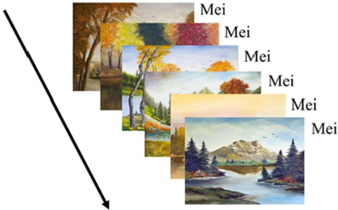
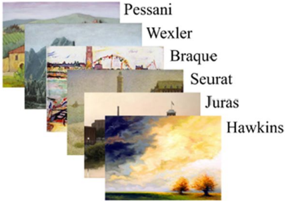
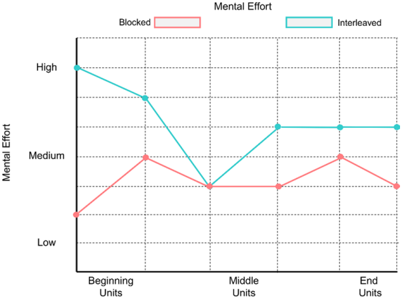
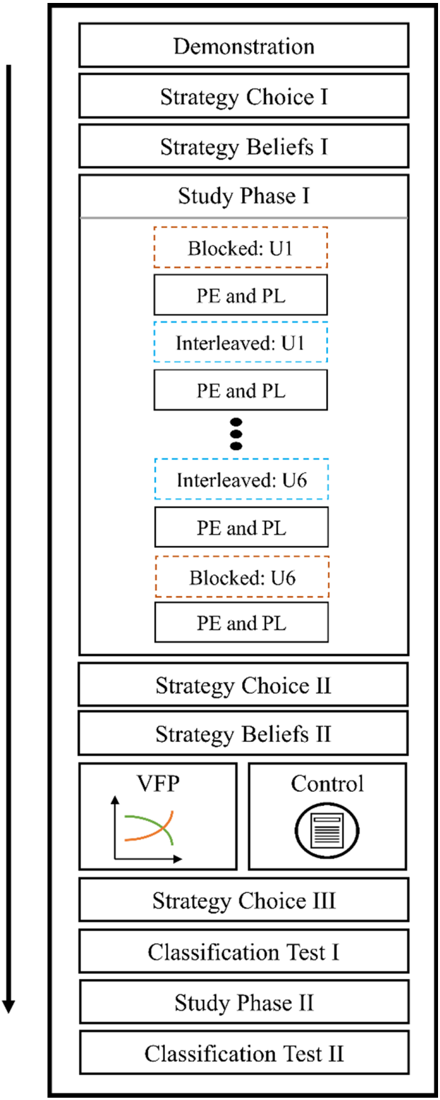
In higher education, many students make poor learning strategy decisions. This, in part, results from the counterintuitive nature of effective learning strategies: they enhance long-term learning but also cost high initial effort and appear to not improve learning (immediately). This mixed-method study investigated how students make learning strategy decisions in category learning, and whether students can be supported to make effective strategy decisions through a metacognitive prompt, designed to support accurate monitoring of effort and learning. Participants (N = 150) studied painting styles through blocked and interleaved practice, rated their perceived effort and perceived learning across time, and chose between either blocked or interleaved practice. Half of the participants (N = 74) were provided with a metacognitive prompt that showed them how their subjective experiences per strategy changed across time and required them to relate these experiences to the efficacy of learning strategies. Results indicated that subjective experiences with interleaved practice improved across time: students’ perceived learning increased as their perceived effort decreased. Mediation analysis revealed that the increased feeling of learning increased the likelihood to select interleaved practice. The percentage of students who chose interleaved practice increased from 13 to 40%. Students’ learning strategy decisions, however, did not benefit from the metacognitive prompt. Qualitative results revealed that students initially had inaccurate beliefs about the efficacy of learning strategies, but on-task experiences overrode the influence of prior beliefs in learning strategy decisions. This study suggests that repeated monitoring of effort and learning have the potential to improve the use of interleaved practice.
Overview
The claims and statistics of this paper haven’t been checked yet.
Free: it reads the open-access text and checks the first 5 claims that cite a source we can check. Create a free account to check every claim.
Integrity signals
Registry
Cites
Statistics
Figures
Verification
Claims the paper makes
The claims and statistics of this paper haven’t been checked yet.
Free: it reads the open-access text and checks the first 5 claims that cite a source we can check. Create a free account to check every claim.
Claims other papers make about this one
Each is checked against this paper’s own text: does it say what the citing paper says it does?
The source backs part of the claim, not all of it — or backs it for a different population, condition or comparison.
In the citing paper
“This was observed in a recent study by Onan and colleagues (2022). Students who reported ease of use or ease of retrieval as a basis for choosing a learning strategy indicated they chose the desirable difficulty of interleaving less often and were more inclined to use blocking as the preferred learning strategy.”
From Worth the Effort: the Start and Stick to Desirable Difficulties (S2D2) Framework (2023) · cites this paper as Onan et al., 2022
Experimental — accuracy not yet measuredThe cited source says what the claim attributes to it.
In the citing paper
“Note that some students reported higher fluency when using interleaving, stating that to them this desirable difficulty felt easier to use.”
From Worth the Effort: the Start and Stick to Desirable Difficulties (S2D2) Framework (2023) · cites this paper as Onan et al., 2022
The cited source says what the claim attributes to it.
In the citing paper
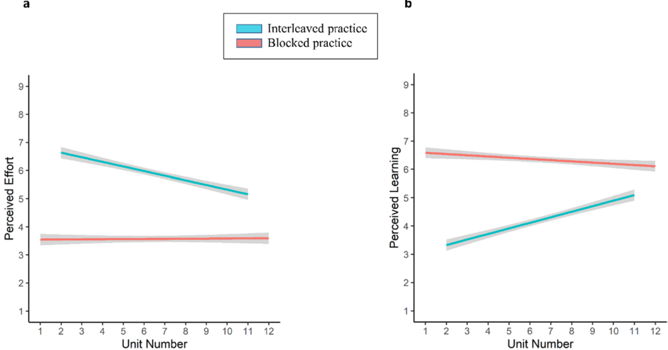
“Perceived effort was higher and perceived learning was lower for interleaving than for blocking.”
From Worth the Effort: the Start and Stick to Desirable Difficulties (S2D2) Framework (2023) · cites this paper as Onan et al., 2022
The cited source says what the claim attributes to it.
In the citing paper
“These differences between blocking and interleaving decreased after experience with the strategies.”
From Worth the Effort: the Start and Stick to Desirable Difficulties (S2D2) Framework (2023) · cites this paper as Onan et al., 2022
The cited source says what the claim attributes to it.
In the citing paper
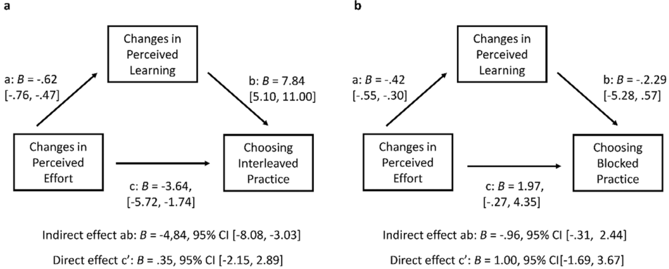
“Moreover, the effect of this decrease in perceived effort on use of interleaving was mediated by the increase in perceived learning.”
From Worth the Effort: the Start and Stick to Desirable Difficulties (S2D2) Framework (2023) · cites this paper as Onan et al., 2022
2 more claims about this paper
Create a free account to see every claim other papers make about this one.
Self-check
Percentages, sums and reported differences re-computed from the paper’s own numbers.
The self-check needs the paper’s full text.
Citations
Cites
Fitting Linear Mixed-Effects Models Using lme4
Bates, D., Mächler, M., Bolker, B., & Walker, S. (2015) · Journal of Statistical Software · doi:10.18637/jss.v067.i01 · Cited by 86,835
Faul, F., Erdfelder, E., Lang, A.-G., & Buchner, A. (2007) · Behavior Research Methods · doi:10.3758/bf03193146 · Cited by 65,971
Dunlosky, J., Rawson, K. A., Marsh, E. J., Nathan, M. J., & Willingham, D. T. (2013) · Psychological Science in the Public Interest · doi:10.1177/1529100612453266 · Cited by 3,138
Misinformation and Its Correction: Continued Influence and Successful Debiasing
Lewandowsky, S., Ecker, U. K. H., Seifert, C. M., Schwarz, N., & Cook, J. (2012) · Psychological Science in the Public Interest · doi:10.1177/1529100612451018 · Cited by 2,920
Test-Enhanced Learning: Taking Memory Tests Improves Long-Term Retention
Roediger, H. L., & Karpicke, J. D. (2006) · Psychological Science · doi:10.1111/j.1467-9280.2006.01693.x · Cited by 2,867
Paas, F. G. W. C. (1992) · Journal of Educational Psychology · doi:10.1037/0022-0663.84.4.429 · Cited by 2,150 · cited 1×
“Perceived effort was measured by the single item “how much mental effort did this strategy cost you?” on a 9-point (1: very, very low to 9: very, very high) rating scale (Paas, 1992).”
MethodUsing Templates in the Thematic Analysis of Text
King, N. (2004) · Essential Guide to Qualitative Methods in Organizational Research · doi:10.4135/9781446280119.n21 · Cited by 2,137
The Utility of Template Analysis in Qualitative Psychology Research
Brooks, J., McCluskey, S., Turley, E., & King, N. (2015) · Qualitative Research in Psychology · doi:10.1080/14780887.2014.955224 · Cited by 1,923
Self-Regulated Learning: Beliefs, Techniques, and Illusions
Bjork, R. A., Dunlosky, J., & Kornell, N. (2013) · Annual Review of Psychology · doi:10.1146/annurev-psych-113011-143823 · Cited by 1,468 · cited 1×
“…learning strategies · Interleaved practice * Erdem Onan e.onan@maastrichtuniversity.nl Extended author information available on the last page of the article 1 3 In higher education, students have substantial freedom to monitor and control (i.e., self-regulate) their learning (Bjork et al., 2013).”
BackgroundMonitoring one’s own knowledge during study: A cue-utilization approach to judgments of learning
Koriat, A. (1997) · Journal of Experimental Psychology: General · doi:10.1037/0096-3445.126.4.349 · Cited by 1,363
Memory and Metamemory Considerations in the Training of Human Beings
Bjork, R. A. (1994) · Metacognition · doi:10.7551/mitpress/4561.003.0011 · Cited by 1,084
King, N. (2012) · Qualitative Organizational Research: Core Methods and Current Challenges · doi:10.4135/9781526435620.n24 · Cited by 902
Regression analyses of repeated measures data in cognitive research.
Lorch, R. F., & Myers, J. L. (1990) · Journal of Experimental Psychology: Learning, Memory, and Cognition · doi:10.1037//0278-7393.16.1.149 · Cited by 791
(2011) · Cited by 725
Learning Concepts and Categories: Is Spacing the “Enemy of Induction”?
Kornell, N., & Bjork, R. A. (2008) · Psychological Science · doi:10.1111/j.1467-9280.2008.02127.x · Cited by 602 · cited 6×
“In various domains, it has been shown that interleaved practice results in better category learning than blocked practice, such as science (Eglington & Kang, 2017), statistics (Sana et al., 2017), and arts (Kornell & Bjork, 2008).”
BackgroundMethodInfluentialRepeated testing produces superior transfer of learning relative to repeated studying.
Butler, A. C. (2010) · Journal of Experimental Psychology: Learning, Memory, and Cognition · doi:10.1037/a0019902 · Cited by 492 · cited 1×
“Meanwhile, participants in the control condition read an article about the Internet obtained from Butler (2010).”
BackgroundPsychology and the real world: Essays illustrating fundamental contributions to society.
Gernsbacher, M. A., Pew, R. W., Hough, L. M., & Pomerantz, J. R. (2011) · Cited by 460
Why interleaving enhances inductive learning: The roles of discrimination and retrieval
Birnbaum, M. S., Kornell, N., Bjork, E. L., & Bjork, R. A. (2013) · Memory & Cognition · doi:10.3758/s13421-012-0272-7 · Cited by 278 · cited 1×
“Several studies showed that over 60% of the students judged blocked practice to be a more effective strategy than interleaved practice, even though interleaved practice enhanced their category learning more than blocked practice (Birnbaum et al., 2013; Kornell et al., 2010; Zulkiply et al., 2012).”
BackgroundThe what, how much, and when of study strategies: comparing intended versus actual study behaviour.
Blasiman, R. N., Dunlosky, J., & Rawson, K. A. (2017) · Memory · doi:10.1080/09658211.2016.1221974 · Cited by 227 · cited 2×
“In authentic learning situations, learning strategy decisions can become high-stakes decisions, since students significantly increase their study time closer to the exam period (Blasiman et al., 2017).”
BackgroundSynthesizing Cognitive Load and Self-regulation Theory: a Theoretical Framework and Research Agenda
de Bruin, A. B. H., Roelle, J., Carpenter, S. K., Baars, M., & EFG-MRE (2020) · Educational Psychology Review · doi:10.1007/s10648-020-09576-4 · Cited by 196
Fostering effective learning strategies in higher education—A mixed-methods study.
Biwer, F., Egbrink, M. G. A. O., Aalten, P., & de Bruin, A. B. H. (2020) · Journal of Applied Research in Memory and Cognition · doi:10.1016/j.jarmac.2020.03.004 · Cited by 195
Self-citationPositive confirmation bias in the acquisition of information
Jones, M., & Sugden, R. (2001) · Theory and Decision · doi:10.1023/a:1005296023424 · Cited by 187
Spacing as the friend of both memory and induction in young and older adults.
Kornell, N., Castel, A. D., Eich, T. S., & Bjork, R. A. (2010) · Psychology and Aging · doi:10.1037/a0017807 · Cited by 179
Similarity matters: A meta-analysis of interleaved learning and its moderators.
Brunmair, M., & Richter, T. (2019) · Psychological Bulletin · doi:10.1037/bul0000209 · Cited by 178 · cited 2×
“According to a recent meta-analysis (Brunmair & Richter, 2019), the interleaving effect for studying visual categories is medium in effect size (Hedge’s g = 0.67).”
BackgroundMethodInfluential(2009) · Emerald Group Publishing Limited eBooks · doi:10.1108/978-1-60752-341-3 · Cited by 177
Painting-91: a large scale database for computational painting categorization
Khan, F. S., Beigpour, S., van de Weijer, J., & Felsberg, M. (2014) · Machine Vision and Applications · doi:10.1007/s00138-014-0621-6 · Cited by 176
Yan, V. X., Bjork, E. L., & Bjork, R. A. (2016) · Journal of Experimental Psychology: General · doi:10.1037/xge0000177 · Cited by 153
The diminishing criterion model for metacognitive regulation of time investment.
Ackerman, R. (2014) · Journal of Experimental Psychology: General · doi:10.1037/a0035098 · Cited by 152 · cited 1×
“This observation is important because previous studies found that students could adopt a goal-driven perspective in the presence of incentives (Koriat et al., 2014) or under time pressure (Ackerman, 2014).”
Methodde Bruin, A. B. H., & van Merriënboer, J. J. G. (2017) · Learning and Instruction · doi:10.1016/j.learninstruc.2017.06.001 · Cited by 146
Kirk-Johnson, A., Galla, B. M., & Fraundorf, S. H. (2019) · Cognitive Psychology · doi:10.1016/j.cogpsych.2019.101237 · Cited by 142
Effects of Reflection Prompts When Learning with Hypermedia
Bannert, M. (2006) · Journal of Educational Computing Research · doi:10.2190/94v6-r58h-3367-g388 · Cited by 136
Improving self-regulated learning with a retrieval practice intervention.
Ariel, R., & Karpicke, J. D. (2018) · Journal of Experimental Psychology: Applied · doi:10.1037/xap0000133 · Cited by 124
Metacognition of the testing effect: Guiding learners to predict the benefits of retrieval
Tullis, J. G., Finley, J. R., & Benjamin, A. S. (2013) · Memory & Cognition · doi:10.3758/s13421-012-0274-5 · Cited by 118
The Relation Between Students’ Effort and Monitoring Judgments During Learning: A Meta-analysis
Baars, M., Wijnia, L., de Bruin, A., & Paas, F. (2020) · Educational Psychology Review · doi:10.1007/s10648-020-09569-3 · Cited by 101 · cited 1×
“One plausible explanation for these poor strategy decisions is that students struggle to assess the efficacy of learning strategies due to their inaccurate monitoring of effort and learning (Baars et al., 2020; de Bruin et al., 2020; Kirk-Johnson et al., 2019).”
BackgroundCarvalho, P. F., & Goldstone, R. L. (2017) · Journal of Experimental Psychology: Learning, Memory, and Cognition · doi:10.1037/xlm0000406 · Cited by 99
Sequential and Concurrent Strategies of Multiple Goal Pursuit
Orehek, E., & Vazeou‐Nieuwenhuis, A. (2013) · Review of General Psychology · doi:10.1037/a0032584 · Cited by 93
Spacing and induction: Application to exemplars presented as auditory and visual text
Zulkiply, N. B., McLean, J. P., Burt, J. S., & Bath, D. M. (2011) · Learning and Instruction · doi:10.1016/j.learninstruc.2011.11.002 · Cited by 81
Self-regulated learning of a natural category: Do people interleave or block exemplars during study?
Tauber, S. K., Dunlosky, J. T., Rawson, K. A., Wahlheim, C. N., & Jacoby, L. L. (2012) · Psychonomic Bulletin & Review · doi:10.3758/s13423-012-0319-6 · Cited by 80
Interleaved practice enhances memory and problem-solving ability in undergraduate physics
Samani, J., & Pan, S. C. (2021) · npj Science of Learning · doi:10.1038/s41539-021-00110-x · Cited by 76
Judgments of learning depend on how learners interpret study effort.
Koriat, A., Nussinson, R., & Ackerman, R. (2014) · Journal of Experimental Psychology: Learning, Memory, and Cognition · doi:10.1037/xlm0000009 · Cited by 73
Interleaved presentation benefits science category learning.
Eglington, L. G., & Kang, S. H. K. (2017) · Journal of Applied Research in Memory and Cognition · doi:10.1016/j.jarmac.2017.07.005 · Cited by 72
Study sequence matters for the inductive learning of cognitive concepts.
Sana, F., Yan, V. X., & Kim, J. A. (2016) · Journal of Educational Psychology · doi:10.1037/edu0000119 · Cited by 69
Andersen, S. A. W., Konge, L., & Sørensen, M. S. (2018) · Medical Teacher · doi:10.1080/0142159x.2018.1465182 · Cited by 63
Kung, F. Y. H., & Scholer, A. A. (2019) · Social and Personality Psychology Compass · doi:10.1111/spc3.12509 · Cited by 62
Improving metacomprehension accuracy in an undergraduate course context.
Wiley, J., Griffin, T. D., Jaeger, A. J., Jarosz, A. F., Cushen, P. J., & Thiede, K. W. (2016) · Journal of Experimental Psychology: Applied · doi:10.1037/xap0000096 · Cited by 49
van de Pol, J., van Loon, M., van Gog, T., Braumann, S., & de Bruin, A. (2020) · Educational Psychology Review · doi:10.1007/s10648-020-09560-y · Cited by 45
Carpenter, S. K., Rahman, S., Lund, T. J. S., Armstrong, P. I., Lamm, M. H., Reason, R. D., & Coffman, C. R. (2017) · CBE—Life Sciences Education · doi:10.1187/cbe.16-06-0205 · Cited by 41
Does Individual Performance Feedback Increase the Use of Retrieval Practice?
Hui, L., de Bruin, A. B. H., Donkers, J., & van Merriënboer, J. J. G. (2021) · Educational Psychology Review · doi:10.1007/s10648-021-09604-x · Cited by 30
Exploring the necessary conditions for observing interleaved practice benefits in math learning
Mielicki, M. K., & Wiley, J. (2022) · Learning and Instruction · doi:10.1016/j.learninstruc.2022.101583 · Cited by 28
Cited by
Worth the Effort: the Start and Stick to Desirable Difficulties (S2D2) Framework
de Bruin, A. B. H., Biwer, F., Hui, L., Onan, E., David, L., & Wiradhany, W. (2023) · Educational Psychology Review · doi:10.1007/s10648-023-09766-w · Cited by 109
“Effort put into desirable difficulties will often remain higher than effort put into ineffective strategies, even though this difference may become smaller after practice (Onan et al., 2022).”
BackgroundSelf-citationComplexity affects performance, cognitive load, and awareness
Zeitlhofer, I., Zumbach, J., & Schweppe, J. (2024) · Learning and Instruction · doi:10.1016/j.learninstruc.2024.102001 · Cited by 81
Grund, A., Fries, S., Nückles, M., Renkl, A., & Roelle, J. (2024) · Educational Psychology Review · doi:10.1007/s10648-024-09852-7 · Cited by 68
David, L., Biwer, F., Baars, M., Wijnia, L., PAAS, F. G. W. C., & de Bruin, A. B. H. (2024) · Educational Psychology Review · doi:10.1007/s10648-024-09903-z · Cited by 37
Self-citationJanssen, E. M., van Gog, T., van de Groep, L., de Lange, A. J., Knopper, R. L., Onan, E., Wiradhany, W., & de Bruin, A. B. H. (2023) · Educational Psychology Review · doi:10.1007/s10648-023-09797-3 · Cited by 26
Self-citation
Metadata
- Authors
- Onan, E., Wiradhany, W., Biwer, F., Janssen, E. M., & de Bruin, A. B. H.
- Affiliations
- Maastricht University (NL)
- Binus University (ID)
- Utrecht University (NL)
- Corresponding author
- Onan, Erdem
- Venue
- Educational Psychology Review
- Published
- 2022-07-20
- Volume
- 34
- Issue
- 4
- Pages
- 2451-2484
- ISSN
- 1040-726X (ISSN-L)
- 1573-336X
- OpenAlex
- W4285988059
- Cited by
- 35
- References
- 49
- Citations by year
- 2026: 3 · 2025: 13 · 2024: 14 · 2023: 5
- FWCI
- 12.18
- Type
- journal article
- Language
- en
- Open access
- hybrid
- doi.org
- Licence
- cc-by
- creativecommons.org/licenses/by/4.0 (tdm)
- creativecommons.org/licenses/by/4.0 (vor)
- Locations
- Educational Psychology Review (publishedVersion, cc-by)
- Research Publications (Maastricht University) (publishedVersion, cc-by)
- Utrecht University Repository (Utrecht University) (submittedVersion, other-oa)
- Research Publications (Maastricht University) (submittedVersion, other-oa)
- Funders
- Nederlandse Organisatie voor Wetenschappelijk Onderzoek (VI.Vidi.195.135)
- Topics
- Social Sciences › Psychology › Developmental and Educational Psychology › Innovative Teaching and Learning Methods
- Life Sciences › Neuroscience › Cognitive Neuroscience › Memory Processes and Influences
- Social Sciences › Psychology › Experimental and Cognitive Psychology › Visual and Cognitive Learning Processes
- Keywords
- interleaving, blocked practice, metacognition, perceived effort, perceived learning, metacognitive prompts, category learning, painting style, effort monitoring, university students
About these checks
Registry, retraction, Cites and statistics results are computed, not judged, with one exception: a printed reference that no index lists is read once by a model before it counts as a citation error. Claims are extracted by a model and kept only when their quote appears verbatim in the text; each cited source is then checked, with a model’s help, for whether it says what the claim relies on. Those verdicts can be wrong — read the claim’s quote and the cited source before relying on one.
Statistics and arithmetic are recomputed, not judged.
Confidence bands are shown only for fields calibrated on our annotated test set. None is calibrated yet, so no band is shown.
What counts as a claim ›How we measure confidence ›How we check this ›
Are you an author, or do you see a problem with this page? Request a review
Data sources
Bibliographic data: Semantic Scholar, OpenAlex, Crossref.
Contains information from the Semantic Scholar Academic Graph Datasets, made available under the ODC Attribution License (ODC-BY 1.0).
Semantic Scholar’s data is described in: Kinney, R., et al. (2023). The Semantic Scholar Open Data Platform. arXiv:2301.10140.
