

The process of problem posing: development of a descriptive phase model of problem posing
Open accessThe DOI matches its Crossref record; 55 of the 57 references it cites were found in a registry or an index, and 1 are not checked yet; 1 of the 46 sources its claims cite were checked for support.
Abstract
The aim of this study is to develop a descriptive phase model for problem-posing activities based on structured situations. For this purpose, 36 task-based interviews with pre-service primary and secondary mathematics teachers working in pairs who were given two structured problem-posing situations were conducted. Through an inductive-deductive category development, five types of activities (situation analysis, variation, generation, problem-solving, evaluation) were identified. These activities were coded in so-called episodes, allowing time-covering analyses of the observed processes. Recurring transitions between these episodes were observed, through which a descriptive phase model was derived. In addition, coding of the developed episode types was validated for its interrater agreement.
Verified 2026-11-22 · 1 reference not checked yet
Overview
CoChat Summary
TL;DR
The paper develops a descriptive phase model for problem-posing processes based on structured situations, using task-based interviews with pre-service mathematics teachers. It identifies five content-related episode types and derives a cyclic model with high interrater agreement.
Key findings
- Five content-related episode types were identified: situation analysis, variation, generation, problem-solving, and evaluation.
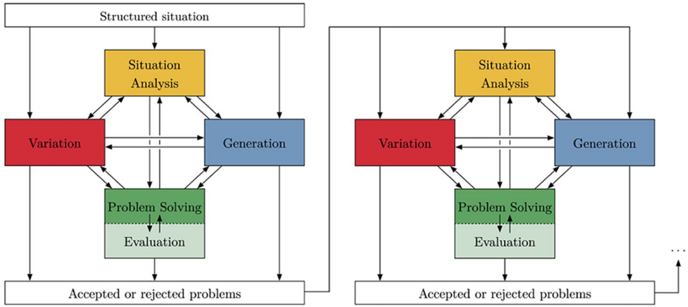
- The derived descriptive phase model has a cyclic structure; there is no predetermined order, and transitions between any episode types were observed empirically, though a “natural order” often appeared: situation analysis → variation/generation → problem-solving → evaluation.
- Interrater agreement for the episode coding was Cohen’s κ = 0.81, described as almost perfect; separate category kappas were κ SA = 0.87, κ V = 0.83, κ G = 0.72, κ PS = 0.87, κ PS/E = 0.73, κ E = 0.49, and κ O = 0.97.
- The largest coding differences were for variation vs. generation and for distinguishing problem-solving, problem-solving/evaluation, and evaluation.
Methods
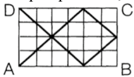
- Task-based interviews were conducted with pre-service primary and secondary mathematics teachers working in pairs on two structured problem-posing situations: (A) Nim game and (B) Number pyramid. The abstract states 36 task-based interviews; the data collection section reports 64 PSTs and 32 analyzed processes (15 for situation A, 17 for situation B).
- Processes ranged from 9 to 25 min, averaged 14.5 min, and totaled 7 h 46 min of video material.
- Analysis adapted Schoenfeld’s verbal protocol analysis with event-based sampling: interviews were segmented into episodes and coded through inductive-deductive category development. Interrater agreement used the EasyDIAg algorithm with a 60% overlap criterion; a second coder analyzed about 2 h 23 min (30.7% of the material, 10 of 32 processes).
Limitations
- The paper states the model offers one possible perspective on problem-posing processes; depending on the problem-posing situation, sample, or study design, slightly different or additional episode types may occur.
- The study considers two specific structured situations with a non-routine initial problem and uses PSTs as the sample, though the authors report successful applications to other situations, contents, and sample groups in bachelor’s and master’s theses.
- Evident from the text: the abstract’s “36 task-based interviews” is inconsistent with the data collection section’s report of 64 PSTs in pairs and 32 analyzed processes; the evaluation category also had the lowest reported kappa (κ E = 0.49).
Model-written summary. Check it against the paper before relying on it.
Integrity signals
Registry
Cites
Statistics
Figures

Verification
Claims the paper makes
1 Valid · 7 Not valid · 35 Not checked · 57 Own results and interpretations
Every source the paper cites for this claim was checked and supports it.
In the paper
“Although there are studies considering problem-posing processes (Headrick et al., 2020;Ponte & Henriques, 2013), general knowledge about learners' problem-posing processes remains limited (Cai & Leikin, 2020).”
§ The process of problem posing: development of a descriptive phase model of problem posing > 1 Introduction
What the sources say
- Supportedcites Cai & Leikin, 2020 matched to “Affect in mathematical problem posing: conceptualization, advances, and future directions for research” (2020) source
Section 2 'Research on problem posing in mathematics education' (p. 1 of our copy) states that despite interest in classroom problem posing, 'our knowledge remains relatively limited with respect to the processes involved when learners generate their own problems,' plus instructional strategies and effectiveness — exactly what the citing sentence attributes to Cai & Leikin (2020). The same passage also acknowledges existing efforts/studies, matching the sentence's concessive framing. Section 5 'Future directions' reinforces this by posing unanswered questions about problem-posing processes and their affective interaction. (LLM, conf=0.90)
plain- Asserted: passes — The authors put it forward as true.
- Checkable: passes — It can be checked against evidence.
- Load-bearing: passes — The paper’s conclusions depend on it.
- Based: passes — The paper gives a reason why it holds.
- Supported
None of the sources cited for this claim have been checked yet.
In the paper
“If a non-routine problem has been posed, the respondents go through a shortened problem-solving process in which the phases of devising and carrying out the plan (Pólya, 1945) are the main focus.”
§ The process of problem posing: development of a descriptive phase model of problem posing > 4.1.4 Problem solving
What the sources say
- Not checked yetcites Pólya, 1945 matched to “How to Solve It: A New Aspect of Mathematical Method” (1945) source
Checked before — its earlier verdict is held back until a new check runs.
plainstates a cause- Asserted: passes — The authors put it forward as true.
- Checkable: passes — It can be checked against evidence.
- Load-bearing: unclear — It is unclear whether the paper’s conclusions depend on it.
- Based: passes — The paper gives a reason why it holds.
- Not checked yet
A result the paper states — it cites no source for it, so there is none to check. The quote shows it is in the paper.
In the paper
“The need for developing a phase model for problem posing is, furthermore, based on our general observation that the quality of the posed problems did not always match the quality of the observed activity.”
§ The process of problem posing: development of a descriptive phase model of problem posing > 2.2 Process of problem posing-state of research
plain- Asserted: passes — The authors put it forward as true.
- Checkable: passes — It can be checked against evidence.
- Load-bearing: passes — The paper’s conclusions depend on it.
- Based: passes — The paper gives a reason why it holds.
A result the paper reports from its own data — it cites no other source for it, so there is none to check. The quote shows it is in the paper.
In the paper
“In the evaluation, the posers assess the posed tasks based on individually defined criteria.”
§ The process of problem posing: development of a descriptive phase model of problem posing > 4.1.5 Evaluation Description
plain- Asserted: passes — The authors put it forward as true.
- Checkable: passes — It can be checked against evidence.
- Load-bearing: unclear — It is unclear whether the paper’s conclusions depend on it.
- Based: passes — The paper gives a reason why it holds.
A result the paper reports from its own data — it cites no other source for it, so there is none to check. The quote shows it is in the paper.
In the paper
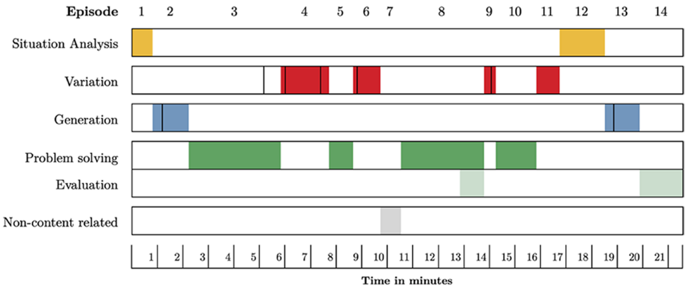
“In the process of T&U, episodes 3, 5, 8, and 10 are coded as problem solving as the participants are engaged in solving their posed problems.”
§ The process of problem posing: development of a descriptive phase model of problem posing > 4.1.4 Problem solving
plain- Asserted: passes — The authors put it forward as true.
- Checkable: passes — It can be checked against evidence.
- Load-bearing: unclear — It is unclear whether the paper’s conclusions depend on it.
- Based: passes — The paper gives a reason why it holds.
34 more claims
Create a free account to see all 100 claims and to verify the 21 references still open.
- Probably not a substantial claim. 46
- It may state two separate claims as one. 23
Self-check
Percentages, sums and reported differences re-computed from the paper’s own numbers.
Each contradiction between two passages listed here was confirmed by an independent check.
Rated minor: it would not touch a result — a value no result rests on, a p-value that stays on the same side of the significance level, or a conflict that is clerical, resolved elsewhere in the paper, or outside its own findings.
In the paper
§ The process of problem posing: development of a descriptive phase model of problem posing > Abstract
“For this purpose, 36 task-based interviews with pre-service primary and secondary mathematics teachers working in pairs who were given two structured problem-posing situations were conducted.”
§ The process of problem posing: development of a descriptive phase model of problem posing > 3.1 Data collection
“The interviews were conducted with 64 pre-service primary and secondary mathematics teachers (PST).The PSTs worked in pairs on one of two structured problem-posing situations, either (A) Nim game or (B) Number pyramid, which are presented in Table 2.”
Citations
Cites
The Measurement of Observer Agreement for Categorical Data
Landis, J. R., & Koch, G. G. (1977) · Biometrics · doi:10.2307/2529310 · Cited by 81,148
A Coefficient of Agreement for Nominal Scales
Cohen, J. (1960) · Educational and Psychological Measurement · doi:10.1177/001316446002000104 · Cited by 42,398
Metacognition and cognitive monitoring: A new area of cognitive–developmental inquiry
Flavell, J. H. (1979) · American Psychologist · doi:10.1037/0003-066x.34.10.906 · Cited by 11,282 · cited 1×
“The activity of evaluation is closely related to the metacognitive activity of the regulation of cognition (Flavell, 1979; Schraw & Moshman, 1995).”
BackgroundLearning Together and Alone: Cooperative, Competitive, and Individualistic Learning
Johnson, D. W., & Johnson, R. T. (1998) · Cited by 2,586
Qualitative Content Analysis: Theoretical Background and Procedures
Mayring, P. (2015) · Advances in Mathematics Education · doi:10.1007/978-94-017-9181-6_13 · Cited by 2,263
Forschungsmethoden und Evaluation in den Sozial- und Humanwissenschaften
Döring, N., & Bortz, J. (2016) · Springer-Lehrbuch · doi:10.1007/978-3-642-41089-5 · Cited by 1,961
(1985) · Elsevier eBooks · doi:10.1016/c2013-0-05012-8 · Cited by 1,934
How to Solve It: A New Aspect of Mathematical Method
Polya, G. (1945) · Princeton University Press eBooks · doi:10.1515/9781400828678 · Cited by 1,652
Schraw, G., & Moshman, D. (1995) · Educational Psychology Review · doi:10.1007/bf02212307 · Cited by 1,443 · cited 1×
“The activity of evaluation is closely related to the metacognitive activity of the regulation of cognition (Flavell, 1979; Schraw & Moshman, 1995).”
BackgroundHandbook of research design in mathematics and science education
(2000) · Choice Reviews Online · doi:10.5860/choice.38-2281 · Cited by 1,122
Research works printed but not linked: 7
- Brown, S. I., & Walter, M. I. (1983). The art of problem posing. Franklin Institute Press.
- Christou, C., Mousoulides, N., Pittalis, M., Pitta-Pantazi, D., & Sriraman, B. (2005). An empirical taxon- omy of problem posing processes. ZDM -Mathematics Education, 37(3), 149-158. https:// doi. org/ 10. 1007/ s11858-005-0004-6 · DOI · Paper page
- Cruz, M. (2006). A mathematical problem-formulating strategy. International Journal for Mathematics Teaching and Learning, 79-90.
- Mason, J., Burton, L., & Stacey, K. (1982). Thinking mathematically (2nd ed.). Prentice Hall.
- Pelczer, I., & Gamboa, F. (2009). Problem posing: Comparison between experts and novices. In M. Tze- kaki, M. Kaldrimidou, & H. Sakonidis (Eds.), Proceedings of the 33th conference of the International group for the Psychology of Mathematics Education. Vol. 4 (pp. 353-360). PME.
- Pólya, G. (1966). On teaching problem solving. In The Conference Board of the Mathematical Sciences (Ed.), The role of axiomatics and problem solving in mathematics (pp. 123-129).
- Singer, F. M., Ellerton, N. F., & Cai, J. (Eds.). (2015). Mathematical problem posing. Springer.
Cited by
What Research Says About Teaching Mathematics Through Problem Posing
Cai, J. (2022) · Éducation et didactique · doi:10.4000/educationdidactique.10642 · Cited by 114
On understanding mathematical problem-posing processes
Cai, J., & Rott, B. (2023) · ZDM · doi:10.1007/s11858-023-01536-w · Cited by 88
Self-citationBaumanns, L., & Rott, B. (2022) · International Journal of Science and Mathematics Education · doi:10.1007/s10763-022-10297-z · Cited by 50
Self-citationBaumanns, L., & Rott, B. (2024) · The Journal of Mathematical Behavior · doi:10.1016/j.jmathb.2024.101130 · Cited by 42
Self-citationImpact of prompts on students’ mathematical problem posing
Cai, J., Ran, H., Hwang, S., Ma, Y., Han, J., & Muirhead, F. (2023) · The Journal of Mathematical Behavior · doi:10.1016/j.jmathb.2023.101087 · Cited by 36
Hartmann, L.-M., Krawitz, J., & Schukajlow, S. (2023) · Journal für Mathematik-Didaktik · doi:10.1007/s13138-023-00223-3 · Cited by 40
Mathematics teachers’ specialized knowledge mobilized through problem transformation
Montes, M., Chico, J., Martín-Díaz, J. P., & Jiménez, E. R. B. (2024) · The Journal of Mathematical Behavior · doi:10.1016/j.jmathb.2024.101132 · Cited by 26
Ran, H., Cai, J., Muirhead, F., & Hwang, S. (2025) · Educational Studies in Mathematics · doi:10.1007/s10649-025-10399-9 · Cited by 24
A model for problem creation: implications for teacher training
Burgos, M., Tizón-Escamilla, N., & Chaverri, J. (2024) · Mathematics Education Research Journal · doi:10.1007/s13394-023-00482-w · Cited by 24
Siller, H.-S., Vorhölter, K., & Just, J. (2024) · International Journal of Science and Mathematics Education · doi:10.1007/s10763-024-10518-7 · Cited by 23
Effect of Teaching Mathematics Supported by Problem-posing Strategies on Problem-posing Skills
Divrik, R. (2023) · International Journal of Modern Education Studies · doi:10.51383/ijonmes.2023.308 · Cited by 19
Does problem posing affect self-efficacy, task value, and performance in mathematical modelling?
Krawitz, J., Schukajlow, S., & Hartmann, L.-M. (2025) · Educational Studies in Mathematics · doi:10.1007/s10649-025-10385-1 · Cited by 19
Walking through Algebraic Thinking with Theme-Based (Mobile) Math Trails
Barbosa, A., Vale, I. P., Jablonski, S., & Ludwig, M. (2022) · Education Sciences · doi:10.3390/educsci12050346 · Cited by 17
Christou, C., Pitta‐Pantazi, D., & Chimoni, M. (2024) · The Journal of Mathematical Behavior · doi:10.1016/j.jmathb.2024.101134 · Cited by 14
Marco, N., & Palatnik, A. (2023) · The Journal of Mathematical Behavior · doi:10.1016/j.jmathb.2023.101119 · Cited by 13
Kontorovich, I. (2024) · The Journal of Mathematical Behavior · doi:10.1016/j.jmathb.2024.101135 · Cited by 12
Understanding the cognitive processes of mathematical problem posing: evidence from eye movements
Zhang, L., Song, N., Wu, G., & Cai, J. (2023) · Educational Studies in Mathematics · doi:10.1007/s10649-023-10262-9 · Cited by 12
Habilidades Matemáticas na Resolução de Problemas: análise da compreensão de futuros professores
de Proença, M. C. (2022) · Bolema Boletim de Educação Matemática · doi:10.1590/1980-4415v36n74a09 · Cited by 9
Identifying competent problem posers and exploring their characteristics
Zhang, L., Stylianides, A. J., & Stylianides, G. J. (2023) · The Journal of Mathematical Behavior · doi:10.1016/j.jmathb.2023.101086 · Cited by 8
Borji, V., Surynková, P., Kuper, E., & Robová, J. (2024) · International Journal of Mathematical Education in Science and Technology · doi:10.1080/0020739x.2024.2309284 · Cited by 9
Liu, X., Bulut, O., Cui, Y., & Gao, Y. (2024) · Journal of Computer Assisted Learning · doi:10.1111/jcal.13089 · Cited by 8
Dificuldades de Licenciandos em Matemática na Escolha do Problema na Perspectiva do EAMvRP
de Proença, M. C. (2024) · Bolema Boletim de Educação Matemática · doi:10.1590/1980-4415v38a230236 · Cited by 6
Research on task design in pre-service mathematics teacher education: a scoping review
Markle, J., & McGarvey, L. M. (2025) · Frontiers in Education · doi:10.3389/feduc.2025.1467482 · Cited by 5
The influence of problem-posing task situation: Prospective primary teachers working with fractions
Sosa-Martín, D., Perdomo-Díaz, J., Bruno, A., Almeida, R., & García-Alonso, I. (2024) · The Journal of Mathematical Behavior · doi:10.1016/j.jmathb.2024.101139 · Cited by 6
Sanders, M., Kwok, M., & Gooden, M. (2025) · The Journal of Mathematical Behavior · doi:10.1016/j.jmathb.2025.101267 · Cited by 5
Mathematical Problem-Posing Research: Revisiting Some Answered and Unanswered Questions
Ölmez, İ. B., Han, J., Hwang, S., & Cai, J. (2025) · Avances de Investigación en Educación Matemática · doi:10.35763/aiem28.8124 · Cited by 4
Explorando competencias de modelación matemática y errores en la formación docente
Aguerrea, M., Alveal, F. E. R., & Huincahue, J. (2025) · PNA · doi:10.30827/pna.v19i2.30336 · Cited by 4
Problem-Driven Teaching: Estimating the Population from a Sample
Dang, G., Shi, X., Si, Z., & Guo, Y. (2023) · International Online Conference on Mathematics and Applications (IOCMA) · doi:10.3390/iocma2023-14431 · Cited by 4
Problem Posing in Mathematics Education Research
Bakri, A. Y. M., Rosli, R., Mahmud, M. S., Maat, S. M., & Suhaimi, S. N. (2024) · Jurnal Pendidikan Sains Dan Matematik Malaysia · doi:10.37134/jpsmm.vol14.1.2.2024 · Cited by 3
Liu, Q., Liu, J., Cai, J., & Cui, T. (2025) · European Journal of Education · doi:10.1111/ejed.70091 · Cited by 3
Problem Posing Model sebagai Upaya Meningkatkan Keterampilan Berpikir Kritis dan Kreatif
Rahim, F. R., & Ayop, S. K. (2023) · SAP (Susunan Artikel Pendidikan) · doi:10.30998/sap.v8i2.19229 · Cited by 4
Teixeira, C. D. J., & Moreira, G. E. (2024) · Rematec · doi:10.37084/rematec.1980-3141.2024.n47.e2024002.id523 · Cited by 4
Exploring the Cognitive Model of Scientific Problem-Solving While Using Simulations
Zeng, Y., Chi, S., & Wang, Z. (2025) · Journal of Science Education and Technology · doi:10.1007/s10956-025-10263-8 · Cited by 2
ERGENE, B. Ç., Ergene, Ö., & Kontorovich, I. (2026) · International Journal of Mathematical Education in Science and Technology · doi:10.1080/0020739x.2026.2687118 · Cited by 2
Guo, Y., Yan, J., Zhou, W., & Dang, G. (2024) · Humanities and Social Sciences Communications · doi:10.1057/s41599-024-03084-4 · Cited by 2
Kar, T., Öztürk, F., & Özkaya, M. (2024) · Teaching Mathematics and its Applications An International Journal of the IMA · doi:10.1093/teamat/hrae010 · Cited by 2
Students’ Difficulties with Problem Posing in Early Childhood Education
Medeiro, E. C., & Climent, N. (2025) · Education Sciences · doi:10.3390/educsci15050630 · Cited by 3
Ningsih, E. F., Wawan, W., & Susandi, A. D. (2025) · Journal of Transdisiplinary Studies in Education · doi:10.64268/jtse.v1i1.10 · Cited by 2
ANALOGY PROBLEM POSING FOR ELEMENTARY SCHOOL STUDENTS ON WORD PROBLEMS
Yunita, S. R., & Amir, M. F. (2023) · Jurnal Lebesgue Jurnal Ilmiah Pendidikan Matematika Matematika dan Statistika · doi:10.46306/lb.v4i1.283 · Cited by 1
Spinillo, A. G., Lautert, S. L., Agranionih, N. T., Borba, R. E. D. S. R., dos Santos, E. M., & da Silva, J. F. G. (2023) · Springer eBooks · doi:10.1007/978-981-99-7205-0_9 · Cited by 4
Growing patterns invention by primary education students
Torres, M. D., Ayala-Altamirano, C., & Uclés, R. R. (2024) · Research in Mathematics Education · doi:10.1080/14794802.2024.2344211 · Cited by 1
Stoffels, G., Schäfer, J., Köster, J., & Witzke, I. (2025) · LUMAT International Journal on Math Science and Technology Education · doi:10.31129/lumat.12.4.2394 · Cited by 1
Formulación de problemas y uso de IA: Creencias motivacionales en futuros docentes de primaria
Solano, S. E., Perdomo-Díaz, J., & Giaconi, V. (2025) · Avances de Investigación en Educación Matemática · doi:10.35763/aiem28.7546 · Cited by 1
Exploring Beginning Teachers’ Ability to Design Mathematical Games
Applebaum, M. (2026) · International Journal of Education in Mathematics Science and Technology · doi:10.46328/ijemst.5218 · Cited by 1
Pallauta, J. D., Batanero, C., Rivas, M., & Vera, O. D. (2026) · Uniciencia · doi:10.15359/ru.40-1.2 · Cited by 2
Cai, J. (2023) · Educación matemática · doi:10.24844/em3503.01 · Cited by 2
Keefektivan pembelajaran problem posing terhadap penguatan creative thinking siswa SMA
Shofi, M., & Wulandari, E. (2023) · PYTHAGORAS Jurnal Program Studi Pendidikan Matematika · doi:10.33373/pythagoras.v12i2.5622 · Cited by 2
Multi-variable narratives in qualitative research on mathematical problem posing
Koichu, B., & Cooper, J. (2024) · The Journal of Mathematical Behavior · doi:10.1016/j.jmathb.2024.101157 · Cited by 1
Many Chefs in the Kitchen—a Collaborative Model for Problem-Posing
Cooper, J., Koichu, B., Widder, M., Aiber, S., Amir, Y., Badarneh, A., Farber, M., Gorodin, M., Gottlib, O., Gruenhut, E., et al. (2023) · Springer eBooks · doi:10.1007/978-3-658-41061-2_2
Sibanda, J. (2023) · Research in Educational Policy and Management · doi:10.46303/repam.2023.24
How do prospective primary teachers interpret ‘to promote understanding’?
Chico, J., Martín-Díaz, J. P., Montes, M., & Jiménez, E. R. B. (2023) · HAL
The Practicality of the Problem Posing Approach with the STAD Setting in Mathematics Learning
Farman, F., & Vivin, M. (2023) · Logaritma Jurnal Ilmu-ilmu Pendidikan dan Sains · doi:10.24952/logaritma.v11i02.10063
Selek, H. K. G., & Başaran, E. S. (2025) · International Journal of Science and Mathematics Education · doi:10.1007/s10763-025-10606-2
Taking up Ownership—What Can Be Learned from Varying Modelling Problems?
Krawitz, J., & Hartmann, L. (2025) · International perspectives on the teaching and learning of mathematical modelling · doi:10.1007/978-3-031-53533-8_24
Kılıç, G., & Öztürk, M. (2025) · Kastamonu Eğitim Dergisi · doi:10.24106/kefdergi.1795820
Álvarez‐Arroyo, R., Batanero, C., & Gea, M. M. (2025) · Avances de Investigación en Educación Matemática · doi:10.35763/aiem28.7429
Inconsistencies in the process of posing problems for use in class by pre-service teachers
Martín, J. P., Chico, Á., Gómez, I. P., & Montes, M. (2025) · HAL
The Semiotic perspective in teachers’ training in Mathematics Education
Asenova, M., Del Zozzo, A., & Garzetti, M. (2024) · Institutional Research Information System University of Turin (University of Turin)
Krummenauer, J., Kuntze, S., Friesen, M. E., Skilling, K., Samková, L., Verdú, C. F., Ivars, P., & Llinares, S. (2022) · Cross Connect (Southern Cross University) · Cited by 1
Chaverri, J. (2024) · Institutional Repository of the University of Granada (University of Granada)
UMA ANÁLISE DOS ERROS DAS CRIANÇAS AO FORMULAREM PROBLEMAS DE MULTIPLICAÇÃO E DIVISÃO
da Silva, J. A., de Melo, N. P. T. B., Spinillo, A. G., & do Nascimento, J. B. (2023) · Revista de História da Educação Matemática · Cited by 4
Florilegium (parte 3) revisado
Moretti, M. T. (2024) · LA Referencia (Red Federada de Repositorios Institucionales de Publicaciones Científicas)
Hwang, S., Zhu, Y., & Cai, J. (2026) · Research in mathematics education · doi:10.1007/978-3-032-05493-7_4
Investigating the Use of Prompts on Prospective Mathematics Teachers’ Problem-Posing Processes
Kar, T., Öçal, M. F., Öztürk, F., & Özkaya, M. (2026) · Research in mathematics education · doi:10.1007/978-3-032-05493-7_10
Baumanns, L., & Rott, B. (2026) · Research in mathematics education · doi:10.1007/978-3-032-05493-7_9
Self-citationLiu, Q., Cui, T., Shao, Y., Liu, H., & Liu, J. (2025) · Asia Pacific Journal of Education · doi:10.1080/02188791.2025.2541087
Kaya, D., & Kutluca, T. (2026) · International Journal on Studies in Education · doi:10.46328/ijonse.5727
Li, D., Wu, Y., & Cai, J. (2026) · Research in mathematics education · doi:10.1007/978-3-032-08175-9_11
Problem posing on vectors in space: preservice teachers’ perspectives
Ergin, A. N., Öztürk, M., & Aydın, T. A. (2026) · Educational Studies in Mathematics · doi:10.1007/s10649-026-10516-2
Problem posing in mathematics education: Research trends and global collaborations over four decades
Serin, M. K. (2026) · Eurasia Journal of Mathematics Science and Technology Education · doi:10.29333/ejmste/18590
Conceptual Questioning in Mathematics Teacher Education: Transforming Routine Questions
Cumhur, F. (2026) · SAGE Open · doi:10.1177/21582440261453414 · Cited by 1
Amilia, N. D., Siswono, T. Y. E. U. N. S., & Rahaju, E. B. (2026) · Benchmarking · doi:10.30821/benchmarking.v10i1.28441
Zaman, O., & Saka, E. (2026) · Bayburt Eğitim Fakültesi Dergisi · doi:10.35675/befdergi.1738859
Liu, Q., Cui, T., & Liu, J. (2026) · International Journal of Science and Mathematics Education · doi:10.1007/s10763-026-10708-5
Nurmawati, N., Purnomo, E. A., Mawarsari, V. D., Prihaswati, M., Pamungkas, M. D., & Kintoko, K. (2026) · IJORER International Journal of Recent Educational Research · doi:10.46245/ijorer.v7i4.1377
Tunç, M. P., & Turan, F. (2026) · Batı anadolu eğitim bilimleri dergisi · doi:10.51460/baebd.1834976
Raquel, J. D. (2026) · JOURNAL OF MATHEMATICS LEARNING INNOVATION (JMLI) · doi:10.35905/jmlipare.v5i2.18510
Zhang, L., Stylianides, A. J., & Stylianides, G. (2026) · Mathematical Thinking and Learning · doi:10.1080/10986065.2026.2747795
Pertianti, R. D., Asnawati, S., Dwiniasih, D., Asih, C. D., & Sundawan, M. D. (2026) · JUDIKDAS Jurnal Ilmu Pendidikan Dasar Indonesia · doi:10.51574/judikdas.v5i4.6040
Öztürk, M., Akyazı, N., Yavuz, S., & Sönmez, N. (2026) · Education Sciences · doi:10.3390/educsci16111914
Jufri, W. N., Arnawa, I. M., Musdi, E., Abdullah, R., Hidayati, A., & Arifin, A. S. R. (2026) · International Journal of Information and Education Technology · doi:10.18178/ijiet.2026.16.11.2743
Metadata
- Authors
- Baumanns, L., & Rott, B.
- Affiliations
- University of Cologne (DE)
- Corresponding author
- Baumanns, Lukas
- Venue
- Educational Studies in Mathematics
- Published
- 2021-12-27
- Volume
- 110
- Issue
- 2
- Pages
- 251-269
- ISSN
- 0013-1954 (ISSN-L)
- 1573-0816
- OpenAlex
- W4200385303
- Cited by
- 81
- References
- 57
- Citations by year
- 2026: 20 · 2025: 19 · 2024: 19 · 2023: 18 · 2022: 5
- FWCI
- 13.28
- Type
- journal article
- Language
- en
- Open access
- hybrid
- doi.org
- Licence
- cc-by
- creativecommons.org/licenses/by/4.0 (tdm)
- creativecommons.org/licenses/by/4.0 (vor)
- Locations
- Educational Studies in Mathematics (publishedVersion, cc-by)
- Kölner Universitäts PublikationsServer (Universität zu Köln) (publishedVersion)
- Funders
- Universität zu Köln
- Topics
- Social Sciences › Education › Mathematics Education and Teaching Techniques
- Social Sciences › Education › Mathematics Education and Pedagogy
- Social Sciences › Education › Teacher Education and Leadership Studies
- Keywords
- problem posing, phase model, pre-service mathematics teachers, teacher professional development, task-based interviews, situation analysis, variations, problem generation, problem solving, interobserver agreement
About these checks
Registry, retraction, Cites and statistics results are computed, not judged, with one exception: a printed reference that no index lists is read once by a model before it counts as a citation error. Claims are extracted by a model and kept only when their quote appears verbatim in the text; each cited source is then checked, with a model’s help, for whether it says what the claim relies on. Those verdicts can be wrong — read the claim’s quote and the cited source before relying on one.
A language model drew the claims from the paper on 2026-11-15, under version 3 of the claim definition (model deepseek-v4.1-flash, prompt extract-v3).
A second model labelled each claim on 2026-11-15 (model jev-1.13-20260917, definition revision gold-guideline-v0.2).
Cited sources are checked with a language model’s help (qwen3.8-omni-flash).
Statistics and arithmetic are recomputed, not judged.
Confidence bands are shown only for fields calibrated on our annotated test set. None is calibrated yet, so no band is shown.
What counts as a claim ›How we measure confidence ›How we check this ›
Are you an author, or do you see a problem with this page? Request a review
Data sources
Bibliographic data: Semantic Scholar, OpenAlex, Crossref.
Contains information from the Semantic Scholar Academic Graph Datasets, made available under the ODC Attribution License (ODC-BY 1.0).
Semantic Scholar’s data is described in: Kinney, R., et al. (2023). The Semantic Scholar Open Data Platform. arXiv:2301.10140.
