

The DOI matches its Crossref record; 518 of the 521 references it cites were found in a registry or an index.
The Generation R Study: design and cohort update 2010
Open accessAbstract
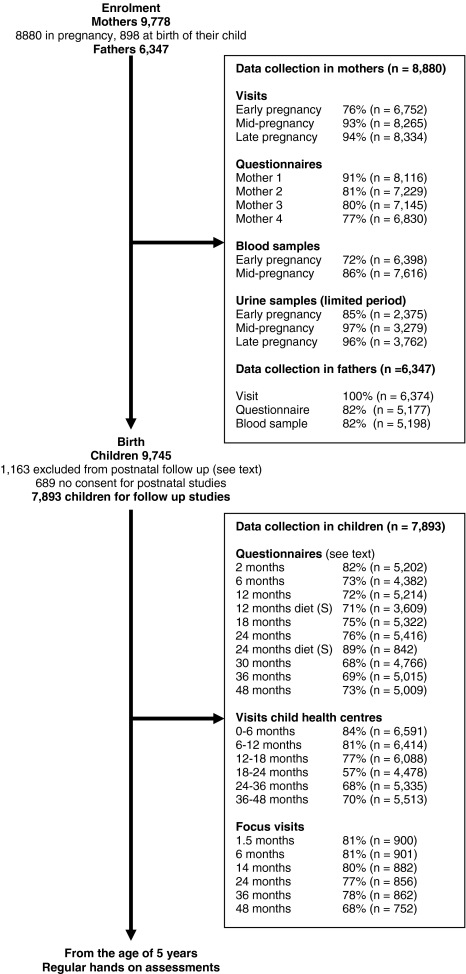
The Generation R Study is a population-based prospective cohort study from fetal life until adulthood. The study is designed to identify early environmental and genetic causes and causal pathways leading to normal and abnormal growth, development and health from fetal life, childhood and young adulthood. This multidisciplinary study focuses on several health outcomes including behaviour and cognition, body composition, eye development, growth, hearing, heart and vascular development, infectious disease and immunity, oral health and facial growth, respiratory health, allergy and skin disorders of children and their parents. Main exposures of interest include environmental, endocrine, genomic (genetic, epigenetic, microbiome), lifestyle related, nutritional and socio-demographic determinants. In total, 9778 mothers with a delivery date from April 2002 until January 2006 were enrolled in the study. Response at baseline was 61%, and general follow-up rates until the age of 10 years were around 80%. Data collection in children and their parents includes questionnaires, interviews, detailed physical and ultrasound examinations, behavioural observations, lung function, Magnetic Resonance Imaging and biological sampling. Genome and epigenome wide association screens are available. Eventually, results from the Generation R Study contribute to the development of strategies for optimizing health and healthcare for pregnant women and children.
Overview
The claims and statistics of this paper haven’t been checked yet.
Run the check — free, no account needed. It reads the open-access text and checks the sources it cites.
Integrity signals
Registry
Cites
Statistics
Figures
Verification
Claims the paper makes
The claims and statistics of this paper haven’t been checked yet.
Run the check — free, no account needed. It reads the open-access text and checks the sources it cites.
Claims other papers make about this one
Each is checked against this paper’s own text: does it say what the citing paper says it does?
The source backs part of the claim, not all of it — or backs it for a different population, condition or comparison.
In the citing paper
“The tools that we have for measuring brain functioning and connectivity are growing, but only recently sizeable multimodal normative brain developmental data have become available, with large prospective studies ongoing in Rotterdam (68), San Diego (69) and Philadelphia (70).”
From Pediatric psychopharmacology: Too much or too little? (2013) · cites this paper as [68]
Experimental — accuracy not yet measured
Self-check
Percentages, sums and reported differences re-computed from the paper’s own numbers.
The self-check needs the paper’s full text.
Citations
Cites
QIIME allows analysis of high-throughput community sequencing data
Caporaso, J. G., Kuczynski, J., Stombaugh, J., Bittinger, K., Bushman, F. D., Costello, E. K., Fierer, N., Peña, A. G., Goodrich, J. K., Gordon, J. I., et al. (2010) · Nature Methods · doi:10.1038/nmeth.f.303 · Cited by 34,887
(1992) · PubMed · Cited by 33,716
The MOS 36-ltem Short-Form Health Survey (SF-36): I. Conceptual Framework and Item Selection
Ware, J. E., & Sherbourne, C. D. (1992) · Medical Care · doi:10.1097/00005650-199206000-00002 · Cited by 30,033
UPARSE: highly accurate OTU sequences from microbial amplicon reads
Edgar, R. C. (2013) · Nature Methods · doi:10.1038/nmeth.2604 · Cited by 16,770
The Strengths and Difficulties Questionnaire: A research note
Goodman, R. (1997) · Journal of Child Psychology and Psychiatry · doi:10.1111/j.1469-7610.1997.tb01545.x · Cited by 14,908
Detection of Postnatal Depression: Development of the 10-item Edinburgh Postnatal Depression Scale
Cox, J. L., Holden, J. M., & Sagovsky, R. (1987) · British Journal of Psychiatry · doi:10.1192/bjp.150.6.782 · Cited by 14,183
KAUFMAN, J., BIRMAHER, B., BRENT, D., RAO, U., FLYNN, C., MORECI, P., WILLIAMSON, D., & RYAN, N. (1997) · Journal of the American Academy of Child & Adolescent Psychiatry · doi:10.1097/00004583-199707000-00021 · Cited by 10,148
(1991) · Medical Entomology and Zoology · Cited by 8,071
Genetics of Food Intake Self-Regulation in Childhood: Literature Review and Research Opportunities
Faith, M. S., Carnell, S., & Kral, T. V. E. (2013) · Human Heredity · doi:10.1159/000353879 · Cited by 7,633
The brief symptom inventory: an introductory report.
Derogatis, L. R., & Melisaratos, N. (1983) · Psychological Medicine · doi:10.1017/s0033291700048017 · Cited by 6,650
Research works printed but not linked: 4
- Statistics Netherlands. Allochtonen in Nederland 2004. Voorburg/Heerlen: Statistics Netherlands; 2004.
- Statistics Netherlands. Standaard Onderwijsindeling 2003. Voorburg/Heerlen: Statistics Netherlands; 2004.
- De Brock AJLL, Vermulst AA, Gerris JRM, Abidin RR. Nijmeegse Ouderlijke Stress Index. Lisse: Swets en Zeitlinger b.v.; 1992.
- Gerris JR, Boxtel DA, Vermulst AA, Janssens JM, van Zuthpen RA, Felling AJ. Parenting in Dutch families. Nijmegen, The Netherlands: University of Nijmegen, Institute of Family Studies; 1993.
Cited by
Sorted by citations
The Rotterdam Study: objectives and design update
Albert Hofman, D., Breteler, M. M. B., van Duijn, C. M., Krestin, G. P., Pols, H. A. P., Stricker, B. H. C., Tiemeier, H. W., Uitterlinden, A. G., Vingerling, J. R., & Witteman, J. C. M. (2007) · European Journal of Epidemiology · doi:10.1007/s10654-007-9199-x · Cited by 1,408
Self-citationRecruiting the ABCD sample: Design considerations and procedures
Garavan, H., Bartsch, H., Conway, K., Decastro, A., Goldstein, R. Z., Heeringa, S., Jernigan, T., Potter, A., Thompson, W., & Zahs, D. (2018) · Developmental Cognitive Neuroscience · doi:10.1016/j.dcn.2018.04.004 · Cited by 1,393
The Generation R Study: design and cohort update 2017
Kooijman, M. N., Kruithof, C. J., van Duijn, C. M., Duijts, L., Franco, O. H., van IJzendoorn, M. H., de Jongste, J. C., Klaver, C. C. W., van der Lugt, A., Mackenbach, J. P., et al. (2016) · European Journal of Epidemiology · doi:10.1007/s10654-016-0224-9 · Cited by 1,238
Self-citationEnhancing studies of the connectome in autism using the autism brain imaging data exchange II
Martino, A. D., O’Connor, D. A., Chen, B., Alaerts, K., Anderson, J. S., Assaf, M., Balsters, J. H., Baxter, L. C., Beggiato, A., Bernaerts, S., et al. (2017) · Scientific Data · doi:10.1038/sdata.2017.10 · Cited by 713
Fundamental constructs in food parenting practices: a content map to guide future research
Vaughn, A., Ward, D. S., Fisher, J. O., Faith, M. S., Hughes, S. O., Kremers, S., Musher‐Eizenman, D. R., O’Connor, T. M., Patrick, H., & Power, T. G. (2016) · Nutrition Reviews · doi:10.1093/nutrit/nuv061 · Cited by 731
Metadata
- Authors
- Jaddoe, V. W. V., van Duijn, C. M., van der Heijden, A. J., Mackenbach, J. P., Moll, H. A., Steegers, E. A. P., Tiemeier, H., Uitterlinden, A. G., Verhulst, F. C., & Hofman, A.
- Affiliations
- Erasmus MC (NL)
- Erasmus MC - Sophia Children’s Hospital (NL)
- Corresponding author
- Jaddoe, Vincent W. V.
- ORCID
- Venue
- European Journal of Epidemiology
- Published
- 2010-10-22
- Volume
- 25
- Issue
- 11
- Pages
- 823-841
- ISSN
- 0393-2990 (ISSN-L)
- 1573-7284
- PMC
- PMC2991548
- OpenAlex
- W2157465110
- Cited by
- 1,027
- References
- 521
- Citations by year
- 2026: 5 · 2025: 22 · 2024: 46 · 2023: 60 · 2022: 73 · 2021: 98 · 2020: 119 · 2019: 91 · 2018: 66 · 2017: 69 · 2016: 62 · 2015: 74 · 2014: 61 · 2013: 59 · 2012: 76
- FWCI
- 51.31
- Type
- journal article
- Language
- en
- Open access
- hybrid
- doi.org
- Licence
- cc-by-nc
- Locations
- European Journal of Epidemiology (publishedVersion, cc-by-nc)
- PubMed Central (publishedVersion, cc-by-nc)
- PubMed (publishedVersion)
- EUR Research Repository (Erasmus University Rotterdam) (publishedVersion, other-oa)
- RePub (Erasmus University Rotterdam) (submittedVersion, other-oa)
- EUR Research Repository (Erasmus University Rotterdam) (submittedVersion, other-oa)
- HAL (submittedVersion, other-oa)
- RePub (Erasmus University Rotterdam) (submittedVersion)
- Trinity's Access to Research Output (TARA) (Trinity College Dublin) (submittedVersion)
- Funders
- ZonMw (907.00303, ZonMw 90700303, 916.10159)
- Erasmus Universiteit Rotterdam
- Erasmus Medisch Centrum
- Nederlandse Organisatie voor Wetenschappelijk Onderzoek (90700303, 916.10159)
- Topics
- Health Sciences › Medicine › Pediatrics, Perinatology and Child Health › Birth, Development, and Health
- Physical Sciences › Environmental Science › Health, Toxicology and Mutagenesis › Health, Environment, Cognitive Aging
- Health Sciences › Medicine › Pediatrics, Perinatology and Child Health › Maternal and Neonatal Healthcare
- Keywords
- Generation R Study, prospective cohort, prenatal exposure, fetal development, child growth, developmental origins of health and disease, epigenetics, microbiome, body composition, eye development, hearing, oral health, facial growth, respiratory health, allergy, skin diseases, genome-wide association study, cohort studies
- MeSH terms
- Adult, Child, Child Behavior, Child Development, Child, Preschool, Cognition, Environmental Exposure, Female, Health Status Indicators, Humans, Infant, Infant, Newborn, Interviews as Topic, Male, Maternal-Child Health Centers, Netherlands, Physical Examination, Pregnancy, Prenatal Care, Prospective Studies, Surveys and Questionnaires, Cohort Studies, Epidemiologic Research Design, Genetic Diseases, Inborn, Genome-Wide Association Study, Young Adult
About these checks
Registry, retraction, Cites and statistics results are computed, not judged, with one exception: a printed reference that no index lists is read once by a model before it counts as a citation error. Claims are extracted by a model and kept only when their quote appears verbatim in the text; each cited source is then checked, with a model’s help, for whether it says what the claim relies on. Those verdicts can be wrong — read the claim’s quote and the cited source before relying on one.
Statistics and arithmetic are recomputed, not judged.
Confidence bands are shown only for fields calibrated on our annotated test set. None is calibrated yet, so no band is shown.
What counts as a claim ›How we measure confidence ›How we check this ›
Are you an author, or do you see a problem with this page? Request a review
