

The DOI matches its Crossref record; 25 of the 25 references it cites were found in a registry or an index.
Are Mendelian randomization investigations immune from bias due to reverse causation?
Open accessAbstract
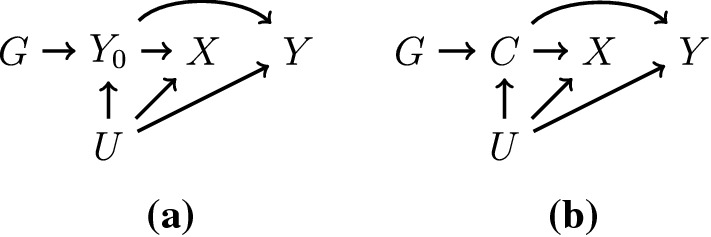
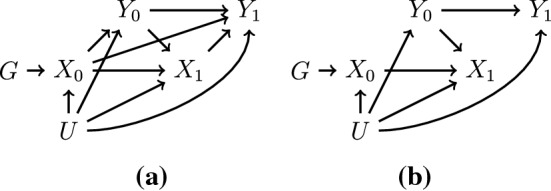
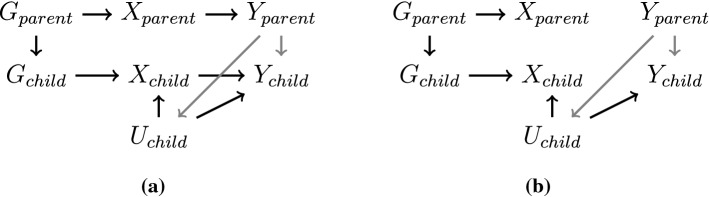
Reverse causation occurs when the outcome variable at an earlier timepoint, or a proximal precursor of the outcome (such as pre-clinical disease), has a causal effect on the risk factor. This confounding by pre-clinical or prior outcome can lead to bias when trying to estimate an average causal effect of the risk factor on the outcome. By proposing genetic variants as instrumental variables, Mendelian randomization can make inferences about the effect of shifting the trajectory of a risk factor on a later-measured outcome. As genetic variants are fixed at conception, it has been stated that Mendelian randomization investigations are not affected by reverse causation. While Mendelian randomization analyses have some protection against bias due to reverse causation, the claim of complete immunity is a misconception. We provide three plausible scenarios and accompanying examples of how reverse causation can influence Mendelian randomization estimates: 1) the effect of the genetic variant on the risk factor is mediated (at least in part) by the outcome, 2) the genetic association with the outcome is distorted by a feedback mechanism whereby the risk factor and outcome variable both influence each other over time, and 3) the genetic association with the outcome is distorted by an effect of the outcome in the parental generation on the outcome in the offspring generation. In these scenarios, we show that all causal effects typically estimated in Mendelian randomization analyses will be biased, though hypothesis testing can still be valid in Scenario 2 and 3 for a sharp causal null hypothesis. This underscores the general recommendation to view Mendelian randomization as primarily testing a causal null hypothesis rather than estimating a causal effect.
Overview
The claims and statistics of this paper haven’t been checked yet.
Run the check — free, no account needed. It reads the open-access text and checks the sources it cites.
Integrity signals
Registry
Cites
Statistics
Figures
Verification
Claims the paper makes
The claims and statistics of this paper haven’t been checked yet.
Run the check — free, no account needed. It reads the open-access text and checks the sources it cites.
Claims other papers make about this one
Each is checked against this paper’s own text: does it say what the citing paper says it does?
In the citing paper
“Violations of the third IV condition can be caused by pleiotropy, where genetic variants have effects on multiple phenotypes.61,62”
From Mendelian randomization (2022) · cites this paper as [62]
Self-check
Percentages, sums and reported differences re-computed from the paper’s own numbers.
The self-check needs the paper’s full text.
Citations
Cites
Mendelian randomization: Using genes as instruments for making causal inferences in epidemiology
Lawlor, D. A., Harbord, R. M., Sterne, J. A. C., Timpson, N., & Davey Smith, G. (2008) · Statistics in Medicine · doi:10.1002/sim.3034 · Cited by 4,618
Orienting the causal relationship between imprecisely measured traits using GWAS summary data.
Hemani, G., Tilling, K., & Davey Smith, G. (2017) · PLoS Genetics · doi:10.1371/journal.pgen.1007081 · Cited by 2,607
Guidelines for performing Mendelian randomization investigations
Burgess, S., Smith, G. D., Davies, N. M., Dudbridge, F., Gill, D., Glymour, M. M., Hartwig, F. P., Holmes, M. V., Minelli, C., Relton, C. L., et al. (2019) · Wellcome Open Research · doi:10.12688/wellcomeopenres.15555.1 · Cited by 1,828
Self-citationGuidelines for performing Mendelian randomization investigations
Burgess, S., Davey Smith, G., Davies, N. M., Dudbridge, F., Gill, D., Glymour, M. M., Hartwig, F. P., Holmes, M. V., Minelli, C., Relton, C. L., et al. (2020) · Wellcome Open Research · doi:10.12688/wellcomeopenres.15555.2 · Cited by 1,273
Self-citationMendelian randomization: prospects, potentials, and limitations
Smith, G. D. (2004) · International Journal of Epidemiology · doi:10.1093/ije/dyh132 · Cited by 1,222
Instruments for Causal Inference: An Epidemiologist's Dream?
Hernán, M. A., & Robins, J. M. (2006) · Epidemiology · doi:10.1097/01.ede.0000222409.00878.37 · Cited by 961
Mendelian randomization as an instrumental variable approach to causal inference
Didelez, V., & Sheehan, N. (2007) · Statistical Methods in Medical Research · doi:10.1177/0962280206077743 · Cited by 923
Using human genetics to understand the disease impacts of testosterone in men and women
The Endometrial Cancer Association Consortium, Ruth, K. S., Day, F. R., Tyrrell, J., Thompson, D. J., Wood, A. R., Mahajan, A., Beaumont, R. N., Wittemans, L., Martin, S., et al. (2020) · Nature Medicine · doi:10.1038/s41591-020-0751-5 · Cited by 720
Self-citationWarrington, N. M., Beaumont, R. N., Horikoshi, M., Day, F. R., Helgeland, Ø., Laurin, C., Bačelis, J., Peng, S., Hao, K., Feenstra, B., et al. (2019) · Nature Genetics · doi:10.1038/s41588-019-0403-1 · Cited by 590
Smith, G. D., Lawlor, D. A., Harbord, R., Timpson, N., Day, I., & Ebrahim, S. (2007) · PLoS Medicine · doi:10.1371/journal.pmed.0040352 · Cited by 569
Research works printed but not linked: 1
- Hernán M, Robins J. Causal inference: What If? Boca Raton: Chapman and Hall/CRC Press; 2020.
Cited by
Sorted by citations
Sanderson, E., Glymour, M. M., Holmes, M. V., Kang, H., Morrison, J., Munafò, M. R., Palmer, T., Schooling, C. M., Wallace, C., Zhao, Q., et al. (2022) · Nature Reviews Methods Primers · doi:10.1038/s43586-021-00092-5 · Cited by 2,229
Guidelines for performing Mendelian randomization investigations
Burgess, S., Davey Smith, G., Davies, N. M., Dudbridge, F., Gill, D., Glymour, M. M., Hartwig, F. P., Holmes, M. V., Minelli, C., Relton, C. L., et al. (2020) · Wellcome Open Research · doi:10.12688/wellcomeopenres.15555.2 · Cited by 1,273
Self-citationGuidelines for performing Mendelian randomization investigations: update for summer 2023
Burgess, S., Smith, G. D., Davies, N. M., Dudbridge, F., Gill, D., Glymour, M. M., Hartwig, F. P., Kutalik, Z., Holmes, M. V., Minelli, C., et al. (2023) · Wellcome Open Research · doi:10.12688/wellcomeopenres.15555.3 · Cited by 747
Self-citationZuber, V., Grinberg, N. F., Gill, D., Manipur, I., Slob, E. A. W., Patel, A., Wallace, C., & Burgess, S. (2022) · The American Journal of Human Genetics · doi:10.1016/j.ajhg.2022.04.001 · Cited by 532
Self-citationStatistical methods for Mendelian randomization in genome-wide association studies: A review
Boehm, F. J., & Zhou, X. (2022) · Computational and Structural Biotechnology Journal · doi:10.1016/j.csbj.2022.05.015 · Cited by 333
Burgess, S., Mason, A. M., Grant, A. J., Slob, E. A. W., Gkatzionis, A., Zuber, V., Patel, A. R., Tian, H., Liu, C., Haynes, W. G., et al. (2023) · The American Journal of Human Genetics · doi:10.1016/j.ajhg.2022.12.017 · Cited by 157
Self-citationYuan, S., Xu, F., Li, X., Chen, J., Zheng, J., Mantzoros, C. S., & Larsson, S. C. (2023) · Cell Reports Medicine · doi:10.1016/j.xcrm.2023.101174 · Cited by 146
Kuppa, A., Tripathi, H., Al‐Darraji, A., Tarhuni, W. M., & Abdel‐Latif, A. (2023) · International Journal of Molecular Sciences · doi:10.3390/ijms24119129 · Cited by 116
Mendelian randomization: causal inference leveraging genetic data
Chen, L. G., Tubbs, J. D., Liu, Z., Thach, T., & Sham, P. C. (2024) · Psychological Medicine · doi:10.1017/s0033291724000321 · Cited by 93
Wei, Z., Yang, B., Tang, T., Xiao, Z., Ye, F., Li, X., Wu, S., Huang, J., & Jiang, S. (2023) · Cancer Medicine · doi:10.1002/cam4.5772 · Cited by 80
Cai, J., Wei, Z., Chen, M., He, L., Wang, H., Li, M., & Peng, Y. (2022) · European Psychiatry · doi:10.1192/j.eurpsy.2022.18 · Cited by 87
Richardson, T. G., Crouch, D. J. M., Power, G. M., Berstein, F. M., Hazelwood, E., Fang, S., Cho, Y., Inshaw, J. R. J., Robertson, C. C., Sidore, C., et al. (2022) · Nature Communications · doi:10.1038/s41467-022-29932-y · Cited by 65
Asthma and the risk of gastrointestinal disorders: a Mendelian randomization study
Freuer, D., Linseisen, J., & Meisinger, C. (2022) · BMC Medicine · doi:10.1186/s12916-022-02283-7 · Cited by 61
Interpretation of mendelian randomization using one measure of an exposure that varies over time
Morris, T. T., Heron, J., Sanderson, E., Smith, G. D., & Tilling, K. (2021) · doi:10.1101/2021.11.18.21266515 · Cited by 58
Causal inference on neuroimaging data with Mendelian randomisation
Taschler, B., Smith, S. M., & Nichols, T. E. (2022) · NeuroImage · doi:10.1016/j.neuroimage.2022.119385 · Cited by 47
A burden of proof study on alcohol consumption and ischemic heart disease
Carr, S., Bryazka, D., McLaughlin, S. A., Zheng, P., Bahadursingh, S., Aravkin, A. Y., Hay, S. I., Lawlor, H. R., Mullany, E. C., Murray, C. J. L., et al. (2024) · Nature Communications · doi:10.1038/s41467-024-47632-7 · Cited by 49
Review of Mendelian Randomization Studies on Ovarian Cancer
Guo, J.-Z., Xiao, Q., Gao, S., Li, X., Wu, Q., & Gong, T. (2021) · Frontiers in Oncology · doi:10.3389/fonc.2021.681396 · Cited by 47
Nielsen, M. B., Çolak, Y., Benn, M., Mason, A. M., Burgess, S., & Nordestgaard, B. G. (2023) · Cardiovascular Research · doi:10.1093/cvr/cvad162 · Cited by 30
Self-citationEVALUATING THE CAUSAL RELATIONSHIP BETWEEN EDUCATIONAL ATTAINMENT AND MENTAL HEALTH
Demange, P., Boomsma, D. I., van Bergen, E., & Nivard, M. G. (2023) · European Neuropsychopharmacology · doi:10.1016/j.euroneuro.2023.08.044 · Cited by 28
Zhang, X., Ma, L., Li, J., Zhang, W., Xie, Y., & Wang, Y. (2024) · Journal of Psychosomatic Research · doi:10.1016/j.jpsychores.2024.111599 · Cited by 29
Nielsen, M. B., Çolak, Y., Benn, M., & Nordestgaard, B. G. (2021) · Diabetes · doi:10.2337/db21-0131 · Cited by 27
Yuan, S., Mason, A. M., Burgess, S., & Larsson, S. C. (2022) · Diabetes · doi:10.2337/db21-0905 · Cited by 24
Self-citationGenetic association of inflammatory marker GlycA with lung function and respiratory diseases
Guo, Y., Liu, Q., Zheng, Z., Qing, M., Yao, T., Wang, B., Zhou, M., Wang, D., Ke, Q., Ma, J., et al. (2024) · Nature Communications · doi:10.1038/s41467-024-47845-w · Cited by 23
Causal relationship between cannabis use and cancer: a genetically informed perspective
Huang, P., Zhang, P. F., & Li, Q. (2023) · Journal of Cancer Research and Clinical Oncology · doi:10.1007/s00432-023-04807-x · Cited by 23
Burgess, S., Sun, Y., Zhou, A., Buck, C., Mason, A. M., & Mai, X. (2024) · BMJ Open · doi:10.1136/bmjopen-2023-081399 · Cited by 22
Self-citationGenetic Complexities of Cerebral Small Vessel Disease, Blood Pressure, and Dementia
Sargurupremraj, M., Soumaré, A., Bis, J. C., Surakka, I. L., Jürgenson, T., Joly, P., Knol, M. J., Wang, R., Yang, Q., Satizábal, C. L., et al. (2024) · JAMA Network Open · doi:10.1001/jamanetworkopen.2024.12824 · Cited by 25
Gagnon, É., Mitchell, P. L., & Arsenault, B. J. (2022) · The Journal of Clinical Endocrinology & Metabolism · doi:10.1210/clinem/dgac758 · Cited by 20
Dark chocolate intake and cardiovascular diseases: a Mendelian randomization study
Yang, J., Zhou, J., Yang, J., Lou, H., Zhao, B., Chi, J., & Tang, W. (2024) · Scientific Reports · doi:10.1038/s41598-023-50351-6 · Cited by 23
Yu, Y., Hou, L., Wu, Y., Yu, Y., Liu, X., Wu, S., He, Y., Ge, Y., Wei, Y., Qian, F., et al. (2023) · BMC Psychiatry · doi:10.1186/s12888-023-05203-y · Cited by 17
Ye, L., Wang, F., Wu, H., Yuan, Y., & Zhang, Q. (2024) · Scientific Reports · doi:10.1038/s41598-024-74883-7 · Cited by 17
Marchis, G. M. D., Dittrich, T. D., Malik, R., Zietz, A. V., Kriemler, L. F., Ference, B. A., Dichgans, M., & Georgakis, M. K. (2022) · Atherosclerosis · doi:10.1016/j.atherosclerosis.2022.09.007 · Cited by 14
Du, W., Yang, S., Zhou, H., Wu, Y., Cai, Y., Meng, H., Teng, H., & He, A. F. (2023) · Frontiers in Neuroscience · doi:10.3389/fnins.2023.1276032 · Cited by 17
Yang, T., Bi, S., Zhang, X. Y., Yin, M., Feng, S., & Li, H. (2024) · Metabolites · doi:10.3390/metabo14010066 · Cited by 15
Wu, K., Liu, L., Shu, T., Li, A., Xia, D., & Sun, X. (2022) · Frontiers in Nutrition · doi:10.3389/fnut.2022.942155 · Cited by 14
Lou, J., Xiang, Z., Zhu, X., Li, J., Jin, G., Cui, S., Huang, N., Xu, P., Xu, S., Fan, Y., et al. (2025) · Scientific Reports · doi:10.1038/s41598-025-07455-y · Cited by 13
Causal association between 637 human metabolites and ovarian cancer: a mendelian randomization study
Huang, Y., Lin, W., & Zheng, X. (2024) · BMC Genomics · doi:10.1186/s12864-024-09997-3 · Cited by 13
Li, G., Jiang, J., & Li, Z. (2024) · European Journal of Preventive Cardiology · doi:10.1093/eurjpc/zwae117 · Cited by 12
Demange, P., Boomsma, D. I., van Bergen, E., & Nivard, M. G. (2024) · Nature Mental Health · doi:10.1038/s44220-024-00245-x · Cited by 13
Framing Causal Questions in Life Course Epidemiology
Stavola, B. L. D., Herle, M., & Pickles, A. R. (2021) · Annual Review of Statistics and Its Application · doi:10.1146/annurev-statistics-040120-024748 · Cited by 12
Mendelian Randomization Methods for Causal Inference: Estimands, Identification and Inference
Yao, M., Wang, A., Li, X., & Liu, Z. (2026) · Statistics in Medicine · doi:10.1002/sim.70394 · Cited by 12
Li, H., Zhang, X., Zhang, X., Wang, Z., Feng, S., & Zhang, G. (2023) · Journal of Intelligence · doi:10.3390/jintelligence11020029 · Cited by 11
Sallis, H., Palmer, T., Tilling, K. M., Smith, G. D., & Munafo, M. R. (2022) · International Journal of Epidemiology · doi:10.1093/ije/dyac165 · Cited by 11
Vitamin D, chronic pain, and depression: linear and non-linear Mendelian randomization analyses
Bassett, E., Gjekmarkaj, E., Mason, A. M., Zhao, S. S., & Burgess, S. (2024) · Translational Psychiatry · doi:10.1038/s41398-024-02997-7 · Cited by 14
Self-citationDong, J., Liu, C., Lu, J., Wang, L., Xie, S., Ji, L., & Lu, B. (2023) · European Journal of Clinical Investigation · doi:10.1111/eci.14082 · Cited by 10
Nielsen, M. B., Nordestgaard, B. G., Benn, M., & Çolak, Y. (2021) · Thorax · doi:10.1136/thoraxjnl-2021-217675 · Cited by 9
Associations of 10 dietary habits with breast cancer: a Mendelian randomization study
Wang, X., Chen, L., Cao, R., Ma, R., Liu, Y., Zhao, Q., & Du, Y. (2023) · Frontiers in Nutrition · doi:10.3389/fnut.2023.1215220 · Cited by 8
Yang, W., Yang, Y., & Han, B. (2023) · Medicine · doi:10.1097/md.0000000000036470 · Cited by 8
A Principled Framework for Mendelian Randomization in Oral Health Research
Bashir, N. Z., Romandini, M., Kebschull, M., Tsilidis, K. K., Michaud, D. S., & Burgess, S. (2025) · Journal of Periodontal Research · doi:10.1111/jre.13411 · Cited by 8
Self-citationCausal mediation analysis for time-varying heritable risk factors with Mendelian randomization
Wu, Z., Lewis, E., Zhao, Q., & Wang, J. (2025) · Nature Communications · doi:10.1038/s41467-025-61648-7 · Cited by 8
The causal relationship between osteoarthritis and bladder cancer: A Mendelian randomization study
Zhang, X., Wen, Z., Xing, Z., Zhou, X., Yang, Z., Dong, R., & Yang, J. (2023) · Cancer Medicine · doi:10.1002/cam4.6829 · Cited by 6
Engström, G., Lampa, E., Dekkers, K. F., Lin, Y., Ahlm, K., Ahlström, H. K., Alfredsson, J., Bergström, G. M. L., Blomberg, A., Brandberg, J., et al. (2024) · European Journal of Epidemiology · doi:10.1007/s10654-023-01088-z · Cited by 8
Barry, C.-J. S., Carslake, D., Wade, K. H., Sanderson, E. C. M., & Smith, G. D. (2022) · International Journal of Epidemiology · doi:10.1093/ije/dyac159 · Cited by 6
Kjaergaard, A. D., Krakauer, J. C., Krakauer, N. Y., Teumer, A., Winkler, T. W., & Ellervik, C. (2023) · Diabetes Obesity and Metabolism · doi:10.1111/dom.15037 · Cited by 6
Genetically Supported Drug Targets and Dental Traits: A Mendelian Randomization Study
Liu, L., Wang, T., Duan, C., Mao, S., Wu, B.-T., Chen, Y., Huang, D., & Cao, Y. (2024) · Journal of Dental Research · doi:10.1177/00220345241272045 · Cited by 6
Bao, Y., Gu, L., Chen, J., Wang, H., Wang, Z., Wang, H., Wang, S., & Wang, L. (2024) · Journal of Translational Autoimmunity · doi:10.1016/j.jtauto.2024.100259 · Cited by 6
Ovarian Cancer and Parkinson’s Disease: A Bidirectional Mendelian Randomization Study
Guo, J.-Z., Xiao, Q., Wu, L., Chen, F., Yin, J.-L., Qin, X., Gong, T., & Wu, Q. (2023) · Journal of Clinical Medicine · doi:10.3390/jcm12082961 · Cited by 6
Coffee consumption and risk of multiple sclerosis: A systematic review and meta-analysis
Amirnia, M., Raeisnia, K., Ashayeri, H., Hakimzadeh, Z., Nasiri, E., Talebi, M., Sanaie, S., & Naseri, A. (2025) · Autoimmunity Reviews · doi:10.1016/j.autrev.2025.103822 · Cited by 5
Hui, J., Cui, X., & Han, Q. (2026) · Asia-Pacific Journal of Ophthalmology · doi:10.1016/j.apjo.2026.100277 · Cited by 5
Li, J., & Liang, Y. (2023) · International Journal of General Medicine · doi:10.2147/ijgm.s401059 · Cited by 5
Li, H., Zhang, X., Cao, Y., & Zhang, G. (2023) · Computers in Human Behavior · doi:10.1016/j.chb.2023.107722 · Cited by 8
Hujoel, I. A., & Hujoel, M. L. A. (2024) · BMJ Open Gastroenterology · doi:10.1136/bmjgast-2023-001236 · Cited by 5
Genetic predictors of traits in elderly subjects: risk of survival bias and reverse causation
Burgess, S., & Zhou, A. (2024) · European Heart Journal · doi:10.1093/eurheartj/ehae295 · Cited by 5
Self-citationFat-brain axis indicated by mutual impacts between body fat and brain phenotypes
Baranova, A. V., Fu, L., Zhao, Q., Liu, D., Cao, H., Chandhoke, V., & Zhang, F. (2025) · Journal of Translational Medicine · doi:10.1186/s12967-025-07453-8 · Cited by 4
Larsson, S. C., Mason, A. M., Cronjé, H. T., Bassett, E., Horta, G., Kar, S., & Burgess, S. (2025) · BMC Medicine · doi:10.1186/s12916-025-04543-8 · Cited by 4
Self-citationZhang, L., Yu, K., Huo, J., Mei, S., Zhao, Z., & Zhu, B. (2023) · Frontiers in Immunology · doi:10.3389/fimmu.2023.1253986 · Cited by 4
Zhang, Y., Chen, B., Yang, Q., & Wan, Q. (2024) · Diabetes Obesity and Metabolism · doi:10.1111/dom.15792 · Cited by 5
Zhou, T., Wei, B., Hu, Y., Zhou, X., Cai, X., & Shi, X. (2024) · Brain and Behavior · doi:10.1002/brb3.3468 · Cited by 3
Yan, B., Cui, X., Chen, L., Miao, X., Jiang, H., Wang, Y., & Wang, F. (2025) · International Journal of Clinical and Health Psychology · doi:10.1016/j.ijchp.2025.100656 · Cited by 3
Serum uric acid levels and intracerebral hemorrhage: A two-sample Mendelian randomization study
Lu, B., Sun, X., Zhong, Q., & Sun, Z. (2025) · Journal of Stroke and Cerebrovascular Diseases · doi:10.1016/j.jstrokecerebrovasdis.2024.108192 · Cited by 3
Haworth, S. J., Timpson, N. J., & Divaris, K. (2024) · Journal Of Clinical Periodontology · doi:10.1111/jcpe.14029 · Cited by 3
Papadimitriou, N., Kazmi, N., Dimou, N. L., Tsilidis, K. K., Martin, R. M., Lewis, S. J., Lynch, B. M., Hoffmeister, M., Kweon, S., Li, L., et al. (2023) · Cancer Medicine · doi:10.1002/cam4.6732 · Cited by 2
Glubb, D. M., Wang, X. M., & O’Mara, T. A. (2025) · Biomedicines · doi:10.3390/biomedicines13071729 · Cited by 2
Shi, J., Swanson, S. A., Diemer, E. W., Gerlovin, H., Posner, D. C., Wilson, P. W. F., Gaziano, J. M., Cho, K., Hernán, M. Á., & Program, O. B. O. T. V. M. V. (2025) · American Journal of Epidemiology · doi:10.1093/aje/kwaf190 · Cited by 2
Self-citationAssociation between childhood adiposity and gynecologic cancers: a mendelian randomization analysis
Zhu, M., Zhang, Y., Bao, X., Zhu, H., & Jin, W. (2025) · BMC Women s Health · doi:10.1186/s12905-025-04010-9 · Cited by 2
Wang, S., Zeng, X., Lan, J., & Li, S. (2026) · Journal of Health Population and Nutrition · doi:10.1186/s41043-026-01269-y · Cited by 2
Yang, C., Chang, Z., Dai, Y., Mo, J., Zhang, Q., Zhu, M., Luan, L., Zhang, J., Sun, B., & Jia, J. (2024) · PLoS ONE · doi:10.1371/journal.pone.0301811 · Cited by 2
Nielsen, M. B., Benn, M., Nordestgaard, B. G., Skov, L., & Çolak, Y. (2024) · Clinical Chemistry · doi:10.1093/clinchem/hvae160 · Cited by 2
Associations between psoriasis and risk of 33 cancers: a Mendelian randomization study
Liu, M., Sun, Z., Tan, P., Xie, D., Liu, Y., Feng, W., Chen, R., & Du, S. (2025) · BMC Cancer · doi:10.1186/s12885-025-14243-4 · Cited by 2
Miao, J., & Xu, Y. (2025) · International Journal of Women s Health · doi:10.2147/ijwh.s508380 · Cited by 2
Genetic insights into cytokine-thrombosis cross-talk: an integrated multi-omics network analysis
Zhou, W., Qin, X., Xu, H., & Pan, J. (2025) · Thrombosis Research · doi:10.1016/j.thromres.2025.109376 · Cited by 2
Causality of genetically determined gut microbiota on lung cancer: a Mendelian randomization study
Yu, H., Pan, C., Jiang, Y., Lin, Y., Chen, F., Zhao, Y., Liang, H., Wang, W., He, J., Xu, X., et al. (2025) · Journal of Thoracic Disease · doi:10.21037/jtd-24-1796 · Cited by 2
Circulating Proteins and Bone Mineral Density: A Proteome-Wide Mendelian Randomization Study
Wang, T., Liu, L., Han, R., He, Y., Cao, Y., Bai, D., & Guo, Y. (2025) · Current Medicinal Chemistry · doi:10.2174/0109298673385463250811030618 · Cited by 2
ADHD and Student Grades in Children from the ABCD Study®: A Twin and Siblings Study
Castro-de-Araujo, L. F. S., Zhou, D., Su, M., Kramer, S., Loughnan, R. J., & Neale, M. C. (2026) · Behavior Genetics · doi:10.1007/s10519-026-10274-0 · Cited by 2
Richardson, T. G., Crouch, D. J. M., Power, G. M., Morales-Berstein, F., Hazelwood, E., Fang, S., Cho, Y., Inshaw, J. R. J., Robertson, C. C., Sidore, C., et al. (2022) · Yearbook of pediatric endocrinology · doi:10.1530/ey.19.10.4 · Cited by 2
Wu, J., Mao, Z., Ren, Z., Zang, W., Tian, H., Huang, L., Liu, H., Liu, F., & Peng, L. H. (2024) · Digital Health · doi:10.1177/20552076241256519 · Cited by 2
Sargurupremraj, M., Soumaré, A., Bis, J. C., Surakka, I. L., Jürgenson, T., Joly, P., Knol, M. J., Wang, R., Yang, Q., Satizábal, C. L., et al. (2023) · medRxiv · doi:10.1101/2023.08.08.23293761 · Cited by 2
Zou, X., Li, D., Zhang, L., & Shen, J. (2025) · Discover Oncology · doi:10.1007/s12672-025-01980-y · Cited by 1
Ye, X., Wang, X., & Jia, J. (2023) · medRxiv · doi:10.1101/2023.12.05.23299535 · Cited by 1
Mendelian Randomisation Analysis Suggests that Hypothyroidism Reduces Endometrial Cancer RiskPreprint
Glubb, D. M., Wang, X. M., & O’Mara, T. A. (2023) · medRxiv · doi:10.1101/2023.07.30.23293405
Wang, H., Lu, P., Zhang, X., Jin, C., Wang, Y., Yu, Q., Zhen, M., Zhu, L., Zhu, X., & Zhang, Y. (2023) · Research Square · doi:10.21203/rs.3.rs-3279975/v1
Li, H., Zhang, X., Cao, Y., & Zhang, G. (2023) · International Journal for the Psychology of Religion · doi:10.1080/10508619.2023.2267956
Jiacheng, L. (2023) · MEDS Clinical Medicine · doi:10.23977/medsc.2023.040607
Yu, X., Xu, W., Ruan, X., Xu, L., & Ye, Y. (2024) · Research Square · doi:10.21203/rs.3.rs-3924061/v1
Huang, Y., Lin, W., & Zheng, X. (2024) · Figshare · doi:10.6084/m9.figshare.25052181
Yang, Z., Song, C., & Lu, C. (2024) · Health Science Reports · doi:10.1002/hsr2.70126
Zhang, M., Chen, X., Zhang, Y., Huang, J., & Chen, L. (2024) · Medical & Clinical Research · doi:10.33140/mcr.09.12.03
Insights into drug adverse reactions prediction through Mendelian randomization: a review
Huang, Z., Gong, H., Sun, X., Yi, W., Liang, S., Yang, S., Sun, Q., & Yan, X. (2025) · Postgraduate Medical Journal · doi:10.1093/postmj/qgae203
Causal link between mental disorders and gastrointestinal diseases: a Mendelian randomization study
Ding, W., Chen, L., Pei, B., Gao, D., Xia, J., Li, X., & Wang, Y. (2025) · Frontiers in Endocrinology · doi:10.3389/fendo.2025.1288619
Zhou, W., & Pan, J. (2025) · Thrombosis Research · doi:10.1016/j.thromres.2025.109405
Sum, K. K., Hughes, A., Havdahl, A., Smith, G. D., & Howe, L. D. (2025) · medRxiv · doi:10.1101/2025.10.17.25338214
Metadata
- Authors
- Burgess, S., Swanson, S. A., & Labrecque, J. A.
- Affiliations
- University of Cambridge (GB)
- Erasmus MC (NL)
- Corresponding author
- Burgess, Stephen
- Venue
- European Journal of Epidemiology
- Published
- 2021-02-21
- Volume
- 36
- Issue
- 3
- Pages
- 253-257
- ISSN
- 0393-2990 (ISSN-L)
- 1573-7284
- PMC
- PMC8032609
- OpenAlex
- W3131213308
- Cited by
- 106
- References
- 25
- Citations by year
- 2026: 11 · 2025: 21 · 2024: 28 · 2023: 27 · 2022: 15 · 2021: 4
- FWCI
- 11.31
- Type
- journal article
- Language
- en
- Open access
- hybrid
- doi.org
- Locations
- European Journal of Epidemiology (publishedVersion, cc-by)
- PubMed Central (publishedVersion, cc-by)
- PubMed (publishedVersion)
- EUR Research Repository (Erasmus University Rotterdam) (submittedVersion, cc-by)
- RePub (Erasmus University Rotterdam) (submittedVersion, other-oa)
- Apollo (University of Cambridge) (submittedVersion)
- Apollo (University of Cambridge) (submittedVersion, cc-by)
- Apollo
- Funders
- Wellcome Trust (204623/Z/16/Z)
- National Institute for Health Research
- ZonMw (91617066)
- Topics
- Life Sciences › Biochemistry, Genetics and Molecular Biology › Genetics › Genetic Associations and Epidemiology
- Physical Sciences › Mathematics › Statistics and Probability › Advanced Causal Inference Techniques
- Physical Sciences › Mathematics › Statistics and Probability › Statistical Methods in Epidemiology
- Keywords
- reverse causality, Mendelian randomization, instrumental variables, genetic variants, causal inference, mediation, feedback mechanisms, parental effects
- MeSH terms
- Humans, Genetic Variation, Bias, Causality, Mendelian Randomization Analysis
About these checks
Registry, retraction, Cites and statistics results are computed, not judged, with one exception: a printed reference that no index lists is read once by a model before it counts as a citation error. Claims are extracted by a model and kept only when their quote appears verbatim in the text; each cited source is then checked, with a model’s help, for whether it says what the claim relies on. Those verdicts can be wrong — read the claim’s quote and the cited source before relying on one.
Statistics and arithmetic are recomputed, not judged.
Confidence bands are shown only for fields calibrated on our annotated test set. None is calibrated yet, so no band is shown.
What counts as a claim ›How we measure confidence ›How we check this ›
Are you an author, or do you see a problem with this page? Request a review
