

Factors affecting adoption intention of electric vehicle: a cross-cultural study
Open accessThe DOI matches its Crossref record; 125 of the 125 references it cites were found in a registry or an index.
Abstract
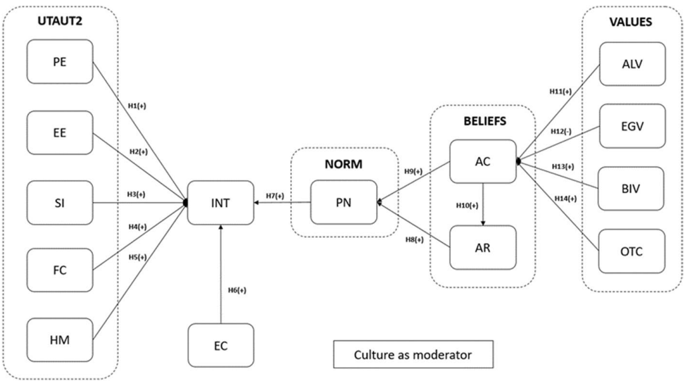
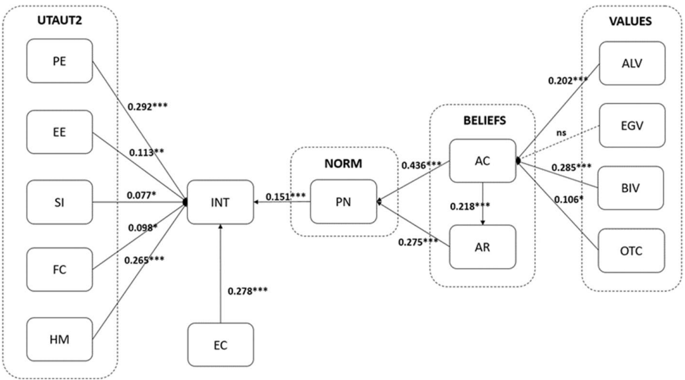
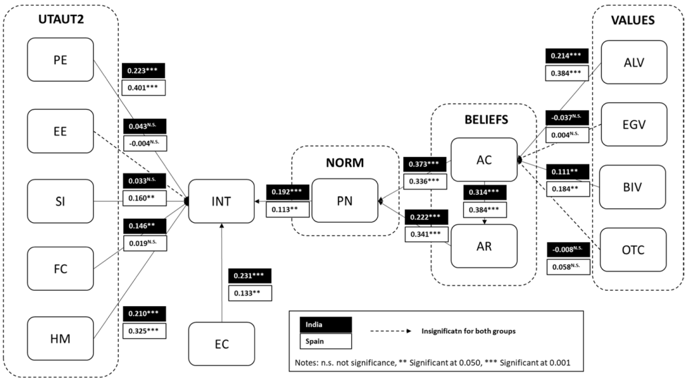
In recent years, the surge in the adoption of electric vehicles has played a vital role in reducing fossil fuel consumption and greenhouse gas emissions. However, limited cross-national research has been conducted on the determinants of electric vehicle adoption in developing and developed countries. This study examines the factors influencing the intention to adopt electric vehicles in India (378 participants) and Spain (265 participants). This study develops an integrated model that combines the unified theory of acceptance and use of technology (UTAUT2) and the value-belief-norm (VBN) model while accounting for the impact of national culture. The model is tested using structural equation modeling. The results indicate the integrated UTAUT2-VBN model is a valuable tool for explaining the differences in adoption intention across cultures. Moreover, the national cultural system plays a significant moderating role in most relationships within the model. This study offers valuable insights into the factors influencing electric vehicle adoption in different cultural contexts, which can inform policies and strategies to promote sustainable transportation.
Overview
The claims and statistics of this paper haven’t been checked yet.
Free: it reads the open-access text and checks the first 5 claims that cite a source we can check. Create a free account to check every claim.
Integrity signals
Registry
Cites
Statistics
Figures
Verification
Claims the paper makes
The claims and statistics of this paper haven’t been checked yet.
Free: it reads the open-access text and checks the first 5 claims that cite a source we can check. Create a free account to check every claim.
Claims other papers make about this one
Each is checked against this paper’s own text: does it say what the citing paper says it does?
The source backs part of the claim, not all of it — or backs it for a different population, condition or comparison.
In the citing paper
“The current body of literature on EV adoption tends to focus on specific aspects, often overlooking the multifaceted impacts of EVs.”
From Electric Vehicle Adoption: A Comprehensive Systematic Review of Technological, Environmental, Organizational and Policy Impacts (2024) · cites this paper as [16]
Experimental — accuracy not yet measuredThe cited source says what the claim attributes to it.
In the citing paper
“Technological research has delved into areas such as charging infrastructure, power management, and control techniques, and the impact of national culture on technology acceptance [15,16].”
From Electric Vehicle Adoption: A Comprehensive Systematic Review of Technological, Environmental, Organizational and Policy Impacts (2024) · cites this paper as [16]
Self-check
Percentages, sums and reported differences re-computed from the paper’s own numbers.
The self-check needs the paper’s full text.
Citations
Cites
Evaluating structural equation models with unobservable variables and measurement error
Fornell, C., & Larcker, D. F. (1981) · Journal of Marketing Research · doi:10.1177/002224378101800104 · Cited by 109,190 · cited 2×
“Therefore, the discriminant validity of the integrated model was regarded as satisfactory following prior studies by Anderson and Gerbing (1988) and Fornell and Larcker (1981).”
InfluentialStructural equation modeling in practice: A review and recommended two-step approach
Anderson, J. C., & Gerbing, D. W. (1988) · Psychological Bulletin · doi:10.1037/0033-2909.103.3.411 · Cited by 41,941 · cited 1×
“Therefore, the discriminant validity of the integrated model was regarded as satisfactory following prior studies by Anderson and Gerbing (1988) and Fornell and Larcker (1981).”
Culture's Consequences: Comparing Values, Behaviors, Institutions, and Organizations across Nations
Bhagat, R. S., & Hofstede, G. (2002) · The Academy of Management Review · doi:10.2307/4134391 · Cited by 21,664
Multivariate data analysis : a global perspective
Hair, J. F. (2010) · Cited by 19,929
Venkatesh, V., Thong, J. Y. L., & Xu, X. (2012) · MIS Quarterly · doi:10.2307/41410412 · Cited by 15,756 · cited 26×
“We hypothesize that the factors identified in the UTAUT2 theory, and the personal norms derived from the VBN theory will significantly influence individuals’ intention to adopt EV.”
InfluentialSchwartz, S. H. (1992) · Advances in Experimental Social Psychology · doi:10.1016/s0065-2601(08)60281-6 · Cited by 14,619 · cited 1×
“On the other hand, the value–belief–norm (VBN) theory, introduced by Stern (2000), combines the New Environmental Paradigm (NEP) by Dunlap and Van Liere (1978) and Dunlap et al. (2000), the Personal Values Theory by Schwartz (1992), and the norm activation model (NAM) by Schwartz (1970, 1975).”
Culture's Consequences: International Differences in Work-Related Values
Gladwin, T. N., & Hofstede, G. (1981) · The Academy of Management Review · doi:10.2307/257651 · Cited by 9,275
New Environmental Theories: Toward a Coherent Theory of Environmentally Significant Behavior
Stern, P. C. (2000) · Journal of Social Issues · doi:10.1111/0022-4537.00175 · Cited by 8,682 · cited 3×
“On the other hand, the value–belief–norm (VBN) theory, introduced by Stern (2000), combines the New Environmental Paradigm (NEP) by Dunlap and Van Liere (1978) and Dunlap et al. (2000), the Personal Values Theory by Schwartz (1992), and the norm activation model (NAM) by Schwartz (1970, 1975).”
Dunlap, R. E., Van Liere, K. D., Mertig, A. G., & Jones, R. E. (2000) · Journal of Social Issues · doi:10.1111/0022-4537.00176 · Cited by 5,678
Normative Influences on Altruism
Schwartz, S. H. (1977) · Advances in Experimental Social Psychology · doi:10.1016/s0065-2601(08)60358-5 · Cited by 5,364 · cited 1×
“PN can be described as individuals’ internal beliefs and motivations helping them perceive morally right attitudes and behave following their value system (Schwartz, 1977).”
Research works printed but not linked: 5
- Alcántara-Pilar, J. M., del Barrio-García, S., Crespo-Almendros, E., & Porcu, L. (2017). Toward an understanding of online information processing in e-tourism: Does national culture matter? Jour- nal of Travel and Tourism Marketing, 34(8), 1128-1142.
- Bhalla, P., Ali, I. S., & Nazneen, A. (2018). A study of consumer perception and purchase intention of electric vehicles. European Journal of Scientific Research, 149(4), 362-368.
- Hofstede, G. (1980). Cultures consequences: International differences in work-related values. Sage.
- Sharif, M. S., Yaqub, R. M. S., Saleem, H. M. N., Iqbal, J., & Rasool, F. (2021). The consumers'intention to adopt hybrid electric vehicles in Pakistan; the role of cultural values. International Journal of Management (IJM), 12(4).
- Thananusak, T., Rakthin, S., Tavewatanaphan, T., & Punnakitikashem, P. (2017). Factors affecting the intention to buy electric vehicles: Empirical evidence from Thailand. International Journal of Electric and Hybrid Vehicles, 9(4), 361-381. · DOI
Cited by
Zaino, R., Ahmed, V., Alhammadi, A. M., & Alghoush, M. (2024) · World Electric Vehicle Journal · doi:10.3390/wevj15080375 · Cited by 211
“Technological research has delved into areas such as charging infrastructure, power management, and control techniques, and the impact of national culture on technology acceptance [15,16].”
BackgroundSingh, A. R., Vishnuram, P., Alagarsamy, S., Bajaj, M., Blazek, V., Damaj, I., Rathore, R. S., Al-Wesabi, F. N., & Othman, K. M. (2024) · Alexandria Engineering Journal · doi:10.1016/j.aej.2024.06.093 · Cited by 183
Buhmann, K. M., Criado, J. R., & Rialp, A. (2024) · Sustainability · doi:10.3390/su16031284 · Cited by 112
“Consumers with a higher level of EC exhibited a greater intention to purchase environmentally friendly products [8], indicating that EC positively influences the preference for and adoption of EVs [52,53].”
BackgroundElectric vehicle adoption in Indonesia: Lesson learned from developed and developing countries
Hakam, D. F., & Jumayla, S. (2024) · Sustainable Futures · doi:10.1016/j.sftr.2024.100348 · Cited by 85
Choo, S. Y., Zadeh, A. V., Hanifah, H. M., & Ramayah, T. (2024) · Research in Transportation Business & Management · doi:10.1016/j.rtbm.2024.101183 · Cited by 68
Chanda, R. C., Zadeh, A. V., Hanifah, H. M., Ashrafi, D. M., & Ahmed, T. (2024) · Sustainable Futures · doi:10.1016/j.sftr.2024.100386 · Cited by 63
A comprehensive view of biometric payment in retailing: A complete study from user to expert
Zarco, C., Giráldez-Cru, J., Cordón, Ó., & Liébana-Cabanillas, F. J. (2024) · Journal of Retailing and Consumer Services · doi:10.1016/j.jretconser.2024.103789 · Cited by 50
Self-citationAhmad, S., Chaveesuk, S., & Chaiyasoonthorn, W. (2024) · International Journal of Sustainable Energy · doi:10.1080/14786451.2024.2387908 · Cited by 43
Shetty, A., & Rizwana, M. (2024) · Management of Environmental Quality An International Journal · doi:10.1108/meq-08-2023-0257 · Cited by 36
Psychological and contextual determinants of clean energy technology adoption
Günther, A., Engel, L., Hornsey, M. J., Nielsen, K. S., Roy, J., Steg, L., Tam, K., van Valkengoed, A. M., Wolske, K. S., Wong‐Parodi, G., et al. (2025) · Nature Reviews Clean Technology · doi:10.1038/s44359-025-00075-9 · Cited by 43
“Research thus tends to find that people with stronger altruistic and biospheric values are more likely to adopt clean energy technologies, whereas stronger endorsement of egoistic and hedonic values is not strongly related to or even hinders adoption 84–86 .”
Champahom, T., Wisutwattanasak, P., Chonsalasin, D., Se, C., Jomnonkwao, S., & Ratanavaraha, V. (2025) · Transport Policy · doi:10.1016/j.tranpol.2025.01.033 · Cited by 31
Farm, M. Y., Zadeh, A. V., Hanifah, H. M., & Nikbin, D. (2024) · Energy Policy · doi:10.1016/j.enpol.2024.114334 · Cited by 26
The prospects of adopting electric vehicles in urban contexts: A systematic review of literature
Taamneh, M., & Makahleh, H. Y. (2025) · Transportation Research Interdisciplinary Perspectives · doi:10.1016/j.trip.2025.101420 · Cited by 44
Eppe, P. S., Niehoff, E., Albers, C. J., & Bouman, T. (2025) · Energy Research & Social Science · doi:10.1016/j.erss.2025.104152 · Cited by 29
Savari, M., & Khaleghi, B. (2025) · Scientific Reports · doi:10.1038/s41598-025-15580-x · Cited by 26
“This sense of responsibility can influence behavior through PN, encouraging individuals to take proactive steps toward mitigating environmental damage 185 .”
Demographic disparity and influences in electric vehicle adoption: A Florida case study
Tao, R., Yang, X., Hao, F., & Chen, P. (2024) · Transportation Research Part D Transport and Environment · doi:10.1016/j.trd.2024.104465 · Cited by 27
Chonsalasin, D., Champahom, T., Limpasirisuwan, N., Jomnonkwao, S., & Ratanavaraha, V. (2025) · Civil Engineering Journal · doi:10.28991/cej-2025-011-05-010 · Cited by 23
“For instance, Higueras-Castillo et al. [36] successfully employed MI testing to validate cross-cultural comparisons of EV adoption intentions, while Singh et al. [32] utilized this approach to examine adoption variations across different demographic groups.”
InfluentialJaiswal, D., Kant, R., & Mehta, B. (2024) · International Journal of Energy Sector Management · doi:10.1108/ijesm-04-2024-0009 · Cited by 22
Salah, M., Alnoor, A., Abdelfattah, F., Dahleez, K. A., Sinawi, S. A., Hussein, J. S., Bareas, A. K., Ismail, M. M., & Halbusi, H. A. (2025) · Sustainable Futures · doi:10.1016/j.sftr.2025.100899 · Cited by 23
Shah, T., & Shah, M. (2024) · Green Technologies and Sustainability · doi:10.1016/j.grets.2024.100101 · Cited by 24
Enkel, E., & Wintgens, S. (2025) · Technological Forecasting and Social Change · doi:10.1016/j.techfore.2025.124329 · Cited by 19
A Study on the Factors Influencing the Adoption Intentions of Electric Vehicles
Shalu, & Pandey, A. (2025) · NMIMS Management Review · doi:10.1177/09711023251375288 · Cited by 18
Kumar, V., Kaur, A., Cao, D., Sindhwani, R., Mathiyazhagan, K., & Lin, B. (2025) · Energy Economics · doi:10.1016/j.eneco.2025.108408 · Cited by 18
Champahom, T., Se, C., Laphrom, W., Jomnonkwao, S., Karoonsoontawong, A., & Ratanavaraha, V. (2024) · Logistics · doi:10.3390/logistics8030083 · Cited by 15
Ahmad, S., Chaveesuk, S., & Chaiyasoonthorn, W. (2025) · Acta Psychologica · doi:10.1016/j.actpsy.2025.104833 · Cited by 16
Schiaroli, V., & Fraccascia, L. (2025) · Environmental Innovation and Societal Transitions · doi:10.1016/j.eist.2025.101044 · Cited by 15
Investigating the factors affecting electric scooter usage behavior with a proposed structural model
Arı, E., & Yılmaz, V. (2024) · Research in Transportation Business & Management · doi:10.1016/j.rtbm.2024.101164 · Cited by 15
Fairuz, S. A., Chen, G., & Maraseni, T. (2025) · Renewable and Sustainable Energy Reviews · doi:10.1016/j.rser.2025.116295 · Cited by 9
Thi Thuy An, N. G. O., Pham, T. T., Tran, V. S., Nguyen Boi Ngoc, L. E., Thai Ngan, D. I. N. H., & Nguyen, Q. M. C. (2025) · Acta Psychologica · doi:10.1016/j.actpsy.2025.105873 · Cited by 11
Feng, F., Ding, X., Zou, J., Gao, L., & Sun, Q. (2025) · Research in Transportation Economics · doi:10.1016/j.retrec.2025.101649 · Cited by 9
Users’ Perceived Value of Electric Vehicles in China: A Latent Class Model-Based Analysis
Li, W., Cui, K., Wu, L., & Zheng, B. (2025) · World Electric Vehicle Journal · doi:10.3390/wevj16080461 · Cited by 10
Liébana-Cabanillas, F. J., Abbasi, G. A., Higueras‐Castillo, E., & Wagner, R. (2025) · Technological Forecasting and Social Change · doi:10.1016/j.techfore.2025.124365 · Cited by 11
Self-citationRahi, S., Ghani, M. A., Alghizzawi, M., Rashid, A., & Rasheed, R. (2025) · Asia-Pacific Journal of Business Administration · doi:10.1108/apjba-12-2024-0675 · Cited by 7
Higueras‐Castillo, E., Criado, J. R., Buhmann, K. M., & Liébana-Cabanillas, F. J. (2025) · Transport Policy · doi:10.1016/j.tranpol.2025.103792 · Cited by 8
Self-citationChang, R., Chanda, R. C., Zadeh, A. V., & Hanifah, H. M. (2025) · Energy Strategy Reviews · doi:10.1016/j.esr.2025.101964 · Cited by 7
Higueras‐Castillo, E., Buhmann, K. M., Criado, J. R., & Liébana-Cabanillas, F. J. (2026) · International Journal of Consumer Studies · doi:10.1111/ijcs.70177 · Cited by 8
Self-citationGouveia, S., de la Iglesia, D. H., Abrantes, J. L., Rivero, A. J. L., Silva, E., Gouveia, E. M., & Santos, V. (2025) · Sustainability · doi:10.3390/su17051785 · Cited by 7
Beyond the first charge: Understanding continuance intention among electric vehicle drivers in China
Ooi, S. K., Xu, Y., & Yeap, J. A. L. (2025) · Research in Transportation Business & Management · doi:10.1016/j.rtbm.2025.101420 · Cited by 14
Aithal, P. S. (2025) · Poornaprajna International Journal of Teaching & Research Case Studies (PIJTRCS) · doi:10.64818/pijtrcs.3107.8494.0025 · Cited by 14
Sen, E., & Aksoy, N. C. (2025) · Journal of Cleaner Production · doi:10.1016/j.jclepro.2025.145147 · Cited by 6
Singh, V., Singh, H., & Singh, T. (2025) · Energy Sustainable Development/Energy for sustainable development · doi:10.1016/j.esd.2025.101732 · Cited by 7
Self-citationVelazquez, L. (2025) · Discover Sustainability · doi:10.1007/s43621-025-01509-x · Cited by 6
Putri, R. R. (2024) · J TI UNDIP JURNAL TEKNIK INDUSTRI · doi:10.14710/jati.19.2.96-107 · Cited by 5
“Cultural and demographic factors influence adoption, with high "power distance" societies more likely to follow authority figures (Higueras-Castillo et al., 2023).”
Dangelico, R. M., Fraccascia, L., & Schiaroli, V. (2025) · Business Strategy and the Environment · doi:10.1002/bse.70428 · Cited by 5
Xu, H., Zhou, D., Zhong, R., Li, S., Meng, X., & Liu, B. (2024) · Carbon Footprints · doi:10.20517/cf.2024.24 · Cited by 6
Navigating the electric shift: the interplay of consumer preferences and infrastructure in EV uptake
Ryu, J., Kim, J., Hong, K. J., & Lee, S. S. (2025) · Asia Pacific Journal of Marketing and Logistics · doi:10.1108/apjml-01-2025-0079 · Cited by 4
Deka, C., Dutta, M. K., Yazdanpanah, M., & Komendantova, N. (2025) · Frontiers in Sustainable Resource Management · doi:10.3389/fsrma.2025.1650833 · Cited by 4
Exploring the Predictors of Intention to Purchase Electric Vehicles
Hasan, F., Zaidi, N., Kirmani, M. D., Kumar, A., Zahidi, F., & Rehman, A. U. (2024) · International Conference on Electrical Electronics and Computing Technologies (ICEECT) · doi:10.1109/iceect61758.2024.10739004 · Cited by 4
Sakshi, S., Sumithra, S., & Ravichandran, S. S. (2025) · International Journal of Sustainable Transportation · doi:10.1080/15568318.2025.2542292 · Cited by 4
“Previous Research emphasizes adopting collaborative and situational strategies in overcoming such impediments in India (Higueras-Castillo et al., 2023; Munshi et al., 2022; Priyam et al., 2023; Tarei et al., 2021).”
Saleem, M. A., Hinchcliff, M., Papakosmas, M., Hughes, G., & Heffernan, T. W. (2025) · Australasian Marketing Journal (AMJ) · doi:10.1177/14413582251345550 · Cited by 6
Values and pro-environmental intention: Do green social climate and personal norm matter?
Hu, X., Wang, S., Zhou, R., Wu, X., & Li, P. R. (2025) · Environment Development and Sustainability · doi:10.1007/s10668-025-06908-8 · Cited by 3
Ma, H., Lou, X., Gu, S., Siswanto, I., & Asmara, A. (2026) · Transportation Research Interdisciplinary Perspectives · doi:10.1016/j.trip.2025.101814 · Cited by 3
Machavarapu, P. K., & Simhadri, K. V. (2026) · Transportation Research Record Journal of the Transportation Research Board · doi:10.1177/03611981251411243 · Cited by 4
“PBC, including service dependability and safety, has a significant impact on utilization probability ( 8 , 17 , 38 , 50 ).”
Rahmani, A., & Zamani, M. (2026) · Energy Conversion and Management X · doi:10.1016/j.ecmx.2026.101875 · Cited by 6
Kumar, A., Lim, J. S., Rathee, V., Mittal, P., & Kakran, S. (2026) · Discover Sustainability · doi:10.1007/s43621-026-03529-7 · Cited by 3
“A central finding of a study on public acceptance in Denmark and Sweden is that practical constraints, specifically the vehicle's driving range, are among the most pivotal determinants of the decision to purchase an electric vehicle [17].”
THE TRANSITION TO ELECTRIC VEHICLES FOR THE SUSTAINABLE FUTURE OF THE JAKARTA METROPOLITAN AREA
Alfarizi, M., Sari, R. K., & Arifian, R. (2024) · Jurnal Kebijakan Pembangunan Daerah · doi:10.56945/jkpd.v8i1.279 · Cited by 3
Why Chinese residents underinvest in new energy vehicles? Insights from prospect theory
Jia, H., & Lin, B. (2025) · Technology Analysis and Strategic Management · doi:10.1080/09537325.2025.2467947 · Cited by 4
Movilidad sostenible. Caso de estudio: Ecuador
Guasgua, J. A., Álvarez, D. O., Mazón, P. V., & Flores, J. C. (2025) · Revista Conectividad · doi:10.37431/conectividad.v6i3.216 · Cited by 3
Driving Muslim female riders to go green: switching to eco-friendly e-motorcycles
Suhartanto, D., Dean, D., Sutrisno, R., Arsawan, I. W. E., & Leo, G. (2025) · Journal of Islamic marketing · doi:10.1108/jima-08-2024-0380 · Cited by 3
Zhao, J., & Li, Y. (2025) · Results in Engineering · doi:10.1016/j.rineng.2025.106277 · Cited by 2
Ryczyński, J., Kierzkowski, A. A., Nowakowska, M., & Uchroński, P. (2025) · Energies · doi:10.3390/en18143853 · Cited by 3
Driving Change: Unveiling the Power of Perceived Marketplace Influence and Green Consumer Behavior
Higueras‐Castillo, E., Ramdhony, D., Singh, V., & Liébana-Cabanillas, F. J. (2025) · Environment and Behavior · doi:10.1177/00139165251370017 · Cited by 2
“…(Kautish et al., 2024), social cognitive theory (Jaiswal et al., 2022), the theory of planned behavior (Adu-Gyamfi et al., 2022), innovation diffusion theory (Xia et al., 2022) and Unified Theory of Acceptance and Use of Technology 2 (UTAUT2, Higueras-Castillo et al., 2023; Singh et al., 2023).”
Self-citationNhu, N. T., Nishiuchi, H., Mai, N. T. H., Tu, S. S., Ngoc, A. M., & Nguyen-Ngoc, D. (2025) · Transportation Research Part F Traffic Psychology and Behaviour · doi:10.1016/j.trf.2025.103492 · Cited by 3
Attitudes towards sustainable mobility technologies: Insights from electric vehicle adoption
Balassa, B. E., & Koteczki, R. (2026) · Social Sciences & Humanities Open · doi:10.1016/j.ssaho.2025.102379 · Cited by 4
AI-Generated Advertising Through the Eyes of Generation Z
Bachnik, K., Nowacki, R., Fandrejewska, A., Zatwarnicka-Madura, B., & Eisenbardt, T. (2025) · Contemporary Economics · doi:10.5709/ce.1897-9254.575 · Cited by 3
Getie, G. A., Wodaje, M. N., Weldehawariat, G. T., & Olaleye, S. A. (2026) · International Journal of Energy Sector Management · doi:10.1108/ijesm-07-2025-0020 · Cited by 2
Understanding the hesitation of Indonesian consumers toward battery electric vehicle adoption
Yotapditya, I., Prabawani, B., & Dewi, R. S. (2026) · Discover Sustainability · doi:10.1007/s43621-026-03591-1 · Cited by 2
“Spatial inequalities between metropolitan and non-metropolitan areas create feasibility asymmetry that directly influences adoption decisions [39, 86].”
Oprea, S., & Bârã, A. (2025) · IEEE Access · doi:10.1109/access.2025.3597101 · Cited by 3
“To address this, a study examined the factors influencing EV adoption intentions in India (378 participants) and Spain (265 participants) [21].”
Asida, A. Y. N., Kuswati, R., & Sholahuddin, M. (2024) · Indonesian Interdisciplinary Journal of Sharia Economics (IIJSE) · doi:10.31538/iijse.v8i1.5905 · Cited by 9
IDENTIFYING FACTORS OF CONSUMER’S PURCHASE INTENTION ON E-CARS
Maulida, D. N., & Amalia, F. A. (2024) · ASEAN Marketing Journal · doi:10.7454/amj.v16i2.1241 · Cited by 1
EMPOWERING YOUTH GENERATION TO BE SUSTAINABLE IN INTERNATIONAL COMMUNITY
Hamidi, I., Delovarova, L., Suhel, S., Sukanto, S., Atiyatna, D. P., Imelda, I., & Habibi, M. A. (2025) · PENA DIMAS Jurnal Pengabdian Masyarakat · doi:10.33474/penadimas.v3i2.26401 · Cited by 1
Memon, M. M., BAKAR, S. A., & Tat, H. H. (2025) · Business and Management Horizons · doi:10.5296/bmh.v13i1.22956 · Cited by 2
Aristanty, M. A., Wijaya, G., & Mustikasari, F. (2025) · Dinasti International Journal of Economics Finance & Accounting · doi:10.38035/dijefa.v6i4.4905 · Cited by 1
Infrastructure Barriers to the Electrification of Vehicle Fleets in Russian Cities
Plesovskikh, A. E., Kolyan, N. S., Gordeev, R. V., & Pyzhev, A. I. (2026) · World Electric Vehicle Journal · doi:10.3390/wevj17010051 · Cited by 1
How biospheric values and ecological worldviews connect green drive to pro-environmental behavior
Remadna, A., Alalwan, A. A., & Algharabat, R. (2026) · Environmental Development · doi:10.1016/j.envdev.2026.101446 · Cited by 2
Radhakrishnan, M., Mamun, A. A., Reza, M. N. H., Masukujjaman, M., & Masud, M. M. (2026) · Discover Sustainability · doi:10.1007/s43621-026-03080-5 · Cited by 2
Pachpore, P., Maji, S. K., Israel, D., Kumar, P., & Patro, S. K. (2026) · Transportation Planning and Technology · doi:10.1080/03081060.2026.2673562 · Cited by 1
PENGEMBANGAN MODUL AJAR SEPEDA MOTOR LISTRIK DI SMK MUHAMMADIYAH PRAMBANAN
Rabiman, R., Pratama, M. A. P., Hadi3, S. H. S., & Mutohhari, F. (2025) · Jurnal Pendidikan Vokasi Otomotif · doi:10.21831/jpvo.v8i1.88672 · Cited by 1
“Lebih jauh, pendidikan kejuruan di tingkat sekolah menengah sebagian besar masih berfokus pada teknologi ICE konvensional, sehingga lulusan tidak siap menghadapi transformasi industri menuju elektrifikasi (Meszaros et al., 2020).”
Adoption of Electric Vehicles Among the Buyers of India
Rawat, B., & Indapurkar, K. (2024) · Advances in civil and industrial engineering book series · doi:10.4018/979-8-3693-3755-4.ch018 · Cited by 1
Sharma, A. (2024) · Emerald Group Publishing Limited eBooks · doi:10.1108/978-1-83797-979-020241009 · Cited by 1
Deng, T., Zhang, X., Guo, K., Wei, L., & Zhang, W. (2024) · International Conference on Artificial Intelligence, Digital Media Technology and Interaction Design (ICADI) · doi:10.1145/3726010.3726065 · Cited by 1
“Czvetko, T [11] et al. and colleagues conducted a systematic literature review using the PRISMA methodology, focusing on automated ML, B2MML, and data sharing solutions based on international data spaces within the framework of Industry 4.0.”
InfluentialThe determinants of electric and hybrid vehicle adoption: A perspective from Serbia
Mitić, P., Kojić, M., Hanić, A., Fedajev, A., Rãdulescu, M., & Dembińska, I. (2025) · Serbian Journal of Management · doi:10.5937/sjm20-56056 · Cited by 1
Christopher Raj, D. (2023) · International Journal of Research Publication and Reviews · doi:10.55248/gengpi.4.1223.123525
SAHA, A., & Mukherjee, A. (2024) · SSRN Electronic Journal · doi:10.2139/ssrn.4956974
Battery Electric Vehicles in Freight Transportation
Özlü, L., & Çelebi, D. (2024) · Lecture notes in networks and systems · doi:10.1007/978-3-031-70935-7_10
Consumer Perception towards Electric Vehicles in Emerging Markets
Mustaphi, R. K. S. B. M. (2025) · Journal of Information Systems Engineering & Management · doi:10.52783/jisem.v10i20s.3202
A Review of Adoption Studies on Four-Wheeler Electric Vehicles in India
Mathew, N., & Varaprasad, G. (2024) · International Conference on Sustainable Power & Energy (ICSPE) · doi:10.1109/icspe62629.2024.10924341
Consumer behaviour towards electric vehicles in India
Barreto, O. D. (2024) · TRAP@NCI (National College of Ireland) · Cited by 1
Sbai Tangi, N. (2025) · Theseus (Ammattikorkeakoulujen)
Güler, H. (2025) · LUTPub (LUT University)
The Influences of Malaysian Intention to Adopt Electric Vehicles (EVs)
Bakar, K. A., Ahmat, N. N., & Shin, N. C. (2025) · International Journal of Research and Innovation in Social Science · doi:10.47772/ijriss.2025.92800047
García-Aliaga, M. I., Prados-Castillo, J. F., Martínez, J. M. G., & Soriano, D. R. (2025) · Contemporary Economics · doi:10.5709/ce.1897-9254.574
Nieto, H. S., & de Frutos, N. G. (2026) · IGI Global eBooks · doi:10.4018/979-8-3373-4495-9.ch004
Shahzad Ali*, M. A. (2026) · Journal of Business and Management Research · doi:10.5281/zenodo.18654209
Singh, M., & Dahiya, R. (2026) · Indian Journal of Marketing · doi:10.17010/ijom/2026/v56/i1/175898
Elektrikli Araç Benimsenmesinde TAM–TRA Çerçevesi ve Tüketici Etnosentrizminin Moderatör Rolü
Beğendik, B., & Yener, D. (2026) · Gazi Üniversitesi Fen Bilimleri Dergisi Part C Tasarım ve Teknoloji · doi:10.29109/gujsc.1839067
Tirumalaiah, D. K., Rapoori, J., & Nimmaraju, L. V. H. K. (2026) · Iconic Research and Engineering Journals · doi:10.64388/irev9i9-1715386
Sunanda, B. V., & Parchure, R. (2026) · Case Studies on Transport Policy · doi:10.1016/j.cstp.2026.101802 · Cited by 1
Gonçalves, L., das Neves, C. P. P. C., & Oliveira, T. (2026) · Transportation Research Interdisciplinary Perspectives · doi:10.1016/j.trip.2026.101982 · Cited by 3
Jiménez, P. A. M., & Méndez, G. I. P. (2026) · Repositorio Institucional UNIMAYOR
Metadata
- Authors
- Higueras-Castillo, E., Singh, V., Singh, V., & Liébana-Cabanillas, F.
- Affiliations
- Universidad de Granada (ES)
- Venue
- Environment, Development and Sustainability
- Published
- 2023-09-25
- Volume
- 26
- Issue
- 11
- Pages
- 29293-29329
- ISSN
- 1387-585X (ISSN-L)
- 1573-2975
- OpenAlex
- W4387023940
- Cited by
- 102
- References
- 124
- Citations by year
- 2026: 36 · 2025: 42 · 2024: 23 · 2023: 1
- FWCI
- 7.58
- Type
- journal article
- Language
- en
- Open access
- hybrid
- doi.org
- Licence
- cc-by
- creativecommons.org/licenses/by/4.0 (tdm)
- creativecommons.org/licenses/by/4.0 (vor)
- Locations
- Environment Development and Sustainability (publishedVersion, cc-by)
- Institutional Repository of the University of Granada (University of Granada) (submittedVersion, cc-by-nc-nd)
- RePEc: Research Papers in Economics (submittedVersion)
- Funders
- Universidad de Granada
- Topics
- Physical Sciences › Engineering › Electrical and Electronic Engineering › Electric Vehicles and Infrastructure
- Social Sciences › Decision Sciences › Information Systems and Management › Technology Adoption and User Behaviour
- Social Sciences › Sociology and Political Science › Social Acceptance of Renewable Energy
- Keywords
- electric vehicle adoption, adoption intention, UTAUT2, value-belief-norm theory, national culture, cross-cultural comparison, India, Spain, sustainable transport, moderating effect of culture
About these checks
Registry, retraction, Cites and statistics results are computed, not judged, with one exception: a printed reference that no index lists is read once by a model before it counts as a citation error. Claims are extracted by a model and kept only when their quote appears verbatim in the text; each cited source is then checked, with a model’s help, for whether it says what the claim relies on. Those verdicts can be wrong — read the claim’s quote and the cited source before relying on one.
Statistics and arithmetic are recomputed, not judged.
Confidence bands are shown only for fields calibrated on our annotated test set. None is calibrated yet, so no band is shown.
What counts as a claim ›How we measure confidence ›How we check this ›
Are you an author, or do you see a problem with this page? Request a review
Data sources
Bibliographic data: Semantic Scholar, OpenAlex, Crossref.
Contains information from the Semantic Scholar Academic Graph Datasets, made available under the ODC Attribution License (ODC-BY 1.0).
Semantic Scholar’s data is described in: Kinney, R., et al. (2023). The Semantic Scholar Open Data Platform. arXiv:2301.10140.
