

Students’ trajectories through higher education: a review of quantitative research
Open accessThe DOI matches its Crossref record; 80 of the 82 references it cites were found in a registry or an index.
Abstract
With the increasing availability of high-quality longitudinal data on students in higher education, scholars’ interest in how students proceed through higher education has risen. So far, the research field is diverse in theoretical perspectives and methodological approaches. Thus, based on 27 studies published in (higher) education research journals during the past two decades, this literature review provides an overview of the theoretical concepts, methodologies and main empirical findings in the study of students’ trajectories in higher education. The results depict a US dominated research field. Most theoretical frameworks are based on student’s decision-making. Across different country contexts and research designs—ranging from descriptions of student trajectories to studies predicting who engages in which types of trajectories to sequential trajectory reconstruction—we found that historically disadvantaged groups in higher education such as students from low social origin follow less linear and less smooth higher education trajectories. However, while the field of comparative education is growing steadily and may significantly contribute to explaining the link between the realization of students’ opportunities and the way how higher education is designed and implemented both on the national and local level, there were no cross-country comparison studies on higher education trajectories.
Overview
The claims and statistics of this paper haven’t been checked yet.
Free: it reads the open-access text and checks the first 5 claims that cite a source we can check. Create a free account to check every claim.
Integrity signals
Registry
Cites
Statistics
Figures
Verification
Claims the paper makes
The claims and statistics of this paper haven’t been checked yet.
Free: it reads the open-access text and checks the first 5 claims that cite a source we can check. Create a free account to check every claim.
Claims other papers make about this one
Each is checked against this paper’s own text: does it say what the citing paper says it does?
The cited source says what the claim attributes to it.
In the citing paper
“Higher education trajectory research treats persistence as a pathway rather than a single access event [49], and inclusion mechanisms are more likely to protect that pathway when they remain available during disruption or resource pressure [16,50].”
From Inclusive Higher Education and Disability: Policy–Implementation Gaps Across Universities in Mexico and Colombia (2026) · cites this paper as [49]
Self-check
Percentages, sums and reported differences re-computed from the paper’s own numbers.
The self-check needs the paper’s full text.
Citations
Cites
Dropout from Higher Education: A Theoretical Synthesis of Recent Research
Tinto, V. (1975) · Review of Educational Research · doi:10.2307/1170024 · Cited by 7,888 · cited 1×
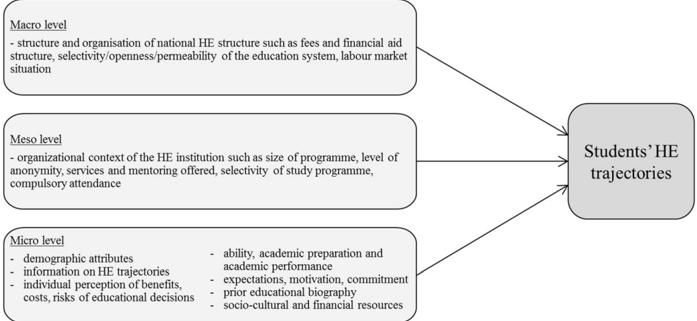
“The micro-/meso-level link: trajectories as processes of integration into the HE environment Another dominant theoretical perspective refers to a lack of students’ integration in educational institutions as a major cause of dropout (e.g. Bean and Metzner 1985; Tinto 1975).”
BackgroundHuman Capital. A Theoretical and Empirical Analysis, with Special Reference to Education
Muhsam, H. V., & Becker, G. S. (1965) · Revue de l'Institut International de Statistique / Review of the International Statistical Institute · doi:10.2307/1401709 · Cited by 5,146
(1964) · SSRN Electronic Journal · Cited by 5,128
A Conceptual Model of Nontraditional Undergraduate Student Attrition
Bean, J. P., & Metzner, B. S. (1985) · Review of Educational Research · doi:10.3102/00346543055004485 · Cited by 2,017 · cited 1×
“The micro-/meso-level link: trajectories as processes of integration into the HE environment Another dominant theoretical perspective refers to a lack of students’ integration in educational institutions as a major cause of dropout (e.g. Bean and Metzner 1985; Tinto 1975).”
BackgroundThe Worldwide Expansion of Higher Education in the Twentieth Century
Schofer, E., & Meyer, J. W. (2005) · American Sociological Review · doi:10.1177/000312240507000602 · Cited by 1,653 · cited 1×
“…from undergraduate to graduate studies) and states (e.g. enrolment patterns such as part-time vs full-time enrolment) within a certain period (e.g. academic year or 3-year life period; Sackmann and Wingens 2001, 42), while we assign the term Bpathway^ to institutionally ideal progression patterns.”
BackgroundEXPLAINING EDUCATIONAL DIFFERENTIALS: TOWARDS A FORMAL RATIONAL ACTION THEORY
Breen, R., & Goldthorpe, J. H. (1997) · Rationality and Society · doi:10.1177/104346397009003002 · Cited by 1,644 · cited 1×
“In addition, Breen and Goldthorpe (1997) advanced this theoretical frame to explain differences in decision-making by social origin.”
Background(2006) · US Department of Education · Cited by 1,586
Answers In The Tool Box: Academic Intensity, Attendance Patterns, And Bachelor's Degree Attainment
Adelman, C. (1999) · Cited by 1,409
Manski, C. F., & Wise, D. A. (1983) · Harvard University Press eBooks · doi:10.4159/harvard.9780674422285 · Cited by 965
Life Course Dynamics: Trajectories and Transitions, 1968-1980.
Chew, K. S. Y., & Elder, G. H. (1987) · Social Forces · doi:10.2307/2578775 · Cited by 926
Social Background and School Continuation Decisions
Mare, R. D. (1980) · Journal of the American Statistical Association · doi:10.1080/01621459.1980.10477466 · Cited by 920 · cited 1×
“This goes back to Mare (1980), who framed educational careers as successive transitions, where the sequential nature of students’ HE trajectories is emphasized.”
BackgroundCrisp, G., Nora, A., & Taggart, A. (2009) · American Educational Research Journal · doi:10.3102/0002831209349460 · Cited by 497 · cited 1×
“Furthermore, comprehensive information provided through mentoring, guidance and counselling on opportunities and demands—given before and after HE enrolment—appears to be essential for successful trajectories (Crisp et al. 2009; Baker 2019).”
BackgroundStratification in Higher Education: A Comparative Study
(2007) · Stanford University Press eBooks · doi:10.1515/9780804768146 · Cited by 426
Stevens, M. L., Armstrong, E. A., & Arum, R. (2008) · Annual Review of Sociology · doi:10.1146/annurev.soc.34.040507.134737 · Cited by 415 · cited 1×
“The relevance of students’ trajectories in HE, enrolment patterns and how students proceed through HE as a theme constitutes an important future research programme, especially as Bcompletion of any four-year degree is likely a watershed event in individual biographies^ (Stevens et al. 2008, 131).”
BackgroundFollowing Their Every Move: An Investigation of Social-Class Differences in College Pathways
Goldrick-Rab, S. (2006) · Sociology of Education · doi:10.1177/003804070607900104 · Cited by 414 · cited 12×
“…origin have more interruptions and more reverse transfers (transfer from 4-year institution to 2-year institution; Byun et al. 2017; Ewert 2010; Goldrick-Rab 2006; Goldrick-Rab and Pfeffer 2009; Kalogrides and Grodsky 2011; Milesi 2010), while students from high social origin more often engage…”
BackgroundInfluentialHigher Education: Handbook of Theory and Research: Volume 36
(2020) · Higher Education: Handbook of Theory and Research · doi:10.1007/978-3-030-43030-6 · Cited by 358
Education and Social Stratification Processes in Comparative Perspective
Kerckhoff, A. C. (2001) · Sociology of Education · doi:10.2307/2673250 · Cited by 334 · cited 1×
“…levels or transitions, for example at the transition from primary to secondary education, secondary schooling or school-to-work transitions (Hadjar and Gross 2016; Kerckhoff 2001), these have not been widely adopted in HE research (exceptions: Shavit et al. 2007; Reisel and Brekke 2009).”
BackgroundAdvancements in Research Synthesis Methods: From a Methodologically Inclusive Perspective
Suri, H., & Clarke, D. (2009) · Review of Educational Research · doi:10.3102/0034654308326349 · Cited by 316 · cited 1×
“In an attempt to link a systematic review methodology with a broad overview of concepts, data types and regional focus, we opted for a narrative review with systematic elements (Suri and Clarke 2009).”
BackgroundBecker, R. (2003) · European Sociological Review · doi:10.1093/esr/19.1.1 · Cited by 296 · cited 2×
“Becker and Hecken 2009), are often studied in light of rational choice or subjectively expected utility approaches (Becker 2003), assuming that decisions in favour of or against educational institutions or pathways are taken considering the benefits (labour market outcomes, maintenance of family status), costs (direct…”
BackgroundSystematic review methodology in higher education
Bearman, M., Smith, C. D., Carbone, A., Slade, S., Baik, C., Hughes-Warrington, M., & Neumann, D. L. (2012) · Higher Education Research & Development · doi:10.1080/07294360.2012.702735 · Cited by 275 · cited 10×
“Graduation is the final step of a long trajectory of decisions and transitions. Students may leave at various points, but every step needs to be taken in order to reach the next one. This goes back to Mare (1980), who framed educational careers as successive transitions, where the sequential nature of students’ HE tra…”
BackgroundInfluentialResearch into higher education: an a‐theoretical community of practice?
Tight *, M. (2004) · Higher Education Research & Development · doi:10.1080/0729436042000276431 · Cited by 245
Becker, R., & Hecken, A. E. (2009) · Acta Sociologica · doi:10.1177/0001699308100632 · Cited by 207 · cited 1×
“Educational decisions in general, and decisions on HE specifically (e.g. Becker and Hecken 2009), are often studied in light of rational choice or subjectively expected utility approaches (Becker 2003), assuming that decisions in favour of or against educational institutions or pathways are taken…”
BackgroundBeyond Access: Explaining Socioeconomic Differences in College Transfer
Goldrick-Rab, S., & Pfeffer, F. T. (2009) · Sociology of Education · doi:10.1177/003804070908200201 · Cited by 178 · cited 8×
“Yet, there were also studies that found no gender differences (Goldrick-Rab and Pfeffer 2009; Tumen et al. 2008) in students’ progression and transfer patterns and studies that employed multivariate modelling in which no remaining net effect of gender was found (Byun et al.”
BackgroundResultInfluentialEducational Transitions, Trajectories, and Pathways
Pallas, A. M. (2007) · Handbooks of Sociology and Social Research · doi:10.1007/978-0-306-48247-2_8 · Cited by 169 · cited 4×
“In this regard, Pallas (2003) referred particularly to the features of education systems, but one might also think of labour markets, welfare states, norms and societal expectations, such as those regarding age or gender.”
BackgroundMethodInfluentialMcCormick, A. C. (2003) · New Directions for Higher Education · doi:10.1002/he.98 · Cited by 162 · cited 1×
“McCormick (2003) investigated the number of HE institutions students enrol at along their HE trajectory.”
BackgroundThe future of higher education and of higher education research
Brennan, J., & Teichler, U. (2008) · Higher Education · doi:10.1007/s10734-008-9124-6 · Cited by 145 · cited 1×
“Reale (2014) pointed to the challenges of comparative research designs (see also Brennan and Teichler 2008; Kosmützky and Krücken 2014).”
BackgroundBensimon, E. M., & Dowd, A. C. (2009) · Harvard Educational Review · doi:10.17763/haer.79.4.05w66u23662k1444 · Cited by 139 · cited 3×
“However, theoretical works (Robinson and Bornholt 2007) and qualitative studies (such as the works of Ashwin et al. 2016; Bensimon and Dowd 2009; Christie et al. 2016; Harper 2007; Tett et al. 2017) focusing on reconstructing students’ motives and reflections on their choices made along their HE…”
BackgroundFrom further to higher education: transition as an on-going process
Tett, L., Cree, V. E., & Christie, H. (2016) · Higher Education · doi:10.1007/s10734-016-0101-1 · Cited by 136 · cited 1×
“…and Bornholt 2007) and qualitative studies (such as the works of Ashwin et al. 2016; Bensimon and Dowd 2009; Christie et al. 2016; Harper 2007; Tett et al. 2017) focusing on reconstructing students’ motives and reflections on their choices made along their HE trajectories did not gain the…”
BackgroundUnrealized Potential: Community College Pathways to STEM Baccalaureate Degrees
Bahr, P. R., Jackson, G., McNaughtan, J., Oster, M., & Gross, J. (2017) · The Journal of Higher Education · doi:10.1080/00221546.2016.1257313 · Cited by 126
Explaining Academic Progress via Combining Concepts of Integration Theory and Rational Choice Theory
Beekhoven, S., de Jong, U., & van Hout, H. (2002) · Research in Higher Education · doi:10.1023/a:1020166215457 · Cited by 121 · cited 1×
“Surprisingly, theories predominantly employed in dropout research, such as Tinto’s (1975) student integration model, were not that often discussed, although HE research scholars had already tried to integrate these two theoretical lines (Beekhoven et al. 2002).”
BackgroundA Review of the Theories Developed to Describe the Process of College Persistence and Attainment
Melguizo, T. (2011) · Higher education · doi:10.1007/978-94-007-0702-3_10 · Cited by 116 · cited 2×
“Despite agreeing that HE is a crucial educational stage for individual and societal development, researchers’ interest has also centred on narrow conceptions of dropout and/or (long) study durations (Melguizo 2011), neglecting the fact that students may leave HE, transfer study programmes or HE institutions, interrupt…”
BackgroundTHE PLACE OF SYSTEMATIC REVIEWS IN EDUCATION RESEARCH
Andrews, R. (2005) · British Journal of Educational Studies · doi:10.1111/j.1467-8527.2005.00303.x · Cited by 111 · cited 4×
“Similarly, Andrews et al. (2014) framed students as actors that constantly update their information on HE prospects and that only decide to transfer from one HE institution to another when they realize that the expected benefits of doing so outweigh the costs. Educational decisions in general, and decisions on HE spec…”
BackgroundMethodInfluentialHow do students’ accounts of sociology change over the course of their undergraduate degrees?
Ashwin, P., Abbas, A., & McLean, M. (2013) · Higher Education · doi:10.1007/s10734-013-9659-z · Cited by 110 · cited 2×
“However, theoretical works (Robinson and Bornholt 2007) and qualitative studies (such as the works of Ashwin et al. 2016; Bensimon and Dowd 2009; Christie et al. 2016; Harper 2007; Tett et al. 2017) focusing on reconstructing students’ motives and reflections on their choices made along their HE trajectories did not g…”
BackgroundHearn, J. C. (1992) · Research in Higher Education · doi:10.1007/bf00992053 · Cited by 110
Higher education journals: their characteristics and contribution
Tight, M. (2017) · Higher Education Research & Development · doi:10.1080/07294360.2017.1389858 · Cited by 109 · cited 2×
“This high research concentration led to an inward-looking perspective on HE in the USA, in which reflections at the system level seemed not so relevant or taken for granted (Tight 2018).”
BackgroundResultPredictors of College Attendance Patterns of Rural Youth
Byun, S., Meece, J. L., & Agger, C. A. (2017) · Research in Higher Education · doi:10.1007/s11162-017-9449-z · Cited by 108 · cited 6×
“For example, Byun et al. (2017) referred to students’ sociocultural and financial resources as a major factor while Goldrick-Rab (2006) and Goldrick-Rab and Pfeffer (2009) stressed differences in students’ strategies regarding institutional transfers.”
BackgroundResultInfluentialCrosta, P. M. (2014) · Community College Review · doi:10.1177/0091552113518233 · Cited by 103 · cited 1×
“Bach et al. (2000) focused on enrolment patterns distinguishing HE institutions enrolled at, whereas Marti (2008), Noy and Zeidenberg (2017), Robinson (2004), Cosser (2018) and Crosta (2014) made use of semester-wise enrolment patterns such as non-enrolment, part-time and full-time enrolment.”
BackgroundDo all roads lead to Rome? Effect of educational trajectories on educational transitions
Milesi, C. (2010) · Research in Social Stratification and Mobility · doi:10.1016/j.rssm.2009.12.002 · Cited by 102 · cited 5×
“…institution to 2-year institution; Byun et al. 2017; Ewert 2010; Goldrick-Rab 2006; Goldrick-Rab and Pfeffer 2009; Kalogrides and Grodsky 2011; Milesi 2010), while students from high social origin more often engage in smooth 4-year trajectories and lateral transfer trajectories (transfer from…”
BackgroundInfluentialPathways to completion: Patterns of progression through a university degree
Robinson, R. A. (2003) · Higher Education · doi:10.1023/b:high.0000009803.70418.9c · Cited by 101 · cited 3×
“Applications were provided in Robinson (2004) on reenrolment vs departure, Ewert (2010) on gender differences along the development of HE trajectories, Meggiolaro et al. (2017) and Johnson and Muse (2012).”
BackgroundMethodUsing qualitative methods to assess student trajectories and college impact
Harper, S. R. (2007) · New Directions for Institutional Research · doi:10.1002/ir.231 · Cited by 98
Bahr, P. R. (2010) · Research in Higher Education · doi:10.1007/s11162-010-9180-5 · Cited by 95 · cited 8×
“Although an increasing number of HE researchers perceive variable-centred and single-institution approaches to research on dropout as too narrow to encompass the complex nature of how students proceed through HE today, trajectory research remains scant (e.g. Andrews et al. 2014; Bahr 2013; Marti 2008).”
BackgroundMethodInfluential‘It all just clicked’: a longitudinal perspective on transitions within university
Christie, H., Tett, L., Cree, V. E., & McCune, V. (2014) · Studies in Higher Education · doi:10.1080/03075079.2014.942271 · Cited by 92 · cited 5×
“Two articles specifically focused on gender differences in HE trajectories (Ewert 2010; Carbonaro et al. 2011). Ewert (2010) investigated gender differences among students enrolled at 4-year institutions as an explanation for the growing gender gap in US graduation rates.”
BackgroundResultInfluentialAndrews, R., Li, J., & Lovenheim, M. (2014) · Economics of Education Review · doi:10.1016/j.econedurev.2014.07.002 · Cited by 90 · cited 3×
“…an increasing number of HE researchers perceive variable-centred and single-institution approaches to research on dropout as too narrow to encompass the complex nature of how students proceed through HE today, trajectory research remains scant (e.g. Andrews et al. 2014; Bahr 2013; Marti 2008).”
BackgroundWang, X. (2015) · Research in Higher Education · doi:10.1007/s11162-015-9397-4 · Cited by 89 · cited 1×
“In contrast, specifically when it comes to shedding light on the question of which community college trajectories are beneficial for upward transfer to a research university in the USA, authors used data on course units and course characteristics (Bahr 2010; Bahr et al. 2017; Wang 2016).”
MethodStudent pathways at the university: patterns and predictors of completion
Tumen, S., Shulruf, B., & Hattie, J. (2008) · Studies in Higher Education · doi:10.1080/03075070802049145 · Cited by 87 · cited 3×
“Yet, there were also studies that found no gender differences (Goldrick-Rab and Pfeffer 2009; Tumen et al. 2008) in students’ progression and transfer patterns and studies that employed multivariate modelling in which no remaining net effect of gender was found (Byun et al. 2017).”
BackgroundResultThe Deconstructive Approach to Understanding Community College Students’ Pathways and Outcomes
Bahr, P. R. (2013) · Community College Review · doi:10.1177/0091552113486341 · Cited by 87 · cited 3×
“…an increasing number of HE researchers perceive variable-centred and single-institution approaches to research on dropout as too narrow to encompass the complex nature of how students proceed through HE today, trajectory research remains scant (e.g. Andrews et al. 2014; Bahr 2013; Marti 2008).”
BackgroundGrowth or steady state? A bibliometric focus on international comparative higher education research
Kosmützky, A., & Krücken, G. (2013) · Higher Education · doi:10.1007/s10734-013-9694-9 · Cited by 82 · cited 1×
“Reale (2014) pointed to the challenges of comparative research designs (see also Brennan and Teichler 2008; Kosmützky and Krücken 2014).”
BackgroundHadjar, A., & Becker, R. (2009) · Cited by 79
Self-citationDeciphering the sophomore slump: changes to student perceptions during the undergraduate journey
Webb, O. J., & Cotton, D. (2018) · Higher Education · doi:10.1007/s10734-018-0268-8 · Cited by 76 · cited 2×
“Mechanisms behind negative outcomes such as dropout at certain critical moments occurring between year 1 in HE and the final year (Webb and Cotton 2019) cannot be identified.”
BackgroundDiversification and Inequality in Higher Education: A Comparison of Israel and the United States
Ayalon, H., Grodsky, E., Gamoran, A., & Yogev, A. (2008) · Sociology of Education · doi:10.1177/003804070808100301 · Cited by 70 · cited 1×
“…of HE during the last 50 years, namely the expansion, diversification (Schofer and Meyer 2005) and heterogenisation of student populations due to facilitated access for under-represented social groups (cf. Ayalon et al. 2008; Hadjar and Becker 2009), motivate longitudinal studies on trajectories.”
BackgroundEducation Systems and Inequalities: International Comparisons
(2016) · Policy Press eBooks · doi:10.1332/policypress/9781447326106.001.0001 · Cited by 65
Something to Fall Back On: Community Colleges as a Safety Net
Kalogrides, D., & Grodsky, E. (2011) · Social Forces · doi:10.1353/sof.2011.0019 · Cited by 63 · cited 9×
“…transfers (transfer from 4-year institution to 2-year institution; Byun et al. 2017; Ewert 2010; Goldrick-Rab 2006; Goldrick-Rab and Pfeffer 2009; Kalogrides and Grodsky 2011; Milesi 2010), while students from high social origin more often engage in smooth 4-year trajectories and lateral…”
BackgroundInfluentialBaker, Z. (2018) · British Journal of Sociology of Education · doi:10.1080/01425692.2018.1483820 · Cited by 62 · cited 5×
“Such applications of the classical human capital approach (Becker 1964) have been applied in several of the reviewed papers. For example, Johnson and Muse (2012) perceived students in HE as utility-maximizing agents that are willing to invest in HE as long as the benefits exceed the costs of it.”
BackgroundMethodInfluentialAshwin, P., Abbas, A., & McLean, M. (2016) · British Educational Research Journal · doi:10.1002/berj.3244 · Cited by 61 · cited 2×
“However, theoretical works (Robinson and Bornholt 2007) and qualitative studies (such as the works of Ashwin et al. 2016; Bensimon and Dowd 2009; Christie et al. 2016; Harper 2007; Tett et al. 2017) focusing on reconstructing students’ motives and reflections on their choices made along their HE…”
BackgroundEwert, S. (2010) · American Educational Research Journal · doi:10.3102/0002831210374351 · Cited by 57 · cited 8×
“Applications were provided in Robinson (2004) on reenrolment vs departure, Ewert (2010) on gender differences along the development of HE trajectories, Meggiolaro et al. (2017) and Johnson and Muse (2012).”
BackgroundMethodInfluentialReisel, L., & Brekke, I. (2009) · European Sociological Review · doi:10.1093/esr/jcp045 · Cited by 56
Postsecondary Student Persistence and Pathways: Evidence From the YITS-A in Canada
Childs, S., Finnie, R., & Martinello, F. (2016) · Research in Higher Education · doi:10.1007/s11162-016-9424-0 · Cited by 53 · cited 9×
“In a similar vein, some studies conceptualized HE trajectories as sequential steps to be made but stressed specific actions to be taken in order to make such choices (Childs et al. 2017; Cosser and Nenweli 2014).”
BackgroundInfluentialStudent Swirl at a Single Institution: The Role of Timing and Student Characteristics
Johnson, I. Y., & Muse, W. B. (2012) · Research in Higher Education · doi:10.1007/s11162-011-9253-0 · Cited by 50 · cited 5×
“Applications were provided in Robinson (2004) on reenrolment vs departure, Ewert (2010) on gender differences along the development of HE trajectories, Meggiolaro et al. (2017) and Johnson and Muse (2012).”
BackgroundMethodInfluentialChallenges in higher education research: the use of quantitative tools in comparative analyses
Reale, E. (2013) · Higher Education · doi:10.1007/s10734-013-9680-2 · Cited by 49 · cited 1×
“Reale (2014) pointed to the challenges of comparative research designs (see also Brennan and Teichler 2008; Kosmützky and Krücken 2014).”
BackgroundLatent Postsecondary Persistence Pathways: Educational Pathways in American Two-Year Colleges
Marti, C. N. (2007) · Research in Higher Education · doi:10.1007/s11162-007-9083-2 · Cited by 46 · cited 5×
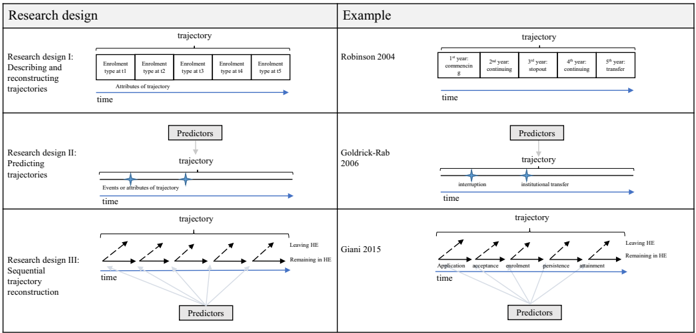
“As an exemplary outcome, Marti (2008) identified five different trajectory types that differed by length of enrolment and enrolment intensity.”
BackgroundInfluentialA multilevel competing risks model for analysis of university students’ careers in Italy
Meggiolaro, S., Giraldo, A., & Clerici, R. (2015) · Studies in Higher Education · doi:10.1080/03075079.2015.1087995 · Cited by 44 · cited 5×
“Applications were provided in Robinson (2004) on reenrolment vs departure, Ewert (2010) on gender differences along the development of HE trajectories, Meggiolaro et al. (2017) and Johnson and Muse (2012).”
BackgroundMethodInfluentialStudent Attendance Patterns and Performance in an Urban Postsecondary Environment
Bach, S. K., Banks, M., Kinnick, M. K., Ricks, M. F., Stoering, J. M., & Walleri, R. D. (2000) · Research in Higher Education · doi:10.1023/a:1007038726940 · Cited by 42 · cited 1×
“Bach et al. (2000) focused on enrolment patterns distinguishing HE institutions enrolled at, whereas Marti (2008), Noy and Zeidenberg (2017), Robinson (2004), Cosser (2018) and Crosta (2014) made use of semester-wise enrolment patterns such as non-enrolment, part-time and full-time enrolment.”
BackgroundThe Finance of Higher Education.
Russell, J. D. (1955) · Economica · doi:10.2307/2626935 · Cited by 41
Gender inequalities in the college pipeline
Carbonaro, W. J., Ellison, B. J., & Covay, E. (2010) · Social Science Research · doi:10.1016/j.ssresearch.2010.07.004 · Cited by 39 · cited 4×
“Similar studies, but in the tradition of Manski and Wise (1983) and Hossler et al. (1989), focused on sequences of student decisions other than yearly or semester-wise re-enrolment (Carbonaro et al. 2011; Giani 2015).”
BackgroundResultInfluentialTracking students’ progress through the Spanish university school sector
Lassibille, G., & Gómez, M. L. N. (2009) · Higher Education · doi:10.1007/s10734-009-9227-8 · Cited by 39 · cited 7×
“Yet, some studies provided a conceptual embedding of their national cases in the international landscape (Clerici et al. 2015 on Italy; Lassibille and Gómez 2009 on Spain).”
BackgroundMethodResultInfluentialCommunity College Pathways to the STEM Workforce: What Are They, Who Follows Them, and How?
Noy, M. V., & Zeidenberg, M. (2017) · New Directions for Community Colleges · doi:10.1002/cc.20249 · Cited by 37 · cited 1×
“Bach et al. (2000) focused on enrolment patterns distinguishing HE institutions enrolled at, whereas Marti (2008), Noy and Zeidenberg (2017), Robinson (2004), Cosser (2018) and Crosta (2014) made use of semester-wise enrolment patterns such as non-enrolment, part-time and full-time enrolment.”
BackgroundThe determinants of academic outcomes in a competing risks approach: evidence from Italy
Clerici, R., Giraldo, A., & Meggiolaro, S. (2014) · Studies in Higher Education · doi:10.1080/03075079.2013.878835 · Cited by 36 · cited 7×
“Yet, some studies provided a conceptual embedding of their national cases in the international landscape (Clerici et al. 2015 on Italy; Lassibille and Gómez 2009 on Spain).”
BackgroundMethodInfluentialChanges in Research on College Students Published in Selected Journals between 1969 and 1983
Kuh, G. D., Bean, J. P., Bradley, R. K., Coomes, M. D., & Hunter, D. E. (1986) · Review of higher education/The review of higher education · doi:10.1353/rhe.1986.0030 · Cited by 32 · cited 1×
“…and directions for further research: first, as we intended to place an emphasis on theories framing students’ trajectories in HE, we noted that several studies seemed to be rather data driven and lack conceptual frames, building their argument upon prior empirical findings (see Kuh et al. 1986).”
BackgroundCrosnoe, R. L., & Benner, A. D. (2015) · Handbooks of sociology and social research · doi:10.1007/978-3-319-20880-0_8 · Cited by 30
Renn, K. A., Brazelton, G. B., & Holmes, J. M. (2014) · Journal of college student development · doi:10.1353/csd.2014.0029 · Cited by 25 · cited 2×
“…HE system in the USAwas the first to experience expansion and massification, there was an early interest in, and need for, research on students’ experiences, thereby leading to a long tradition of study in the field and expertise in exploiting large-scale panel data on students (Renn et al. 2014).”
BackgroundGiani, M. (2015) · Research in Higher Education · doi:10.1007/s11162-014-9357-4 · Cited by 23
Pathways theory of progression through higher education
Robinson, R. A., & Bornholt, L. J. (2007) · Australian journal of educational and developmental psychology · Cited by 23
Rodríguez‐Gómez, D., Meneses, J., Sallán, J. G., Condom, M. F. I., & Moreno, J. L. M. (2016) · Higher Education Research & Development · doi:10.1080/07294360.2015.1137886 · Cited by 23 · cited 1×
“…to follow specific trajectories in theory-led mixed methods or qualitative studies—a claim that has already been raised elsewhere (Harper 2007; Rodríguez-Gómez et al. 2016): B[A]s long as student behaviour remains a proverbial black box, institutional adjustments and interventions will be…”
BackgroundEducation systems and inequalities
Hadjar, A., & Groß, C. (2016) · Policy Press eBooks · doi:10.1332/policypress/9781447326106.003.0001 · Cited by 20 · cited 2×
“…levels or transitions, for example at the transition from primary to secondary education, secondary schooling or school-to-work transitions (Hadjar and Gross 2016; Kerckhoff 2001), these have not been widely adopted in HE research (exceptions: Shavit et al. 2007; Reisel and Brekke 2009).”
BackgroundSelf-citationDifferential pathways of South African students through higher education
Cosser, M. (2017) · International Journal of Educational Development · doi:10.1016/j.ijedudev.2017.10.003 · Cited by 18 · cited 3×
“Bach et al. (2000) focused on enrolment patterns distinguishing HE institutions enrolled at, whereas Marti (2008), Noy and Zeidenberg (2017), Robinson (2004), Cosser (2018) and Crosta (2014) made use of semester-wise enrolment patterns such as non-enrolment, part-time and full-time enrolment.”
BackgroundHorta, H. (2017) · Higher education in Asia · doi:10.1007/978-981-10-4989-7_2 · Cited by 15 · cited 1×
“In contrast, the lack of studies from Asia mirrors the general state of Asian HE research in the international context (Horta 2018).”
ResultWingens, M. (2020) · Springer eBooks · doi:10.1007/978-3-658-28951-5_5 · Cited by 11
Student pathways in a New Zealand polytechnic: Key factors for completion
Shulruf, B., Tumen, S., & Hattie, J. (2010) · Vocational and Technical Education · doi:10.5897/ijvte.9000031 · Cited by 7 · cited 5×
“In their models already controlling for a wide range of factors, Tumen et al. (2008) and Shulruf et al. (2010) did not find any remaining significant social origin effect for New Zealand students.”
BackgroundInfluential“We’ve got you pegged”: programme choice in the transition to, and passage through, higher education
Cosser, M., & Nenweli, S. (2013) · Higher Education · doi:10.1007/s10734-013-9655-3 · Cited by 5 · cited 2×
“In a similar vein, some studies conceptualized HE trajectories as sequential steps to be made but stressed specific actions to be taken in order to make such choices (Childs et al. 2017; Cosser and Nenweli 2014).”
BackgroundTight, M. (2017) · Springer eBooks · doi:10.1007/978-94-017-9553-1_201-1 · Cited by 4
Research works printed but not linked: 1
- 42. Hossler, D., Braxton, J., & Coopersmith, G. (1989). Understanding student choice. In J. Smart (Ed.), Higher education: handbook of theory and research (Vol. 5, pp. 231-288). New York: Agathon Press.
Cited by
A sense of belonging at university: student retention, motivation and enjoyment
Pedler, M. L., Willis, R., & Nieuwoudt, J. E. (2022) · Journal of Further and Higher Education · doi:10.1080/0309877x.2021.1955844 · Cited by 473
Research Approaches in Education: A Comparison of Quantitative, Qualitative and Mixed Methods
Pregoner, J. D. (2024) · IMCC Journal of Science · doi:10.65931/x1r6v8n4 · Cited by 194
How does millennial employee job satisfaction affect performance?
Indrayani, I., Nurhatisyah, N., Damsar, D., & Wibisono, C. (2023) · Higher Education Skills and Work-based Learning · doi:10.1108/heswbl-01-2023-0004 · Cited by 142
Gwosć, C., Hauschildt, K., Wartenbergh-Cras, F. P., & Schirmer, H. (2021) · doi:10.3278/6001920dw · Cited by 140
Teaching and learning intervention in the educational setting: adapting the teacher theory model
Mallillin, L. L. D. (2022) · International Journal of Educational Innovation and Research · doi:10.31949/ijeir.v1i2.2493 · Cited by 73
Metadata
- Authors
- Haas, C., & Hadjar, A.
- Affiliations
- University of Luxembourg (LU)
- Corresponding author
- Haas, Christina
- Venue
- Higher Education
- Published
- 2019-10-31
- Volume
- 79
- Issue
- 6
- Pages
- 1099-1118
- ISSN
- 0018-1560 (ISSN-L)
- 1573-174X
- OpenAlex
- W2985657353
- Cited by
- 97
- References
- 82
- Citations by year
- 2026: 9 · 2025: 15 · 2024: 19 · 2023: 17 · 2022: 20 · 2021: 16 · 2020: 1
- FWCI
- 24.96
- Type
- journal article
- Language
- en
- Open access
- hybrid
- doi.org
- Licence
- cc-by
- creativecommons.org/licenses/by/4.0 (tdm)
- creativecommons.org/licenses/by/4.0 (vor)
- Locations
- Higher Education (publishedVersion, cc-by)
- Open Repository and Bibliography (University of Luxembourg) (submittedVersion, cc-by-nc-sa)
- Topics
- Social Sciences › Education › Higher Education Research Studies
- Social Sciences › Sociology and Political Science › Sociology and Education Studies
- Social Sciences › Education › Higher Education Governance and Development
- Keywords
- student trajectories, student decision-making, longitudinal student data, historically disadvantaged students, trajectory reconstruction, comparative education, educational inequality
About these checks
Registry, retraction, Cites and statistics results are computed, not judged, with one exception: a printed reference that no index lists is read once by a model before it counts as a citation error. Claims are extracted by a model and kept only when their quote appears verbatim in the text; each cited source is then checked, with a model’s help, for whether it says what the claim relies on. Those verdicts can be wrong — read the claim’s quote and the cited source before relying on one.
Statistics and arithmetic are recomputed, not judged.
Confidence bands are shown only for fields calibrated on our annotated test set. None is calibrated yet, so no band is shown.
What counts as a claim ›How we measure confidence ›How we check this ›
Are you an author, or do you see a problem with this page? Request a review
Data sources
Bibliographic data: Semantic Scholar, OpenAlex, Crossref.
Contains information from the Semantic Scholar Academic Graph Datasets, made available under the ODC Attribution License (ODC-BY 1.0).
Semantic Scholar’s data is described in: Kinney, R., et al. (2023). The Semantic Scholar Open Data Platform. arXiv:2301.10140.
