

Students’ trajectories through higher education: a review of quantitative research
Open accessThe DOI matches its Crossref record; 80 of the 82 references it cites were found in a registry or an index.
Abstract
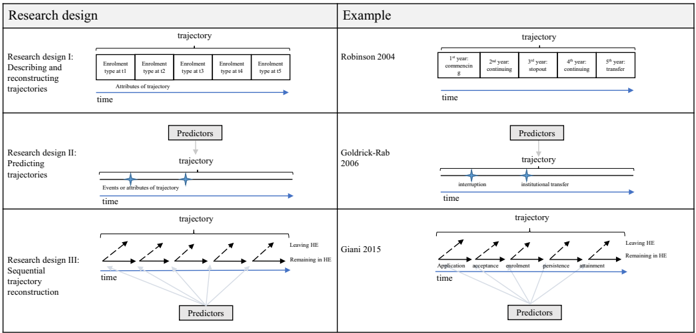
With the increasing availability of high-quality longitudinal data on students in higher education, scholars’ interest in how students proceed through higher education has risen. So far, the research field is diverse in theoretical perspectives and methodological approaches. Thus, based on 27 studies published in (higher) education research journals during the past two decades, this literature review provides an overview of the theoretical concepts, methodologies and main empirical findings in the study of students’ trajectories in higher education. The results depict a US dominated research field. Most theoretical frameworks are based on student’s decision-making. Across different country contexts and research designs—ranging from descriptions of student trajectories to studies predicting who engages in which types of trajectories to sequential trajectory reconstruction—we found that historically disadvantaged groups in higher education such as students from low social origin follow less linear and less smooth higher education trajectories. However, while the field of comparative education is growing steadily and may significantly contribute to explaining the link between the realization of students’ opportunities and the way how higher education is designed and implemented both on the national and local level, there were no cross-country comparison studies on higher education trajectories.
Overview
The claims and statistics of this paper haven’t been checked yet.
Free: it reads the open-access text and checks the first 5 claims that cite a source we can check. Create a free account to check every claim.
Integrity signals
Registry
Cites
Statistics
Figures
Verification
Claims the paper makes
The claims and statistics of this paper haven’t been checked yet.
Free: it reads the open-access text and checks the first 5 claims that cite a source we can check. Create a free account to check every claim.
Claims other papers make about this one
Each is checked against this paper’s own text: does it say what the citing paper says it does?
The cited source says what the claim attributes to it.
In the citing paper
“Higher education trajectory research treats persistence as a pathway rather than a single access event [49], and inclusion mechanisms are more likely to protect that pathway when they remain available during disruption or resource pressure [16,50].”
From Inclusive Higher Education and Disability: Policy–Implementation Gaps Across Universities in Mexico and Colombia (2026) · cites this paper as [49]
Self-check
Percentages, sums and reported differences re-computed from the paper’s own numbers.
The self-check needs the paper’s full text.
Citations
Cites
Dropout from Higher Education: A Theoretical Synthesis of Recent Research
Tinto, V. (1975) · Review of Educational Research · doi:10.2307/1170024 · Cited by 7,888 · cited 1×
“The micro-/meso-level link: trajectories as processes of integration into the HE environment Another dominant theoretical perspective refers to a lack of students’ integration in educational institutions as a major cause of dropout (e.g. Bean and Metzner 1985; Tinto 1975).”
BackgroundHuman Capital. A Theoretical and Empirical Analysis, with Special Reference to Education
Muhsam, H. V., & Becker, G. S. (1965) · Revue de l'Institut International de Statistique / Review of the International Statistical Institute · doi:10.2307/1401709 · Cited by 5,146
(1964) · SSRN Electronic Journal · Cited by 5,128
A Conceptual Model of Nontraditional Undergraduate Student Attrition
Bean, J. P., & Metzner, B. S. (1985) · Review of Educational Research · doi:10.3102/00346543055004485 · Cited by 2,017 · cited 1×
“The micro-/meso-level link: trajectories as processes of integration into the HE environment Another dominant theoretical perspective refers to a lack of students’ integration in educational institutions as a major cause of dropout (e.g. Bean and Metzner 1985; Tinto 1975).”
BackgroundThe Worldwide Expansion of Higher Education in the Twentieth Century
Schofer, E., & Meyer, J. W. (2005) · American Sociological Review · doi:10.1177/000312240507000602 · Cited by 1,653 · cited 1×
“…from undergraduate to graduate studies) and states (e.g. enrolment patterns such as part-time vs full-time enrolment) within a certain period (e.g. academic year or 3-year life period; Sackmann and Wingens 2001, 42), while we assign the term Bpathway^ to institutionally ideal progression patterns.”
BackgroundEXPLAINING EDUCATIONAL DIFFERENTIALS: TOWARDS A FORMAL RATIONAL ACTION THEORY
Breen, R., & Goldthorpe, J. H. (1997) · Rationality and Society · doi:10.1177/104346397009003002 · Cited by 1,644 · cited 1×
“In addition, Breen and Goldthorpe (1997) advanced this theoretical frame to explain differences in decision-making by social origin.”
Background(2006) · US Department of Education · Cited by 1,586
Answers In The Tool Box: Academic Intensity, Attendance Patterns, And Bachelor's Degree Attainment
Adelman, C. (1999) · Cited by 1,409
Manski, C. F., & Wise, D. A. (1983) · Harvard University Press eBooks · doi:10.4159/harvard.9780674422285 · Cited by 965
Life Course Dynamics: Trajectories and Transitions, 1968-1980.
Chew, K. S. Y., & Elder, G. H. (1987) · Social Forces · doi:10.2307/2578775 · Cited by 926
Research works printed but not linked: 1
- 42. Hossler, D., Braxton, J., & Coopersmith, G. (1989). Understanding student choice. In J. Smart (Ed.), Higher education: handbook of theory and research (Vol. 5, pp. 231-288). New York: Agathon Press.
Cited by
A sense of belonging at university: student retention, motivation and enjoyment
Pedler, M. L., Willis, R., & Nieuwoudt, J. E. (2022) · Journal of Further and Higher Education · doi:10.1080/0309877x.2021.1955844 · Cited by 473
Research Approaches in Education: A Comparison of Quantitative, Qualitative and Mixed Methods
Pregoner, J. D. (2024) · IMCC Journal of Science · doi:10.65931/x1r6v8n4 · Cited by 194
How does millennial employee job satisfaction affect performance?
Indrayani, I., Nurhatisyah, N., Damsar, D., & Wibisono, C. (2023) · Higher Education Skills and Work-based Learning · doi:10.1108/heswbl-01-2023-0004 · Cited by 142
Gwosć, C., Hauschildt, K., Wartenbergh-Cras, F. P., & Schirmer, H. (2021) · doi:10.3278/6001920dw · Cited by 140
Teaching and learning intervention in the educational setting: adapting the teacher theory model
Mallillin, L. L. D. (2022) · International Journal of Educational Innovation and Research · doi:10.31949/ijeir.v1i2.2493 · Cited by 73
Hauschildt, K. (2024) · wbv Media eBooks · doi:10.3278/6001920ew · Cited by 74
Resch, K., Alnahdi, G. H., & Schwab, S. (2022) · Higher Education Research & Development · doi:10.1080/07294360.2022.2040446 · Cited by 71
Equidad en la educación superior latinoamericana: Dimensiones e indicadores
de Fanelli, A. M. G., & Adrogué, C. (2021) · Revista Educación Superior y Sociedad (ESS) · doi:10.54674/ess.v33i1.339 · Cited by 58
Ro, H. K., Fernandez, F., & Ramon, E. J. (2021) · Routledge eBooks · doi:10.4324/9781003053217 · Cited by 52
Zakharova, I. G., Vorobeva, M. S., & Boganyuk, Y. V. (2022) · The Education and science journal · doi:10.17853/1994-5639-2022-1-163-190 · Cited by 45
Brechas de equidad en el acceso a la educación superior argentina
Adrogué, C., & de Fanelli, A. M. G. (2021) · Páginas de Educación · doi:10.22235/pe.v14i2.2507 · Cited by 42
Student mobility choices in transnational education: impact of macro-, meso- and micro-level factors
Li, X., Haupt, J. P., & Lee, J. J. (2021) · Journal of Higher Education Policy and Management · doi:10.1080/1360080x.2021.1905496 · Cited by 38
“In addition, this study expands the application of Haas and Hadjar (2020)’s three-level contextual model on student trajectories through higher education within a single country context to TNE.”
MethodSánchez‐Gelabert, A. (2021) · Studia paedagogica · doi:10.5817/sp2020-4-3 · Cited by 35
“In response to this complexity, an increasing number of studies have been incorporating a longitudinal perspective that considers the university experience as a long and broad educational trajectory (Haas & Hadjar, 2019; Robinson, 2004).”
BackgroundGérard, É., & Lebeau, Y. (2023) · International Journal of Educational Development · doi:10.1016/j.ijedudev.2023.102780 · Cited by 30
Piepenburg, J. G., & Fervers, L. (2021) · Higher Education · doi:10.1007/s10734-021-00770-z · Cited by 29
“At the most general level, they deepen our understanding of the determinants of choice of major in general and gender segregation in particular (Barone & Assirelli, 2020; Chang & ChangTzeng, 2020; Haas & Hadjar, 2020).”
BackgroundTeixeira, A. M. (2023) · Handbook of Open, Distance and Digital Education · doi:10.1007/978-981-19-2080-6_48 · Cited by 23
Helin, J., Jokinen, J., Koerselman, K., Nokkala, T., & Räikkönen, E. (2022) · Higher Education · doi:10.1007/s10734-022-00897-7 · Cited by 20
Jones, C. S., & Bell, H. (2024) · Perspectives Policy and Practice in Higher Education · doi:10.1080/13603108.2024.2317316 · Cited by 20
“Ahn and Davis (2022) de fi ne sense of belonging as the interplay between students ’ feelings of acceptance, engagement and connection to the HEI within which they are located, and identify student sense of belonging within the macro, meso and micro domains of HE (Haas and Hadjar 2020).”
BackgroundNjifen, I. (2023) · Studies in Higher Education · doi:10.1080/03075079.2023.2234397 · Cited by 19
“They can either reduce the incentives to be enrolled or reduce the opportunity costs of attending university (Haas and Hadjar 2020; Martinez and Ruiz-Castillo 1998).”
BackgroundZhou, N., Li, Q., & Zhang, Y. (2024) · SAGE Open · doi:10.1177/21582440241240303 · Cited by 19
“The refined three-factor framework presented in Figure 1 is very similar to the three-layer (macro-, meso-, and micro-level) framework (Haas & Hadjar, 2020) that has proved useful in decoding students’ mobility choice to Sino-foreign cooperative programs (X. Li et al., 2021).”
Cohen, A. K., Ryan, S., Smith, L. H., Ream, R. K., Glymour, M. M., López, A., & Yen, I. H. (2021) · Race and Social Problems · doi:10.1007/s12552-021-09352-1 · Cited by 19
“Haas and Hadjar (2019) emphasize conceptual parallels between life-course sociology (Crosnoe & Benner, 2016; Settersten & Mayer, 1997) and research on trajectories in higher education (Milesi, 2010) and the potential value in their combination for understanding how variations in educational…”
BackgroundBlanchard, M., & Lemistre, P. (2022) · Formation emploi · doi:10.4000/formationemploi.10613 · Cited by 18
Learning Strategic Representations: Exploring the Effects of Taking a Strategy Course
Heshmati, M., & Csaszar, F. A. (2023) · Organization Science · doi:10.1287/orsc.2023.1676 · Cited by 19
Struggling for equal access and success: disability in European higher education
Kleemola, K., Hadjar, A., Haas, C., Hyytinen, H., Tuononen, T., Powell, J. J. W., & Toom, A. (2025) · Comparative Education · doi:10.1080/03050068.2025.2466905 · Cited by 18
Self-citationPtuchy, I. D. T. S. D. I. M. V. (2026) · Demography and social economy · doi:10.15407/dse · Cited by 18
Liu, T., Sato, Y., & Breaden, J. (2023) · International journal of comparative education and development · doi:10.1108/ijced-08-2022-0060 · Cited by 17
Students’ complex trajectories: exploring degree change and time to degree
Pêgo, J. P., Miguéis, V. L., & Soeiro, A. A. V. (2024) · International Journal of Educational Technology in Higher Education · doi:10.1186/s41239-024-00438-5 · Cited by 17
“…refers to the “progression through higher education including all transitions (e.g. from undergraduate to graduate studies) and states (e.g. enrolment patterns such as part-time vs full-time enrolment) within a certain period (e.g. academic year or 3-year life period)” (Haas & Hadjar, 2020).”
BackgroundMethodInfluentialHigher education retention in Ireland and Scotland: the role of admissions policies
Iannelli, C., McMullin, P., & Smyth, E. (2024) · Higher Education · doi:10.1007/s10734-024-01259-1 · Cited by 17
“…theoretical explanations and empirical research on HE drop-out focus on micro-level factors linked to students’ characteristics and decision-making, and/or meso-level institutional factors (such as the size of HE institutions and the services they provide) (Aina et al., 2022; Haas & Hadjar, 2019).”
Reifman, J. B., White, M., & Kalish, L. (2022) · Intersection A Journal at the Intersection of Assessment and Learning · doi:10.61669/001c.32399 · Cited by 17
“This echoes other research that suggests that integrating student perspectives informs increasing efforts to redefine successful student trajectories and outcomes contingent on its population for more inclusive teaching and assessment practices (Haas & Hadjar, 2019).”
BackgroundAcademic trajectories analysis with a life-course approach: A case study in medical students
Sánchez, D. C., Godínez, T. B., Moreno, J., García-Minjares, M., & Mendiola, M. S. (2022) · Cogent Education · doi:10.1080/2331186x.2021.2018118 · Cited by 16
“The quantitative method for construction of academic trajectories and its calculation presented in this paper, is placed in the meso-level theoretical perspective (Haas & Hadjar, 2020).”
BackgroundMethodInfluentialAlternative pathways and social disparities in access to elite higher education institutions
Herbaut, E. (2022) · Higher Education · doi:10.1007/s10734-021-00794-5 · Cited by 14
Students’ Trust and Their Educational Trajectory after Graduation
Kuznetsov, I. S. (2023) · Высшее образование в России · doi:10.31992/0869-3617-2023-32-1-110-129 · Cited by 14
Social Inequalities in Study Trajectories: A Comparison of the United States and Germany
Haas, C., & Hadjar, A. (2024) · Sociology of Education · doi:10.1177/00380407241228553 · Cited by 13
“Previous findings on U.S. higher education suggest pronounced social stratification in study trajectories (Haas and Hadjar 2020).”
BackgroundSelf-citationDiversity of LIS School Students: Trends Over the Past 30 Years
Yoon, J., & McCook, K. D. L. P. (2021) · Journal of Education for Library and Information Science · doi:10.3138/jelis.2020-0031 · Cited by 13
Marvell, R. (2021) · Sussex Research Online (University of Sussex) · Cited by 13
Determinantes da evasão no ensino superior : uma abordagem de riscos competitivos
Gomes, M., & Hirata, G. (2023) · doi:10.38116/ppe52n3art1 · Cited by 12
Complex trajectories in higher education students: online and face-to-face universities
Aguilés, A. V., & Rodríguez, D. M. (2024) · Journal of New Approaches in Educational Research · doi:10.1007/s44322-023-00006-1 · Cited by 12
“…trajectories are based on students’ decision making, a notable finding being that although access to university has expanded, historically disadvantaged groups in higher education, such as students from lower social backgrounds, follow less linear and less fluid trajectories (Haas & Hadjar, 2020).”
Breitschwerdt, L., Hümmer, C., & Egetenmeyer, R. (2025) · Higher Education · doi:10.1007/s10734-025-01487-z · Cited by 11
Gender Equality and Sustainability in Vietnamese Higher Education: Educators’ Perspectives
Rana, M. Q., Lee, A. H.-C., Tỷ, T. V., & Lam, D. P. (2025) · Administrative Sciences · doi:10.3390/admsci15050164 · Cited by 10
“To capture these perspectives comprehensively, this study adopts a quantitative research approach (Haas & Hadjar, 2020).”
Weinert, S., Blossfeld, G. J., & Blossfeld, H. (2023) · Methodology of educational measurement and assessment · doi:10.1007/978-3-031-27007-9 · Cited by 10
Snegurenko, A. P., Сагитович, З. С., Новикова, С. В., Valitova, N. L., & Kremleva, E. S. (2022) · Integration of Education · doi:10.15507/1991-9468.106.026.202201.055-071 · Cited by 10
Sánchez‐Gelabert, A., & Andreu, M. E. (2023) · International Journal of Educational Technology in Higher Education · doi:10.1186/s41239-023-00407-4 · Cited by 10
Madani, M. N., Faradila, N., & Rasyad, R. Z. (2025) · Nusantara Innovation Journal. · doi:10.70260/nij.v3i2.53 · Cited by 9
“Penelitian menunjukkan bahwa penerima beasiswa cenderung memiliki tingkat retensi yang lebih tinggi dan menyelesaikan pendidikan mereka dalam waktu yang lebih cepat dibandingkan dengan mahasiswa yang tidak menerima bantuan (Haas & Hadjar, 2020).”
Nadilah, P., Hakim, L., & Utomo, B. (2025) · Edukasiana Jurnal Inovasi Pendidikan · doi:10.56916/ejip.v4i4.1953 · Cited by 9
“Rancangan tersebut dipilih untuk memungkinkan perbandingan yang cermat antara kondisi sebelum dan sesudah intervensi diberikan kepada kelompok eksperimen dan kontrol, seraya mengendalikan perbedaan awal antar kelompok (Haas & Hadjar, 2020).”
Sánchez‐Gelabert, A., & Troiano, H. (2023) · Studies in Higher Education · doi:10.1080/03075079.2023.2281539 · Cited by 9
“Independently of the students ’ trajectories, higher education institutions design pathways, in the sense of mapped itineraries (Haas and Hadjar 2020; Picard, Trottier, and Doray 2011), that students are supposed to follow at a certain pace.”
InfluentialBollom, J. E., Baldé, A., Jandi, Z., Boiro, H., Gunnlaugsson, G., & Einarsdóttir, J. (2022) · International Journal of Educational Research · doi:10.1016/j.ijer.2022.102129 · Cited by 9
Alam, R. (2026) · American Journal of Advanced Technology and Engineering Solutions · doi:10.63125/2hj6p796 · Cited by 8
Exploring Risk of Delay in Academic Trajectories in Two Undergraduate Programs
Boegeholz, R., Guerra, J., & Scheihing, E. (2022) · IEEE Revista Iberoamericana de Tecnologias del Aprendizaje · doi:10.1109/rita.2022.3191298 · Cited by 8
“In contrast, the institutional factors influencing trajectories, such as the structure of study programs, are a relatively less explored field [21].”
BackgroundTieben, N. (2023) · Methodology of educational measurement and assessment · doi:10.1007/978-3-031-27007-9_10 · Cited by 8
Andres, L., Lauterbach, W., Jongbloed, J., & Hümme, H. (2021) · International Journal of Lifelong Education · doi:10.1080/02601370.2021.1924302 · Cited by 8
“Although research has begun to examine gendered employment biographies and educational pathways in comparative perspective (Antonini et al., 2020; Haas & Hadjar, 2020; Simonson et al., 2011), the interplay of these three variables from a life course perspective remains largely unaddressed.”
BackgroundOcampo-Gómez, E. (2021) · Formación universitaria · doi:10.4067/s0718-50062021000200189 · Cited by 8
Sato, Y., Bista, K., & Matsuzuka, Y. (2022) · Journal of Comparative & International Higher Education · doi:10.32674/jcihe.v14i3b.3832 · Cited by 8
Lemistre, P. (2022) · Lien social et Politiques · doi:10.7202/1094549ar · Cited by 8
Wajahat, A. (2024) · Siazga Research Journal · doi:10.58341/srj.v3i1.53 · Cited by 7
Arek-Bawa, O., & Reddy, S. (2025) · Journal of Education · doi:10.17159/2520-9868/i97a01 · Cited by 7
Sicard, A., Taillandier‐Schmitt, A., Nugier, A., & Martinot, D. (2023) · Current Psychology · doi:10.1007/s12144-023-05098-8 · Cited by 7
“Although many predictors of university dropout have been identified in the literature (e.g., Haas and Hadjar, 2020; Jeno et al., 2018; see Behr et al., 2020 for a literature review across psychology, economy and sociology), we show for the first time that, through their effect on basic…”
Hoshaw, J. P., Isaacson, E. M., Grabau, A. A., Wilkinson, R., Genova, L. D., Schramm-Possinger, M., Santilli, N. R., Daugherty, K. K., & Ben‐Avie, M. (2021) · Intersection A Journal at the Intersection of Assessment and Learning · doi:10.61669/001c.24571 · Cited by 7
“In a 2020 review of empirical research studies dealing with students’ trajectories through higher education, Haas and Hadjar (2020) stated that the field of research on students’ higher education trajectories (rather than on static points in time, such as singular transitions) is “rather small” and…”
BackgroundHaas, C. (2023) · Studies in Higher Education · doi:10.1080/03075079.2023.2203163 · Cited by 7
Self-citationFrom the main track to the winding path: considering the diversity of trajectories at university
Troiano, H., Brennan, J., & Giret, J. (2024) · International Journal of Educational Technology in Higher Education · doi:10.1186/s41239-024-00441-w · Cited by 7
“With the intention of contributing to its concrete realisation and extension, we have adopted the research programme described by Haas and Hadjar (2020) in their review and systematisation of existing research in the field.”
MethodRahman, W., Judijanto, L., & Sanulita, H. (2024) · Journal of Education Research and Evaluation · doi:10.23887/jere.v8i1.71067 · Cited by 6
“Higher education is a formal education organizing unit where everyone dreams of gaining knowledge and a degree at their dream university (Haas & Hadjar, 2020; Krstikj et al., 2022).”
BackgroundTeixeira, A. M. (2022) · Handbook of Open, Distance and Digital Education · doi:10.1007/978-981-19-0351-9_48-1 · Cited by 6
Ariovaldo, T. C. D. C. (2023) · LA Referencia (Red Federada de Repositorios Institucionales de Publicaciones Científicas) · Cited by 6
Haas, C. (2023) · Soziale Welt · doi:10.5771/0038-6073-2023-3-431 · Cited by 5
Self-citationLoder, A. K. F. (2024) · Trends in Higher Education · doi:10.3390/higheredu3020023 · Cited by 5
“However, a literature review concluded that the current research on trajectories in higher education is rather US-centered and that more research is needed [58].”
BackgroundMethodCamozzi, I., Grüning, B., & Gambardella, M. G. (2022) · Cambio Rivista sulle Trasformazioni Sociali · doi:10.36253/cambio-11564 · Cited by 4
“Tuttavia, partendo spesso dall’assunto che l’attore compia le sue scelte razionalmente, anche in ambito di mobilità, si forza talvolta la correlazione tra decisioni rispet-to al percorso educativo e le proprie origini sociali (Haas e Hadjar 2019).”
BackgroundDaniel, A., & Neumann, M. (2022) · Springer eBooks · doi:10.1007/978-3-658-24729-4_73 · Cited by 4
Sanders, C. V. (2023) · ScholarWorks (Walden University) · Cited by 4
Parental Effect of Higher Education on Attitudes Towards Immigrants: A Family Approach
Donnaloja, V., & Borkowska, M. (2025) · British Journal of Sociology · doi:10.1111/1468-4446.70005 · Cited by 3
“They also have more stable trajectories through higher education (Breen and Goldthorpe 1997; Haas and Hadjar 2020) and are more capable of foregoing the income they would earn if they entered the labour market earlier instead of staying in higher education.”
Troiano, H., & Sánchez‐Gelabert, A. (2025) · European Journal of Higher Education · doi:10.1080/21568235.2025.2556438 · Cited by 3
“…in the growing interest in analysing the trajectories followed by students during their university studies (see the systematised compilation by Haas and Hadjar 2020), an interest facilitated by increasingly efficient administrative management of longitudinal student data and the development…”
InfluentialGiraldo, A., Meggiolaro, S., Re, L. D., & Franceschini, C. (2026) · Social Indicators Research · doi:10.1007/s11205-026-03944-3 · Cited by 3
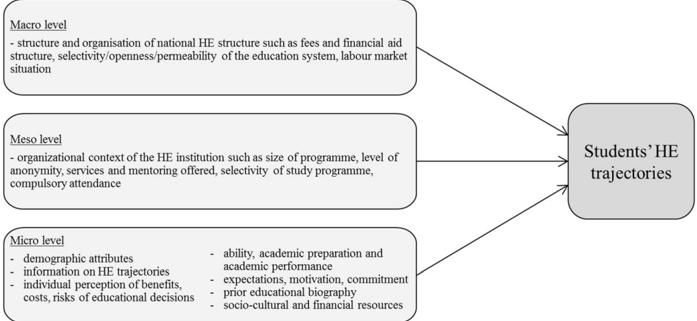
“Haas and Hadjar (2020) provided a classification of such determinants in which they distinguished micro-(individual factors), meso-(characteristics and functioning of the institution) and macro-level factors (features of the tertiary education system and national context).”
Владимировна, Ч. Е., & Arzhanik, M. B. (2024) · Perspectives of science and education · doi:10.32744/pse.2024.3.41 · Cited by 3
“…понятия «индивидуальная образовательная траектория» [10], особую роль, отводимую студенту в процессе индивидуализации [11] и его специфику [12], на основании компиляции походов индивидуальную обра - зовательную траекторию с позиций формирования субъектности можно определить, как особую…”
Snegurenko, A. P., Сагитович, З. С., Новикова, С. В., Valitova, N. L., & Kremleva, E. S. (2021) · Sovremennye informacionnye tehnologii i IT-obrazovanie. · doi:10.25559/sitito.17.202101.737 · Cited by 3
The Impact of Confucius Education on the Choice of Major Course of Current Vietnamese Students
Dung, V. V. (2024) · Cadernos de Educação Tecnologia e Sociedade · doi:10.14571/brajets.v17.nse5.260-269 · Cited by 3
“Research on the influence of family in forming attitudes has influenced students' choice of major (Sundly, A., & Galway, G. J. 2021); (Wiswall, M., & Zafar, B. 2021); (Wang, T., & Li, S. 2022); (Bo, S., Chen, J., et al. 2020); (Sahu, R., et al. 2021); (Haas, C., & Hadjar, A. 2020).”
Troiano, H. (2025) · Educación XX1 · doi:10.5944/educxx1.42268 · Cited by 3
Barkaoui, K., Holmes, J. E., & Viegen, S. V. (2025) · Journal of English for Academic Purposes · doi:10.1016/j.jeap.2025.101555 · Cited by 3
Jones, C., & Bell, H. (2025) · Journal of University Teaching and Learning Practice · doi:10.53761/b96chc12 · Cited by 3
Definition of Professional Vector in Educational Systems of Training Future It Specialists
Dubas, Y., & Kunanets, N. E. (2021) · Vìsnik Nacìonalʹnogo unìversitetu Lʹvìvsʹka polìtehnìka Serìâ Ìnformacìjnì sistemi ta merežì · doi:10.23939/sisn2021.09.142 · Cited by 3
Mallillin, L. L. D. (2021) · European Journal of English Language Studies · doi:10.12973/ejels.1.1.1 · Cited by 3
“It highlights the increased measure of the teaching approach in the new normal among the higher education institutions in a theoretical diverse method and approach perspective (Haas & Hadjar, 2020).”
BackgroundChoosing a Business or Economics Study Program at University: The Role of the Economics Teacher
Jüttler, M., & Schumann, S. (2022) · Journal of risk and financial management · doi:10.3390/jrfm15110522 · Cited by 3
Navarrete, F., Romero, R. Á., & Olascoaga, B. G. J. (2024) · Salud Ciencia y Tecnología - Serie de Conferencias · doi:10.56294/sctconf2024738 · Cited by 3
Finnish open university education and students’ transitions into and within higher education
Isopahkala-Bouret, U., & Haltia, N. (2024) · Journal of Praxis in Higher Education · doi:10.47989/kpdc588 · Cited by 3
“In particular, students from under-represented social groups, such as first-generation university students and students from minority ethnic backgrounds, tend to follow less linear HE trajectories (Baker & Irwin, 2021: Haas & Hadjar, 2020; Sánchez-Gelabert, 2020).”
BackgroundThouin, É. (2022) · Papyrus : Institutional Repository (Université de Montréal) · doi:10.71781/23961 · Cited by 3
Noskova, A. V., Goloukhova, D. V., & Kuzmina, E. I. (2023) · Высшее образование в России · doi:10.31992/0869-3617-2023-32-12-88-106 · Cited by 2
Studying Student Behaviour: Towards an Integrated Conceptual Framework
Bauer, V. A. (2024) · Emerald Group Publishing Limited eBooks · doi:10.1108/s2056-375220240000010002 · Cited by 3
“I Can Do It If I Work Hard”: Perceived Educational Opportunity in the Netherlands’ Tracked System
van Wanrooij, B., Volman, M. L. L., & Elffers, L. (2026) · European Educational Research Journal · doi:10.1177/14749041251401055 · Cited by 2
“…educational systems varies considerably across Europe, many countries, including Germany, Austria, Switzerland, and parts of Belgium, share key features of selectivity, such as early tracking and differentiated pathways based on academic performance (Buchmann and Park, 2009; Haas and Hadjar, 2020).”
Bădulescu, D., Bădulescu, A., Abuselidze, G. D., & Zoidze, G. (2026) · BUSINESS EXCELLENCE AND MANAGEMENT · doi:10.24818/beman/2026.16.2-03 · Cited by 2
“The literature also emphasizes the importance of longitudinal studies, which track students and graduates over extended periods to assess the long-term impact of entrepreneurial education (Haas & Hadjar, 2020; Young, Miller, Urban, & Petrescu, 2024).”
Jones, C. S., & Sweeney, L. (2025) · Student Engagement in Higher Education Journal · doi:10.66561/sehej.v6i1.1240 · Cited by 2
Trajetórias acadêmicas de diplomadas(os) em Ciências da Educação
Correia, M., & Vaz, H. (2023) · Revista de Educação PUC-Campinas · doi:10.24220/2318-0870v28e2023a8562 · Cited by 2
Vandelannote, I., & Demanet, J. (2024) · British Educational Research Journal · doi:10.1002/berj.4077 · Cited by 2
Acharya, K. P. (2024) · Interdisciplinary Research in Education · doi:10.3126/ire.v9i1.69752 · Cited by 2
Bautista-Rodríguez, G., & van der Goes, T. I. F. (2025) · Investigación en Educación Médica · doi:10.22201/fm.20075057e.2025.53.24609 · Cited by 2
Александрович, К. В., Владимирович, К. Р., & Voevodina, E. I. (2025) · Perspectives of science and education · doi:10.32744/pse.2025.5.5 · Cited by 2
Valdivia Velasco, M., de la Torre Gutiérrez, H., Araiza Lozano, M. Á., & Alvarado-Carrillo, A. (2024) · Dialnet (Universidad de la Rioja) · Cited by 2
Vandelannote, I. (2021) · Ghent University Academic Bibliography (Ghent University) · Cited by 2
A comparative analysis of critical educational trajectories of academicians in China and Japan
Guo, J., Wang, F., Wu, H. Y., Huang, J., & Rui, X. (2025) · Journal of Informetrics · doi:10.1016/j.joi.2025.101689 · Cited by 1
Navigating the university minor choice: search strategies and the role of choice architecture
Tenisheva, K., Sharin, N., Trefilova, M., & Loseva, A. А. (2025) · Discover Education · doi:10.1007/s44217-025-00794-y · Cited by 1
Cate, I. P.-T., Kroezen, T., Ottenbacher, M., Alieva, A., Hadjar, A., Torabian, J. E., de Moll, F., & Fischbach, A. (2026) · International Journal of Comparative Sociology · doi:10.1177/00207152251409378 · Cited by 1
“There are consistent findings that educational pathways vary greatly between different student groups in relation to sociodemographic characteristics and academic potential (e.g. Haas and Hadjar, 2020; OECD, 2018; Sonnleitner et al., 2021; Thiele et al., 2016; Van de Werfhorst and Mijs, 2010).”
Self-citationZuckerman, A. L., Stocker, G. J., Mercer, C. N., Tsai, R. G., Bussey, T. J., & Lo, S. M. (2026) · PLoS ONE · doi:10.1371/journal.pone.0340395 · Cited by 1
Complex pathways of Russian university graduates: which pathways lead upwards?
Lukina, A. A., Maltseva, V., & Rozenfeld, N. (2026) · Higher Education Research & Development · doi:10.1080/07294360.2026.2615306 · Cited by 1
“Gender addressed the gendered stratification of higher education pathways, influencing course selection and career linearity (Elder & Kring, 2016; Haas & Hadjar, 2020; Sebők, 2024).”
Metadata
- Authors
- Haas, C., & Hadjar, A.
- Affiliations
- University of Luxembourg (LU)
- Corresponding author
- Haas, Christina
- Venue
- Higher Education
- Published
- 2019-10-31
- Volume
- 79
- Issue
- 6
- Pages
- 1099-1118
- ISSN
- 0018-1560 (ISSN-L)
- 1573-174X
- OpenAlex
- W2985657353
- Cited by
- 97
- References
- 82
- Citations by year
- 2026: 9 · 2025: 15 · 2024: 19 · 2023: 17 · 2022: 20 · 2021: 16 · 2020: 1
- FWCI
- 24.96
- Type
- journal article
- Language
- en
- Open access
- hybrid
- doi.org
- Licence
- cc-by
- creativecommons.org/licenses/by/4.0 (tdm)
- creativecommons.org/licenses/by/4.0 (vor)
- Locations
- Higher Education (publishedVersion, cc-by)
- Open Repository and Bibliography (University of Luxembourg) (submittedVersion, cc-by-nc-sa)
- Topics
- Social Sciences › Education › Higher Education Research Studies
- Social Sciences › Sociology and Political Science › Sociology and Education Studies
- Social Sciences › Education › Higher Education Governance and Development
- Keywords
- student trajectories, student decision-making, longitudinal student data, historically disadvantaged students, trajectory reconstruction, comparative education, educational inequality
About these checks
Registry, retraction, Cites and statistics results are computed, not judged, with one exception: a printed reference that no index lists is read once by a model before it counts as a citation error. Claims are extracted by a model and kept only when their quote appears verbatim in the text; each cited source is then checked, with a model’s help, for whether it says what the claim relies on. Those verdicts can be wrong — read the claim’s quote and the cited source before relying on one.
Statistics and arithmetic are recomputed, not judged.
Confidence bands are shown only for fields calibrated on our annotated test set. None is calibrated yet, so no band is shown.
What counts as a claim ›How we measure confidence ›How we check this ›
Are you an author, or do you see a problem with this page? Request a review
Data sources
Bibliographic data: Semantic Scholar, OpenAlex, Crossref.
Contains information from the Semantic Scholar Academic Graph Datasets, made available under the ODC Attribution License (ODC-BY 1.0).
Semantic Scholar’s data is described in: Kinney, R., et al. (2023). The Semantic Scholar Open Data Platform. arXiv:2301.10140.
