

Chronic Childhood Peer Rejection is Associated with Heightened Neural Responses to Social Exclusion During Adolescence
Open accessThe DOI matches its Crossref record; 70 of the 73 references it cites were found in a registry or an index; 22 of the 79 sources its claims cite were checked for support.
Abstract
Examined subjective and neural responses to Cyberball social exclusion in adolescents with chronic peer rejection vs accepted peers. Chronically rejected youth showed heightened dorsal anterior cingulate cortex (dACC) and anterior prefrontal cortex activity during exclusion and incidental exclusion.
Overview
CoChat Summary
TL;DR
This fMRI study found that adolescents with chronic childhood peer rejection (ages 6–12) showed heightened neural responses to social exclusion in Cyberball at ages 12–15 compared with stably accepted peers, despite similar self-reported distress. Specifically, chronically rejected adolescents had greater dACC activity during exclusion and greater dACC/aPFC activity during incidental exclusion.
Key findings
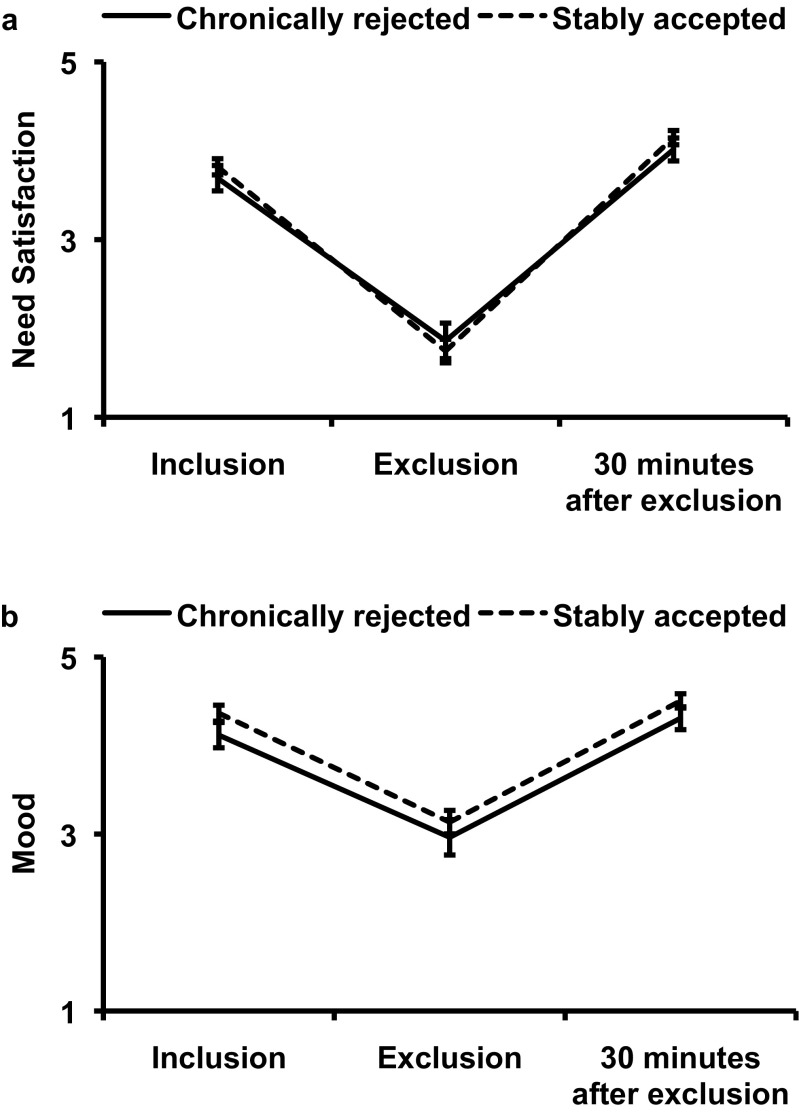
- Both groups reported similar exclusion-induced distress: need satisfaction dropped after exclusion (main effect of time: F(2,84) = 221.73, p < .001, ηp² = .84) and mood dropped (F(2,84) = 98.24, p < .001, ηp² = .71); group × time interactions were not significant (p = .49 and p = .87).
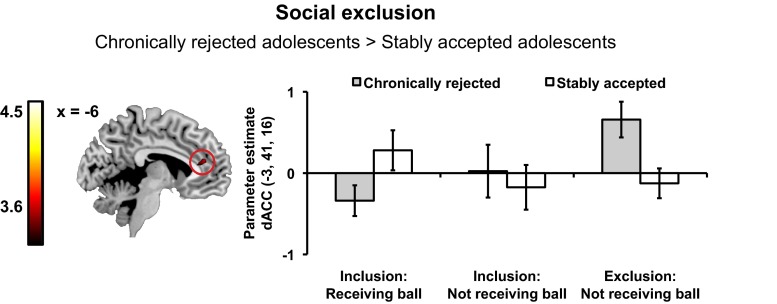
- Chronically rejected adolescents, compared with stably accepted adolescents, showed higher dACC activity during social exclusion (peak MNI −3, 41, 16; thresholded p < .001 uncorrected, >10 voxels).
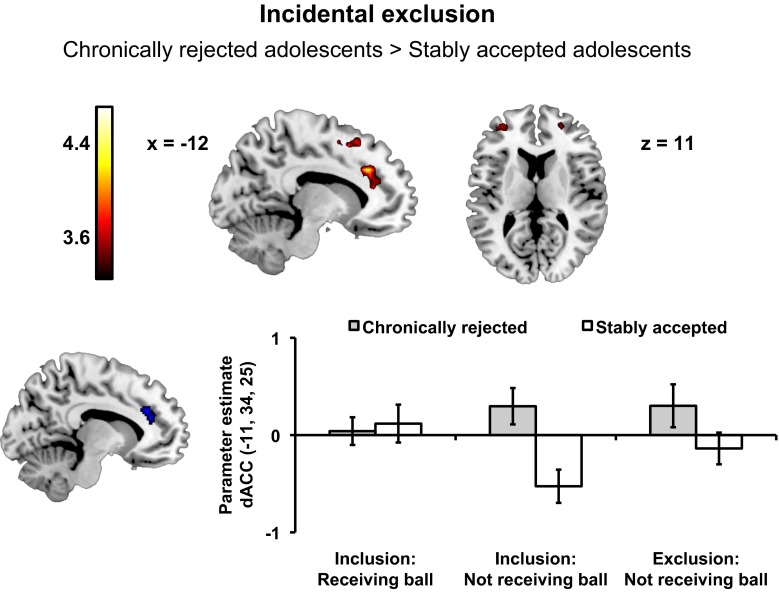
- Chronically rejected adolescents also showed higher activity in dACC (peak −15, 29, 31) extending into left aPFC (−36, 50, 13) and right aPFC (24, 50, 13) during incidental exclusion in the inclusion game.
- No regions showed higher activity in stably accepted adolescents than chronically rejected adolescents in any of the three contrasts.
Methods
- Participants came from the eighth wave of a longitudinal study: 1,189 children were followed annually from first to sixth grade (ages 6–12) with peer nominations; adolescents in the upper or lower 10th percentile of 6-year average social preference were selected. The final fMRI sample was 44 adolescents (mean age 14.0; 27 stably accepted, 17 chronically rejected; the abstract states 19 chronically rejected, while the Method and Table 1 report 17).
- Participants completed the Cyberball fMRI task with inclusion and exclusion runs; mood and need satisfaction were assessed after inclusion, after exclusion, and approximately 30 min after exclusion.
- fMRI data were analyzed with event-related whole-brain SPM8 models; group comparisons tested chronically rejected vs. stably accepted adolescents, with results thresholded at p < .001 uncorrected, minimum 10 contiguous voxels, and FDR-corrected results also reported.
Limitations
- Stated: the study cannot conclude that neural differences are caused by peer status histories; differences may have been present before elementary school, so directionality remains unresolved.
- Stated: the extreme-group design compared only upper and lower 10th percentile groups, so differences may partly reflect hyposensitivity in stably accepted adolescents rather than only hypersensitivity in chronically rejected adolescents.
- Stated/evident: the chronically rejected group included four adolescents with ADHD; removing them did not change findings, but comorbidity remains a consideration. Evident: the final sample was small, especially the chronically rejected group (n = 17), limiting tests of sex interactions and individual differences; Cyberball’s strong distress induction may also reduce self-report variability.
Model-written summary. Check it against the paper before relying on it.
Integrity signals
Registry
Cites
Statistics
Figures
Verification
Claims the paper makes
17 Valid · 0 Not valid · 27 Not checked · 42 Own results and interpretations
The cited sources support only part of this claim — read each source’s verdict below.
In the paper
“Children and adolescents who are rejected by peers suffer from widespread impairments in mental health that can persist across development”
§ Chronic Childhood Peer Rejection is Associated with Heightened Neural Responses to Social Exclusion During Adolescence > Introduction
What the sources say
- Not checked — no full text of the sourcecites Ladd 2006 matched to “Peer Rejection, Aggressive or Withdrawn Behavior, and Psychological Maladjustment from Ages 5 to 12: An Examination of Four Predictive Models” (2006) source
- Not checked — no full text of the sourcecites Ladd and Troop-Gordon 2003 matched to “The Role of Chronic Peer Difficulties in the Development of Children's Psychological Adjustment Problems” (2003) source
- Partly supportedcites Prinstein and Aikins 2004 matched to “Cognitive Moderators of the Longitudinal Association Between Peer Rejection and Adolescent Depressive Symptoms” (2004) sourceExperimental — accuracy not yet measured
The Discussion (page unavailable) links peer rejection in children and adolescents to stress, loneliness, and possible suicidal behavior; the study’s longitudinal findings link it to later depressive symptoms under particular conditions, especially for girls. These passages support adverse mental-health associations, but not a general claim that rejected children and adolescents suffer widespread mental-health impairments that persist across development. (LLM, conf=0.86)
plainstates an association- Asserted: passes — The authors put it forward as true.
- Checkable: passes — It can be checked against evidence.
- Load-bearing: passes — The paper’s conclusions depend on it.
- Based: passes — The paper gives a reason why it holds.
The sources with a verdict support this claim; the rest weren’t checked yet, have no full text we could read, or their verdicts aren’t rated yet.
In the paper
“but also that the self-reports of such distress seem to be less amenable to moderation by individual differences, such as the participant’s sex (Williams and Sommer 1997), their levels of loneliness (Wesselmann et al. 2012) or social anxiety (Zadro et al. 2006).”
§ Chronic Childhood Peer Rejection is Associated with Heightened Neural Responses to Social Exclusion During Adolescence > Discussion > Childhood Peer Status and Self-Reported Distress After Exclusion
What the sources say
- Not checked — no full text of the sourcecites Williams and Sommer 1997 matched to “Social Ostracism by Coworkers: Does Rejection Lead to Loafing or Compensation?” (1997) source
- Supportedcites Wesselmann et al. 2012 matched to “Dial a feeling: Detecting moderation of affect decline during ostracism” (2012) source
The citation to Wesselmann et al. is attached specifically to loneliness, not to sex or social anxiety. Section 3.4 reports that loneliness did not moderate retrospective self-reports or end-of-game affect ratings. The paper distinguishes these measures from continuous affect ratings during Cyberball, which did show moderation by loneliness. (LLM, conf=0.93)
- Not checked — no full text of the sourcecites Zadro et al. 2006 matched to “How long does it last? The persistence of the effects of ostracism in the socially anxious” (2006) source
hedged- Asserted: passes — The authors put it forward as true.
- Checkable: passes — It can be checked against evidence.
- Load-bearing: passes — The paper’s conclusions depend on it.
- Based: passes — The paper gives a reason why it holds.
Every source the paper cites for this claim was checked and supports it.
In the paper
“Higher levels of activity in the dACC and aPFC during exclusion in Cyberball have been shown to be associated with higher levels of rejection sensitivity (Masten et al. 2009)”
§ Chronic Childhood Peer Rejection is Associated with Heightened Neural Responses to Social Exclusion During Adolescence > Discussion > Childhood Peer Status and Neural Responses to Exclusion
What the sources say
- Supportedcites Masten et al. 2009 matched to “Neural correlates of social exclusion during adolescence: understanding the distress of peer rejection” (2009) source
The paper’s analysis of neural activity during social exclusion reports that adolescents with higher rejection-sensitivity scores showed greater dACC and anterolateral PFC activity during Cyberball exclusion compared with inclusion. The claim’s “aPFC” corresponds to the anterolateral PFC reported in the paper. (LLM, conf=0.91)
plainstates an association- Asserted: passes — The authors put it forward as true.
- Checkable: passes — It can be checked against evidence.
- Load-bearing: passes — The paper’s conclusions depend on it.
- Based: passes — The paper gives a reason why it holds.
- Supported
A result the paper reports from its own data — it cites no other source for it, so there is none to check. The quote shows it is in the paper.
In the paper
“No regions showed higher activity in stably accepted adolescents than chronically rejected adolescents in any of the three contrasts”
§ Chronic Childhood Peer Rejection is Associated with Heightened Neural Responses to Social Exclusion During Adolescence > Results > Neuroimaging Results
plain- Asserted: passes — The authors put it forward as true.
- Checkable: passes — It can be checked against evidence.
- Load-bearing: passes — The paper’s conclusions depend on it.
- Based: passes — The paper gives a reason why it holds.
A result the paper reports from its own data — it cites no other source for it, so there is none to check. The quote shows it is in the paper.
In the paper
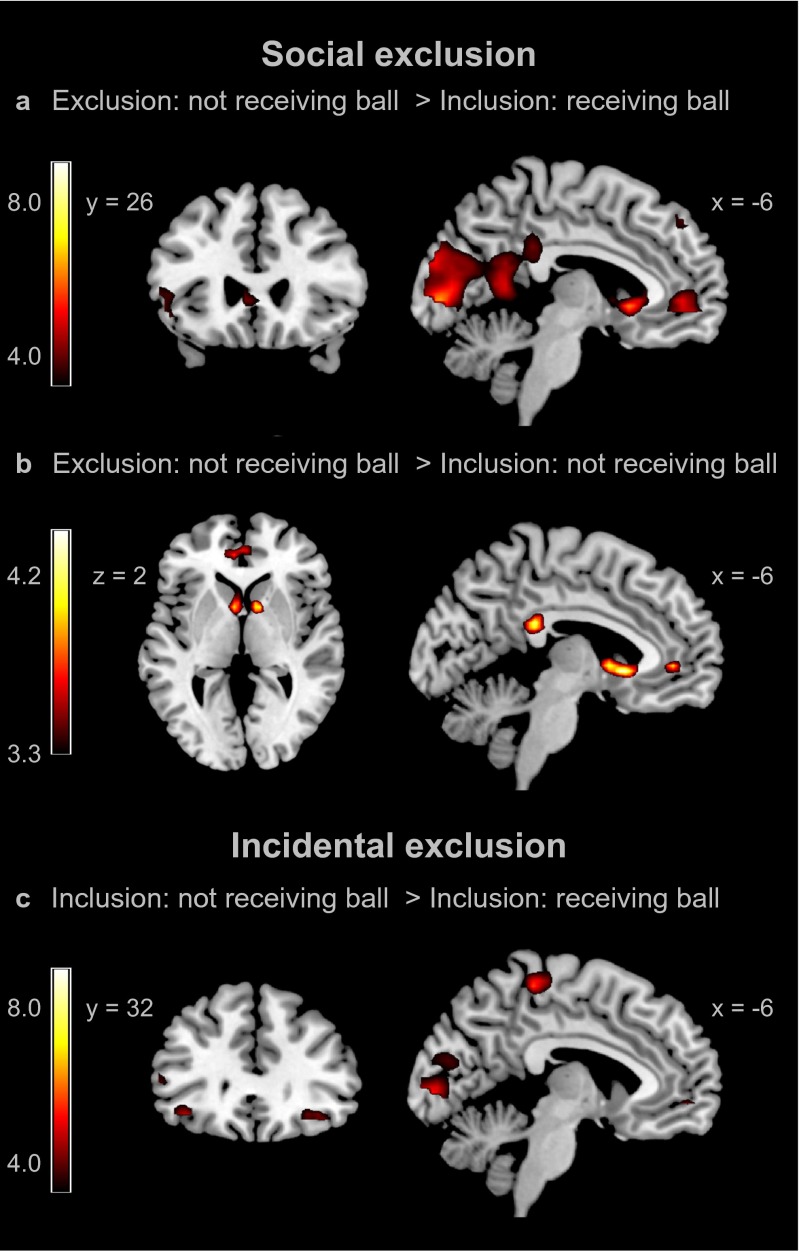
“The second contrast, which compared activation on trials where participants did not receive the ball in the exclusion game with trials where they did not receive the ball in the inclusion game (Exclusion: not receiving the ball > Inclusion: not receiving the ball), resulted in activation in the striatum (peak at -6, 17, -2) and the vACC (peak at -6, 44, 1)”
§ Chronic Childhood Peer Rejection is Associated with Heightened Neural Responses to Social Exclusion During Adolescence > Results > Neuroimaging Results
plain- Asserted: passes — The authors put it forward as true.
- Checkable: passes — It can be checked against evidence.
- Load-bearing: passes — The paper’s conclusions depend on it.
- Based: passes — The paper gives a reason why it holds.
35 more claims
Create a free account to see all 86 claims and to verify the 2 references still open.
- Probably not a substantial claim. 37
- It may state two separate claims as one. 16
Statistics that don’t add up
Each reported p-value recomputed from its test statistic and degrees of freedom, each partial η² from its F, and each ratio, mean difference or B printed with a p checked against its own confidence interval.
Rated minor: it would not touch a result — a value no result rests on, a p-value that stays on the same side of the significance level, or a conflict that is clerical, resolved elsewhere in the paper, or outside its own findings.
In the paper
“F(2, 84) = 98.24, p < .001, ηp 2 = 0.71”
§ Chronic Childhood Peer Rejection is Associated with Heightened Neural Responses to Social Exclusion During Adolescence > Results > Self-Reported Distress
Reported ηp² = .71 · recomputed ηp² .70051–.70052
Statistics recomputed
Every reported test result, recomputed from its test statistic and degrees of freedom. A result shows as not adding up only once an independent check has confirmed it.
- Consistentχ²(1) = 0.4reported p = .51 · recomputed p = .527
“χ 2(1) = 0.4, p = .51”
- ConsistentF(2, 84) = 221.73reported p < .001 · recomputed p < .001
“F(2, 84) = 221.73, p < .001”
- ConsistentF(2, 84) = 98.24reported p < .001 · recomputed p < .001
“F(2, 84) = 98.24, p < .001”
Self-check
Percentages, sums and reported differences re-computed from the paper’s own numbers.
Each contradiction between two passages listed here was confirmed by an independent check.
Rated minor: it would not touch a result — a value no result rests on, a p-value that stays on the same side of the significance level, or a conflict that is clerical, resolved elsewhere in the paper, or outside its own findings.
In the paper
§ Chronic Childhood Peer Rejection is Associated with Heightened Neural Responses to Social Exclusion During Adolescence > Results > Neuroimaging Results
“Table 2 Brain regions revealed by whole-brain analyses testing for peer status history differences in the Cyberball game (all thresholded p < .001 uncorrected, > 10 voxels)”
§ Chronic Childhood Peer Rejection is Associated with Heightened Neural Responses to Social Exclusion During Adolescence > Results > Neuroimaging Results
“| Superior Temporal gyrus | L | 10 | 3.38 | −60 | −34 | 19 |”
Rated minor: it would not touch a result — a value no result rests on, a p-value that stays on the same side of the significance level, or a conflict that is clerical, resolved elsewhere in the paper, or outside its own findings.
In the paper
§ Chronic Childhood Peer Rejection is Associated with Heightened Neural Responses to Social Exclusion During Adolescence > Abstract
“stable accepted (n = 27; 14 males) or a chronic rejected (n = 19; 12 males)”
§ Chronic Childhood Peer Rejection is Associated with Heightened Neural Responses to Social Exclusion During Adolescence > Method > Participants
“The remaining 44 participants had a mean age of 14.0 years (SD = 0.70; 26 males). Twenty-seven adolescents met our criteria for a history of stable peer acceptance (M age = 14.0; SD = 0.77; 14 male) and 17 for a history of chronic peer rejection”
Rated minor: it would not touch a result — a value no result rests on, a p-value that stays on the same side of the significance level, or a conflict that is clerical, resolved elsewhere in the paper, or outside its own findings.
In the paper
§ Chronic Childhood Peer Rejection is Associated with Heightened Neural Responses to Social Exclusion During Adolescence > Method > Participants
“Twenty-seven adolescents met our criteria for a history of stable peer acceptance (M age = 14.0; SD = 0.77; 14 male) and 17 for a history of chronic peer rejection (M age = 14.0; SD = 0.56; 12 male).”
§ Chronic Childhood Peer Rejection is Associated with Heightened Neural Responses to Social Exclusion During Adolescence > Method > Participants
“| Age | 13.98 (0.77) | 14.04 (0.58) | 0.78 |”
Rated minor: it would not touch a result — a value no result rests on, a p-value that stays on the same side of the significance level, or a conflict that is clerical, resolved elsewhere in the paper, or outside its own findings.
In the paper
§ Chronic Childhood Peer Rejection is Associated with Heightened Neural Responses to Social Exclusion During Adolescence > Results > Neuroimaging Results
“the pre-supplementary motor area (peak at -9, 23, 46)”
§ Chronic Childhood Peer Rejection is Associated with Heightened Neural Responses to Social Exclusion During Adolescence > Results > Neuroimaging Results
“| Supplementary Motor Area | R | 16 | 3.37 | 9 | 23 | 46 |”
Citations
Cites
The need to belong: Desire for interpersonal attachments as a fundamental human motivation.
Baumeister, R. F., & Leary, M. R. (1995) · Psychological Bulletin · doi:10.1037//0033-2909.117.3.497 · Cited by 23,245 · cited 2×
“Social exclusion is highly distressing and immediately threatens fundamental human needs, such as our need to belong, our need for control over our (social) environment and our needs for self-esteem and a meaningful existence (Baumeister and Leary 1995; Williams 2007).”
BackgroundTzourio-Mazoyer, N., Landeau, B., Papathanassiou, D., Crivello, F., Etard, O., Delcroix, N., Mazoyer, B., & Joliot, M. (2002) · NeuroImage · doi:10.1006/nimg.2001.0978 · Cited by 16,319
Crick, N. R., & Dodge, K. A. (1994) · Psychological Bulletin · doi:10.1037/0033-2909.115.1.74 · Cited by 5,510
Does Rejection Hurt? An fMRI Study of Social Exclusion
Eisenberger, N. I., Lieberman, M. D., & Williams, K. D. (2003) · Science · doi:10.1126/science.1089134 · Cited by 3,849 · cited 4×
“Of these youths, recent full contact information was available for 131 adolescents, who were subsequently approached for participation in the fMRI study.”
BackgroundInfluentialConflict monitoring and anterior cingulate cortex: an update
Botvinick, M. M., Cohen, J. D., & Carter, C. S. (2004) · Trends in Cognitive Sciences · doi:10.1016/j.tics.2004.10.003 · Cited by 3,623 · cited 2×
“The ACC is implicated in a wide variety of cognitive and emotional processes including conflict monitoring (Botvinick et al. 2004), expectancy violation (Somerville et al. 2006), physical pain and other negative emotions (Shackman et al. 2011), reactions to being treated unfairly (Sanfey et al.…”
BackgroundThe neural basis of economic decision-making in the Ultimatum Game.
Sanfey, A. G., Rilling, J. K., Aronson, J. A., Nystrom, L. E., & Cohen, J. D. (2003) · Science · doi:10.1126/science.1082976 · Cited by 3,375
Peer relations and later personal adjustment: Are low-accepted children at risk?
Parker, J. G., & Asher, S. R. (1987) · Psychological Bulletin · doi:10.1037//0033-2909.102.3.357 · Cited by 2,961
Peer Interactions, Relationships, and Groups
Rubin, K. H., Bukowski, W. M., & Parker, J. G. (2007) · Handbook of Child Psychology · doi:10.1002/9780470147658.chpsy0310 · Cited by 2,755 · cited 1×
“Relationships with peers are vital to satisfying these needs across the lifespan (Ladd 1999; Rubin et al. 2006) and therefore we hypothesized that childhood peer acceptance and rejection have an impact on the extent to which these needs are threatened by social exclusion in adolescence.”
BackgroundThe expected value of control: an integrative theory of anterior cingulate cortex function
Shenhav, A., Botvinick, M. M., & Cohen, J. D. (2013) · Neuron · doi:10.1016/j.neuron.2013.07.007 · Cited by 2,321 · cited 2×
“That is, the dorsal ACC is connected with prefrontal, parietal and motor cortices, and is important for signaling conflict and integrating top-down and bottom-up processes (Shenhav et al. 2013).”
BackgroundCyberostracism: effects of being ignored over the Internet
Williams, K. D., Cheung, C. K. T., & Choi, W. (2000) · Journal of Personality and Social Psychology · doi:10.1037/0022-3514.79.5.748 · Cited by 2,276
Research works printed but not linked: 1
- Brett, M., Anton, J.-L., Valabregue, R., & Poline, J.-B. (2002). Region of interest analysis using an SPM toolbox [abstract]. Presented at the 8th International Conference on Functional Mapping of the Human Brain, June 2-6, 2002, Sendai, Japan. Available on CD-ROM in NeuroImage, 16.
Cited by
Items 101–169 of 169
The Lonelier, the More Conservative? A Research about Loneliness and Risky Decision-Making
Zhu, Y. Q., & Wang, C. (2017) · Psychology · doi:10.4236/psych.2017.810104 · Cited by 9
Asscheman, J. S., Koot, S., Ma, I., Buil, J. M., Krabbendam, L., Cillessen, A. H. N., & van Lier, P. A. C. (2020) · Developmental Cognitive Neuroscience · doi:10.1016/j.dcn.2020.100792 · Cited by 5
Self-citationTroop‐Gordon, W., Schwartz, D., Mayeux, L., & McWood, L. M. (2021) · Elsevier eBooks · doi:10.1016/b978-0-12-818872-9.00049-2 · Cited by 9
Rauterkus, H., Hennemann, T., Hagen, T., Krull, J., Nitz, J., Eiben, K., Kulawiak, P. R., Verbeck, L., & Hanisch, C. (2025) · Frontiers in Education · doi:10.3389/feduc.2025.1713822 · Cited by 9
Peer Victimization and Neurobiological Models: Building Toward Comprehensive Developmental Theories
Troop‐Gordon, W., & Erath, S. A. (2018) · Merrill-palmer Quarterly · doi:10.13110/merrpalmquar1982.64.1.0162 · Cited by 4
Wever, M. C. M., Will, G., van Houtum, L. A. E. M., Janssen, L. H. C., Wentholt, W. G. M., Spruit, I. M., Tollenaar, M. S., & Elzinga, B. M. (2024) · Cognitive Affective & Behavioral Neuroscience · doi:10.3758/s13415-024-01169-w · Cited by 5
Self-citationDevelopmental Computational PsychiatryPreprint
Hauser, T. U., Will, G., Dubois, M., & Dolan, R. J. (2018) · PsyArXiv (OSF Preprints) · doi:10.31234/osf.io/85prq · Cited by 4
Self-citationPrince, T., Driver, C., Boyes, A., Mulgrew, K. E., Elwyn, R., Mills, L., & Hermens, D. F. (2025) · Behavioural Brain Research · doi:10.1016/j.bbr.2025.115647 · Cited by 5
García‐Guerrero, M. A., Lasa, J. P., Zubiaurre‐Elorza, L., Benítez, D., Hernández, A. M., & del Pozo, N. O. (2021) · Actas Españolas de Psiquiatría · Cited by 3
Social motives in children: Greed and fear in a social bargaining game
Zhen, S., & Yu, R. (2022) · Journal of Behavioral Decision Making · doi:10.1002/bdm.2305 · Cited by 3
CORRELATION OF SOCIAL COHESION WITH PSYCHOLOGICAL AND SOCIAL SUPPORT FOR PEOPLE WITH SPECIAL NEEDS
Alqsaireen, E., & Firas Ahmad Saleem Al Taqatqa, M. N. A. (2023) · Journal of Southwest Jiaotong University · doi:10.35741/issn.0258-2724.58.3.41 · Cited by 3
Self-Compassion Versus Self-Esteem for an Experience of Ostracism
Anderson, R. S. (2019) · Digital Commons - DU (University of Denver) · Cited by 5
Wan, J., Ji, L., Wang, Z., Zhao, J., & Li, X. (2025) · PLoS ONE · doi:10.1371/journal.pone.0327089 · Cited by 2
De ontwikkeling van het sociale brein: meer begrip van sociale en antisociale trajecten
Klapwijk, E. T., & Crone, E. A. (2019) · Neuropraxis · doi:10.1007/s12474-019-00232-4 · Cited by 2
Self-citationSchool Social Relations, Self-Regulation, and Social Decision-Making
Troop‐Gordon, W., & Erath, S. A. (2022) · Springer eBooks · doi:10.1007/978-3-031-07109-6_7 · Cited by 3
Kellij, S., Dobbelaar, S., Lodder, G. M. A., Veenstra, R., & Güroğlu, B. (2024) · Research on Child and Adolescent Psychopathology · doi:10.1007/s10802-024-01227-4 · Cited by 2
Self-citationPfeiffer, S., & In‐Albon, T. (2016) · Zeitschrift für Klinische Psychologie und Psychotherapie · doi:10.1026/1616-3443/a000373 · Cited by 3
Galván, A. (2018) · Cambridge University Press eBooks · doi:10.1017/9781316106143.008 · Cited by 2
Effects of environmental stress on human brain development and its mechanisms
Liu, F., Zhao, J., Wang, Y., & Huang, Q. (2024) · Chinese Science Bulletin (Chinese Version) · doi:10.1360/tb-2023-1245 · Cited by 3
Riggle, E., Schmidt, L. A., Lahat, A., Crowley, M. J., & Tang, A. (2025) · Developmental Psychobiology · doi:10.1002/dev.70019 · Cited by 1
Sankalaite, S., Pollé, S., Huizinga, M., der Oord, S. V., Rakickienė, L., & Baeyens, D. (2025) · Education Sciences · doi:10.3390/educsci15101379 · Cited by 4
Bullying Victimization and Complex Trauma: A Systematic Review of CPTSD and DTD Symptoms
Morgado, D., Correia‐Santos, P., Pinto, R. J., & Maia, Â. (2025) · Trauma Violence & Abuse · doi:10.1177/15248380251401923 · Cited by 3
Spohrs, J., Abler, B., Chioccheti, A. G., Ebner‐Priemer, U., Fegert, J. M., Höper, S., In‐Albon, T., Kaess, M., Koelch, M., Koenig, E., et al. (2026) · European Child & Adolescent Psychiatry · doi:10.1007/s00787-025-02940-1 · Cited by 1
Adolescent empathy predicts reduced neural responses to social rejection in adulthood
Lin, J., Moore, J., Field, N. H., Stern, J. A., Allen, J. P., & Coan, J. A. (2026) · Development and Psychopathology · doi:10.1017/s095457942610131x · Cited by 1
The Effect of Visual Stressors on Adolescents’ Neural Response: A Review of Laboratory Research
Duncan, O., Cook, E. C., Pimental, D., Wilkinson, K., & Champagne, A. (2018) · Adolescent Research Review · doi:10.1007/s40894-018-0087-2 · Cited by 1
Vangelisti, A. L., & Brody, N. (2020) · Oxford University Press eBooks · doi:10.1093/oxfordhb/9780190679446.013.5 · Cited by 5
Development and Initial Validation of the Neglectful Experiences and Deprivation Scale
Bounoua, N., Church, L. D., & Sadeh, N. (2022) · Assessment · doi:10.1177/10731911211072906 · Cited by 1
Koot, H. M. (2022) · ALPHA PSYCHIATRY · doi:10.5152/alphapsychiatry.2022.2210222 · Cited by 1
Galván, A. (2018) · Cambridge University Press eBooks · doi:10.1017/9781316106143.006 · Cited by 1
Social Media and the Developing Brain
Telzer, E. H., & Maza, M. T. (2024) · Springer eBooks · doi:10.1007/978-3-031-56537-3_3 · Cited by 4
Brietzke, S. C., Barbarossa, K., & Meyer, M. L. (2024) · Cerebral Cortex · doi:10.1093/cercor/bhae280 · Cited by 1
Porter, P. A., Zhao, Y., & Hinshaw, S. P. (2025) · Research on Child and Adolescent Psychopathology · doi:10.1007/s10802-025-01333-x · Cited by 2
Bruning, M. R., & Peper, J. S. (2020) · Erasmus Law Review · doi:10.5553/elr.000157 · Cited by 3
Galván, A. (2018) · Cambridge University Press eBooks · doi:10.1017/9781316106143.002 · Cited by 1
Differential neural sensitivity to social inclusion and exclusion in adolescents in foster care
Vijayakumar, N., Cheng, T. W., Flannery, J., Flournoy, J. C., Ross, G., Mobasser, A., de Macks, Z. A. O., Fisher, P. A., & Pfeifer, J. H. (2022) · NeuroImage Clinical · doi:10.1016/j.nicl.2022.102986 · Cited by 3
Who cares?:negative peer experiences and empathy for rejected others
Gibson, C. J. (2018) · Cited by 1
Asscheman, J. S., Koot, S., Ma, I., Buil, J. M., Krabbendam, L., Cillessen, A. H. N., & van Lier, P. A. C. (2020) · Developmental Cognitive Neuroscience · doi:10.1016/j.dcn.2020.100793 · Cited by 1
Self-citationGalván, A. (2018) · Cambridge University Press eBooks · doi:10.1017/9781316106143.011 · Cited by 1
Peers getting under the skin: The impact of childhood social stressors on the stress system
Behnsen, P. (2023) · doi:10.5463/thesis.135 · Cited by 1
Social Selves and Social Others in Adolescent Development
Walsh, R. J. (2023) · doi:10.5463/thesis.360 · Cited by 2
Middle-School Girls' Behavioral Responses to Ostracism: How Much Does Inclusion Cost?
Leja, A. M. (2015) · ISU Red - Research and eData (Illinois State University) · doi:10.30707/etd2015.leja.a · Cited by 2
Buil, J. M. (2018) · Digital Academic REpository of VU University Amsterdam (Vrije Universiteit Amsterdam)
Learning and plasticity in adolescence
Fuhrmann, D. (2017) · UCL Discovery (University College London) · Cited by 1
AS CONSEQUÊNCIAS DO BULLYING: AUTOAGRESSÃO E SUICÍDIO NO COTIDIANO ESCOLAR
Andrade, E. P., & Li, L. D. (2020) · Revista Educa��o - UNG-Ser · doi:10.33947/1980-6469-v15n1-4003 · Cited by 13
The Implications of Adolescent Neuroscience on Policy
Galván, A. (2018) · Cambridge University Press eBooks · doi:10.1017/9781316106143.009
Galván, A. (2018) · Cambridge University Press eBooks · doi:10.1017/9781316106143.010
Cognitive Neuroscience Methods to Study the Adolescent Brain
Galván, A. (2018) · Cambridge University Press eBooks · doi:10.1017/9781316106143.004
Weik, E. (2021) · cIRcle (University of British Columbia) · doi:10.14288/1.0401490
Scanning the Global Literature
(2015) · Global Advances in Health and Medicine · doi:10.7453/gahmj.2015.102
School Social Relationships and Brain Functioning
Asscheman, J. S., & Deater-Deckard, K. D. (2022) · Springer eBooks · doi:10.1007/978-3-031-07109-6_8 · Cited by 1
Galván, A. (2018) · Cambridge University Press eBooks · doi:10.1017/9781316106143.001
Galván, A. (2018) · Cambridge University Press eBooks · doi:10.1017/9781316106143.005
Brietzke, S. C., Barbarossa, K., & Meyer, M. L. (2023) · doi:10.31234/osf.io/v6zxh
Galván, A. (2018) · Cambridge University Press eBooks · doi:10.1017/9781316106143.003
Galván, A. (2018) · Cambridge University Press eBooks · doi:10.1017/9781316106143.007
Wang, Y., Zhu, Z., Liu, J. Y., Chen, S., Zhou, Y., Folcuț, O., & Niu, B. (2023) · doi:10.1145/3635175.3635208 · Cited by 1
Putri, F. R., Andarini, S., Purwaningtyas, N. H., Ariani, Koentartiwi, D., Runtuk, K. S., Abhilasha, P., Maharani, P., Yosef, H., Valencia, J., et al. (2025) · Jurnal Psikiatri Surabaya · doi:10.20473/jps.v14i1.54659
Palacios-Ariza, M. A., Benavides‐Cruz, J., González-Amado, P. A., Sosa-Montañez, J. D., & Parra-García, J. C. (2025) · International Journal of Adolescence and Youth · doi:10.1080/02673843.2025.2517857
Conceptual and Methodological Issues in Studying Early Adversity and Development
Pollak, S. D., & Smith, K. E. (2026) · Annual Review of Clinical Psychology · doi:10.1146/annurev-clinpsy-061724-091000 · Cited by 5
Pandey, D., Bhavsar, A. V., & Bajpai, A. (2026) · Journal of Ayurveda and Integrative Medicine · doi:10.1016/j.jaim.2025.101293 · Cited by 1
Shared network between social exclusion and physiological needsPreprint
Bosulu, J., Mzireg, Y., Luo, Y., & Hétu, S. (2026) · bioRxiv (Cold Spring Harbor Laboratory) · doi:10.64898/2026.02.27.707574
Joint Trajectories of Bullying Victimization and Perpetration from Grade 5 to Grade 12
Desmarais, R., Krygsman, A., Brittain, H. L., & Vaillancourt, T. (2026) · International Journal of Bullying Prevention · doi:10.1007/s42380-026-00348-2
Krasberg-Schoett, M. J. S., Deichmann, R., Fischmann, T., & Fiebach, C. J. (2026) · Social Neuroscience · doi:10.1080/17470919.2026.2649161
The role of sensory experience in the maturation of prefrontal cortical circuits
Anqueira-González, A., & Canetta, S. (2026) · Frontiers in Neuroscience · doi:10.3389/fnins.2026.1808558 · Cited by 1
Kuutti, T., Heiskanen, H., Björn, P. M., & Sajaniemi, N. K. (2026) · European Early Childhood Education Research Journal · doi:10.1080/1350293x.2026.2678938
The relationship between parental phubbing and social ostracism in adolescents
Kurudirek, F., Ekici, S., & Doğan, T. (2026) · Journal of Pediatric Nursing · doi:10.1016/j.pedn.2026.06.020
Lu, D., Kong, Y., & Tang, J. (2026) · Frontiers in Psychology · doi:10.3389/fpsyg.2026.1807335
Metadata
- Authors
- Will, G.-J., van Lier, P. A. C., Crone, E. A., & Güroğlu, B.
- Affiliations
- Leiden University (NL)
- Corresponding author
- Will, Geert-Jan
- Venue
- Journal of Abnormal Child Psychology
- Published
- 2015-03-12
- Volume
- 44
- Issue
- 1
- Pages
- 43-55
- ISSN
- 0091-0627 (ISSN-L)
- 1573-2835
- PMC
- PMC4715124
- OpenAlex
- W1978329260
- Cited by
- 169
- References
- 73
- Citations by year
- 2026: 11 · 2025: 9 · 2024: 13 · 2023: 9 · 2022: 20 · 2021: 20 · 2020: 16 · 2019: 12 · 2018: 30 · 2017: 13 · 2016: 12 · 2015: 4
- FWCI
- 32.17
- Type
- journal article
- Language
- en
- Open access
- hybrid
- doi.org
- Locations
- Research on Child and Adolescent Psychopathology (publishedVersion, cc-by)
- PubMed Central (publishedVersion, cc-by)
- PubMed (publishedVersion)
- VU Research Portal (publishedVersion, other-oa)
- Leiden Repository (Leiden University) (submittedVersion)
- Data Archiving and Networked Services (DANS) (submittedVersion, other-oa)
- Funders
- Nederlandse Organisatie voor Wetenschappelijk Onderzoek (451-10-021, 056-34-010)
- Topics
- Social Sciences › Psychology › Social Psychology › Death Anxiety and Social Exclusion
- Social Sciences › Psychology › Social Psychology › Bullying, Victimization, and Aggression
- Social Sciences › Psychology › Clinical Psychology › Child and Adolescent Psychosocial and Emotional Development
- Keywords
- social exclusion, adolescents, dorsal anterior cingulate cortex, anterior prefrontal cortex, Cyberball, social distress, peer acceptance, mental health outcomes
- MeSH terms
- Adolescent, Affect, Analysis of Variance, Brain, Child, Female, Humans, Interpersonal Relations, Longitudinal Studies, Magnetic Resonance Imaging, Male, Peer Group, Rejection, Psychology, Self Concept, Sports, Video Games
About these checks
Registry, retraction, Cites and statistics results are computed, not judged, with one exception: a printed reference that no index lists is read once by a model before it counts as a citation error. Claims are extracted by a model and kept only when their quote appears verbatim in the text; each cited source is then checked, with a model’s help, for whether it says what the claim relies on. Those verdicts can be wrong — read the claim’s quote and the cited source before relying on one.
The claim verdicts this report counts are experimental: their accuracy is not yet measured.
A language model drew the claims from the paper on 2026-10-10, under version 3 of the claim definition (model deepseek-v4.1-flash, prompt extract-v3).
A second model labelled each claim on 2026-10-10 (model jev-1.13-20260917, definition revision gold-guideline-v0.2).
Cited sources are checked with a language model’s help (gpt-6-sol).
Statistics and arithmetic are recomputed, not judged.
Confidence bands are shown only for fields calibrated on our annotated test set. None is calibrated yet, so no band is shown.
What counts as a claim ›How we measure confidence ›How we check this ›
Are you an author, or do you see a problem with this page? Request a review
Data sources
Bibliographic data: Semantic Scholar, OpenAlex, Crossref.
Contains information from the Semantic Scholar Academic Graph Datasets, made available under the ODC Attribution License (ODC-BY 1.0).
Semantic Scholar’s data is described in: Kinney, R., et al. (2023). The Semantic Scholar Open Data Platform. arXiv:2301.10140.
