

Chronic Childhood Peer Rejection is Associated with Heightened Neural Responses to Social Exclusion During Adolescence
Open accessThe DOI matches its Crossref record; 70 of the 73 references it cites were found in a registry or an index; 22 of the 79 sources its claims cite were checked for support.
Abstract
Examined subjective and neural responses to Cyberball social exclusion in adolescents with chronic peer rejection vs accepted peers. Chronically rejected youth showed heightened dorsal anterior cingulate cortex (dACC) and anterior prefrontal cortex activity during exclusion and incidental exclusion.
Overview
CoChat Summary
TL;DR
This fMRI study found that adolescents with chronic childhood peer rejection (ages 6–12) showed heightened neural responses to social exclusion in Cyberball at ages 12–15 compared with stably accepted peers, despite similar self-reported distress. Specifically, chronically rejected adolescents had greater dACC activity during exclusion and greater dACC/aPFC activity during incidental exclusion.
Key findings
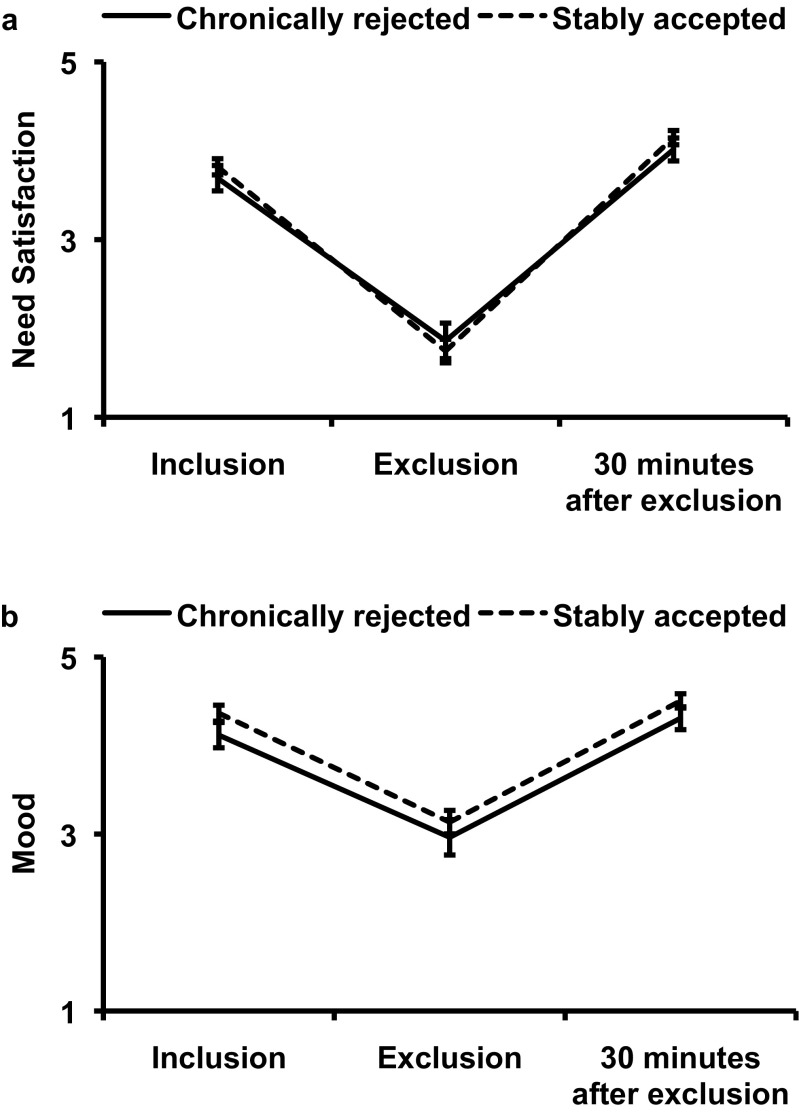
- Both groups reported similar exclusion-induced distress: need satisfaction dropped after exclusion (main effect of time: F(2,84) = 221.73, p < .001, ηp² = .84) and mood dropped (F(2,84) = 98.24, p < .001, ηp² = .71); group × time interactions were not significant (p = .49 and p = .87).
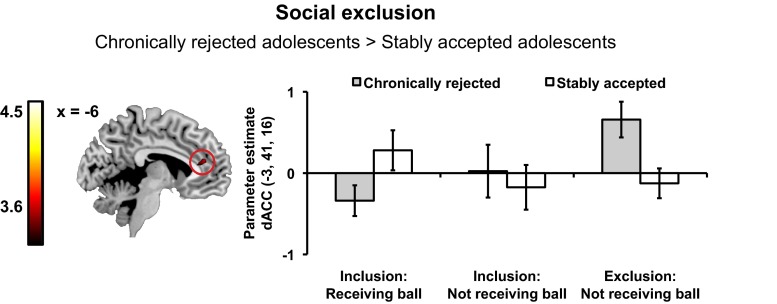
- Chronically rejected adolescents, compared with stably accepted adolescents, showed higher dACC activity during social exclusion (peak MNI −3, 41, 16; thresholded p < .001 uncorrected, >10 voxels).
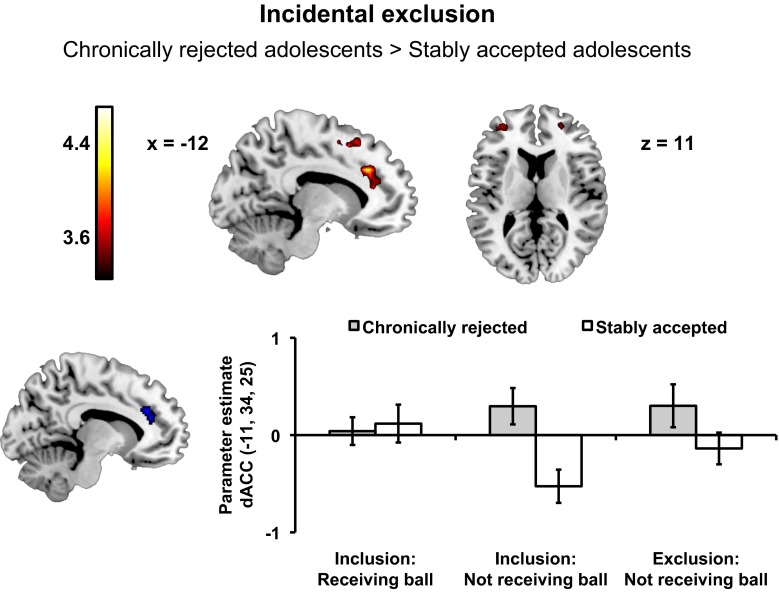
- Chronically rejected adolescents also showed higher activity in dACC (peak −15, 29, 31) extending into left aPFC (−36, 50, 13) and right aPFC (24, 50, 13) during incidental exclusion in the inclusion game.
- No regions showed higher activity in stably accepted adolescents than chronically rejected adolescents in any of the three contrasts.
Methods
- Participants came from the eighth wave of a longitudinal study: 1,189 children were followed annually from first to sixth grade (ages 6–12) with peer nominations; adolescents in the upper or lower 10th percentile of 6-year average social preference were selected. The final fMRI sample was 44 adolescents (mean age 14.0; 27 stably accepted, 17 chronically rejected; the abstract states 19 chronically rejected, while the Method and Table 1 report 17).
- Participants completed the Cyberball fMRI task with inclusion and exclusion runs; mood and need satisfaction were assessed after inclusion, after exclusion, and approximately 30 min after exclusion.
- fMRI data were analyzed with event-related whole-brain SPM8 models; group comparisons tested chronically rejected vs. stably accepted adolescents, with results thresholded at p < .001 uncorrected, minimum 10 contiguous voxels, and FDR-corrected results also reported.
Limitations
- Stated: the study cannot conclude that neural differences are caused by peer status histories; differences may have been present before elementary school, so directionality remains unresolved.
- Stated: the extreme-group design compared only upper and lower 10th percentile groups, so differences may partly reflect hyposensitivity in stably accepted adolescents rather than only hypersensitivity in chronically rejected adolescents.
- Stated/evident: the chronically rejected group included four adolescents with ADHD; removing them did not change findings, but comorbidity remains a consideration. Evident: the final sample was small, especially the chronically rejected group (n = 17), limiting tests of sex interactions and individual differences; Cyberball’s strong distress induction may also reduce self-report variability.
Model-written summary. Check it against the paper before relying on it.
Integrity signals
Registry
Cites
Statistics
Figures
Verification
Claims the paper makes
17 Valid · 0 Not valid · 27 Not checked · 42 Own results and interpretations
The cited sources support only part of this claim — read each source’s verdict below.
In the paper
“Children and adolescents who are rejected by peers suffer from widespread impairments in mental health that can persist across development”
§ Chronic Childhood Peer Rejection is Associated with Heightened Neural Responses to Social Exclusion During Adolescence > Introduction
What the sources say
- Not checked — no full text of the sourcecites Ladd 2006 matched to “Peer Rejection, Aggressive or Withdrawn Behavior, and Psychological Maladjustment from Ages 5 to 12: An Examination of Four Predictive Models” (2006) source
- Not checked — no full text of the sourcecites Ladd and Troop-Gordon 2003 matched to “The Role of Chronic Peer Difficulties in the Development of Children's Psychological Adjustment Problems” (2003) source
- Partly supportedcites Prinstein and Aikins 2004 matched to “Cognitive Moderators of the Longitudinal Association Between Peer Rejection and Adolescent Depressive Symptoms” (2004) sourceExperimental — accuracy not yet measured
The Discussion (page unavailable) links peer rejection in children and adolescents to stress, loneliness, and possible suicidal behavior; the study’s longitudinal findings link it to later depressive symptoms under particular conditions, especially for girls. These passages support adverse mental-health associations, but not a general claim that rejected children and adolescents suffer widespread mental-health impairments that persist across development. (LLM, conf=0.86)
plainstates an association- Asserted: passes — The authors put it forward as true.
- Checkable: passes — It can be checked against evidence.
- Load-bearing: passes — The paper’s conclusions depend on it.
- Based: passes — The paper gives a reason why it holds.
The sources with a verdict support this claim; the rest weren’t checked yet, have no full text we could read, or their verdicts aren’t rated yet.
In the paper
“but also that the self-reports of such distress seem to be less amenable to moderation by individual differences, such as the participant’s sex (Williams and Sommer 1997), their levels of loneliness (Wesselmann et al. 2012) or social anxiety (Zadro et al. 2006).”
§ Chronic Childhood Peer Rejection is Associated with Heightened Neural Responses to Social Exclusion During Adolescence > Discussion > Childhood Peer Status and Self-Reported Distress After Exclusion
What the sources say
- Not checked — no full text of the sourcecites Williams and Sommer 1997 matched to “Social Ostracism by Coworkers: Does Rejection Lead to Loafing or Compensation?” (1997) source
- Supportedcites Wesselmann et al. 2012 matched to “Dial a feeling: Detecting moderation of affect decline during ostracism” (2012) source
The citation to Wesselmann et al. is attached specifically to loneliness, not to sex or social anxiety. Section 3.4 reports that loneliness did not moderate retrospective self-reports or end-of-game affect ratings. The paper distinguishes these measures from continuous affect ratings during Cyberball, which did show moderation by loneliness. (LLM, conf=0.93)
- Not checked — no full text of the sourcecites Zadro et al. 2006 matched to “How long does it last? The persistence of the effects of ostracism in the socially anxious” (2006) source
hedged- Asserted: passes — The authors put it forward as true.
- Checkable: passes — It can be checked against evidence.
- Load-bearing: passes — The paper’s conclusions depend on it.
- Based: passes — The paper gives a reason why it holds.
Every source the paper cites for this claim was checked and supports it.
In the paper
“Higher levels of activity in the dACC and aPFC during exclusion in Cyberball have been shown to be associated with higher levels of rejection sensitivity (Masten et al. 2009)”
§ Chronic Childhood Peer Rejection is Associated with Heightened Neural Responses to Social Exclusion During Adolescence > Discussion > Childhood Peer Status and Neural Responses to Exclusion
What the sources say
- Supportedcites Masten et al. 2009 matched to “Neural correlates of social exclusion during adolescence: understanding the distress of peer rejection” (2009) source
The paper’s analysis of neural activity during social exclusion reports that adolescents with higher rejection-sensitivity scores showed greater dACC and anterolateral PFC activity during Cyberball exclusion compared with inclusion. The claim’s “aPFC” corresponds to the anterolateral PFC reported in the paper. (LLM, conf=0.91)
plainstates an association- Asserted: passes — The authors put it forward as true.
- Checkable: passes — It can be checked against evidence.
- Load-bearing: passes — The paper’s conclusions depend on it.
- Based: passes — The paper gives a reason why it holds.
- Supported
A result the paper reports from its own data — it cites no other source for it, so there is none to check. The quote shows it is in the paper.
In the paper
“No regions showed higher activity in stably accepted adolescents than chronically rejected adolescents in any of the three contrasts”
§ Chronic Childhood Peer Rejection is Associated with Heightened Neural Responses to Social Exclusion During Adolescence > Results > Neuroimaging Results
plain- Asserted: passes — The authors put it forward as true.
- Checkable: passes — It can be checked against evidence.
- Load-bearing: passes — The paper’s conclusions depend on it.
- Based: passes — The paper gives a reason why it holds.
A result the paper reports from its own data — it cites no other source for it, so there is none to check. The quote shows it is in the paper.
In the paper
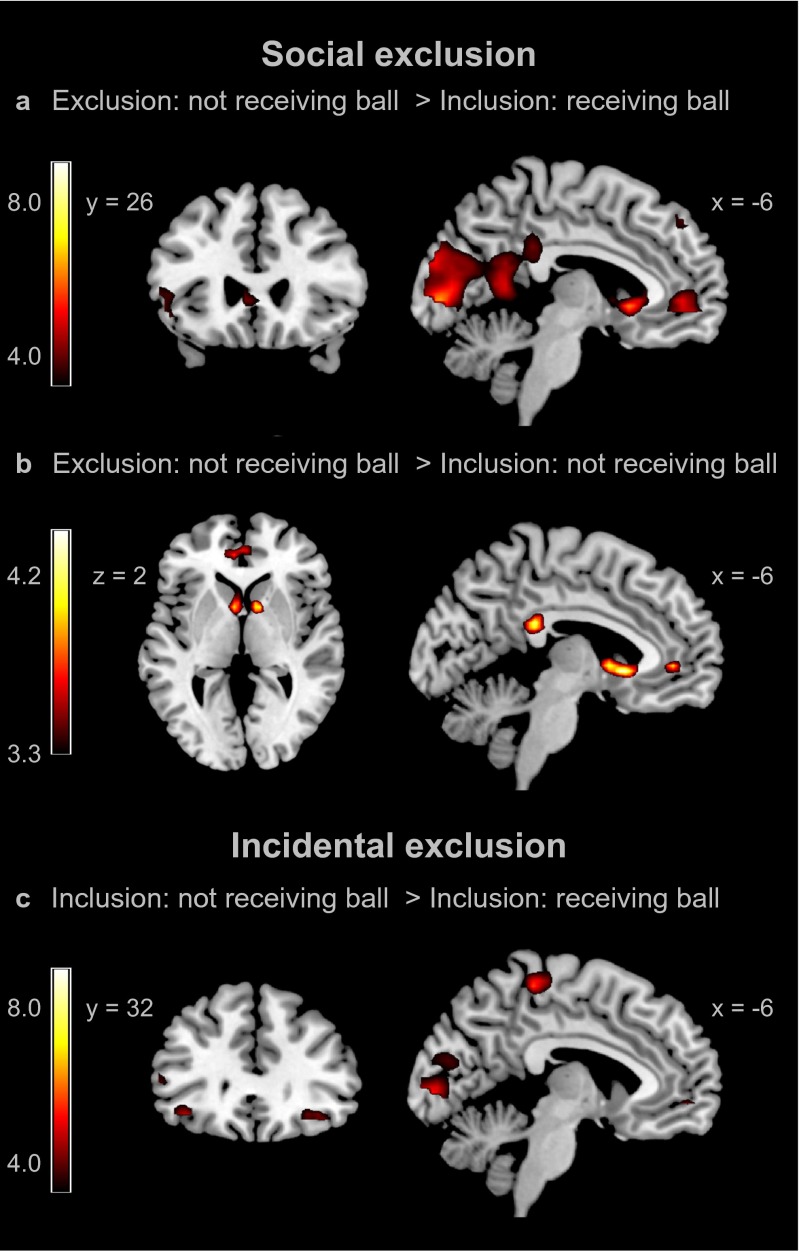
“The second contrast, which compared activation on trials where participants did not receive the ball in the exclusion game with trials where they did not receive the ball in the inclusion game (Exclusion: not receiving the ball > Inclusion: not receiving the ball), resulted in activation in the striatum (peak at -6, 17, -2) and the vACC (peak at -6, 44, 1)”
§ Chronic Childhood Peer Rejection is Associated with Heightened Neural Responses to Social Exclusion During Adolescence > Results > Neuroimaging Results
plain- Asserted: passes — The authors put it forward as true.
- Checkable: passes — It can be checked against evidence.
- Load-bearing: passes — The paper’s conclusions depend on it.
- Based: passes — The paper gives a reason why it holds.
35 more claims
Create a free account to see all 86 claims and to verify the 2 references still open.
- Probably not a substantial claim. 37
- It may state two separate claims as one. 16
Statistics that don’t add up
Each reported p-value recomputed from its test statistic and degrees of freedom, each partial η² from its F, and each ratio, mean difference or B printed with a p checked against its own confidence interval.
Rated minor: it would not touch a result — a value no result rests on, a p-value that stays on the same side of the significance level, or a conflict that is clerical, resolved elsewhere in the paper, or outside its own findings.
In the paper
“F(2, 84) = 98.24, p < .001, ηp 2 = 0.71”
§ Chronic Childhood Peer Rejection is Associated with Heightened Neural Responses to Social Exclusion During Adolescence > Results > Self-Reported Distress
Reported ηp² = .71 · recomputed ηp² .70051–.70052
Statistics recomputed
Every reported test result, recomputed from its test statistic and degrees of freedom. A result shows as not adding up only once an independent check has confirmed it.
- Consistentχ²(1) = 0.4reported p = .51 · recomputed p = .527
“χ 2(1) = 0.4, p = .51”
- ConsistentF(2, 84) = 221.73reported p < .001 · recomputed p < .001
“F(2, 84) = 221.73, p < .001”
- ConsistentF(2, 84) = 98.24reported p < .001 · recomputed p < .001
“F(2, 84) = 98.24, p < .001”
Self-check
Percentages, sums and reported differences re-computed from the paper’s own numbers.
Each contradiction between two passages listed here was confirmed by an independent check.
Rated minor: it would not touch a result — a value no result rests on, a p-value that stays on the same side of the significance level, or a conflict that is clerical, resolved elsewhere in the paper, or outside its own findings.
In the paper
§ Chronic Childhood Peer Rejection is Associated with Heightened Neural Responses to Social Exclusion During Adolescence > Results > Neuroimaging Results
“Table 2 Brain regions revealed by whole-brain analyses testing for peer status history differences in the Cyberball game (all thresholded p < .001 uncorrected, > 10 voxels)”
§ Chronic Childhood Peer Rejection is Associated with Heightened Neural Responses to Social Exclusion During Adolescence > Results > Neuroimaging Results
“| Superior Temporal gyrus | L | 10 | 3.38 | −60 | −34 | 19 |”
Rated minor: it would not touch a result — a value no result rests on, a p-value that stays on the same side of the significance level, or a conflict that is clerical, resolved elsewhere in the paper, or outside its own findings.
In the paper
§ Chronic Childhood Peer Rejection is Associated with Heightened Neural Responses to Social Exclusion During Adolescence > Abstract
“stable accepted (n = 27; 14 males) or a chronic rejected (n = 19; 12 males)”
§ Chronic Childhood Peer Rejection is Associated with Heightened Neural Responses to Social Exclusion During Adolescence > Method > Participants
“The remaining 44 participants had a mean age of 14.0 years (SD = 0.70; 26 males). Twenty-seven adolescents met our criteria for a history of stable peer acceptance (M age = 14.0; SD = 0.77; 14 male) and 17 for a history of chronic peer rejection”
Rated minor: it would not touch a result — a value no result rests on, a p-value that stays on the same side of the significance level, or a conflict that is clerical, resolved elsewhere in the paper, or outside its own findings.
In the paper
§ Chronic Childhood Peer Rejection is Associated with Heightened Neural Responses to Social Exclusion During Adolescence > Method > Participants
“Twenty-seven adolescents met our criteria for a history of stable peer acceptance (M age = 14.0; SD = 0.77; 14 male) and 17 for a history of chronic peer rejection (M age = 14.0; SD = 0.56; 12 male).”
§ Chronic Childhood Peer Rejection is Associated with Heightened Neural Responses to Social Exclusion During Adolescence > Method > Participants
“| Age | 13.98 (0.77) | 14.04 (0.58) | 0.78 |”
Rated minor: it would not touch a result — a value no result rests on, a p-value that stays on the same side of the significance level, or a conflict that is clerical, resolved elsewhere in the paper, or outside its own findings.
In the paper
§ Chronic Childhood Peer Rejection is Associated with Heightened Neural Responses to Social Exclusion During Adolescence > Results > Neuroimaging Results
“the pre-supplementary motor area (peak at -9, 23, 46)”
§ Chronic Childhood Peer Rejection is Associated with Heightened Neural Responses to Social Exclusion During Adolescence > Results > Neuroimaging Results
“| Supplementary Motor Area | R | 16 | 3.37 | 9 | 23 | 46 |”
Citations
Cites
The need to belong: Desire for interpersonal attachments as a fundamental human motivation.
Baumeister, R. F., & Leary, M. R. (1995) · Psychological Bulletin · doi:10.1037//0033-2909.117.3.497 · Cited by 23,245 · cited 2×
“Social exclusion is highly distressing and immediately threatens fundamental human needs, such as our need to belong, our need for control over our (social) environment and our needs for self-esteem and a meaningful existence (Baumeister and Leary 1995; Williams 2007).”
BackgroundTzourio-Mazoyer, N., Landeau, B., Papathanassiou, D., Crivello, F., Etard, O., Delcroix, N., Mazoyer, B., & Joliot, M. (2002) · NeuroImage · doi:10.1006/nimg.2001.0978 · Cited by 16,319
Crick, N. R., & Dodge, K. A. (1994) · Psychological Bulletin · doi:10.1037/0033-2909.115.1.74 · Cited by 5,510
Does Rejection Hurt? An fMRI Study of Social Exclusion
Eisenberger, N. I., Lieberman, M. D., & Williams, K. D. (2003) · Science · doi:10.1126/science.1089134 · Cited by 3,849 · cited 4×
“Of these youths, recent full contact information was available for 131 adolescents, who were subsequently approached for participation in the fMRI study.”
BackgroundInfluentialConflict monitoring and anterior cingulate cortex: an update
Botvinick, M. M., Cohen, J. D., & Carter, C. S. (2004) · Trends in Cognitive Sciences · doi:10.1016/j.tics.2004.10.003 · Cited by 3,623 · cited 2×
“The ACC is implicated in a wide variety of cognitive and emotional processes including conflict monitoring (Botvinick et al. 2004), expectancy violation (Somerville et al. 2006), physical pain and other negative emotions (Shackman et al. 2011), reactions to being treated unfairly (Sanfey et al.…”
BackgroundThe neural basis of economic decision-making in the Ultimatum Game.
Sanfey, A. G., Rilling, J. K., Aronson, J. A., Nystrom, L. E., & Cohen, J. D. (2003) · Science · doi:10.1126/science.1082976 · Cited by 3,375
Peer relations and later personal adjustment: Are low-accepted children at risk?
Parker, J. G., & Asher, S. R. (1987) · Psychological Bulletin · doi:10.1037//0033-2909.102.3.357 · Cited by 2,961
Peer Interactions, Relationships, and Groups
Rubin, K. H., Bukowski, W. M., & Parker, J. G. (2007) · Handbook of Child Psychology · doi:10.1002/9780470147658.chpsy0310 · Cited by 2,755 · cited 1×
“Relationships with peers are vital to satisfying these needs across the lifespan (Ladd 1999; Rubin et al. 2006) and therefore we hypothesized that childhood peer acceptance and rejection have an impact on the extent to which these needs are threatened by social exclusion in adolescence.”
BackgroundThe expected value of control: an integrative theory of anterior cingulate cortex function
Shenhav, A., Botvinick, M. M., & Cohen, J. D. (2013) · Neuron · doi:10.1016/j.neuron.2013.07.007 · Cited by 2,321 · cited 2×
“That is, the dorsal ACC is connected with prefrontal, parietal and motor cortices, and is important for signaling conflict and integrating top-down and bottom-up processes (Shenhav et al. 2013).”
BackgroundCyberostracism: effects of being ignored over the Internet
Williams, K. D., Cheung, C. K. T., & Choi, W. (2000) · Journal of Personality and Social Psychology · doi:10.1037/0022-3514.79.5.748 · Cited by 2,276
Research works printed but not linked: 1
- Brett, M., Anton, J.-L., Valabregue, R., & Poline, J.-B. (2002). Region of interest analysis using an SPM toolbox [abstract]. Presented at the 8th International Conference on Functional Mapping of the Human Brain, June 2-6, 2002, Sendai, Japan. Available on CD-ROM in NeuroImage, 16.
Cited by
Media use and brain development during adolescence
Crone, E. A., & Konijn, E. A. (2018) · Nature Communications · doi:10.1038/s41467-018-03126-x · Cited by 464
Self-citationStudying individual differences in human adolescent brain development
Foulkes, L., & Blakemore, S.-J. (2018) · Nature Neuroscience · doi:10.1038/s41593-018-0078-4 · Cited by 413
Navigating the Social Environment in Adolescence: The Role of Social Brain Development
Andrews, J. L., Ahmed, S. P., & Blakemore, S.-J. (2021) · Biological Psychiatry · doi:10.1016/j.biopsych.2020.09.012 · Cited by 337
The neurobiology of the emotional adolescent: From the inside out
Guyer, A. E., Silk, J. S., & Nelson, E. E. (2016) · Neuroscience & Biobehavioral Reviews · doi:10.1016/j.neubiorev.2016.07.037 · Cited by 318
Vijayakumar, N., Cheng, T. W., & Pfeifer, J. H. (2017) · NeuroImage · doi:10.1016/j.neuroimage.2017.02.050 · Cited by 161
“…convenience samples aged approximately between 18 and 25 years, a number of studies have also focused specifically on developing (primarily adolescent) samples to examine developmental correlates of social exclusion (Bolling et al., 2011a; Falk et al., 2014; Puetz et al., 2014; Will et al., 2016).”
BackgroundInfluentialResilience and the brain: a key role for regulatory circuits linked to social stress and support
Holz, N. E., Tost, H., & Meyer-Lindenberg, A. (2020) · Molecular Psychiatry · doi:10.1038/s41380-019-0551-9 · Cited by 162
How the brain reacts to social stress (exclusion) – A scoping review
Wang, H., Braun, C., & Enck, P. (2017) · Neuroscience & Biobehavioral Reviews · doi:10.1016/j.neubiorev.2017.05.012 · Cited by 150
Future Directions in Peer Relations Research
Prinstein, M. J., & Giletta, M. (2020) · Journal of Clinical Child & Adolescent Psychology · doi:10.1080/15374416.2020.1756299 · Cited by 112
Social exclusion reliably engages the default network: A meta-analysis of Cyberball
Mwilambwe-Tshilobo, L., & Spreng, R. N. (2020) · NeuroImage · doi:10.1016/j.neuroimage.2020.117666 · Cited by 130
Rudolph, K. D., Miernicki, M. E., Troop-Gordon, W., Davis, M. M., & Telzer, E. H. (2016) · Social Cognitive and Affective Neuroscience · doi:10.1093/scan/nsw021 · Cited by 104
Bullying Victimization and Trauma
Idsøe, T., Vaillancourt, T., Dyregrov, A., Hagen, K. A., Ogden, T., & Nærde, A. (2021) · Frontiers in Psychiatry · doi:10.3389/fpsyt.2020.480353 · Cited by 153
Children's Reasoning About Social Exclusion: Balancing Many Factors
Mulvey, K. L. (2015) · Child Development Perspectives · doi:10.1111/cdep.12157 · Cited by 94
Adolescent brain development and contextual influences: a decade in review
Galván, A. (2021) · Journal of Research on Adolescence · doi:10.1111/jora.12687 · Cited by 77
Frequent Bullying Involvement and Brain Morphology in Children
Muetzel, R. L., Mulder, R. H., Lamballais, S., Cortes Hidalgo, A. P., Jansen, P., Güroğlu, B., Vernooiji, M. W., Hillegers, M., White, T., El Marroun, H., et al. (2019) · Frontiers in Psychiatry · doi:10.3389/fpsyt.2019.00696 · Cited by 76
Self-citationCrone, E. A., Achterberg, M., Dobbelaar, S., Euser, S., van den Bulk, B., der Meulen, M. V., van Drunen, L., Wierenga, L. M., Bakermans-Kranenburg, M. J., & van IJzendoorn, M. H. (2020) · Developmental Cognitive Neuroscience · doi:10.1016/j.dcn.2020.100805 · Cited by 74
Self-citationvan Lier, P. A. C., & Deater-Deckard, K. D. (2015) · Research on Child and Adolescent Psychopathology · doi:10.1007/s10802-015-0113-9 · Cited by 90
Self-citationChronic peer victimization heightens neural sensitivity to risk taking
Telzer, E. H., Miernicki, M. E., & Rudolph, K. D. (2018) · Development and Psychopathology · doi:10.1017/s0954579417000438 · Cited by 61
The Social Cognitions of Victims of Bullying: A Systematic Review
Kellij, S., Lodder, G. M. A., van den Bedem, N. P., Güroğlu, B., & Veenstra, R. (2022) · Adolescent Research Review · doi:10.1007/s40894-022-00183-8 · Cited by 80
Self-citationBabinski, D. E., Kujawa, A., Kessel, E. M., Arfer, K. B., & Klein, D. N. (2019) · Journal of Abnormal Child Psychology · doi:10.1007/s10802-018-0470-2 · Cited by 58
Social relationships and children’s perceptions of adversity
Smith, K. E., & Pollak, S. D. (2021) · Child Development Perspectives · doi:10.1111/cdep.12427 · Cited by 61
Will, G., Crone, E. A., van Lier, P. A. C., & Güroğlu, B. (2016) · Developmental Cognitive Neuroscience · doi:10.1016/j.dcn.2016.05.004 · Cited by 66
Self-citationSocial exclusion affects working memory performance in young adolescent girls
Fuhrmann, D., Casey, C. S., Speekenbrink, M., & Blakemore, S. (2019) · Developmental Cognitive Neuroscience · doi:10.1016/j.dcn.2019.100718 · Cited by 61
Annual Research Review: Developmental computational psychiatry
Hauser, T. U., Will, G., Dubois, M., & Dolan, R. J. (2018) · Journal of Child Psychology and Psychiatry · doi:10.1111/jcpp.12964 · Cited by 57
Self-citationBehavioral and EEG responses to social evaluation: A two-generation family study on social anxiety
Harrewijn, A., van der Molen, M. J. W., van Vliet, I. M., Tissier, R., & Westenberg, P. M. (2017) · NeuroImage Clinical · doi:10.1016/j.nicl.2017.11.010 · Cited by 58
Olino, T. M. (2016) · Journal of Clinical Child & Adolescent Psychology · doi:10.1080/15374416.2015.1118694 · Cited by 59
Kuutti, T., Sajaniemi, N. K., Björn, P. M., Heiskanen, N., & Reunamo, J. (2021) · European Journal of Special Needs Education · doi:10.1080/08856257.2021.1920214 · Cited by 102
Rudolph, K. D., Davis, M. M., Modi, H. H., Fowler, C. H., Kim, Y., & Telzer, E. H. (2018) · Journal of Research on Adolescence · doi:10.1111/jora.12458 · Cited by 51
Heritability of neural reactions to social exclusion and prosocial compensation in middle childhood
van der Meulen, M., Steinbeis, N., Achterberg, M., van IJzendoorn, M. H., & Crone, E. A. (2018) · Developmental Cognitive Neuroscience · doi:10.1016/j.dcn.2018.05.010 · Cited by 48
Self-citationLongitudinal Changes in Social Brain Development: Processing Outcomes for Friend and Self
Braams, B. R., & Crone, E. A. (2017) · Child Development · doi:10.1111/cdev.12665 · Cited by 44
Self-citationLambe, L. J., Craig, W., & Hollenstein, T. (2019) · Research on Child and Adolescent Psychopathology · doi:10.1007/s10802-019-00565-y · Cited by 43
Adolescent social rejection alters pain processing in a CB1 receptor dependent manner
Schneider, P., Pätz, M., Spanagel, R., & Schneider, M. (2016) · European Neuropsychopharmacology · doi:10.1016/j.euroneuro.2016.04.007 · Cited by 38
Rudolph, K. D., Skymba, H. V., Modi, H. H., Davis, M. M., Sze, W. Y., Rosswurm, C. P., & Telzer, E. H. (2020) · Developmental Psychobiology · doi:10.1002/dev.22022 · Cited by 42
Smith, K. E., & Pollak, S. D. (2021) · Cognitive Affective & Behavioral Neuroscience · doi:10.3758/s13415-021-00901-0 · Cited by 41
du Plessis, M. R., Smeekens, S., Cillessen, A. H. N., Whittle, S., & Güroğlu, B. (2019) · Frontiers in Psychology · doi:10.3389/fpsyg.2018.02706 · Cited by 55
Self-citationRudolph, K. D., Davis, M. M., Skymba, H. V., Modi, H. H., & Telzer, E. H. (2020) · Developmental Cognitive Neuroscience · doi:10.1016/j.dcn.2020.100903 · Cited by 44
LoParo, D., Fonseca, A. C., Matos, A. P., & Craighead, W. E. (2023) · Research on Child and Adolescent Psychopathology · doi:10.1007/s10802-023-01053-0 · Cited by 46
Schriber, R. A., Rogers, C. R., Ferrer, E. E., Conger, R. D., Robins, R. W., Hastings, P. D., & Guyer, A. E. (2018) · Journal of Research on Adolescence · doi:10.1111/jora.12340 · Cited by 40
Weinberg, A., Ethridge, P., Pegg, S. L., Freeman, C. R., Kujawa, A., & Dirks, M. A. (2020) · Psychophysiology · doi:10.1111/psyp.13748 · Cited by 40
Palamarchuk, I. S., & Vaillancourt, T. (2022) · Frontiers in Integrative Neuroscience · doi:10.3389/fnint.2022.782154 · Cited by 46
Neurobiological correlates of the social and emotional impact of peer victimization: A review
Cubillo, A. (2022) · Frontiers in Psychiatry · doi:10.3389/fpsyt.2022.866926 · Cited by 43
Davis, M. M., Modi, H. H., Skymba, H. V., Finnegan, M. K., Haigler, K., Telzer, E. H., & Rudolph, K. D. (2022) · Social Cognitive and Affective Neuroscience · doi:10.1093/scan/nsac055 · Cited by 39
Longitudinal links between childhood peer acceptance and the neural correlates of sharing
Will, G., Crone, E. A., van Lier, P. A. C., & Güroğlu, B. (2016) · Developmental Science · doi:10.1111/desc.12489 · Cited by 37
Self-citationPerceived live interaction modulates the developing social brain
Warnell, K. R., Moraczewski, D., & Redcay, E. (2016) · Social Cognitive and Affective Neuroscience · doi:10.1093/scan/nsw060 · Cited by 36
Neural responses to social exclusion in adolescents: Effects of peer status
de Water, E., Mies, G. W., Ma, I., Mennes, M., Cillessen, A. H. N., & Scheres, A. (2017) · Cortex · doi:10.1016/j.cortex.2017.02.018 · Cited by 32
Bhui, K. S., Silva, M. J., Harding, S., & Stansfeld, S. A. (2017) · Journal of Adolescent Health · doi:10.1016/j.jadohealth.2017.03.009 · Cited by 37
The impact of social exclusion on anticipatory attentional processing
Kiat, J. E., Cheadle, J. E., & Goosby, B. J. (2017) · International Journal of Psychophysiology · doi:10.1016/j.ijpsycho.2017.11.010 · Cited by 31
Amygdala activity to angry and fearful faces relates to bullying and victimization in adolescents
Swartz, J. R., Carranza, A. F., & Knodt, A. R. (2019) · Social Cognitive and Affective Neuroscience · doi:10.1093/scan/nsz084 · Cited by 35
Cheng, T. W., Vijayakumar, N., Flournoy, J. C., Op de Macks, Z., Peake, S. J., Flannery, J. E., Mobasser, A., Alberti, S. L., Fisher, P. A., & Pfeifer, J. H. (2020) · Cognitive, Affective, & Behavioral Neuroscience · doi:10.3758/s13415-020-00772-x · Cited by 29
Connecting Childhood Wariness to Adolescent Social Anxiety through the Brain and Peer Experiences
Jarcho, J. M., Grossman, H., Guyer, A. E., Quarmley, M., Smith, A. R., Fox, N. A., Leibenluft, E., Pine, D. S., & Nelson, E. E. (2019) · Research on Child and Adolescent Psychopathology · doi:10.1007/s10802-019-00543-4 · Cited by 30
Peer Victimization Is Associated With Neural Response to Social Exclusion
McIver, T. A., Bosma, R. L., Sandre, A., Goegan, S. A., Klassen, J. A., Chiarella, J., Booij, L., & Craig, W. (2018) · Merrill-palmer Quarterly · doi:10.13110/merrpalmquar1982.64.1.0135 · Cited by 32
Silk, J. S., Sequeira, S. L., Jones, N. P., Lee, K. H., Dahl, R. E., Forbes, E. E., Ryan, N. D., & Ladouceur, C. D. (2022) · Journal of Clinical Child & Adolescent Psychology · doi:10.1080/15374416.2021.2019048 · Cited by 32
Social anxiety and age are associated with neural response to social evaluation during adolescence
Smith, A. R., Nelson, E. E., Kircanski, K., Rappaport, B. I., Do, Q. B., Leibenluft, E., Pine, D. S., & Jarcho, J. M. (2020) · Developmental Cognitive Neuroscience · doi:10.1016/j.dcn.2020.100768 · Cited by 31
Sequeira, S. L., Silk, J. S., Edershile, E. A., Jones, N. P., Hanson, J. L., Forbes, E. E., & Ladouceur, C. D. (2021) · Social Cognitive and Affective Neuroscience · doi:10.1093/scan/nsab038 · Cited by 25
Ponsi, G., Monachesi, B., Panasiti, V., Aglioti, S. M., & Panasiti, M. S. (2018) · Journal of Neurophysiology · doi:10.1152/jn.00555.2018 · Cited by 28
Cucu-Ciuhan, G., & Iliescu, D. (2021) · Acta Psychologica · doi:10.1016/j.actpsy.2021.103420 · Cited by 30
Ke, T., Simoni, S. D., Barker, E. D., & Smith, P. A. (2022) · JCPP Advances · doi:10.1002/jcv2.12081 · Cited by 31
Adolescents’ affective and neural responses to parental praise and criticism
van Houtum, L. A. E. M., Will, G., Wever, M. C. M., Janssen, L. H. C., van Schie, C. C., Tollenaar, M. S., & Elzinga, B. M. (2022) · Developmental Cognitive Neuroscience · doi:10.1016/j.dcn.2022.101099 · Cited by 27
Self-citationBACETE, F. J. G., Tinoco, V. M., Perrin, G. M., & Rosel, J. (2021) · Sustainability · doi:10.3390/su13052650 · Cited by 31
He, J., Koot, H. M., Buil, J. M., & van Lier, P. A. C. (2017) · Research on Child and Adolescent Psychopathology · doi:10.1007/s10802-017-0382-6 · Cited by 21
Self-citationThe Physiological and Psychological Effects of Ostracism in Adults with ASD
Trimmer, E. M., McDonald, S., Kelly, M., & Rushby, J. A. (2017) · Journal of Autism and Developmental Disorders · doi:10.1007/s10803-017-3146-9 · Cited by 22
Schulz, C. C., von Klitzing, K., Deserno, L., Sheridan, M. A., Crowley, M. J., Schoett, M. J. S., Hoffmann, F., Villringer, A., Vrtička, P., & White, L. O. (2022) · Development and Psychopathology · doi:10.1017/s0954579421001681 · Cited by 22
Dishion, T. J. (2016) · Research on Child and Adolescent Psychopathology · doi:10.1007/s10802-015-0117-5 · Cited by 27
Contextual exclusion processing: an fMRI study of rejection in a performance-related context
Wagels, L., Bergs, R., Clemens, B., Bauchmüller, M., Gur, R. C., Schneider, F. W., Habel, U., & Kohn, N. (2016) · Brain Imaging and Behavior · doi:10.1007/s11682-016-9561-2 · Cited by 20
Rudolph, K. D. (2017) · Journal of Applied Developmental Psychology · doi:10.1016/j.appdev.2017.05.006 · Cited by 27
Bidirectional Associations between Peer Relations and Attention Problems from 9 to 16 Years
Ji, L., Pan, B., Zhang, W., Zhang, L., Chen, L., & Deater-Deckard, K. D. (2018) · Research on Child and Adolescent Psychopathology · doi:10.1007/s10802-018-0440-8 · Cited by 24
Neural Underpinnings of Peer Experiences and Interactions: A Review of Social Neuroscience Research
Güroğlu, B., & Veenstra, R. (2021) · Merrill-palmer Quarterly · doi:10.1353/mpq.2021.0021 · Cited by 29
Self-citationGeckeler, K. C., Barch, D. M., & Karcher, N. R. (2022) · Neuropsychopharmacology · doi:10.1038/s41386-022-01286-5 · Cited by 22
Meisel, S. N., Colder, C. R., Bowker, J. C., & Hussong, A. M. (2018) · Developmental Psychology · doi:10.1037/dev0000569 · Cited by 24
Fritz, J., Stretton, J., Askelund, A. D., Schweizer, S., Walsh, N. D., Elzinga, B. M., Goodyer, I. M., Wilkinson, P. O., & van Harmelen, A.-L. (2020) · Development and Psychopathology · doi:10.1017/s0954579419000178 · Cited by 18
“Similarly, Will et al. (2016) as well as van Harmelen et al. (2014) showed that (a) social rejection is associated with negative mood responses, but (b) negative mood responses to social rejection are not specific to adolescents with a history of chronic social rejection.”
Brain Responses to Peer Feedback in Social Media Are Modulated by Valence in Late Adolescence
Wikman, P. A., Moisala, M., Ylinen, A., Lindblom, J., Leikas, S., Salmela‐Aro, K., Lonka, K., Güroğlu, B., & Alho, K. (2022) · Frontiers in Behavioral Neuroscience · doi:10.3389/fnbeh.2022.790478 · Cited by 30
Self-citationNeural signatures of bullying experience and social rejection in teenagers
Kiefer, M., Sim, E.-J., Heil, S., Brown, R. C., Herrnberger, B., Spitzer, M., & Grön, G. (2021) · PLoS ONE · doi:10.1371/journal.pone.0255681 · Cited by 25
Perceived burdensomeness and neural responses to ostracism in the Cyberball task
Le, T. M., Zhornitsky, S., Wang, W., & Li, C. R. (2020) · Journal of Psychiatric Research · doi:10.1016/j.jpsychires.2020.06.015 · Cited by 20
Kirshenbaum, J. S., Pagliaccio, D., Pizzagalli, D. A., & Auerbach, R. P. (2024) · Translational Psychiatry · doi:10.1038/s41398-024-02818-x · Cited by 19
Asscheman, J. S., Koot, S., Ma, I., Buil, J. M., Krabbendam, L., Cillessen, A. H. N., & van Lier, P. A. C. (2019) · Developmental Cognitive Neuroscience · doi:10.1016/j.dcn.2019.100673 · Cited by 16
Self-citationVicarious praise and pain: parental neural responses to social feedback about their adolescent child
van Houtum, L. A. E. M., Wever, M. C. M., Janssen, L. H. C., van Schie, C. C., Will, G., Tollenaar, M. S., & Elzinga, B. M. (2021) · Social Cognitive and Affective Neuroscience · doi:10.1093/scan/nsab004 · Cited by 14
Self-citationBierman, K. L., Welsh, J. A., Hall, C. M., Jacobson, L. N., Lee, D. L., & Jones, D. E. (2022) · Journal of Clinical Child & Adolescent Psychology · doi:10.1080/15374416.2022.2051523 · Cited by 18
Schrimpf, A. M., Kube, J., Neumann, J., Horstmann, A., Villringer, A., & Gaebler, M. (2016) · Cognitive Affective & Behavioral Neuroscience · doi:10.3758/s13415-016-0482-8 · Cited by 16
Tang, A., Lahat, A., Crowley, M. J., Wu, J., & Schmidt, L. A. (2021) · Cognitive Affective & Behavioral Neuroscience · doi:10.3758/s13415-021-00916-7 · Cited by 13
Do, K. T., McCormick, E. M., Prinstein, M. J., Lindquist, K. A., & Telzer, E. H. (2022) · Scientific Reports · doi:10.1038/s41598-022-17780-1 · Cited by 16
Akçakese, A., & Demirel, M. (2024) · World Leisure Journal · doi:10.1080/16078055.2024.2337911 · Cited by 15
Walsh, R. J., van Buuren, M., Hollarek, M., Sijtsma, H., Lee, N. C., & Krabbendam, L. (2023) · The Journal of Early Adolescence · doi:10.1177/02724316231160147 · Cited by 12
A Longitudinal Study of Forms of Peer Victimization and Internalizing Problems in Adolescence
Kawabata, Y., Kinoshita, M., & Onishi, A. (2024) · Research on Child and Adolescent Psychopathology · doi:10.1007/s10802-023-01155-9 · Cited by 13
Abiodun, O. A., Lawal, I. A., & Omokanye, C. O. (2018) · AIDS Care · doi:10.1080/09540121.2018.1441973 · Cited by 12
Vandenbroucke, L., Spilt, J. L., Verschueren, K., & Baeyens, D. (2018) · Learning and Individual Differences · doi:10.1016/j.lindif.2018.06.007 · Cited by 15
Social Supports Available to Persons with Disabilities in Nigeria
Onalu, C. E., & Nwafor, N. F. (2021) · IntechOpen eBooks · doi:10.5772/intechopen.97790 · Cited by 11
How Self-Appraisal Is Mediated by the Brain
Knyazev, G. G., Savostyanov, A. N., Bocharov, A. V., & Rudych, P. D. (2021) · Frontiers in Human Neuroscience · doi:10.3389/fnhum.2021.700046 · Cited by 16
Understanding the Dynamics of the Developing Adolescent Brain Through Team Science
Zanolie, K., Ma, I., Bos, M. G. N., Schreuders, E., Vandenbroucke, A. R. E., van Hoorn, J., van Duijvenvoorde, A. C. K., Wierenga, L. M., Crone, E. A., & Güroğlu, B. (2022) · Frontiers in Integrative Neuroscience · doi:10.3389/fnint.2022.827097 · Cited by 16
Self-citationSilk, J. S., Sequeira, S. L., James, K. M., Kilic, Z., Grad-Freilich, M. J., Choukas‐Bradley, S., & Ladouceur, C. D. (2024) · Affective Science · doi:10.1007/s42761-024-00252-2 · Cited by 12
Morosan, L., Wigman, J. T. W., Groen, R. N., Schreuder, M. J., Wichers, M., & Hartman, C. A. (2022) · Journal of Youth and Adolescence · doi:10.1007/s10964-022-01660-y · Cited by 13
Behnsen, P., Buil, J. M., Koot, S., Huizink, A. C., & van Lier, P. A. C. (2019) · Development and Psychopathology · doi:10.1017/s0954579419000269 · Cited by 10
Self-citationKaniušonytė, G., & Laursen, B. P. (2024) · Journal of Child Psychology and Psychiatry · doi:10.1111/jcpp.14043 · Cited by 8
Beard, S. J., Hastings, P. D., Ferrer, E. E., Robins, R. W., & Guyer, A. E. (2021) · Biological Psychiatry Cognitive Neuroscience and Neuroimaging · doi:10.1016/j.bpsc.2021.06.006 · Cited by 15
Media use and brain development during adolescence
Crone, E. A., & Konijn, E. A. (2018) · Yearbook of pediatric endocrinology · doi:10.1530/ey.15.7.4 · Cited by 9
Self-citationThe Cognitive Mechanisms That Drive Social Belief Updates During AdolescencePreprint
Ma, I., Westhoff, B., & van Duijvenvoorde, A. C. K. (2020) · bioRxiv (Cold Spring Harbor Laboratory) · doi:10.1101/2020.05.19.105114 · Cited by 9
Surakka, A., Vengeliene, V., Skorodumov, I., Meinhardt, M. W., Hansson, A. C., & Spanagel, R. (2021) · Alcoholism Clinical and Experimental Research · doi:10.1111/acer.14640 · Cited by 8
Clark, K. A., Pachankis, J. E., Dougherty, L. R., Katz, B. A., Hill, K. E., Klein, D. N., & Kujawa, A. (2023) · Clinical Psychological Science · doi:10.1177/21677026231158574 · Cited by 14
Social exclusion: differences in neural mechanisms underlying direct versus vicarious experience
Song, J., Lian, T., Zhang, Y., Cao, M., & Jiao, Z. (2024) · Frontiers in Psychology · doi:10.3389/fpsyg.2024.1368214 · Cited by 4
“Previous research has shown that social exclusion increases activation in the prefrontal cortex (PFC) among adolescents (Will et al., 2016) and enhances activation in the temporoparietal junction (TPJ) of observers (Tousignant et al., 2018).”
BackgroundMethodLev‐Wiesel, R., Ami, R. B., Jerbi, L. H., Posklinsky, E., Marom, S., Alon, S. N., Weinger, S., & Shenaar‐Golan, V. (2021) · The Arts in Psychotherapy · doi:10.1016/j.aip.2021.101856 · Cited by 5
Hollarek, M., van Buuren, M., Asscheman, J. S., Cillessen, A. H. N., Koot, S., van Lier, P. A. C., & Krabbendam, L. (2023) · Social Neuroscience · doi:10.1080/17470919.2023.2207837 · Cited by 5
Self-citationLi, M., Jin, G., Ren, T., Haidabieke, A., Chen, L., & Ding, X. (2023) · Behavioral Sciences · doi:10.3390/bs13070547 · Cited by 9
Metadata
- Authors
- Will, G.-J., van Lier, P. A. C., Crone, E. A., & Güroğlu, B.
- Affiliations
- Leiden University (NL)
- Corresponding author
- Will, Geert-Jan
- Venue
- Journal of Abnormal Child Psychology
- Published
- 2015-03-12
- Volume
- 44
- Issue
- 1
- Pages
- 43-55
- ISSN
- 0091-0627 (ISSN-L)
- 1573-2835
- PMC
- PMC4715124
- OpenAlex
- W1978329260
- Cited by
- 169
- References
- 73
- Citations by year
- 2026: 11 · 2025: 9 · 2024: 13 · 2023: 9 · 2022: 20 · 2021: 20 · 2020: 16 · 2019: 12 · 2018: 30 · 2017: 13 · 2016: 12 · 2015: 4
- FWCI
- 32.17
- Type
- journal article
- Language
- en
- Open access
- hybrid
- doi.org
- Locations
- Research on Child and Adolescent Psychopathology (publishedVersion, cc-by)
- PubMed Central (publishedVersion, cc-by)
- PubMed (publishedVersion)
- VU Research Portal (publishedVersion, other-oa)
- Leiden Repository (Leiden University) (submittedVersion)
- Data Archiving and Networked Services (DANS) (submittedVersion, other-oa)
- Funders
- Nederlandse Organisatie voor Wetenschappelijk Onderzoek (451-10-021, 056-34-010)
- Topics
- Social Sciences › Psychology › Social Psychology › Death Anxiety and Social Exclusion
- Social Sciences › Psychology › Social Psychology › Bullying, Victimization, and Aggression
- Social Sciences › Psychology › Clinical Psychology › Child and Adolescent Psychosocial and Emotional Development
- Keywords
- social exclusion, adolescents, dorsal anterior cingulate cortex, anterior prefrontal cortex, Cyberball, social distress, peer acceptance, mental health outcomes
- MeSH terms
- Adolescent, Affect, Analysis of Variance, Brain, Child, Female, Humans, Interpersonal Relations, Longitudinal Studies, Magnetic Resonance Imaging, Male, Peer Group, Rejection, Psychology, Self Concept, Sports, Video Games
About these checks
Registry, retraction, Cites and statistics results are computed, not judged, with one exception: a printed reference that no index lists is read once by a model before it counts as a citation error. Claims are extracted by a model and kept only when their quote appears verbatim in the text; each cited source is then checked, with a model’s help, for whether it says what the claim relies on. Those verdicts can be wrong — read the claim’s quote and the cited source before relying on one.
The claim verdicts this report counts are experimental: their accuracy is not yet measured.
A language model drew the claims from the paper on 2026-10-10, under version 3 of the claim definition (model deepseek-v4.1-flash, prompt extract-v3).
A second model labelled each claim on 2026-10-10 (model jev-1.13-20260917, definition revision gold-guideline-v0.2).
Cited sources are checked with a language model’s help (gpt-6-sol).
Statistics and arithmetic are recomputed, not judged.
Confidence bands are shown only for fields calibrated on our annotated test set. None is calibrated yet, so no band is shown.
What counts as a claim ›How we measure confidence ›How we check this ›
Are you an author, or do you see a problem with this page? Request a review
Data sources
Bibliographic data: Semantic Scholar, OpenAlex, Crossref.
Contains information from the Semantic Scholar Academic Graph Datasets, made available under the ODC Attribution License (ODC-BY 1.0).
Semantic Scholar’s data is described in: Kinney, R., et al. (2023). The Semantic Scholar Open Data Platform. arXiv:2301.10140.
