

The relationship between intolerance of uncertainty, sensory sensitivities and anxiety in autistic and typically developing children
Open accessThe DOI matches its Crossref record; 55 of the 59 references it cites were found in a registry or an index.
Abstract
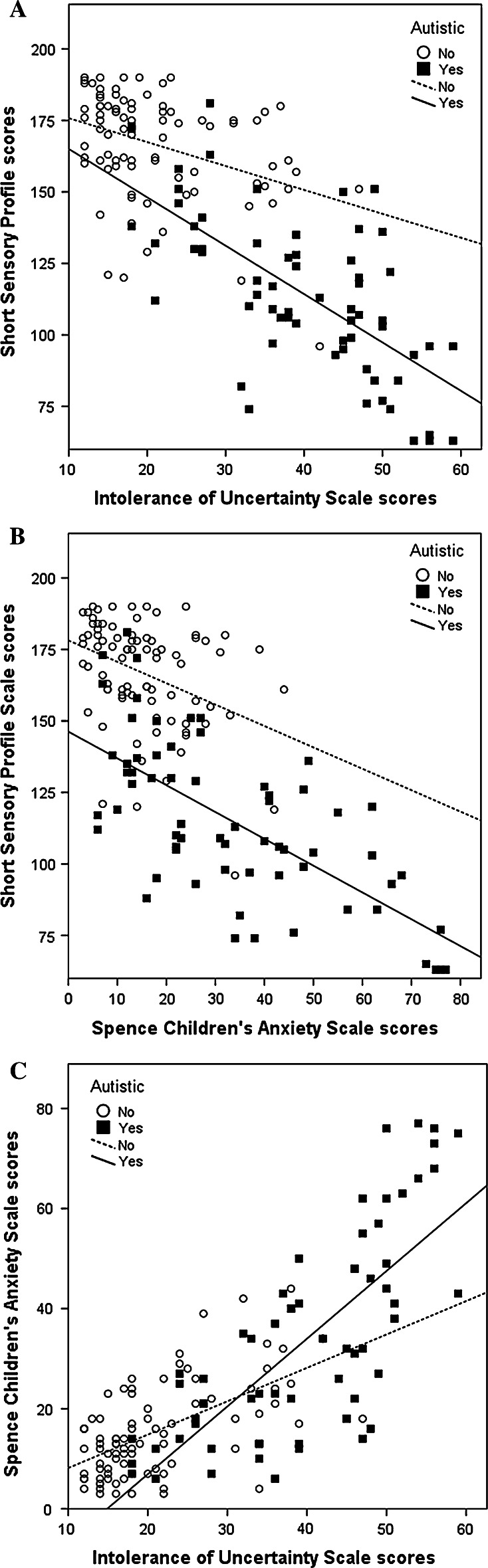
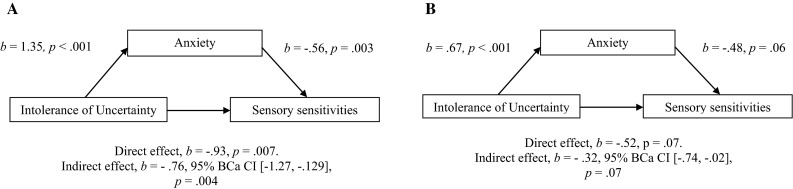
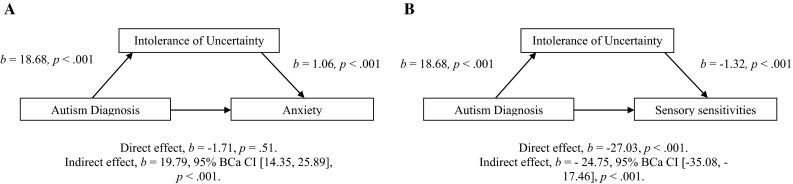
Guided by a recent theory that proposes fundamental differences in how autistic individuals deal with uncertainty, we investigated the extent to which the cognitive construct 'intolerance of uncertainty' and anxiety were related to parental reports of sensory sensitivities in 64 autistic and 85 typically developing children aged 6-14 years. Intolerance of uncertainty and anxiety explained approximately half the variance in autistic children's sensory sensitivities, but only around a fifth of the variance in typical children's sensory sensitivities. In children with autism only, intolerance of uncertainty remained a significant predictor of children's sensory sensitivities once the effects of anxiety were adjusted for. Our results suggest intolerance of uncertainty is a relevant construct to sensory sensitivities in children with and without autism.
Overview
The claims and statistics of this paper haven’t been checked yet.
Free: it reads the open-access text and checks the first 5 claims that cite a source we can check. Create a free account to check every claim.
Integrity signals
Registry
Cites
Statistics
Figures
Verification
Claims the paper makes
The claims and statistics of this paper haven’t been checked yet.
Free: it reads the open-access text and checks the first 5 claims that cite a source we can check. Create a free account to check every claim.
Claims other papers make about this one
Each is checked against this paper’s own text: does it say what the citing paper says it does?
The source backs part of the claim, not all of it — or backs it for a different population, condition or comparison.
In the citing paper
“For example, cognitive and behavioral rigidity may create enhanced uncertainty about whether exact rules will be followed, and may also be associated with repetitive and restricted behaviors (see e.g., Wigham et al., 2015; Neil et al., 2016).”
From Sensory, emotional and cognitive contributions to anxiety in autism spectrum disorders (2017) · cites this paper as Neil et al., 2016
Experimental — accuracy not yet measuredThe source backs part of the claim, not all of it — or backs it for a different population, condition or comparison.
In the citing paper
“They found significantly higher IUS-C and SCAS scores for ASD children and adolescents than a typical comparison group, a finding recently replicated by Neil et al. (2016) with similarly large samples.”
From Sensory, emotional and cognitive contributions to anxiety in autism spectrum disorders (2017) · cites this paper as Neil et al., 2016
Experimental — accuracy not yet measuredThe source backs part of the claim, not all of it — or backs it for a different population, condition or comparison.
In the citing paper
“Parent-report scores were higher for the ASD than control group for sensory sensitivities, IU and anxiety scales.”
From Sensory, emotional and cognitive contributions to anxiety in autism spectrum disorders (2017) · cites this paper as Neil et al., 2016
Experimental — accuracy not yet measuredThe cited source says what the claim attributes to it.
In the citing paper
“Neil, Olsson and Pellicano (2016) found that intolerance of uncertainty and anxiety were related to autistic children’s sensory sensitivities, suggesting that there could be a dynamic interplay between different variables and mental health outcomes.”
From Experiences of autism acceptance and mental health in autistic adults (2018) · cites this paper as Neil, Olsson and Pellicano (2016)
The cited source says what the claim attributes to it.
In the citing paper
“and Neil et al. (2016) have shown that the interrelations among SPD, IU and anxiety can also be understood under alternative causal assumptions.”
From Examining a model of anxiety in autistic adults (2024) · cites this paper as Neil et al. (2016)
7 more claims about this paper
Create a free account to see every claim other papers make about this one.
Self-check
Percentages, sums and reported differences re-computed from the paper’s own numbers.
The self-check needs the paper’s full text.
Citations
Cites
Diagnostic and Statistical Manual of Mental Disorders
American Psychiatric Association (2013) · doi:10.1176/appi.books.9780890425596 · Cited by 116,369
Diagnostic and Statistical Manual of Mental Disorders
Williams, J. B. W., & First, M. (2013) · Encyclopedia of Social Work · doi:10.1093/acrefore/9780199975839.013.104 · Cited by 109,519
Statistical Power Analysis for the Behavioral Sciences
Muller, K. (1989) · Technometrics · doi:10.1080/00401706.1989.10488618 · Cited by 99,167
Statistical power analysis for the behavioral sciences
(1990) · Computers, Environment and Urban Systems · doi:10.1016/0198-9715(90)90050-4 · Cited by 65,269
Statistical Power Analysis for the Behavioral Sciences (2nd ed.).
Lachenbruch, P. A., & Cohen, J. (1989) · Journal of the American Statistical Association · doi:10.2307/2290095 · Cited by 37,395
Diagnostic and Statistical Manual of Mental Disorders(DSM)
(2008) · Encyclopedia of Counseling · doi:10.4135/9781412963978.n182 · Cited by 10,830
Lord, C., Risi, S., Lambrecht, L., Cook, E. H., Leventhal, B. L., DiLavore, P. C., Pickles, A., & Rutter, M. (2000) · Journal of Autism and Developmental Disorders · doi:10.1023/a:1005592401947 · Cited by 7,520 · cited 2×
“Second Edition (ADOS-2; Lord et al. 2000, 2012).”
BackgroundMethodSimonoff, E., Pickles, A., Charman, T., Chandler, S., Loucas, T., & Baird, G. (2008) · Journal of the American Academy of Child & Adolescent Psychiatry · doi:10.1097/chi.0b013e318179964f · Cited by 3,399
Fearing the unknown: A short version of the Intolerance of Uncertainty Scale
Carleton, R. N., Norton, M. A. P. J., & Asmundson, G. J. G. (2007) · Journal of Anxiety Disorders · doi:10.1016/j.janxdis.2006.03.014 · Cited by 2,288 · cited 2×
“The construct has typically been measured using a questionnaire (Carleton et al. 2007; Freeston et al. 1994), in which two factors have been identified: a desire for predictability, in which an individual perceives unexpected events as negative and craves sameness; and uncertainty paralysis, in…”
MethodEnhanced Perceptual Functioning in Autism: An Update, and Eight Principles of Autistic Perception
Mottron, L., Dawson, M., Soulières, I., Hubert, B., & Burack, J. (2006) · Journal of Autism and Developmental Disorders · doi:10.1007/s10803-005-0040-7 · Cited by 1,957 · cited 2×
“perceptual functioning (Mottron et al. 2006) and enhanced discrimination/reduced generalisation (Plaisted 2001).”
Background
Research works printed but not linked: 6
- 14. Dunn, W. (1999). The sensory profile: User's manual. San Antonio, TX: Psychological Corporation.
- 33. McIntosh, D. N., Miller, L. J., Shyu, V., & Dunn, W. (1999). Overview of the short sensory profile. In W. Dunn (Ed.), Sensory profile user's manual (pp. 59-73). San Antonio: Pearsons.
- 40. Rutter, M., Bailey, A., & Lord, C. (2003). The Social Communication Questionnaire-Manual. Los Angeles, CA: Western Psycholog- ical Services.
- 48. Walker, S. (2009). What do we know about the relationship between intolerance of uncertainty and worry in young children? Unpublished Thesis. Newcastle University, UK.
- 49. Wechsler, D. (2011). WASI-II: Wechsler abbreviated scale of intelligence (2nd ed.). San Antonio, TX: Psychological Corporation.
- 53. Williams, D. (1994). Somebody somewhere. New York: Doubleday.
Cited by
Items 101–200 of 200
Dwyer, P. S. R., Sillas, A., Prieto, M., Camp, E., Nordahl, C. W., & Rivera, S. M. (2024) · Autism Research · doi:10.1002/aur.3174 · Cited by 17
Adams, D., Malone, S. A., Dargue, N., Keen, D., Rodgers, J., Simpson, K., Wicks, R., Bullot, A., & Rapee, R. M. (2024) · Journal of Autism and Developmental Disorders · doi:10.1007/s10803-024-06570-5 · Cited by 15
“Very Misunderstood”: Self-Perceived Social Communication Experiences of Autistic Young Adults
Banks, A. L., Mainess, K. J., Javaherian-Dysinger, H., & Natsuaki, M. N. (2024) · Youth · doi:10.3390/youth4040104 · Cited by 12
Mansoor, K. M. A. (2025) · Frontiers in Psychiatry · doi:10.3389/fpsyt.2025.1492304 · Cited by 13
Intolerance of uncertainty and neural measures of anticipation and reactivity for affective stimuli
Wiese, A. D., Lim, S.-L., Filion, D. L., & Kang, S. S. (2022) · International Journal of Psychophysiology · doi:10.1016/j.ijpsycho.2022.11.010 · Cited by 9
The sensory school: working with teachers, parents and pupils to create good sensory conditions
Martin, N. C., Milton, D. E. M., Krupa, J., Brett, S., Bulman, K., Callow, D., Copeland, F., Cunningham, L., Ellis, W. R., Harvey, T., et al. (2019) · Advances in Autism · doi:10.1108/aia-09-2018-0034 · Cited by 17
Emerson, A., & Costley, D. (2023) · Education Sciences · doi:10.3390/educsci13060575 · Cited by 13
Understanding how autistic pupils experience secondary school: autism criteria, theory and FAMe™
Leatherland, J. (2018) · Sheffield Hallam University · doi:10.7190/shu-thesis-00101 · Cited by 19
Kennedy, L. J., Richdale, A. L., & Lawson, L. P. (2025) · Autism in Adulthood · doi:10.1089/aut.2024.0159 · Cited by 12
Sensory Subtypes in Autism Spectrum Disorder
Lane, A. E. (2021) · Autism and child psychopathology series · doi:10.1007/978-3-030-66445-9_6 · Cited by 8
Obtaining Testimony from Autistic People
Maras, K. (2021) · Springer eBooks · doi:10.1007/978-3-030-70913-6_7 · Cited by 13
Many Hands Working Together: Adapting Hospital Care to Support Autistic Children’s Mental Health
Mahoney, W. J., Abraham, G., & Villacrusis, M. (2023) · American Journal of Occupational Therapy · doi:10.5014/ajot.2023.050032 · Cited by 18
Dwyer, P., Wang, X., De Meo-Monteil, R., Hsieh, F., Saron, C. D., & Rivera, S. M. (2021) · Brain Topography · doi:10.1007/s10548-021-00863-z · Cited by 7
Anxiety and Interpretation of Ambiguity in Autistic Children, Typical Children and Their Mothers
Neil, L., White, H., Warren, K., & Pellicano, E. (2018) · Journal of Autism and Developmental Disorders · doi:10.1007/s10803-018-3781-9 · Cited by 14
Self-citationCardon, G. J., McQuarrie, M., Calton, S., & Gabrielsen, T. P. (2023) · Research in Autism · doi:10.1016/j.rasd.2023.102263 · Cited by 15
Lin, Y., Mason, D., Hirsch, C. R., & Happe, F. G. E. (2024) · Journal of Autism and Developmental Disorders · doi:10.1007/s10803-024-06310-9 · Cited by 8
Fernandes, L., & Panwar, N. (2024) · Discover Psychology · doi:10.1007/s44202-024-00214-6 · Cited by 6
Zaidman‐Zait, A., Hollocks, M. J., Kerns, C. M., Magiati, I., McVey, A. J., Smith, I. M., Bedford, R., Bennett, T. A., Duku, E., Georgiades, S., et al. (2025) · Child and Adolescent Mental Health · doi:10.1111/camh.70026 · Cited by 8
Avaliação de aspectos emocionais e comportamentais de crianças com Transtorno do Espectro Autista
Almeida, F. S., Giordani, J. P., Yates, D. B., & Trentini, C. M. (2021) · Aletheia · doi:10.29327/226091.54.1-9 · Cited by 23
Powell, H. J., He, J. L., Khalil, N., Wodka, E. L., Deronda, A. C., Edden, R. A. E., Vasa, R. A., Mostofsky, S. H., & Puts, N. A. J. (2023) · Development and Psychopathology · doi:10.1017/s0954579423001360 · Cited by 11
Josyfon, E., Spain, D., Blackmore, C. E., Murphy, D., & Oakley, B. F. M. (2023) · Healthcare · doi:10.3390/healthcare11243114 · Cited by 10
Wong, J. X., & Caporino, N. E. (2022) · Journal of Psychopathology and Behavioral Assessment · doi:10.1007/s10862-022-10016-6 · Cited by 8
Machine Learning Approaches in Detecting Autism Spectrum Disorder
Daniel, D., Dominic, N., Cenggoro, T. W., & Pardamean, B. (2023) · Procedia Computer Science · doi:10.1016/j.procs.2023.10.617 · Cited by 11
Autistic Traits and Somatic Symptom Disorders: What Is the Link?
Carpita, B., Nardi, B., Tognini, V., Poli, F., Amatori, G., Cremone, I. M., Pini, S., & Dell’Osso, L. (2024) · Brain Sciences · doi:10.3390/brainsci14030274 · Cited by 8
Suominen, E. H., Chen, C. A., Dunlop, A., Saunders, R., & Mandy, W. (2025) · Journal of the American Academy of Child & Adolescent Psychiatry · doi:10.1016/j.jaac.2025.10.010 · Cited by 11
Perception and adaptation of receptive prosody in autistic adolescents
Kurumada, C., Rivera, R. B., Allen, P. D., & Bennetto, L. (2024) · Scientific Reports · doi:10.1038/s41598-024-66569-x · Cited by 7
Lisøy, R. S., Pfuhl, G., Sunde, H. F., & Biegler, R. (2022) · PLoS ONE · doi:10.1371/journal.pone.0275308 · Cited by 6
Exploring the Symptom Profiles of Intolerance of Uncertainty in Autistic Children
Keefer, A. J., Singh, V., Jang, Y. S., Alon, L., Surmacz, M., Holingue, C., Mostofsky, S. H., & Vasa, R. A. (2022) · Journal of Autism and Developmental Disorders · doi:10.1007/s10803-022-05744-3 · Cited by 7
Negri, O., White, R. C., & Remington, A. (2019) · Autism in Adulthood · doi:10.1089/aut.2019.0027 · Cited by 8
Beneytez, C. (2023) · Research in Autism · doi:10.1016/j.rasd.2023.102116 · Cited by 5
Ben‐Sasson, A., & Stephenson, K. G. (2021) · Autism and child psychopathology series · doi:10.1007/978-3-030-66445-9_11 · Cited by 10
Johnson, M., & Saunderson, H. (2023) · Frontiers in Education · doi:10.3389/feduc.2023.1179015 · Cited by 9
Prata, J., Coelho, R. C., & Lawson, W. B. (2018) · Journal of Intellectual Disability - Diagnosis and Treatment · doi:10.6000/2292-2598.2018.06.01.3 · Cited by 6
Tomeny, T. S., Hudac, C. M., Malaia, E., Morett, L. M., Tomeny, K. R., Watkins, L., & Kana, R. K. (2023) · Rural Special Education Quarterly · doi:10.1177/87568705231167440 · Cited by 9
Cardon, G. J., Buckhannon, M., & Rojas, D. C. (2023) · Biological Psychology · doi:10.1016/j.biopsycho.2023.108712 · Cited by 6
Tollerfield, I., Chapman, H. M., & Lovell, A. (2021) · Journal of Autism and Developmental Disorders · doi:10.1007/s10803-021-05092-8 · Cited by 4
Doğaner, F., & Çelen, R. (2025) · Journal of Pediatric Nursing · doi:10.1016/j.pedn.2025.02.006 · Cited by 7
Holloway-George, C. A., Munro, N., Jackson, J., & Ropar, D. (2025) · Journal of Autism and Developmental Disorders · doi:10.1007/s10803-025-06952-3 · Cited by 9
“In Real Life, Everything Feels so Different”: Autistic, Embodied Perspectives on Online Sociality
Ekdahl, D., & Krueger, J. W. (2026) · Autism in Adulthood · doi:10.1177/25739581261422981 · Cited by 4
Adaptación al español de la Anxiety Scale for Children with ASD (ASC ASD-P)
Beneytez, C., Armentia, A. D. P., García-Villamisar, D. A., & Rodgers, J. (2020) · Acción Psicológica · doi:10.5944/ap.17.2.28066 · Cited by 5
Autistic People, Gelotophobia, Gelotophilia and Katagelasticism: a Narrative Review
Keates, N., & Waldock, K. E. (2023) · Review Journal of Autism and Developmental Disorders · doi:10.1007/s40489-023-00376-4 · Cited by 4
Washbourn, G. (2024) · Developing Academic Practice · doi:10.3828/dap.2024.10 · Cited by 5
Langdon, P. E., Apanasionok, M. M., Scripps, E., Bunning, K., Filipczuk, M., Gillespie, D., Hastings, R. P., Jahoda, A. J., McNamara, R. L., Rai, D., et al. (2024) · Health Technology Assessment · doi:10.3310/mwtq5721 · Cited by 3
Cardon, G. J., Tindall, K., & Rojas, D. C. (2024) · Research in Autism · doi:10.1016/j.reia.2025.202618 · Cited by 3
Måleegenskaper ved den norske versjonen av Social Communication Questionnaire (SCQ)
Kaasbøll, J., Jozefiak, T., & Aanondsen, C. M. (2021) · PsykTestBarn · doi:10.21337/0071 · Cited by 3
Ong, C. S. Y., Rodgers, J., Cooper, M. N., Dempsey, Z., Eaton, R., Haines, K., Kuzminski, R., Magiati, I., Maybery, M. T., Uljarević, M., et al. (2025) · JCPP Advances · doi:10.1002/jcv2.70027 · Cited by 6
The measurements and mechanisms of restricted and repetitive behaviors in autism spectrum disorders
Li, T., Hu, Y., Song, C., Lu, H., & Yi, L. (2018) · Chinese Science Bulletin (Chinese Version) · doi:10.1360/n972017-01249 · Cited by 2
Chen, Y., Hantman, R. M., & Tager-Flusberg, H. B. (2023) · Research in Autism · doi:10.1016/j.rasd.2023.102104 · Cited by 3
Stability and Validity of Self-Reported Depression and Anxiety in Autistic Youth
Kim, S. Y., & Lecavalier, L. (2024) · Journal of Autism and Developmental Disorders · doi:10.1007/s10803-024-06456-6 · Cited by 4
Giltinan, K., Goodall, C., & Kenny, N. (2025) · Journal of Research in Special Educational Needs · doi:10.1111/1471-3802.70017 · Cited by 6
Gathering autistic adults’ visual experiences to inform adaptations: a qualitative interview study
Rattray, F., Ruane, M., Saliko, N., Absoud, M., & Happe, F. G. E. (2025) · Disability & Society · doi:10.1080/09687599.2025.2498415 · Cited by 4
Sedgewick, F. (2018) · UCL Discovery (University College London) · Cited by 4
Building Bridges: On Effective Weather Communication to, and with, Vulnerable PopulationsPreprint
Bolton, M. J., Mogil, H. M., & Hanes, S. H. (2021) · PsyArXiv (OSF Preprints) · doi:10.31234/osf.io/kx64f · Cited by 4
How auditory processing influences the autistic profile - a reviewPreprint
Poulsen, R. E., Williams, Z. J., Dwyer, P. S. R., Pellicano, E., Sowman, P. F., & McAlpine, D. (2024) · doi:10.31234/osf.io/a7kr5 · Cited by 2
Self-citationAnsiedad y trastornos del espectro del autismo: notas para la intervención psicoeducativa
Sánchez-Cueva, M. S., Alcantud Marín, F., & Alonso-Esteban, Y. (2022) · Siglo Cero: Revista Española sobre Discapacidad Intelectual · doi:10.14201/scero2022534930 · Cited by 1
“La relación entre la IIn y la ansiedad en las personas autistas ha sido ya descrita (Boulter et al., 2014; Neil et al., 2016; Vasa et al., 2018; Wigham et al., 2015).”
BackgroundGerc, K., Novak, J. M., & Furman, M. (2023) · Journal of Preschool and Elementary School Education/Multidisciplinary Journal of School Education · doi:10.35765/mjse.2023.1224.16 · Cited by 1
Concurrent predictors of behavioral inflexibility in minimally verbal and verbal autistic children
Gaynor, C., Chen, Y., & Tager-Flusberg, H. B. (2024) · Autism Research · doi:10.1002/aur.3251 · Cited by 1
MySensory: a Novel Solution for Sound Hyper-Reactivity in Autism
Player, O. R., Kelly, M. A., & Cho, Y. (2025) · Designing Interactive Systems Conference · doi:10.1145/3715668.3736366 · Cited by 1
Smith, K., Perry, V., Groves, L., Moss, J. F., Oliver, C., Knight, E., Patterson, T. G., Rodgers, J., Waite, J., & Crawford, H. (2025) · Journal of Intellectual Disability Research · doi:10.1111/jir.70024 · Cited by 1
Rai, A. J., Rishworth, B., Gutierrez, R. G., & Ludlow, A. (2026) · Research in Autism · doi:10.1016/j.reia.2026.202816 · Cited by 2
Chunyan, L. I. U., & Chen, G. (2019) · Advances in Psychological Science · doi:10.3724/sp.j.1042.2019.01713 · Cited by 2
Ke, Y., & Zhou, X. (2023) · Current Psychology · doi:10.1007/s12144-023-05324-3 · Cited by 1
Ong, J. J., Nor, N. K., Ahmad, N., & Ismail, J. (2024) · International Journal of Developmental Disabilities · doi:10.1080/20473869.2023.2301190 · Cited by 2
Material Cultures of Psychiatry
Ankele, M., & Majerus, B. (2020) · transcript Verlag eBooks · doi:10.1515/9783839447888-002 · Cited by 1
Autism Spectrum Disorder Versus Anxiety Disorders
South, M., Brewe, A. M., Kerns, C. M., & White, S. (2022) · Oxford University Press eBooks · doi:10.1093/med-psych/9780197516881.003.0006 · Cited by 2
Algebres a operateurs de nombre de presentation quadratique
Besnard, F. (2000) · OpenGrey (Institut de l'Information Scientifique et Technique) · Cited by 1
Uncertainty Processing in Autism
Goodwin, C. D., Mosner, M. G., & Dichter, G. S. (2021) · Springer eBooks · doi:10.1007/978-3-319-91280-6_102322 · Cited by 1
Uncertainty Processing in Autism
Goodwin, C. D., Mosner, M. G., & Dichter, G. S. (2019) · Springer eBooks · doi:10.1007/978-1-4614-6435-8_102322-1 · Cited by 1
Bolton, M. J., Blumberg, W. G., & Mogil, H. M. (2017) · OSF Preprints (OSF Preprints) · doi:10.31219/osf.io/52nqd · Cited by 2
The role of attention in learning for pupils with and without autism
McDougal, E. (2019) · Durham e-Theses (Durham University) · Cited by 1
Unwin, K. L. (2019) · ORCA Online Research @Cardiff (Cardiff University) · Cited by 2
How Discrete Emotions Affect Misinformation Reported in Eyewitness Testimonies
Mahendran, D. D., & Hwa, Q. A. (2020) · JURNAL PSIKOLOGI MALAYSIA
"The Magical Device": Temple Grandin's Hug Machine
Göhlsdorf, N. (2020) · transcript Verlag eBooks · doi:10.14361/9783839447888-016 · Cited by 1
South, E. (2020) · UWA Profiles and Research Repository (University of Western Australia) · doi:10.26182/qxyg-j118
Davenport, M. (2021) · MOspace Institutional Repository (University of Missouri) · doi:10.32469/10355/88048
Cognitive Behavioral Therapy for Children and Adults with Autism
Langdon, P. E. (2021) · Cambridge University Press eBooks · doi:10.1017/9781108355605.031
Specialist Applications of Cognitive Behavioral Therapy for Anxiety Disorders and Depression
Todd, G., & Branch, R. (2021) · Cambridge University Press eBooks · doi:10.1017/9781108355605.029
Cognition and Therapy in Autism Spectrum Disorder (ASD)Preprint
Diederich, J., Nawfal, M., Moussawi, N. A., & Tfaily, L. (2018) · PsyArXiv (OSF Preprints) · doi:10.31234/osf.io/uct93
The impact of COVID-19 on people with intellectual disabilities
Warner, K., & Marrington, C. (2022) · Therapeutic Communities The International Journal of Therapeutic Communities · doi:10.1108/tc-11-2021-0023
Equity in education for autistic students: professional learning to accommodate inclusive education
Petersson‐Bloom, L. (2022) · doi:10.24834/isbn.9789178773176 · Cited by 11
Intolerance of Uncertainty and Challenges in Decision-making in Adults with High-Functioning Autism
Kozunova, G. L., Novikov, A. Y., Stroganova, T. A., & Chernyshev, B. (2022) · Clinical Psychology and Special Education · doi:10.17759/cpse.2022110402
Binocular rivalry in autistic and socially anxious adults
Kamhout, S., Olivier, J. M., Morris, J., Brimhall, H. R., Black, B. L., Gabrielsen, T. P., South, M., Lundwall, R. A., & Nielsen, J. A. (2023) · Frontiers in Psychiatry · doi:10.3389/fpsyt.2023.1181797 · Cited by 1
Yousaf, I., Khan, M. S., Haqqani, S., & Saba, M. (2025) · Research in Autism · doi:10.1016/j.reia.2025.202548
Huettig, F. (2025) · Cambridge University Press eBooks · doi:10.1017/9781009245470.031
Hussien, R. M., Mansoor, K. M. A., & Adly, B. A. E. (2025) · The Open Nursing Journal · doi:10.2174/0118744346366402250113103402
Iannattone, S., Toffoli, L., Farina, A., Mento, G., & Bottesi, G. (2025) · Research on Child and Adolescent Psychopathology · doi:10.1007/s10802-025-01355-5
Factors Influencing Spoken Language in Autistic Cochlear Implant Users: A Mixed Methods StudyPreprint
Cardon, G. J., & Marks, C. (2025) · SSRN Electronic Journal · doi:10.2139/ssrn.5349296
Exploring Open Dialogue and autism: A qualitative client-perspective study
Lorenz-Artz, K., Bierbooms, J. J. P. A., Kneepkens, M., & Bongers, I. M. B. (2025) · PLOS mental health. · doi:10.1371/journal.pmen.0000449
Ruiz, M., Arranz, M. J., Pérez, V., & Hervas, A. (2025) · European Archives of Psychiatry and Clinical Neuroscience · doi:10.1007/s00406-025-02171-0 · Cited by 1
Additional file 1 of Prediction learning in adults with autism and its molecular correlates
Sapey‐Triomphe, L., Temmerman, J., Puts, N. A. J., & Wagemans, J. P. (2021) · Figshare · doi:10.6084/m9.figshare.16755911
Kinnaird, E., Stewart, C. S., & Tchanturia, K. (2020) · Figshare · doi:10.6084/m9.figshare.12114876
Diagnoza różnicowa zaburzeń ze spektrum autyzmu i zaburzeń osobowości
Danielewicz, D. (2025) · Man – Disability – Society · doi:10.71358/cns.2785
Differences in causal reasoning in preschool-aged children with and without autism
Wang, T. L., Carver, L. J., & Walker, C. M. (2026) · Child Development · doi:10.1093/chidev/aacaf040 · Cited by 1
Reduced Habituation: A Key to Understanding Sensory Sensitivity in Autism
Tarantino, V., Santostefano, A., Catania, A., Giordano, S., Montalto, G., Calistro, F., Oliveri, M., & Turriziani, P. (2026) · Journal of Autism and Developmental Disorders · doi:10.1007/s10803-026-07241-3
Beta power as a neural correlate of sensory features in autistic individuals
Chaudet, J., Pichot, J., Pedoux, A., Fleury, M., Maruani, A., Vantalon, V., Humeau, É., Bourgeron, T., Houenou, J., Dumas, G., et al. (2026) · Journal of Neurodevelopmental Disorders · doi:10.1186/s11689-026-09685-1
Majumder, C., Bhongade, A., Samantaray, A., Gulati, S., & Gandhi, T. K. (2026) · Lecture notes in computer science · doi:10.1007/978-3-032-18477-1_50
Cominotti, A., & Green, C. F. (2026) · Health Services Insights · doi:10.1177/11786329261465576
A Critical Historical Account of Sensory Sensitivities Research in Autism
Baggott, J. (2026) · Springer eBooks · doi:10.1007/978-3-030-12852-4_103-1
Layton, C., Keith, J. M., & Bennetto, L. (2026) · Research in Autism · doi:10.1016/j.reia.2026.203047
Metadata
- Authors
- Neil, L., Olsson, N. C., & Pellicano, E.
- Affiliations
- University College London (GB)
- Karolinska Institutet (SE)
- The University of Western Australia (AU)
- Corresponding author
- Neil, Louise
- Venue
- Journal of Autism and Developmental Disorders
- Published
- 2016-02-10
- Volume
- 46
- Issue
- 6
- Pages
- 1962-1973
- ISSN
- 0162-3257 (ISSN-L)
- 1573-3432
- PMC
- PMC4860201
- OpenAlex
- W2270942366
- Cited by
- 201
- References
- 59
- Citations by year
- 2026: 9 · 2025: 21 · 2024: 16 · 2023: 26 · 2022: 22 · 2021: 29 · 2020: 29 · 2019: 16 · 2018: 17 · 2017: 13 · 2016: 2
- FWCI
- 10.18
- Type
- journal article
- Language
- en
- Open access
- hybrid
- doi.org
- Locations
- Journal of Autism and Developmental Disorders (publishedVersion, cc-by)
- PubMed Central (publishedVersion, cc-by)
- UWA Profiles and Research Repository (UWA) (publishedVersion, other-oa)
- PubMed (publishedVersion)
- UCL Discovery (University College London) (submittedVersion)
- Funders
- Medical Research Council (GB) (MR/J013145/1)
- Topics
- Life Sciences › Neuroscience › Cognitive Neuroscience › Autism Spectrum Disorder Research
- Health Sciences › Medicine › Psychiatry and Mental health › Child Nutrition and Feeding Issues
- Social Sciences › Psychology › Clinical Psychology › Child and Adolescent Psychosocial and Emotional Development
- Keywords
- intolerance of uncertainty, sensory sensitivity, anxiety, autism spectrum disorder, typically developing children, children, uncertainty processing, parent report
- MeSH terms
- Adolescent, Anxiety, Autistic Disorder, Child, Child Development, Female, Humans, Male, Parents, Sensation Disorders, Uncertainty
About these checks
Registry, retraction, Cites and statistics results are computed, not judged, with one exception: a printed reference that no index lists is read once by a model before it counts as a citation error. Claims are extracted by a model and kept only when their quote appears verbatim in the text; each cited source is then checked, with a model’s help, for whether it says what the claim relies on. Those verdicts can be wrong — read the claim’s quote and the cited source before relying on one.
Statistics and arithmetic are recomputed, not judged.
Confidence bands are shown only for fields calibrated on our annotated test set. None is calibrated yet, so no band is shown.
What counts as a claim ›How we measure confidence ›How we check this ›
Are you an author, or do you see a problem with this page? Request a review
Data sources
Bibliographic data: Semantic Scholar, OpenAlex, Crossref.
Contains information from the Semantic Scholar Academic Graph Datasets, made available under the ODC Attribution License (ODC-BY 1.0).
Semantic Scholar’s data is described in: Kinney, R., et al. (2023). The Semantic Scholar Open Data Platform. arXiv:2301.10140.
