

The relationship between intolerance of uncertainty, sensory sensitivities and anxiety in autistic and typically developing children
Open accessThe DOI matches its Crossref record; 55 of the 59 references it cites were found in a registry or an index.
Abstract
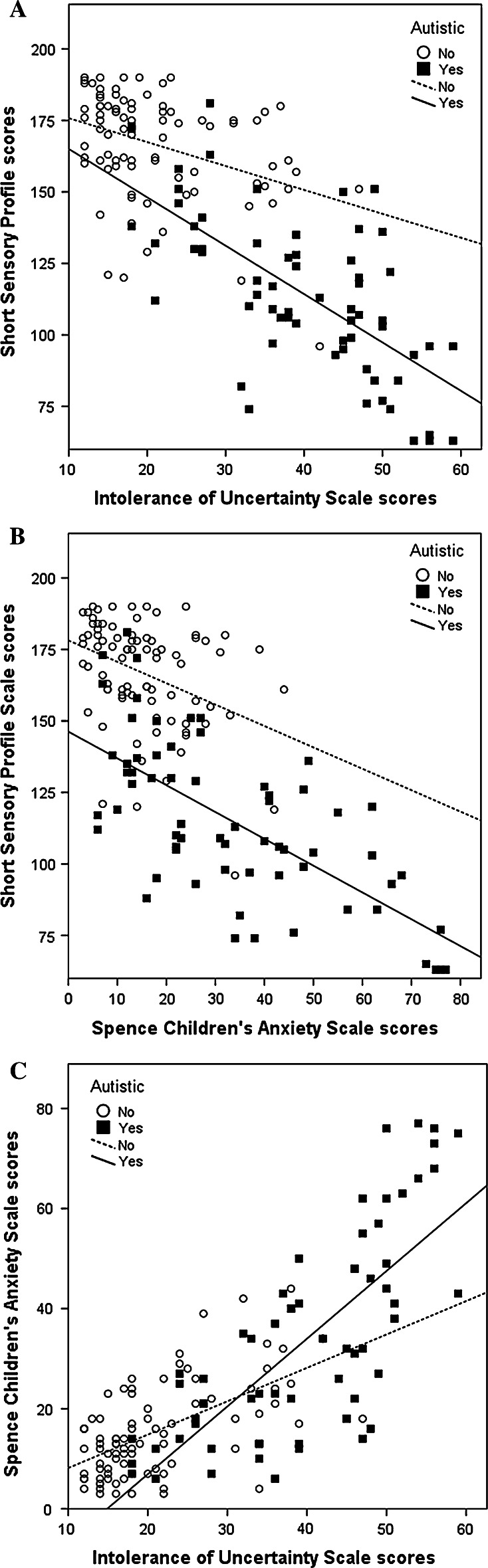
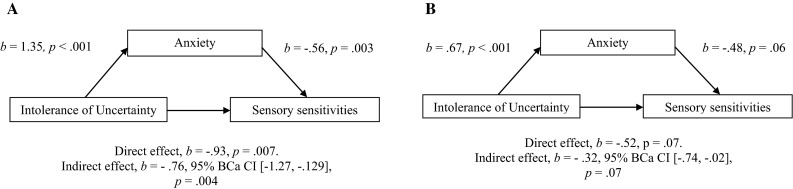
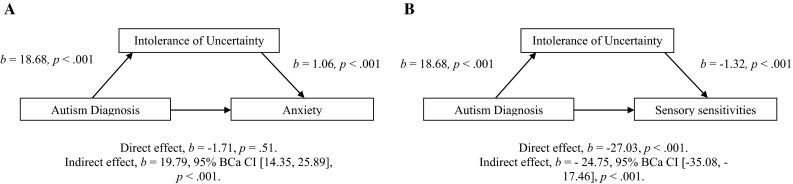
Guided by a recent theory that proposes fundamental differences in how autistic individuals deal with uncertainty, we investigated the extent to which the cognitive construct 'intolerance of uncertainty' and anxiety were related to parental reports of sensory sensitivities in 64 autistic and 85 typically developing children aged 6-14 years. Intolerance of uncertainty and anxiety explained approximately half the variance in autistic children's sensory sensitivities, but only around a fifth of the variance in typical children's sensory sensitivities. In children with autism only, intolerance of uncertainty remained a significant predictor of children's sensory sensitivities once the effects of anxiety were adjusted for. Our results suggest intolerance of uncertainty is a relevant construct to sensory sensitivities in children with and without autism.
Overview
The claims and statistics of this paper haven’t been checked yet.
Free: it reads the open-access text and checks the first 5 claims that cite a source we can check. Create a free account to check every claim.
Integrity signals
Registry
Cites
Statistics
Figures
Verification
Claims the paper makes
The claims and statistics of this paper haven’t been checked yet.
Free: it reads the open-access text and checks the first 5 claims that cite a source we can check. Create a free account to check every claim.
Claims other papers make about this one
Each is checked against this paper’s own text: does it say what the citing paper says it does?
The source backs part of the claim, not all of it — or backs it for a different population, condition or comparison.
In the citing paper
“For example, cognitive and behavioral rigidity may create enhanced uncertainty about whether exact rules will be followed, and may also be associated with repetitive and restricted behaviors (see e.g., Wigham et al., 2015; Neil et al., 2016).”
From Sensory, emotional and cognitive contributions to anxiety in autism spectrum disorders (2017) · cites this paper as Neil et al., 2016
Experimental — accuracy not yet measuredThe source backs part of the claim, not all of it — or backs it for a different population, condition or comparison.
In the citing paper
“They found significantly higher IUS-C and SCAS scores for ASD children and adolescents than a typical comparison group, a finding recently replicated by Neil et al. (2016) with similarly large samples.”
From Sensory, emotional and cognitive contributions to anxiety in autism spectrum disorders (2017) · cites this paper as Neil et al., 2016
Experimental — accuracy not yet measuredThe source backs part of the claim, not all of it — or backs it for a different population, condition or comparison.
In the citing paper
“Parent-report scores were higher for the ASD than control group for sensory sensitivities, IU and anxiety scales.”
From Sensory, emotional and cognitive contributions to anxiety in autism spectrum disorders (2017) · cites this paper as Neil et al., 2016
Experimental — accuracy not yet measuredThe cited source says what the claim attributes to it.
In the citing paper
“Neil, Olsson and Pellicano (2016) found that intolerance of uncertainty and anxiety were related to autistic children’s sensory sensitivities, suggesting that there could be a dynamic interplay between different variables and mental health outcomes.”
From Experiences of autism acceptance and mental health in autistic adults (2018) · cites this paper as Neil, Olsson and Pellicano (2016)
The cited source says what the claim attributes to it.
In the citing paper
“and Neil et al. (2016) have shown that the interrelations among SPD, IU and anxiety can also be understood under alternative causal assumptions.”
From Examining a model of anxiety in autistic adults (2024) · cites this paper as Neil et al. (2016)
7 more claims about this paper
Create a free account to see every claim other papers make about this one.
Self-check
Percentages, sums and reported differences re-computed from the paper’s own numbers.
The self-check needs the paper’s full text.
Citations
Cites
Diagnostic and Statistical Manual of Mental Disorders
American Psychiatric Association (2013) · doi:10.1176/appi.books.9780890425596 · Cited by 116,369
Diagnostic and Statistical Manual of Mental Disorders
Williams, J. B. W., & First, M. (2013) · Encyclopedia of Social Work · doi:10.1093/acrefore/9780199975839.013.104 · Cited by 109,519
Statistical Power Analysis for the Behavioral Sciences
Muller, K. (1989) · Technometrics · doi:10.1080/00401706.1989.10488618 · Cited by 99,167
Statistical power analysis for the behavioral sciences
(1990) · Computers, Environment and Urban Systems · doi:10.1016/0198-9715(90)90050-4 · Cited by 65,269
Statistical Power Analysis for the Behavioral Sciences (2nd ed.).
Lachenbruch, P. A., & Cohen, J. (1989) · Journal of the American Statistical Association · doi:10.2307/2290095 · Cited by 37,395
Diagnostic and Statistical Manual of Mental Disorders(DSM)
(2008) · Encyclopedia of Counseling · doi:10.4135/9781412963978.n182 · Cited by 10,830
Lord, C., Risi, S., Lambrecht, L., Cook, E. H., Leventhal, B. L., DiLavore, P. C., Pickles, A., & Rutter, M. (2000) · Journal of Autism and Developmental Disorders · doi:10.1023/a:1005592401947 · Cited by 7,520 · cited 2×
“Second Edition (ADOS-2; Lord et al. 2000, 2012).”
BackgroundMethodSimonoff, E., Pickles, A., Charman, T., Chandler, S., Loucas, T., & Baird, G. (2008) · Journal of the American Academy of Child & Adolescent Psychiatry · doi:10.1097/chi.0b013e318179964f · Cited by 3,399
Fearing the unknown: A short version of the Intolerance of Uncertainty Scale
Carleton, R. N., Norton, M. A. P. J., & Asmundson, G. J. G. (2007) · Journal of Anxiety Disorders · doi:10.1016/j.janxdis.2006.03.014 · Cited by 2,288 · cited 2×
“The construct has typically been measured using a questionnaire (Carleton et al. 2007; Freeston et al. 1994), in which two factors have been identified: a desire for predictability, in which an individual perceives unexpected events as negative and craves sameness; and uncertainty paralysis, in…”
MethodEnhanced Perceptual Functioning in Autism: An Update, and Eight Principles of Autistic Perception
Mottron, L., Dawson, M., Soulières, I., Hubert, B., & Burack, J. (2006) · Journal of Autism and Developmental Disorders · doi:10.1007/s10803-005-0040-7 · Cited by 1,957 · cited 2×
“perceptual functioning (Mottron et al. 2006) and enhanced discrimination/reduced generalisation (Plaisted 2001).”
BackgroundWhich terms should be used to describe autism? Perspectives from the UK autism community
Kenny, L., Hattersley, C., Molins, B., Buckley, C., Povey, C., & Pellicano, E. (2016) · Autism · doi:10.1177/1362361315588200 · Cited by 1,941
Self-citationA measure of anxiety symptoms among children
Spence, S. H. (1998) · Behaviour Research and Therapy · doi:10.1016/s0005-7967(98)00034-5 · Cited by 1,928 · cited 3×
“…of intolerance of uncertainty, as measured by the Intolerance of Uncertainty scale (Rodgers et al. 2012; Walker 2009), were associated with elevated levels of anxiety, as measured by the Spence Children’s Anxiety scale (Spence, 1998), in both children with (n = 114) and without autism (n = 110).”
MethodFreeston, M. H., Rhéaume, J., Letarte, H., Dugas, M. J., & Ladouceur, R. (1994) · Personality and Individual Differences · doi:10.1016/0191-8869(94)90048-5 · Cited by 1,731 · cited 3×
“…literature, having been identified as a cognitive vulnerability factor for the development of generalised anxiety disorder (Carleton et al. 2012; Freeston et al. 1994) and also implicated in social anxiety (Whiting et al. 2014), obsessive compulsive disorder (Calleo et al. 2010) and…”
BackgroundMethodAutism Diagnostic Observation Schedule
Lord, C., Rutter, M., Goode, S., Heemsbergen, J., Jordan, H., Mawhood, L., & Schopler, E. (2016) · PsycTESTS Dataset · doi:10.1037/t54175-000 · Cited by 1,678
Frontiers in Human Neuroscience
Avenanti, A. (2013) · Archivio istituzionale della ricerca (Alma Mater Studiorum Università di Bologna) · Cited by 1,572
Tomchek, S. D., & Dunn, W. (2007) · American Journal of Occupational Therapy · doi:10.5014/ajot.61.2.190 · Cited by 1,534 · cited 5×
“Like previous studies (Boulter et al. 2014; Tomchek and Dunn 2007), we expected that parents would report elevated levels of intolerance of uncertainty, sensory sensitivities and anxiety in their autistic children, relative to typical children, and that there would be strong positive links between these variables with…”
BackgroundMethodResultInfluentialAutism: beyond “theory of mind”
Frith, U., & Happé, F. (1994) · Cognition · doi:10.1016/0010-0277(94)90024-8 · Cited by 1,450
Anxiety in children and adolescents with autism spectrum disorders
White, S. W., Oswald, D., Ollendick, T., & Scahill, L. (2009) · Clinical Psychology Review · doi:10.1016/j.cpr.2009.01.003 · Cited by 1,427 · cited 2×
“showed that, once the effect of intolerance of uncertainty on anxiety had been taken into account, diagnostic group no longer significantly predicted anxiety, suggesting that high levels of intolerance of uncertainty might explain the high levels of anxiety consistently found in autistic children (Simonoff et al. 2008…”
BackgroundThe intolerance of uncertainty scale: psychometric properties of the English version
Buhr, K., & Dugas, M. J. (2002) · Behaviour Research and Therapy · doi:10.1016/s0005-7967(01)00092-4 · Cited by 1,391
Diagnostic and Statistical Manual of Mental Disorders
(2018) · The SAGE Encyclopedia of Educational Research, Measurement, and Evaluation · doi:10.4135/9781506326139.n198 · Cited by 1,230
The Autism Diagnostic Observation Schedule: Revised Algorithms for Improved Diagnostic Validity
Gotham, K., Risi, S., Pickles, A., & Lord, C. (2007) · Journal of Autism and Developmental Disorders · doi:10.1007/s10803-006-0280-1 · Cited by 1,161
When the world becomes ‘too real’: a Bayesian explanation of autistic perception
Pellicano, E., & Burr, D. (2012) · Trends in Cognitive Sciences · doi:10.1016/j.tics.2012.08.009 · Cited by 1,156 · cited 5×
“The current study was guided by a theoretical account of autistic perception put forward by Pellicano and Burr (2012), who hypothesised that difficulties utilising prior experience when processing inherently ambiguous sensory information give rise to a greater reliance on bottom-up sensory signals…”
BackgroundMethodInfluentialSelf-citationDescribing the Sensory Abnormalities of Children and Adults with Autism
Leekam, S. R., Nieto, C., Libby, S. J., Wing, L., & Gould, J. (2007) · Journal of Autism and Developmental Disorders · doi:10.1007/s10803-006-0218-7 · Cited by 1,140 · cited 2×
“Such sensitivities are known to be common (Baranek et al. 2006; Tomchek and Dunn 2007), can cause much distress to individuals (Leekam et al. 2007), and have a negative impact on social relationships (Hilton et al. 2010) and family life (Baranek et al. 2006).”
BackgroundBaranek, G. T., David, F. J., Poe, M. D., Stone, W. L., & Watson, L. R. (2006) · Journal of Child Psychology and Psychiatry · doi:10.1111/j.1469-7610.2005.01546.x · Cited by 975 · cited 1×
“Such sensitivities are known to be common (Baranek et al. 2006; Tomchek and Dunn 2007), can cause much distress to individuals (Leekam et al. 2007), and have a negative impact on social relationships (Hilton et al. 2010) and family life (Baranek et al. 2006).”
BackgroundPrecise minds in uncertain worlds: Predictive coding in autism.
Van de Cruys, S., Evers, K., Van der Hallen, R., Van Eylen, L., Boets, B., de-Wit, L., & Wagemans, J. (2014) · Psychological Review · doi:10.1037/a0037665 · Cited by 885 · cited 2×
“Difficulties dealing effectively with uncertainty are at the heart of Pellicano and Burr’s (2012) model and related accounts (Lawson et al. 2014; Van de Cruys et al. 2014), which all attempt to explain autistic perception at the computational and neural levels.”
BackgroundIncreasingly certain about uncertainty: Intolerance of uncertainty across anxiety and depression
Carleton, R. N., Mulvogue, M. K., Thibodeau, M. A., McCabe, R. E., Antony, M. M., & Asmundson, G. J. G. (2012) · Journal of Anxiety Disorders · doi:10.1016/j.janxdis.2012.01.011 · Cited by 775 · cited 3×
“…been identified as a cognitive vulnerability factor for the development of generalised anxiety disorder (Carleton et al. 2012; Freeston et al. 1994) and also implicated in social anxiety (Whiting et al. 2014), obsessive compulsive disorder (Calleo et al. 2010) and depression (Carleton et al. 2012).”
BackgroundNauta, M. H., Scholing, A., Rapee, R. M., Abbott, M., Spence, S. H., & Waters, A. (2004) · Behaviour Research and Therapy · doi:10.1016/s0005-7967(03)00200-6 · Cited by 763
Structure of anxiety symptoms among children: A confirmatory factor-analytic study.
Spence, S. H. (1997) · Journal of Abnormal Psychology · doi:10.1037/0021-843x.106.2.280 · Cited by 753 · cited 1×
“The SCAS-P is a 38-item parent report measure of children’s anxiety (Nauta et al. 2004), adapted from the original child version of the scale (Spence 1997, 1998).”
MethodAn aberrant precision account of autism
Lawson, R. P., Rees, G., & Friston, K. J. (2014) · Frontiers in Human Neuroscience · doi:10.3389/fnhum.2014.00302 · Cited by 641
Internet survey of treatments used by parents of children with autism.
Green, V. A., Pituch, K. A., Itchon, J., Choi, A., O’Reilly, M., & Sigafoos, J. (2006) · Research in Developmental Disabilities · doi:10.1016/j.ridd.2004.12.002 · Cited by 617 · cited 2×
“Sensory interventions in autism are common (Green et al. 2006) yet there is huge variation in the principles underlying these interventions, the behaviours they target, and the methodologies that are applied, as well as a lack of rigorous evaluation of their effectiveness (see review by Case-Smith…”
MethodAutism as a disorder of prediction
Sinha, P., Kjelgaard, M. M., Gandhi, T. K., Tsourides, K., Cardinaux, A. L., Pantazis, D., Diamond, S. P., & Held, R. M. (2014) · Proceedings of the National Academy of Sciences · doi:10.1073/pnas.1416797111 · Cited by 563 · cited 1×
“More recently, computational accounts of sensory perception have attempted to explain sensory sensitivities in autism in terms of difficulties in generating expectations in regards to the sensory environment (Lawson et al. 2014; Sinha et al. 2014; Van de Cruys et al. 2014).”
BackgroundThe development of autism: Perspectives from theory and research.
Howlin, P. (2002) · Journal of Child Psychology and Psychiatry · doi:10.1111/1469-7610.t01-9-00044 · Cited by 526
Birrell, J., Meares, K., Wilkinson, A., & Freeston, M. (2011) · Clinical Psychology Review · doi:10.1016/j.cpr.2011.07.009 · Cited by 459
A systematic review of sensory processing interventions for children with autism spectrum disorders
Case-Smith, J., Weaver, L. L., & Fristad, M. A. (2015) · Autism · doi:10.1177/1362361313517762 · Cited by 409
Boulter, C., Freeston, M., South, M., & Rodgers, J. (2014) · Journal of Autism and Developmental Disorders · doi:10.1007/s10803-013-2001-x · Cited by 401 · cited 11×
“There is some evidence to suggest that the differences in anxiety levels between autistic and typically developing children on the Spence Children’s Anxiety scale are more pronounced among parent-reported, than child-reported data (Boulter et al. 2014), but whether this discrepancy is replicated in reports of sensory…”
BackgroundMethodResultInfluentialA Replication of the Autism Diagnostic Observation Schedule (ADOS) Revised Algorithms
GOTHAM, K., RISI, S., DAWSON, G., TAGER-FLUSBERG, H., JOSEPH, R., CARTER, A., HEPBURN, S., McMAHON, W., RODIER, P., HYMAN, S. L., et al. (2008) · Journal of the American Academy of Child & Adolescent Psychiatry · doi:10.1097/chi.0b013e31816bffb7 · Cited by 374 · cited 1×
“Parents completed the Social Communication Questionnaire (SCQ; Rutter et al. 2003) and researchers administered the Autism Diagnostic Observation Schedule (ADOS-G or ADOS-2; Lord et al. 2000, 2012) to autistic children using the revised algorithm (Gotham et al. 2007, 2008).”
MethodWigham, S., Rodgers, J., South, M., McConachie, H., & Freeston, M. (2015) · Journal of Autism and Developmental Disorders · doi:10.1007/s10803-014-2248-x · Cited by 373 · cited 4×
“3 In keeping with Wigham et al. (2015), scores on the SSP minus items assessing the underresponsiveness/seeks sensation, auditory filtering and low energy/weak subscales were also calculated to create ‘sensory over responsiveness’ scores.”
BackgroundMethodInfluentialGreen, S. A., & Ben-Sasson, A. (2010) · Journal of Autism and Developmental Disorders · doi:10.1007/s10803-010-1007-x · Cited by 327 · cited 4×
“In this hypervigilant state, individuals may be more likely to notice and respond to aversive sensory stimuli, and less likely to successfully disengage from potentially threatening sensory stimuli (Green and Ben-Sasson 2010).”
BackgroundInfluentialReduced Generalization in Autism: An Alternative to Weak Central Coherence
Plaisted, K. C. (2001) · Apollo (University of Cambridge) · Cited by 295
The Power of the Positive: Revisiting Weak Coherence in Autism Spectrum Disorders
Happé, F. G. E., & Booth, R. D. L. (2008) · Quarterly Journal of Experimental Psychology · doi:10.1080/17470210701508731 · Cited by 280
Sensory Symptoms in Autism Spectrum Disorders
Hazen, E. P., Stornelli, J. L., O’Rourke, J. A., Koesterer, K., & McDougle, C. J. (2014) · Harvard Review of Psychiatry · doi:10.1097/01.hrp.0000445143.08773.58 · Cited by 274 · cited 1×
“Sensory sensitivities also vary considerably between and within individuals on the autism spectrum (Grandin 2009; Hazen et al. 2014).”
BackgroundGreen, S. A., Ben-Sasson, A., Soto, T. W., & Carter, A. S. (2012) · Journal of Autism and Developmental Disorders · doi:10.1007/s10803-011-1361-3 · Cited by 268
Sensory clusters of toddlers with autism spectrum disorders: differences in affective symptoms
Ben‐Sasson, A., Cermak, S. A., Orsmond, G. I., Tager‐Flusberg, H., Kadlec, M. B., & Carter, A. S. (2008) · Journal of Child Psychology and Psychiatry · doi:10.1111/j.1469-7610.2008.01899.x · Cited by 254
Sensory Modulation and Affective Disorders in Children and Adolescents With Asperger’s Disorder
Pfeiffer, B., Kinnealey, M., Reed, C., & Herzberg, G. (2005) · The American Journal of Occupational Therapy · doi:10.5014/ajot.59.3.335 · Cited by 237
Hilton, C. L., Harper, J. D., Kueker, R. H., Lang, A. R., Abbacchi, A. M., Todorov, A., & LaVesser, P. D. (2010) · Journal of Autism and Developmental Disorders · doi:10.1007/s10803-010-0944-8 · Cited by 233
Grandin, T. (1992) · High-Functioning Individuals with Autism · doi:10.1007/978-1-4899-2456-8_6 · Cited by 181
Why I dislike “person first” Language
Sinclair, J. (2013) · Cited by 151
Intolerance of uncertainty, fear of anxiety, and adolescent worry
Dugas, M. J., Laugesen, N., & Bukowski, W. M. (2012) · Journal of Abnormal Child Psychology · doi:10.1007/s10802-012-9611-1 · Cited by 127 · cited 1×
“In conclusion, intolerance of uncertainty is well established as an important construct in the development of affective symptoms (Calleo et al. 2010; Dugas et al. 2012; Whiting et al. 2014).”
BackgroundChamberlain, P. D., Rodgers, J., Crowley, M. J., White, S. E., Freeston, M. H., & South, M. (2013) · Molecular Autism · doi:10.1186/2040-2392-4-31 · Cited by 99 · cited 3×
“Consistent with previous research (Boulter et al. 2014; Chamberlain et al. 2013; Tomchek and Dunn 2007), parents of children on the autism spectrum reported greater levels of intolerance of uncertainty, anxiety and sensory sensitivities in their Sensory sensitivities Intolerance of Uncertainty Anxiety b = .”
BackgroundMethodResultVisual Abilities and Sensory Differences in a Person with Autism
Grandin, T. (2008) · Biological Psychiatry · doi:10.1016/j.biopsych.2008.11.005 · Cited by 65
The Role of Intolerance of Uncertainty in Social Anxiety Subtypes
Whiting, S. E., Jenkins, W. S., May, A. C., Rudy, B. M., Davis, T. E., & Reuther, E. T. (2014) · Journal of Clinical Psychology · doi:10.1002/jclp.22024 · Cited by 60
Zainal, N. H., Magiati, I., Tan, J. W., Sung, M., Fung, D. S. S., & Howlin, P. (2014) · Journal of Autism and Developmental Disorders · doi:10.1007/s10803-014-2075-0 · Cited by 57
Obsessions and worry beliefs in an inpatient OCD population
Calleo, J. S., Hart, J., Björgvinsson, T., & Stanley, M. A. (2010) · Journal of Anxiety Disorders · doi:10.1016/j.janxdis.2010.06.015 · Cited by 55 · cited 3×
“In conclusion, intolerance of uncertainty is well established as an important construct in the development of affective symptoms (Calleo et al. 2010; Dugas et al. 2012; Whiting et al. 2014).”
BackgroundBuxbaum, J. D., & Baron-Cohen, S. (2013) · Molecular Autism · doi:10.1186/2040-2392-4-11 · Cited by 29
Barbero (2014) · doi:10.1016/j · Cited by 1
Research works printed but not linked: 6
- 14. Dunn, W. (1999). The sensory profile: User's manual. San Antonio, TX: Psychological Corporation.
- 33. McIntosh, D. N., Miller, L. J., Shyu, V., & Dunn, W. (1999). Overview of the short sensory profile. In W. Dunn (Ed.), Sensory profile user's manual (pp. 59-73). San Antonio: Pearsons.
- 40. Rutter, M., Bailey, A., & Lord, C. (2003). The Social Communication Questionnaire-Manual. Los Angeles, CA: Western Psycholog- ical Services.
- 48. Walker, S. (2009). What do we know about the relationship between intolerance of uncertainty and worry in young children? Unpublished Thesis. Newcastle University, UK.
- 49. Wechsler, D. (2011). WASI-II: Wechsler abbreviated scale of intelligence (2nd ed.). San Antonio, TX: Psychological Corporation.
- 53. Williams, D. (1994). Somebody somewhere. New York: Doubleday.
Cited by
Experiences of autism acceptance and mental health in autistic adults
Cage, E., Di Monaco, J., & Newell, V. (2018) · Journal of Autism and Developmental Disorders · doi:10.1007/s10803-017-3342-7 · Cited by 538
Sensory, emotional and cognitive contributions to anxiety in autism spectrum disorders
South, M., & Rodgers, J. (2017) · Frontiers in Human Neuroscience · doi:10.3389/fnhum.2017.00020 · Cited by 270
Jenkinson, R., Milne, E., & Thompson, A. (2020) · Autism · doi:10.1177/1362361320932437 · Cited by 205
“All four of the studies in which the correlation was based on at least one measure that was parent reported (Damiano, 2015; Glod, 2017; Neil et al., 2016; Wigham et al., 2015) found a significant association between IoU and anxiety of a large effect size.”
BackgroundIntolerance of uncertainty, anxiety, and worry in children and adolescents: A meta-analysis
Osmanağaoğlu, N., Creswell, C., & Dodd, H. F. (2018) · Journal of Affective Disorders · doi:10.1016/j.jad.2017.07.035 · Cited by 177
“…Donovan et al., 2017; Kertz & Woodruff-Borden, 2013; Osmanagaoglu et al., 2017; Read et al., 2013), three studies used the IUS-C parent report (Neil et al., 2016; Sanchez et al., 2017; Sanchez et al., 2016), three studies used both the parent and child report of IUS-C (Boulter et al., 2014;…”
InfluentialWilliams, Z. J., He, J. L., Cascio, C. J., & Woynaroski, T. G. (2021) · Neuroscience & Biobehavioral Reviews · doi:10.1016/j.neubiorev.2020.11.030 · Cited by 175
Metadata
- Authors
- Neil, L., Olsson, N. C., & Pellicano, E.
- Affiliations
- University College London (GB)
- Karolinska Institutet (SE)
- The University of Western Australia (AU)
- Corresponding author
- Neil, Louise
- Venue
- Journal of Autism and Developmental Disorders
- Published
- 2016-02-10
- Volume
- 46
- Issue
- 6
- Pages
- 1962-1973
- ISSN
- 0162-3257 (ISSN-L)
- 1573-3432
- PMC
- PMC4860201
- OpenAlex
- W2270942366
- Cited by
- 201
- References
- 59
- Citations by year
- 2026: 9 · 2025: 21 · 2024: 16 · 2023: 26 · 2022: 22 · 2021: 29 · 2020: 29 · 2019: 16 · 2018: 17 · 2017: 13 · 2016: 2
- FWCI
- 10.18
- Type
- journal article
- Language
- en
- Open access
- hybrid
- doi.org
- Locations
- Journal of Autism and Developmental Disorders (publishedVersion, cc-by)
- PubMed Central (publishedVersion, cc-by)
- UWA Profiles and Research Repository (UWA) (publishedVersion, other-oa)
- PubMed (publishedVersion)
- UCL Discovery (University College London) (submittedVersion)
- Funders
- Medical Research Council (GB) (MR/J013145/1)
- Topics
- Life Sciences › Neuroscience › Cognitive Neuroscience › Autism Spectrum Disorder Research
- Health Sciences › Medicine › Psychiatry and Mental health › Child Nutrition and Feeding Issues
- Social Sciences › Psychology › Clinical Psychology › Child and Adolescent Psychosocial and Emotional Development
- Keywords
- intolerance of uncertainty, sensory sensitivity, anxiety, autism spectrum disorder, typically developing children, children, uncertainty processing, parent report
- MeSH terms
- Adolescent, Anxiety, Autistic Disorder, Child, Child Development, Female, Humans, Male, Parents, Sensation Disorders, Uncertainty
About these checks
Registry, retraction, Cites and statistics results are computed, not judged, with one exception: a printed reference that no index lists is read once by a model before it counts as a citation error. Claims are extracted by a model and kept only when their quote appears verbatim in the text; each cited source is then checked, with a model’s help, for whether it says what the claim relies on. Those verdicts can be wrong — read the claim’s quote and the cited source before relying on one.
Statistics and arithmetic are recomputed, not judged.
Confidence bands are shown only for fields calibrated on our annotated test set. None is calibrated yet, so no band is shown.
What counts as a claim ›How we measure confidence ›How we check this ›
Are you an author, or do you see a problem with this page? Request a review
Data sources
Bibliographic data: Semantic Scholar, OpenAlex, Crossref.
Contains information from the Semantic Scholar Academic Graph Datasets, made available under the ODC Attribution License (ODC-BY 1.0).
Semantic Scholar’s data is described in: Kinney, R., et al. (2023). The Semantic Scholar Open Data Platform. arXiv:2301.10140.
