

Systematic Review of the Relationship Between Autism Stigma and Informal Caregiver Mental Health
Open accessThe DOI matches its Crossref record; 63 of the 64 references it cites were found in a registry or an index.
Abstract
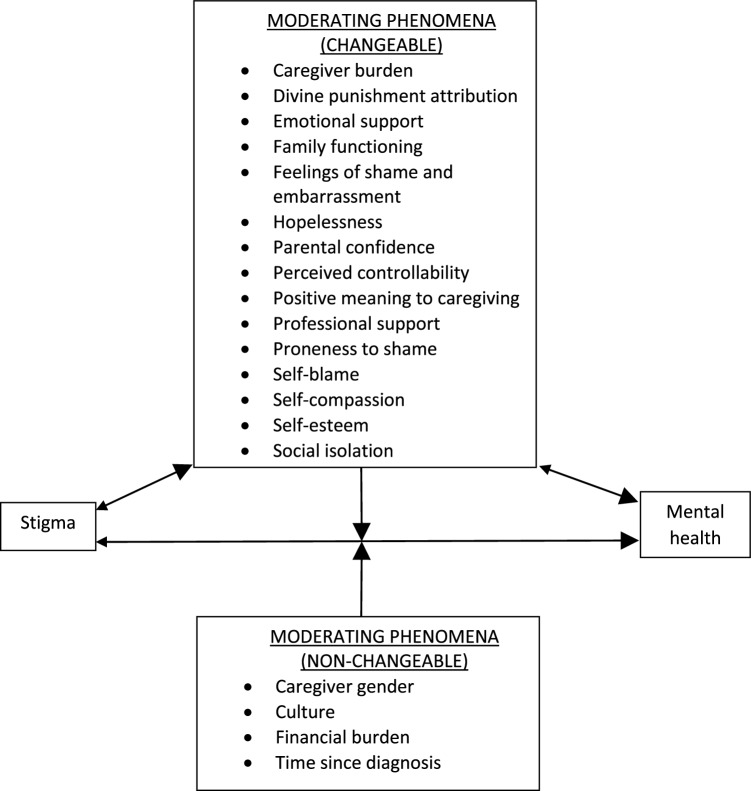
Families play a crucial role in determining the mental health of the autistic individual(s) they are caring for. However, the stigma associated with autism can impair caregiver health. To investigate this, empirical evidence pertaining to stigma's impact on informal caregivers' mental health was systematically reviewed. All twelve included studies (n = 1442 informal caregivers) consistently reported the impact of autism related stigma upon caregiver mental health to be significant, meaningful and complex. A new theoretical framework describing the relationship between stigma and caregiver mental health is constructed. Moderating variables include those both changeable through intervention (e.g. hopelessness, self-esteem, self-compassion) and not changeable (gender, culture, financial burden and time since diagnosis). Implications and recommendations for professionals, interventions and future research are proposed.
Overview
The claims and statistics of this paper haven’t been checked yet.
Free: it reads the open-access text and checks the first 5 claims that cite a source we can check. Create a free account to check every claim.
Integrity signals
Registry
Cites
Statistics
Figures
Verification
Claims the paper makes
The claims and statistics of this paper haven’t been checked yet.
Free: it reads the open-access text and checks the first 5 claims that cite a source we can check. Create a free account to check every claim.
Claims other papers make about this one
Each is checked against this paper’s own text: does it say what the citing paper says it does?
The source backs part of the claim, not all of it — or backs it for a different population, condition or comparison.
In the citing paper
“Across East Asia, the Middle East, and Western societies, a recent review suggested a strong negative impact of ASD stigma on some caregivers resulting in attempts to hide their circumstances (sometimes the child with ASD as well) to avoid rejection from the community (Papadopoulos et al. 2019).”
From The Diagnosis of Autism: From Kanner to DSM-III to DSM-5 and Beyond (2021) · cites this paper as Papadopoulos et al. 2019
Experimental — accuracy not yet measured
Self-check
Percentages, sums and reported differences re-computed from the paper’s own numbers.
The self-check needs the paper’s full text.
Citations
Cites
The CES-D Scale: A Self-Report Depression Scale for Research in the General Population
Radloff, L. S. (1977) · Applied Psychological Measurement · doi:10.1177/014662167700100306 · Cited by 53,267
The PHQ-9: Validity of a brief depression severity measure
Kroenke, K., Spitzer, R. L., & Williams, J. B. W. (2001) · Journal of General Internal Medicine · doi:10.1046/j.1525-1497.2001.016009606.x · Cited by 44,910
A Brief Measure for Assessing Generalized Anxiety Disorder: The GAD-7
Spitzer, R. L., Kroenke, K., Williams, J. B. W., & Löwe, B. (2006) · Archives of Internal Medicine · doi:10.1001/archinte.166.10.1092 · Cited by 31,765
International Journal of Business and Social Science
(2018) · International Journal of Business and Social Science · doi:10.30845/ijbss · Cited by 4,284
Clinical Psychology: Science and Practice
(2021) · Clinical Psychology Science and Practice · doi:10.1111/(issn)1468-2850 · Cited by 3,672
The structure of psychological distress and well-being in general populations.
Veit, C. T., & Ware, J. E. (1983) · Journal of Consulting and Clinical Psychology · doi:10.1037//0022-006x.51.5.730 · Cited by 1,967
The paradox of self-stigma and mental illness.
Corrigan, P. W., & Watson, A. C. (2002) · Clinical Psychology: Science and Practice · doi:10.1093/clipsy.9.1.35 · Cited by 1,872 · cited 1×
“2009) and being more likely to perceive themselves and their situation negatively (Corrigan and Watson 2002).”
Background(2022) · Singapore Medical Journal · doi:10.11622/smedj · Cited by 1,730
Self-stigma and the “why try” effect: impact on life goals and evidence-based practices
CORRIGAN, P. W., LARSON, J. E., & RÜSCH, N. (2009) · World Psychiatry · doi:10.1002/j.2051-5545.2009.tb00218.x · Cited by 1,074
Loneliness and friendship in high-functioning children with autism
Bauminger, N., & Kasari, C. (2000) · Child Development · doi:10.1111/1467-8624.00156 · Cited by 980
What should autism research focus upon? Community views and priorities from the United Kingdom
Pellicano, E., Dinsmore, A., & Charman, T. (2014) · Autism · doi:10.1177/1362361314529627 · Cited by 800
Lucas, P. J., Baird, J., Arai, L., Law, C., & Roberts, H. M. (2007) · BMC Medical Research Methodology · doi:10.1186/1471-2288-7-4 · Cited by 553
Osborne, L. A., McHugh, L., Saunders, J., & Reed, P. (2008) · Journal of Autism and Developmental Disorders · doi:10.1007/s10803-007-0497-7 · Cited by 553
Affiliate Stigma Among Caregivers of People with Intellectual Disability or Mental Illness
Mak, W. W. S., & Cheung, R. Y. M. (2008) · Journal of Applied Research in Intellectual Disabilities · doi:10.1111/j.1468-3148.2008.00426.x · Cited by 508
Peer interaction and loneliness in high-functioning children with autism
Bauminger, N., Shulman, C., & Agam, G. (2003) · Journal of Autism and Developmental Disorders · doi:10.1023/a:1025827427901 · Cited by 495
Dumont, R., & Willis, J. O. (2008) · Encyclopedia of Special Education · doi:10.1002/9780470373699.speced0926 · Cited by 478 · cited 1×
“They also examined the potential moderating effect of ‘autism quotient’ [as measured by the Gilliam Autism Rating Scale (Gilliam 2001)] but found no significant association.”
MethodMugno, D., Ruta, L., D'Arrigo, V. G., & Mazzone, L. (2007) · Health and Quality of Life Outcomes · doi:10.1186/1477-7525-5-22 · Cited by 450
Myers, B. J., Mackintosh, V. H., & Goin-Kochel, R. P. (2009) · Research in Autism Spectrum Disorders · doi:10.1016/j.rasd.2009.01.004 · Cited by 419
Corrigan, P. W., Watson, A. C., & Miller, F. E. (2006) · Journal of Family Psychology · doi:10.1037/0893-3200.20.2.239 · Cited by 412
Sanders, J. L., & Morgan, S. B. (1997) · Child & Family Behavior Therapy · doi:10.1300/j019v19n04_02 · Cited by 399
Resch, J. A., Mireles, G., Benz, M. R., Grenwelge, C., Peterson, R., & Zhang, D. (2010) · Rehabilitation Psychology · doi:10.1037/a0019473 · Cited by 369
Kinnear, S. H., Link, B. G., Ballan, M. S., & Fischbach, R. L. (2016) · Journal of Autism and Developmental Disorders · doi:10.1007/s10803-015-2637-9 · Cited by 365
Reducing distress in mothers of children with autism and other disabilities: a randomized trial
Dykens, E. M., Fisher, M. H., Taylor, J. L., Lambert, W., & Miodrag, N. (2014) · Pediatrics · doi:10.1542/peds.2013-3164 · Cited by 355
Internalization of stigma for parents of children with autism spectrum disorder in Hong Kong
Mak, W. W. S., & Kwok, Y. T. Y. (2010) · Social Science & Medicine · doi:10.1016/j.socscimed.2010.02.023 · Cited by 354
Perceptions of stigma: the parents of autistic children
Gray, D. E. (1993) · Sociology of Health & Illness · doi:10.1111/1467-9566.ep11343802 · Cited by 348 · cited 1×
“Holding such views can lead to caregivers being socially rejected (Gray 1993; Corrigan et al.”
BackgroundAli, A., Hassiotis, A., Strydom, A., & King, M. (2012) · Research in Developmental Disabilities · doi:10.1016/j.ridd.2012.06.013 · Cited by 342
Ten years on: a longitudinal study of families of children with autism
Gray, D. E. (2002) · Journal of Intellectual & Developmental Disability · doi:10.1080/1366825021000008639 · Cited by 341 · cited 7×
“However, only two studies showed clear congruity between their philosophical or theoretical perspectives and research methodology, with both adopting an ethnographic theoretical perspective and adopting methods in keeping with this approach (Crabtree 2007; Gray 2002).”
BackgroundInfluentialStruening, E. L., Perlick, D. A., Link, B. G., Hellman, F., Herman, D., & Sirey, J. A. (2001) · Psychiatric Services · doi:10.1176/appi.ps.52.12.1633 · Cited by 332
Zablotsky, B., Bradshaw, C. P., & Stuart, E. A. (2013) · Journal of Autism and Developmental Disorders · doi:10.1007/s10803-012-1693-7 · Cited by 262
Regression modelling and other methods to control confounding
McNamee, R. (2005) · Occupational and Environmental Medicine · doi:10.1136/oem.2002.001115 · Cited by 250 · cited 1×
“Future quantitative research could control for these and other potential confounding variables, for example, through statistical regression modelling (McNamee 2005).”
BackgroundJahoda, A., & Markova, I. (2004) · Journal of Intellectual Disability Research · doi:10.1111/j.1365-2788.2003.00561.x · Cited by 227
Werner, S., & Shulman, C. (2013) · Research in Developmental Disabilities · doi:10.1016/j.ridd.2013.08.029 · Cited by 189
Self-stigma among parents of children with autism spectrum disorder
Chan, K. K. S., & Lam, C. B. (2018) · Research in Autism Spectrum Disorders · doi:10.1016/j.rasd.2018.01.001 · Cited by 188
Review: The development of family quality of life concepts and measures
Samuel, P. S., Rillotta, F., & Brown, I. (2012) · Journal of Intellectual Disability Research · doi:10.1111/j.1365-2788.2011.01486.x · Cited by 182
‘Individualism-Collectivism’ as an Explanatory Device for Mental Illness Stigma
Papadopoulos, C., Foster, J., & Caldwell, K. (2013) · Community Mental Health Journal · doi:10.1007/s10597-012-9534-x · Cited by 176
Self-citationDa Paz, N. S., & Wallander, J. L. (2017) · Clinical Psychology Review · doi:10.1016/j.cpr.2016.10.006 · Cited by 176
Zhou, T., Wang, Y., & Yi, C. (2018) · Psychiatry Research · doi:10.1016/j.psychres.2018.03.071 · Cited by 171
Obeid, R., Daou, N., DeNigris, D., Shane-Simpson, C., Brooks, P. J., & Gillespie-Lynch, K. (2015) · Journal of Autism and Developmental Disorders · doi:10.1007/s10803-015-2499-1 · Cited by 166
Broady, T. R., Stoyles, G. J., & Morse, C. (2017) · Health & Social Care in the Community · doi:10.1111/hsc.12297 · Cited by 166
Wong, C. C. Y., Mak, W. W. S., & Liao, K. Y.-H. (2016) · Mindfulness · doi:10.1007/s12671-016-0580-2 · Cited by 159
East Asian Archives of Psychiatry
(2019) · doi:10.12809/easap · Cited by 135
Chiu, M. Y.-L., Yang, X., Wong, F. H. T., Li, J. H., & Li, J. (2012) · Journal of Intellectual Disability Research · doi:10.1111/j.1365-2788.2012.01624.x · Cited by 121
Chan, K. K. S., & Lam, C. B. (2017) · Mindfulness · doi:10.1007/s12671-016-0675-9 · Cited by 118
Crabtree, S. A. (2006) · Disability & Society · doi:10.1080/09687590601056618 · Cited by 101 · cited 9×
“However, only two studies showed clear congruity between their philosophical or theoretical perspectives and research methodology, with both adopting an ethnographic theoretical perspective and adopting methods in keeping with this approach (Crabtree 2007; Gray 2002).”
BackgroundInfluentialTranscultural Health and Social Care: Development of Culturally Competent Practitioners
Fuller, J. D. (2007) · Health Sociology Review · doi:10.5172/hesr.2007.16.2.200 · Cited by 96
Journal of Pediatric Neurology
Sahin, A. T. Y. B. T. C. (2025) · Journal of Pediatric Neurology · doi:10.1055/s-00029030 · Cited by 95
Zuckerman, K. E., Lindly, O. J., Reyes, N., Chavez, A. E., Cobian, M., Macias, K., Reynolds, A., & Smith, K. A. (2018) · Journal of Autism and Developmental Disorders · doi:10.1007/s10803-018-3586-x · Cited by 92
Transcultural Health and Social Care: development of culturally competent practitioners
Papadopoulos, I. (2006) · Middlesex University Research Repository (Middlesex University Of London) · Cited by 87
“At a moment, you could collapse”: Raising children with autism in the West Bank
Dababnah, S., & Parish, S. L. (2013) · Children and Youth Services Review · doi:10.1016/j.childyouth.2013.07.007 · Cited by 86
Isa, S. N. I., Aziz, A. A., Rahman, A. A., Ibrahim, M. I., Ibrahim, W. P. W., Mohamad, N., Othman, A., Rahman, N. A., Harith, S., & Rostenberghe, H. V. (2013) · Journal of Developmental & Behavioral Pediatrics · doi:10.1097/dbp.0b013e318287cdfe · Cited by 75
Zheng, Q., Tian, Q., Hao, C., Gu, J., Lucas, R., Tao, J., Liang, Z.-Y., Chen, X., Fang, J., Ruan, J.-H., et al. (2014) · Health and Quality of Life Outcomes · doi:10.1186/1477-7525-12-25 · Cited by 66
Understanding autism in Saudi Arabia: A qualitative analysis of the community and cultural context
Alqahtani, M. M. J. (2012) · Journal of Pediatric Neurology · doi:10.3233/jpn-2012-0527 · Cited by 62 · cited 1×
“Alqahtani (2012) and Bankole (2016) have previously highlighted how religion plays a prominent role in shaping people’s cultural values and perceptions about autism, particularly when professional autism services do not exist, are inaccessible and/or distrusted.”
BackgroundThe content and process of self-stigma in people with mental illness
Chan, K. K. S., & Mak, W. W. S. (2017) · American Journal of Orthopsychiatry · doi:10.1037/ort0000127 · Cited by 61
Gatzoyia, D., Kotsis, K., Koullourou, I., Goulia, P., Carvalho, A. F., Soulis, S., & Hyphantis, T. (2014) · Disability and health journal · doi:10.1016/j.dhjo.2013.10.008 · Cited by 58
Ngo, H., Shin, J. Y., Nhan, N. V., & Yang, L. H. (2012) · PubMed · Cited by 51
Tendency towards stigmatization of families of a person with autistic spectrum disorders
Milačić-Vidojević, I., Gligorović, M., & Dragojević, N. (2014) · International Journal of Social Psychiatry · doi:10.1177/0020764012463298 · Cited by 51
Culture and Autism Spectrum Disorders: The Impact on Prevalence and Recognition
Grinker, R. R., Yeargin-Allsopp, M., & Boyle, C. (2011) · Autism Spectrum Disorders · doi:10.1093/med/9780195371826.003.0008 · Cited by 47
Green, S. E. (2001) · Sociology of Health & Illness · doi:10.1111/1467-9566.00276 · Cited by 42
Dehnavi, S. R., Malekpour, M., Faramarzi, S., & Houshang, T. (2011) · Cited by 23
Autism stigma and the role of ethnicity and culture
Papadopoulos, C. (2016) · University of Bedfordshire Repository (University of Bedfordshire) · Cited by 16
Self-citationYu, Y.-W., Chung, K.-H., Lee, Y.-K., Lam, W.-C., & Yiu, M. G. C. (2016) · PubMed · Cited by 14
Carsley, D., Khoury, B., & Heath, N. L. (2018) · eScholarship@McGill (McGill) · doi:10.1007/s1267 · Cited by 12
Self-stigma among carers of autistic people
Papadopoulos, C. (2016) · University of Bedfordshire Repository (University of Bedfordshire) · Cited by 10
Self-citation
Research works printed but not linked: 1
- 49. Sesame Workshop (No date). See amazing in all children. Available at: http://www.sesam ework shop.org/what-we-do/our-initi ative s/ autis m/.
Cited by
The Lancet Commission on the future of care and clinical research in autism
Lord, C., Charman, T., Havdahl, A., Carbone, P., Anagnostou, E., Boyd, B., Carr, T., de Vries, P. J., Dissanayake, C., Divan, G., et al. (2022) · The Lancet · doi:10.1016/s0140-6736(21)01541-5 · Cited by 924
Understanding Stigma in Autism: A Narrative Review and Theoretical Model
Turnock, A., Langley, K., & Jones, C. R. G. (2022) · Autism in Adulthood · doi:10.1089/aut.2021.0005 · Cited by 407
“The caregivers of autistic people are also adversely affected, with affiliate stigma correlated with anxiety and depression, 37,145 poorer physical health, 42 lower subjective well-being, 146 and fewer working hours.”
The Diagnosis of Autism: From Kanner to DSM-III to DSM-5 and Beyond
Rosen, N. E., Lord, C., & Volkmar, F. R. (2021) · Journal of Autism and Developmental Disorders · doi:10.1007/s10803-021-04904-1 · Cited by 302
de Leeuw, A., Happé, F., & Hoekstra, R. A. (2020) · Autism Research · doi:10.1002/aur.2276 · Cited by 295
A systematic review on autistic people's experiences of stigma and coping strategies
Han, E., Scior, K., Avramides, K., & Crane, L. (2022) · Autism Research · doi:10.1002/aur.2652 · Cited by 233
“However, these survey results also reflected persisting misconceptions about, and reluctance to interact with, autistic people (Jensen et al., 2016; Park et al., 2018).”
BackgroundResultInfluential
Metadata
- Authors
- Papadopoulos, C., Lodder, A., Constantinou, G., & Randhawa, G.
- Affiliations
- University of Bedfordshire (GB)
- Corresponding author
- Papadopoulos, Chris
- Venue
- Journal of Autism and Developmental Disorders
- Published
- 2018-12-19
- Volume
- 49
- Issue
- 4
- Pages
- 1665-1685
- ISSN
- 0162-3257 (ISSN-L)
- 1573-3432
- PMC
- PMC6450836
- OpenAlex
- W2903958701
- Semantic Scholar
- 8cb80f50e703a126cad24e0b1efdb27d5811e2bf
- Cited by
- 146
- References
- 64
- Citations by year
- 2026: 22 · 2025: 24 · 2024: 20 · 2023: 18 · 2022: 23 · 2021: 20 · 2020: 14 · 2019: 4 · 2018: 1
- FWCI
- 1.64
- Type
- journal article
- Language
- en
- Open access
- hybrid
- doi.org
- Licence
- cc-by
- creativecommons.org/licenses/by/4.0 (tdm)
- Locations
- Journal of Autism and Developmental Disorders (publishedVersion, cc-by)
- PubMed Central (publishedVersion, cc-by)
- PubMed (publishedVersion)
- City Research Online (City University London) (acceptedVersion)
- University of Bedfordshire Repository (University of Bedfordshire) (submittedVersion, cc-by-nc-nd)
- Funders
- Autistica (7241)
- Topics
- Social Sciences › Psychology › Clinical Psychology › Family and Disability Support Research
- Social Sciences › Psychology › Clinical Psychology › Family Caregiving in Mental Illness
- Life Sciences › Neuroscience › Cognitive Neuroscience › Autism Spectrum Disorder Research
- Keywords
- autism stigma, informal caregivers, caregiver mental health, family caregiving, theoretical framework, hopelessness, self-esteem, self-compassion, financial burden, gender differences, cultural factors, time since diagnosis
- MeSH terms
- Autistic Disorder, Empathy, Asia, Eastern, Humans, Mental Health, Middle East, United States, Caregivers, Social Stigma
About these checks
Registry, retraction, Cites and statistics results are computed, not judged, with one exception: a printed reference that no index lists is read once by a model before it counts as a citation error. Claims are extracted by a model and kept only when their quote appears verbatim in the text; each cited source is then checked, with a model’s help, for whether it says what the claim relies on. Those verdicts can be wrong — read the claim’s quote and the cited source before relying on one.
Statistics and arithmetic are recomputed, not judged.
Confidence bands are shown only for fields calibrated on our annotated test set. None is calibrated yet, so no band is shown.
What counts as a claim ›How we measure confidence ›How we check this ›
Are you an author, or do you see a problem with this page? Request a review
Data sources
Bibliographic data: Semantic Scholar, OpenAlex, Crossref.
Contains information from the Semantic Scholar Academic Graph Datasets, made available under the ODC Attribution License (ODC-BY 1.0).
Semantic Scholar’s data is described in: Kinney, R., et al. (2023). The Semantic Scholar Open Data Platform. arXiv:2301.10140.
