

The DOI matches its Crossref record; 49 of the 49 references it cites were found in a registry or an index.
A Systematic Review of What Barriers and Facilitators Prevent and Enable Physical Healthcare Services Access for Autistic Adults
Open accessAbstract
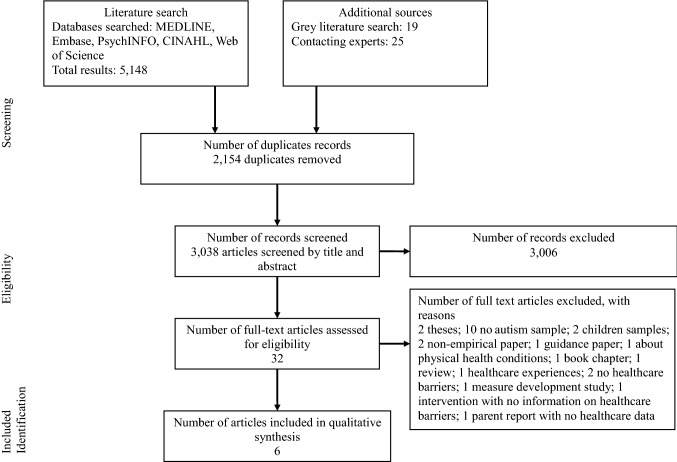
Autistic people are more likely to: be diagnosed with a range of physical health conditions (i.e. cardio-vascular disease); experience premature mortality (for most disease categories); and experience barriers to effectively accessing healthcare. This systematic review sought to identify studies that report on barriers and facilitators to physical healthcare access for autistic people. A total of 3111 records were screened and six studies were included: two quantitative, two qualitative, and two mixed-methodology studies. Patient-provider communication, sensory sensitivities, and executive functioning/planning issues emerged as important barriers to healthcare. Recommendations for clinicians and those planning services are discussed.
Overview
The claims and statistics of this paper haven’t been checked yet.
Run the check — free, no account needed. It reads the open-access text and checks the sources it cites.
Integrity signals
Registry
Cites
Statistics
Figures
Verification
Claims the paper makes
The claims and statistics of this paper haven’t been checked yet.
Run the check — free, no account needed. It reads the open-access text and checks the sources it cites.
Claims other papers make about this one
Each is checked against this paper’s own text: does it say what the citing paper says it does?
The source backs part of the claim, not all of it — or backs it for a different population, condition or comparison.
In the citing paper
“Well-described difficulties accessing healthcare for autistic people include patient-provider communication challenges, sensory difficulties, and systemic factors such as resource and time constraints (Mason et al, 2019; Walsh et al, 2020).”
From Autistic SPACE: a novel framework for meeting the needs of autistic people in healthcare settings (2023) · cites this paper as Mason et al, 2019
Experimental — accuracy not yet measuredThe cited source says what the claim attributes to it.
In the citing paper
“A growing body of research describes the substantial barriers that autistic adults face in accessing physical healthcare, which include such diverse factors as inaccessible sensory environments; providers’ knowledge about and attitudes towards autism; and the complexity of healthcare systems (Mason et al., 2019; Nicolaidis et al., 2015).”
From Annual Research Review: Shifting from ‘normal science’ to neurodiversity in autism science (2022) · cites this paper as Mason et al., 2019
Self-check
Percentages, sums and reported differences re-computed from the paper’s own numbers.
The self-check needs the paper’s full text.
Citations
Cites
Preferred Reporting Items for Systematic Reviews and Meta-Analyses: the PRISMA statement
Moher, D., Liberati, A., Tetzlaff, J., Altman, D. G., & for the PRISMA Group (2009) · BMJ · doi:10.1136/bmj.b2535 · Cited by 83,823
Preferred reporting items for systematic reviews and meta-analyses: the PRISMA Statement.
(2009) · PubMed Central · Cited by 44,859
Preferred reporting items for systematic reviews and meta-analyses: The PRISMA statement
Moher, D., Liberati, A., Tetzlaff, J., Altman, D. G., & the PRISMA Group* (2009) · Annals of Internal Medicine · doi:10.7326/0003-4819-151-4-200908180-00135 · Cited by 37,554
Baron-Cohen, S., Wheelwright, S., Skinner, R., Martin, J., & Clubley, E. (2001) · Journal of Autism and Developmental Disorders · doi:10.1023/a:1005653411471 · Cited by 6,450 · cited 1×
“(2015) also allocated a portion of their sample to those who self-identified as being on the autism spectrum, with the autism quotient (AQ; Baron-Cohen et al. 2001) used as a screen to indicate autistic traits.”
Sensory Processing in Autism: A Review of Neurophysiologic Findings
MARCO, E. J., HINKLEY, L. B. N., HILL, S. S., & NAGARAJAN, S. S. (2011) · Pediatric Research · doi:10.1203/pdr.0b013e3182130c54 · Cited by 1,112
The health status of adults on the autism spectrum
Croen, L. A., Zerbo, O., Qian, Y., Massolo, M. L., Rich, S., Sidney, S., & Kripke, C. (2015) · Autism · doi:10.1177/1362361315577517 · Cited by 1,110 · cited 19×
“One study did not provide sample size data (Dern and Sappok 2016).”
BackgroundMethodInfluentialPremature mortality in autism spectrum disorder
Hirvikoski, T., Mittendorfer-Rutz, E., Boman, M., Larsson, H., Lichtenstein, P., & Bölte, S. (2016) · British Journal of Psychiatry · doi:10.1192/bjp.bp.114.160192 · Cited by 1,011
Taylor, J. L., & Seltzer, M. M. (2011) · Journal of Autism and Developmental Disorders · doi:10.1007/s10803-010-1070-3 · Cited by 735
Reviewing studies with diverse designs: the development and evaluation of a new tool
Sirriyeh, R., Lawton, R., Gardner, P., & Armitage, G. (2012) · Journal of Evaluation in Clinical Practice · doi:10.1111/j.1365-2753.2011.01662.x · Cited by 715
Sensory processing in adults with autism spectrum disorders.
Crane, L., Goddard, L., & Pring, L. (2009) · Autism · doi:10.1177/1362361309103794 · Cited by 602
Cited by
Sorted by citations
Annual Research Review: Shifting from ‘normal science’ to neurodiversity in autism science
Pellicano, E., & den Houting, J. (2022) · Journal of Child Psychology and Psychiatry · doi:10.1111/jcpp.13534 · Cited by 744
“knowledge about and attitudes towards autism; and the complexity of healthcare systems (Mason et al., 2019; Nicolaidis et al., 2015).”
BackgroundTackling healthcare access barriers for individuals with autism from diagnosis to adulthood
Malik-Soni, N., Shaker, A., Luck, H., Mullin, A. E., Wiley, R. E., Lewis, M. E. S., Fuentes, J., & Frazier, T. W. (2022) · Pediatric Research · doi:10.1038/s41390-021-01465-y · Cited by 309
What factors affect patients’ ability to access healthcare? An overview of systematic reviews
Dawkins, B., Renwick, C., Ensor, T., Shinkins, B., Jayne, D. G., & Meads, D. M. (2021) · Tropical Medicine & International Health · doi:10.1111/tmi.13651 · Cited by 276
A capabilities approach to understanding and supporting autistic adulthood
Pellicano, E., Fatima, U., Hall, G., Heyworth, M., Lawson, W., Lilley, R., Mahony, J., & Stears, M. (2022) · Nature Reviews Psychology · doi:10.1038/s44159-022-00099-z · Cited by 237
Doherty, M., Neilson, S., O'Sullivan, J., Carravallah, L., Johnson, M., Cullen, W., & Shaw, S. C. K. (2022) · BMJ Open · doi:10.1136/bmjopen-2021-056904 · Cited by 257
Metadata
- Authors
- Mason, D., Ingham, B., Urbanowicz, A., Michael, C., Birtles, H., Woodbury-Smith, M., Brown, T., James, I., Scarlett, C., Nicolaidis, C., & Parr, J. R.
- Affiliations
- Royal Victoria Infirmary (GB)
- Cumbria Northumberland Tyne and Wear NHS Foundation Trust (GB)
- RMIT University (AU)
- Newcastle University (GB)
- Newcastle Hospitals - Campus for Ageing and Vitality (GB)
- North Tyneside General Hospital (GB)
- Portland State University (US)
- Corresponding author
- Mason, David
- Venue
- Journal of Autism and Developmental Disorders
- Published
- 2019-05-23
- Volume
- 49
- Issue
- 8
- Pages
- 3387-3400
- ISSN
- 0162-3257 (ISSN-L)
- 1573-3432
- PMC
- PMC6647496
- OpenAlex
- W2945521062
- Cited by
- 291
- References
- 49
- Citations by year
- 2026: 55 · 2025: 38 · 2024: 41 · 2023: 52 · 2022: 42 · 2021: 45 · 2020: 17 · 2019: 1
- FWCI
- 3.28
- Type
- journal article
- Language
- en
- Open access
- hybrid
- doi.org
- Locations
- Journal of Autism and Developmental Disorders (publishedVersion, cc-by)
- Europe PMC (PubMed Central) (publishedVersion, cc-by)
- PubMed Central (publishedVersion, cc-by)
- PubMed (publishedVersion)
- Gredos (University of Salamanca) (publishedVersion, cc-by-nc-nd)
- PDXScholar (Portland State University) (submittedVersion, cc-by)
- RMIT Research Repository (RMIT University Library) (submittedVersion)
- Figshare (submittedVersion, cc-by)
- Figshare (submittedVersion)
- Newcastle University ePrints (Newcastle Univesity) (cc-by)
- Topics
- Life Sciences › Neuroscience › Cognitive Neuroscience › Autism Spectrum Disorder Research
- Health Sciences › Medicine › Public Health, Environmental and Occupational Health › Down syndrome and intellectual disability research
- Health Sciences › Health Professions › General Health Professions › Patient-Provider Communication in Healthcare
- Keywords
- autism spectrum disorder, autistic adults, barriers to care, patient-provider communication, sensory sensitivity, executive function, cardiovascular disease, premature mortality, health planning
- MeSH terms
- Adult, Autistic Disorder, Communication, Health Services Accessibility, Humans, Executive Function
About these checks
Registry, retraction, Cites and statistics results are computed, not judged, with one exception: a printed reference that no index lists is read once by a model before it counts as a citation error. Claims are extracted by a model and kept only when their quote appears verbatim in the text; each cited source is then checked, with a model’s help, for whether it says what the claim relies on. Those verdicts can be wrong — read the claim’s quote and the cited source before relying on one.
Statistics and arithmetic are recomputed, not judged.
Confidence bands are shown only for fields calibrated on our annotated test set. None is calibrated yet, so no band is shown.
What counts as a claim ›How we measure confidence ›How we check this ›
Are you an author, or do you see a problem with this page? Request a review
