

Anxiety and Worries of Individuals with Down Syndrome During the COVID-19 Pandemic: A Comparative Study in the UK
Open accessPublished version of a preprint
The DOI matches its Crossref record; 77 of the 77 references it cites were found in a registry or an index.
Abstract
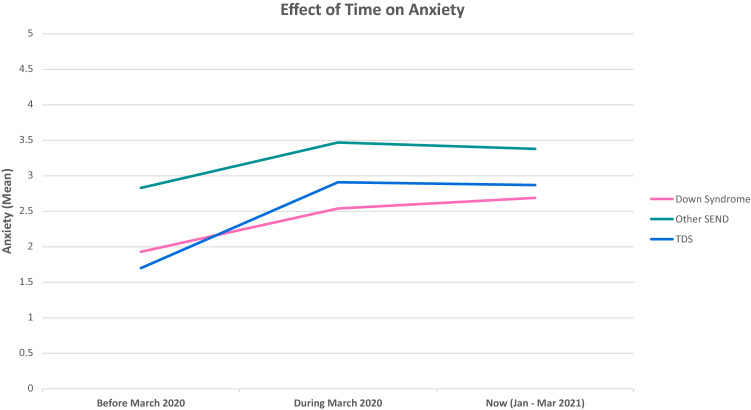
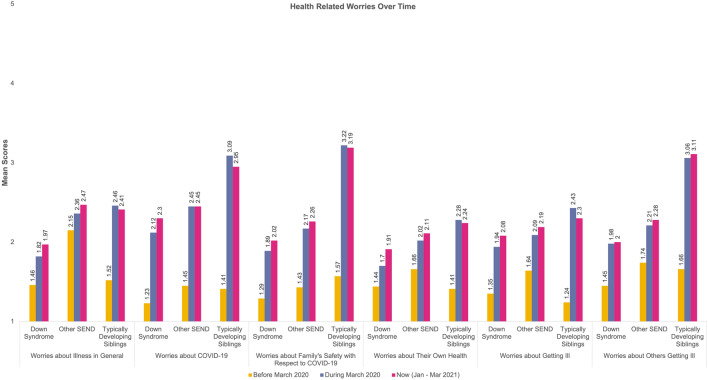
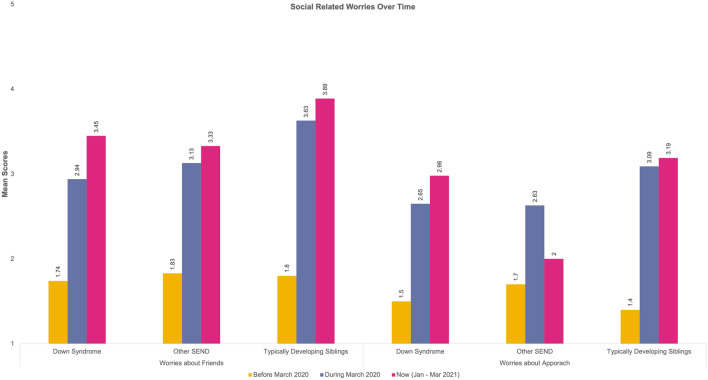
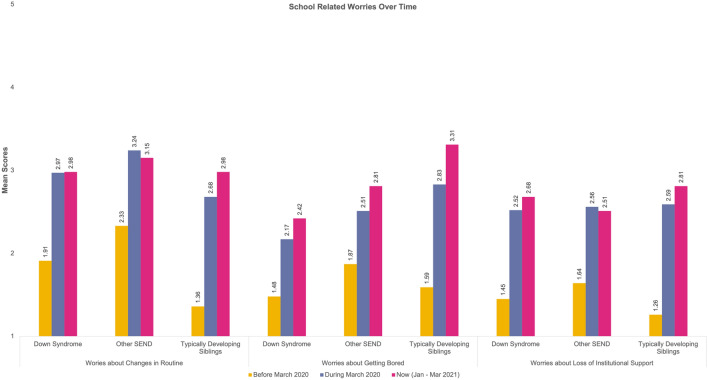
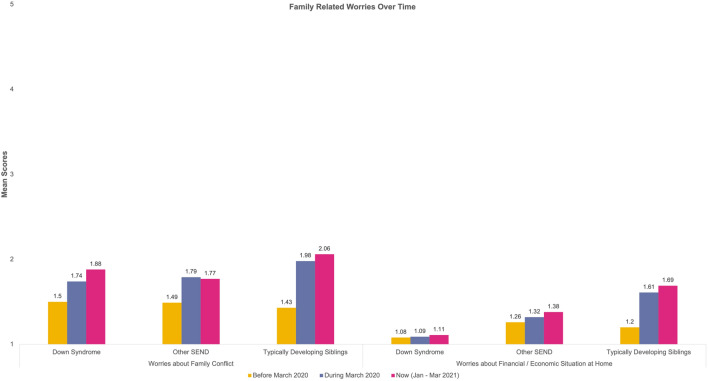
The present study explored the effects of the pandemic on individuals with Down Syndrome (DS; n = 67) compared to other groups with Special Education Needs and Disabilities (SEND; n = 48) and their Typically Developing Siblings (TDS; n = 56). In total, 115 caregivers reported on their own anxiety and worries and of their children. Anxiety levels for individuals with DS appeared to be lower compared to other SEND populations and to TDS. In terms of worries, individuals with DS worried more about social-related worries but worried less about family-related aspects compared to the other groups. In sum, individuals with DS might show less anxiety but still worried more about specific aspects related to the impact of COVID-19 pandemic on their lives.
Overview
The claims and statistics of this paper haven’t been checked yet.
Free: it reads the open-access text and checks the first 5 claims that cite a source we can check. Create a free account to check every claim.
Integrity signals
Registry
Cites
Statistics
Figures
Verification
Claims the paper makes
The claims and statistics of this paper haven’t been checked yet.
Free: it reads the open-access text and checks the first 5 claims that cite a source we can check. Create a free account to check every claim.
Claims other papers make about this one
Each is checked against this paper’s own text: does it say what the citing paper says it does?
The check wasn’t confident either way, so it gives no verdict — never disputed.
In the citing paper
“Research also indicates that mindfulness practice may help with the development of compassion and reducing stress, anxiety [34], and depression [10-13].”
From Psychological Interventions and Those With Elements of Positive Psychology for Child and Youth Mental Health During the COVID-19 Pandemic: Literature Review, Lessons Learned, and Areas for Future Knowledge Dissemination (2024) · cites this paper as [13]
Experimental — accuracy not yet measured
Self-check
Percentages, sums and reported differences re-computed from the paper’s own numbers.
The self-check needs the paper’s full text.
Citations
Cites
A Brief Measure for Assessing Generalized Anxiety Disorder: The GAD-7
Spitzer, R. L., Kroenke, K., Williams, J. B. W., & Löwe, B. (2006) · Archives of Internal Medicine · doi:10.1001/archinte.166.10.1092 · Cited by 31,765
A scaled version of the General Health Questionnaire
Goldberg, D. P., & Hillier, V. F. (1979) · Psychological Medicine · doi:10.1017/s0033291700021644 · Cited by 5,459
Rossi, R., Socci, V., Talevi, D., Mensi, S., Niolu, C., Pacitti, F., Di Marco, A., Rossi, A., Siracusano, A., & Di Lorenzo, G. (2020) · Frontiers in Psychiatry · doi:10.3389/fpsyt.2020.00790 · Cited by 1,448 · cited 1×
“…show the effect of multiple lockdowns can be effective (Scala, 2021), mental health researchers raised concerns around their impact on mental health as many countries, including the UK, were undergoing a series of lockdowns (Rossi et al., 2020; Thakur et al., 2020; Adams-Prassl et al., 2020).”
The impact of COVID-19 lockdown on child and adolescent mental health: systematic review
Panchal, U., Salazar de Pablo, G., Franco, M., Moreno, C., Parellada, M., Arango, C., & Fusar-Poli, P. (2023) · European Child & Adolescent Psychiatry · doi:10.1007/s00787-021-01856-w · Cited by 1,028 · cited 1×
“Though the impact of the COVID-19 pandemic and its restrictions have caused significant elevated rates of mental health to individuals with SEND (Panchal et al., 2021), to our knowledge there is no research on the effects of the pandemic on individuals with Down Syndrome and the challenges and…”
Parenting stress and child behavior problems: a transactional relationship across time
Neece, C. L., Green, S. A., & Baker, B. L. (2012) · American Journal on Intellectual and Developmental Disabilities · doi:10.1352/1944-7558-117.1.48 · Cited by 953
Russell, B. S., Hutchison, M., Tambling, R., Tomkunas, A. J., & Horton, A. L. (2020) · Child Psychiatry & Human Development · doi:10.1007/s10578-020-01037-x · Cited by 704
Behavioral phenotype of individuals with Down syndrome
Chapman, R. S., & Hesketh, L. J. (2000) · Mental Retardation and Developmental Disabilities Research Reviews · doi:10.1002/1098-2779(2000)6:2<84::aid-mrdd2>3.0.co;2-p · Cited by 672
Asbury, K., Fox, L., Deniz, E., Code, A., & Toseeb, U. (2021) · Journal of Autism and Developmental Disorders · doi:10.1007/s10803-020-04577-2 · Cited by 558
Validity of the scaled version of the General Health Questionnaire (GHQ-28) in a Spanish population
Lobo, A., Pérez-Echeverría, M. J., & Artal, J. (1986) · Psychological Medicine · doi:10.1017/s0033291700002579 · Cited by 535
Hauser-Cram, P., Warfield, M. E., Shonkoff, J. P., & Krauss, M. W. (2003) · Monographs of the Society for Research in Child Development · doi:10.1111/1540-5834.00151 · Cited by 449
Research works printed but not linked: 2
- Cuskelly, M., Faragher, R., & Jobling, A. (2017). Indicative evidence that developmental dyscalculia may be part of the down syndrome behavioural phenotype. Paper presented at the Conference of the Society for the Study of Behavioural Phenotypes, Leiden, Netherlands.
- Schalock RL Quality of life: Vol. 1. Conceptualization and measurement 1996 American Association on Mental Retardation
Cited by
Raza, A., Munir, K., Almutairi, M. S., & Sehar, R. (2024) · IEEE Access · doi:10.1109/access.2024.3359235 · Cited by 52
Memahami Anak Berkebutuhan Khusus: Down Syndrome
Kamil, N., Fitri, Z. Z., Nasution, H., & Putro, . Z. (2023) · Murhum Jurnal Pendidikan Anak Usia Dini · doi:10.37985/murhum.v4i2.179 · Cited by 33
Sideropoulos, V., Sokhn, N., Palikara, O., Herwegen, J. V., & Samson, A. C. (2023) · Scientific Reports · doi:10.1038/s41598-023-35176-7 · Cited by 19
Self-citationSantoro, S. L., Baker, S., Blake, J. M., Cabrera, M. J., Caughman, K., Chung, J. A., Cullen, S., Gallagher, M., Haugen, K. L., Hoke‐Chandler, R., et al. (2023) · American Journal of Medical Genetics Part A · doi:10.1002/ajmg.a.63233 · Cited by 11
Lyzwinski, L., Zwicker, J. D., Mcdonald, S., & Tough, S. (2024) · JMIR Pediatrics and Parenting · doi:10.2196/59171 · Cited by 7
“Research also indicates that mindfulness practice may help with the development of compassion and reducing stress, anxiety [34], and depression [10-13].”
BackgroundResult
Metadata
- Authors
- Sideropoulos, V., Kye, H., Dukes, D., Samson, A. C., Palikara, O., & Van Herwegen, J.
- Affiliations
- University College London (GB)
- University of Geneva (CH)
- University of Fribourg (CH)
- University of Warwick (GB)
- Corresponding author
- Sideropoulos, V.
- Venue
- Journal of Autism and Developmental Disorders
- Published
- 2022-02-01
- Volume
- 53
- Issue
- 5
- Pages
- 2021-2036
- ISSN
- 0162-3257 (ISSN-L)
- 1573-3432
- PMC
- PMC8806133
- OpenAlex
- W4220689434
- Cited by
- 21
- References
- 77
- Citations by year
- 2026: 1 · 2025: 2 · 2024: 10 · 2023: 7 · 2022: 1
- FWCI
- 4.56
- Type
- journal article
- Language
- en
- Open access
- hybrid
- doi.org
- Licence
- cc-by
- creativecommons.org/licenses/by/4.0 (tdm)
- creativecommons.org/licenses/by/4.0 (vor)
- Locations
- Journal of Autism and Developmental Disorders (publishedVersion, cc-by)
- PubMed Central (publishedVersion, cc-by)
- PubMed (publishedVersion)
- Warwick Research Archive Portal (University of Warwick) (acceptedVersion)
- Archive ouverte UNIGE (University of Geneva) (submittedVersion, cc-by)
- UCL Discovery (University College London) (submittedVersion)
- PsyArXiv (OSF Preprints) (submittedVersion, cc-by)
- PsyArXiv (OSF Preprints) (submittedVersion)
- Funders
- Baily Thomas Charitable Fund (TRUST/VC/AC/SG/5852-9005)
- Swiss National Science Foundation (SNSF PP00P1_176722)
- Topics
- Social Sciences › Psychology › Clinical Psychology › COVID-19 and Mental Health
- Health Sciences › Medicine › Public Health, Environmental and Occupational Health › Down syndrome and intellectual disability research
- Social Sciences › Psychology › Clinical Psychology › Family and Disability Support Research
- Keywords
- Down syndrome, COVID-19 pandemic, anxiety, worry, special educational needs and disabilities, typically developing siblings, caregivers, children with disabilities
- MeSH terms
- Autism Spectrum Disorder, COVID-19, Anxiety, Child, Down Syndrome, United Kingdom, Humans, Pandemics
About these checks
Registry, retraction, Cites and statistics results are computed, not judged, with one exception: a printed reference that no index lists is read once by a model before it counts as a citation error. Claims are extracted by a model and kept only when their quote appears verbatim in the text; each cited source is then checked, with a model’s help, for whether it says what the claim relies on. Those verdicts can be wrong — read the claim’s quote and the cited source before relying on one.
Statistics and arithmetic are recomputed, not judged.
Confidence bands are shown only for fields calibrated on our annotated test set. None is calibrated yet, so no band is shown.
What counts as a claim ›How we measure confidence ›How we check this ›
Are you an author, or do you see a problem with this page? Request a review
How to cite
Cite CoChat for the checks on this page, and the paper for its own findings.
- This page
- CoChat. (2026). Citation check: Anxiety and Worries of Individuals with Down Syndrome During the COVID-19 Pandemic: A Comparative Study in the UK. https://app.cochat.ai/papers/10.1007/s10803-022-05450-0
- The paper
- Sideropoulos, V., Kye, H., Dukes, D., Samson, A. C., Palikara, O., & Van Herwegen, J. (2023). Anxiety and Worries of Individuals with Down Syndrome During the COVID-19 Pandemic: A Comparative Study in the UK. Journal of Autism and Developmental Disorders. https://doi.org/10.1007/s10803-022-05450-0
Data sources
Bibliographic data: Semantic Scholar, OpenAlex, Crossref.
Contains information from the Semantic Scholar Academic Graph Datasets, made available under the ODC Attribution License (ODC-BY 1.0).
Semantic Scholar’s data is described in: Kinney, R., et al. (2023). The Semantic Scholar Open Data Platform. arXiv:2301.10140.
