

Autism Spectrum Disorder and Gender Dysphoria/Incongruence. A systematic Literature Review and Meta-Analysis
Open accessThe DOI matches its Crossref record; 115 of the 116 references it cites were found in a registry or an index.
Abstract
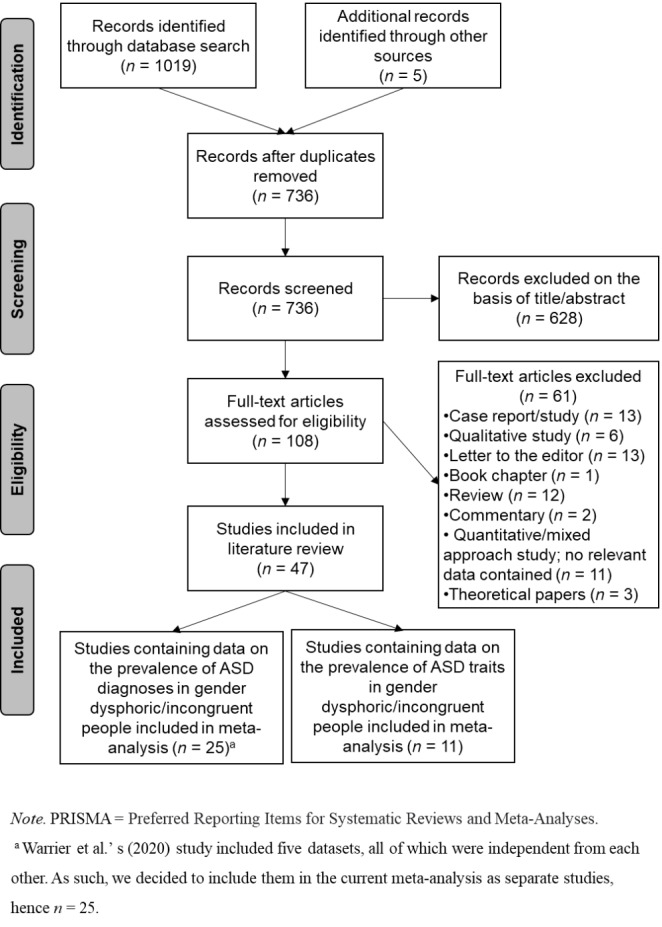
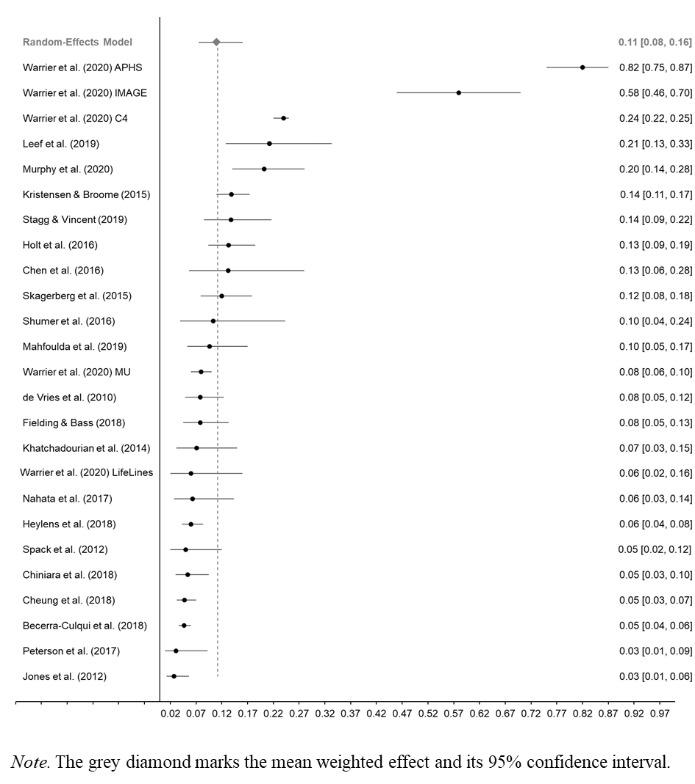
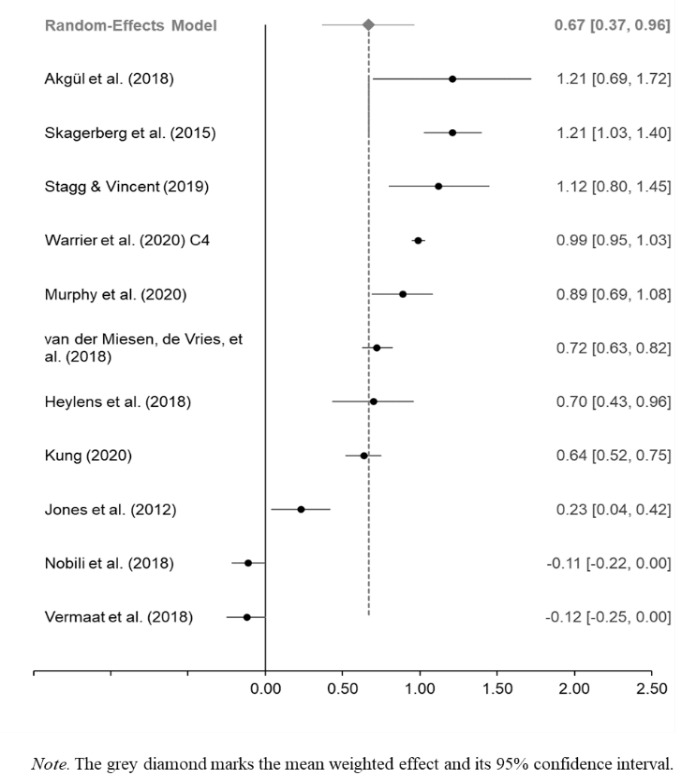
The suggested overlap between autism spectrum disorder (ASD) and gender dysphoria/incongruence (GD/GI) has been much disputed. This review showed a relationship between ASD traits and GD feelings in the general population and a high prevalence of GD/GI in ASD. Our meta-analyses revealed that the pooled estimate of the prevalence of ASD diagnoses in GD/GI people was 11% ( p < .001) and the overall effect size of the difference in ASD traits between GD/GI and control people was significant ( g = 0.67, p < .001). Heterogeneity was high in both meta-analyses. We demonstrated that the chances that there is not a link between ASD and GD/GI are negligible, yet the size of it needs further investigation.
Overview
The claims and statistics of this paper haven’t been checked yet.
Free: it reads the open-access text and checks the first 5 claims that cite a source we can check. Create a free account to check every claim.
Integrity signals
Registry
Cites
Statistics
Figures
Verification
Claims the paper makes
The claims and statistics of this paper haven’t been checked yet.
Free: it reads the open-access text and checks the first 5 claims that cite a source we can check. Create a free account to check every claim.
Claims other papers make about this one
Each is checked against this paper’s own text: does it say what the citing paper says it does?
In the citing paper
“Gender diversity has also been associated with some neurodevelopmental conditions16,17 (Box 4).”
From Sex and gender in neurodevelopmental conditions (2023) · cites this paper as [16]
Self-check
Percentages, sums and reported differences re-computed from the paper’s own numbers.
The self-check needs the paper’s full text.
Citations
Cites
Diagnostic and Statistical Manual of Mental Disorders
American Psychiatric Association (2013) · doi:10.1176/appi.books.9780890425596 · Cited by 116,369
Statistical Power Analysis for the Behavioral Sciences
Muller, K. (1989) · Technometrics · doi:10.1080/00401706.1989.10488618 · Cited by 99,167
Measuring inconsistency in meta-analyses
Higgins, J. P. T., Thompson, S. G., Deeks, J. J., & Altman, D. G. (2003) · BMJ · doi:10.1136/bmj.327.7414.557 · Cited by 63,139 · cited 2×
“…of the observed variance reflects variation in the true effect sizes rather than sampling error, we calculated I2 values and to identify how much the true effects vary across studies we estimated prediction intervals (Borenstein et al., 2009; Borenstein et al., 2017; Higgins et al., 2003).”
BackgroundStatistical Power Analysis for the Behavioral Sciences (2nd ed.).
Lachenbruch, P. A., & Cohen, J. (1989) · Journal of the American Statistical Association · doi:10.2307/2290095 · Cited by 37,395 · cited 13×
“Also, results did not change substantively when we replaced Kung’s (2020) control group from Baron-Cohen et al. (2014) with Ruzich et al's (2015), instead (see Supplementary Material).”
BackgroundMethodInfluentialPRISMA-P Group, Moher, D., Shamseer, L., Clarke, M., Ghersi, D., Liberati, A., Petticrew, M., Shekelle, P., & Stewart, L. A. (2015) · Systematic Reviews · doi:10.1186/2046-4053-4-1 · Cited by 26,223
Borenstein, M., Hedges, L. V., Higgins, J. P. T., & Rothstein, H. R. (2009) · doi:10.1002/9780470743386 · Cited by 14,225
(2000) · Cited by 9,198
Lord, C., Risi, S., Lambrecht, L., Cook, E. H., Leventhal, B. L., DiLavore, P. C., Pickles, A., & Rutter, M. (2000) · Journal of Autism and Developmental Disorders · doi:10.1023/a:1005592401947 · Cited by 7,520 · cited 2×
“Along with a formal diagnosis of ASD, standardized diagnostic tools (e.g., Autism Diagnostic Observation Schedule and Autism Diagnostic Interview-Revised; Lord et al., 2000; Rutter et al., 2003) could also be used in an attempt to elucidate the high heterogeneity we observe in the prevalence of ASD diagnoses in this p…”
MethodBaron-Cohen, S., Wheelwright, S., Skinner, R., Martin, J., & Clubley, E. (2001) · Journal of Autism and Developmental Disorders · doi:10.1023/a:1005653411471 · Cited by 6,450 · cited 4×
“Jones et al. (2012) and Pasterski et al. (2014) took the data of their control group from the same source (i.e., Baron-Cohen et al., 2001).”
BackgroundInfluentialDistribution Theory for Glass's Estimator of Effect Size and Related Estimators
Hedges, L. V. (1981) · Journal of Educational Statistics · doi:10.2307/1164588 · Cited by 5,695 · cited 1×
“Likewise, Kung (2020) found that transgender men and nonbinary females reported significantly more 3107 Journal of Autism and Developmental Disorders (2023) 53:3103–3117 1 3 (Hedges, 1981; Hedges & Olkin, 1985).”
Background
Research works printed but not linked: 2
- Comprehensive Meta-Analysis Borenstein M Hedges L Higgins J Rothstein H Version 3) [Computer software] 2013 Englewood: NJ Biostat
- Rutter M Le Couteur A Lord C ADI-R: Autism Diagnostic Interview-Revised (ADI-R) 2003 Los Angeles, CA Western Psychological Services
Cited by
Items 101–200 of 220
Self-Reported Multidimensional Gender Identity in Autistic and Non-Autistic Children
To, J. C. S., Hui, M. M. C., & Kung, K. T. F. (2024) · Journal of Autism and Developmental Disorders · doi:10.1007/s10803-024-06667-x · Cited by 2
Mears, K., Rai, D., Shah, P., & Ashwin, C. (2025) · Molecular Autism · doi:10.1186/s13229-025-00649-1 · Cited by 3
“For example, roughly 11% of gender-diverse people are autistic [31], autistic and non-autistic gender diverse people report elevated levels of autistic traits when compared to their cisgender counterpart [56], and autistic children and adolescents are more likely to endorse the wish to be the…”
Was brauchen Jugendliche mit Geschlechtsinkongruenz – und was brauchen sie nicht?
Pauli, D. (2025) · Pädiatrie & Pädologie · doi:10.1007/s00608-025-01284-y · Cited by 2
Kulatunga-Moruzi, C., Sim, P., Mitchell, I., Palmer, D., & Joffe, A. R. (2025) · Archives of Sexual Behavior · doi:10.1007/s10508-025-03335-8 · Cited by 2
“…the elevated rates of neurodevelopmental conditions such as autism spectrum disorders and attention-deficit hyper-activity disorder frequently associated with gender distress (Kallitsounaki & Williams, 2022; Lehmann et al., 2020; Warrier et al., 2020), which cannot be explained by minority stress.”
Nordahl, C. W. (2023) · Elsevier eBooks · doi:10.1016/b978-0-12-820480-1.00033-4 · Cited by 3
Recognising and Responding to Physical and Mental Health Issues in Neurodivergent WomenPreprint
Kelly, C. A., Martin, R., & Taylor, R. (2023) · Qeios · doi:10.32388/nfb3fk.11 · Cited by 2
Introduction to the special issue on gender diversity in development
Gülgöz, S., & Martin, C. L. (2025) · British Journal of Developmental Psychology · doi:10.1111/bjdp.12563 · Cited by 2
Tawata, S., Sakaguchi, K., & Saito, A. (2024) · Frontiers in Child and Adolescent Psychiatry · doi:10.3389/frcha.2024.1356802 · Cited by 1
“A meta-analysis of 25 studies on transgender and other gender-nonconforming individuals ( n = 8,662) estimated an ASD prevalence of approximately 11% (21).”
Compensación social e identidad en los adolescentes con trastorno del espectro autista
Ageitos, A. G., Vicente-Alba, J., Pérez, V. Á., Hijano, C. M. G., & Millares, M. V. (2024) · Revista de Psiquiatría Infanto-Juvenil · doi:10.31766/revpsij.v41n4a5 · Cited by 1
Sexual health and well-being: A study of autistic youth in Canada
Shao, Y. W., McKay, A. S., Wood, J. R., Byers, E. S., & Wentland, J. (2024) · The Canadian Journal of Human Sexuality · doi:10.3138/cjhs-2024-0033 · Cited by 2
The development of pervasive social dysphoria in autistic people with gender dysphoria in Japan
Shimoyama, S., & Endo, T. (2025) · The Japanese journal of psychology · doi:10.4992/jjpsy.96.23035 · Cited by 1
Neurodivergent Students' Views on Internet Threats: A Call for Research
Stone, B. G., Saggers, B. R., Campbell, M. A., & Yates, C. (2025) · Advances in social networking and online communities book series · doi:10.4018/979-8-3693-4191-9.ch003 · Cited by 6
Sex-typical toy, activity, and playmate preferences in autistic and non-autistic children
To, J. C. S., & Kung, K. T. F. (2025) · Autism · doi:10.1177/13623613251321207 · Cited by 3
“…autistic individuals (Calderoni, 2023; Hull, Mandy, & Petrides, 2017), and systematic reviews have reported increased gender identity diversity in autistic individuals (Kallitsounaki & Williams, 2023; Mears et al., 2024), but much less research has looked at sex-typical play in autistic children.”
Tokarek͐, A., Gąsiorowska, A., & Król, M. E. (2025) · Research in Autism · doi:10.1016/j.reia.2025.202590 · Cited by 2
Lehmann, K., Rosato, M., & Leavey, G. (2025) · Journal of Child and Adolescent Mental Health · doi:10.2989/17280583.2025.2504587 · Cited by 1
Mournet, A. M., Wilkinson, E. H., Libsack, E. J., Dekker, E. D., Bal, V. H., & Kleiman, E. M. (2026) · International Journal of Transgender Health · doi:10.1080/26895269.2026.2664760 · Cited by 1
Mears, K., & Ashwin, C. (2025) · International Journal of Transgender Health · doi:10.1080/26895269.2025.2553741 · Cited by 1
Cooper, K., van der Miesen, A. I. R., & Lai, M. (2025) · JAACAP Open · doi:10.1016/j.jaacop.2025.10.001 · Cited by 1
“1,15 These reviews and authors’ knowledge were used to create the first survey.”
Baseline findings from the Longitudinal Outcomes of Gender Identity in Children (LOGIC) study
Kennedy, E., Fysh, M. C., Vickerstaff, V., Gronostaj-Miara, A., Hanson, C. S., McKay, K., Lane, C., Senior, R., Carmichael, P., Allison, C. L., et al. (2025) · The British Journal of Psychiatry · doi:10.1192/bjp.2025.10451 · Cited by 1
“There is a growing interest in the intersection of autism and gender diversity, with recent evidence suggesting that around 11% of gender-diverse people are also autistic, 41 despite an estimated prevalence of 1 – 2% in the general population.”
Validating the German Translation of the Revised Comprehensive Autistic Trait Inventory
Hechler, F. C., Caruana, N., Fahr, F., Karlek, B., Maroske, M., Misia, M., & Tuomainen, O. (2026) · Autism in Adulthood · doi:10.1177/25739581251406751 · Cited by 1
Kennedy, B. S., Weir, E. M., Fysh, M. C., Tsompanidis, A., Payne, R., Allison, C. L., Matthews, F. E., & Baron‐Cohen, S. (2026) · Molecular Autism · doi:10.1186/s13229-025-00698-6 · Cited by 1
“As gender diversity is over-represented in autism [62, 63], this may affect the validity of our matching criteria based on gender. v) As outlined in Fig.”
Uglik‐Marucha, N., Show, S., Vitoratou, S., Happe, F. G. E., & Belcher, H. (2026) · PLoS ONE · doi:10.1371/journal.pone.0337600 · Cited by 4
“This is especially relevant given the higher proportion of autistic individuals identifying as gender diverse [24], particularly those assigned female at birth (AFAB) [25].”
Sensory-processing informed autism practice for child-centred therapists
Daniel, S. W., Mahler, K., Ray, D. C., Sharp, K., Clairy, K., Inderbitzen, S. M., Laurent, A. C., Fede, J. H., & Delafield‐Butt, J. T. (2026) · Research in Neurodiversity · doi:10.1016/j.rin.2026.100015 · Cited by 2
Camp, J., Kashirsky, N., Pinckard, S., Hambleton, S., Oliver, A., Smith, L. J., Badrick, E., Bhopal, S., Baudinet, J., & Absoud, M. (2026) · Wellcome Open Research · doi:10.12688/wellcomeopenres.24147.2 · Cited by 1
Gender-Affirming Care: A 21st Century Bibliometric Perspective
Vervalcke, J., Barouti, K., Ciancia, S., Motmans, J., & T'Sjoen, G. G. (2026) · International Journal of Sexual Health · doi:10.1080/19317611.2026.2633626 · Cited by 1
“While consensus is growing that a link exists, researchers continue to debate the nature and degree of interrelatedness between ASD and gender incon-gruence (Kallitsounaki & Williams, 2023).”
Woodhill, B. M. (2026) · Futures · doi:10.1016/j.futures.2026.103810 · Cited by 1
Schuster, C. R., Giovanni, K., Thomas, K., Conn, B. M., & Liang, F. (2026) · Current Psychiatry Reports · doi:10.1007/s11920-026-01669-1 · Cited by 1
MacKinnon, K. R., Newman, K., Khan, N. K., Expósito-Campos, P., Marshall, G., Gould, W. A., Sansfaçon, A. P., Rackliff, K., & Lam, J. S. H. (2026) · The Journal of LGBTQ+ Mental Health · doi:10.1080/30678935.2026.2653130 · Cited by 1
Kallitsounaki, A., Williams, D. M., & Fysh, M. C. (2026) · International Journal of Transgender Health · doi:10.1080/26895269.2026.2658857 · Cited by 2
Self-citationPascoe, M. I., Vincent, J., Lai, M., Desarkar, P., Vitopoulos, N. A., Lunsky, Y., MacKinnon, K. R., & Lam, J. S. H. (2026) · The Canadian Journal of Psychiatry · doi:10.1177/07067437261442432 · Cited by 1
Demasculinized digit ratios in a sample of boys with childhood autism
Hampson, E., Waxman, S. E., & Nicolson, R. (2026) · Hormones and Behavior · doi:10.1016/j.yhbeh.2026.105950 · Cited by 1
Advances in supporting development in autistic children and youth
Penner, M., Zwaigenbaum, L., Piroddi, N., Park, S., Minhas, R. S., & Singal, D. (2026) · BMJ · doi:10.1136/bmj-2025-086562 · Cited by 2
Exploring the Psychological Mechanisms of Gender Transition and Detransition
Lal, M., & Levine, S. B. (2026) · Journal of Sex & Marital Therapy · doi:10.1080/0092623x.2026.2685303 · Cited by 1
Bates, C., & Matthews, R. J. (2024) · Advances in Autism · doi:10.1108/aia-05-2023-0027 · Cited by 1
Facial Sexual Dimorphism and Attractiveness Perception in High Autistic Trait Individuals
Pazhoohi, F., Forby, L., & Kingstone, A. F. (2025) · Evolutionary Psychological Science · doi:10.1007/s40806-025-00438-2 · Cited by 1
“Recent research has found that relative to controls, individuals high in autistic traits identify less with their gender (Cooper et al., 2018; Kallitsounaki & Williams, 2023).”
Sanders, M., Saade, Z., & Mortillaro, G. A. (2025) · Child and Adolescent Mental Health · doi:10.1111/camh.70042 · Cited by 1
Clawson, A., Phan, J., Baldwin, S. A., Wallace, G. L., Persky, R., Kenworthy, L. E., Khuu, A., Jack, A., Webb, S. J., Pelphrey, K. A., et al. (2023) · PsyArXiv (OSF Preprints) · doi:10.31234/osf.io/jbtge · Cited by 1
Hormone Treatments for Children and Young People with Gender Dysphoria
Fernandez, C. C., & Bunn, S. (2023) · doi:10.58248/pb55 · Cited by 1
Recognising and Responding to Physical and Mental Health Issues in Neurodivergent WomenPreprint
Kelly, C. A., Martin, R., Taylor, R., & Doherty, M. (2023) · Qeios · doi:10.32388/nfb3fk.9
Trans Autistic Experiences of Gender-Affirming Care in Ontario
Jacobsen, K. V. G. (2024) · Carleton University's Institutional Repository (MacOdrum Library, Carleton University) · doi:10.22215/etd/2024-16318 · Cited by 1
Thomas, K. S., Keith, M., Williams, G. T., Blackbrook, H., Bainbridge, R., Merry, J., LEADING Lived Experience Advisory Group, Williams, M. O., Henley, J., Jones, C. R. G., et al. (2026) · Journal of Eating Disorders · doi:10.21203/rs.3.rs-9556606/v1 · Cited by 4
Spotted around the web: Sex differences in microglia, Google searches, Kavli Prize
Adams, J. U., & Askham, A. V. (2022) · The Transmitter · doi:10.53053/mylk1740
Finoulst, M., & Vankrunkelsven, P. (2022) · Tijdschrift voor Geneeskunde · doi:10.47671/tvg.78.22.108
Lacroix, A. (2023) · UGA Éditions eBooks · doi:10.4000/books.ugaeditions.29935
Walker, C. (2023) · SSRN Electronic Journal · doi:10.2139/ssrn.4572842
AUTISM AND GENDER DYSPHORIA: A NARRATIVE REVIEW OF THEIR COEXISTENCE AND CLINICAL IMPLICATIONS
Barbosa, N. D. S. A., Andreoli, C. D. S., Faletti, C. B., Coldebella, L. R., Franco, T. M. A., Ribeiro, R. P. M., Barboza, V. D. O., Rodrigues, J. D. S., Vasques, L. F., Simões, M. H., et al. (2024) · International Journal of Health Science · doi:10.22533/at.ed.1594112423017
Gender Incongruence and Autistic Traits: Cerebral and Behavioral Underpinnings
Khorashad, B. S., Wang, Y., Holmberg, M., Dhejne, C., & Savic, I. (2024) · Archives of Sexual Behavior · doi:10.1007/s10508-024-02809-5 · Cited by 2
Mental Health Issues in Adults with Autism Spectrum Disorders
Volkmar, F. R., Grindle, H., Solomon, C., O’Brian, S., & Øien, R. A. (2024) · Springer eBooks · doi:10.1007/978-3-031-46463-8_13 · Cited by 2
Sternberg, K. F., Bausha, C. E., Jones, C., Knight, E., Steltenpohl, C. N., Parton, R. R., McLaren, J., & Barnett, E. R. (2024) · Developmental Disabilities Network Journal · doi:10.59620/2694-1104.1093
Tokarek͐, A., Gąsiorowska, A., & Król, M. E. (2024) · SSRN Electronic Journal · doi:10.2139/ssrn.4875380
Hechler, F. C., Tuomainen, O., Weber, N., Fahr, F., Karlek, B., Maroske, M., Misia, M., & Caruana, N. (2024) · Research Square · doi:10.21203/rs.3.rs-4667044/v1
Relationship between sexual issues, gender identity, and autism spectrum disorder: A review
Włodarczyk, K., Myślicka, M., Orzeł, M., Orzeł, B., Józefiak, A., Szczepanik, M., Mazurek, G., Kropidłowska, D., Hałasiński, P., Mazurek, J., et al. (2024) · Medical Science · doi:10.54905/disssi.v28i149.e80ms3383
Hechler, F. C., Tuomainen, O., Weber, N., Fahr, F., Karlek, B., Maroske, M., Misia, M., & Caruana, N. (2024) · PsyArXiv (OSF Preprints) · doi:10.31234/osf.io/se6zn
Berthonneche, L., Lapoirie, M., & Jurek, L. (2024) · Journal de Pédiatrie et de Puériculture · doi:10.1016/j.jpp.2024.07.005
Özel, F., Stratmann, M., Papadopoulos, F. C., Rüegg, J., & Bornehag, C. (2024) · PLoS ONE · doi:10.1371/journal.pone.0308605
Domingues, G. P. C., Egidio, B. C. G., Valandro, B. F., Sznajder, L. B., Rosa, L. D. O. M., Galvão, L. C., Campos, L. G. G., Maciel, M. P., Martins, N. D. C., & Dorneles, S. G. S. V. D. M. (2024) · Brazilian Journal of Health Review · doi:10.34119/bjhrv7n4-483 · Cited by 1
Mental health concerns and dual diagnosis
Hartley-McAndrew, M. (2024) · Elsevier eBooks · doi:10.1016/b978-0-443-15682-3.00007-9
Lemaitre, I., Jurek, L., & Souiller, L. (2024) · L Encéphale · doi:10.1016/j.encep.2024.05.007 · Cited by 1
Myers, S. M., & Challman, T. D. (2024) · Elsevier eBooks · doi:10.1016/b978-0-12-824060-1.00038-9
Included but Not Inclusive: A Femme Theory Analysis of Autism Research on the Feminine Spectrum
Coombs, E. C., Maroney, M. R., Brown, H. M., & McMorris, C. A. (2024) · Journal of femininities. · doi:10.1163/29501229-bja10008 · Cited by 2
The Etiology of Autism Spectrum Disorder and Gender Dysphoria
Nelson, A., Somerville, P., Patel, S., & Matta, J. (2024) · Annual International Conference of the IEEE Engineering in Medicine and Biology Society (EMBC) · doi:10.1109/embc53108.2024.10781615
“A meta-analysis [11] showed that approximately 11% of people diagnosed with ASD also had GD/gender incongruence (GI), and concluded that “the chances that there is not a link between ASD and GD/GI are negligible, yet the size of it needs further investigation.””
Mendelevich, В. D., Katok, A. A., & Митрофанов, И. А. (2024) · Neurology Bulletin · doi:10.17816/nb640889
Care of Transgender and Gender Diverse Youth
Lee, J. Y., Perl, L., & Rosenthal, S. M. (2024) · Springer eBooks · doi:10.1007/978-3-031-66296-6_39
One Size Does Not Fit All: Clothing Choice in Young People with Autism and Gender Dysphoria
Ottman, M. S. (2025) · Archives of Sexual Behavior · doi:10.1007/s10508-025-03084-8
Asociación entre el autismo y la disforia de género. Actualización
de la Fuente-Ruiz, E., Villar, S. C., & Cortés, M. P. J. (2025) · Psiquiatría Biológica · doi:10.1016/j.psiq.2025.100733
STUDENTS’ PERCEPTIONS OF GENDER ROLE IDENTIFICATION IN CHILDREN WITH ASD: EDUCATIONAL IMPLICATIONS
Khomenko, V. I. (2025) · Baltic Journal of Legal and Social Sciences · doi:10.30525/2592-8813-2025-2-31
“Universities and schools should facilitate interdisciplinary courses combining psychology, sociology, and ethics to encourage critical thinking about gender identity and neurodiversity without alienating students from different backgrounds (Huberman, 2023; Kallitsounaki & Williams, 2023).”
From Misophonia Through Puberphonia: Window Toward Gender Dysphoria in Autism?
Ruaño, G., & Uscătescu, L. C. (2025) · Autism Research · doi:10.1002/aur.70092
Camp, J., Kashirsky, N., Pinckard, S., Hambleton, S., Oliver, A., Smith, L. J., Badrick, E., Bhopal, S., Baudinet, J., & Absoud, M. (2025) · Wellcome Open Research · doi:10.12688/wellcomeopenres.24147.1
Gottschalk, S., Konnopka, C., Nettermann, K., Basoglu, A., Marschall, U., Horenkamp‐Sonntag, D., Rölver, A., Karch, A., Romer, G., & König, H. (2025) · The European Journal of Health Economics · doi:10.1007/s10198-025-01832-0
“Beyond, there appears to be a slight diagnostic overlap between GD/GI and autism spectrum disorders, although its precise magnitude and possible underlying mechanisms are yet to be investigated [ 11 ].”
Konoshita, C., Harima, K., Demizu, Y., & Ishimaru, K. (2025) · Journal of Sex & Marital Therapy · doi:10.1080/0092623x.2025.2550961
“Regarding social adjustment, the co-occurrence of gender dysphoria and autism spectrum disorder (ASD) traits has recently attracted international attention as an important issue (de Vries et al., 2010; Kallitsounaki & Williams, 2023; Strang et al., 2023).”
Vasconcelos, C., Grokoski, K. C., & Riesgo, R. D. S. (2025) · Dietetics · doi:10.3390/dietetics4030037
What factors are associated with the age at which autistic adults receive their diagnosis?
Hewitt, N., Wilkinson, E., & Wee, C. (2025) · Advances in Autism · doi:10.1108/aia-07-2024-0046 · Cited by 1
If Your Adolescent Has Autism: An Essential Resource for Parents
Willingham, E. J. (2025) · doi:10.1093/oso/9780197513149.001.0001
Garcia, J. M. C. B. D., Tate, H. K., Sicherer, M., & Schmidt, E. K. (2025) · American Journal of Sexuality Education · doi:10.1080/15546128.2025.2546864
“Many autistic people identify as lesbian, gay, bisexual, transgender, queer, intersex, asexual or hold another minority sexuality or gender (LGBTQIA+) (Kallitsounaki & Williams, 2023).”
Green, M., Kenny, N., & Kavanagh, A. M. (2025) · Irish Educational Studies · doi:10.1080/03323315.2025.2561631
Gender Diversity and Neurodivergence: A Primer for Pediatricians
Mehrtens, I., & Gao, Y. (2025) · Pediatric Annals · doi:10.3928/19382359-20250828-04
Barr, E., & White, A. (2025) · Advances in Autism · doi:10.1108/aia-08-2025-0085
Baczewski, L. M., Gohari, D., Caplan, R., Nachman, B. R., Taylor, R., McDonald, M., Rodriguez, K., Sharp, K., Smith, M., Vu, A., et al. (2025) · Autism in Adulthood · doi:10.1177/25739581251387936
Expósito-Campos, P., Pérez, J. I., & Salaberría, K. (2025) · The Spanish Journal of Psychology · doi:10.1017/sjp.2025.10017 · Cited by 1
Transgender and gender-diverse autistic adolescents are at elevated risk of depression
Pereira, J. A., Ramos, N., Snyder, L. G., Veenstra-VanderWeele, J. M., & Jutla, A. (2025) · Autism · doi:10.1177/13623613251396712
“…studies of TGD individuals have reported that trait-and diagnosis-level autism are both overrepresented (Cook et al., 2017; De Vries et al., 2010; Kallitsounaki & Williams, 2022; Nabbijohn et al., 2019; Nahata et al., 2017; Strang et al., 2018; Warrier et al., 2020), although methodological…”
Transidentité chez l’adulte, aspects relatifs à la santé mentale
Souiller, L., Schettini, C., Jurek, L., & Medjkane, F. (2025) · Encyclopédie médico-chirurgicale. Psychiatrie · doi:10.1016/s0246-1072(25)47299-x
Jiang, X., Chen, X., Su, J., & Liu, N. (2024) · Figshare · doi:10.6084/m9.figshare.25929215
Jiang, X., Chen, X., Su, J., & Liu, N. (2024) · Figshare · doi:10.6084/m9.figshare.25929309
Moura, I., Stober, K., Caldwell, J., & Nguyen, T. U. (2025) · BMC Public Health · doi:10.1186/s12889-025-25605-9 · Cited by 1
Navigating the complexity of managing coexisting inborn errors of metabolism and gender incongruence
Newman, S. K., Gannavarapu, S., Yu, A. C., Ratko, S., Karp, N., Napier, M. P., MacLean, S., Singarayer, R., Rupar, C. A., & Prasad, C. (2026) · Molecular Genetics and Metabolism · doi:10.1016/j.ymgme.2026.109729
Autism, Neurodiversity, and Gender Diversity: Converging Dimensions of Identity
Sokol, S. M. (2026) · IGI Global eBooks · doi:10.4018/979-8-3373-2632-0.ch003
Pascoe, M. I., van der Miesen, A. I. R., Cooper, K., Wang, W., VanderLaan, D. P., Tafarodi, R. W., & Lai, M. (2026) · Autism in Adulthood · doi:10.1177/25739581261423790 · Cited by 1
Gender identity development in autistic individuals: An interview study
Michiels, R., Groffi, M., Dewinter, J., Noens, I. L. J., & Enzlin, P. (2026) · Autism · doi:10.1177/13623613261421391
“…(GI/ GD) is more common in autistic individuals than in non-autistic individuals (Thrower et al., 2020; Warrier et al., 2020), and that 8% to 16% of individuals with GI or GD are diagnosed with autism (Kallitsounaki & Williams, 2022), compared to 1% in the general population (Zeidan et al., 2022).”
Mossa, K. M., Lundwall, R. A., & South, M. (2026) · Frontiers in Psychology · doi:10.3389/fpsyg.2026.1603606
“Studies have shown that somewhere between 5 and 26% of adults presenting to gender dysphoria clinics have an official autism diagnosis in their medical chart (Cheung et al., 2018; Heylens et al., 2018; Kallitsounaki and Williams, 2023).”
Stern, A. P., & Sullivan, J. P. (2026) · Pediatric Annals · doi:10.3928/19382359-20260127-06
Thibeault, C.-A., & Sansfaçon, A. P. (2026) · International Journal of Transgender Health · doi:10.1080/26895269.2026.2652517
Thanaskanda, S., Whitehead, R. E., Hopkins, L., MacMillan, I. C., & Kehoe, M. (2026) · Adolescents · doi:10.3390/adolescents6020032
“Additionally, those with ADHD may experience challenges with emotional regulation and increased impulsivity that may increase suicidal behaviour [36].”
The Prevalence of Autism in the World: An Umbrella Review and Meta-Analysis
Ekvan, M. H., Sahebi, A., Kord, M., Soltanali, Z., Ahmadi, A. H., & Mohamadi, S. (2026) · OBM Neurobiology · doi:10.21926/obm.neurobiol.2602332 · Cited by 1
Rosati, F., Miscioscia, M., & Anzani, A. (2026) · Psychology and Sexuality · doi:10.1080/19419899.2026.2670483 · Cited by 2
Autism Assessment Across the Lifespan: Integrating Research and Clinical Practice
Emick, J. E., Agarwal, S., & McConnell, A. J. (2026) · Autism and child psychopathology series · doi:10.1007/978-3-032-11802-8_1
Warner, C., Curtis, A., Keller, K., & Kim, S. (2026) · Research in Neurodiversity · doi:10.1016/j.rin.2026.100035 · Cited by 1
Barczyński, S., & Młynarczyk-Karabin, E. (2025) · Man – Disability – Society · doi:10.71358/cns.2997
Tien, I. S., Luo, J., Huang, Y., & Jeon, M. (2026) · Research in Autism · doi:10.1016/j.reia.2026.202948
Autism Spectrum Disorder in Childhood
Sterrett, K., Schiltz, H. K., Byrne, K., & Lord, C. (2026) · Cambridge University Press eBooks · doi:10.1017/9781009706896
Mastrantonio, F., Kovshoff, H., & Armstrong, H. L. (2026) · International Journal of Transgender Health · doi:10.1080/26895269.2026.2697290
Metadata
- Authors
- Kallitsounaki, A., & Williams, D. M.
- Affiliations
- University of Kent (GB)
- Corresponding author
- Kallitsounaki, Aimilia
- Venue
- Journal of Autism and Developmental Disorders
- Published
- 2022-05-20
- Volume
- 53
- Issue
- 8
- Pages
- 3103-3117
- ISSN
- 0162-3257 (ISSN-L)
- 1573-3432
- PMC
- PMC10313553
- OpenAlex
- W4281255505
- Semantic Scholar
- 18311e9443d722d7c50fc0819fb3165b8e12f721
- Cited by
- 235
- References
- 116
- Citations by year
- 2026: 59 · 2025: 61 · 2024: 74 · 2023: 36 · 2022: 5
- FWCI
- 6.08
- Type
- journal article
- Language
- en
- Open access
- hybrid
- doi.org
- Licence
- cc-by
- creativecommons.org/licenses/by/4.0 (tdm)
- creativecommons.org/licenses/by/4.0 (vor)
- Locations
- Journal of Autism and Developmental Disorders (publishedVersion, cc-by)
- PubMed Central (publishedVersion, cc-by)
- PubMed (publishedVersion)
- Kent Academic Repository (University of Kent) (acceptedVersion, cc-by)
- Funders
- University of Kent PhD scholarship (University of Kent PhD scholarship)
- Topics
- Life Sciences › Neuroscience › Cognitive Neuroscience › Autism Spectrum Disorder Research
- Social Sciences › Psychology › Social Psychology › LGBTQ Health, Identity, and Policy
- Health Sciences › Medicine › Endocrinology, Diabetes and Metabolism › Sexual Differentiation and Disorders
- Keywords
- autism spectrum disorder, gender dysphoria, gender incongruence
- MeSH terms
- Autism Spectrum Disorder, Gender Dysphoria, Humans, Prevalence
About these checks
Registry, retraction, Cites and statistics results are computed, not judged, with one exception: a printed reference that no index lists is read once by a model before it counts as a citation error. Claims are extracted by a model and kept only when their quote appears verbatim in the text; each cited source is then checked, with a model’s help, for whether it says what the claim relies on. Those verdicts can be wrong — read the claim’s quote and the cited source before relying on one.
Statistics and arithmetic are recomputed, not judged.
Confidence bands are shown only for fields calibrated on our annotated test set. None is calibrated yet, so no band is shown.
What counts as a claim ›How we measure confidence ›How we check this ›
Are you an author, or do you see a problem with this page? Request a review
Data sources
Bibliographic data: Semantic Scholar, OpenAlex, Crossref.
Contains information from the Semantic Scholar Academic Graph Datasets, made available under the ODC Attribution License (ODC-BY 1.0).
Semantic Scholar’s data is described in: Kinney, R., et al. (2023). The Semantic Scholar Open Data Platform. arXiv:2301.10140.
