

Autism Spectrum Disorder and Gender Dysphoria/Incongruence. A systematic Literature Review and Meta-Analysis
Open accessThe DOI matches its Crossref record; 115 of the 116 references it cites were found in a registry or an index.
Abstract
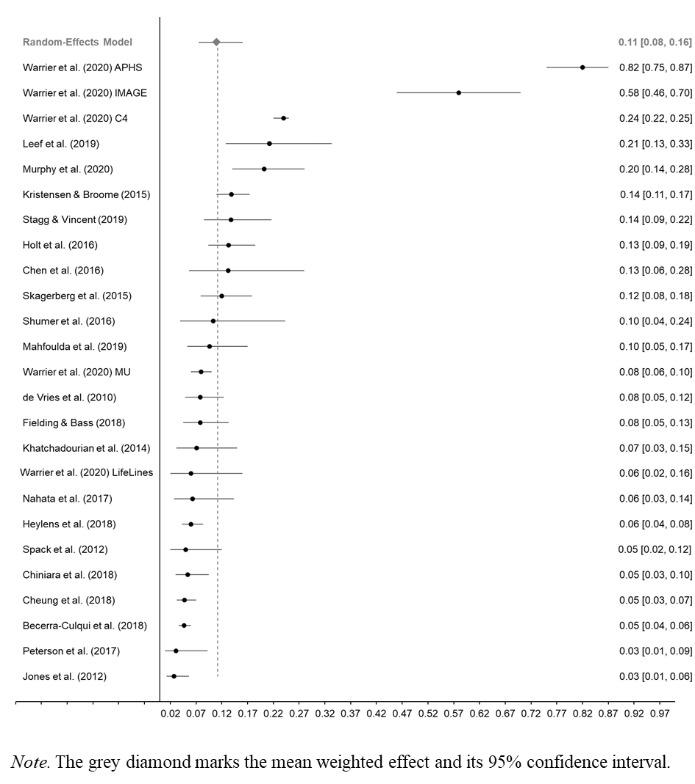
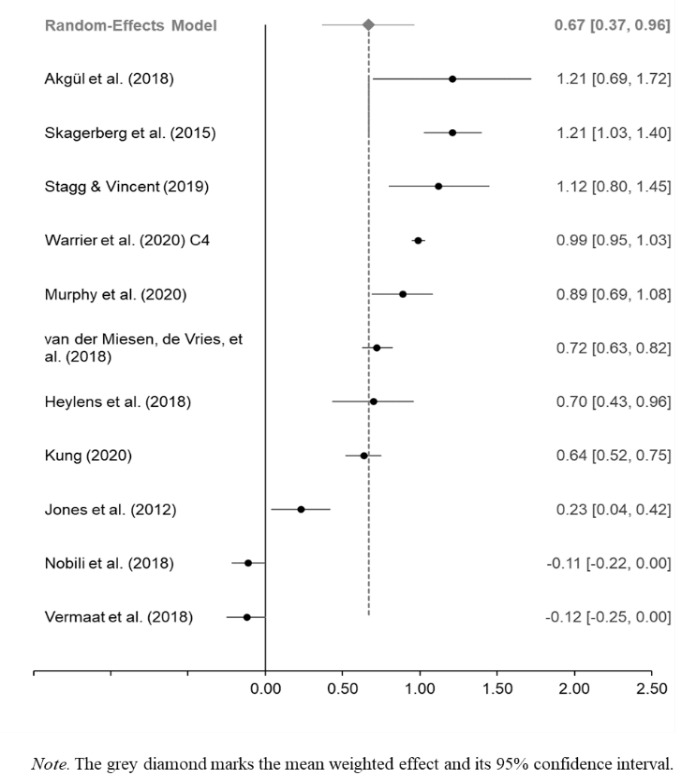
The suggested overlap between autism spectrum disorder (ASD) and gender dysphoria/incongruence (GD/GI) has been much disputed. This review showed a relationship between ASD traits and GD feelings in the general population and a high prevalence of GD/GI in ASD. Our meta-analyses revealed that the pooled estimate of the prevalence of ASD diagnoses in GD/GI people was 11% ( p < .001) and the overall effect size of the difference in ASD traits between GD/GI and control people was significant ( g = 0.67, p < .001). Heterogeneity was high in both meta-analyses. We demonstrated that the chances that there is not a link between ASD and GD/GI are negligible, yet the size of it needs further investigation.
Overview
The claims and statistics of this paper haven’t been checked yet.
Free: it reads the open-access text and checks the first 5 claims that cite a source we can check. Create a free account to check every claim.
Integrity signals
Registry
Cites
Statistics
Figures
Verification
Claims the paper makes
The claims and statistics of this paper haven’t been checked yet.
Free: it reads the open-access text and checks the first 5 claims that cite a source we can check. Create a free account to check every claim.
Claims other papers make about this one
Each is checked against this paper’s own text: does it say what the citing paper says it does?
In the citing paper
“Gender diversity has also been associated with some neurodevelopmental conditions16,17 (Box 4).”
From Sex and gender in neurodevelopmental conditions (2023) · cites this paper as [16]
Self-check
Percentages, sums and reported differences re-computed from the paper’s own numbers.
The self-check needs the paper’s full text.
Citations
Cites
Diagnostic and Statistical Manual of Mental Disorders
American Psychiatric Association (2013) · doi:10.1176/appi.books.9780890425596 · Cited by 116,369
Statistical Power Analysis for the Behavioral Sciences
Muller, K. (1989) · Technometrics · doi:10.1080/00401706.1989.10488618 · Cited by 99,167
Measuring inconsistency in meta-analyses
Higgins, J. P. T., Thompson, S. G., Deeks, J. J., & Altman, D. G. (2003) · BMJ · doi:10.1136/bmj.327.7414.557 · Cited by 63,139 · cited 2×
“…of the observed variance reflects variation in the true effect sizes rather than sampling error, we calculated I2 values and to identify how much the true effects vary across studies we estimated prediction intervals (Borenstein et al., 2009; Borenstein et al., 2017; Higgins et al., 2003).”
BackgroundStatistical Power Analysis for the Behavioral Sciences (2nd ed.).
Lachenbruch, P. A., & Cohen, J. (1989) · Journal of the American Statistical Association · doi:10.2307/2290095 · Cited by 37,395 · cited 13×
“Also, results did not change substantively when we replaced Kung’s (2020) control group from Baron-Cohen et al. (2014) with Ruzich et al's (2015), instead (see Supplementary Material).”
BackgroundMethodInfluentialPRISMA-P Group, Moher, D., Shamseer, L., Clarke, M., Ghersi, D., Liberati, A., Petticrew, M., Shekelle, P., & Stewart, L. A. (2015) · Systematic Reviews · doi:10.1186/2046-4053-4-1 · Cited by 26,223
Borenstein, M., Hedges, L. V., Higgins, J. P. T., & Rothstein, H. R. (2009) · doi:10.1002/9780470743386 · Cited by 14,225
(2000) · Cited by 9,198
Lord, C., Risi, S., Lambrecht, L., Cook, E. H., Leventhal, B. L., DiLavore, P. C., Pickles, A., & Rutter, M. (2000) · Journal of Autism and Developmental Disorders · doi:10.1023/a:1005592401947 · Cited by 7,520 · cited 2×
“Along with a formal diagnosis of ASD, standardized diagnostic tools (e.g., Autism Diagnostic Observation Schedule and Autism Diagnostic Interview-Revised; Lord et al., 2000; Rutter et al., 2003) could also be used in an attempt to elucidate the high heterogeneity we observe in the prevalence of ASD diagnoses in this p…”
MethodBaron-Cohen, S., Wheelwright, S., Skinner, R., Martin, J., & Clubley, E. (2001) · Journal of Autism and Developmental Disorders · doi:10.1023/a:1005653411471 · Cited by 6,450 · cited 4×
“Jones et al. (2012) and Pasterski et al. (2014) took the data of their control group from the same source (i.e., Baron-Cohen et al., 2001).”
BackgroundInfluentialDistribution Theory for Glass's Estimator of Effect Size and Related Estimators
Hedges, L. V. (1981) · Journal of Educational Statistics · doi:10.2307/1164588 · Cited by 5,695 · cited 1×
“Likewise, Kung (2020) found that transgender men and nonbinary females reported significantly more 3107 Journal of Autism and Developmental Disorders (2023) 53:3103–3117 1 3 (Hedges, 1981; Hedges & Olkin, 1985).”
Background
Research works printed but not linked: 2
- Comprehensive Meta-Analysis Borenstein M Hedges L Higgins J Rothstein H Version 3) [Computer software] 2013 Englewood: NJ Biostat
- Rutter M Le Couteur A Lord C ADI-R: Autism Diagnostic Interview-Revised (ADI-R) 2003 Los Angeles, CA Western Psychological Services
Cited by
Items 201–220 of 220
Takahashi, Y. (2026) · Autism in Adulthood · doi:10.1177/25739581261467967
Galindo, C. D., Camacho, A. M. P., Lopera, R., Lopez, N. C., & Arenas, S. V. (2026) · Cureus · doi:10.7759/cureus.112782
O’Neill, A., & Kallitsounaki, A. (2026) · Research in Neurodiversity · doi:10.1016/j.rin.2026.100055
Self-citationKuhlmann, E., & Foley‐Nicpon, M. (2026) · Education Sciences · doi:10.3390/educsci16071155 · Cited by 1
Xu, Q., Wei, X., Gao, Y., Lu, L., Jiang, H., Zhu, X., & Wang, H. (2026) · BMC Psychology · doi:10.1186/s40359-026-05204-y
Fysh, M. C., Kallitsounaki, A., Kennedy, E., Spinner, L., & Williams, D. M. (2026) · Child Development · doi:10.1093/chidev/aacag112
Self-citationLonghurst, P., White, L., & Swami, V. (2026) · Body Image · doi:10.1016/j.bodyim.2026.102154
Adams, N. S., Li, L., Jacobsen, K., Francino, M., & Scheim, A. I. (2026) · International Journal of Transgender Health · doi:10.1080/26895269.2026.2706542
Clark, K. D., White, R. A., Jackson, S. S., Skalkidou, A., Frisell, T., & Papadopoulos, F. C. (2026) · EClinicalMedicine · doi:10.1016/j.eclinm.2026.104088
“13,15 Structural barriers and restrictions to social recognition of TGD identities have also shifted, such as the repeal of Swedish sterilization requirements for legal gender recognition in 2013, which expands the choices for gender-affirming”
Rosa, B. S. C., Jones, A. G., Bernardo, F. M. D. S., Joventino, E. S., Rouberte, E. S. C., Cavalcante, F. M. L., & Barros, L. M. (2026) · Texto & Contexto - Enfermagem · doi:10.1590/1980-265x-tce-2025-0090pt · Cited by 1
CARE STRATEGIES FOR CHILDREN WITH AUTISM SPECTRUM DISORDER IN HOSPITAL SETTINGS: A SCOPING REVIEW
Rosa, B. S. C., Jones, A. G., Bernardo, F. M. D. S., Joventino, E. S., Rouberte, E. S. C., Cavalcante, F. M. L., & Barros, L. M. (2026) · Texto & Contexto - Enfermagem · doi:10.1590/1980-265x-tce-2025-0090en
David, L. W., Diseth, T. H., Jessen, R. S., Mediå, L. M., Nyquist, C. B., Stenberg, N., Stänicke, E., Stänicke, L. I., & Wæhre, A. (2026) · Journal of Autism and Developmental Disorders · doi:10.1007/s10803-026-07486-y
Miller, S. L., Bourke‐Taylor, H. M., Dixon, K., & Upreti, R. (2026) · Australian Occupational Therapy Journal · doi:10.1111/1440-1630.70121
“The prevalence of GI/GD is greater among autistic populations when compared with the general population (Kallitsounaki & Williams, 2023).”
Navigating the binary: how school environments shape the wellbeing of trans and non-binary youth
Meredith, K., & Townley, C. (2026) · International Journal of Adolescence and Youth · doi:10.1080/02673843.2026.2731699
Lundgren, M. R. (2026) · Plants People Planet · doi:10.1002/ppp3.70268
Pratique de l'EMDR avec les enfants, les adolescents et leur famille
Morris-Smith, J. (2025) · Dunod eBooks · doi:10.3917/dunod.tarqu.2025.02.0298
Autism and Puberty: A Mixed Methods Systematic Review
Axbey, H., Ellis, R., Sinfield, M., Firth, E., Shaw, S. C. K., Peeroo, A., Carter, B., & Grant, A. (2026) · Wellcome Open Research · doi:10.12688/wellcomeopenres.27647.1
Symes, E. R., Santo, T., Sutherland, R., Lynch, M. A., Taylor, S., Lewis, P., & Degenhardt, L. J. (2026) · Psychological Medicine · doi:10.1017/s0033291726106254 · Cited by 1
“Substance use findings are reported separately, and neurodevelopmental conditions were excluded due to the availability of recent reviews (Bouzy, Brunelle, Cohen, & Condat, 2023; Kallitsounaki & Williams, 2023).”
Gloanec, C., Bonazzi, G., Boughanmi, M.-E., Demily, C., & Peyroux, É. (2026) · LGBT Health · doi:10.1177/23258292261495121
“19 Other studies have explored gender diversity within the population of people with autism.”
Metadata
- Authors
- Kallitsounaki, A., & Williams, D. M.
- Affiliations
- University of Kent (GB)
- Corresponding author
- Kallitsounaki, Aimilia
- Venue
- Journal of Autism and Developmental Disorders
- Published
- 2022-05-20
- Volume
- 53
- Issue
- 8
- Pages
- 3103-3117
- ISSN
- 0162-3257 (ISSN-L)
- 1573-3432
- PMC
- PMC10313553
- OpenAlex
- W4281255505
- Cited by
- 235
- References
- 116
- Citations by year
- 2026: 59 · 2025: 61 · 2024: 74 · 2023: 36 · 2022: 5
- FWCI
- 6.08
- Type
- journal article
- Language
- en
- Open access
- hybrid
- doi.org
- Licence
- cc-by
- creativecommons.org/licenses/by/4.0 (tdm)
- creativecommons.org/licenses/by/4.0 (vor)
- Locations
- Journal of Autism and Developmental Disorders (publishedVersion, cc-by)
- PubMed Central (publishedVersion, cc-by)
- PubMed (publishedVersion)
- Kent Academic Repository (University of Kent) (acceptedVersion, cc-by)
- Funders
- University of Kent PhD scholarship (University of Kent PhD scholarship)
- Topics
- Life Sciences › Neuroscience › Cognitive Neuroscience › Autism Spectrum Disorder Research
- Social Sciences › Psychology › Social Psychology › LGBTQ Health, Identity, and Policy
- Health Sciences › Medicine › Endocrinology, Diabetes and Metabolism › Sexual Differentiation and Disorders
- Keywords
- autism spectrum disorder, gender dysphoria, gender incongruence
- MeSH terms
- Autism Spectrum Disorder, Gender Dysphoria, Humans, Prevalence
About these checks
Registry, retraction, Cites and statistics results are computed, not judged, with one exception: a printed reference that no index lists is read once by a model before it counts as a citation error. Claims are extracted by a model and kept only when their quote appears verbatim in the text; each cited source is then checked, with a model’s help, for whether it says what the claim relies on. Those verdicts can be wrong — read the claim’s quote and the cited source before relying on one.
Statistics and arithmetic are recomputed, not judged.
Confidence bands are shown only for fields calibrated on our annotated test set. None is calibrated yet, so no band is shown.
What counts as a claim ›How we measure confidence ›How we check this ›
Are you an author, or do you see a problem with this page? Request a review
Data sources
Bibliographic data: Semantic Scholar, OpenAlex, Crossref.
Contains information from the Semantic Scholar Academic Graph Datasets, made available under the ODC Attribution License (ODC-BY 1.0).
Semantic Scholar’s data is described in: Kinney, R., et al. (2023). The Semantic Scholar Open Data Platform. arXiv:2301.10140.
