

Early Urbanism in Northern Mesopotamia
Open accessThe DOI matches its Crossref record; 236 of the 239 references it cites were found in a registry or an index; 2 of the 212 sources its claims cite were checked for support.
Abstract
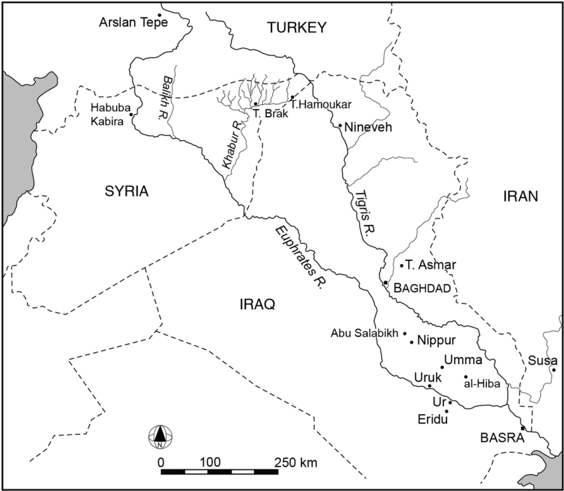
Cities generate challenges as well as confer advantages on their inhabitants. Recent excavations and surveys in northern Mesopotamia have revealed extensive settlements with diverse populations, institutions, extended hinterlands, and mass production by the early fourth millennium BC, comparable to well-known evidence for cities in their traditional homeland of southern Iraq. However, early northern Mesopotamian cities incorporated low-density zones and flexible uses of space not yet identified in southern Mesopotamia. Evidence for violent conflict in northern Mesopotamian cities also raises questions about urban sustainability; cities succeeded despite new sources of social stress.
Overview
CoChat Summary
TL;DR
Recent excavations and surveys show that northern Mesopotamia had independent, extensive cities by the early fourth millennium BC, comparable to southern Mesopotamian urbanism but with low-density zones, flexible space use, and polycentric institutions. These early cities grew rapidly through immigration and mass production, yet also experienced social stress and violent conflict.
Key findings
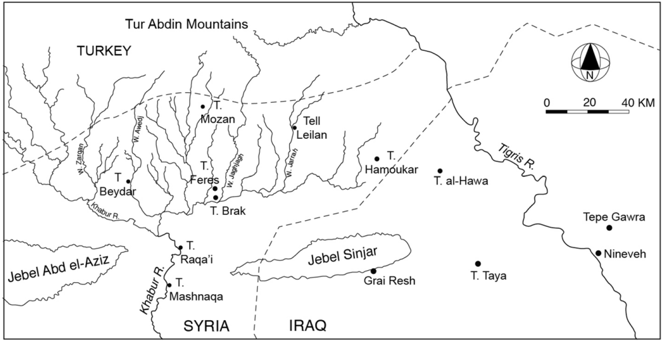
- Northern Mesopotamian urbanism was primary, not derivative: LC2–3 cities in the Upper Khabur and Iraqi Jezira had large size, diverse populations, institutions, hinterlands, and mass production by the early fourth millennium BC. Tell Brak expanded from 50–55 ha in LC2 to 130 ha in LC3 and was 18 times larger than the next largest site in its region (c. 7 ha), implying significant immigration.
- Urban form was variable and low-density: Hamoukar’s Southern Extension (Khirbet al-Fakhar) reached c. 300 ha in LC2 but was short-lived and low-density; Brak’s LC3 outer town had a dense c. 55 ha core, a ring of 1–4 ha submounds 200–500 m away, and low-density occupation between. Excavations showed the submounds were specialized activity, rubbish, and industrial areas, not housing.
- Northern cities were polycentric with separate religious and secular institutions: at Brak, the Eye Temple and the Basalt Threshold Building/feasting building were on opposite edges c. 400 m apart; at Tepe Gawra, a temple and thick-walled public buildings coexisted. At Uruk, public complexes covered c. 10 ha (about 4% of the city), whereas Brak’s Eye Temple was at most 65 by 26 m and both Brak institutions may have filled less than 1% of the late LC2 city.
- Urban life included conflict and sustainability challenges: Tell Majnuna at Brak had three LC3 mass graves of mainly young adults, up to several hundred individuals each; Hamoukar had hundreds of sling bullets and burned buildings; Tepe Gawra was destroyed by fire at least twice during the LC. Agriculture was extensive and risk-limiting, with LC Brak human diet involving less than 20% animal protein and sheep/goat grazing shifting toward suboptimal steppes.
Methods
- Review and synthesis of current research on fourth-millennium BC northern Mesopotamian urbanism, focusing on the Upper Khabur of northeastern Syria and the Jezira of northern Iraq.
- Draws on regional surveys, site surface collections, excavations, satellite imagery, ceramic chronology, radiocarbon dates, isotope analyses, sealings, and faunal/botanical data; key datasets include Tell Brak, Tell Hamoukar, Tell al-Hawa, Grai Resh, Tepe Gawra, Tell Leilan, Tell Mozan, and Nineveh, using the LC1–LC5 Santa Fe phasing system.
- Analysis is comparative and thematic, contrasting northern and southern Mesopotamian cities on transport, scale, epicenters, neighborhoods, sustainability, and conflict; no new primary data collection is stated.
Limitations
- The paper states chronological uncertainty: radiocarbon dates are often contradictory and approximate; no single site provides a full date sequence; LC2–LC3 ceramic typologies remain under construction; late LC3–LC4 dating is difficult, especially for assemblages lacking southern materials and for decontextualized survey sherds.
- The paper states demographic and settlement evidence limits: population density estimates range from 100–200 people/ha, or 248–1205/ha for Abu Salabikh, making population size and density too imprecise for city definition; small settlements and fourth-millennium neighborhoods are rarely excavated; survey only partially addresses hinterland networks.
- The paper states research constraints: civil war in Syria stalled research; northern Iraq and border zones have been difficult for decades and remain artificially empty; new Kurdistan research since 2011 has not yet had a great impact. Evident from the text: as a synthesis, conclusions depend on uneven and patchy published datasets.
Model-written summary. Check it against the paper before relying on it.
Integrity signals
Registry
Cites
Statistics
Figures
Verification
Claims the paper makes
2 Valid · 35 Not valid · 139 Not checked · 214 Own results and interpretations
Every source the paper cites for this claim was checked and supports it.
In the paper
“Satellite imagery (particularly CORONA and ASTER) and digital elevation model data allowed identification of over 14,000 sites in the Upper Khabur through moundedness (volume) and the multispectral, multitemporal signature of anthropogenic soils (Menze and Ur 2012).”
§ Early Urbanism in Northern Mesopotamia > Regional Surveys in Northern Mesopotamia
What the sources say
- Supportedcites Menze and Ur 2012 matched to “Mapping patterns of long-term settlement in Northern Mesopotamia at a large scale” (2012) source
The Abstract (p.1) states the approach maps 'about 14,000 settlement sites' in a 23,000-km2 area of northeastern Syria (Upper Khabur) by 'detecting anthrosols in time series of multispectral satellite images and measure the volume of settlement sites in a digital elevation model.' The Results (p.6) give the exact figure of 14,312 anthrosol-signature sites, of which 9,529 elevate significantly (volume 700–940 million m3), and the Methods sections name the specific data: declassified CORONA imagery and multispectral ASTER scenes with a multitemporal classification strategy, plus the SRTM digital elevation model for moundedness. Every element of the claim (both sensors, the DEM, moundedness-as-volume, the multispectral/multitemporal anthrosol signature, and the >14,000 count in the Upper Khabur) is stated in our copy. (LLM, conf=0.90)
plainstates a cause- Asserted: passes — The authors put it forward as true.
- Checkable: passes — It can be checked against evidence.
- Load-bearing: passes — The paper’s conclusions depend on it.
- Based: passes — The paper gives a reason why it holds.
- Supported
The cited sources support only part of this claim — read each source’s verdict below.
In the paper
“which shows the largest sites somewhat paradoxically near the southern edge of the Upper Khabur in areas of lower rainfall.”
§ Early Urbanism in Northern Mesopotamia > Regional Surveys in Northern Mesopotamia
What the sources say
- Partly supportedcites Menze and Ur 2012 matched to “Mapping patterns of long-term settlement in Northern Mesopotamia at a large scale” (2012) sourceExperimental — accuracy not yet measured
Our copy supports part of the attribution: the potential-map passage (Correlation with Local Resources / 'A Resource-Dependent Long-Term Settlement Potential') says Khabur floodplains form 'high potential zones running through otherwise low potential areas in the southern part of the plain', with 'steep gradients in this potential lead[ing] to a concentration on those few sites close to the most favorable river', 'in accordance with few dominating sites in the south, such as Tell Brak' — and elsewhere Tell Brak, in the lower-rainfall south, is called the largest individual mound in the basin. But the paper's own 'somewhat surprising' observation is different: site number and total volume peak at mid-plain precipitation 'whereas the volume of individual sites increases with precipitation ... suggesting that higher precipitation has allowed a few sites to grow large', alongside 'rather few but stable and large sites in the north'. So the claim's framing that the largest sites sit at the southern edge in low rainfall overstates/inverts the source's average-size trend, and the source does not localize them at the 'southern edge' (it says southern half/part of the plain). (LLM, conf=0.72)
plainstates an association- Asserted: passes — The authors put it forward as true.
- Checkable: passes — It can be checked against evidence.
- Load-bearing: passes — The paper’s conclusions depend on it.
- Based: passes — The paper gives a reason why it holds.
- Partly supported
A result the paper states — it cites no source for it, so there is none to check. The quote shows it is in the paper.
In the paper
“And the central interface, between rivers and rain, had regularly spaced medium-sized sites.”
§ Early Urbanism in Northern Mesopotamia > Regional Surveys in Northern Mesopotamia
plainstates an association- Asserted: passes — The authors put it forward as true.
- Checkable: passes — It can be checked against evidence.
- Load-bearing: passes — The paper’s conclusions depend on it.
- Based: passes — The paper gives a reason why it holds.
None of the sources cited for this claim have been checked yet.
In the paper
“But the climate of the south in the era of urban growth was not as dire as supposed (Kennett and Kennett 2006;Pournelle 2003).”
§ Early Urbanism in Northern Mesopotamia > Environmental Setting of Northern Mesopotamian Cities
What the sources say
- Not checked yetcites Kennett and Kennett 2006 matched to “Early State Formation in Southern Mesopotamia: Sea Levels, Shorelines, and Climate Change” (2006) source
Checked before — its earlier verdict is held back until a new check runs.
- Not checked yetcites Pournelle 2003 matched to “Marshland of Cities: Deltaic Landscapes and the Evolution of Early Mesopotamian Civilization” (2003) source
Checked before — its earlier verdict is held back until a new check runs.
plain- Asserted: passes — The authors put it forward as true.
- Checkable: passes — It can be checked against evidence.
- Load-bearing: unclear — It is unclear whether the paper’s conclusions depend on it.
- Based: passes — The paper gives a reason why it holds.
- Not checked yet
The paper states this without a source or data behind it here, so there is nothing to check it against. The quote shows it is in the paper.
In the paper
“In the last three decades, evidence has accumulated for large, complex settlements in the north during the mid-to-late fourth millennium BC, contemporary with developments at Uruk and elsewhere in the south.”
§ Early Urbanism in Northern Mesopotamia > Mesopotamia, South and North
plainstates an association- Asserted: passes — The authors put it forward as true.
- Checkable: passes — It can be checked against evidence.
- Load-bearing: passes — The paper’s conclusions depend on it.
- Based: unclear — It is unclear why the paper says it holds.
163 more claims
Create a free account to see all 390 claims and to verify the 140 references still open.
- Probably not a substantial claim. 83
- It may state two separate claims as one. 172
Claims other papers make about this one
Each is checked against this paper’s own text: does it say what the citing paper says it does?
In the citing paper
“Similar developments were likely occurring in northern Mesopotamia at the same time (McMahon 2019).”
From Mobility and Social Change: Understanding the European Neolithic Period after the Archaeogenetic Revolution (2021) · cites this paper as McMahon 2019
In the citing paper
“Most sites were only inhabited during certain LC subphases with long hiatuses in occupation, necessitating a complex synchronization of multiple individual site sequences based predominantly on ceramic parallels (Butterlin 2019: Figs. 265 and 442;McMahon 2020:293-294;Renette et al. 2021: Figure 18;Rothman 2001: Table 1.1).”
From ESTABLISHING AN ABSOLUTE CHRONOLOGICAL FRAMEWORK FOR THE LATE CHALCOLITHIC TO EARLY BRONZE AGE IN IRAQI KURDISTAN: RADIOCARBON DATES FROM KANI SHAIE (2023) · cites this paper as McMahon 2020
In the citing paper
“Significant changes in settlement patterns throughout Mesopotamia during the LC2-3 are characterized by rapid urbanization and substantial structural changes (Butterlin 2003;McMahon 2020).”
From Reframing the Uruk Expansion: Glocalization and Local Dynamics in the Late Chalcolithic Adhaim-Sirwan Drainage Basin, Iraqi Kurdistan (2025) · cites this paper as McMahon 2020
In the citing paper
“Decades of research have established that northern Mesopotamia underwent an indigenous development of urbanisation that paralleled the emergence of cities in southern Mesopotamia such as Uruk”
From LATE CHALCOLITHIC CERAMIC DEVELOPMENT IN SOUTHERN IRAQI KURDISTAN: THE STRATIGRAPHIC SOUNDING AT KANI SHAIE (2021) · cites this paper as McMahon 2020
In the citing paper
“However, our knowledge of Late Chalcolithic (hereafter LC) developments remains uneven.Most of our data come from the Middle and Upper Euphrates region and the Upper Khabur region of Syria and Turkey”
From LATE CHALCOLITHIC CERAMIC DEVELOPMENT IN SOUTHERN IRAQI KURDISTAN: THE STRATIGRAPHIC SOUNDING AT KANI SHAIE (2021) · cites this paper as McMahon 2020
Citations
Cites
Proceedings of the American philosophical society
(1838) · Journal of the Franklin Institute · doi:10.1016/s0016-0032(38)92229-x · Cited by 5,524
Jacobs, J. (1969) · Cited by 3,239
Batty, M. (2013) · doi:10.7551/mitpress/9399.001.0001 · Cited by 1,700 · cited 2×
“The resulting urban landscape, with its mixture of organic traditions overlain by limited imposed planning, is typical of many successful modern cities (Batty 2013).”
BackgroundLandry, C. (2012) · Routledge eBooks · doi:10.4324/9781849772945 · Cited by 1,513
The creative city: A toolkit for urban innovators
Miller, C. (2001) · Community Development Journal · doi:10.1093/cdj/36.2.165 · Cited by 1,465
Wrestling Sprawl to the Ground: Defining and measuring an elusive concept
Galster, G., Hanson, R., Ratcliffe, M. R., Wolman, H., Coleman, S., & Freihage, J. (2001) · Housing Policy Debate · doi:10.1080/10511482.2001.9521426 · Cited by 1,427
(2011) · Choice Reviews Online · doi:10.5860/choice.48-6404 · Cited by 1,316
Childe, V. G. (1950) · Town Planning Review · doi:10.3828/tpr.21.1.k853061t614q42qh · Cited by 1,160
A unified theory of urban living
Bettencourt, L., & West, G. (2010) · Nature · doi:10.1038/467912a · Cited by 1,009 · cited 2×
“More than 50% of the world’s population currently lives in cities, with projections increasing for the foreseeable future (Bettencourt and West 2010).”
BackgroundProceedings of the British Academy, 1937
(1939) · Notes and Queries · doi:10.1093/nq/176.25.449 · Cited by 764
Research works printed but not linked: 82
- Al-Quntar, S., and Abu Jayyab, A. K. (2014). The political economy of the Upper Khabur in the Late Chalcolithic 1-2: Ceramic mass-production, standardization and specialization. In McMahon, A., and Crawford, H. (eds.), Preludes to Urbanism: The Late Chalcolithic of Mesopotamia, McDonald Institute for Archaeological Research, Cambridge, pp. 89-108.
- Al-Soof, B. 1969. Excavations at Tell Qalinj Agha (Erbil), summer 1968. Sumer 25: 3-42.
- Al-Soof, B., and El-Siwwani S. (1967). Tell Qalinj Agha. Sumer 23: 69-75.
- Baldi, J. (2012). Tell Feres al-Sharqi in the LC 1-2 period: Serial production and regionalization of ceramic traditions: A perspective from a small site. In Marro, C. (ed.), After the Ubaid: Interpret- ing Change from the Caucasus to Mesopotamia at the Dawn of Urban Civilization (4500-3500 BC), De Boccard, Paris, pp. 129-162.
- Bernbeck. R. (1999). Landflucht und Ethnizität im alten Mesopotamien. In Kühne, K., Bernbeck, R., and Bartl, K. (eds.), Fluchtpunkt Uruk, Archäeologische Einheit aus methodischer Vielfalt, Schriften für Hans Jörg Nissen, Verlag Marie Leidorf, Rahden, pp. 296-310.
- Butterlin, P. (2009). Tepe Gawra et le monde proto-urbain de Mésopotamie. In Butterlin, P. (ed.), À pro- pos de Tepe Gawra: Le monde proto-urbain de Mésopotamie, Subartu 23, Brepols, Turnhout, pp. 1-14.
- Crüsemann, N. (ed.) (2013). Uruk: 5000 Jahre Megacity, Michael Imhof Verlag, Petersburg.
- Deckers, K. (2011). Riverine development in the Tell Hamidi surroundings. In Deckers, K. (ed.), Holo- cene Landscapes through Time in the Fertile Crescent, Subartu 27, Brepols, Turnhout, pp. 85-96.
- Emberling, G. (2002). Political control in an early state: The Eye Temple and the Uruk expansion in northern Mesopotamia. In al-Gailani Werr, L., Curtis, J., Martin, H. McMahon, A., Oates, J., and Reade, J. (eds.), Of Pots and Plans, Papers on the Archaeology and History of Mesopotamia and Syria Presented to David Oates in Honour of his 75th birthday, Nabu Publications, London, pp. 82-90.
- Ferioli, P., and Fiandra, E. (1994). Archival techniques and methods at Arslantepe. In Ferioli, P., Fian- dra, E., Fissore, G., and Frangipane, M. (eds.), Archives Before Writing, Scriptorium, Torino, pp. 149-161.
- Fiandra, E. (2009). Les cretulae à travers le temps: Gawra comme étape dans l'evolution des systèmes adminstratifs. In Butterlin, P. (ed.), À propos de Tepe Gawra: Le monde proto-urbain de Mésopo- tamie, Subartu 23, Brepols, Turnhout, pp. 81-91.
- Finkbeiner, U. (1991). Uruk: Kampagne 35-37, 1982-84: Die archäologische Oberflachen-Untersu- chung, Philipp von Zabern, Maiz am Rhein.
- Gibson M. (1972). The City and Area of Kish, Field Research Projects, Miami.
- Hijara, I. (1973). Excavations at Tell Qalinj Agha (Erbil), fourth season 1970. Sumer 29: 13-35.
- Kepinski, C. (2011). New evidence from Grai Resh, northern Iraq, the 2001 and 2002 seasons: A pre- Uruk expansion site from the Late Chalcolithic period. Zeitschrift für Orient-Archäologie 4: 46-85.
- McMahon A. (2014). State warfare and pre-state violent conflict: Battle's aftermath at Late Chalcolithic Tell Brak. In McMahon, A., and Crawford, H. (eds.), Preludes to Urbanism: The Late Chalcolithic of Mesopotamia, McDonald Institute for Archaeological Research, Cambridge, pp. 175-188.
- Kopanias, K., Beuger, C., Carter, T., Fox, S., Hadjikoumis, A., Kourtessi-Philippakis, G., Livarda, A., and MacGinnis, J. (2013). The Tell Nader and Tell Baqrta Project in the Kurdistan region of Iraq: Preliminary report of the 2011 season. Subartu 6-7: 23-57.
- Liverani, M. (2006). Uruk, The World's First City, Equinox, London.
- Lyonnet, B. (1996). La prospection archéologique de la partie occidentale du Haut-Khabur (Syrie du nord-est): Méthodes, résultats et questions autour de l'occupation aux IIIe et IIe millénaires av. n.E. In Durand, J.-M. (ed.), Mari, Ébla et les Hourites, dix annes de travaux, Amurru 1, Etudes et Recherche sur les Civilisations, Paris, pp. 363-376.
- Lyonnet, B. (2009). Périphérie de la Mésopotamie à la période d'Uruk (IVe millenaire): Le cas des regions du Caucase. In Durand, J., and Jacquet, A. (eds.), Centre et péripherie; Approches nou- velles des Orientalistes, Institut du Proche-Orient Ancien, Paris, pp. 1-15.
- Machule, D. (1998). 1969-1994: Ekalte (Tall Munbaqa), Eine bronzezeitliche Stadt in Syrien. In Wil- helm, G. (ed.), Zwischen Tigris und Nil. 100 Jahre Ausgrabungen der Deutschen Orient-Gesells- chaft in Vorderasien und Ägypten, von Zabern, Mainz, pp. 115-125.
- Marro, C., and Hauptmann, H. (eds.) (2000). Chronologies des pays du Caucase et de l'Euphrate aux IVe-IIIe millénaires, Varia Anatolica 11, De Boccard, Paris.
- McMahon, A. (2013). Tell Brak, early northern Mesopotamian urbanism, economic complexity and social stress, fifth-fourth millennia BC. In Bonatz, D., and Martin, L. (eds.), 100 Jahre Archäe- ologische Feldforschungen in Nordost-Syrien-Eine Bilanz, Harrassowitz, Weisbaden, pp. 67-80.
- McMahon, A., and Crawford, H. (eds.), Preludes to Urbanism: The Late Chalcolithic of Mesopota- mia, McDonald Institute for Archaeological Research, Cambridge, pp. 69-87.
- Meyer, J.-W. (2010). Überlegungen zur Siedlungsstruktur: Eine erste Analyse des Ergebnisse des geomagnetischen Prospektion. In Meyer, J.-W., and Orthmann, W. (eds.), Ausgrabungen in Tell Chuēra in Nordost-Syrien: Vorbericht zu den Grabungskampagnen 1998 bis 2005, Vorderasi- atische Forschungen der Max-Freiherr-von-Oppenheim-Stiftung, Saarbrücken, pp. 199-222.
- Nichols, D. (2006). Shining stars and black holes: Population and preindustrial cities. In Storey, G. (ed.), Urbanism in the Preindustrial World: Cross-Cultural Approaches, University of Alabama Press, Tuscaloosa, pp. 330-340.
- Nissen, H. (2002). Uruk: Key site of the period and key site of the problem. In Postgate, J. N. (ed.), Artefacts of Complexity; Tracking the Uruk in the Near East, British School of Archaeology in Iraq, London, pp. 1-16.
- Oates, J. (1986). The Uruk/Early Dynastic sequence. In Finkbeiner, U., and Röllig, W. (eds.), Gamdat Nasr, Period or Regional Style? Ludwig Reichert, Weisbaden, pp. 245-271.
- In Meller, H. (ed.), Schlachfeldarchäologie-Battlefield Archaeology, Landesdenk- malamt, Halle, pp. 17-30.
- Ristvet, L. (2005). Settlement, Economy and Society in the Tell Leilan Region, Syria, 3000-1000 BC, Ph.D. dissertation, Faculty of Oriental Studies, University of Cambridge, Cambridge.
- Stein, G. (2001). Indigenous social complexity at Hacinebi (Turkey) and the organization of cultural con- tact in the Uruk expansion. In Rothman, M. (ed.), Uruk Mesopotamia and Its Neighbors: Cross- Cultural Interactions in the Era of State Formation, School of American Research Press, Santa Fe, NM, pp. 265-305.
- Rothman, M. (2009). Religion, function, and social networks: Tepe Gawra in the late fifth and early fourth millennia BC. In Butterlin, P. (ed.), À propos de Tepe Gawra: Le monde proto-urbain de Mésopotamie, Subartu 23, Brepols, Turnhout, pp. 15-39.
- Rupley, E., and Wright, H. (2001). Calibrated radiocarbon age determinations of Uruk-related assem- blages. In Rothman, M. (ed.), Uruk Mesopotamia and Its Neighbors: Cross-Cultural Interactions in the Era of State Formation, School of American Research Press, Santa Fe, NM, pp. 85-122.
- Safar, F., Mustafa, M.A., and Lloyd, S. 1981. Eridu, State Organization of Antiquities and Heritage, Baghdad.
- Schwartz, G. (1988a). Excavations at Karatut Mevkii and perspectives on the Uruk/Jemdet Nasr expan- sion. Akkadica 56: 1-41.
- Schwartz, G. (1988b). A Ceramic Chronology from Tell Leilan Operation 1, Yale University Press, New Haven, CT.
- Schwartz, G., and Falconer, S. (1994). Rural approaches to social complexity. In Schwartz, G., and Fal- coner, S. (eds.), Archaeological Views from the Countryside: Village Communities in Early Com- plex Societies, Smithsonian Institution Press, Washington, DC, pp. 1-9.
- Skuldbøl, T. (2009). Earliest Urbanism in Northern Mesopotamia, Settlement Development and Subur- ban Transformation at Tell Brak, Northeastern Syria, 4000-3000 BC, Ph.D. dissertation, Depart- ment of Cross-Cultural and Regional Studies, University of Copenhagen, Copenhagen.
- Stein, G. (1999). Rethinking World-Systems: Diasporas, Colonies, and Interaction in Uruk Mesopotamia, University of Arizona Press, Tucson.
- Stein, G. (2001). Indigenous social complexity at Hacinebi (Turkey) and the organization of cultural contact in the Uruk expansion. In Rothman, M. (ed.), Uruk Mesopotamia and Its Neighbors: Cross-Cultural Interactions in the Era of State Formation, School of American Research Press, Santa Fe, NM, pp. 265–305.
- Stein, G. (2009). Tell Zeidan (2008). Oriental Institute Annual Report, 2008-2009: 126-137.
- Stein, G. (2010). Tell Zeidan (2009). Oriental Institute Annual Report, 2009-2010: 105-118.
- Stein, G. (2011). Tell Zeidan. The Oriental Institute Annual Report, 2010-2011: 122-139.
- Stein, G. (2012). The development of indigenous social complexity in Late Chalcolithic Upper Mesopo- tamia in the fifth-fourth millennia BC: An initial assessment. Origini 34: 125-151.
- Stein, G., and Wattenmaker, P. (2003). Settlement trends and the emergence of social complexity in the Leilan region of the Habur Plains (Syria) from the fourth to the third millennium BC. In Rova, E., and Weiss, H. (eds.), The Origins of North Mesopotamian Civilization: Ninevite 5 Chronology, Economy, Society, Subartu 9, Brepols, Turnhout, pp. 361-386.
- Storey, R. (2006). Mortality through time in an impoverished residence of the Precolumbian city of Teoti- huacan: A palaeodemographic view. In Storey, G. (ed.), Urbanism in the Preindustrial World: Cross-Cultural Approaches, University of Alabama Press, Tuscaloosa, pp. 277-294.
- Strommenger, E. (1980). Habuba Kabira: Eine Stadt vor 5000 Jahren, von Zabern, Mainz.
- Stronach, D. (1994). Village to metropolis: Nineveh and the beginnings of urbanism in northern Meso- potamia. In Mazzoni, S. (ed.), Nuove fondazioni nel Vicino Oriente antico: Realta` e ideologia, Giardini, Pisa, pp. 85-114.
- Sudo, H. (2010). The development of wool exploitation in Ubaid-period settlements of North Mesopota- mia. In Carter, R., and Philip, G. (eds.), Beyond the Ubaid: Transformations and Integration in the Late Prehistoric Societies of the Middle East, Studies in Ancient Oriental Civilization 63, Oriental Institute, Chicago, pp. 169-179.
- Tobler, A. (1950). Excavations at Tepe Gawra Vol. 2, University of Pennsylvania Press, Philadelphia.
- Snead, J., Erickson, C., and Darling. J. (eds.), Landscapes of Movement: Trails, Paths, and Roads in Anthropological Perspective, University of Pennsylvania Museum of Archaeology and Anthropol- ogy, Philadelphia, pp. 180-203.
- Ur, J. (2010b). Urbanism and Cultural Landscapes in Northeastern Syria: The Tell Hamoukar Survey, 1999-2001, Oriental Institute Publications 137, Oriental Institute, Chicago.
- Ur, J. (2014). Urban form at Tell Brak across three millennia. In McMahon, A., and Crawford, H. (eds.), Preludes to Urbanism: The Late Chalcolithic of Mesopotamia, McDonald Institute for Archaeo- logical Research, Cambridge, pp. 49-62. 1 3 Journal of Archaeological Research (2020) 28:289-337
- Ur, J., and Osborne, J. (2016). The rural landscape of the Assyrian heartland: Recent results from Arbail and Kilizu provinces. In MacGinnis, J., Wicke, D., and Greenfield, T. (eds.), The Provincial Archaeology of the Assyrian Empire, McDonald Institute for Archaeological Research, Cambridge, pp. 163-174.
- In Lebeau, M., and Suleiman, A. (eds.), Beydar Studies I, Subartu 21, Brepols, Turnhout, pp. 305-327.
- Weber, J. (2014). Exotic animal consumption at Tell Brak in the mid-fourth millennium BC. In McMa- hon, A., and Crawford, H. (eds.), Preludes to Urbanism: The Late Chalcolithic of Mesopotamia, McDonald Institute for Archaeological Research, Cambridge, pp. 127-134.
- Wilkinson, T., French, C., and Semple, M. (2014b). Hollow ways and routes around Tell Brak. In McMa- hon, A., and Crawford, H. (eds.), Preludes to Urbanism; The Late Chalcolithic of Mesopotamia, McDonald Institute for Archaeological Research, Cambridge, pp. 35-47.
- Woolley, L., and Mallowan, M. (1976). Ur Excavations Vol. VII: The Old Babylonian Period, British Museum, London.
- Adams, R. McC., Heartland of Cities, University of Chicago Press, Chicago, pp. 295-345.
- Yoffee, N. (2015). Conclusion: The meanings of early cities. In Yoffee, N. (ed.), The Cambridge World History Vol. III: Early Cities in Comparative Perspective, 4000 BCE-1200CE, Cambridge Univer- sity Press, Cambridge, pp. 546-557.
- Emberling, G., and Minc, L. (2016). Ceramics and long-distance trade in early Mesopotamian states. Journal of Archaeological Science Reports 7: 819-834.
- Frangipane, M. (2010). Different models of power structuring at the rise of hierarchical societies in the Near East: Primary economy versus luxury and defence management. In Bolger, D., and Maguire, L. (eds.), The Development of Pre-State Communities in the Ancient Near East: Studies in Honour of Edgar Peltenburg, Oxbow Books, Oxford, pp. 79-86.
- Marro, C. (ed.) (2012). After the Ubaid: Interpreting Change from the Caucasus to Mesopotamia at the Dawn of Urban Civilization (4500-3500 BC), Institut français d'études anatoliennes, Istanbul.
- Menze, B., Mühl, S., and Sherratt, A. (2007). Virtual survey on North Mesopotamia tell sites by means of remote sensing. In Ooghe, B., and Verhoeven, G. (eds.), Broadening Horizons. Multidisciplinary Approaches to the Study of Past Landscapes, Cambridge Scholars Press, Cambridge, pp. 1-17.
- Minc, L., and Emberling, G. (2016). Trade and interaction during the era of the Uruk expansion: Recent insights from archaeometric analyses. Journal of Archaeological Science Reports 7: 793-797.
- Pittman, H., and Blackman, J. (2016). Mobile or stationary? Chemical analysis of clay administrative devices from Tell Brak in the Late Uruk period. Journal of Archaeological Science Reports 7: 877-883.
- Smith, M. E., Ur, J., and Feinman, G. (2014). Jane Jacobs' 'cities first' model and archaeological reality. International Journal of Urban and Regional Research 38: 1525-1535.
- Smith, S., Wilkinson, T., and Lawrence, D. (2014). Agro-pastoral landscapes in the zone of uncertainty: The Middle Euphrates and the north Syrian steppe during the 4th and 3rd millennia BC. In Morandi Bonacossi, D. (ed.) Settlement Dynamics and Human-Landscape Interaction in the Dry Steppes of Syria, Harrassowitz, Wiesbaden, pp. 151-72.
- Ur, J. (2017). The birth of cities in ancient West Asia. In Tsuneki A., Yamada S., and Hisada, K. (eds.), Ancient West Asian Civilization, Springer, Singapore.
- Ur, J. (2014). Households and the emergence of cities in ancient Mesopotamia. Cambridge Archaeologi- cal Journal 24: 249-268.
- Wright, H. (2014). Early Uruk ceramic assemblages: Cultural relations in Greater Mesopotamia during the late fifth and early fourth millennia BC. In McMahon, A., and Crawford, H. (eds.), Preludes to Urbanism: The Late Chalcolithic of Mesopotamia, McDonald Institute for Archaeological Research, Cambridge, pp. 109-125.
- Wright, H. (2016). The Uruk expansion and beyond: Archaeometric and social perspectives on exchange in the IVth millennium BCE. Journal of Archaeological Science Reports 7: 900-904.
- Zeder, M. (2003). Food provisioning in urban societies; A view from northern Mesopotamia. In Smith, M. L. (ed.), The Social Construction of Ancient Cities, Smithsonian Books, Washington, DC, pp. 156-183. Bibliography of Recent Literature
- Algaze, G. (2013). The end of prehistory and the Uruk Period. In Crawford, H. (ed.), The Sumerian World, Routledge, London, pp. 68-94.
- Algaze, G. (2017). Demographic trends in early Mesopotamian urbanism. In Maner, Ç., Horowitz, M., and Gilbert, A. (eds.), Overturning Certainties in Near Eastern Archaeology, Brill, Leiden, pp. 25-33.
- Altaweel, M. (2008). Investigating agricultural sustainability and strategies in northern Mesopotamia: Results produced using a socio-ecological modeling approach. Journal of Archaeological Science 35: 821-836.
- Ball, W. (ed.) (2003). Ancient Settlement in the Zammar Region, Excavations by the British Archaeologi- cal Expedition to Iraq in the Saddam Dam Salvage Project 1985-1986, BAR International Series 1096, Archaeopress, Oxford.
- Balossi Restelli, F. (2012). Eating at home and 'dining' out? Commensalities in the Neolithic and Late Chalcolithic in the Near East. In Pollock, S. (ed.), Between Feasts and Daily Meals: Toward an Archaeology of Commensal Spaces. E-TOPOI vol. 2: 75-95.
- Brustolon, A., and Rova, E. (2008). The Late Chalcolithic settlement in the Leilan region of northeast Syria. In Cordoba, J., Molist, M., Perez, M., Rubio, I., and Martinez, S. (eds.), Proceedings of the 5th International Congress on the Archaeology of the Ancient Near East, Universidad Autónoma of Madrid, Madrid, pp. 357-382.
- Chase, A., and Chase, D. (2016). Urbanism and anthropogenic landscapes. Annual Review of Anthropol- ogy 45: 361-376.
- Deckers, K., and Riehl, S. (2008). Resource exploitation of the Upper Khabur Basin (NE Syria) during the third millennium BC. Paléorient 34(2): 173-189.
- deGruchy, M., Deckers, K., and Riehl, S. (2016). A diachronic reconstruction of the northern Mesopo- tamian landscape (4th to 2nd millennia BC) from three separate sources of evidence. Journal of Archaeological Science Reports 8: 250-267.
Cited by
Items 101–137 of 137
Agriculture and Crop Management in the Ninevite V Culture.
Fatah, O. T., & Ahmed, K. M. (2024) · Journal of University of Human Development · doi:10.21928/juhd.v10n3y2024.pp12-17
Paulette, T. (2024) · Oxford University Press eBooks · doi:10.1093/oso/9780197682449.002.0012
Paulette, T. (2024) · Oxford University Press eBooks · doi:10.1093/oso/9780197682449.005.0001
Paulette, T. (2024) · Oxford University Press eBooks · doi:10.1093/oso/9780197682449.003.0007
Drinkers and drinking practices
Paulette, T. (2024) · Oxford University Press eBooks · doi:10.1093/oso/9780197682449.003.0006
Brewing technologies and techniques
Paulette, T. (2024) · Oxford University Press eBooks · doi:10.1093/oso/9780197682449.003.0004
Epilogue: Reviving an ancient art
Paulette, T. (2024) · Oxford University Press eBooks · doi:10.1093/oso/9780197682449.003.0008
Paulette, T. (2024) · Oxford University Press eBooks · doi:10.1093/oso/9780197682449.002.0013
Paulette, T. (2024) · Oxford University Press eBooks · doi:10.1093/oso/9780197682449.003.0005
Paulette, T. (2024) · Oxford University Press eBooks · doi:10.1093/oso/9780197682449.003.0002
Paulette, T. (2024) · Oxford University Press eBooks · doi:10.1093/oso/9780197682449.002.0003
Paulette, T. (2024) · Oxford University Press eBooks · doi:10.1093/oso/9780197682449.003.0003
Paulette, T. (2024) · Oxford University Press eBooks · doi:10.1093/oso/9780197682449.002.0011
Paulette, T. (2024) · Oxford University Press eBooks · doi:10.1093/oso/9780197682449.002.0010
Paulette, T. (2024) · Oxford University Press eBooks · doi:10.1093/oso/9780197682449.002.0008
Paulette, T. (2024) · Oxford University Press eBooks · doi:10.1093/oso/9780197682449.002.0004
Paulette, T. (2024) · Oxford University Press eBooks · doi:10.1093/oso/9780197682449.002.0009
Paulette, T. (2024) · Oxford University Press eBooks · doi:10.1093/oso/9780197682449.002.0005
Back Matter ("About ARWA and the Sumer and the Sea Conference", "Works Cited")
(2025) · Brepols Publishers eBooks · doi:10.1484/m.aratta-eb.5.151079
Wang, Y., Chen, Y., Cao, H., Liu, R., Staff, R. A., Du, L., Yuan, X., Zhang, S., Ma, J., & Qiu, M. (2024) · Figshare · doi:10.6084/m9.figshare.26748713
Montenbruck, A. (2023) · Refubium (Universitätsbibliothek der Freien Universität Berlin) · doi:10.17169/refubium-38594
Wang, Y., Chen, Y., Cao, H., Liu, R., Staff, R. A., Du, L., Yuan, X., Zhang, S., Ma, J., & Qiu, M. (2024) · Figshare · doi:10.6084/m9.figshare.26748710
The social behind the physical - Assessing tie formation processes of ancient route systems
Priß, D., Prell, C., Lawrence, D., Turnbull, L., & Wainwright, J. (2025) · Journal of Archaeological Science · doi:10.1016/j.jas.2025.106413
Çele, A. E. (2024) · OpenMETU (Middle East Technical University)
Davies, P. J. E., & Williamson, C. G. (2025) · Cambridge University Press eBooks · doi:10.1017/9781108993494.001
The Rise of Urbanisation and its Impact on Europe
Morris, I. (2025) · Cambridge University Press eBooks · doi:10.1017/9781108993494.003
Ritual Architecture as Early Models of Sustainability
Salimi, A., Turkan, Z., & Pilehvarian, N. K. (2026) · Sustainability · doi:10.3390/su18041880
Preetha, M. V. (2025) · International Journal of History and Archaeology Research Studies (IJHARS) · doi:10.63090/ijhars/3049.1622.0022
The network structure of the urban revolution
Benati, G., & Pérez, S. L. (2026) · Science Advances · doi:10.1126/sciadv.aee5162
How alleyways shape cities: Mapping global landscapes
Alawadi, K., Aletaywi, A. B., & Anabtawi, R. (2026) · City and Environment Interactions · doi:10.1016/j.cacint.2026.100398
Grossman, K. (2026) · Cambridge Archaeological Journal · doi:10.1017/s0959774326100729
The emergence of urban scaling in Ancient Southwest Asia
Chelazzi, F., & Lawrence, D. (2026) · PLoS ONE · doi:10.1371/journal.pone.0355479
Introduction: Peripheries-Peripherocene
McEwan, C., & Lechner, A. (2026) · The Journal of Architecture · doi:10.1080/13602365.2026.2710509
21. Yüzyıl Sanatında Savaş Altındaki Kentlerin Kentsel ve Ekolojik Temsili
Özgör, F. K. (2026) · Kent Akademisi · doi:10.35674/kent.1988478
International Law in the Ancient Near East (Third Millennium–500 bc)
Eidem, J. (2026) · Cambridge University Press eBooks · doi:10.1017/9781108753999.003
The Ancient Near East and International Law: An Introduction
Eidem, J. (2026) · Cambridge University Press eBooks · doi:10.1017/9781108753999.004
Metadata
- Authors
- McMahon, A.
- Affiliations
- University of Cambridge (GB)
- Corresponding author
- McMahon, Augusta
- ORCID
- McMahon, Augusta
- Venue
- Journal of Archaeological Research
- Published
- 2019-08-31
- Volume
- 28
- Issue
- 3
- Pages
- 289-337
- ISSN
- 1059-0161 (ISSN-L)
- 1573-7756
- OpenAlex
- W2970929455
- Semantic Scholar
- 6aced7c26a4624e9e448b716954e3f366740aa07
- Cited by
- 137
- References
- 239
- Citations by year
- 2026: 16 · 2025: 21 · 2024: 35 · 2023: 13 · 2022: 31 · 2021: 13 · 2020: 8
- FWCI
- 49.47
- Type
- journal article
- Language
- en
- Open access
- hybrid
- doi.org
- Licence
- cc-by
- creativecommons.org/licenses/by/4.0 (tdm)
- creativecommons.org/licenses/by/4.0 (vor)
- Locations
- Journal of Archaeological Research (publishedVersion, cc-by)
- Apollo (University of Cambridge) (submittedVersion)
- Apollo (University of Cambridge) (submittedVersion, cc-by)
- Apollo
- Apollo (cc-by)
- Topics
- Social Sciences › Arts and Humanities › Archeology (arts and humanities) › Ancient Near East History
- Social Sciences › Archeology › Archaeology and ancient environmental studies
- Social Sciences › Arts and Humanities › Archeology (arts and humanities) › Ancient Mediterranean Archaeology and History
- Keywords
- early urbanism, northern Mesopotamia, 4th millennium BC, urban settlement, mass production, hinterland, urban sustainability, violent conflict, social stress, space use
About these checks
Registry, retraction, Cites and statistics results are computed, not judged, with one exception: a printed reference that no index lists is read once by a model before it counts as a citation error. Claims are extracted by a model and kept only when their quote appears verbatim in the text; each cited source is then checked, with a model’s help, for whether it says what the claim relies on. Those verdicts can be wrong — read the claim’s quote and the cited source before relying on one.
The claim verdicts this report counts are experimental: their accuracy is not yet measured.
A language model drew the claims from the paper on 2026-11-18, under version 3 of the claim definition (model deepseek-v4.1-flash, prompt extract-v3).
A second model labelled each claim on 2026-11-18 (model jev-1.13-20260917, definition revision gold-guideline-v0.2).
Cited sources are checked with a language model’s help (qwen3.8-omni-flash).
Statistics and arithmetic are recomputed, not judged.
Confidence bands are shown only for fields calibrated on our annotated test set. None is calibrated yet, so no band is shown.
What counts as a claim ›How we measure confidence ›How we check this ›
Are you an author, or do you see a problem with this page? Request a review
Data sources
Bibliographic data: Semantic Scholar, OpenAlex, Crossref.
Contains information from the Semantic Scholar Academic Graph Datasets, made available under the ODC Attribution License (ODC-BY 1.0).
Semantic Scholar’s data is described in: Kinney, R., et al. (2023). The Semantic Scholar Open Data Platform. arXiv:2301.10140.
