

Enhanced single-diode model parameter extraction method for photovoltaic cells and modules based on integrating genetic algorithm, particle swarm optimization, and comparative objective functions
Open accessThe DOI matches its Crossref record; 46 of the 46 references it cites were found in a registry or an index.
Abstract
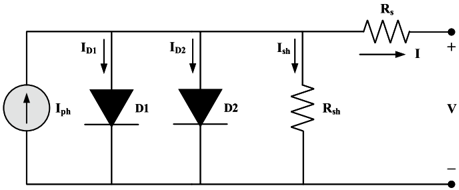
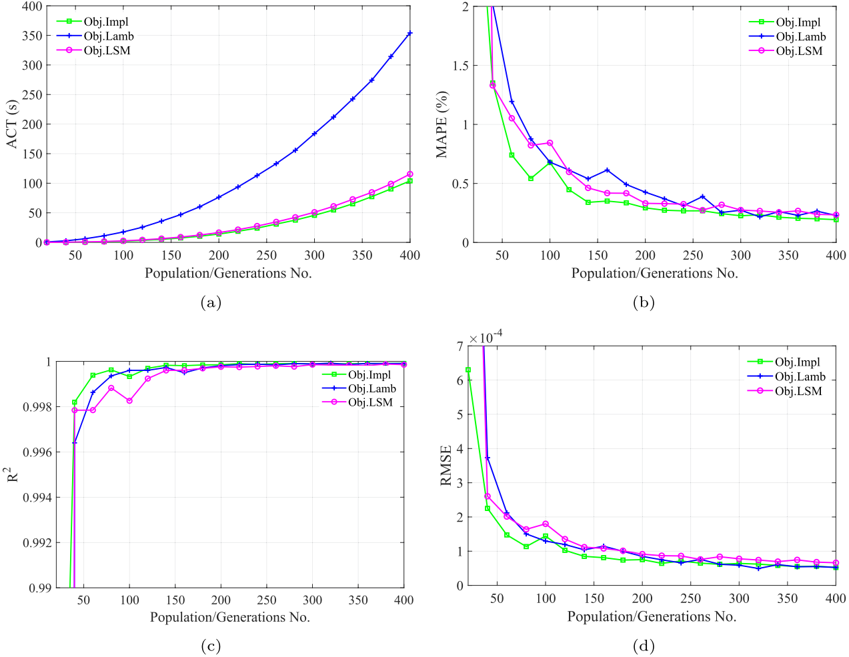
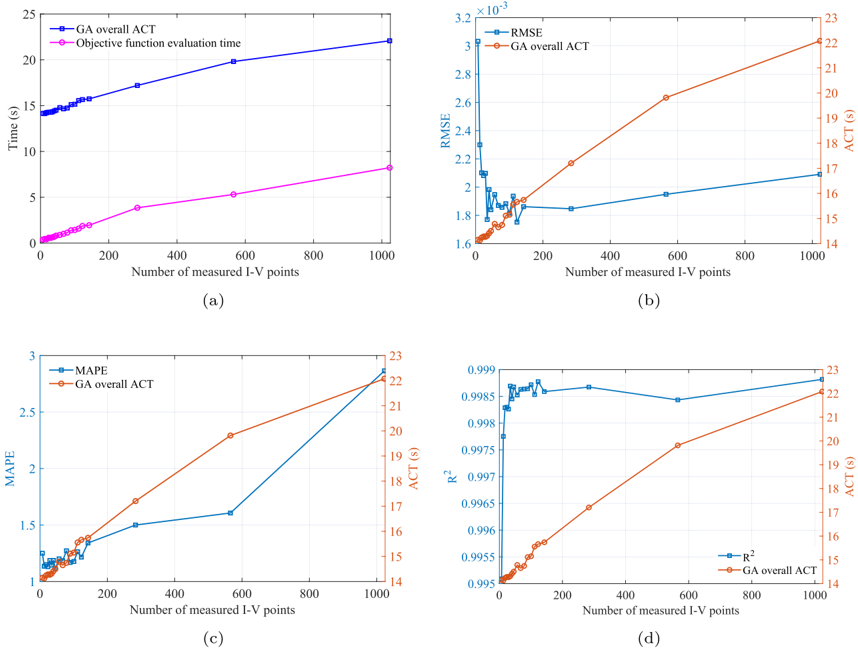
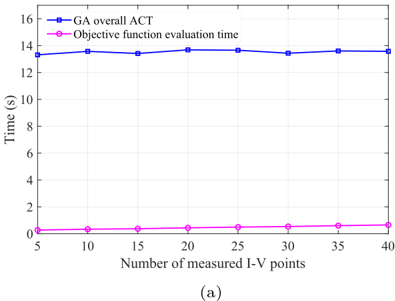
Accurate modeling of the operational behavior of photovoltaic systems is crucial to optimizing and predicting system performance. One of the well-established and widely used modeling techniques is the single-diode equivalent circuit that delivers a sufficiently accurate description of the electric behavior of both photovoltaic cells and modules under various operational conditions. The single-diode model uses five parameters to reproduce the I-V curve for specific operational conditions. However, these five parameters must be extracted from measured or simulated I-V curves. This paper proposes a novel, accurate, and fast method for extracting the single-diode model’s five parameters from measured I-V curves based on a genetic algorithm combined with particle swarm optimization to find the optimal controlling parameters of the genetic algorithm. This approach results in a significant performance improvement in accuracy and convergence speed. The paper also proposes a concept for determining the optimum number of current–voltage data points in the I-V curve, enabling an optimum trade-off between a sufficiently high accuracy and computational costs. Finally, the effect of different objective function formulations on the result has been investigated by comparing the usage of three different objective functions: the implicit form of the single-diode model, the Lambert W-function-based formulation of the explicit single-diode model, and a system of equations based on least square fitting. From the results, it could be concluded that the implicit formulation of the single-diode model delivered the best results compared to the two other formulations. Performance evaluations showed significantly lower error values than recent literature, with mean percent errors of 0.038%, 0.34%, and 0.87% received for the investigated monocrystalline cell, poly-crystalline module, and amorphous module, respectively. The computational cost was reduced by more than 60% after determining the optimum number of I-V points per curve, which was in the range of 20–30 points for each measured curve.
Overview
The claims and statistics of this paper haven’t been checked yet.
Free: it reads the open-access text and checks the first 5 claims that cite a source we can check. Create a free account to check every claim.
Integrity signals
Registry
Cites
Statistics
Figures



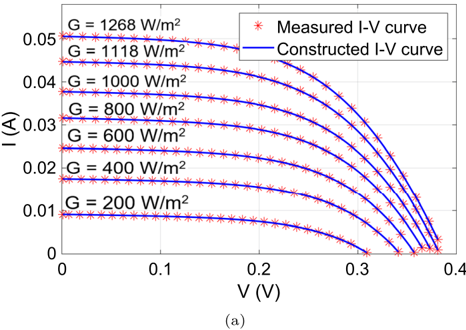
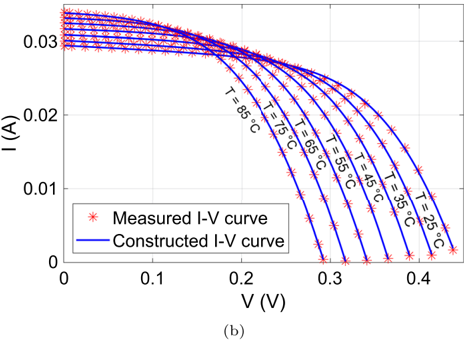
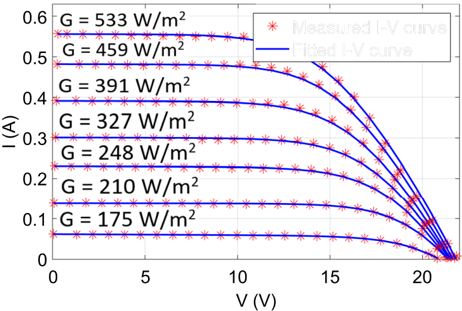
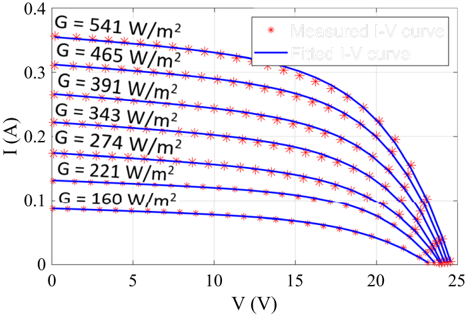
Verification
Claims the paper makes
The claims and statistics of this paper haven’t been checked yet.
Free: it reads the open-access text and checks the first 5 claims that cite a source we can check. Create a free account to check every claim.
Self-check
Percentages, sums and reported differences re-computed from the paper’s own numbers.
The self-check needs the paper’s full text.
Citations
Cites
An Algorithm for Least-Squares Estimation of Nonlinear Parameters
Marquardt, D. W. (1963) · Journal of the Society for Industrial and Applied Mathematics · doi:10.1137/0111030 · Cited by 30,728 · cited 1×
“One of the most well-regarded curve fitting and error quantifying techniques is the least square method (LSM) [41].”
A Fast Elitist Non-dominated Sorting Genetic Algorithm for Multi-objective Optimization: NSGA-II
Deb, K., Agrawal, S., Pratap, A., & Meyarivan, T. (2000) · Lecture Notes in Computer Science · doi:10.1007/3-540-45356-3_83 · Cited by 5,289
Parameter selection in particle swarm optimization
Shi, Y., & Eberhart, R. C. (1998) · Lecture Notes in Computer Science · doi:10.1007/bfb0040810 · Cited by 3,538
Chan, D. S. H., & Phang, J. C. H. (1987) · IEEE Transactions on Electron Devices · doi:10.1109/t-ed.1987.22920 · Cited by 694 · cited 1×
“In the DDM, two diodes are used to model two phenomena separately [4–7].”
Exact analytical solutions of the parameters of real solar cells using Lambert W-function
Jain, A. (2004) · Solar Energy Materials and Solar Cells · doi:10.1016/j.solmat.2003.11.018 · Cited by 560 · cited 1×
“It expresses the current as a function of the voltage and other physical parameters [37–39].”
Zagrouba, M., Sellami, A., Bouaïcha, M., & Ksouri, M. (2010) · Solar Energy · doi:10.1016/j.solener.2010.02.012 · Cited by 445
ORTIZCONDE, A., GARCIASANCHEZ, F., & MUCI, J. (2006) · Solar Energy Materials and Solar Cells · doi:10.1016/j.solmat.2005.04.023 · Cited by 433 · cited 1×
“Researchers sometimes consider the functional expression derived from the original transcendental format as a practical and efficient computational substitute [40]. where W is the principal branch of the Lambert W-func-tion.”
Characterization of PV panel and global optimization of its model parameters using genetic algorithm
Ismail, M. S., Moghavvemi, M., & Mahlia, T. M. I. (2013) · Energy Conversion and Management · doi:10.1016/j.enconman.2013.03.033 · Cited by 337
Particle Swarm Optimization and Intelligence: Advances and Applications
Parsopoulos, K. E., & Vrahatis, M. N. (2010) · Advances in Computational Intelligence and Robotics · doi:10.4018/978-1-61520-666-7 · Cited by 333 · cited 1×
“PSO is an effective solving algorithm widely used in both academia and the industry [44–46].”
Solar photovoltaic system modeling and performance prediction
Ma, T., Yang, H., & Lu, L. (2014) · Renewable and Sustainable Energy Reviews · doi:10.1016/j.rser.2014.04.057 · Cited by 323 · cited 1×
“The number of cells in a PV module connected in series and parallel should be included in the mathematical expression as follows [14–16]: where N s and N p are the number of cells connected in series or parallel, respectively.”
Research works printed but not linked: 5
- 12. Ayodele, T., Ogunjuyigbe, A., Ekoh, E.: Evaluation of numeri- cal algorithms used in extracting the parameters of a single- diode photovoltaic model. Sustain. Energy Technol. Assess. 13, 51-59 (2016)
- 21. Abdalla, A.O.M., Ibrahim, A.A.Z.: Modeling single diode pv using particle swarm optimization (pso ) techniques. Gaziosmanpaşa Bilimsel Araştırma Derg. 11(1), 44-56 (2022)
- 38. Plesz, B.: Investigation of the Temperature Dependence of Thin Photoactive Layer Crystalline Silicon Solar Cells. PhD thesis, Budapest University of Technology and Economics (2016)
- 39. Abdulrazzaq, A.K.: Electro-thermal modeling of photovoltaic (PV) systems. In: Spring Wind 2018, pp. 17-29. Association of Hungarian PhD and DLA students, Györ (2018)
- 45. Jarboui, B., Damak, N., Siarry, P., Rebai, A.: A combinatorial particle swarm optimization for solving multi-mode resource- constrained project scheduling problems. Appl. Math. Comput. 195(1), 299-308 (2008)
Cited by
Polymer–Perovskite Microcrystal Heterojunction for Self-Powered Optical Sensing and Communication
Sathyanarayana, S., & Das, B. C. (2026) · Advanced Materials · doi:10.1002/adma.202517950 · Cited by 7
Chaves, R. R., Oliveira, A. F., Rubinger, R. M., & da Silva, A. J. (2025) · Electronics · doi:10.3390/electronics14173342 · Cited by 7
Malik, M. N., Zhao, Q., & Wang, S. (2026) · Energies · doi:10.3390/en19030754 · Cited by 6
Predictive Energy Storage Management with Redox Flow Batteries in Demand-Driven Microgrids
Benavides, D., Arévalo-Cordero, P., Ochoa-Correa, D., Valverde, L. D. T., & Ríos, A. (2025) · Sustainability · doi:10.3390/su17198915 · Cited by 5
Tummala, A. S. L. V., Kishore, G. I., Dev, A., & Siddaraj, U. (2026) · Scientific Reports · doi:10.1038/s41598-025-32437-5 · Cited by 5
“To address the drawbacks of the basic genetic algorithm and PSO, an enhanced hybrid algorithm combining the genetic algorithm and PSO is proposed in 11 for accurate parameter estimation.”
Metadata
- Authors
- Abdulrazzaq, A. K., Bognár, G., & Plesz, B.
- Affiliations
- Thi Qar University (IQ)
- Budapest University of Technology and Economics (HU)
- Corresponding author
- Abdulrazzaq, Ali Kareem
- Venue
- Journal of Computational Electronics
- Published
- 2025-02-10
- Volume
- 24
- Issue
- 2
- ISSN
- 1569-8025 (ISSN-L)
- 1572-8137
- OpenAlex
- W4407305893
- Semantic Scholar
- 8553fa1980614bb6263c67c67a8d7732e3109256
- Cited by
- 25
- References
- 46
- Citations by year
- 2026: 18 · 2025: 7
- FWCI
- 3.47
- Type
- journal article
- Language
- en
- Open access
- hybrid
- doi.org
- Licence
- cc-by
- creativecommons.org/licenses/by/4.0 (tdm)
- creativecommons.org/licenses/by/4.0 (vor)
- Locations
- Journal of Computational Electronics (publishedVersion, cc-by)
- Funders
- Technische Universität Chemnitz
- Topics
- Physical Sciences › Energy › Renewable Energy, Sustainability and the Environment › Photovoltaic System Optimization Techniques
- Physical Sciences › Energy › Renewable Energy, Sustainability and the Environment › Solar Radiation and Photovoltaics
- Physical Sciences › Computer Science › Artificial Intelligence › Metaheuristic Optimization Algorithms Research
- Keywords
- single-diode model, parameter extraction, solar cells, photovoltaic modules, current-voltage characteristics, genetic algorithm, particle swarm optimization, hybrid optimization, objective function, Lambert W function, least squares fitting
About these checks
Registry, retraction, Cites and statistics results are computed, not judged, with one exception: a printed reference that no index lists is read once by a model before it counts as a citation error. Claims are extracted by a model and kept only when their quote appears verbatim in the text; each cited source is then checked, with a model’s help, for whether it says what the claim relies on. Those verdicts can be wrong — read the claim’s quote and the cited source before relying on one.
Statistics and arithmetic are recomputed, not judged.
Confidence bands are shown only for fields calibrated on our annotated test set. None is calibrated yet, so no band is shown.
What counts as a claim ›How we measure confidence ›How we check this ›
Are you an author, or do you see a problem with this page? Request a review
How to cite
Cite CoChat for the checks on this page, and the paper for its own findings.
- This page
- CoChat. (2026). Citation check: Enhanced single-diode model parameter extraction method for photovoltaic cells and modules based on integrating genetic algorithm, particle swarm optimization, and comparative objective functions. https://app.cochat.ai/papers/10.1007/s10825-025-02282-w
- The paper
- Abdulrazzaq, A. K., Bognár, G., & Plesz, B. (2025). Enhanced single-diode model parameter extraction method for photovoltaic cells and modules based on integrating genetic algorithm, particle swarm optimization, and comparative objective functions. Journal of Computational Electronics. https://doi.org/10.1007/s10825-025-02282-w
Data sources
Bibliographic data: Semantic Scholar, OpenAlex, Crossref.
Contains information from the Semantic Scholar Academic Graph Datasets, made available under the ODC Attribution License (ODC-BY 1.0).
Semantic Scholar’s data is described in: Kinney, R., et al. (2023). The Semantic Scholar Open Data Platform. arXiv:2301.10140.
