

Evaluation of cell binding to collagen and gelatin: a study of the effect of 2D and 3D architecture and surface chemistry
Open accessThe DOI matches its Crossref record; 50 of the 50 references it cites were found in a registry or an index.
Abstract
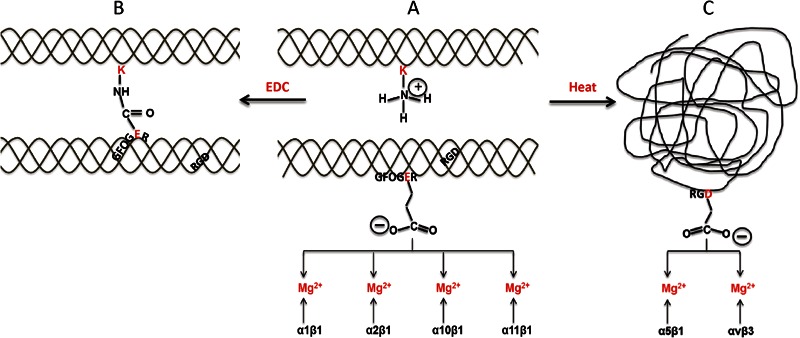
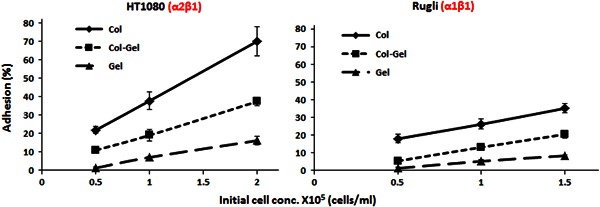
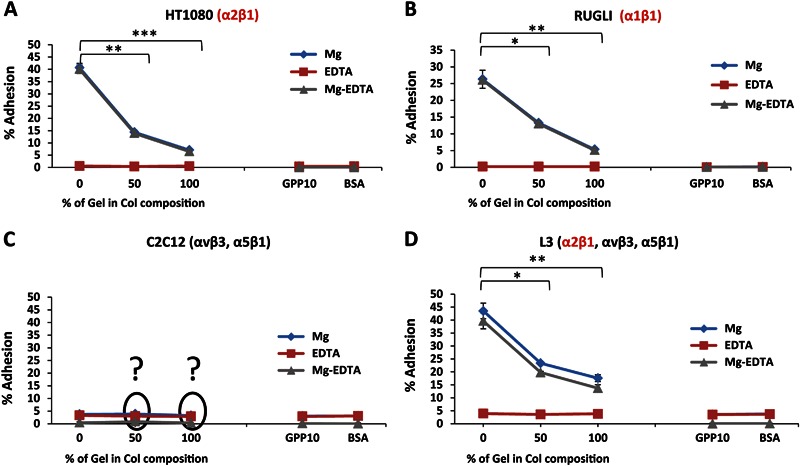
Studies of cell attachment to collagen-based materials often ignore details of the binding mechanisms-be they integrin-mediated or non-specific. In this work, we have used collagen and gelatin-based substrates with different dimensional characteristics (monolayers, thin films and porous scaffolds) in order to establish the influence of composition, crosslinking (using carbodiimide) treatment and 2D or 3D architecture on integrin-mediated cell adhesion. By varying receptor expression, using cells with collagen-binding integrins (HT1080 and C2C12 L3 cell lines, expressing α2β1, and Rugli expressing α1β1) and a parent cell line C2C12 with gelatin-binding receptors (αvβ3 and α5β1), the nature of integrin binding sites was studied in order to explain the bioactivity of different protein formulations. We have shown that alteration of the chemical identity, conformation and availability of free binding motifs (GxOGER and RGD), resulting from addition of gelatin to collagen and crosslinking, have a profound effect on the ability of cells to adhere to these formulations. Carbodiimide crosslinking ablates integrin-dependent cell activity on both two-dimensional and three-dimensional architectures while the three-dimensional scaffold structure also leads to a high level of non-specific interactions remaining on three-dimensional samples even after a rigorous washing regime. This phenomenon, promoted by crosslinking, and attributed to cell entrapment, should be considered in any assessment of the biological activity of three-dimensional substrates. Spreading data confirm the importance of integrin-mediated cell engagement for further cell activity on collagen-based compositions. In this work, we provide a simple, but effective, means of deconvoluting the effects of chemistry and dimensional characteristics of a substrate, on the cell activity of protein-derived materials, which should assist in tailoring their biological properties for specific tissue engineering applications.
Overview
The claims and statistics of this paper haven’t been checked yet.
Free: it reads the open-access text and checks the first 5 claims that cite a source we can check. Create a free account to check every claim.
Integrity signals
Registry
Cites
Statistics
Figures
Verification
Claims the paper makes
The claims and statistics of this paper haven’t been checked yet.
Free: it reads the open-access text and checks the first 5 claims that cite a source we can check. Create a free account to check every claim.
Self-check
Percentages, sums and reported differences re-computed from the paper’s own numbers.
The self-check needs the paper’s full text.
Citations
Cites
Hynes (2002) · doi:10.1016/s0092-8674(02)00971-6 · Cited by 8,606
Stöckl, S., Göttl, C., Grifka, J., & Grässel, S. (2013) · Cellular Physiology and Biochemistry · doi:10.1159/000350089 · Cited by 4,656
Biomaterials & scaffolds for tissue engineering
O'Brien, F. J. (2011) · Materials Today · doi:10.1016/s1369-7021(11)70058-x · Cited by 3,437 · cited 2×
“mechanical support for cells and supplies correct biological signals for cell activity [1–4].”
BackgroundMurphy, C. M., Haugh, M. G., & O'Brien, F. J. (2010) · Biomaterials · doi:10.1016/j.biomaterials.2009.09.063 · Cited by 2,056
Biomedical applications of collagen
Lee, C. H., Singla, A., & Lee, Y. (2001) · International Journal of Pharmaceutics · doi:10.1016/s0378-5173(01)00691-3 · Cited by 1,945 · cited 1×
“Col, in particular fibrillar Type I, is the most abundant constituent of the ECM of many hard and soft tissues in the human body [2, 16–19].”
BackgroundStructural Basis of Integrin Regulation and Signaling
Luo, B.-H., Carman, C. V., & Springer, T. A. (2007) · Annual Review of Immunology · doi:10.1146/annurev.immunol.25.022106.141618 · Cited by 1,660 · cited 1×
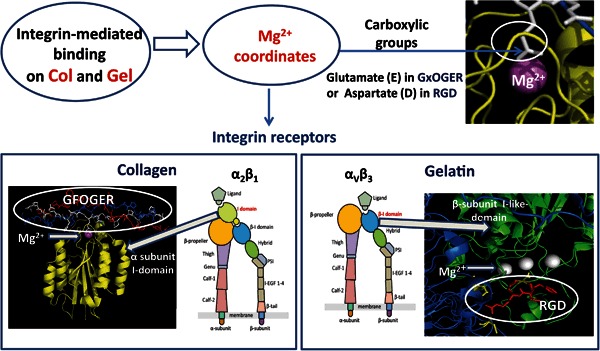
“Schematics of the integrin structure were adapted from [38].”
BackgroundXiong, J.-P., Stehle, T., Zhang, R., Joachimiak, A., Frech, M., Goodman, S. L., & Arnaout, M. A. (2002) · Science · doi:10.1126/science.1069040 · Cited by 1,613 · cited 1×
“The binding of integrins to Col and Gel requires the presence of divalent cations, and Mg is the preferred physiological ion [36–38].”
BackgroundBarczyk, M., Carracedo, S., & Gullberg, D. (2010) · Cell and Tissue Research · doi:10.1007/s00441-009-0834-6 · Cited by 1,512
Structural Basis of Collagen Recognition by Integrin α2β1
Emsley, J., Knight, C. G., Farndale, R. W., Barnes, M. J., & Liddington, R. C. (2000) · Cell · doi:10.1016/s0092-8674(00)80622-4 · Cited by 1,005
Self-citationTissue Engineering of a Differentiated Cardiac Muscle Construct
Zimmermann, W.-H., Schneiderbanger, K., Schubert, P., Didié, M., Münzel, F., Heubach, J. F., Kostin, S., Neuhuber, W. L., & Eschenhagen, T. (2002) · Circulation Research · doi:10.1161/hh0202.103644 · Cited by 917 · cited 1×
“Col, in particular fibrillar Type I, is the most abundant constituent of the ECM of many hard and soft tissues in the human body [2, 16–19].”
Background
Cited by
Cao, H., Duan, L., Zhang, Y., Cao, J., & Zhang, K. (2021) · Signal Transduction and Targeted Therapy · doi:10.1038/s41392-021-00830-x · Cited by 1,274
“Collagen fibrils and fibers with only hundreds of nano-meter thickness are enriched in cell adherence peptide ligands such as collagen triple-helical ligands (GxOGER) and arginine–glycine–aspartic acid (RGD), and these peptides can bind with cell membrane receptors, such as α1β1 and α2β1 integrins.(73,74) As a result,…”
BackgroundPrintability and shape fidelity of bioinks in 3D bioprinting
Schwab, A., Levato, R., D’Este, M., Piluso, S., Eglin, D., & Malda, J. (2020) · Chemical Reviews · doi:10.1021/acs.chemrev.0c00084 · Cited by 1,359
Chemically Modified Biopolymers for the Formation of Biomedical Hydrogels
Muir, V. G., & Burdick, J. A. (2021) · Chemical Reviews · doi:10.1021/acs.chemrev.0c00923 · Cited by 604
Engineering and Functionalization of Gelatin Biomaterials: From Cell Culture to Medical Applications
Bello, A. B., Kim, D., Kim, D., Park, H., & Lee, S.-H. (2020) · Tissue Engineering Part B: Reviews · doi:10.1089/ten.teb.2019.0256 · Cited by 545
“28,42 Another important similarity of collagen and gelatin is the lack or very low presence of the aromatic amino acids, tryptophan, tyrosine, and phenylalanine.”
Bioinks and bioprinting technologies to make heterogeneous and biomimetic tissue constructs
Ashammakhi, N., Ahadian, S., Xu, C., Montazerian, H., Ko, H., Nasiri, R., Barros, N., & Khademhosseini, A. (2019) · Materials Today Bio · doi:10.1016/j.mtbio.2019.100008 · Cited by 549
“For example, natural polymers, such as collagen and gelatin, have been widely used because they contain Arg-Gly-Asp (RGD) motifs [24], which are important for cell attachment and migration.”
Background
Metadata
- Authors
- Davidenko, N., Schuster, C. F., Bax, D. V., Farndale, R. W., Hamaia, S., Best, S. M., & Cameron, R. E.
- Affiliations
- University of Cambridge (GB)
- Corresponding author
- Davidenko, Natalia
- ORCID
- Venue
- Journal of Materials Science: Materials in Medicine
- Published
- 2016-08-31
- Volume
- 27
- Issue
- 10
- Pages
- 148-148
- ISSN
- 0957-4530 (ISSN-L)
- 1573-4838
- PMC
- PMC5007264
- OpenAlex
- W2510973356
- Cited by
- 454
- References
- 50
- Citations by year
- 2026: 34 · 2025: 45 · 2024: 54 · 2023: 48 · 2022: 57 · 2021: 64 · 2020: 62 · 2019: 52 · 2018: 28 · 2017: 9 · 2016: 1
- FWCI
- 12.25
- Type
- journal article
- Language
- en
- Update notices
- correction (2018-03-21)
- Open access
- hybrid
- doi.org
- Locations
- Journal of Materials Science Materials in Medicine (publishedVersion, cc-by)
- Europe PMC (PubMed Central) (publishedVersion, cc-by)
- PubMed Central (publishedVersion, cc-by)
- PubMed (publishedVersion)
- Apollo (University of Cambridge) (submittedVersion, cc-by)
- Apollo (cc-by)
- Funders
- British Heart Foundation (GB) (Grants NH/11/1/28922 and SP/15/7/31561, RG/15/4/31268 and SP/15/7/31561)
- The Welcome Trust (094470/Z/10/Z)
- ERC Advanced Grant (320598 3D-E)
- EPSRC Doctoral Training Account
- Peoples Programme of the EU 7th Framework Programme (RAE no: PIIF-GA-2013-624904)
- EPSRC IKC Proof of Concept Award
- Topics
- Physical Sciences › Materials Science › Biomaterials › Collagen: Extraction and Characterization
- Health Sciences › Medicine › Immunology and Allergy › Cell Adhesion Molecules Research
- Life Sciences › Biochemistry, Genetics and Molecular Biology › Cell Biology › Cellular Mechanics and Interactions
- Keywords
- integrin-mediated adhesion, collagen, gelatin, 3D scaffolds, carbodiimide crosslinking, RGD motif, cell entrapment, non-specific binding, alpha2beta1 integrin, integrin αvβ3, alpha1beta1 integrin, cell spreading, tissue engineering biomaterials, surface chemistry
- MeSH terms
- Achilles Tendon, Animals, Carbodiimides, Cattle, Cell Adhesion, Cell Line, Collagen, Cross-Linking Reagents, Extracellular Matrix, Gelatin, Humans, Ligands, Materials Testing, Protein Binding, Surface Properties, Integrins, Coated Materials, Biocompatible, Amino Acid Motifs, Tissue Engineering, Cell Line, Tumor, Mice, Tissue Scaffolds
About these checks
Registry, retraction, Cites and statistics results are computed, not judged, with one exception: a printed reference that no index lists is read once by a model before it counts as a citation error. Claims are extracted by a model and kept only when their quote appears verbatim in the text; each cited source is then checked, with a model’s help, for whether it says what the claim relies on. Those verdicts can be wrong — read the claim’s quote and the cited source before relying on one.
Statistics and arithmetic are recomputed, not judged.
Confidence bands are shown only for fields calibrated on our annotated test set. None is calibrated yet, so no band is shown.
What counts as a claim ›How we measure confidence ›How we check this ›
Are you an author, or do you see a problem with this page? Request a review
Data sources
Bibliographic data: Semantic Scholar, OpenAlex, Crossref.
Contains information from the Semantic Scholar Academic Graph Datasets, made available under the ODC Attribution License (ODC-BY 1.0).
Semantic Scholar’s data is described in: Kinney, R., et al. (2023). The Semantic Scholar Open Data Platform. arXiv:2301.10140.
