

The DOI matches its Crossref record; 67 of the 67 references it cites were found in a registry or an index; 12 of the 46 sources its claims cite were checked for support.
Evaluating Mechanisms: Mapping Weekly Dynamics between Experiential Avoidance and SAD Symptoms
Open accessAbstract
Widely-used, empirically-supported treatments focus on reducing experiential avoidance (EA) as a mechanism of social anxiety disorder (SAD) symptom change. However, little is known about how EA and SAD symptoms bidirectionally interrelate from session to session, or throughout the course of an intervention—a gap that raises significant theoretical and clinical questions about the mechanistic role of EA. Participants (N = 78) with elevated EA and SAD symptoms completed a 3-session pilot intervention (Approach-Avoidance Task training plus psychoeducation) designed to target EA. Bivariate latent change score modeling was then used to map the bidirectional, temporal interrelationships between EA and SAD symptoms from session to session. Analyses accounted for the overall trajectory of change in both variables (i.e., EA and SAD) and both variables’ preceding measurement. Findings suggested that changes in SAD symptoms preceded and predicted changes in EA from session to session. Contrary to hypotheses, this effect was not bidirectional, as changes in EA did not precede and predict changes in SAD symptoms from session to session. The use of a relatively small analogue sample limit the external validity of the present findings. Nevertheless, these novel findings advance our understanding of the dynamic interrelationships between EA and SAD symptoms throughout treatment. Moreover, given that many leading treatments target EA, this study highlights a need for future work to continue evaluating whether EA is indeed a mechanism of SAD symptom change. © 2021, The Author(s).
Overview
CoChat Summary
TL;DR
In a 3-session pilot intervention targeting experiential avoidance (EA) among 78 students with elevated EA and social anxiety disorder (SAD) symptoms, bivariate latent change score modeling found that weekly decreases in SAD symptoms predicted next-week decreases in EA, but not vice versa. The authors conclude this challenges the assumption that EA change is a proximal mechanism of SAD symptom change.
Key findings
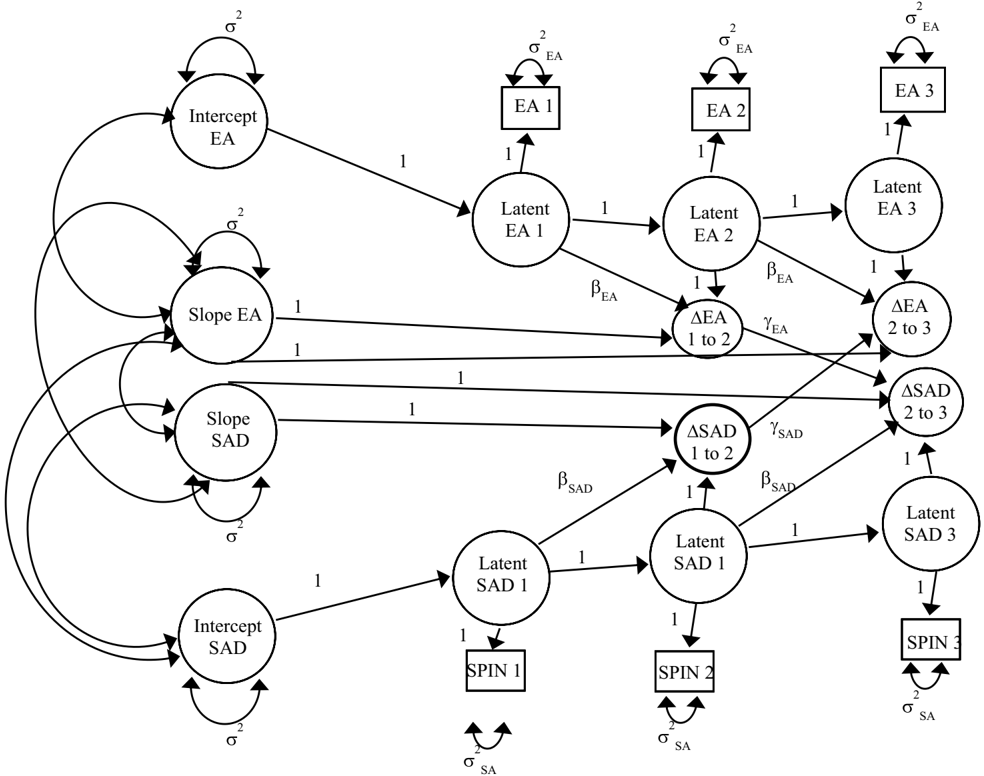
- The bivariate latent change score model fit best compared with univariate models. The coupling parameter with SAD symptoms preceding EA was significant and positive (γ = 0.89, p = 0.02), indicating weekly decreases in SAD symptoms predicted decreases in EA the next week.
- Contrary to hypotheses, the coupling parameter with EA preceding SAD symptoms was not significant (γ = -0.63, p = 0.40), so weekly change in EA did not precede and predict weekly change in SAD symptoms.
- Across sessions, mean BEAQ scores decreased from 58.13 (SD = 9.06) at Session 1 to 53.54 (SD = 11.16) at Session 2 to 48.06 (SD = 12.97) at Session 3; mean SPIN scores decreased from 38.26 (SD = 8.92) to 31.53 (SD = 11.35) to 25.23 (SD = 12.78).
- The authors state this is the first study to directly test how EA and SAD symptoms bidirectionally interrelate session by session throughout an intervention.
Methods
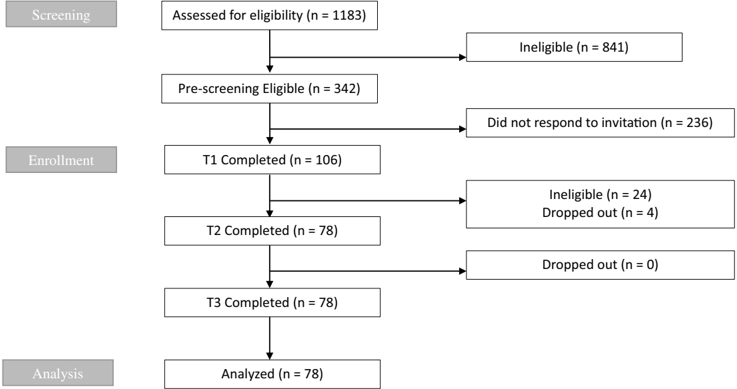
- Participants were recruited from a Midwestern university and screened for elevated EA and SAD symptoms: BEAQ scores ≥ 39.80 and SPIN scores ≥ 25, plus age ≥ 18 and self-reported English fluency. The final analyzed sample was N = 78 who still met inclusion criteria at Session 1 and completed all three sessions.
- The pilot intervention consisted of three weekly sessions combining Approach-Avoidance Task (AAT) training with psychoeducation about EA and emotional acceptance. Participants completed the BEAQ and SPIN at each session.
- Bivariate latent change score modeling (BLCSM) in AMOS 25 was used to test bidirectional, temporal relations between EA and SAD symptoms, controlling for each variable’s overall trajectory of change and preceding measurement. Model fit was evaluated with CFI, RMSEA, χ², and χ²/df.
Limitations
- The paper states that sample sizes approaching 100 to 200 are generally preferable for structural equation modeling/BLCSM, though the authors note conditions of normality and linearity were met; they call for replication with a larger sample.
- The paper states the sample was selected for elevated SAD symptoms and EA, so findings may not generalize to individuals diagnosed with SAD or seeking treatment for SAD.
- The paper states the pilot intervention had no control group, so firm conclusions cannot be drawn about intervention efficacy or whether findings reflect naturalistic versus manipulated interrelations between EA and SAD symptoms.
- The paper states the BEAQ has been criticized for using items related to behavioral rather than internal avoidance and for poor fit in certain samples (e.g., treatment-seeking veterans).
- Text-evident limitations: the sample was predominantly female (83.3%) and White (80.8%), drawn from university students, with only three sessions over roughly two weeks and no longer-term follow-up.
Model-written summary. Check it against the paper before relying on it.
Integrity signals
Registry
Cites
Statistics
Figures
Verification
Claims the paper makes
11 Valid · 2 Not valid · 19 Not checked · 29 Own results and interpretations
The sources with a verdict support this claim; the rest weren’t checked yet, have no full text we could read, or their verdicts aren’t rated yet.
In the paper
“Experiential avoidance, or EA, has been identified as one potential mechanism driving SAD (Glick & Orsillo, 2011;Kashdan et al., 2006Kashdan et al., , 2014)).”
§ Evaluating Mechanisms: Mapping Weekly Dynamics between Experiential Avoidance and SAD Symptoms > Experiential Avoidance
What the sources say
- Not checked — no full text of the sourcecites Glick & Orsillo, 2011
- Not matchedcites Kashdan et al., 2006
Couldn’t be matched to a paper in Crossref, so it can’t be checked.
- Supportedcites Kashdan et al., 2014 sourceExperimental — accuracy not yet measured
The Abstract (page unavailable) identifies experiential avoidance as a hypothesized risk factor for social anxiety. It also reports that avoidance was more strongly associated with anxiety symptoms in people with SAD and, in one experimental interaction condition, preceded increases in social anxiety. This supports its identification as a potential mechanism, without establishing that it causes SAD. (LLM, conf=0.88)
states a possible cause- Asserted: passes — The authors put it forward as true.
- Checkable: passes — It can be checked against evidence.
- Load-bearing: passes — The paper’s conclusions depend on it.
- Based: passes — The paper gives a reason why it holds.
The cited sources support only part of this claim — read each source’s verdict below.
In the paper
“Supporting its efficacy, findings suggest that the AAT may be effective for improving SAD-related behaviors (e.g., intimacy building) and state affect (Loijen et al., 2021;Rinck et al., 2013;Taylor & Amir, 2012; though see Asnaani et al., 2014).”
§ Evaluating Mechanisms: Mapping Weekly Dynamics between Experiential Avoidance and SAD Symptoms > Approach-Avoidance Task Training for EA
What the sources say
- Not checked — no full text of the sourcecites Loijen et al., 2021 source
- Partly supportedcites Rinck et al., 2013 sourceExperimental — accuracy not yet measured
The Abstract and Discussion report that AAT training changed approach behavior in highly socially anxious individuals and improved mood and anxiety after a social stress task. The paper does not report improved intimacy building, and the Discussion cautions that the study does not establish therapeutic efficacy for SAD because it lacked a placebo-training comparison. (LLM, conf=0.88)
- Partly supportedcites Taylor & Amir, 2012 sourceExperimental — accuracy not yet measured
The Results (Main Analyses; page unavailable) report greater social approach behavior during a relationship-building interaction after AAT training, supporting the behavior portion of the claim. But the same section finds no differential effect on state anxiety, and the Discussion says the training did not influence subjective anxiety after training or interaction. The sample comprised students with elevated social anxiety symptoms, not people diagnosed with SAD. (LLM, conf=0.91)
hedgedstates a possible cause- Asserted: passes — The authors put it forward as true.
- Checkable: passes — It can be checked against evidence.
- Load-bearing: passes — The paper’s conclusions depend on it.
- Based: passes — The paper gives a reason why it holds.
The sources with a verdict support this claim; the rest weren’t checked yet, have no full text we could read, or their verdicts aren’t rated yet.
In the paper
“Further, findings from a number of randomized control trials suggest that EA may play a meaningful role in treatment outcomes for SAD symptoms (Dalrymple & Herbert, 2007;Niles et al., 2014;Ossman et al., 2006).”
§ Evaluating Mechanisms: Mapping Weekly Dynamics between Experiential Avoidance and SAD Symptoms > Experiential Avoidance
What the sources say
- Not checked — no full text of the sourcecites Dalrymple & Herbert, 2007 source
- Supportedcites Niles et al., 2014 source
The Discussion (page not provided) reports that change in experiential avoidance significantly mediated social anxiety symptom reduction in ACT, though not in CBT. That supports the hedged claim that experiential avoidance may play a meaningful role in treatment outcomes for SAD symptoms. (LLM, conf=0.92)
- Not matchedcites Ossman et al., 2006
Couldn’t be matched to a paper in Crossref, so it can’t be checked.
hedgedstates a possible cause- Asserted: passes — The authors put it forward as true.
- Checkable: passes — It can be checked against evidence.
- Load-bearing: unclear — It is unclear whether the paper’s conclusions depend on it.
- Based: passes — The paper gives a reason why it holds.
The cited sources support only part of this claim — read each source’s verdict below.
In the paper
“These explicit instructions were based on meta-analytic findings that explicit instructions in AAT trainings are associated with greater effect sizes than instructions that attempt to conceal the purpose of the training by asking participants to focus on neutral aspects of the stimuli (e.g., push/pull based on the color or shape of the stimuli; Phaf et al., 2014).”
§ Evaluating Mechanisms: Mapping Weekly Dynamics between Experiential Avoidance and SAD Symptoms > AAT Training
What the sources say
- Partly supportedcites Phaf et al., 2014 sourceExperimental — accuracy not yet measured
The Introduction (Instruction; page unavailable) defines implicit instructions as responses to task-irrelevant features such as background color. The Results (Moderator analyses of both affects; page unavailable) find smaller effect sizes with implicit than explicit instructions. However, the meta-analysis concerns approach–avoidance effects in manual reaction-time tasks, not the effectiveness of AAT training or whether instructions conceal a training purpose. (LLM, conf=0.86)
plainstates an association- Asserted: passes — The authors put it forward as true.
- Checkable: passes — It can be checked against evidence.
- Load-bearing: passes — The paper’s conclusions depend on it.
- Based: passes — The paper gives a reason why it holds.
- Partly supported
Every source the paper cites for this claim was checked and supports it.
In the paper
“Factor analyses have identified three factors captured by the SPIN: fear of negative evaluation, fear of physical symptoms (i.e., akin to anxiety sensitivity), and fear of uncertainty (i.e., akin to intolerance of uncertainty) in social situations (Campbell-Sills et al., 2015).”
§ Evaluating Mechanisms: Mapping Weekly Dynamics between Experiential Avoidance and SAD Symptoms > Discussion
What the sources say
- Supportedcites Campbell-Sills et al., 2015 source
The Results (§3.2) identify the three SPIN factors exactly as claimed. The Discussion (§4) also links Fear of Physical Symptoms to anxiety sensitivity and Fear of Uncertainty in Social Situations to intolerance of uncertainty, consistent with the citing sentence’s qualified comparisons. (LLM, conf=0.94)
plain- Asserted: passes — The authors put it forward as true.
- Checkable: passes — It can be checked against evidence.
- Load-bearing: passes — The paper’s conclusions depend on it.
- Based: passes — The paper gives a reason why it holds.
- Supported
20 more claims
Create a free account to see all 61 claims and to verify the 3 references still open.
- It may state two separate claims as one. 18
- Probably not a substantial claim. 21
- The quote only partly states this claim. 2
Citations
Cites
Hu, L., & Bentler, P. M. (1999) · Structural Equation Modeling A Multidisciplinary Journal · doi:10.1080/10705519909540118 · Cited by 108,788
Principles and Practice of Structural Equation Modeling
Tabri, N., & Elliott, C. M. (2012) · Canadian Graduate Journal of Sociology and Criminology · doi:10.15353/cgjsc-rcessc.v1i1.25 · Cited by 38,891
(1998) · Cited by 36,049
Kessler, R. C., Chiu, W. T., Demler, O., & Walters, E. E. (2005) · Archives of General Psychiatry · doi:10.1001/archpsyc.62.6.617 · Cited by 12,052
Developing and evaluating complex interventions: the new Medical Research Council guidance
Craig, P., Dieppe, P., Macintyre, S., Michie, S., Nazareth, I., & Petticrew, M. (2008) · BMJ · doi:10.1136/bmj.a1655 · Cited by 10,995
Acceptance and commitment therapy: model, processes and outcomes
Hayes, S. C., Luoma, J. B., Bond, F. W., Masuda, A., & Lillis, J. (2006) · Behaviour Research and Therapy · doi:10.1016/j.brat.2005.06.006 · Cited by 6,587
Hayes, S. C., Wilson, K. G., Gifford, E. V., Follette, V. M., & Strosahl, K. (1996) · Journal of Consulting and Clinical Psychology · doi:10.1037//0022-006x.64.6.1152 · Cited by 3,595 · cited 1×
“1 3 regulation strategy characterized by internal resistance to and avoidance of uncomfortable thoughts, emotions, and physical sensations (Chawla & Ostafin, 2007; Hayes et al., 1996).”
BackgroundMurray, D. D., Suzuki, K., Law, M., Trebicka, J., Neuhaus, J., Wentworth, D., Johnson, M., Vjecha, M. J., Kelleher, A. D., Emery, S., et al. (2015) · PLOS ONE · doi:10.1371/journal.pone.0139981 · Cited by 2,740
A Brief Guide to Structural Equation Modeling
Weston, R., & Gore, P. A. (2006) · The Counseling Psychologist · doi:10.1177/0011000006286345 · Cited by 2,718
Latent Variable Modeling of Differences and Changes with Longitudinal Data
McArdle, J. J. (2009) · Annual Review of Psychology · doi:10.1146/annurev.psych.60.110707.163612 · Cited by 1,952 · cited 1×
“Following recommendations to estimate and 1 3 identify the model, all manifest variable intercepts were set to zero, and slope and autoproportionality were constrained to be constant across time (Magee & Winhusen, 2016; McArdle, 2009).”
Background
Cited by
Mikaeili, N., Narimani, M., & Marhamati, F. (2024) · مجله علمی دانشگاه علوم پزشکی رفسنجان · doi:10.61186/jrums.22.10.1037 · Cited by 9
Metadata
- Authors
- Sarfan, L. D., Magee, J. C., & Clerkin, E. M.
- Affiliations
- Miami University (US)
- Corresponding author
- Sarfan, Laurel D.
- Venue
- Journal of Psychopathology and Behavioral Assessment
- Published
- 2021-06-25
- Volume
- 43
- Issue
- 4
- Pages
- 745-756
- ISSN
- 0164-0305 (ISSN-L)
- 0882-2689
- 1573-3505
- OpenAlex
- W3173865755
- Cited by
- 1
- References
- 67
- Citations by year
- 2024: 1
- FWCI
- 0.24
- Type
- journal article
- Language
- en
- Open access
- hybrid
- doi.org
- Licence
- cc-by
- creativecommons.org/licenses/by/4.0 (tdm)
- creativecommons.org/licenses/by/4.0 (vor)
- Locations
- Journal of Psychopathology and Behavioral Assessment (publishedVersion, cc-by)
- Funders
- Association of Behavioral and Cognitive Therapies
- Miami University
- Topics
- Social Sciences › Psychology › Experimental and Cognitive Psychology › Anxiety, Depression, Psychometrics, Treatment, Cognitive Processes
- Social Sciences › Psychology › Clinical Psychology › Psychotherapy Techniques and Applications
- Social Sciences › Psychology › Clinical Psychology › Mindfulness and Compassion Interventions
- Keywords
- experiential avoidance, social anxiety disorder, therapeutic mechanisms, psychoeducation, symptom trajectories
About these checks
Registry, retraction, Cites and statistics results are computed, not judged, with one exception: a printed reference that no index lists is read once by a model before it counts as a citation error. Claims are extracted by a model and kept only when their quote appears verbatim in the text; each cited source is then checked, with a model’s help, for whether it says what the claim relies on. Those verdicts can be wrong — read the claim’s quote and the cited source before relying on one.
The claim verdicts this report counts are experimental: their accuracy is not yet measured.
A language model drew the claims from the paper on 2026-10-11, under version 3 of the claim definition (model deepseek-v4.1-flash, prompt extract-v3).
A second model labelled each claim on 2026-10-11 (model jev-1.13-20260917, definition revision gold-guideline-v0.2).
Cited sources are checked with a language model’s help (gpt-6-sol).
Statistics and arithmetic are recomputed, not judged.
Confidence bands are shown only for fields calibrated on our annotated test set. None is calibrated yet, so no band is shown.
What counts as a claim ›How we measure confidence ›How we check this ›
Are you an author, or do you see a problem with this page? Request a review
How to cite
Cite CoChat for the checks on this page, and the paper for its own findings.
- This page
- CoChat. (2026). Citation check: Evaluating Mechanisms: Mapping Weekly Dynamics between Experiential Avoidance and SAD Symptoms. https://app.cochat.ai/papers/10.1007/s10862-021-09899-8
- The paper
- Sarfan, L. D., Magee, J. C., & Clerkin, E. M. (2021). Evaluating Mechanisms: Mapping Weekly Dynamics between Experiential Avoidance and SAD Symptoms. Journal of Psychopathology and Behavioral Assessment. https://doi.org/10.1007/s10862-021-09899-8
Data sources
Bibliographic data: Semantic Scholar, OpenAlex, Crossref.
Contains information from the Semantic Scholar Academic Graph Datasets, made available under the ODC Attribution License (ODC-BY 1.0).
Semantic Scholar’s data is described in: Kinney, R., et al. (2023). The Semantic Scholar Open Data Platform. arXiv:2301.10140.
