

Psychiatric Symptoms, Posttraumatic Growth, and Life Satisfaction Among Parents of Seriously Ill Infants: A Prospective Case-Controlled Study
Open accessThe DOI matches its Crossref record; 61 of the 62 references it cites were found in a registry or an index.
Abstract
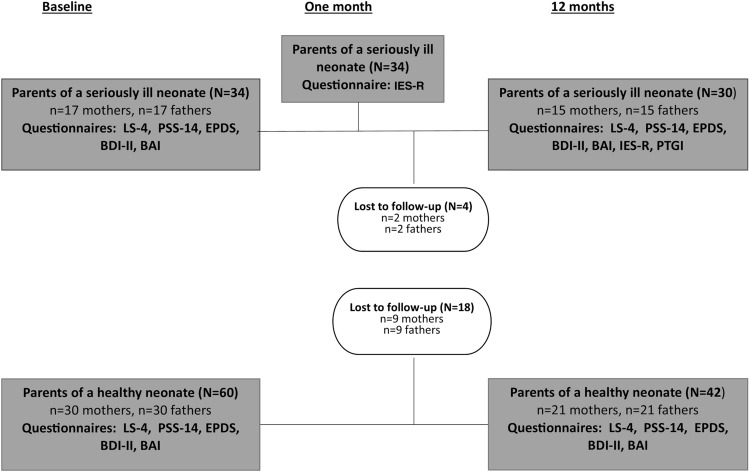
We evaluated psychiatric symptoms, posttraumatic growth, and life satisfaction among the parents (n = 34) of newborns (n = 17) requiring therapeutic hypothermia or urgent surgery (interest group). Our control group included 60 parents of healthy newborns (n = 30). The first surveys were completed soon after diagnosis or delivery and the follow-up surveys 1 year later (participation rate 88% in the interest group and 70% in the control group). General stress was common in both groups but was more prevalent in the interest group as were depressive symptoms, too. Anxiety was more common in the interest group, although it showed a decrease from the baseline in both groups. Life satisfaction had an inverse correlation with all measures of psychiatric symptoms, and it was lower in the interest group in the early stage, but similar at 12 months due to the slight decline in the control group. Mothers in the interest group had more anxiety and depressive symptoms than fathers in the early stage. Mothers had more traumatic distress than fathers at both time points. Half of the parents experienced substantial posttraumatic growth at 12 months. In conclusion, the serious illness of an infant substantially affects the well-being of the parents in the early stages of illness and one year after the illness.
Overview
The claims and statistics of this paper haven’t been checked yet.
Free: it reads the open-access text and checks the first 5 claims that cite a source we can check. Create a free account to check every claim.
Integrity signals
Registry
Cites
Statistics
Figures
Verification
Claims the paper makes
The claims and statistics of this paper haven’t been checked yet.
Free: it reads the open-access text and checks the first 5 claims that cite a source we can check. Create a free account to check every claim.
Claims other papers make about this one
Each is checked against this paper’s own text: does it say what the citing paper says it does?
The source backs part of the claim, not all of it — or backs it for a different population, condition or comparison.
In the citing paper
“In addition to adverse consequences following experiences of traumatic events, it is common for individuals to report positive outcomes or experiences as the result of their traumatic experience (Koivula et al., 2022).”
From “NICU Doesn’t Stop in the NICU”: Maternal Perspectives of the Impact of a NICU Experience over Time (2026) · cites this paper as Koivula et al., 2022
Experimental — accuracy not yet measured
Self-check
Percentages, sums and reported differences re-computed from the paper’s own numbers.
The self-check needs the paper’s full text.
Citations
Cites
A Global Measure of Perceived Stress
Cohen, S., Kamarck, T., & Mermelstein, R. (1983) · Journal of Health and Social Behavior · doi:10.2307/2136404 · Cited by 32,807 · cited 3×
“The Perceived Stress Scale (PSS-14; Cohen et al., 1983) was used to assess subjective experiences of psychological stress.”
MethodInfluentialAn inventory for measuring clinical anxiety: Psychometric properties.
Beck, A. T., Epstein, N., Brown, G., & Steer, R. A. (1988) · Journal of Consulting and Clinical Psychology · doi:10.1037/0022-006x.56.6.893 · Cited by 14,407
Detection of Postnatal Depression: Development of the 10-item Edinburgh Postnatal Depression Scale
Cox, J. L., Holden, J. M., & Sagovsky, R. (1987) · British Journal of Psychiatry · doi:10.1192/bjp.150.6.782 · Cited by 14,183
TARGET ARTICLE: "Posttraumatic Growth: Conceptual Foundations and Empirical Evidence"
Tedeschi, R. G., & Calhoun, L. G. (2004) · Psychological Inquiry · doi:10.1207/s15327965pli1501_01 · Cited by 7,154
The posttraumatic growth inventory: measuring the positive legacy of trauma
Tedeschi, R. G., & Calhoun, L. G. (1996) · Journal of Traumatic Stress · doi:10.1002/jts.2490090305 · Cited by 7,061 · cited 3×
“Only the parents in the interest group filled in the IES-R and the Posttraumatic Growth Inventory (PTGI; Tedeschi & Calhoun, 1996).”
BackgroundMethodAssessing Psychological Trauma and PTSD
Allden, K. (1998) · The Journal of Nervous & Mental Disease · doi:10.1097/00005053-199807000-00018 · Cited by 1,709
Kazak, A. E. (2004) · Journal of Pediatric Psychology · doi:10.1093/jpepsy/jsh022 · Cited by 506 · cited 1×
“Posttraumatic arousal and re-experiencing symptoms may impair the ability of parents to comprehend medical guidelines and communicate essential information about the child’s well-being to healthcare professionals (Kazak et al., 2004).”
BackgroundLefkowitz, D. S., Baxt, C., & Evans, J. R. (2010) · Journal of Clinical Psychology in Medical Settings · doi:10.1007/s10880-010-9202-7 · Cited by 468 · cited 1×
“It is known that PTSD in fathers is related to that in their partners (Lefkowitz et al., 2010).”
BackgroundKazak, A. E., Barakat, L. P., Meeske, K., & Christakis, D. (1997) · Journal of Consulting and Clinical Psychology · doi:10.1037//0022-006x.65.1.120 · Cited by 468
Self-reported Life Satisfaction and 20-Year Mortality in Healthy Finnish Adults
Koivumaa-Honkanen, H. (2000) · American Journal of Epidemiology · doi:10.1093/aje/152.10.983 · Cited by 420 · cited 1×
“The LS-4 score was dichotomized to satisfied (LS-4 score 4–11) and dissatisfied (LS-4 score 12–20) (Koivumaa-Honkanen et al., 2000).”
Fathers’ Experiences in the Neonatal Intensive Care Unit: A Search for Control
Arockiasamy, V., Holsti, L., & Albersheim, S. (2008) · Pediatrics · doi:10.1542/peds.2007-1005 · Cited by 280 · cited 1×
“Despite having less stress, fathers often experienced a sense of lack of control and helplessness when they had an extremely ill infant in intensive care (Arockiasamy et al., 2008; Khoddam et al., 2021).”
BackgroundPosttrauma Symptoms in Childhood Leukemia Survivors and Their Parents
Stuber, M. L., Christakis, D. A., Houskamp, B., & Kazak, A. E. (1996) · Psychosomatics · doi:10.1016/s0033-3182(96)71564-5 · Cited by 256
Brain and cognitive‐behavioural development after asphyxia at term birth
De Haan, M., Wyatt, J. S., Roth, S., Vargha‐Khadem, F., Gadian, D., & Mishkin, M. (2006) · Developmental Science · doi:10.1111/j.1467-7687.2006.00499.x · Cited by 180
Posttraumatic stress disorder and family functioning in adolescent cancer
Pelcovitz, D., Libov, B. G., Mandel, F., Kaplan, S., Weinblatt, M., & Septimus, A. (1998) · Journal of Traumatic Stress · doi:10.1023/a:1024442802113 · Cited by 168 · cited 1×
“On the one hand, hypervigilant parents may request extra doctor visits or have frequent contacts with medical services, consequently overburdening the healthcare system and leading to additional costs (Pelcovitz et al., 1998).”
BackgroundAbdominal wall defects: Prenatal diagnosis, newborn management, and long-term outcomes
Gamba, P., & Midrio, P. (2014) · Seminars in Pediatric Surgery · doi:10.1053/j.sempedsurg.2014.09.009 · Cited by 162 · cited 1×
“Some congenital anomalies, such as omphalocele, gastroschisis, and esophageal atresia, require surgical treatment during the first days after birth (Gamba & Midrio, 2014; van der Zee et al., 2017).”
BackgroundAssessing positive life change: In search of meticulous methods.
Tennen, H. A., & Affleck, G. G. (2009) · American Psychological Association eBooks · doi:10.1037/11854-002 · Cited by 141
Fincher, W., Shaw, J., & Ramelet, A. (2012) · Journal of Clinical Nursing · doi:10.1111/j.1365-2702.2011.03973.x · Cited by 129
Parental anxiety and stress during children’s hospitalisation: The StayClose study
Wray, J., Lee, K., Dearmun, N., & Franck, L. (2011) · Journal of Child Health Care · doi:10.1177/1367493511408632 · Cited by 127 · cited 2×
“Higher anxiety scores of parents have been associated with the use of self-blame, lower optimism scores, higher levels of illness-related uncertainty, and a greater number of previous hospital stays (Wray et al., 2011).”
BackgroundMuscara, F., McCarthy, M. C., Woolf, C., Hearps, S. J. C., Burke, K., & Anderson, V. A. (2015) · European Psychiatry · doi:10.1016/j.eurpsy.2014.12.008 · Cited by 121
Communicating with parents in neonatal intensive care units: The impact on parental stress
Enke, C., y Hausmann, A. O., Miedaner, F., Roth, B., & Woopen, C. (2016) · Patient Education and Counseling · doi:10.1016/j.pec.2016.11.017 · Cited by 121
Santacroce, S. (2002) · Journal of Pediatric Oncology Nursing · doi:10.1053/jpon.2002.123451 · Cited by 120 · cited 1×
“Arousal symptoms may induce parents to overprotect their children and restrict their participation in activities, thereby hindering their normal development (Santacroce, 2002).”
BackgroundColville, G. A., & Cream, P. (2009) · Intensive Care Medicine · doi:10.1007/s00134-009-1444-1 · Cited by 118 · cited 3×
“In earlier studies, the prevalence of PTG among the parents of seriously ill children has varied between 37 and 88% (Barr, 2011; Colville & Cream, 2009; Hungerbuehler et al., 2011; RodríguezRey & Alonso-Tapia, 2019).”
BackgroundPosttraumatic stress disorder in parents of children with chronic illnesses: A meta-analysis.
Cabizuca, M., Marques-Portella, C., Mendlowicz, M. V., Coutinho, E. S. F., & Figueira, I. (2009) · Health Psychology · doi:10.1037/a0014512 · Cited by 112
Posttraumatic Growth in Parents and Pediatric Patients
Picoraro, J. A., Womer, J. W., Kazak, A. E., & Feudtner, C. (2014) · Journal of Palliative Medicine · doi:10.1089/jpm.2013.0280 · Cited by 107 · cited 1×
“This may be related to their resilience and is consistent with previous studies (e.g. Isokääntä et al., 2019; Picoraro et al., 2014).”
ResultThe Role of Peer Support in the Development of Maternal Identity for “NICU Moms”
Rossman, B., Greene, M. M., & Meier, P. P. (2015) · Journal of Obstetric, Gynecologic & Neonatal Nursing · doi:10.1111/1552-6909.12527 · Cited by 92 · cited 1×
“In addition, peer support has been very influential in development of the maternal role in the NICU (Rossman et al., 2015).”
BackgroundPosttraumatic growth in mothers and fathers of children with severe illnesses
Hungerbuehler, I., Vollrath, M. E., & Landolt, M. A. (2011) · Journal of Health Psychology · doi:10.1177/1359105311405872 · Cited by 92 · cited 1×
“In earlier studies, the prevalence of PTG among the parents of seriously ill children has varied between 37 and 88% (Barr, 2011; Colville & Cream, 2009; Hungerbuehler et al., 2011; RodríguezRey & Alonso-Tapia, 2019).”
BackgroundPosttraumatic growth after childbirth: A prospective study
Sawyer, A., Ayers, S., Young, D., Bradley, R., & Smith, H. (2012) · Psychology & Health · doi:10.1080/08870446.2011.578745 · Cited by 89
Ettenberger, M., Rojas Cárdenas, C., Parker, M., & Odell-Miller, H. (2017) · Nordic Journal of Music Therapy · doi:10.1080/08098131.2016.1205650 · Cited by 85
Aftyka, A., Rybojad, B., Rosa, W., Wróbel, A., & Karakuła‐Juchnowicz, H. (2017) · Journal of Clinical Nursing · doi:10.1111/jocn.13773 · Cited by 83
Hall, E. O. C. (2005) · Scandinavian Journal of Caring Sciences · doi:10.1111/j.1471-6712.2005.00352.x · Cited by 79
Cano Giménez, E., & Sánchez‐Luna, M. (2015) · Acta Paediatrica · doi:10.1111/apa.12984 · Cited by 71
Heringhaus, A., Dellenmark‐Blom, M., & Wigert, H. (2013) · International Journal of Qualitative Studies on Health and Well-Being · doi:10.3402/qhw.v8i0.20539 · Cited by 70 · cited 1×
“These specific circumstances may affect the experience of becoming a parent and the establishment of the parent–infant relationship (Heringhaus et al., 2013).”
Dellenmark‐Blom, M., & Wigert, H. (2014) · Journal of Advanced Nursing · doi:10.1111/jan.12218 · Cited by 67
Mendelson, T., McAfee, C., Damian, A. J., Brar, A., Donohue, P., & Sibinga, E. (2018) · Archives of Women's Mental Health · doi:10.1007/s00737-018-0862-x · Cited by 58 · cited 1×
“Psychological, artbased, and musical interventions have also been effective in supporting the psychological well-being of parents in the NICU (e.g. Ettenberger et al., 2017; Mendelson et al., 2018; Mouradian et al., 2013).”
BackgroundBergström, E.-B., Wallin, L., Thomson, G., & Flacking, R. (2011) · Journal of Neonatal Nursing · doi:10.1016/j.jnn.2011.11.001 · Cited by 57
Mouradian, L. E., DeGrace, B. W., & Thompson, D. M. (2013) · American Journal of Occupational Therapy · doi:10.5014/ajot.2013.007682 · Cited by 57
Anxiety and depression in parents of sick neonates: a hospital‐based study
Kong, L., Cui, Y., Qiu, Y., Han, S., Yu, Z., & Guo, X. (2013) · Journal of Clinical Nursing · doi:10.1111/jocn.12090 · Cited by 57
Caretaker Perception of Child Vulnerability Predicts Behavior Problems in NICU Graduates
Ocampo, A. C. D., Macias, M. M., Saylor, C. F., & Katikaneni, L. D. P. (2003) · Child Psychiatry & Human Development · doi:10.1023/a:1027384306827 · Cited by 54
Induced Hypothermia for Neonates With Hypoxic‐Ischemic Encephalopathy
Long, M., & Brandon, D. (2007) · Journal of Obstetric, Gynecologic & Neonatal Nursing · doi:10.1111/j.1552-6909.2007.00150.x · Cited by 52 · cited 1×
“Thus, it is not possible for parents to hold the newborn during the first 72 h (Long & Brandon, 2007).”
BackgroundAxelin, A., Outinen, J., Lainema, K., Lehtonen, L., & Franck, L. S. (2018) · Acta Paediatrica · doi:10.1111/apa.14386 · Cited by 50 · cited 1×
“Moreover, neonatologists have a central role in facilitating parental participation in decisionmaking (Axelin et al., 2018).”
BackgroundExperiences of Parents Whose Newborns Undergo Hypothermia Treatment Following Perinatal Asphyxia
Nassef, S. K., Blennow, M., & Jirwe, M. (2012) · Journal of Obstetric, Gynecologic & Neonatal Nursing · doi:10.1111/j.1552-6909.2012.01429.x · Cited by 50 · cited 2×
“Parents use several strategies for adapting to these challenging situations, and nurses play a pivotal role in providing support for parents in the NICU (Nassef et al., 2013).”
BackgroundPosttraumatic stress and experiences of parents with a newborn in the neonatal intensive care unit
Yaman, S., & Altay, N. (2015) · Journal of Reproductive and Infant Psychology · doi:10.1080/02646838.2014.990872 · Cited by 49
Resilience in children and their parents enduring pediatric medical traumatic stress
Isokääntä, S., Koivula, K., Honkalampi, K. M., & Kokki, H. J. (2018) · Pediatric Anesthesia · doi:10.1111/pan.13573 · Cited by 44
Self-citationParental perceptions of neonatal therapeutic hypothermia; emotional and healing experiences
Craig, A. K., James, C. A., Bainter, J., Evans, S., & Gerwin, R. L. (2018) · The Journal of Maternal-Fetal & Neonatal Medicine · doi:10.1080/14767058.2018.1563592 · Cited by 42
Post‐traumatic growth in parents after infants’ neonatal intensive care unit hospitalisation
Aftyka, A., Rozalska‐Walaszek, I., Rosa, W., Rybojad, B., & Karakuła‐Juchnowicz, H. (2016) · Journal of Clinical Nursing · doi:10.1111/jocn.13518 · Cited by 39
Spiritual well-being after trauma: Correlates with appraisals, coping, and psychological adjustment
Park, C. L. (2017) · Journal of Prevention & Intervention in the Community · doi:10.1080/10852352.2016.1197752 · Cited by 39 · cited 1×
“Components of PTG may include improved interpersonal relating, a greater appreciation for life, a sense of personal strength, new life possibilities, and spiritual change (Park, 2017; Tedeschi & Calhoun, 1996).”
BackgroundPosttraumatic Growth in Parents of Infants Hospitalized in a Neonatal Intensive Care Unit
Barr, P. (2011) · Journal of Loss and Trauma · doi:10.1080/15325024.2010.519265 · Cited by 38 · cited 1×
“In earlier studies, the prevalence of PTG among the parents of seriously ill children has varied between 37 and 88% (Barr, 2011; Colville & Cream, 2009; Hungerbuehler et al., 2011; RodríguezRey & Alonso-Tapia, 2019).”
BackgroundRodríguez‐Rey, R., & Alonso‐Tapia, J. (2018) · Journal of Clinical Psychology in Medical Settings · doi:10.1007/s10880-018-9594-3 · Cited by 38
Resilience Rather than Medical Factors: How Parents Predict Quality of Life of Their Sick Newborn
Ferrand, A., Gorgos, A., Ali, N., & Payot, A. (2018) · The Journal of Pediatrics · doi:10.1016/j.jpeds.2018.05.025 · Cited by 38
Maternal depression and infant daytime cortisol
Azak, S., Murison, R., Wentzel‐Larsen, T., Smith, L., & Gunnar, M. R. (2013) · Developmental Psychobiology · doi:10.1002/dev.21033 · Cited by 34
Gilstrap, C. M. (2020) · Health Communication · doi:10.1080/10410236.2020.1785373 · Cited by 32 · cited 1×
“Nurses have an essential role in providing family centered care in NICUs; they provide individual support, educate parents, promote open communication, and encourage meaningful involvement (Gilstrap, 2021; Nassef et al., 2013).”
BackgroundEsophageal Atresia and Upper Airway Pathology
van der Zee, D. C., Lindeboom, M. Y. A., Hulsker, C. C. C., Witvliet, M. J., & Tytgat, S. H. A. J. (2017) · Clinics in Perinatology · doi:10.1016/j.clp.2017.08.002 · Cited by 32
Guilt, shame and fear of death predict neonatal intensive care unit-related parental distress
BARR, P. A. (2015) · Journal of Reproductive and Infant Psychology · doi:10.1080/02646838.2015.1043624 · Cited by 30 · cited 1×
“Shame and fear of death have substantial actor effects on distress in both mothers and fathers, whereas chronic guilt has a stronger effect on maternal distress (Barr, 2015).”
BackgroundHoge, M. K., Heyne, E., Nicholson, T. D. F., Acosta, D., Mir, I., Brown, L. S., Shaw, R. J., Chalak, L., & Heyne, R. (2021) · Early Human Development · doi:10.1016/j.earlhumdev.2020.105283 · Cited by 27 · cited 1×
“During the child’s recovery, some parents develop heightened parental perceptions of child vulnerability, which leads to a pattern of overprotective parenting and may result in adverse neurodevelopmental and behavioral outcomes in the child over time (De Ocampo et al., 2003; Hoge et al., 2021).”
BackgroundWhite, Z. M., Gilstrap, C. M., & Hull, J. (2016) · Journal of Family Communication · doi:10.1080/15267431.2016.1233105 · Cited by 24 · cited 1×
“Support for the parents should continue after the hospitalization of the child, because they have many uncertainties after their child’s discharge from the NICU (Dellenmark & Wigert, 2014; White et al., 2017).”
BackgroundThe relationship between neonatal encephalopathy and maternal postpartum depression
Laudi, A., & Peeples, E. S. (2019) · The Journal of Maternal-Fetal & Neonatal Medicine · doi:10.1080/14767058.2019.1571574 · Cited by 23
Aftyka, A., Rozalska, I., & Milanowska, J. (2020) · Annals of Agricultural and Environmental Medicine · doi:10.26444/aaem/105800 · Cited by 20 · cited 2×
“Posttraumatic growth has been higher in mothers than in fathers (Aftyka et al., 2020).”
BackgroundDepression Management by NICU Nurses: Mothers’ Views
Segre, L. S., Orengo‐Aguayo, R., & Siewert, R. C. (2015) · Clinical Nursing Research · doi:10.1177/1054773815592596 · Cited by 14
Khoddam, H., Emerson, N. D., & Bursch, B. (2021) · Journal of Clinical Psychology in Medical Settings · doi:10.1007/s10880-021-09800-5 · Cited by 12 · cited 3×
“1 3 important anxiety and risk factors for posttraumatic stress disorder (PTSD), and their coping strategies differ compared to mothers (Aftyka et al., 2017a, 2017b; Dhingra, 2020; Khoddam et al., 2021).”
BackgroundPosttraumatic stress symptom severity and health service utilization in trauma-exposed parents.
Thompson, E., Anderson, V. A., Hearps, S. J. C., McCarthy, M., Mihalopoulos, C., Nicholson, J. M., Rayner, M., & Muscara, F. (2017) · Health Psychology · doi:10.1037/hea0000476 · Cited by 10
Newborn in Neonatal Intensive Care Unit: Parental Concerns
Dhingra, P. (2020) · Journal of Neonatology · doi:10.1177/0973217920980923 · Cited by 9 · cited 1×
“…School of Educational Sciences and Psychology, University of Eastern Finland, Joensuu, Finland 1 3 important anxiety and risk factors for posttraumatic stress disorder (PTSD), and their coping strategies differ compared to mothers (Aftyka et al., 2017a, 2017b; Dhingra, 2020; Khoddam et al., 2021).”
Background
Research works printed but not linked: 1
- Beck AT Steer RA Brown GK Manual for the Beck depression Inventory-II 1996 Psychological Corporation
Cited by
Wilkie, L. J., Moe, S., Malarbi, S., Ryan, N. P., Hickey, L. M., & WOOD, A. G. (2025) · Journal of Child and Adolescent Mental Health · doi:10.2989/17280583.2025.2523753 · Cited by 2
Xingyanan, W., Yuanhong, L., Yang, L., & Xiao, Z. (2025) · BMC Pregnancy and Childbirth · doi:10.1186/s12884-025-07137-7 · Cited by 6
“NICU Doesn’t Stop in the NICU”: Maternal Perspectives of the Impact of a NICU Experience over Time
Poe, C., Bonifacio, L., Gabriel, A., Jacobson, N., Kelley, K., Sorrells, K., & Shaw, R. (2026) · Behavioral Sciences · doi:10.3390/bs16050760
“Post-Traumatic Growth In addition to adverse consequences following experiences of traumatic events, it is common for individuals to report positive outcomes or experiences as the result of their traumatic experience (Koivula et al., 2022).”
Kao, P., & Gau, S. (2022) · Brain Behavior and Immunity · doi:10.1016/j.bbi.2022.05.002
Metadata
- Authors
- Koivula, K., Isokääntä, S., Tavast, K., Toivonen, I., Tuomainen, I., Kokki, M., Honkalampi, K., Sankilampi, U., & Kokki, H.
- Affiliations
- Kuopio University Hospital (FI)
- University of Eastern Finland (FI)
- Corresponding author
- Koivula, Krista
- Venue
- Journal of Clinical Psychology in Medical Settings
- Published
- 2022-03-28
- Volume
- 29
- Issue
- 2
- Pages
- 453-465
- ISSN
- 1068-9583 (ISSN-L)
- 1573-3572
- PMC
- PMC9184431
- OpenAlex
- W4221136407
- Cited by
- 4
- References
- 62
- Citations by year
- 2026: 1 · 2025: 2 · 2022: 1
- FWCI
- 0.68
- Type
- journal article
- Language
- en
- Open access
- hybrid
- doi.org
- Licence
- cc-by
- creativecommons.org/licenses/by/4.0 (tdm)
- creativecommons.org/licenses/by/4.0 (vor)
- Locations
- Journal of Clinical Psychology in Medical Settings (publishedVersion, cc-by)
- PubMed Central (publishedVersion, cc-by)
- PubMed (publishedVersion)
- Funders
- OLVI-Säätiö
- Olvi Säätiö, Iisalmi, Finland
- University of Eastern Finland (UEF) including Kuopio University Hospital
- Topics
- Social Sciences › Psychology › Clinical Psychology › Family and Disability Support Research
- Social Sciences › Psychology › Clinical Psychology › Grief, Bereavement, and Mental Health
- Health Sciences › Medicine › Public Health, Environmental and Occupational Health › Maternal Mental Health During Pregnancy and Postpartum
- Keywords
- parental mental health, posttraumatic growth, life satisfaction, therapeutic hypothermia, neonatal surgery, parental stress, depressive symptoms, anxiety, gender differences, parents, parental well-being
- MeSH terms
- Posttraumatic Growth, Psychological, Anxiety, Fathers, Female, Humans, Infant, Infant, Newborn, Male, Mothers, Parents, Personal Satisfaction, Stress Disorders, Post-Traumatic, Stress, Psychological
About these checks
Registry, retraction, Cites and statistics results are computed, not judged, with one exception: a printed reference that no index lists is read once by a model before it counts as a citation error. Claims are extracted by a model and kept only when their quote appears verbatim in the text; each cited source is then checked, with a model’s help, for whether it says what the claim relies on. Those verdicts can be wrong — read the claim’s quote and the cited source before relying on one.
Statistics and arithmetic are recomputed, not judged.
Confidence bands are shown only for fields calibrated on our annotated test set. None is calibrated yet, so no band is shown.
What counts as a claim ›How we measure confidence ›How we check this ›
Are you an author, or do you see a problem with this page? Request a review
Data sources
Bibliographic data: Semantic Scholar, OpenAlex, Crossref.
Contains information from the Semantic Scholar Academic Graph Datasets, made available under the ODC Attribution License (ODC-BY 1.0).
Semantic Scholar’s data is described in: Kinney, R., et al. (2023). The Semantic Scholar Open Data Platform. arXiv:2301.10140.
