

Derivative-free optimization: a review of algorithms and comparison of software implementations
Open accessThe DOI matches its Crossref record; 130 of the 132 references it cites were found in a registry or an index.
Abstract
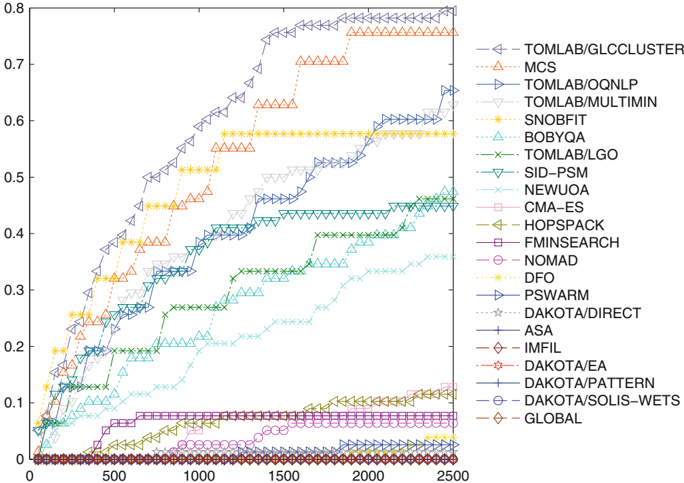
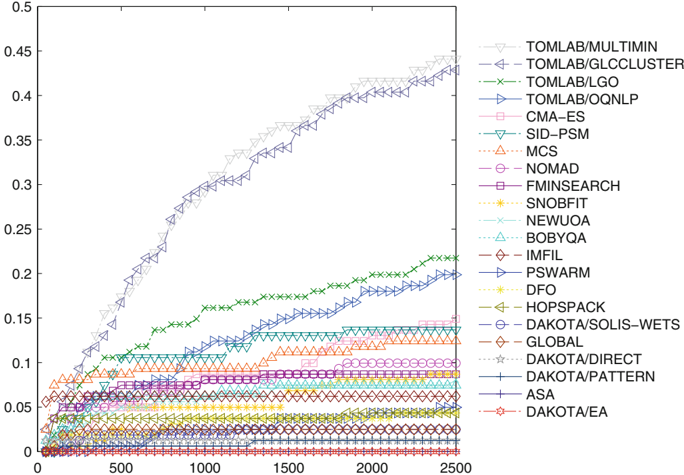
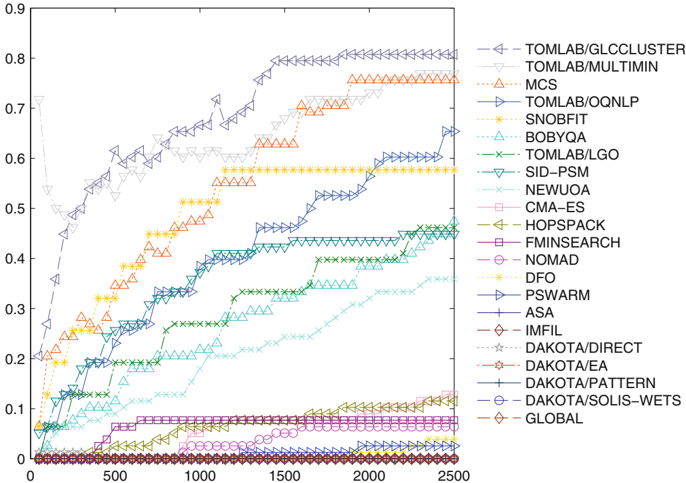
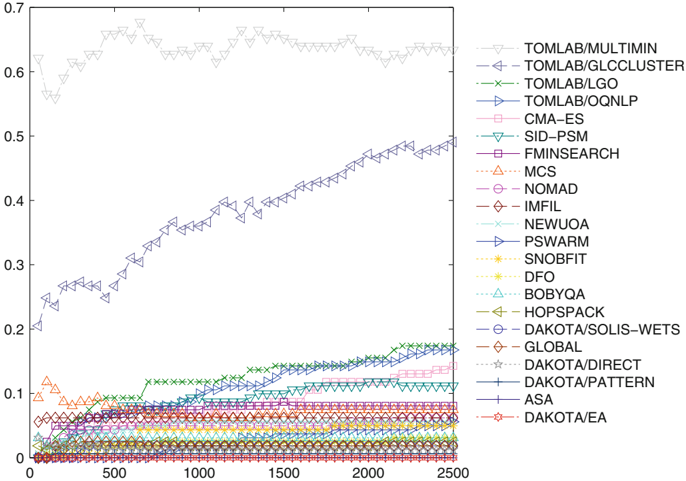
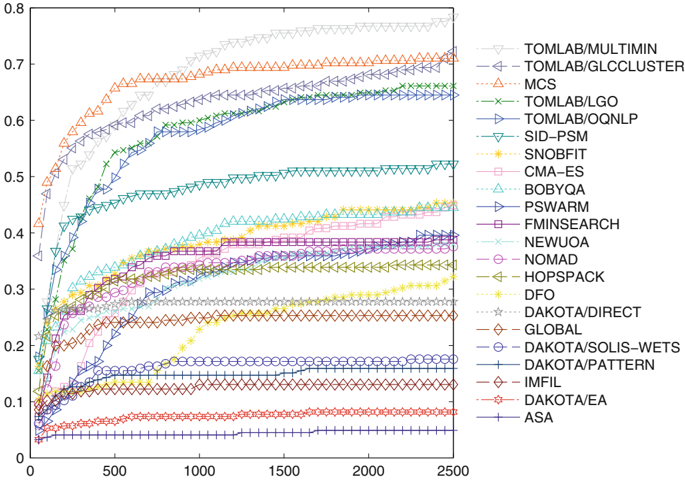
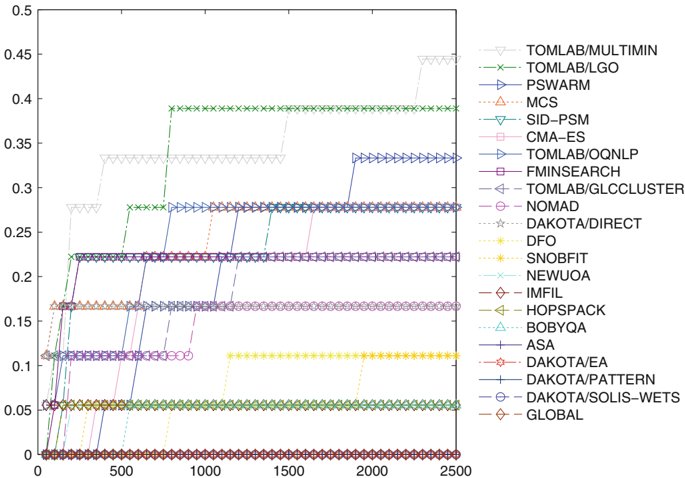
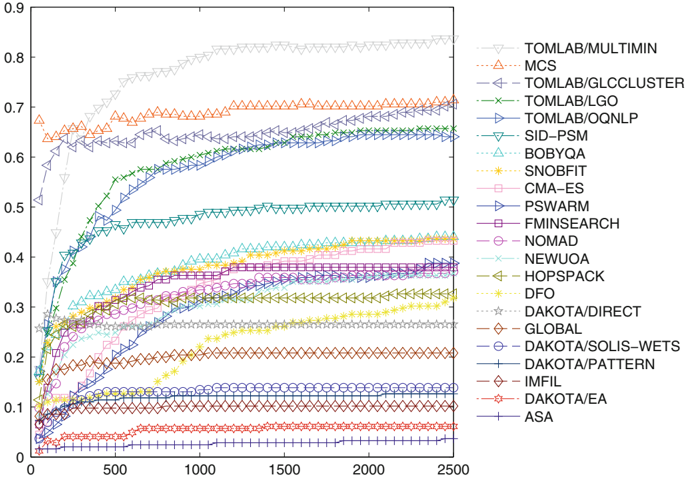
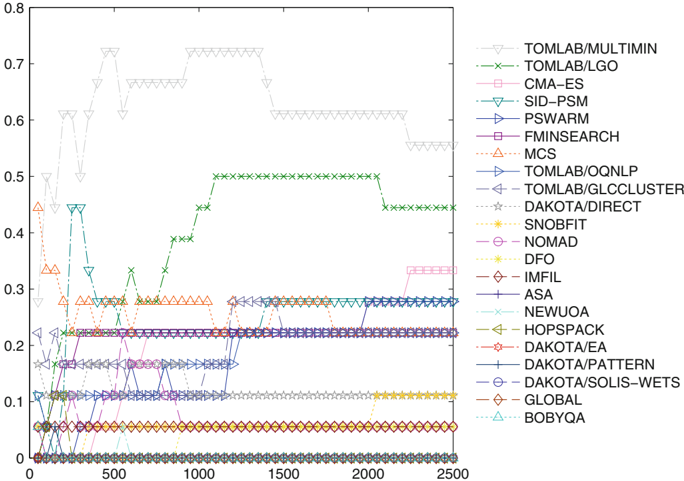
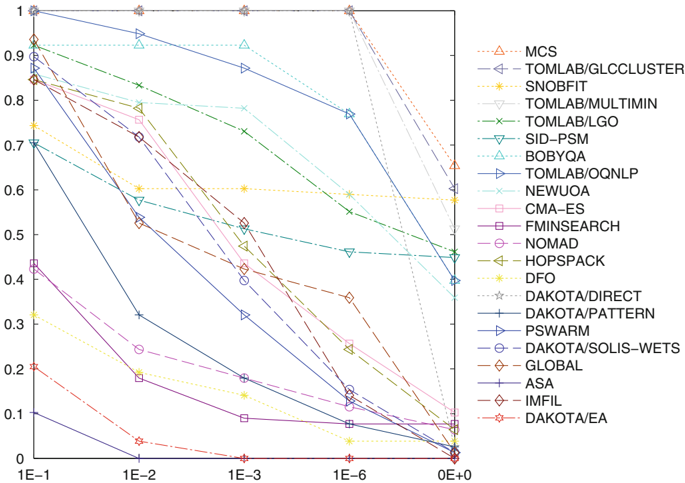
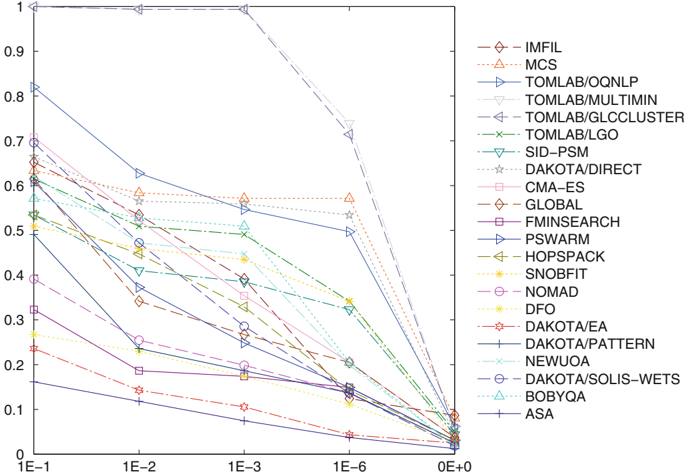
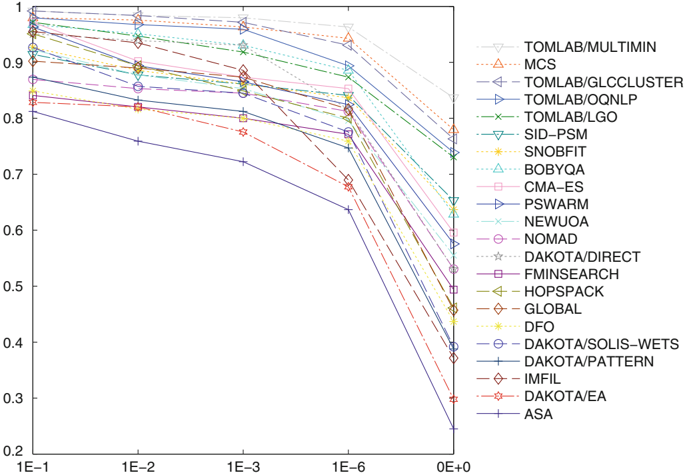
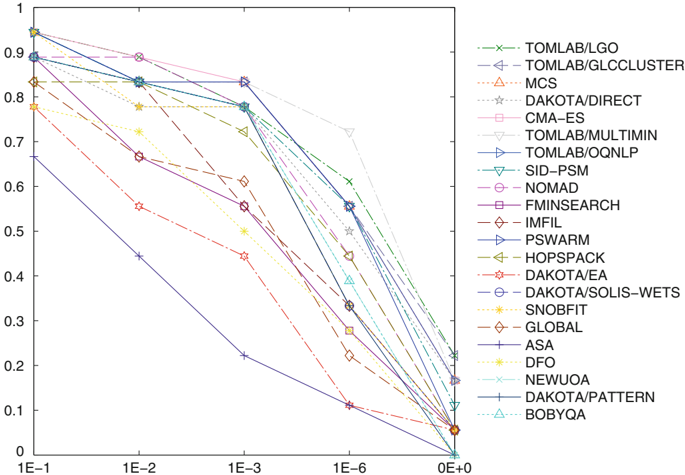
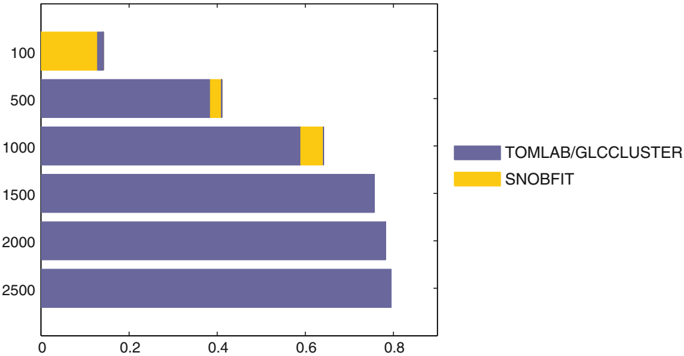
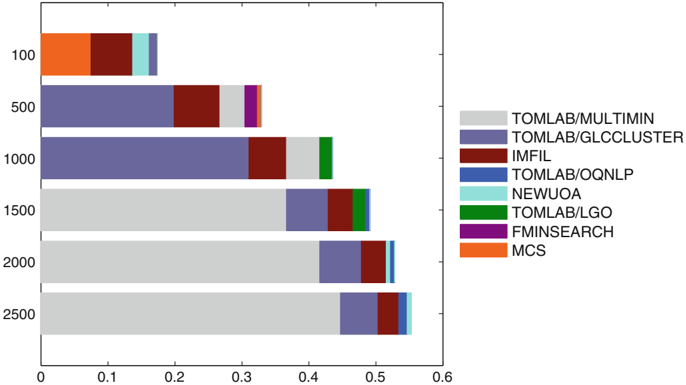
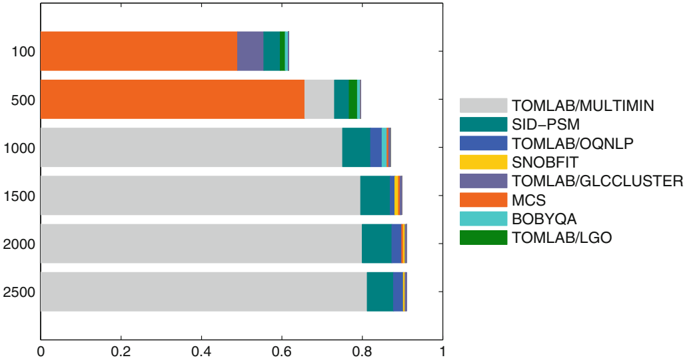
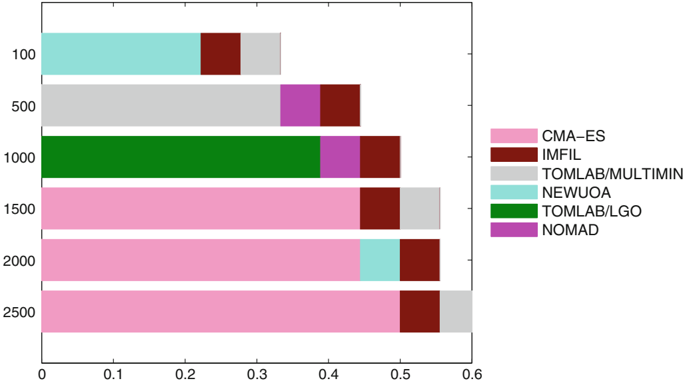
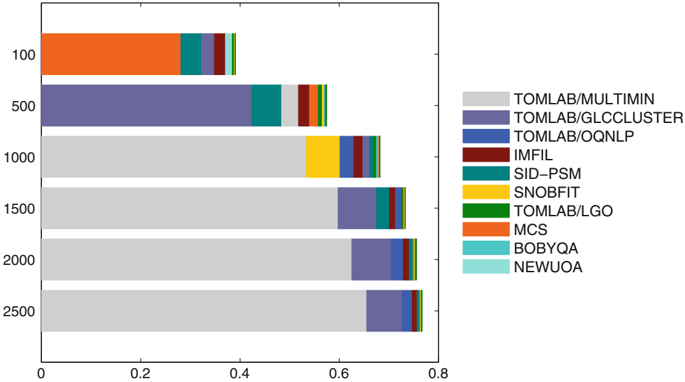
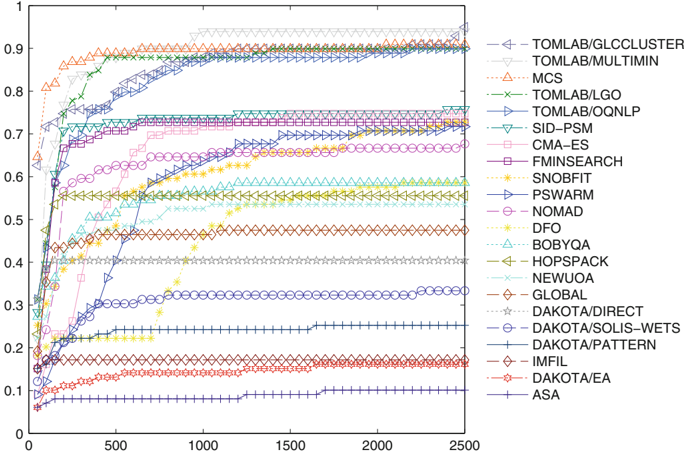
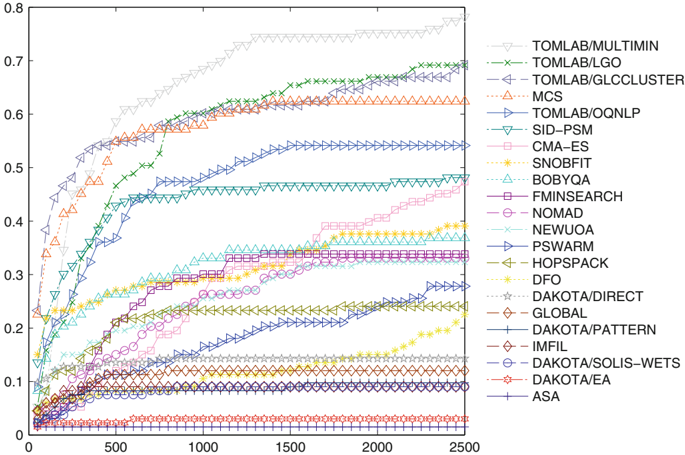
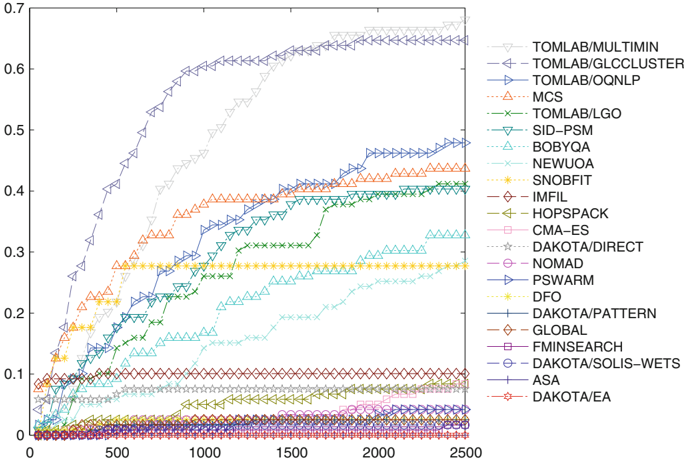
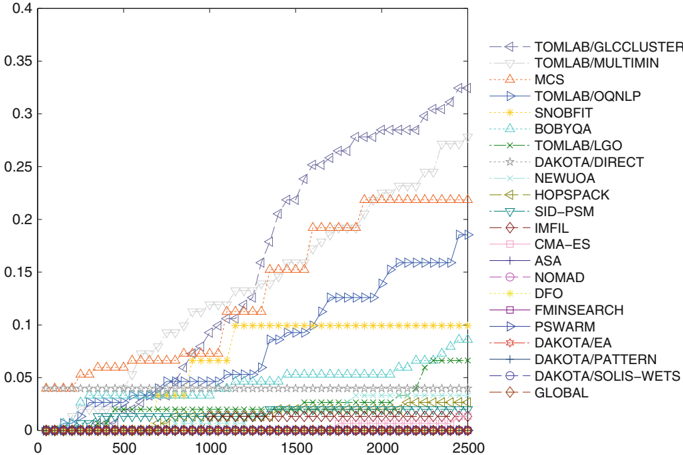
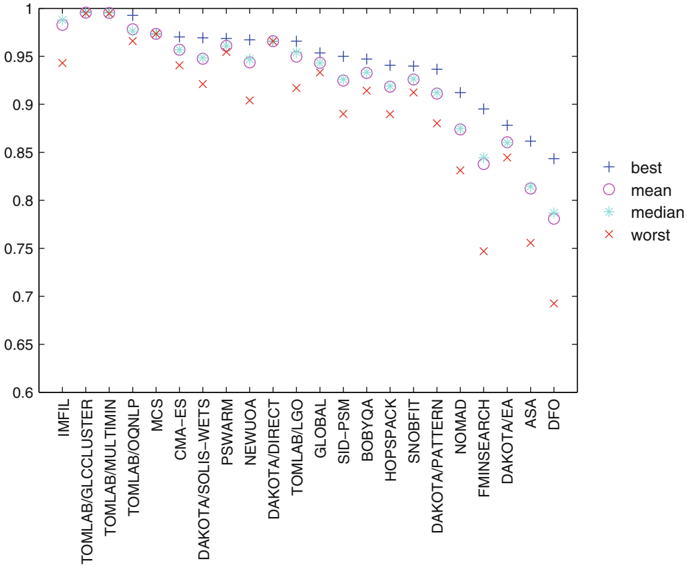
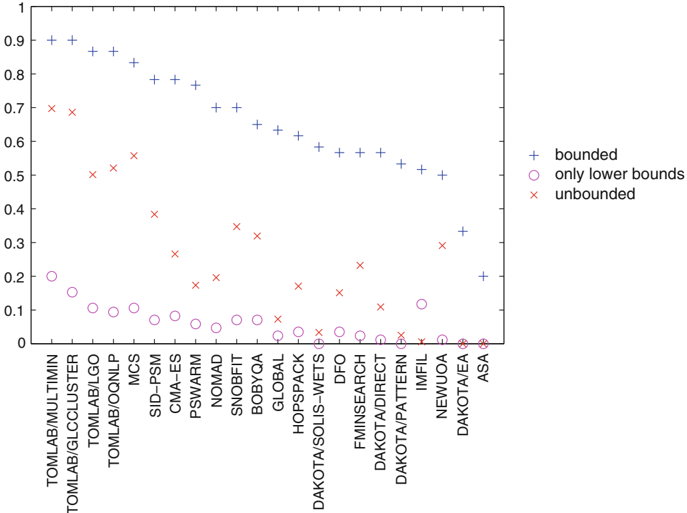
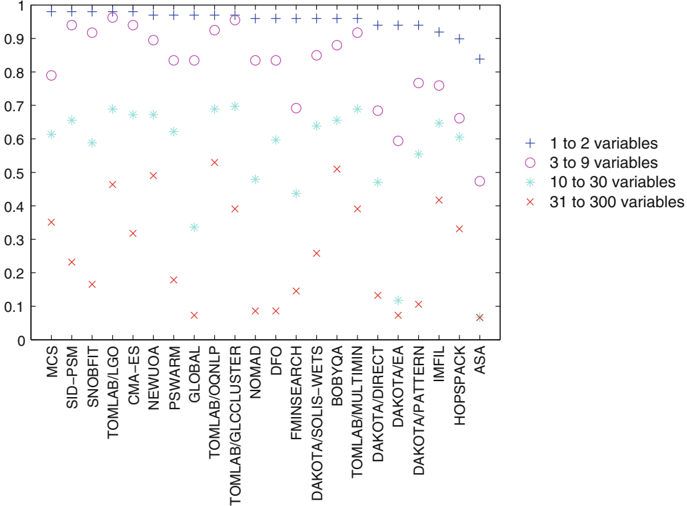
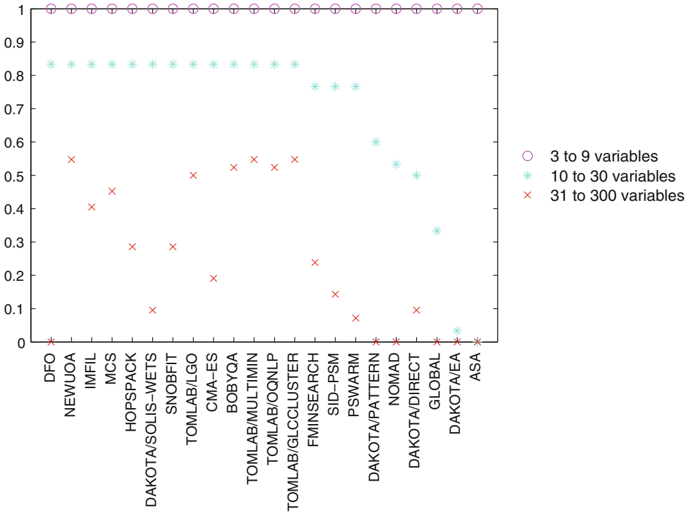
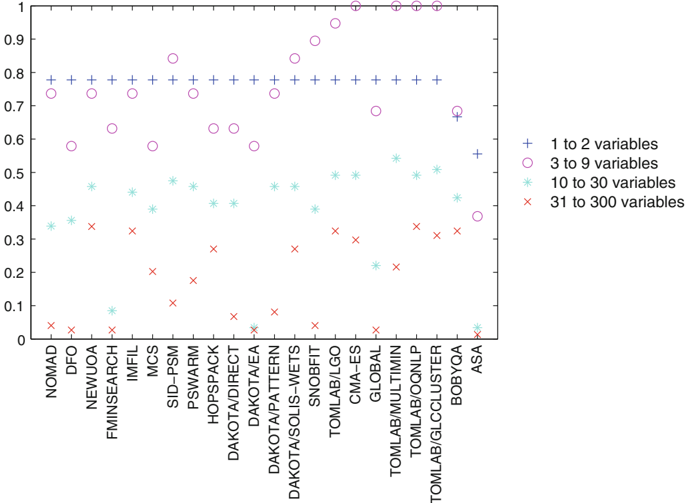
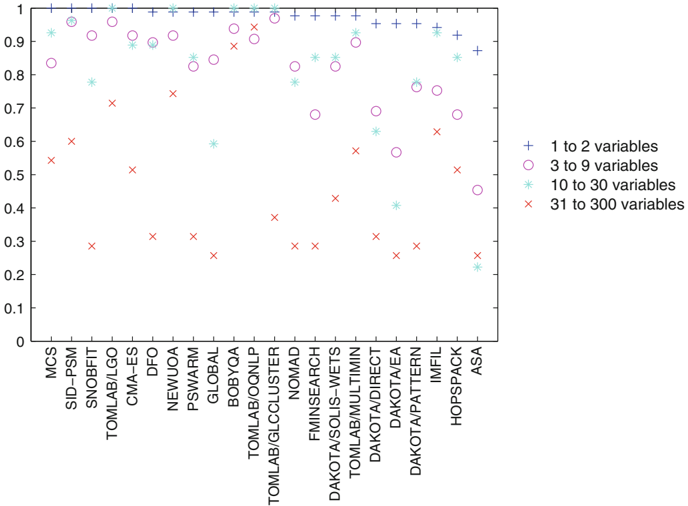
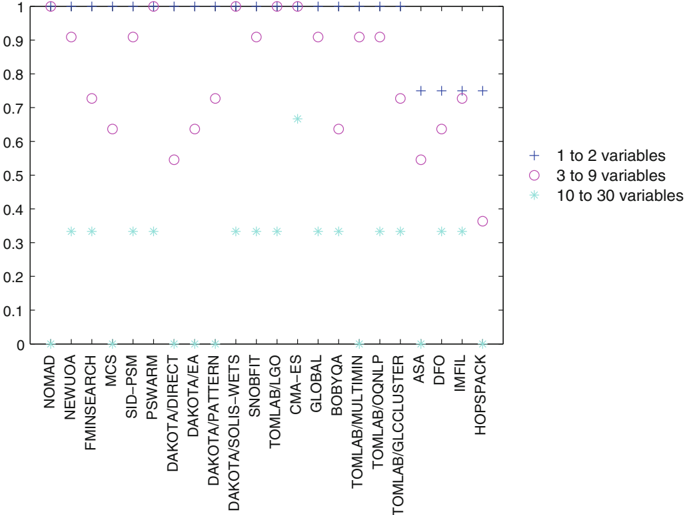
This paper addresses the solution of bound-constrained optimization problems using algorithms that require only the availability of objective function values but no derivative information. We refer to these algorithms as derivative-free algorithms. Fueled by a growing number of applications in science and engineering, the development of derivative-free optimization algorithms has long been studied, and it has found renewed interest in recent time. Along with many derivative-free algorithms, many software implementations have also appeared. The paper presents a review of derivative-free algorithms, followed by a systematic comparison of 22 related implementations using a test set of 502 problems. The test bed includes convex and nonconvex problems, smooth as well as nonsmooth problems. The algorithms were tested under the same conditions and ranked under several criteria, including their ability to find near-global solutions for nonconvex problems, improve a given starting point, and refine a near-optimal solution. A total of 112,448 problem instances were solved. We find that the ability of all these solvers to obtain good solutions diminishes with increasing problem size. For the problems used in this study, , , and are better, on average, than other derivative-free solvers in terms of solution quality within 2,500 function evaluations. These global solvers outperform local solvers even for convex problems. Finally, , , and show superior performance in terms of refining a near-optimal solution.
Overview
The claims and statistics of this paper haven’t been checked yet.
Free: it reads the open-access text and checks the first 5 claims that cite a source we can check. Create a free account to check every claim.
Integrity signals
Registry
Cites
Statistics
Figures
Verification
Claims the paper makes
The claims and statistics of this paper haven’t been checked yet.
Free: it reads the open-access text and checks the first 5 claims that cite a source we can check. Create a free account to check every claim.
Claims other papers make about this one
Each is checked against this paper’s own text: does it say what the citing paper says it does?
In the citing paper
“In the context of quantum chemistry, research has focused on the analog simulation of molecules by mapping the electronic structure problem to a Hamiltonian of spins with additional coupling terms 366 , although proposals exist for simulating chemical reactions 367-369 and protein folding simulations 370,371 .”
From Quantum Chemistry in the Age of Quantum Computing (2019) · cites this paper as [371]
Self-check
Percentages, sums and reported differences re-computed from the paper’s own numbers.
The self-check needs the paper’s full text.
Citations
Cites
Kennedy, J., & Eberhart, R. (2002) · Proceedings of ICNN'95 - International Conference on Neural Networks · doi:10.1109/icnn.1995.488968 · Cited by 58,192
Holland, J. H. (1992) · The MIT Press eBooks · doi:10.7551/mitpress/1090.001.0001 · Cited by 47,002 · cited 3×
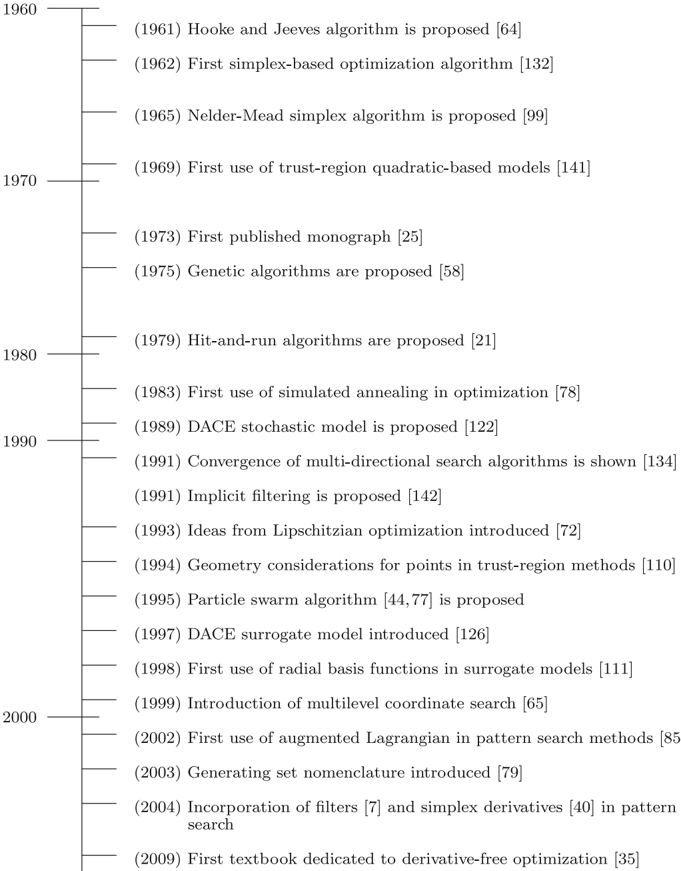
“Examples of methods Table 1 Citations of most cited works in derivative-free algorithms Nelder and Mead [99] 1965 13,486 Brent [25] 1973 2,019 Holland [58] 1975 31,494 Kirkpatrick et al. [78] 1983 23,053 Eberhart and Kennedy [44,77] 1995 20,369 using information from multiple previously evaluated points are genetic al…”
MethodOptimization by Simulated Annealing
Kirkpatrick, S., Gelatt, C. D., & Vecchi, M. P. (1983) · Science · doi:10.1126/science.220.4598.671 · Cited by 45,134 · cited 2×
“Initially proposed to handle combinatorial optimization problems [78], the algorithm was later extended to continuous problems [17].”
Equation of State Calculations by Fast Computing Machines
Metropolis, N., Rosenbluth, A. W., Rosenbluth, M. N., Teller, A. H., & Teller, E. (1953) · The Journal of Chemical Physics · doi:10.1063/1.1699114 · Cited by 37,192
A Simplex Method for Function Minimization
Nelder, J. A., & Mead, R. (1965) · The Computer Journal · doi:10.1093/comjnl/7.4.308 · Cited by 28,905 · cited 11×
“The development of derivative-free algorithms dates back to the works of Spendley et al. [132] and Nelder and Mead [99] with their simplex-based algorithms.”
BackgroundMethodInfluentialA new optimizer using particle swarm theory
Eberhart, R., & Kennedy, J. (2002) · MHS'95. Proceedings of the Sixth International Symposium on Micro Machine and Human Science · doi:10.1109/mhs.1995.494215 · Cited by 16,067 · cited 3×
“Examples of methods Table 1 Citations of most cited works in derivative-free algorithms Nelder and Mead [99] 1965 13,486 Brent [25] 1973 2,019 Holland [58] 1975 31,494 Kirkpatrick et al. [78] 1983 23,053 Eberhart and Kennedy [44,77] 1995 20,369 using information from multiple previously evaluated points are genetic al…”
MethodEfficient Global Optimization of Expensive Black-Box Functions
Jones, D. R., Schonlau, M., & Welch, W. J. (1998) · Journal of Global Optimization · doi:10.1023/a:1008306431147 · Cited by 8,070 · cited 3×
“Although the expected improvement function can be reduced to a closed-form expression [73], it can be highly multimodal.”
BackgroundMethodConvergence Properties of the Nelder--Mead Simplex Method in Low Dimensions
Lagarias, J. C., Reeds, J. A., Wright, M. H., & Wright, P. E. (1998) · SIAM Journal on Optimization · doi:10.1137/s1052623496303470 · Cited by 7,447 · cited 1×
“[81].”
Design and Analysis of Computer Experiments
Sacks, J., Welch, W. J., Mitchell, T. J., & Wynn, H. P. (1989) · Statistical Science · doi:10.1214/ss/1177012413 · Cited by 6,919
(2019) · Handbook of Machine Learning · doi:10.1142/9789811205675_0004 · Cited by 6,270
Research works printed but not linked: 9
- Awasthi, S.: Molecular Docking by Derivative-Free Optimization Solver. Master's thesis, Department of Chemical Engineering, Carnegie Mellon University, Pittsburgh (2008)
- Booker, A.J., Dennis, J.E. Jr., Frank, P.D., Serafini, D.B., Torczon, V.J., Trosset, M.W.: A rigorous framework for optimization of expensive functions by surrogates. Struct. Optim. 17, 1-13 (1999) · DOI · Paper page
- Chang, K.-F.: Modeling and Optimization of Polymerase Chain Reaction Using Derivative-Free Opti- mization. Master's thesis, Department of Chemical Engineering, Carnegie Mellon University, Pittsburgh (2011)
- Desai, R.: A Comparison of Algorithms for Optimizing the Omega Function. Master's thesis, Department of Chemical Engineering, Carnegie Mellon University, Pittsburgh (2010)
- Holland, J.H.: Adaptation in Natural and Artificial Systems. The University of Michigan Press, Ann Arbor (1975)
- Powell, M.J.D.: A direct search optimization method that models the objective by quadratic interpolation. In: Presentation at the 5th Stockholm Optimization Days (1994) 111. · DOI · Paper page
- Wang, H.: Application of Derivative-Free Algorithms in Powder Diffraction. Master's thesis, Department of Chemical Engineering, Carnegie Mellon University, Pittsburgh (2011) 140.
- Winfield, D.: Function and Functional Optimization by Interpolation in Data Tables. PhD thesis, Harvard University, Cambridge (1969) 142.
- Zheng, Y.: Pairs Trading and Portfolio Optimization. Master's thesis, Department of Chemical Engi- neering, Carnegie Mellon University, Pittsburgh (2011)
Cited by
Items 101–200 of 1,002
Wortmann, T. (2018) · Journal of Computational Design and Engineering · doi:10.1016/j.jcde.2018.09.001 · Cited by 78
A finite element model updating method based on global optimization
Girardi, M., Padovani, C., Pellegrini, D., & Robol, L. (2020) · Mechanical Systems and Signal Processing · doi:10.1016/j.ymssp.2020.107372 · Cited by 79
A Risk-Averse Stochastic Dynamic Programming Approach to Energy Hub Optimal Dispatch
Moazeni, S., Miragha, A., & Defourny, B. (2018) · IEEE Transactions on Power Systems · doi:10.1109/tpwrs.2018.2882549 · Cited by 76
“lies on a derivative-free optimization approach [44] where the function evaluations are performed by Monte Carlo simulation.”
MethodFeng, C., Liu, Y., & Zhang, J. (2021) · International Journal of Electrical Power & Energy Systems · doi:10.1016/j.ijepes.2021.107176 · Cited by 80
“, problem formulation, solver, and solution) [249], this section reviews AI-based PV system design optimizations from the perspectives of objective, design variable, constraint, and optimizer.”
BackgroundIdentifying material parameters in crystal plasticity by Bayesian optimization
Kuhn, J., Spitz, J., Sonnweber–Ribic, P., Schneider, M., & Böhlke, T. (2021) · Optimization and Engineering · doi:10.1007/s11081-021-09663-7 · Cited by 75
Deterministic approaches for solving practical black-box global optimization problems
Kvasov, D. E., & Sergeyev, Y. D. (2014) · Advances in Engineering Software · doi:10.1016/j.advengsoft.2014.09.014 · Cited by 75
“A simple alternative could be the usage of the so-called direct (or derivative-free) search methods (see, e.g., [34, 6, 35, 50, 9, 61]), frequently used now for solving engineering design problems (see, e.g., the DIRECT method [17, 34, 30], the response surface, or surrogate model meth-ods [31,…”
MethodGlobal optimization via inverse distance weighting and radial basis functions
Bemporad, A. (2020) · Computational Optimization and Applications · doi:10.1007/s10589-020-00215-w · Cited by 75
“, the excellent survey on derivative-free optimization [32].”
BackgroundMethodAhmadi, A., & Tiruta-Barna, L. (2015) · Journal of Cleaner Production · doi:10.1016/j.jclepro.2015.03.045 · Cited by 87
A deterministic global optimization using smooth diagonal auxiliary functions
Sergeyev, Y. D., & Kvasov, D. E. (2014) · Communications in Nonlinear Science and Numerical Simulation · doi:10.1016/j.cnsns.2014.08.026 · Cited by 74
“…in this framework is represented by the so-called derivative-free (or direct) approach (see, e. g., [4, 5, 22, 30, 37]), often used for solving important applied problems (see, e. g., pattern search methods [22], the DIRECT method [20], the response surface, or surrogate model methods [21], etc.).”
Park, J., & Law, K. H. (2016) · IEEE Transactions on Control Systems Technology · doi:10.1109/tcst.2015.2508007 · Cited by 79
“The concepts and the performances of various derivative-free optimization methods are compared in [26].”
MethodConstrained multi-objective optimization of thermocline packed-bed thermal-energy storage
Marti, J., Geissbühler, L., Becattini, V., Haselbacher, A., & Steinfeld, A. (2018) · Applied Energy · doi:10.1016/j.apenergy.2017.12.072 · Cited by 75
“An extensive review and comparison of gradient-free methods is given in [12].”
BackgroundThe Internet of Federated Things (IoFT)
Kontar, R., Shi, N., Yue, X., Chung, S., Byon, E., Chowdhury, M., Jin, J., Kontar, W., Masoud, N., Nouiehed, M., et al. (2021) · IEEE Access · doi:10.1109/access.2021.3127448 · Cited by 66
“Zeroth-order algorithms is another class of optimization methods that can be useful in problems with only access to noisy evaluations of the objective function [54, 251].”
BackgroundPasquale, C. C., Sacone, S., Siri, S., & Schutter, B. D. (2017) · Transportation Research Part C Emerging Technologies · doi:10.1016/j.trc.2017.04.007 · Cited by 71
PGS-COM: A hybrid method for constrained non-smooth black-box optimization problems
Martelli, E., & Amaldi, E. (2014) · Computers & Chemical Engineering · doi:10.1016/j.compchemeng.2013.12.014 · Cited by 71
“Unlike in Rios and Sahinidis (2013) where non-smooth black-box problems, and which are coded in Matlab ® .”
Managing uncertainty in data-driven simulation-based optimization
Hüllen, G., Zhai, J., Kim, S. H., Sinha, A., Realff, M. J., & Boukouvala, F. (2019) · Computers & Chemical Engineering · doi:10.1016/j.compchemeng.2019.106519 · Cited by 74
Data-driven optimization for process systems engineering applications
van de Berg, D., Savage, T., Petsagkourakis, P., Zhang, D., Shah, N., & del Rio‐Chanona, E. A. (2021) · Chemical Engineering Science · doi:10.1016/j.ces.2021.117135 · Cited by 75
Xu, S., Feng, Q., Wang, S., Javadpour, F., & Yuyao, L. (2018) · Computers & Chemical Engineering · doi:10.1016/j.compchemeng.2018.06.015 · Cited by 69
ZO-AdaMM: Zeroth-Order Adaptive Momentum Method for Black-Box OptimizationPreprint
Chen, X., Liu, S., Xu, K., Li, X., Lin, X., Hong, M., & Cox, D. (2019) · arXiv (Cornell University) · doi:10.48550/arxiv.1910.06513 · Cited by 120
“More comprehensive discussions on DFO methods can be found in [36, 37].”
BackgroundA COSMO-based approach to computer-aided mixture design
Austin, N. D., Sahinidis, N. V., & Trahan, D. W. (2016) · Chemical Engineering Science · doi:10.1016/j.ces.2016.05.025 · Cited by 68
Self-citationProcess design and economic optimization of boil-off-gas re-liquefaction systems for LNG carriers
Kim, D., Hwang, C., Gundersen, T., & Lim, Y. (2019) · Energy · doi:10.1016/j.energy.2019.02.098 · Cited by 68
“PSO is a derivative-free stochastic algorithm based on candidate solutions (particles), thus it is suitable for black box functions where derivative information is either not available or noisy and costly if finite differences are considered [43, 44].”
MethodHigh Spectral Resolution Plasmonic Color Filters with Subwavelength Dimensions
Fleischman, D., Fountaine, K. T., Bukowsky, C. R., Tagliabue, G., Sweatlock, L. A., & Atwater, H. A. (2019) · ACS Photonics · doi:10.1021/acsphotonics.8b01634 · Cited by 69
Muñoz, M. A., & Smith‐Miles, K. (2016) · Evolutionary Computation · doi:10.1162/evco_a_00194 · Cited by 67
“Unlike related work on algorithm Evolutionary Computation Volume 25, Number 4 531 assessment and comparison (Hansen et al., 2011; El-Abd, 2012; Rios and Sahinidis, 2013; Liao et al., 2015), the method quantifies both the nature of the test instances and the algorithm performance.”
MethodFinite element model updating using deterministic optimisation: A global pattern search approach
Hofmeister, B., Bruns, M., & Rolfes, R. (2019) · Engineering Structures · doi:10.1016/j.engstruct.2019.05.047 · Cited by 68
Anytime Performance Assessment in Blackbox Optimization Benchmarking
Hansen, N., Auger, A., Brockhoff, D., & Tušar, T. (2022) · IEEE Transactions on Evolutionary Computation · doi:10.1109/tevc.2022.3210897 · Cited by 88
“Data profiles are commonly used for aggregating results from different functions and different dimensions to reach a single target precision [28].”
BackgroundYin, F., Ahmadianfar, I., Samadi-Koucheksaraee, A., Azarsa, R., Scholz, M., & Yaseen, Z. M. (2021) · Energy Reports · doi:10.1016/j.egyr.2021.11.010 · Cited by 65
Braik, M. S., Al-Zoubi, H. R., Ryalat, M. H., Sheta, A. F., & Alzubi, O. A. (2022) · Artificial Intelligence Review · doi:10.1007/s10462-022-10164-x · Cited by 69
Lu, B., Du, X., & Huang, S. (2016) · Journal of Cleaner Production · doi:10.1016/j.jclepro.2016.10.113 · Cited by 71
Mehmood, A., Zameer, A., & Raja, M. A. Z. (2018) · Applied Soft Computing · doi:10.1016/j.asoc.2018.02.024 · Cited by 64
Diagonal Acceleration for Covariance Matrix Adaptation Evolution Strategies
Akimoto, Y., & Hansen, N. (2019) · Evolutionary Computation · doi:10.1162/evco_a_00260 · Cited by 64
“(2003), Hansen and Kern (2004), and Jastrebski and Arnold (2006), is recognized as a state-of-the-art derivative-free search algorithm for difficult continuous optimization problems (Rios and Sahinidis, 2013).”
BackgroundPietrenko‐Dabrowska, A., & Koziel, S. M. (2019) · IET Microwaves Antennas & Propagation · doi:10.1049/iet-map.2019.0358 · Cited by 64
An active-set trust-region method for derivative-free nonlinear bound-constrained optimization
Gratton, S., Toint, P. L., & Tröltzsch, A. (2011) · Optimization methods & software · doi:10.1080/10556788.2010.549231 · Cited by 63
“SID-PSM has shown to be [11,26] one of the most competitive algorithms in the class of pattern search methods.”
MethodBandaru, S., & Deb, K. (2016) · CRC Press eBooks · doi:10.1201/9781315183176-12 · Cited by 75
A multilevel coordinate search algorithm for well placement, control and joint optimization
Xiang, W., Haynes, R. D., & Feng, Q. (2016) · Computers & Chemical Engineering · doi:10.1016/j.compchemeng.2016.09.006 · Cited by 61
“Though MCS has shown its superiority in benchmark and real world problems (Huyer and Neumaier, 1999; Rios and Sahinidis, 2013; Lambot et al., 2002), to the best of our knowledge, it has not been applied to the optimization of oil field development.”
MethodA Consistent Scheme for Gradient-Based Optimization of Protein – Ligand Poses
Flachsenberg, F., Meyder, A., Sommer, K., Penner, P., & Rarey, M. (2020) · Journal of Chemical Information and Modeling · doi:10.1021/acs.jcim.0c01095 · Cited by 62
An Approach for Solvent Selection in Extractive Distillation Systems Including Safety Considerations
Medina-Herrera, N., Grossmann, I. E., Mannan, M. S., & Jiménez‐Gutiérrez, A. (2014) · Industrial & Engineering Chemistry Research · doi:10.1021/ie501205j · Cited by 59
Quantifying Adversary Capabilities to Inform Defensive Resource Allocation
Wang, C., & Bier, V. M. (2015) · Risk Analysis · doi:10.1111/risa.12399 · Cited by 58
“However, when the number of targets is large, we will need more efficient global optimization techniques,(47) or stochastic programming techniques that use binary variables to represent the attacker’s target choices.”
MethodGaussian Process Surrogate Models for the CMA Evolution Strategy
Bajer, L., Pitra, Z., Repický, J., & Holeňa, M. (2018) · Evolutionary Computation · doi:10.1162/evco_a_00244 · Cited by 65
“While spending extra CPU time for model construction, surrogate models have been shown to save some of the original-fitness evaluations; see Jin (2011) or Rios and Sahinidis (2012).”
MethodEvolutionary Black-Box Topology Optimization: Challenges and Promises
Guirguis, D., Aulig, N., Picelli, R., Zhu, B., Zhou, Y., Vicente, W. M., Iorio, F., Olhofer, M., Matusik, W., Coello, C. A. C., et al. (2019) · IEEE Transactions on Evolutionary Computation · doi:10.1109/tevc.2019.2954411 · Cited by 64
“A review on comparing different derivative-free algorithms, including increasing problems sizes can be found in [253].”
BackgroundA machine learning approach to determine the elastic properties of printed fiber-reinforced polymers
Thomas, A. J., Barocio, E., & Pipes, R. B. (2022) · Composites Science and Technology · doi:10.1016/j.compscitech.2022.109293 · Cited by 56
Enhanced compact artificial bee colony
Banitalebi, A., Aziz, M. I. A., Bahar, A., & Aziz, Z. A. (2014) · Information Sciences · doi:10.1016/j.ins.2014.12.015 · Cited by 58
Boukouvala, F., & Ierapetritou, M. (2014) · AIChE Journal · doi:10.1002/aic.14442 · Cited by 56
Cost Optimization of Mooring Solutions for Large Floating Wave Energy Converters
Thomsen, J. B., Ferri, F., Kofoed, J. P., & Black, K. (2018) · Energies · doi:10.3390/en11010159 · Cited by 56
“Many different types of surrogate models are available and presented in [46,51] and are generally either interpolating (radial basis functions (RBF) and kriging) or non-interpolating (polynomial regression models and multivariate adaptive regression splines (MARS)) [51].”
BackgroundMethod(Global) Optimization: Historical notes and recent developments
Locatelli, M., & Schoen, F. (2021) · EURO Journal on Computational Optimization · doi:10.1016/j.ejco.2021.100012 · Cited by 64
Calibration and uniqueness analysis of microparameters for DEM cohesive granular material
Ji, S., & Karlovšek, J. (2021) · International Journal of Mining Science and Technology · doi:10.1016/j.ijmst.2021.11.003 · Cited by 60
Wortmann, T., Cichocka, J. M., & Waibel, C. (2022) · Energy and Buildings · doi:10.1016/j.enbuild.2022.111863 · Cited by 60
On the numerical performance of finite-difference-based methods for derivative-free optimization
Shi, H.-J. M., Xuan, M. Q., Öztoprak, F., & Nocedal, J. M. (2022) · Optimization methods & software · doi:10.1080/10556788.2022.2121832 · Cited by 55
“Rios and Sahinidis [42] confirmed the findings of Moré and Wild concerning the inefficiency of traditional methods based on Nelder–Mead or pattern searches.”
MethodAuction optimization using regression trees and linear models as integer programs
Verwer, S., Zhang, Y., & Ye, Q. C. (2015) · Artificial Intelligence · doi:10.1016/j.artint.2015.05.004 · Cited by 55
“eturning a decision rule given a state with scenario tree techniques from multi-stage stochastic programming. This line of work shares similarities with the field of black-box optimization, see, e.g., [14, 15, 31]. In black-box optimization, methods are used to approximate a function with unknown analytical form and wh…”
A New Run-to-Run Approach for Reducing Contact Bounce in Electromagnetic Switches
Ramirez-Laboreo, E., Sagüés, C., & Llorente, S. (2016) · IEEE Transactions on Industrial Electronics · doi:10.1109/tie.2016.2605622 · Cited by 56
“present pattern-search methods [25], [26] to obtain a better per-”
MethodA modified DIRECT algorithm for hidden constraints in an LNG process optimization
Na, J., Lim, Y., & Han, C. (2017) · Energy · doi:10.1016/j.energy.2017.03.047 · Cited by 59
Computer-Aided Molecular Design: Fundamentals, Methods, and Applications
Παπαδόπουλος, Α. Ι., Tsivintzelis, I., Linke, P., & Seferlis, P. (2018) · Elsevier eBooks · doi:10.1016/b978-0-12-409547-2.14342-2 · Cited by 55
Global optimization based on active preference learning with radial basis functions
Bemporad, A., & Piga, D. (2020) · Machine Learning · doi:10.1007/s10994-020-05935-y · Cited by 55
On the choice of the low-dimensional domain for global optimization via random embeddings
Binois, M., Ginsbourger, D., & Roustant, O. (2019) · Journal of Global Optimization · doi:10.1007/s10898-019-00839-1 · Cited by 75
Convolutional long short term memory deep neural networks for image sequence prediction
Balderas, D., Ponce, P., & Molina, A. (2018) · Expert Systems with Applications · doi:10.1016/j.eswa.2018.12.055 · Cited by 56
Chakraborty, D., Wang, T., Andre, K., Konnert, M., Lexer, M. J., Matulla, C., Weißenbacher, L., & Schueler, S. (2016) · European Journal of Forest Research · doi:10.1007/s10342-016-0984-5 · Cited by 53
“Such an optimization problem can be solved by derivativefree optimization procedures mostly implemented through specialized software packages (Audet and Orban 2006; Karasözen 2007; Rios and Sahinidis 2013).”
MethodResultCOSMO‐based computer‐aided molecular/mixture design: A focus on reaction solvents
Austin, N. D., Sahinidis, N. V., Konstantinov, I. A., & Trahan, D. W. (2017) · AIChE Journal · doi:10.1002/aic.15871 · Cited by 53
Self-citationIntroduction to Architectural Design Optimization
Wortmann, T., & Nannicini, G. (2017) · Springer optimization and its applications · doi:10.1007/978-3-319-65338-9_14 · Cited by 65
Bajaj, I., Iyer, S. S., & Hasan, M. M. F. (2017) · Computers & Chemical Engineering · doi:10.1016/j.compchemeng.2017.12.011 · Cited by 62
Wang, L., Yang, Z., Sharma, S., Mian, A., Lin, T., Tsatsaronis, G., Marechal, F. M. A., & Yang, Y. (2018) · Energies · doi:10.3390/en12010073 · Cited by 60
“, a comprehensive description of the most effective methods in continuous optimization [121], an extensive review on mathematical optimization for process engineering [122,123], recent advances in global optimization [124], derivative-free algorithms for bound-constrained optimization problems [125,126], and a broad c…”
MethodTREGO: a trust-region framework for efficient global optimization
Diouane, Y., Picheny, V., Riche, R. L., & Perrotolo, A. S. D. (2022) · Journal of Global Optimization · doi:10.1007/s10898-022-01245-w · Cited by 52
“MCS is among the best DFO solvers on bound constrained optimization problems [49].”
BackgroundYe, W., & You, F. (2016) · Computers & Chemical Engineering · doi:10.1016/j.compchemeng.2016.01.015 · Cited by 58
“A thorough comparison of the recently eveloped DFO solvers is available (Rios and Sahinidis, 2013).”
BackgroundModel-based Optimization for Architectural Design: Optimizing Daylight and Glare in Grasshopper
Wortmann, T. (2017) · Technology|Architecture + Design · doi:10.1080/24751448.2017.1354615 · Cited by 52
Parameter Inference for Computational Cognitive Models with Approximate Bayesian Computation
Kangasrääsiö, A., Jokinen, J., Oulasvirta, A., Howes, A., & Kaski, S. (2019) · Cognitive Science · doi:10.1111/cogs.12738 · Cited by 67
The variants of the Bees Algorithm (BA): a survey
Hussein, W. A., Sahran, S., & Abdullah, S. N. H. S. (2016) · Artificial Intelligence Review · doi:10.1007/s10462-016-9476-8 · Cited by 55
“However, the derivative of an objective function might be unreliable, unavailable, or time consuming to calculate (Chen and Wang 2013; Rios and Sahinidis 2013).”
BackgroundWarm Starting CMA-ES for Hyperparameter Optimization
Nomura, M., Watanabe, S., Akimoto, Y., Ozaki, Y., & Onishi, M. (2021) · Proceedings of the AAAI Conference on Artificial Intelligence · doi:10.1609/aaai.v35i10.17109 · Cited by 73
A new design methodology for four-bar linkage mechanisms based on derivations of coupler curve
Kim, J., Seo, T., & Kim, J. (2016) · Mechanism and Machine Theory · doi:10.1016/j.mechmachtheory.2016.02.006 · Cited by 50
Online Optimization With Costly and Noisy Measurements Using Random Fourier Expansions
Bliek, L., Verstraete, H. R. G. W., Verhaegen, M., & Wahls, S. (2016) · IEEE Transactions on Neural Networks and Learning Systems · doi:10.1109/tnnls.2016.2615134 · Cited by 50
“Typically, in DFO algorithm s a model is used that can be optimized without making use of the derivative of the underlying function [1], [2].”
MethodXue, F., Lu, W., Chen, K., & Zetkulic, A. (2019) · Journal of Computing in Civil Engineering · doi:10.1061/(asce)cp.1943-5487.0000839 · Cited by 50
“However, in the problem of generating as-built BIMs from 3D point clouds the derivatives of objective functions are impractical to obtain (Rios and Sahinidis, 2013).”
A method for reducing multi-modality in the wind farm layout optimization problem
Thomas, J., & Ning, A. (2018) · Journal of Physics Conference Series · doi:10.1088/1742-6596/1037/4/042012 · Cited by 51
Performance evaluation of automatically tuned continuous optimizers on different benchmark sets
Liao, T., Molina, D., & Stützle, T. (2014) · Applied Soft Computing · doi:10.1016/j.asoc.2014.11.006 · Cited by 49
Grayver, A. V., & KUVSHINOV, A. V. (2016) · Geophysical Journal International · doi:10.1093/gji/ggw063 · Cited by 52
“CMAES was shown to work well on a wide class of functions (Hansen et al. 2010; Rios & Sahinidis 2013).”
MethodHY-POP: Hyperparameter optimization of machine learning models through parametric programming
Tso, W. W., Burnak, B., & Pistikopoulos, E. N. (2020) · Computers & Chemical Engineering · doi:10.1016/j.compchemeng.2020.106902 · Cited by 58
Thermodynamic and technoeconomic optimization of Organic Rankine Cycle systems
Astolfi, M., Martelli, E., & Pierobon, L. (2016) · Elsevier eBooks · doi:10.1016/b978-0-08-100510-1.00007-7 · Cited by 48
Gu, Z., & Saberi, M. (2020) · Transportation Research Part C Emerging Technologies · doi:10.1016/j.trc.2020.102894 · Cited by 48
Smoothing and worst-case complexity for direct-search methods in nonsmooth optimization
Garmanjani, R., & Vicente, L. N. (2012) · IMA Journal of Numerical Analysis · doi:10.1093/imanum/drs027 · Cited by 47
“code performed relatively well in a number of benchmarkings [14, 32], especially among directsearch solvers, in particular due to a search step where a quadratic model is fitted using previous function evaluations and minimized in a trust region, and due to a poll step where polling points are ordered for evaluation u…”
MethodSimultaneous process optimization and heat integration based on rigorous process simulations
Chen, Y., Eslick, J. C., Grossmann, I. E., & Miller, D. C. (2015) · Computers & Chemical Engineering · doi:10.1016/j.compchemeng.2015.04.033 · Cited by 47
Dictionary Indexing of Electron Channeling Patterns
Singh, S., & Graef, M. D. (2017) · Microscopy and Microanalysis · doi:10.1017/s1431927616012769 · Cited by 47
Si, B., Tian, Z., Chen, W., Jin, X., Zhou, X., & Shi, X. (2018) · Sustainability · doi:10.3390/su11010018 · Cited by 51
“In relation to the optimization algorithms used in BEO, three types of studies can be found:”
Derivative-free reinforcement learning: a review
Qian, H., & Yu, Y. (2021) · Frontiers of Computer Science · doi:10.1007/s11704-020-0241-4 · Cited by 62
Process Systems Engineering Perspective on the Design of Materials and Molecules
Adjiman, C. S., Sahinidis, N. V., Vlachos, D. G., Bakshi, B. R., Maravelias, C. T., & Georgakis, C. (2021) · Industrial & Engineering Chemistry Research · doi:10.1021/acs.iecr.0c05399 · Cited by 48
Self-citationZeroth-order algorithms for nonconvex–strongly-concave minimax problems with improved complexities
Wang, Z., Balasubramanian, K., Ma, S., & Razaviyayn, M. (2022) · Journal of Global Optimization · doi:10.1007/s10898-022-01160-0 · Cited by 65
“These algorithms have been studied for decades in the optimization literature; see, for example, Conn et al. [14], Rios and Sahinidis [48] and Audet and Hare [4] for a detailed overview of the existing approaches.”
MethodPaulson, J. A., & Lu, C. (2022) · Computers & Chemical Engineering · doi:10.1016/j.compchemeng.2022.107700 · Cited by 55
“When gradient information is not readily available, as is the case for black-box models, one of the main alternatives is to rely on so-called derivative-free optimization (DFO) methods [6, 7, 8], which can be very broadly divided into stochastic and deterministic approaches.”
MethodShafiee, A., Nomvar, M., Liu, Z., & Abbas, A. (2017) · Journal of Cleaner Production · doi:10.1016/j.jclepro.2017.02.151 · Cited by 46
Ma, Y., Luo, Y., Zhang, S., & Yuan, X. (2017) · Computers & Chemical Engineering · doi:10.1016/j.compchemeng.2017.10.004 · Cited by 46
PDFO: a cross-platform package for Powell’s derivative-free optimization solvers
Ragonneau, T. M., & Zhang, Z. (2024) · Mathematical Programming Computation · doi:10.1007/s12532-024-00257-9 · Cited by 45
“For more extensive discussions on DFO methods and theory, see the mono-graphs [3, 18], the survey papers [20, 36, 66], the recent thesis [62], and the references therein.”
Simulation and optimization: A short review
Bierlaire, M. (2015) · Transportation Research Part C Emerging Technologies · doi:10.1016/j.trc.2015.01.004 · Cited by 45
A risk-averse stochastic program for integrated system design and preventive maintenance planning
Bei, X., Zhu, X., & Coit, D. W. (2019) · European Journal of Operational Research · doi:10.1016/j.ejor.2019.01.038 · Cited by 46
Convergence acceleration of ensemble Kalman inversion in nonlinear settings
Chada, N. K., & Tong, X. T. (2021) · Mathematics of Computation · doi:10.1090/mcom/3709 · Cited by 56
DOMINO: Data-driven Optimization of bi-level Mixed-Integer NOnlinear Problems
Beykal, B., Avraamidou, S., Pistikopoulos, I. P. E., Onel, M., & Pistikopoulos, E. N. (2020) · Journal of Global Optimization · doi:10.1007/s10898-020-00890-3 · Cited by 45
Evolving a Nelder–Mead Algorithm for Optimization with Genetic Programming
Fajfar, I., Puhan, J., & Bűrmen, Á. (2016) · Evolutionary Computation · doi:10.1162/evco_a_00174 · Cited by 44
“Derivative-free optimization has long history and has experienced a revived interest over the past two decades, fed by a growing number of solvers for problems from diverse fields (Rios and Sahinidis, 2013; Conn et al., 2009).”
BackgroundLarge scale optimization of a sour water stripping plant using surrogate models
Quirante, N., & Caballero, J. A. (2016) · Computers & Chemical Engineering · doi:10.1016/j.compchemeng.2016.04.039 · Cited by 44
Review and comparison of algorithms and software for mixed-integer derivative-free optimization
Πλόσκας, Ν., & Sahinidis, N. V. (2021) · Journal of Global Optimization · doi:10.1007/s10898-021-01085-0 · Cited by 44
Self-citationWake expansion continuation: Multi‐modality reduction in the wind farm layout optimization problem
Thomas, J., McOmber, S., & Ning, A. (2022) · Wind Energy · doi:10.1002/we.2692 · Cited by 46
Selected Mathematical Optimization Methods for Solving Problems of Engineering Practice
Vagaská, A., Gombár, M., & Straka, Ľ. (2022) · Energies · doi:10.3390/en15062205 · Cited by 44
“MATLAB supports single ‐ objective and multi ‐ objective optimization, including constraints, by its optimization toolboxes [18,19], providing multiple functionalities for optimization pur ‐ poses.”
BackgroundMinimal distributed charges: Multipolar quality at the cost of point charge electrostatics
Unke, O. T., Devereux, M., & Meuwly, M. (2017) · The Journal of Chemical Physics · doi:10.1063/1.4993424 · Cited by 43
Multi-defect modelling of bridge deterioration using truncated inspection records
Calvert, G., Neves, L. C., Andrews, J., & Hamer, M. (2020) · Reliability Engineering & System Safety · doi:10.1016/j.ress.2020.106962 · Cited by 43
“Rios and Sahinidis authored a review paper of the algorithms and software implementations of derivative-free optimisation [49].”
BackgroundActive learning for regression by inverse distance weighting
Bemporad, A. (2023) · Information Sciences · doi:10.1016/j.ins.2023.01.028 · Cited by 53
“Another problem related to AL is black-box derivative-free optimization [32] in which a surrogate of the objective function is learned incrementally from a finite number of samples of it, such as in Bayesian optimization methods [36].”
BackgroundDesign method of optimal control schedule for the adaptive cycle engine steady-state performance
Xu, Y., Tang, H., & Chen, M. (2021) · Chinese Journal of Aeronautics · doi:10.1016/j.cja.2021.08.025 · Cited by 42
Zhou, J., Shi, T., Ren, J., & He, C. (2023) · Chemical Engineering Journal · doi:10.1016/j.cej.2023.148421 · Cited by 44
A Hybrid Evolutionary–Deterministic Optimization Approach for Conceptual Design
Skiborowski, M., Rautenberg, M., & Marquardt, W. (2015) · Industrial & Engineering Chemistry Research · doi:10.1021/acs.iecr.5b01995 · Cited by 46
Data-driven strategies for extractive distillation unit optimization
Ma, K., Sahinidis, N. V., Bindlish, R., Bury, S. J., Haghpanah, R., & Rajagopalan, S. (2022) · Computers & Chemical Engineering · doi:10.1016/j.compchemeng.2022.107970 · Cited by 42
Self-citation
Metadata
- Authors
- Rios, L. M., & Sahinidis, N. V.
- Affiliations
- Carnegie Mellon University (US)
- Corresponding author
- Sahinidis, Nikolaos V.
- Venue
- Journal of Global Optimization
- Published
- 2012-07-12
- Volume
- 56
- Issue
- 3
- Pages
- 1247-1293
- ISSN
- 0925-5001 (ISSN-L)
- 1573-2916
- OpenAlex
- W2160960847
- Cited by
- 1,276
- References
- 132
- Citations by year
- 2026: 57 · 2025: 65 · 2024: 79 · 2023: 99 · 2022: 114 · 2021: 138 · 2020: 167 · 2019: 125 · 2018: 108 · 2017: 93 · 2016: 87 · 2015: 57 · 2014: 58 · 2013: 15 · 2012: 8
- FWCI
- 52.92
- Type
- journal article
- Language
- en
- Open access
- hybrid
- doi.org
- Licence
- cc-by
- creativecommons.org/licenses/by/2.0 (tdm)
- creativecommons.org/licenses/by/2.0 (vor)
- Locations
- Journal of Global Optimization (publishedVersion, cc-by)
- RePEc: Research Papers in Economics (submittedVersion)
- Funders
- National Science Foundation (1033661, DE-FE-0004000)
- National Institutes of Health
- National Energy Technology Laboratory (DE-FE-0004000, 0004000)
- National Institute of General Medical Sciences (GM072023)
- Division of Chemical, Bioengineering, Environmental, and Transport Systems
- Topics
- Physical Sciences › Mathematics › Numerical Analysis › Advanced Optimization Algorithms Research
- Physical Sciences › Computer Science › Artificial Intelligence › Metaheuristic Optimization Algorithms Research
- Physical Sciences › Computer Science › Computational Theory and Mathematics › Optimization and Variational Analysis
- Keywords
- derivative-free optimization, bound-constrained optimization, global optimization, local optimization, solver comparison, non-convex optimization, nonsmooth optimization, convex optimization, solution refinement, function evaluations
About these checks
Registry, retraction, Cites and statistics results are computed, not judged, with one exception: a printed reference that no index lists is read once by a model before it counts as a citation error. Claims are extracted by a model and kept only when their quote appears verbatim in the text; each cited source is then checked, with a model’s help, for whether it says what the claim relies on. Those verdicts can be wrong — read the claim’s quote and the cited source before relying on one.
Statistics and arithmetic are recomputed, not judged.
Confidence bands are shown only for fields calibrated on our annotated test set. None is calibrated yet, so no band is shown.
What counts as a claim ›How we measure confidence ›How we check this ›
Are you an author, or do you see a problem with this page? Request a review
Data sources
Bibliographic data: Semantic Scholar, OpenAlex, Crossref.
Contains information from the Semantic Scholar Academic Graph Datasets, made available under the ODC Attribution License (ODC-BY 1.0).
Semantic Scholar’s data is described in: Kinney, R., et al. (2023). The Semantic Scholar Open Data Platform. arXiv:2301.10140.
