

Derivative-free optimization: a review of algorithms and comparison of software implementations
Open accessThe DOI matches its Crossref record; 130 of the 132 references it cites were found in a registry or an index.
Abstract
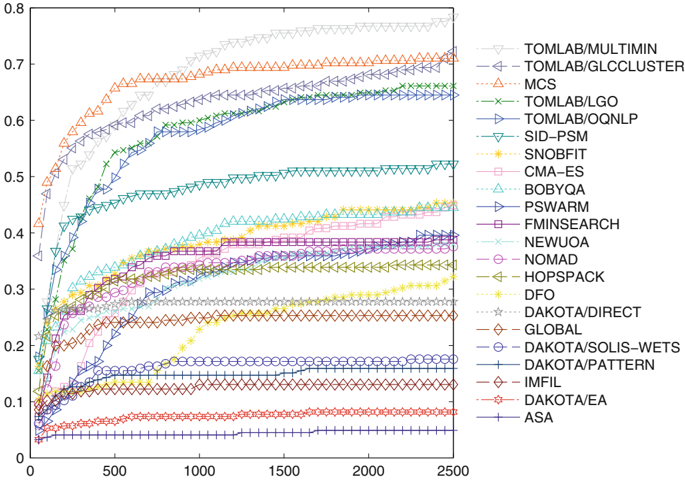
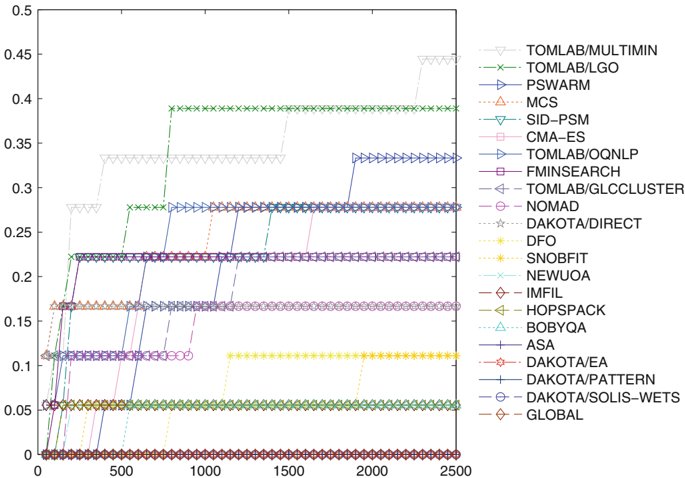
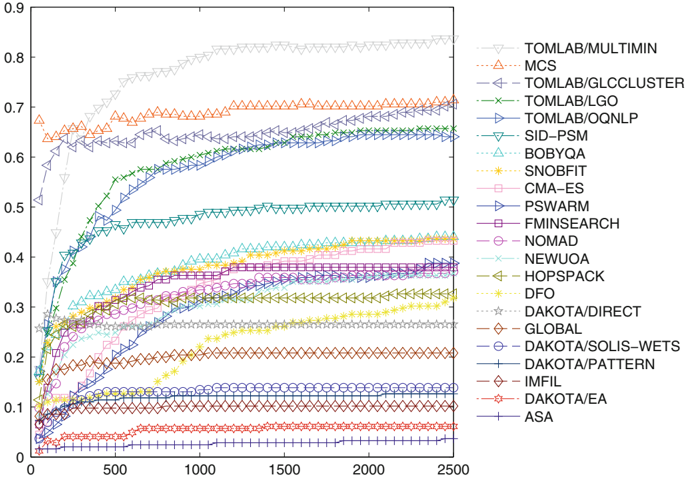
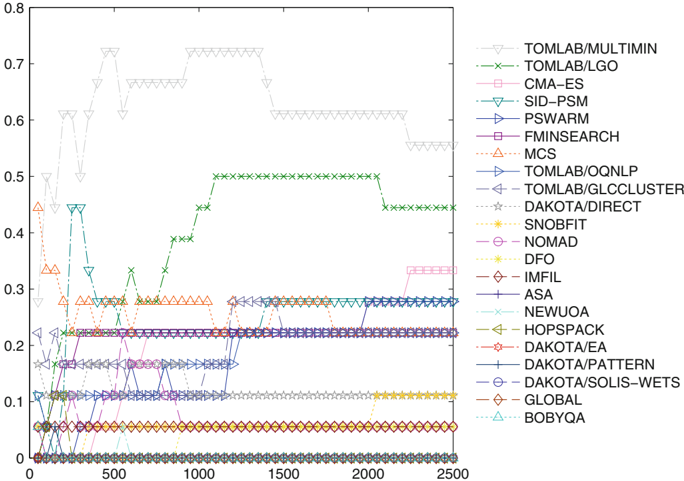
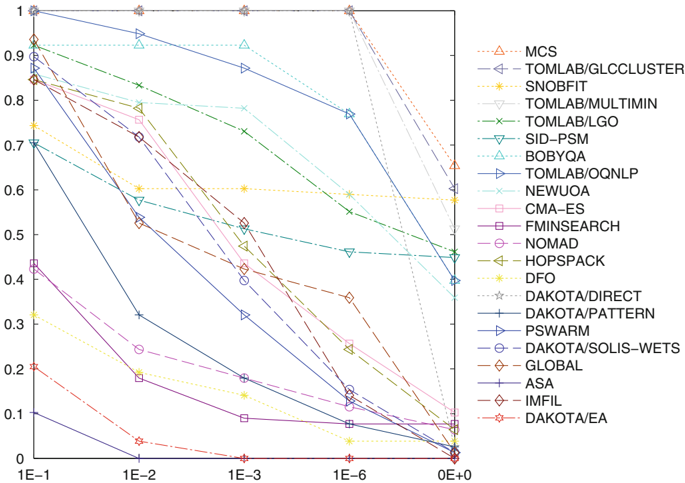
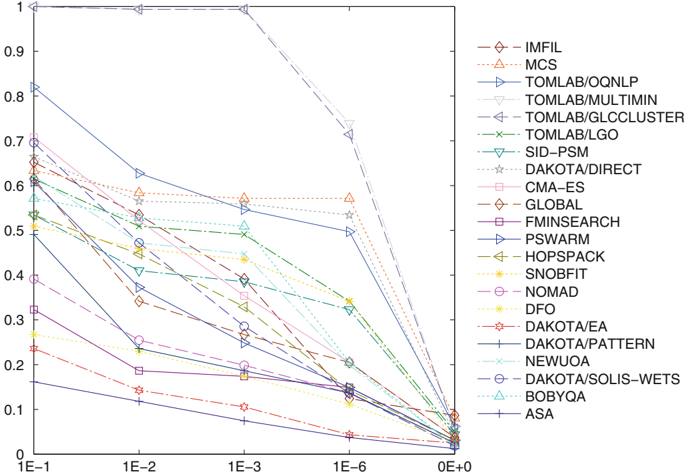
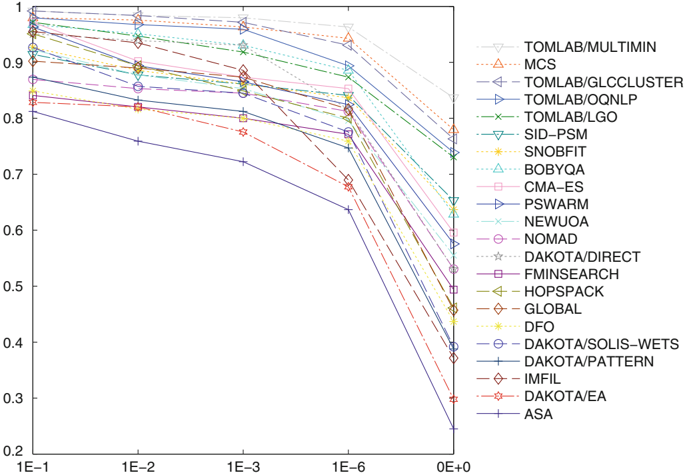
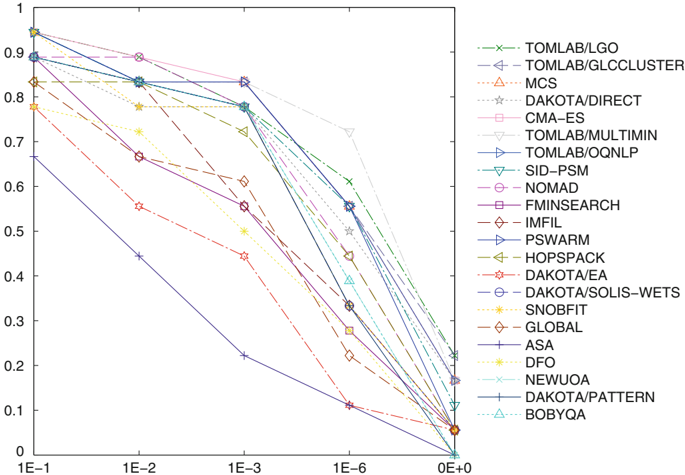
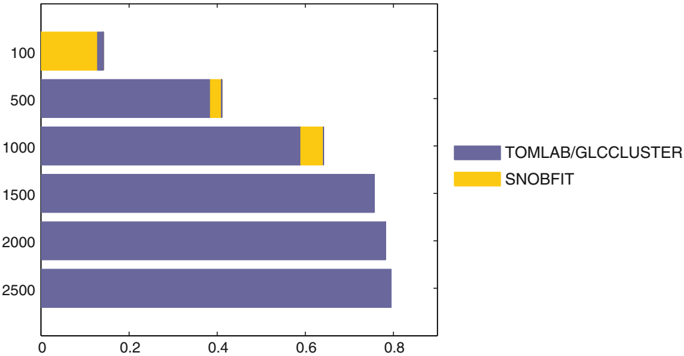
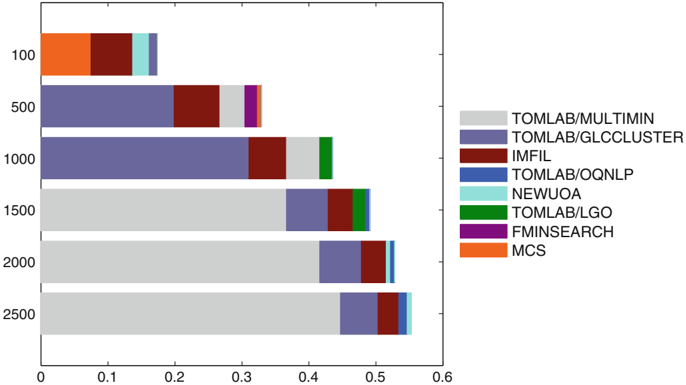
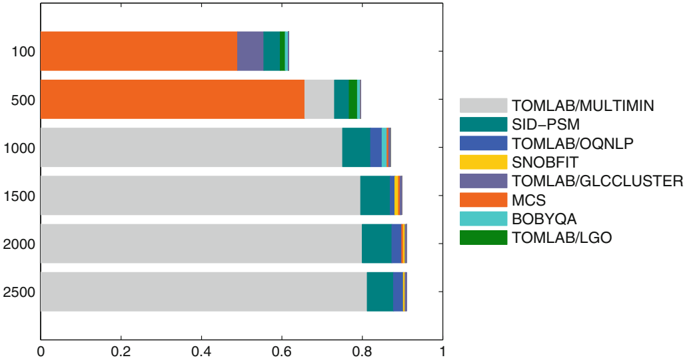
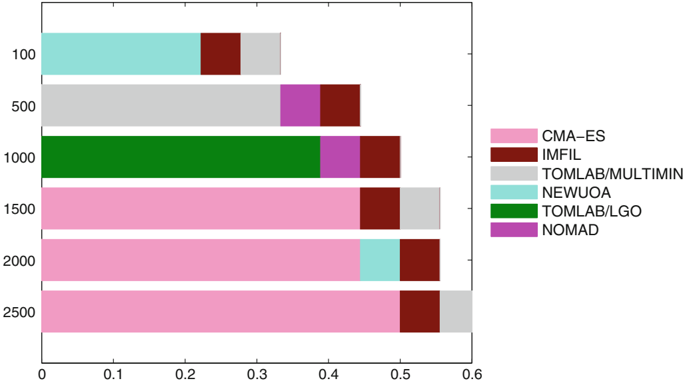
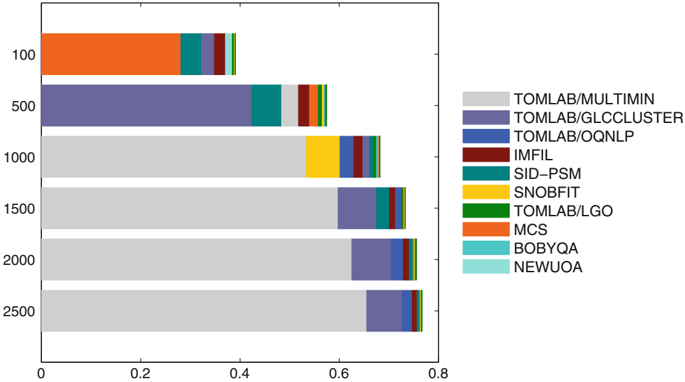
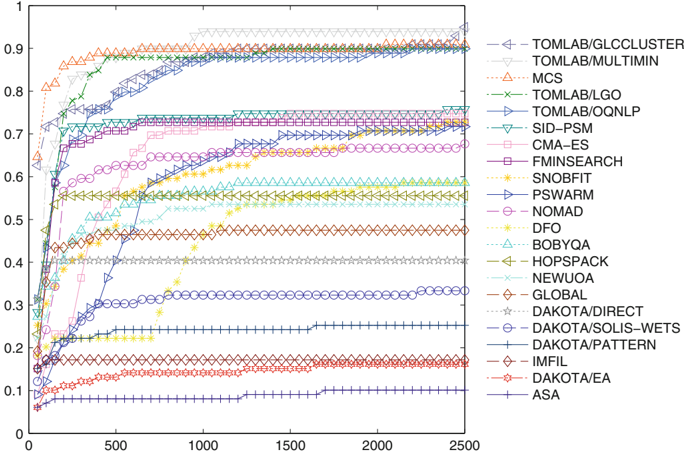
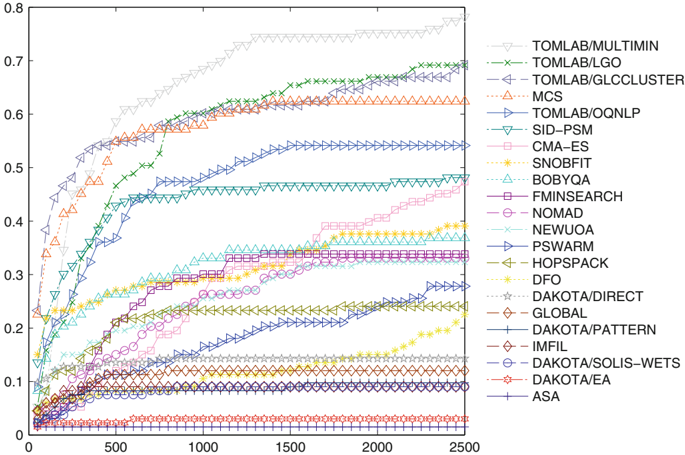
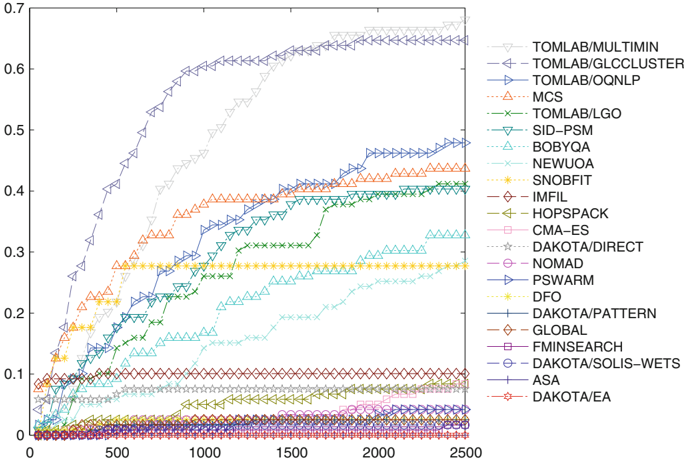
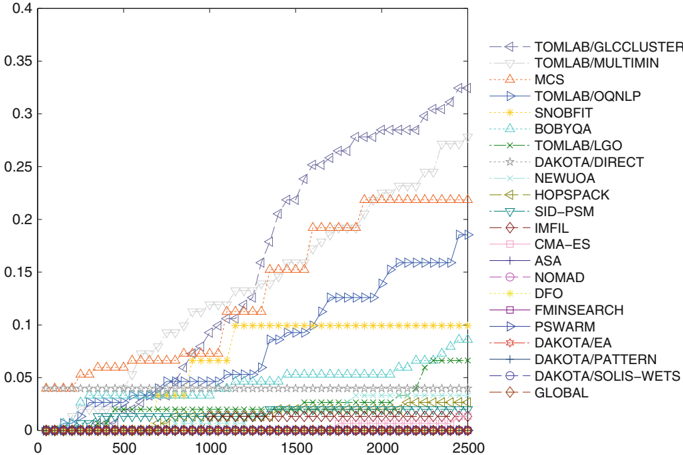
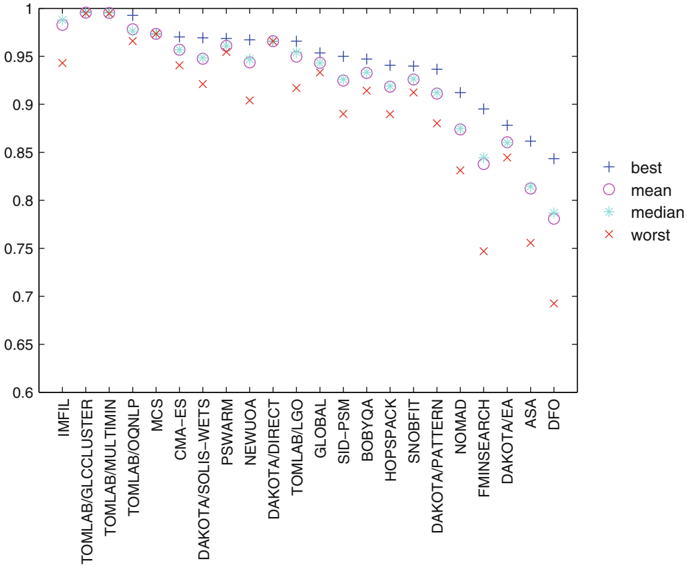
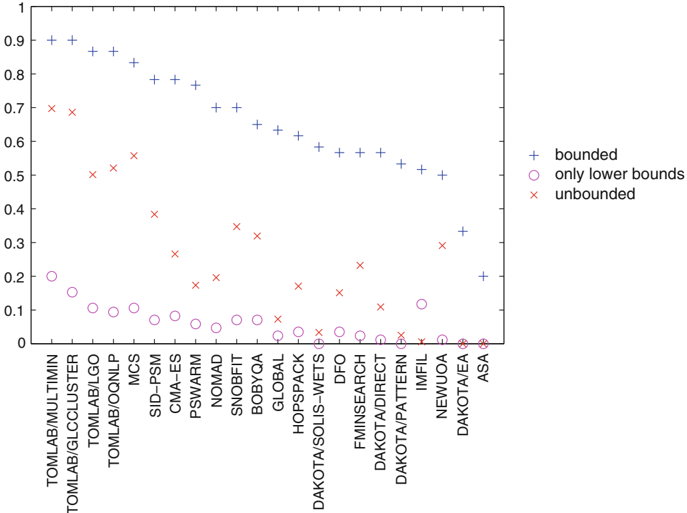
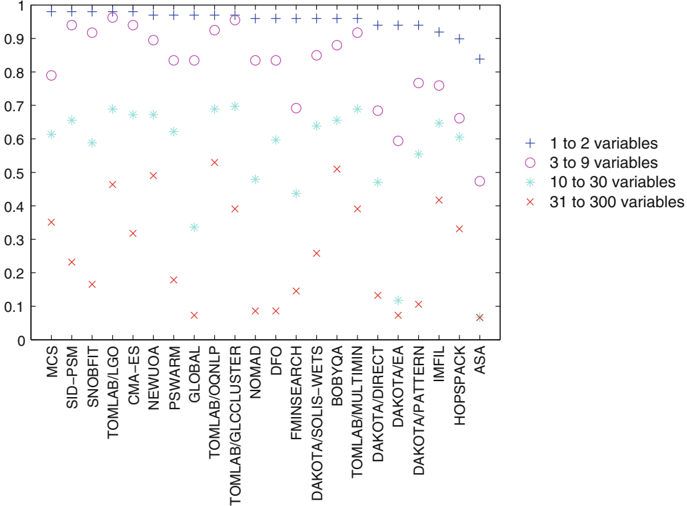
This paper addresses the solution of bound-constrained optimization problems using algorithms that require only the availability of objective function values but no derivative information. We refer to these algorithms as derivative-free algorithms. Fueled by a growing number of applications in science and engineering, the development of derivative-free optimization algorithms has long been studied, and it has found renewed interest in recent time. Along with many derivative-free algorithms, many software implementations have also appeared. The paper presents a review of derivative-free algorithms, followed by a systematic comparison of 22 related implementations using a test set of 502 problems. The test bed includes convex and nonconvex problems, smooth as well as nonsmooth problems. The algorithms were tested under the same conditions and ranked under several criteria, including their ability to find near-global solutions for nonconvex problems, improve a given starting point, and refine a near-optimal solution. A total of 112,448 problem instances were solved. We find that the ability of all these solvers to obtain good solutions diminishes with increasing problem size. For the problems used in this study, , , and are better, on average, than other derivative-free solvers in terms of solution quality within 2,500 function evaluations. These global solvers outperform local solvers even for convex problems. Finally, , , and show superior performance in terms of refining a near-optimal solution.
Overview
The claims and statistics of this paper haven’t been checked yet.
Free: it reads the open-access text and checks the first 5 claims that cite a source we can check. Create a free account to check every claim.
Integrity signals
Registry
Cites
Statistics
Figures
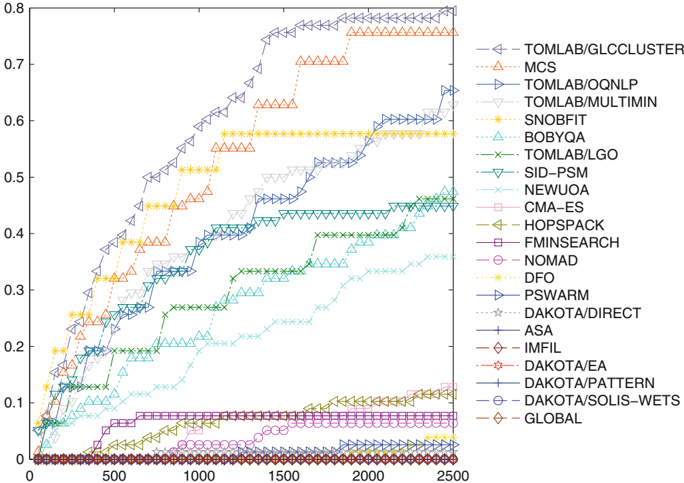
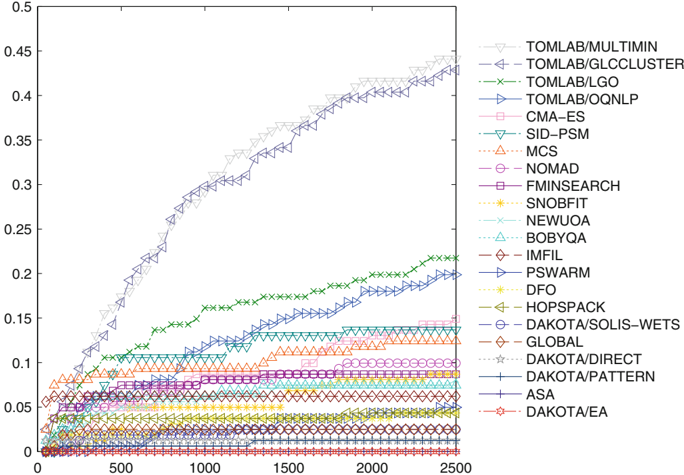
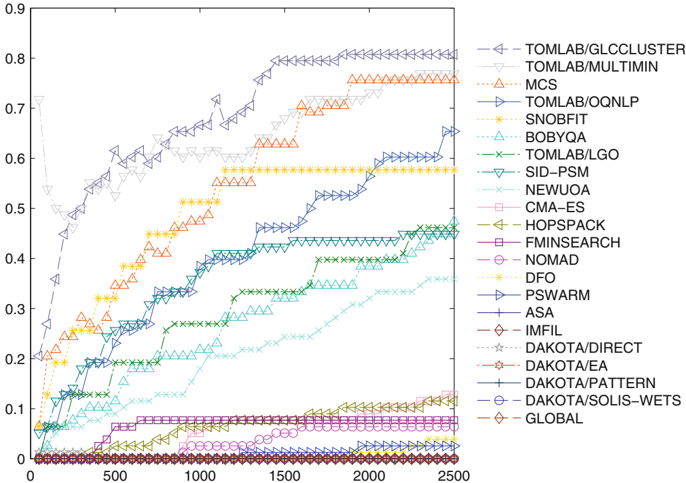
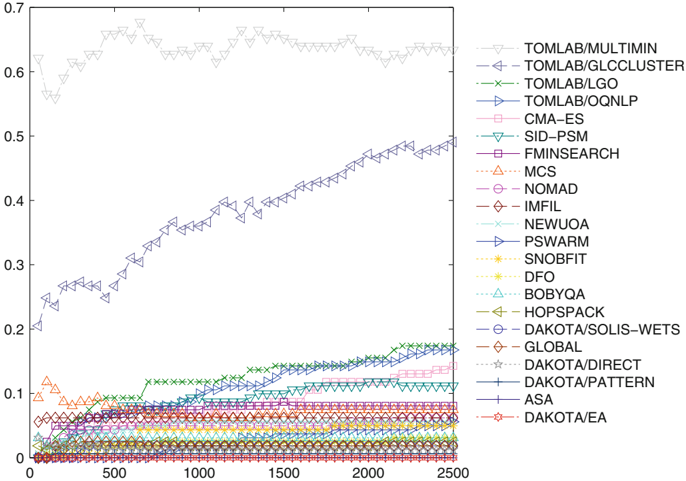
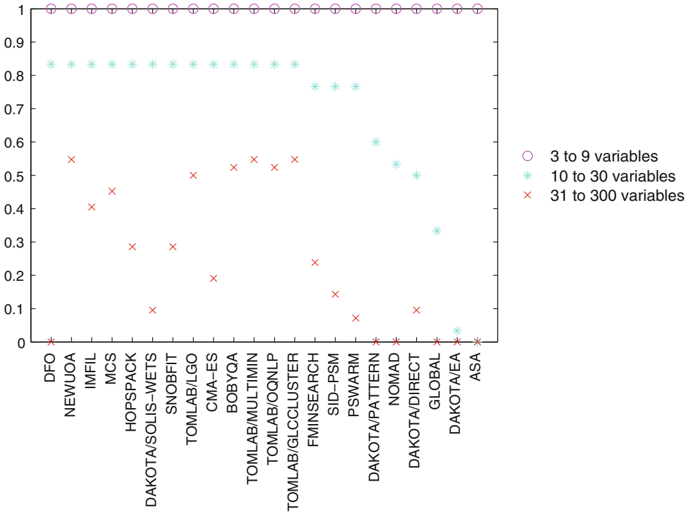
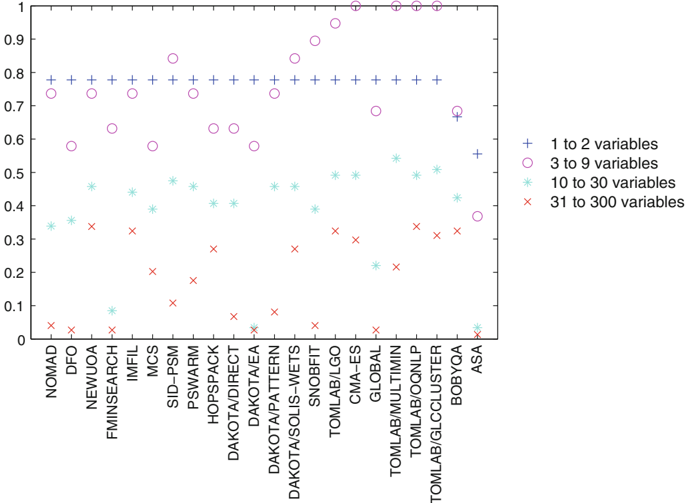
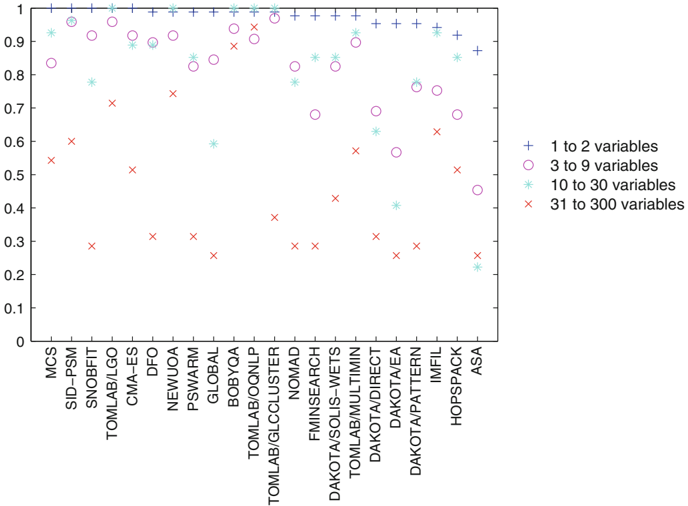
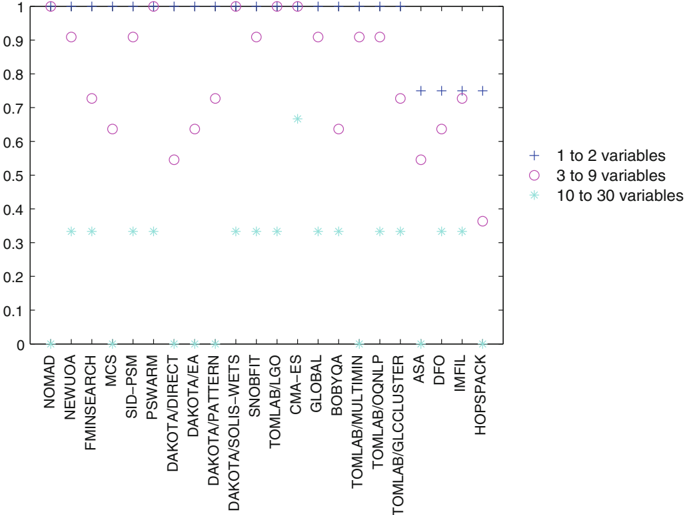
Verification
Claims the paper makes
The claims and statistics of this paper haven’t been checked yet.
Free: it reads the open-access text and checks the first 5 claims that cite a source we can check. Create a free account to check every claim.
Claims other papers make about this one
Each is checked against this paper’s own text: does it say what the citing paper says it does?
In the citing paper
“In the context of quantum chemistry, research has focused on the analog simulation of molecules by mapping the electronic structure problem to a Hamiltonian of spins with additional coupling terms 366 , although proposals exist for simulating chemical reactions 367-369 and protein folding simulations 370,371 .”
From Quantum Chemistry in the Age of Quantum Computing (2019) · cites this paper as [371]
Self-check
Percentages, sums and reported differences re-computed from the paper’s own numbers.
The self-check needs the paper’s full text.
Citations
Cites
Kennedy, J., & Eberhart, R. (2002) · Proceedings of ICNN'95 - International Conference on Neural Networks · doi:10.1109/icnn.1995.488968 · Cited by 58,192
Holland, J. H. (1992) · The MIT Press eBooks · doi:10.7551/mitpress/1090.001.0001 · Cited by 47,002 · cited 3×
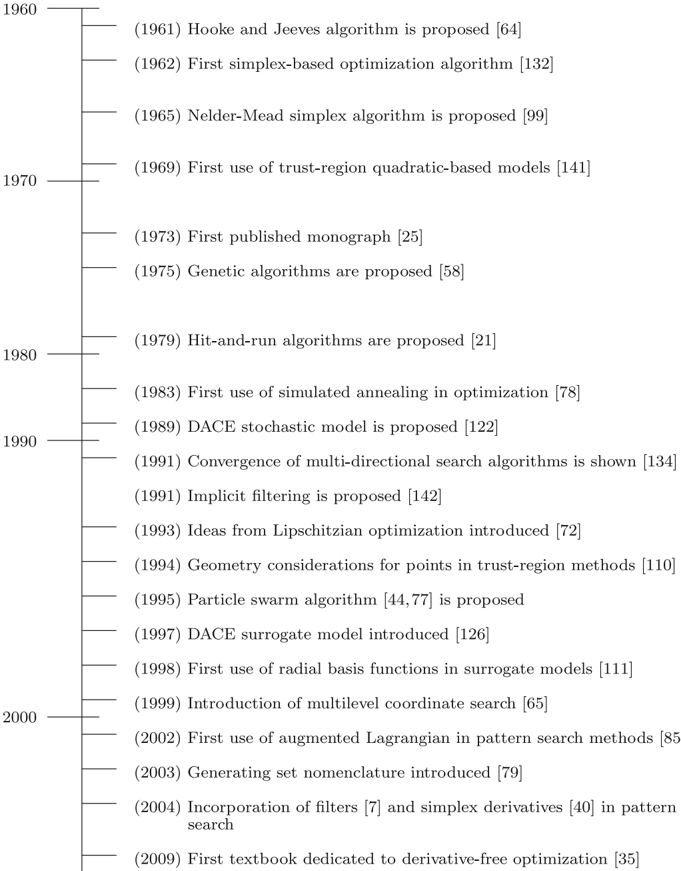
“Examples of methods Table 1 Citations of most cited works in derivative-free algorithms Nelder and Mead [99] 1965 13,486 Brent [25] 1973 2,019 Holland [58] 1975 31,494 Kirkpatrick et al. [78] 1983 23,053 Eberhart and Kennedy [44,77] 1995 20,369 using information from multiple previously evaluated points are genetic al…”
MethodOptimization by Simulated Annealing
Kirkpatrick, S., Gelatt, C. D., & Vecchi, M. P. (1983) · Science · doi:10.1126/science.220.4598.671 · Cited by 45,134 · cited 2×
“Initially proposed to handle combinatorial optimization problems [78], the algorithm was later extended to continuous problems [17].”
Equation of State Calculations by Fast Computing Machines
Metropolis, N., Rosenbluth, A. W., Rosenbluth, M. N., Teller, A. H., & Teller, E. (1953) · The Journal of Chemical Physics · doi:10.1063/1.1699114 · Cited by 37,192
A Simplex Method for Function Minimization
Nelder, J. A., & Mead, R. (1965) · The Computer Journal · doi:10.1093/comjnl/7.4.308 · Cited by 28,905 · cited 11×
“The development of derivative-free algorithms dates back to the works of Spendley et al. [132] and Nelder and Mead [99] with their simplex-based algorithms.”
BackgroundMethodInfluentialA new optimizer using particle swarm theory
Eberhart, R., & Kennedy, J. (2002) · MHS'95. Proceedings of the Sixth International Symposium on Micro Machine and Human Science · doi:10.1109/mhs.1995.494215 · Cited by 16,067 · cited 3×
“Examples of methods Table 1 Citations of most cited works in derivative-free algorithms Nelder and Mead [99] 1965 13,486 Brent [25] 1973 2,019 Holland [58] 1975 31,494 Kirkpatrick et al. [78] 1983 23,053 Eberhart and Kennedy [44,77] 1995 20,369 using information from multiple previously evaluated points are genetic al…”
MethodEfficient Global Optimization of Expensive Black-Box Functions
Jones, D. R., Schonlau, M., & Welch, W. J. (1998) · Journal of Global Optimization · doi:10.1023/a:1008306431147 · Cited by 8,070 · cited 3×
“Although the expected improvement function can be reduced to a closed-form expression [73], it can be highly multimodal.”
BackgroundMethodConvergence Properties of the Nelder--Mead Simplex Method in Low Dimensions
Lagarias, J. C., Reeds, J. A., Wright, M. H., & Wright, P. E. (1998) · SIAM Journal on Optimization · doi:10.1137/s1052623496303470 · Cited by 7,447 · cited 1×
“[81].”
Design and Analysis of Computer Experiments
Sacks, J., Welch, W. J., Mitchell, T. J., & Wynn, H. P. (1989) · Statistical Science · doi:10.1214/ss/1177012413 · Cited by 6,919
(2019) · Handbook of Machine Learning · doi:10.1142/9789811205675_0004 · Cited by 6,270
Research works printed but not linked: 9
- Awasthi, S.: Molecular Docking by Derivative-Free Optimization Solver. Master's thesis, Department of Chemical Engineering, Carnegie Mellon University, Pittsburgh (2008)
- Booker, A.J., Dennis, J.E. Jr., Frank, P.D., Serafini, D.B., Torczon, V.J., Trosset, M.W.: A rigorous framework for optimization of expensive functions by surrogates. Struct. Optim. 17, 1-13 (1999) · DOI · Paper page
- Chang, K.-F.: Modeling and Optimization of Polymerase Chain Reaction Using Derivative-Free Opti- mization. Master's thesis, Department of Chemical Engineering, Carnegie Mellon University, Pittsburgh (2011)
- Desai, R.: A Comparison of Algorithms for Optimizing the Omega Function. Master's thesis, Department of Chemical Engineering, Carnegie Mellon University, Pittsburgh (2010)
- Holland, J.H.: Adaptation in Natural and Artificial Systems. The University of Michigan Press, Ann Arbor (1975)
- Powell, M.J.D.: A direct search optimization method that models the objective by quadratic interpolation. In: Presentation at the 5th Stockholm Optimization Days (1994) 111. · DOI · Paper page
- Wang, H.: Application of Derivative-Free Algorithms in Powder Diffraction. Master's thesis, Department of Chemical Engineering, Carnegie Mellon University, Pittsburgh (2011) 140.
- Winfield, D.: Function and Functional Optimization by Interpolation in Data Tables. PhD thesis, Harvard University, Cambridge (1969) 142.
- Zheng, Y.: Pairs Trading and Portfolio Optimization. Master's thesis, Department of Chemical Engi- neering, Carnegie Mellon University, Pittsburgh (2011)
Cited by
The theory of variational hybrid quantum-classical algorithms
McClean, J. R., Romero, J., Babbush, R., & Aspuru-Guzik, A. (2016) · New Journal of Physics · doi:10.1088/1367-2630/18/2/023023 · Cited by 2,227
Quantum Chemistry in the Age of Quantum Computing
Cao, Y., Romero, J., Olson, J. P., Degroote, M., Johnson, P. D., Kieferová, M., Kivlichan, I. D., Menke, T., Peropadre, B., Sawaya, N. P. D., et al. (2019) · Chemical Reviews · doi:10.1021/acs.chemrev.8b00803 · Cited by 1,560
Accessorize to a Crime: Real and Stealthy Attacks on State-of-the-Art Face Recognition
Sharif, M., Bhagavatula, S., Bauer, L., & Reiter, M. K. (2016) · Proceedings of the 2016 ACM SIGSAC Conference on Computer and Communications Security · doi:10.1145/2976749.2978392 · Cited by 1,530
“…over other black-box optimization meth-ods such as surrogate models [3]—which require that the adversary has the training data and enough computational resources to train an effective surrogate—and genetic algorithms [2]—which though similar to PSO are much less computationally efficient [15, 34].”
BackgroundLattimore, T., & Szepesvári, C. (2020) · Cambridge University Press eBooks · doi:10.1017/9781108571401 · Cited by 976
A Survey of Optimization Methods From a Machine Learning Perspective
Sun, S., Cao, Z., Zhu, H., & Zhao, J. (2020) · IEEE Transactions on Cybernetics · doi:10.1109/tcyb.2019.2950779 · Cited by 789
“The derivative-free optimization methods [11], [12] are mainly used in the case that the derivative of the objective function may not exist or be difficult to calculate.”
MethodAdvances in surrogate based modeling, feasibility analysis, and optimization: A review
Bhosekar, A., & Ierapetritou, M. (2018) · Computers & Chemical Engineering · doi:10.1016/j.compchemeng.2017.09.017 · Cited by 707
Deep Reinforcement Learning for Intelligent Transportation Systems: A Survey
Haydari, A., & Yilmaz, Y. (2022) · IEEE Transactions on Intelligent Transportation Systems · doi:10.1109/tits.2020.3008612 · Cited by 690
Algorithm 909: NOMAD: Nonlinear Optimization with the MADS Algorithm
Digabel, S. L. (2011) · ACM Transactions on Mathematical Software · doi:10.1145/1916461.1916468 · Cited by 816
Google Vizier: A Service for Black-Box Optimization
Golovin, D., Solnik, B., Moitra, S., Kochanski, G., Karro, J., & Sculley, D. (2017) · Proceedings of the 23rd ACM SIGKDD International Conference on Knowledge Discovery and Data Mining · doi:10.1145/3097983.3098043 · Cited by 571
“Black–box optimization makes minimal assumptions about the problem under consideration, and thus is broadly applicable across many domains and has been studied in multiple scholarly fields under names including Bayesian Optimization [2, 25, 26], Derivative– free optimization [7, 24], Sequential Experimental Design [5]…”
BackgroundSimulation optimization: a review of algorithms and applications
Amaran, S., Sahinidis, N. V., Sharda, B., & Bury, S. J. (2016) · Annals of Operations Research · doi:10.1007/s10479-015-2019-x · Cited by 467
“Most testing and comparisons happen with classical test problems in nonlinear optimization (many of which have been compiled in [166] and available at http://archimedes.”
InfluentialSelf-citationLearning surrogate models for simulation‐based optimization
Cozad, A., Sahinidis, N. V., & Miller, D. C. (2014) · AIChE Journal · doi:10.1002/aic.14418 · Cited by 456
“As shown recently in [34], these methods are most effective in low-dimensional cases, like we have here thanks to the decomposition of the original large simulation into pieces.”
BackgroundMethodSelf-citationDerivative-free optimization methods
Larson, J., Menickelly, M., & Wild, S. M. (2019) · Acta Numerica · doi:10.1017/s0962492919000060 · Cited by 381
Kudela, J., & Matousek, R. (2022) · Soft Computing · doi:10.1007/s00500-022-07362-8 · Cited by 370
Mestres, A., Rodriguez-Natal, A., Carner, J., Barlet-Ros, P., Alarcón, E., Solé, M., Muntés-Mulero, V., Meyer, D., Barkai, S., Hibbett, M. J., et al. (2017) · ACM SIGCOMM Computer Communication Review · doi:10.1145/3138808.3138810 · Cited by 352
“Conceptually, the KDN architecture borrows many ideas from other areas, notably from black-box optimization [5], neural-network in feedback control systems [6] and autonomic self-* architectures [7].”
BackgroundDifferentiable learning of quantum circuit Born machines
Liu, J.-G., & Wang, L. (2018) · Physical Review A · doi:10.1103/physreva.98.062324 · Cited by 279
A Competitive Divide-and-Conquer Algorithm for Unconstrained Large-Scale Black-Box Optimization
Mei, Y., Omidvar, M. N., Li, X., & Yao, X. (2016) · ACM Transactions on Mathematical Software · doi:10.1145/2791291 · Cited by 249
“From previous studies [Rios and Sahinidis 2012], the complexity of CMA-ES is dominated by the covariance matrix estimation, which has a complexity of O ( n 3 ) , where n is the problem size.”
MethodResultInfluentialA Review of Particle Swarm Optimization
Jain, N. K., Nangia, U., & Jain, J. (2018) · Journal of The Institution of Engineers (India): Series B · doi:10.1007/s40031-018-0323-y · Cited by 247
“Rios and Sahinidis [49] presented a review of derivative free algorithms including PSO for constrained problems.”
BackgroundA review on superstructure optimization approaches in process system engineering
Mencarelli, L., Chen, Q., Pagot, A., & Grossmann, I. E. (2020) · Computers & Chemical Engineering · doi:10.1016/j.compchemeng.2020.106808 · Cited by 244
Horvath, B. N., Muguruza, A., & Tomas, M. (2019) · Quantitative Finance · doi:10.1080/14697688.2020.1817974 · Cited by 308
State-of-the-art in aerodynamic shape optimisation methods
Skinner, S. N., & Zare-Behtash, H. (2018) · Applied Soft Computing · doi:10.1016/j.asoc.2017.09.030 · Cited by 233
“[16] L.M. Rios, N.V. Sahinidis, Derivative-free optimization: a review of algorithms and comparison of software implementations, J. Glob.”
BackgroundInfluentialBoukouvala, F., Misener, R., & Floudas, C. A. (2016) · European Journal of Operational Research · doi:10.1016/j.ejor.2015.12.018 · Cited by 229
“…interest in CDFO methods because they are suitable for problems which deterministic global optimization methods are unable to handle due to lack of information, noise, non-smoothness and discontinuities (Kolda et al., 2003; Conn et al., 2009b; Rios and Sahinidis, 2013; Martelli and Amaldi, 2014).”
A new optimization algorithm for solving complex constrained design optimization problems
Rao, R. V., & Waghmare, G. (2016) · Engineering Optimization · doi:10.1080/0305215x.2016.1164855 · Cited by 210
“Rios and Sahinidis (2013) addressed the solution of bound-constrained optimization problems using a derivative-free algorithm which required only the availability of objective function values but no derivative information.”
BackgroundSergeyev, Y. D., Kvasov, D. E., & Mukhametzhanov, M. S. (2018) · Scientific Reports · doi:10.1038/s41598-017-18940-4 · Cited by 206
The ALAMO approach to machine learning
Wilson, Z. T., & Sahinidis, N. V. (2017) · Computers & Chemical Engineering · doi:10.1016/j.compchemeng.2017.02.010 · Cited by 202
“A comparative study [57] has investigated the use of a number of DFO solvers and discovered that SNOBFIT [34] is currently a highly effective DFO solver for minimizing problems such as 10.”
BackgroundSelf-citationBest practices for comparing optimization algorithms
Beiranvand, V., Hare, W., & Lucet, Y. (2017) · Optimization and Engineering · doi:10.1007/s11081-017-9366-1 · Cited by 201
“Known solution available: When the expected solution for a problem is available, two methods can be employed to measure the quality of an algorithmic output: fixed-target and fixed-cost [FRK + 08, RU01, RS13].”
MethodOptimal undulatory swimming for a single fish-like body and for a pair of interacting swimmers
Maertens, A. P., Gao, A., & Triantafyllou, M. S. (2017) · Journal of Fluid Mechanics · doi:10.1017/jfm.2016.845 · Cited by 200
Variational quantum state diagonalization
LaRose, R., Tikku, A., O’Neel-Judy, É., Cincio, L., & Coles, P. J. (2019) · npj Quantum Information · doi:10.1038/s41534-019-0167-6 · Cited by 199
“[43]), the particular case of optimization for variational hybrid algorithms [44] is limited and needs further work [45].”
BackgroundAn artificial agent for robust image registration
Liao, R., Miao, S., De Tournemire, P., Grbic, S., Kamen, A., Mansi, T., & Comaniciu, D. (2017) · Proceedings of the AAAI Conference on Artificial Intelligence · doi:10.1609/aaai.v31i1.11230 · Cited by 199
“The transformation parameters between the image pairs are then estimated via maximization of the defined matching metric using an optimizer (Rios and Sahinidis 2013).”
MethodWho is Real Bob? Adversarial Attacks on Speaker Recognition Systems
Chen, G., Chenb, S., Fan, L., Du, X., Zhao, Z., Song, F., & Liu, Y. (2021) · 2021 IEEE Symposium on Security and Privacy (SP) · doi:10.1109/sp40001.2021.00004 · Cited by 198
From 4G to 5G: Self-organized network management meets machine learning
Moysen, J., & Giupponi, L. (2018) · Computer Communications · doi:10.1016/j.comcom.2018.07.015 · Cited by 198
A simplicial homology algorithm for Lipschitz optimisation
Endres, S. C., Sandrock, C., & Focke, W. W. (2018) · Journal of Global Optimization · doi:10.1007/s10898-018-0645-y · Cited by 192
“A recent review and experimental comparison of 22 derivative-free optimisation algorithms by Rios and Sahinidis [38] concluded that global optimisation solvers solvers such as TOMLAB/MULTI-MIN, TOMLAB/GLCCLUSTER, MCS and TOMLAB/LGO perform better, on average, than other derivative-free solvers in…”
MethodLiu, S., Chen, P.-Y., Kailkhura, B., Zhang, G., Hero, A. O., & Varshney, P. K. (2020) · IEEE Signal Processing Magazine · doi:10.1109/msp.2020.3003837 · Cited by 185
Recent Developments and Challenges in Optimization-Based Process Synthesis
Chen, Q., & Grossmann, I. E. (2017) · Annual Review of Chemical and Biomolecular Engineering · doi:10.1146/annurev-chembioeng-080615-033546 · Cited by 183
“Another recent development has been a proliferation in codes for derivative-free optimization (137).”
BackgroundThe Response of Drug Expenditure to Nonlinear Contract Design: Evidence from Medicare Part D *
Einav, L., Finkelstein, A., & Schrimpf, P. (2015) · The Quarterly Journal of Economics · doi:10.1093/qje/qjv005 · Cited by 182
RBFOpt: an open-source library for black-box optimization with costly function evaluations
Costa, A., & Nannicini, G. (2018) · Mathematical Programming Computation · doi:10.1007/s12532-018-0144-7 · Cited by 175
“Rios [49] benchmarks numerous solvers, but as discussed above, many of those are not suitable”
BackgroundMethodInfluentialSuárez, J. L., García, S., & Herrera, F. (2020) · Neurocomputing · doi:10.1016/j.neucom.2020.08.017 · Cited by 200
Optimal undulatory swimming for a single fish-like body and for a pair of interacting swimmersPreprint
Maertens, A., Gao, A., & Triantafyllou, M. S. (2016) · DSpace@MIT (Massachusetts Institute of Technology) · Cited by 171
Kohn-Sham Equations as Regularizer: Building Prior Knowledge into Machine-Learned Physics
Li, L., Hoyer, S., Pederson, R., Sun, R., Cubuk, E. D., Riley, P., & Burke, K. (2021) · Physical Review Letters · doi:10.1103/physrevlett.126.036401 · Cited by 169
ReLU networks as surrogate models in mixed-integer linear programs
Grimstad, B., & Andersson, H. (2019) · Computers & Chemical Engineering · doi:10.1016/j.compchemeng.2019.106580 · Cited by 206
“A review of surrogate modeling and optimization can be found in [7], and more recently in [5].”
BackgroundNeural offset min-sum decoding
Lugosch, L., & Gross, W. J. (2017) · 2017 IEEE International Symposium on Information Theory (ISIT) · doi:10.1109/isit.2017.8006751 · Cited by 167
“Finally, the genetic algorithm used to learn the offsets in [16] is a random heuristic method, which, unlike gradient-based optimization methods, has been found to perform poorly as the size of the optimization problem increases [17].”
MethodSimulation optimization: a review of algorithms and applications
Amaran, S., Sahinidis, N. V., Sharda, B., & Bury, S. J. (2014) · 4OR · doi:10.1007/s10288-014-0275-2 · Cited by 187
“Most testing and comparisons happen with classical test problems in nonlinear optimization (many of which have been compiled in Rios and Sahinidis (2013) and available at http://archimedes.cheme.cmu.edu/?q=dfocomp), to which stochastic noise has been added.”
InfluentialSelf-citationToward autonomous design and synthesis of novel inorganic materials
Szymanski, N. J., Zeng, Y., Huo, H., Bartel, C. J., Kim, H., & Ceder, G. (2021) · Materials Horizons · doi:10.1039/d1mh00495f · Cited by 159
Modern applications of machine learning in quantum sciencesPreprint
Dawid, A., Arnold, J., Requena, B., Gresch, A., Płodzień, M., Donatella, K., Nicoli, K. A., Stornati, P., Koch, R., Büttner, M., et al. (2022) · arXiv (Cornell University) · doi:10.48550/arxiv.2204.04198 · Cited by 180
Paszkowicz, W. (2013) · Materials and Manufacturing Processes · doi:10.1080/10426914.2012.746707 · Cited by 161
Large Language Models as Optimizers
Yang, C., Wang, X., Lu, Y., Liu, H., Le, Q. V., Zhou, D., & Chen, X. (2023) · arXiv · doi:10.48550/arxiv.2309.03409 · Cited by 151
“Many optimization techniques are iterative: the optimization starts from an initial solution, then iteratively updates the solution to optimize the objective function (Amari, 1993; Qian, 1999; Kingma & Ba, 2015; Bäck & Schwefel, 1993; Rios & Sahinidis, 2013; Reeves, 1993).”
MethodAlgorithms for the self-optimisation of chemical reactions
Clayton, A. D., Manson, J. A., Taylor, C. J., Chamberlain, T. W., Taylor, B. A., Clemens, G., & Bourne, R. A. (2019) · Reaction Chemistry & Engineering · doi:10.1039/c9re00209j · Cited by 146
AI augmented Edge and Fog computing: Trends and challenges
Tuli, S., Mirhakimi, F., Pallewatta, S., Zawad, S., Casale, G., Javadi, B., Yan, F., Buyya, R., & Jennings, N. R. (2023) · Journal of Network and Computer Applications · doi:10.1016/j.jnca.2023.103648 · Cited by 174
Recent Advances for Quantum Neural Networks in Generative Learning
Tian, J., Sun, X., Du, Y., Zhao, S., Liu, Q., Zhang, K., Yi, W., Huang, W., Wang, C., Wu, X., et al. (2023) · IEEE Transactions on Pattern Analysis and Machine Intelligence · doi:10.1109/tpami.2023.3272029 · Cited by 111
“optimizing non-linear and non-convex objective functions [138], and it has been exploited in Refs.”
BackgroundThe DIRECT algorithm: 25 years Later
Jones, D. R., & Martins, J. R. R. A. (2020) · Journal of Global Optimization · doi:10.1007/s10898-020-00952-6 · Cited by 168
“glcCluster is a DIRECT-inspired search procedure that was one of the most successful in the comparison of derivative-free search algorithms carried out by Rios and Sahinidis [57].”
MethodHassani, S., & Dackermann, U. (2023) · Sensors · doi:10.3390/s23063293 · Cited by 146
“The theory of DFO algorithms has developed over time, making them useful in a wide variety of practical applications.”
InfluentialBartoli, N., Lefebvre, T., Dubreuil, S., Olivanti, R., Priem, R., Bons, N. P., Martins, J. R. R. A., & Morlier, J. (2019) · Aerospace Science and Technology · doi:10.1016/j.ast.2019.03.041 · Cited by 156
“When the gradient information is not available, an interesting option is to use gradient-free optimizers known as derivative-free optimization (DFO) methods [7, 8, 9, 10].”
MethodEscaping local minima with local derivative-free methods: a numerical investigation
Cartis, C., Roberts, L., & Sheridan-Methven, O. (2021) · Optimization · doi:10.1080/02331934.2021.1883015 · Cited by 158
“ricGO algorithms. Despite only local theoretical guarantees of convergence, DFO methods have long been regardedasamoresuitablealternativeforGOthanlocalderivative-basedmethods. Indeed,Rios andSahinidis[45]recentlyperformedextensivebenchmarkingofvariousGOandDFOsolvers, andfoundthatinsomeinstances,suchaswhenclosetoasolut…”
BackgroundInfluentialARGONAUT: AlgoRithms for Global Optimization of coNstrAined grey-box compUTational problems
Boukouvala, F., & Floudas, C. A. (2016) · Optimization Letters · doi:10.1007/s11590-016-1028-2 · Cited by 138
Easum, J. A., Nagar, J., Werner, P. L., & Werner, D. H. (2018) · IEEE Transactions on Antennas and Propagation · doi:10.1109/tap.2018.2870338 · Cited by 137
“Identifying the high-performance designs is a process that is typically realized by employing modern optimization techniques, which rely on computer simulations, global search strategies, and evolutionary algorithms [4].”
BackgroundAbbaszadeh, P., Moradkhani, H., & Daescu, D. N. (2019) · Water Resources Research · doi:10.1029/2018wr023629 · Cited by 133
Kim, S. H., & Boukouvala, F. (2019) · Optimization Letters · doi:10.1007/s11590-019-01428-7 · Cited by 146
Classical Optimizers for Noisy Intermediate-Scale Quantum Devices
Lavrijsen, W., Tudor, A., Muller, J., Iancu, C., & de Jong, W. (2020) · 2020 IEEE International Conference on Quantum Computing and Engineering (QCE) · doi:10.1109/qce49297.2020.00041 · Cited by 97
Kelley, C. T. (2011) · Society for Industrial and Applied Mathematics eBooks · doi:10.1137/1.9781611971903 · Cited by 154
Tuli, S., Poojara, S. R., Srirama, S. N., Casale, G., & Jennings, N. R. (2022) · IEEE Transactions on Parallel and Distributed Systems · doi:10.1109/tpds.2021.3087349 · Cited by 112
“However, gradient-free methods like GA are slow to converge to optima due to undirected search schemes [15].”
BackgroundMethodCOCO: Performance AssessmentPreprint
Hansen, N., Auger, A., Brockhoff, D., Tušar, D., & Tušar, T. (2016) · arXiv (Cornell University) · doi:10.48550/arxiv.1605.03560 · Cited by 128
“s of optimization algorithms are also known as data profiles[MOR2009]. They are widely used for aggregating results from different functions and different dimensions to reach a single target precision [RIO2012]. In theCOCOframework, we do not aggregation over dimension but aggregate often over a wide range of target pr…”
BackgroundA global optimization algorithm for trajectory data based car-following model calibration
Li, L., Chen, X. M., & Zhang, L. (2016) · Transportation Research Part C Emerging Technologies · doi:10.1016/j.trc.2016.04.011 · Cited by 133
Pseudo expected improvement criterion for parallel EGO algorithm
Zhan, D., Qian, J., & Cheng, Y. (2016) · Journal of Global Optimization · doi:10.1007/s10898-016-0484-7 · Cited by 122
“Many derivative-free algorithms have been developed for solving the optimization work of these black-box problems [1,2].”
MethodMaximizing information from chemical engineering data sets: Applications to machine learning
Thebelt, A., Wiebe, J., Kronqvist, J., Tsay, C., & Misener, R. (2022) · Chemical Engineering Science · doi:10.1016/j.ces.2022.117469 · Cited by 135
“…engineering, e.g. artificial intelligence (Venkatasubramanian, 2019), machine learning (Lee et al., 2018; Yan et al., 2020), optimization approaches (Rios and Sahinidis, 2013; Biegler et al., 2014; Boukouvala et al., 2016; Ning and You, 2019), surrogate modeling (Bhosekar and Ierapetritou, 2018;…”
Boukouvala, F., Hasan, M. M. F., & Floudas, C. A. (2015) · Journal of Global Optimization · doi:10.1007/s10898-015-0376-2 · Cited by 117
“A comprehensive analysis and comparison of the existing box-constrained DFOmethods available in the literature can be found in two recent reviews,Rios andSahinidis [21] and Kolda et al.”
BackgroundMethodRobust and fast nonlinear optimization of diffusion MRI microstructure models
Harms, R. L., Fritz, F. J., Tobisch, A., Goebel, R., & Roebroeck, A. (2017) · NeuroImage · doi:10.1016/j.neuroimage.2017.04.064 · Cited by 115
A review on optimization algorithms and application to wind energy integration to grid
Behera, S., Sahoo, S., & Pati, B. B. (2015) · Renewable and Sustainable Energy Reviews · doi:10.1016/j.rser.2015.03.066 · Cited by 116
Metaheuristic vs. deterministic global optimization algorithms: The univariate case
Kvasov, D. E., & Mukhametzhanov, M. S. (2017) · Applied Mathematics and Computation · doi:10.1016/j.amc.2017.05.014 · Cited by 114
Turay, T., & Vladimirova, T. (2022) · IEEE Access · doi:10.1109/access.2022.3147495 · Cited by 137
“The heuristic derivative-free algorithms in [322], [329] have been proposed to address the case when the derivative information of the target functions may not exist or be hard to calculate.”
MethodFormulating data-driven surrogate models for process optimization
Misener, R., & Biegler, L. T. (2023) · Computers & Chemical Engineering · doi:10.1016/j.compchemeng.2023.108411 · Cited by 132
“Recent research integrating data-driven techniques into mathematical optimization includes: derivative-free optimization (Rios and Sahinidis, 2013), hybrid data-driven / mechanistic modeling (Von Stosch et al., 2014; Boukou-vala et al., 2016), using surrogate models in optimization (Bhosekar and…”
MethodBuilding energy optimization: An extensive benchmark of global search algorithms
Waibel, C., Wortmann, T., Evins, R., & Carmeliet, J. (2019) · Energy and Buildings · doi:10.1016/j.enbuild.2019.01.048 · Cited by 117
Dias, L. S., & Ierapetritou, M. (2017) · Computers & Chemical Engineering · doi:10.1016/j.compchemeng.2017.02.006 · Cited by 125
A combined first-principles and data-driven approach to model building
Cozad, A., Sahinidis, N. V., & Miller, D. C. (2014) · Computers & Chemical Engineering · doi:10.1016/j.compchemeng.2014.11.010 · Cited by 110
Self-citationClassical Optimizers for Noisy Intermediate-Scale Quantum Devices
Lavrijsen, W., Tudor, A., Müller, J., Iancu, C., & de Jong, W. (2020) · arXiv · doi:10.48550/arxiv.2004.03004 · Cited by 103
A Survey and Taxonomy of Loss Functions in Machine Learning
Ciampiconi, L., Elwood, A., Leonardi, M., Mohamed, A., & Rozza, A. (2026) · AI · doi:10.3390/ai7040128 · Cited by 111
Global optimization of Lipschitz functionsPreprint
Malherbe, C., & Vayatis, N. (2017) · arXiv (Cornell University) · doi:10.48550/arxiv.1703.02628 · Cited by 102
Massive simplification of the wind farm layout optimization problem
Stanley, A. P. J., & Ning, A. (2019) · Wind energy science · doi:10.5194/wes-4-663-2019 · Cited by 101
“Although these methods can be highly effective for small numbers of design variables, the computational expense required to converge scales poorly, approximately quadratically, with increasing numbers of variables (Zingg et al., 2008; Rios and Sahinidis, 2013; Lyu et al., 2014; Ning and Petch, 2016; Thomas and Ning, 2…”
MethodAdvantages of surrogate models for architectural design optimization
Wortmann, T., Costa, A., Nannicini, G., & Schroepfer, T. (2015) · Artificial intelligence for engineering design analysis and manufacturing · doi:10.1017/s0890060415000451 · Cited by 100
Du, X., Xu, H., & Zhu, F. (2021) · Computer-Aided Design · doi:10.1016/j.cad.2021.103013 · Cited by 111
Evolution strategies for continuous optimization: A survey of the state-of-the-art
Li, Z., Lin, X., Zhang, Q., & Liu, H. (2020) · Swarm and Evolutionary Computation · doi:10.1016/j.swevo.2020.100694 · Cited by 86
Nguyen, T. H. H., Pérez, A., Bermeo, S., & Simmerling, C. L. (2015) · Journal of Chemical Theory and Computation · doi:10.1021/acs.jctc.5b00271 · Cited by 98
“objective function minimization because of its quick convergence compared to other local optimization methods.(43) Additionally, NEWUOA is an improved version of UOBYQA(44) which Page 10 of 52”
BackgroundGrillanda, N., Chiozzi, A., Milani, G., & Tralli, A. (2019) · Engineering Structures · doi:10.1016/j.engstruct.2019.109517 · Cited by 95
Yang, D., Boesch, H., Liu, Y., Somkuti, P., Cai, Z., Chen, X., Noia, A. D., Lin, C., Lu, N., Lyu, D., et al. (2020) · Journal of Geophysical Research Atmospheres · doi:10.1029/2020jd032794 · Cited by 97
Opossum - Introducing and Evaluating a Model-based Optimization Tool for Grasshopper
Wortmann, T. (2017) · Proceedings of the International Conference on Computer-Aided Architectural Design Research in Asia · doi:10.52842/conf.caadria.2017.283 · Cited by 94
Derivative-Free Optimization of Noisy Functions via Quasi-Newton Methods
Berahas, A. S., Byrd, R. H., & Nocedal, J. M. (2019) · SIAM Journal on Optimization · doi:10.1137/18m1177718 · Cited by 93
“DFO OF NOISY FUNCTIONS VIA QUASI-NEWTON METHODS 3 sign other approaches for derivative-free optimization [9, 38], most prominently di88 rect search methods [10, 17, 18, 22, 26, 41] and model based trust region methods 89 [7–9, 27, 28, 36, 37, 40].”
MethodOnline Data Integrity Attacks Against Real-Time Electrical Market in Smart Grid
Tan, S., Song, W., Stewart, M., Yang, J., & Tong, L. (2016) · IEEE Transactions on Smart Grid · doi:10.1109/tsg.2016.2550801 · Cited by 92
“Therefore, derivative-free optimization methods have to be employed [16].”
MethodOptimizing Information Freshness in Computing-Enabled IoT Networks
Xu, C., Yang, H. H., Wang, X., & Quek, T. Q. S. (2019) · IEEE Internet of Things Journal · doi:10.1109/jiot.2019.2947419 · Cited by 97
“In this regard, we adopt the derivative-free optimization methods [44], [45] to address our formulated problem P.”
MethodCarbon Capture Simulation Initiative: A Case Study in Multiscale Modeling and New Challenges
Miller, D. C., Syamlal, M., Mebane, D. S., Storlie, C. B., Bhattacharyya, D., Sahinidis, N. V., Agarwal, D., Tong, C., Zitney, S. E., Sarkar, A., et al. (2014) · Annual Review of Chemical and Biomolecular Engineering · doi:10.1146/annurev-chembioeng-060713-040321 · Cited by 91
Self-citationKoziel, S. M., & Pietrenko‐Dabrowska, A. (2020) · IEEE Access · doi:10.1109/access.2020.2992134 · Cited by 91
“This is the case even for local methods (gradient [8] or pattern search algorithms [9]), let alone global algorithms, nowadays extensively utilizing population-based metaheuristics (genetic algorithms [10], differential evolution [11], or particle swarm optimizers [12]).”
MethodCloaking a concentrator in thermal conduction via topology optimization
FUJII, G., & Akimoto, Y. (2020) · International Journal of Heat and Mass Transfer · doi:10.1016/j.ijheatmasstransfer.2020.120082 · Cited by 91
Practical Design Space Exploration
Nardi, L., Koeplinger, D., & Olukotun, K. (2019) · Proceedings - International Symposium on Modeling, Analysis, and Simulation of Computer and Telecommunication Systems · doi:10.1109/mascots.2019.00045 · Cited by 115
“This problem is referred to in the literature as DFO [10], [24], also known as black-box optimization [12] and, in”
BackgroundOpenBox: A Generalized Black-box Optimization Service
Li, Y., Shen, Y., Zhang, W., Chen, Y., Jiang, H., Liu, M., Jiang, J., Gao, J., Wu, W., Yang, Z., et al. (2021) · ACM SIGKDD Conference on Knowledge Discovery and Data Mining (KDD) · doi:10.1145/3447548.3467061 · Cited by 104
A comparison of eight optimization methods applied to a wind farm layout optimization problem
Thomas, J., Baker, N. F., Malisani, P., Quaeghebeur, E., Perez-Moreno, S. S., Jasa, J., Bay, C. J., Tilli, F., Bieniek, D., Robinson, N., et al. (2023) · Wind energy science · doi:10.5194/wes-8-865-2023 · Cited by 85
Yuan, H.-F., & Dung, L.-R. (2017) · IEEE Transactions on Vehicular Technology · doi:10.1109/tvt.2016.2572163 · Cited by 85
“The fminsearch is an optimization solver developed to find the minimum of a multivariable function using derivative-free method [50].”
MethodRigorous design of distillation columns using surrogate models based on K riging interpolation
Quirante, N., Javaloyes-Antón, J., & Caballero, J. A. (2015) · AIChE Journal · doi:10.1002/aic.14798 · Cited by 95
“Although DFO algorithms can be used in models with costly and/or noisy function evaluations, these methods are often constrained to models in which the number of degrees of freedom does not exceed about 10.(13) According to the framework of application, a single model of the objective function is usually approximated…”
MethodSurrogate-based optimization for mixed-integer nonlinear problems
Kim, S. H., & Boukouvala, F. (2020) · Computers & Chemical Engineering · doi:10.1016/j.compchemeng.2020.106847 · Cited by 90
Performance indices and evaluation of algorithms in building energy efficient design optimization
Si, B., Tian, Z., Jin, X., Zhou, X., Tang, P., & Shi, X. (2016) · Energy · doi:10.1016/j.energy.2016.07.114 · Cited by 86
Beykal, B., Boukouvala, F., Floudas, C. A., Sorek, N., Zalavadia, H., & Gildin, E. (2018) · Computers & Chemical Engineering · doi:10.1016/j.compchemeng.2018.01.005 · Cited by 81
Model-data interaction in groundwater studies: Review of methods, applications and future directions
Rajabi, M. M., Ataie‐Ashtiani, B., & Simmons, C. T. (2018) · Journal of Hydrology · doi:10.1016/j.jhydrol.2018.09.053 · Cited by 82
“2) Derivative-free methods which are used when derivative information is unavailable, unreliable or impractical to obtain due to the above mentioned problems (Rios and Sahinidis, 2013).”
MethodMetaheuristics in nature-inspired algorithms
Lones, M. A. (2014) · Genetic and Evolutionary Computation Conference Companion (GECCO Companion) · doi:10.1145/2598394.2609841 · Cited by 78
Investigation of Melt Pool Geometry Control in Additive Manufacturing Using Hybrid Modeling
Mondal, S., Gwynn, D., Ray, A., & Basak, A. (2020) · Metals · doi:10.3390/met10050683 · Cited by 83
Metadata
- Authors
- Rios, L. M., & Sahinidis, N. V.
- Affiliations
- Carnegie Mellon University (US)
- Corresponding author
- Sahinidis, Nikolaos V.
- Venue
- Journal of Global Optimization
- Published
- 2012-07-12
- Volume
- 56
- Issue
- 3
- Pages
- 1247-1293
- ISSN
- 0925-5001 (ISSN-L)
- 1573-2916
- OpenAlex
- W2160960847
- Cited by
- 1,276
- References
- 132
- Citations by year
- 2026: 57 · 2025: 65 · 2024: 79 · 2023: 99 · 2022: 114 · 2021: 138 · 2020: 167 · 2019: 125 · 2018: 108 · 2017: 93 · 2016: 87 · 2015: 57 · 2014: 58 · 2013: 15 · 2012: 8
- FWCI
- 52.92
- Type
- journal article
- Language
- en
- Open access
- hybrid
- doi.org
- Licence
- cc-by
- creativecommons.org/licenses/by/2.0 (tdm)
- creativecommons.org/licenses/by/2.0 (vor)
- Locations
- Journal of Global Optimization (publishedVersion, cc-by)
- RePEc: Research Papers in Economics (submittedVersion)
- Funders
- National Science Foundation (1033661, DE-FE-0004000)
- National Institutes of Health
- National Energy Technology Laboratory (DE-FE-0004000, 0004000)
- National Institute of General Medical Sciences (GM072023)
- Division of Chemical, Bioengineering, Environmental, and Transport Systems
- Topics
- Physical Sciences › Mathematics › Numerical Analysis › Advanced Optimization Algorithms Research
- Physical Sciences › Computer Science › Artificial Intelligence › Metaheuristic Optimization Algorithms Research
- Physical Sciences › Computer Science › Computational Theory and Mathematics › Optimization and Variational Analysis
- Keywords
- derivative-free optimization, bound-constrained optimization, global optimization, local optimization, solver comparison, non-convex optimization, nonsmooth optimization, convex optimization, solution refinement, function evaluations
About these checks
Registry, retraction, Cites and statistics results are computed, not judged, with one exception: a printed reference that no index lists is read once by a model before it counts as a citation error. Claims are extracted by a model and kept only when their quote appears verbatim in the text; each cited source is then checked, with a model’s help, for whether it says what the claim relies on. Those verdicts can be wrong — read the claim’s quote and the cited source before relying on one.
Statistics and arithmetic are recomputed, not judged.
Confidence bands are shown only for fields calibrated on our annotated test set. None is calibrated yet, so no band is shown.
What counts as a claim ›How we measure confidence ›How we check this ›
Are you an author, or do you see a problem with this page? Request a review
Data sources
Bibliographic data: Semantic Scholar, OpenAlex, Crossref.
Contains information from the Semantic Scholar Academic Graph Datasets, made available under the ODC Attribution License (ODC-BY 1.0).
Semantic Scholar’s data is described in: Kinney, R., et al. (2023). The Semantic Scholar Open Data Platform. arXiv:2301.10140.
