

Derivative-free optimization: a review of algorithms and comparison of software implementations
Open accessThe DOI matches its Crossref record; 130 of the 132 references it cites were found in a registry or an index.
Abstract
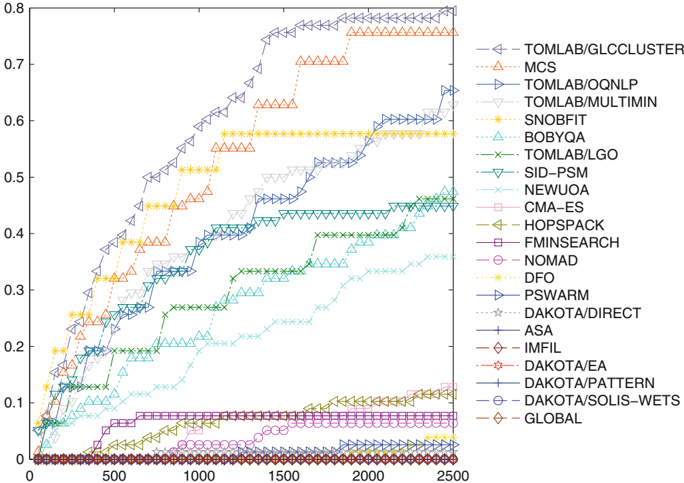
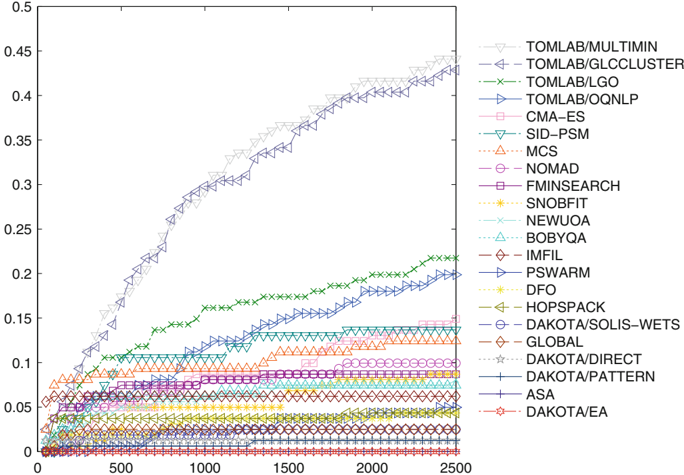
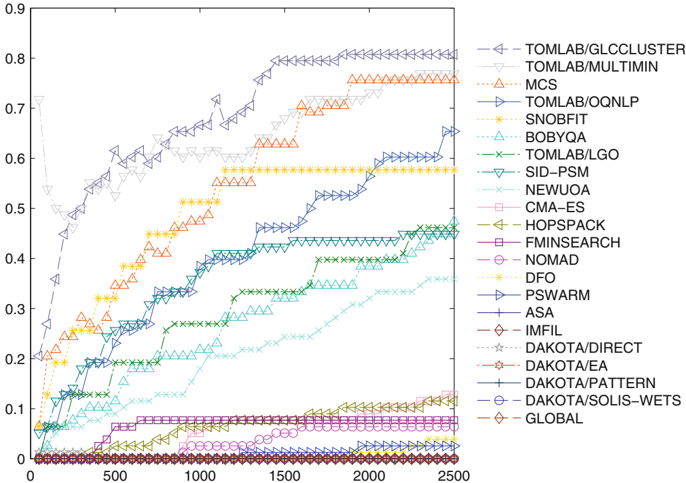
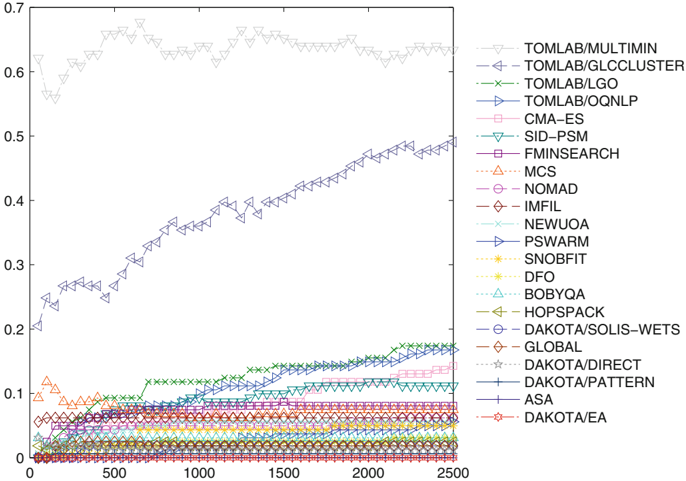
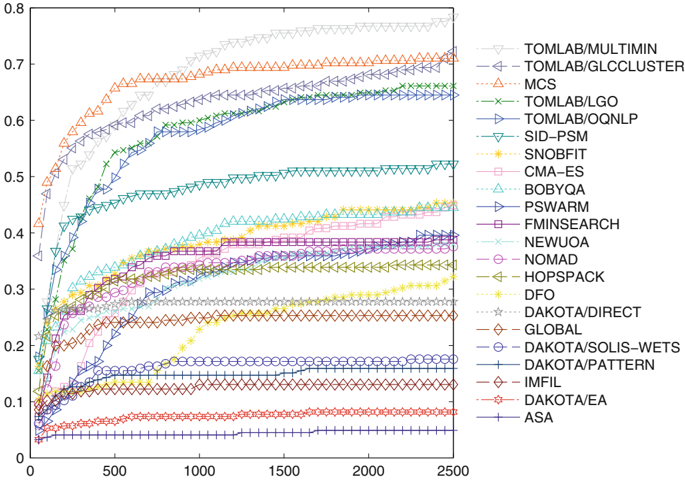
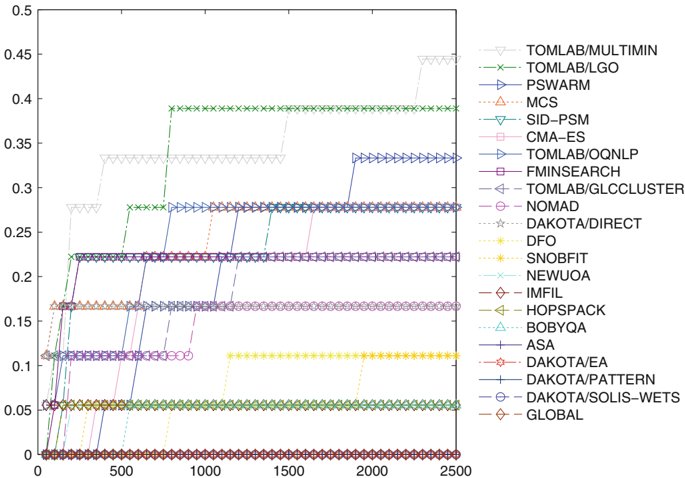
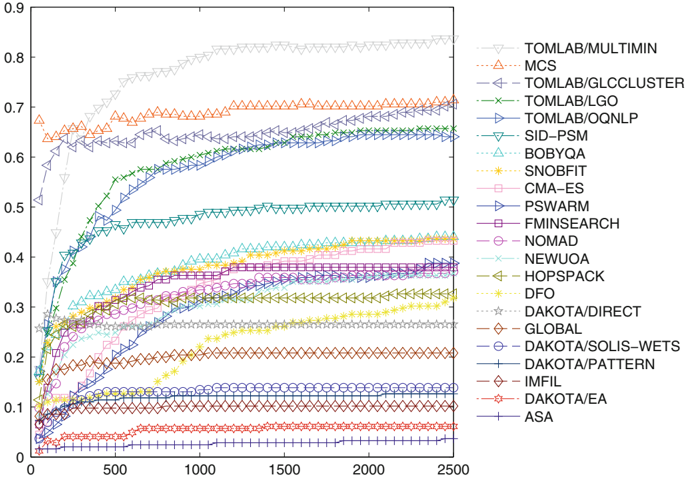
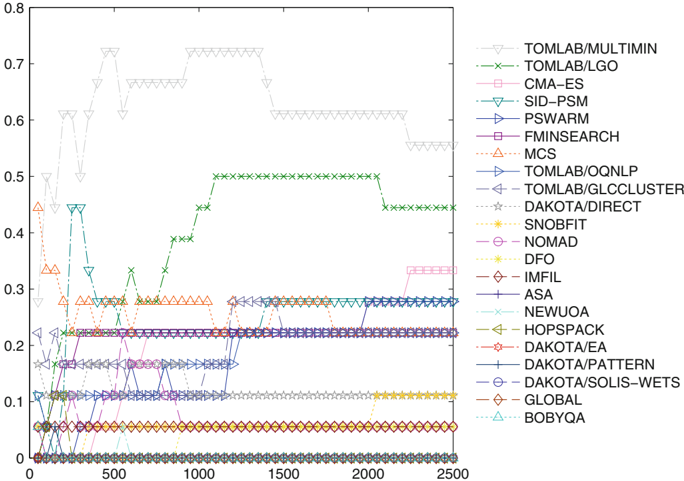
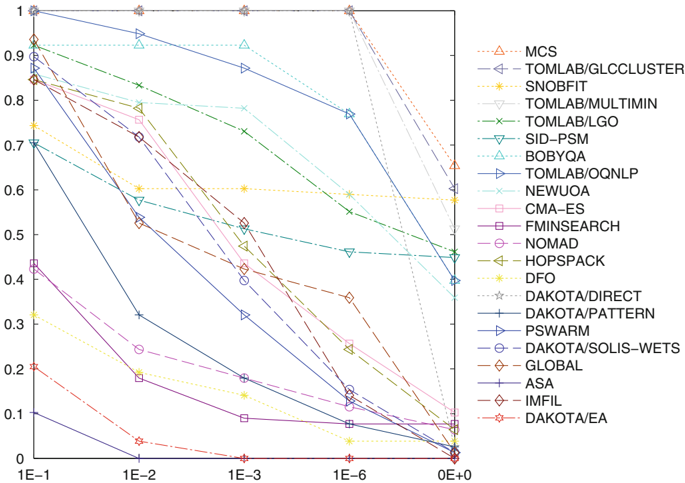
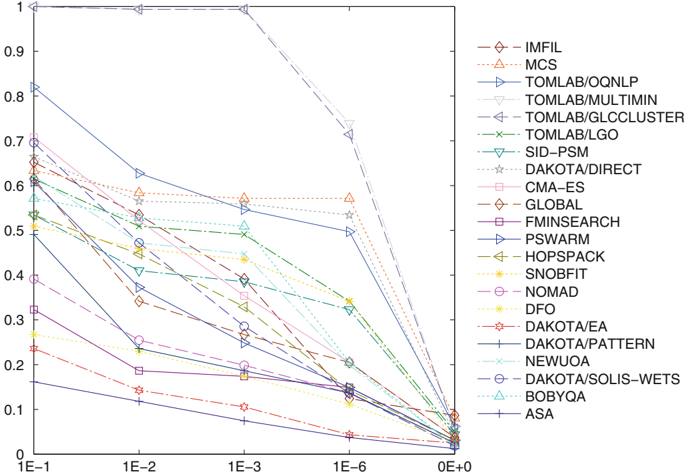
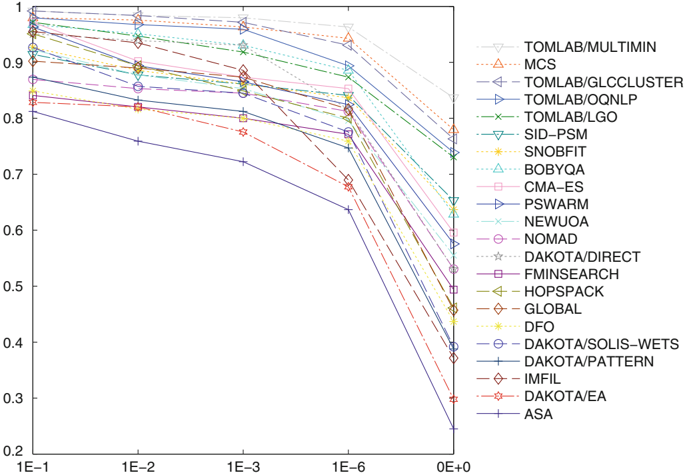
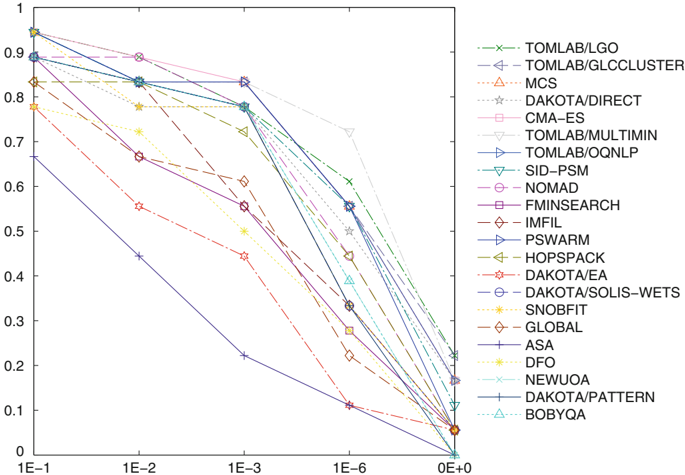
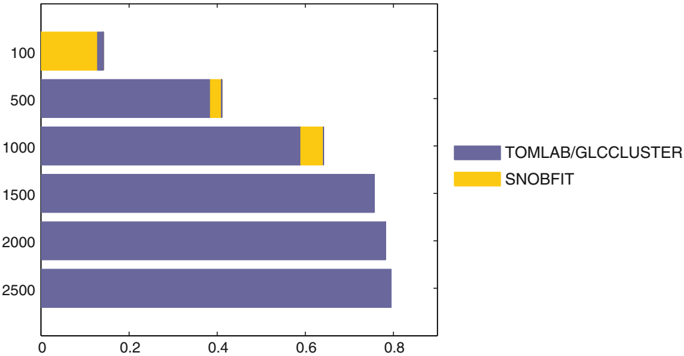
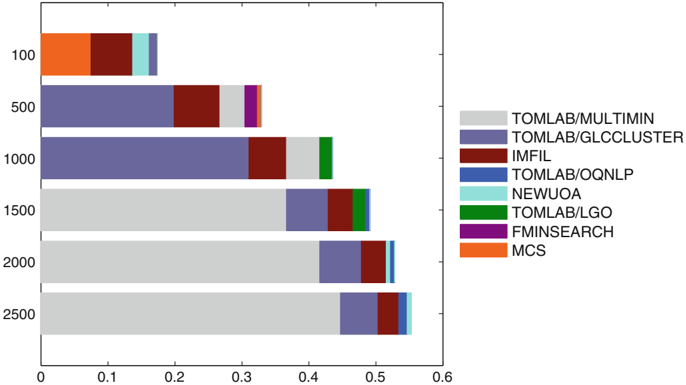
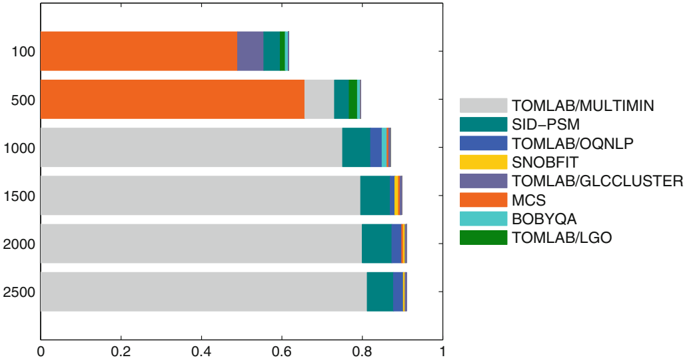
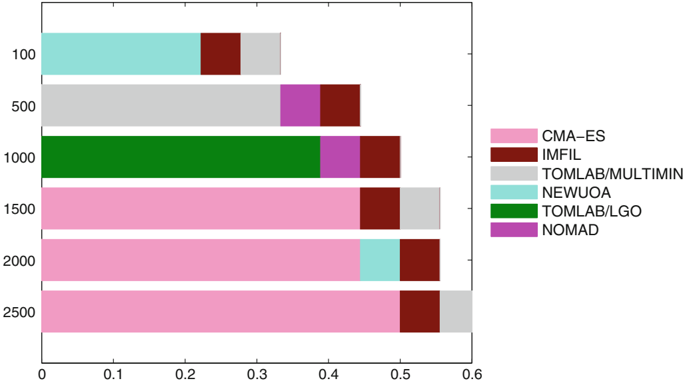
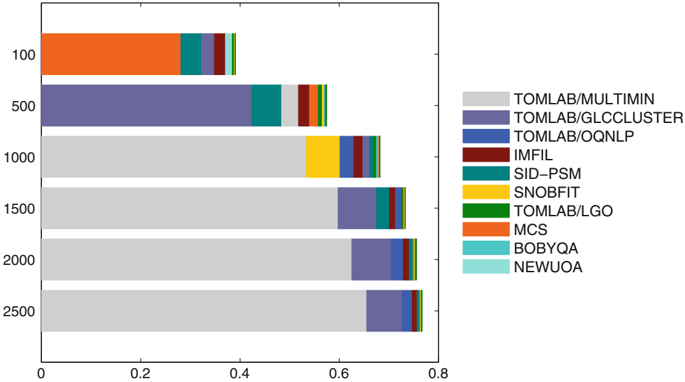
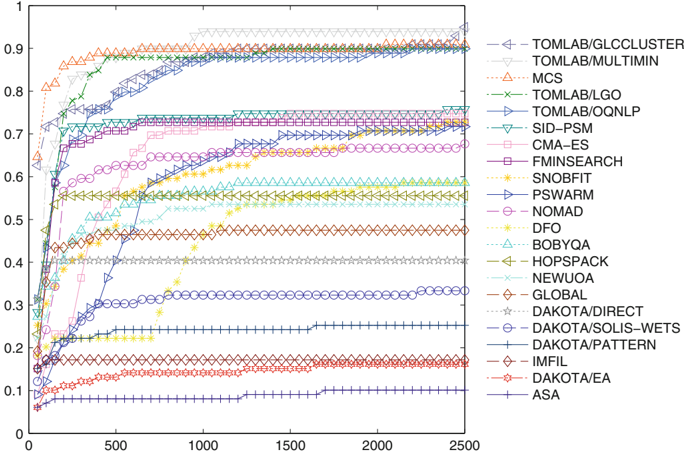
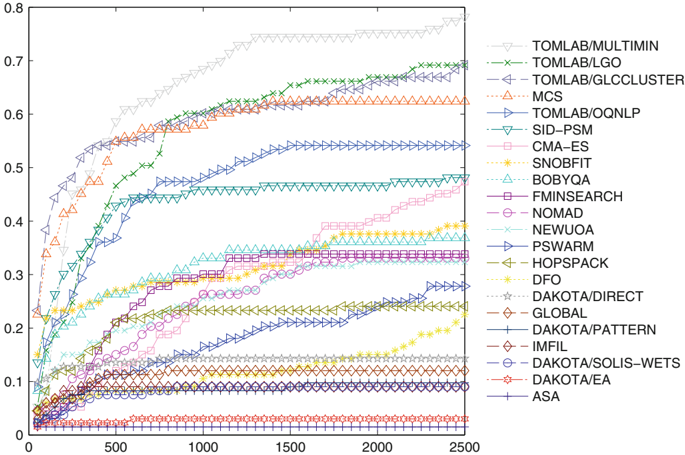
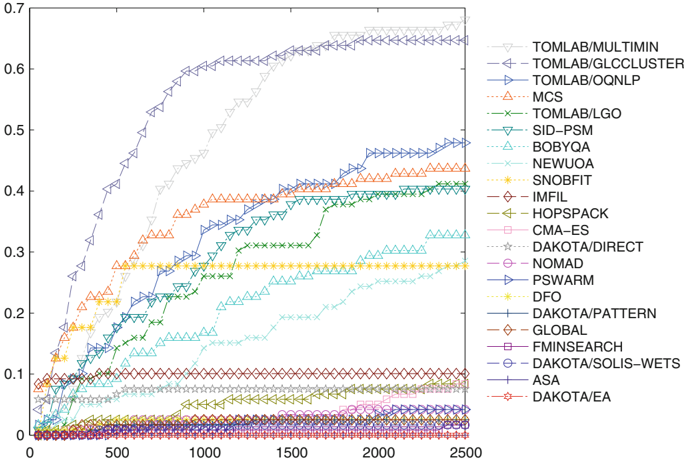
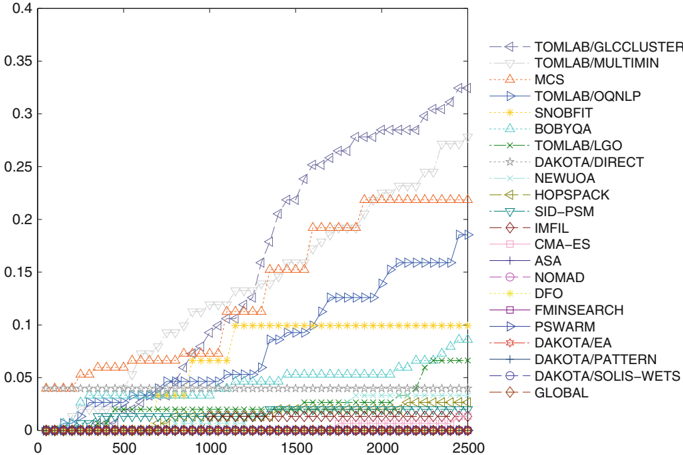
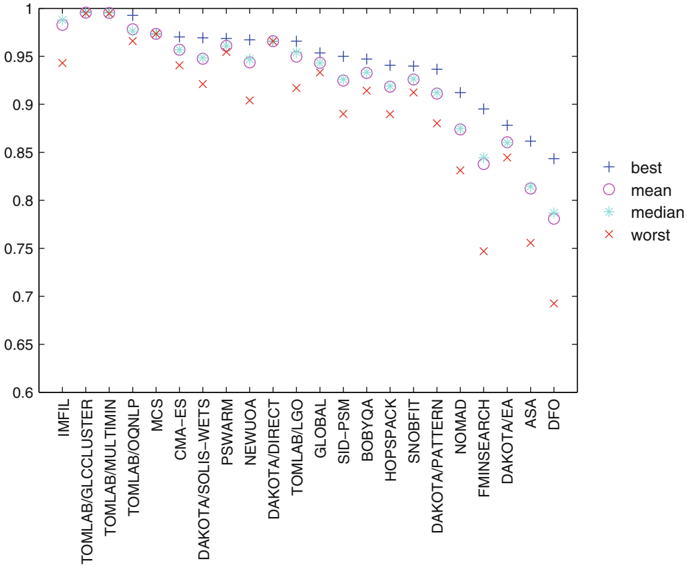
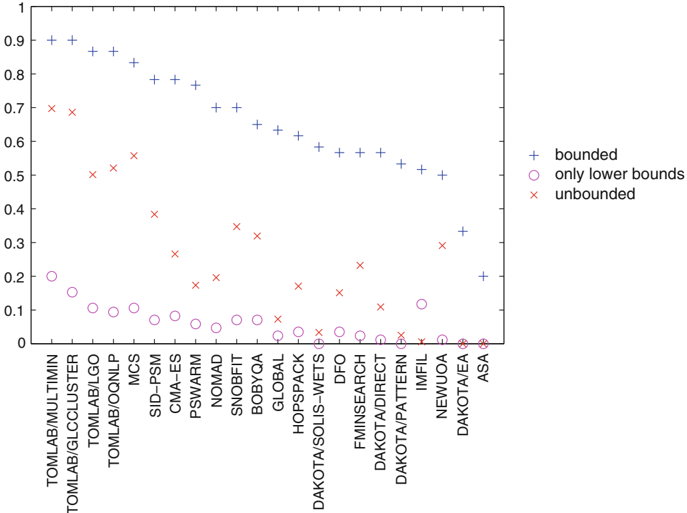
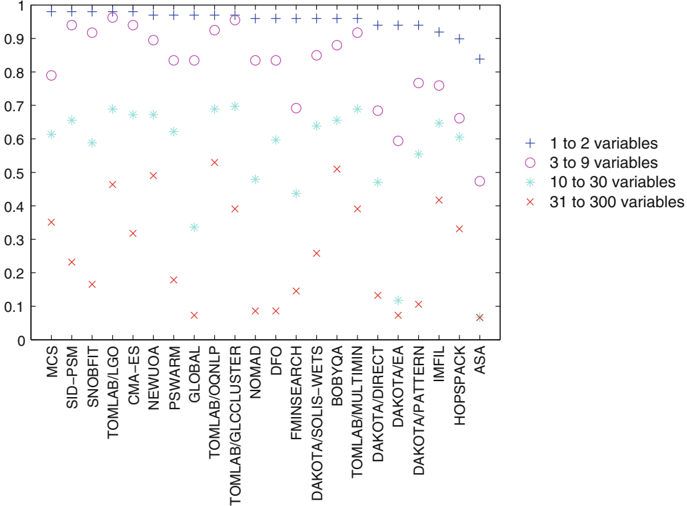
This paper addresses the solution of bound-constrained optimization problems using algorithms that require only the availability of objective function values but no derivative information. We refer to these algorithms as derivative-free algorithms. Fueled by a growing number of applications in science and engineering, the development of derivative-free optimization algorithms has long been studied, and it has found renewed interest in recent time. Along with many derivative-free algorithms, many software implementations have also appeared. The paper presents a review of derivative-free algorithms, followed by a systematic comparison of 22 related implementations using a test set of 502 problems. The test bed includes convex and nonconvex problems, smooth as well as nonsmooth problems. The algorithms were tested under the same conditions and ranked under several criteria, including their ability to find near-global solutions for nonconvex problems, improve a given starting point, and refine a near-optimal solution. A total of 112,448 problem instances were solved. We find that the ability of all these solvers to obtain good solutions diminishes with increasing problem size. For the problems used in this study, , , and are better, on average, than other derivative-free solvers in terms of solution quality within 2,500 function evaluations. These global solvers outperform local solvers even for convex problems. Finally, , , and show superior performance in terms of refining a near-optimal solution.
Overview
The claims and statistics of this paper haven’t been checked yet.
Free: it reads the open-access text and checks the first 5 claims that cite a source we can check. Create a free account to check every claim.
Integrity signals
Registry
Cites
Statistics
Figures
Verification
Claims the paper makes
The claims and statistics of this paper haven’t been checked yet.
Free: it reads the open-access text and checks the first 5 claims that cite a source we can check. Create a free account to check every claim.
Claims other papers make about this one
Each is checked against this paper’s own text: does it say what the citing paper says it does?
In the citing paper
“In the context of quantum chemistry, research has focused on the analog simulation of molecules by mapping the electronic structure problem to a Hamiltonian of spins with additional coupling terms 366 , although proposals exist for simulating chemical reactions 367-369 and protein folding simulations 370,371 .”
From Quantum Chemistry in the Age of Quantum Computing (2019) · cites this paper as [371]
Self-check
Percentages, sums and reported differences re-computed from the paper’s own numbers.
The self-check needs the paper’s full text.
Citations
Cites
Kennedy, J., & Eberhart, R. (2002) · Proceedings of ICNN'95 - International Conference on Neural Networks · doi:10.1109/icnn.1995.488968 · Cited by 58,192
Holland, J. H. (1992) · The MIT Press eBooks · doi:10.7551/mitpress/1090.001.0001 · Cited by 47,002 · cited 3×
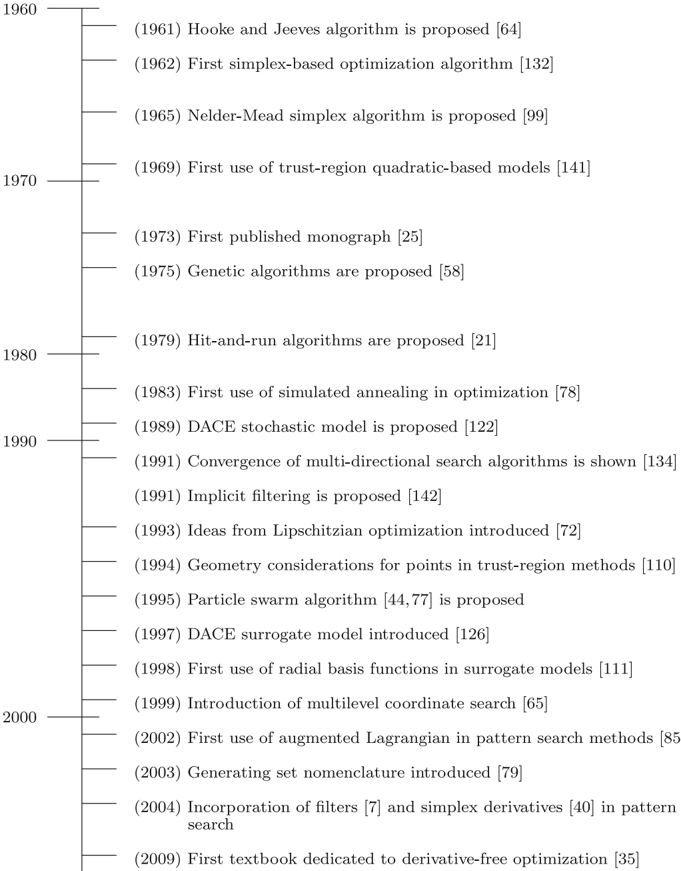
“Examples of methods Table 1 Citations of most cited works in derivative-free algorithms Nelder and Mead [99] 1965 13,486 Brent [25] 1973 2,019 Holland [58] 1975 31,494 Kirkpatrick et al. [78] 1983 23,053 Eberhart and Kennedy [44,77] 1995 20,369 using information from multiple previously evaluated points are genetic al…”
MethodOptimization by Simulated Annealing
Kirkpatrick, S., Gelatt, C. D., & Vecchi, M. P. (1983) · Science · doi:10.1126/science.220.4598.671 · Cited by 45,134 · cited 2×
“Initially proposed to handle combinatorial optimization problems [78], the algorithm was later extended to continuous problems [17].”
Equation of State Calculations by Fast Computing Machines
Metropolis, N., Rosenbluth, A. W., Rosenbluth, M. N., Teller, A. H., & Teller, E. (1953) · The Journal of Chemical Physics · doi:10.1063/1.1699114 · Cited by 37,192
A Simplex Method for Function Minimization
Nelder, J. A., & Mead, R. (1965) · The Computer Journal · doi:10.1093/comjnl/7.4.308 · Cited by 28,905 · cited 11×
“The development of derivative-free algorithms dates back to the works of Spendley et al. [132] and Nelder and Mead [99] with their simplex-based algorithms.”
BackgroundMethodInfluentialA new optimizer using particle swarm theory
Eberhart, R., & Kennedy, J. (2002) · MHS'95. Proceedings of the Sixth International Symposium on Micro Machine and Human Science · doi:10.1109/mhs.1995.494215 · Cited by 16,067 · cited 3×
“Examples of methods Table 1 Citations of most cited works in derivative-free algorithms Nelder and Mead [99] 1965 13,486 Brent [25] 1973 2,019 Holland [58] 1975 31,494 Kirkpatrick et al. [78] 1983 23,053 Eberhart and Kennedy [44,77] 1995 20,369 using information from multiple previously evaluated points are genetic al…”
MethodEfficient Global Optimization of Expensive Black-Box Functions
Jones, D. R., Schonlau, M., & Welch, W. J. (1998) · Journal of Global Optimization · doi:10.1023/a:1008306431147 · Cited by 8,070 · cited 3×
“Although the expected improvement function can be reduced to a closed-form expression [73], it can be highly multimodal.”
BackgroundMethodConvergence Properties of the Nelder--Mead Simplex Method in Low Dimensions
Lagarias, J. C., Reeds, J. A., Wright, M. H., & Wright, P. E. (1998) · SIAM Journal on Optimization · doi:10.1137/s1052623496303470 · Cited by 7,447 · cited 1×
“[81].”
Design and Analysis of Computer Experiments
Sacks, J., Welch, W. J., Mitchell, T. J., & Wynn, H. P. (1989) · Statistical Science · doi:10.1214/ss/1177012413 · Cited by 6,919
(2019) · Handbook of Machine Learning · doi:10.1142/9789811205675_0004 · Cited by 6,270
Research works printed but not linked: 9
- Awasthi, S.: Molecular Docking by Derivative-Free Optimization Solver. Master's thesis, Department of Chemical Engineering, Carnegie Mellon University, Pittsburgh (2008)
- Booker, A.J., Dennis, J.E. Jr., Frank, P.D., Serafini, D.B., Torczon, V.J., Trosset, M.W.: A rigorous framework for optimization of expensive functions by surrogates. Struct. Optim. 17, 1-13 (1999) · DOI · Paper page
- Chang, K.-F.: Modeling and Optimization of Polymerase Chain Reaction Using Derivative-Free Opti- mization. Master's thesis, Department of Chemical Engineering, Carnegie Mellon University, Pittsburgh (2011)
- Desai, R.: A Comparison of Algorithms for Optimizing the Omega Function. Master's thesis, Department of Chemical Engineering, Carnegie Mellon University, Pittsburgh (2010)
- Holland, J.H.: Adaptation in Natural and Artificial Systems. The University of Michigan Press, Ann Arbor (1975)
- Powell, M.J.D.: A direct search optimization method that models the objective by quadratic interpolation. In: Presentation at the 5th Stockholm Optimization Days (1994) 111. · DOI · Paper page
- Wang, H.: Application of Derivative-Free Algorithms in Powder Diffraction. Master's thesis, Department of Chemical Engineering, Carnegie Mellon University, Pittsburgh (2011) 140.
- Winfield, D.: Function and Functional Optimization by Interpolation in Data Tables. PhD thesis, Harvard University, Cambridge (1969) 142.
- Zheng, Y.: Pairs Trading and Portfolio Optimization. Master's thesis, Department of Chemical Engi- neering, Carnegie Mellon University, Pittsburgh (2011)
Cited by
Items 201–300 of 1,002
Bei, X., Chatwattanasiri, N., Coit, D. W., & Zhu, X. (2017) · IEEE Transactions on Reliability · doi:10.1109/tr.2017.2715172 · Cited by 41
“The performance of NOMAD is affected by starting point [15], while the four TOMLAB solvers in Table I are not.”
BackgroundMethodInfluentialLuo, Z., Sun, C. T., & Dong, Q. (2020) · Building and Environment · doi:10.1016/j.buildenv.2020.106854 · Cited by 41
Bouchekara, H. R. E. H. (2020) · Artificial Intelligence Review · doi:10.1007/s10462-020-09890-x · Cited by 41
Electromagnetic-acoustic biphysical cloak designed through topology optimization
FUJII, G., & Akimoto, Y. (2022) · Optics Express · doi:10.1364/oe.450787 · Cited by 41
Learning From Sparse Demonstrations
Jin, W., Murphey, T. D., Kulić, D., Ezer, N., & Mou, S. (2022) · IEEE Transactions on Robotics · doi:10.1109/tro.2022.3191592 · Cited by 49
“Further, the derivative-free methods are known to be challenging for the problem of large size [30].”
MethodA unifying framework for optimization-based design of integrated reaction–separation processes
Recker, S., Skiborowski, M., Redepenning, C., & Marquardt, W. (2015) · Computers & Chemical Engineering · doi:10.1016/j.compchemeng.2015.03.014 · Cited by 40
Thomas, J., Annoni, J. R., Fleming, P., & Ning, A. (2019) · AIAA SciTech Forum · doi:10.2514/6.2019-0538 · Cited by 40
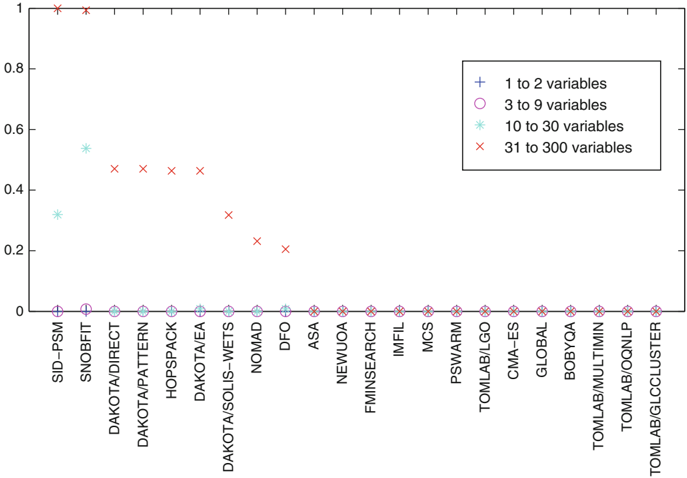
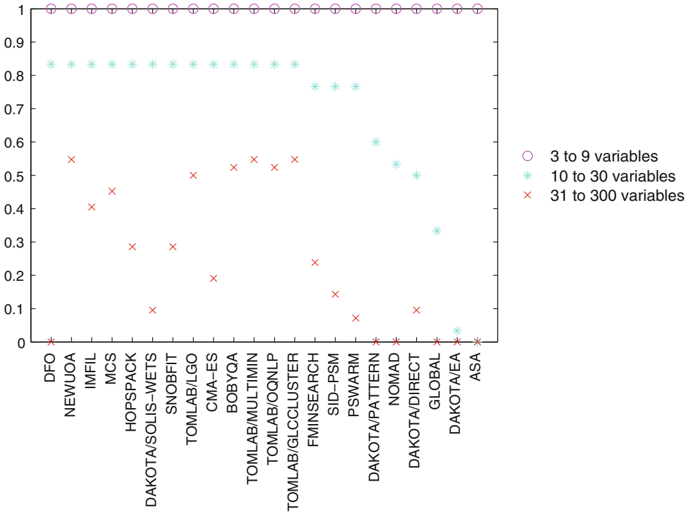
“In [27], most gradient-free solvers were unable to solve more than 15% of the test problems studied with 10–30 design variables, and even the best methods tested could solve only 28% of the test problems with 31–300 design variables.”
BackgroundMethodDirected particle swarm optimization with Gaussian-process-based function forecasting
Jakubik, J., Binding, A., & Feuerriegel, S. (2021) · European Journal of Operational Research · doi:10.1016/j.ejor.2021.02.053 · Cited by 41
Corbetta, M., Grossmann, I. E., & Manenti, F. (2016) · Computers & Chemical Engineering · doi:10.1016/j.compchemeng.2016.02.009 · Cited by 40
“38 Typical problem size should not exceed 10 continuous decision variables in the NLP subproblems, 39 due to the intrinsic limit of DFO solvers (Rios & Sahinidis, 2013), but can reach several hundreds of 40 discrete decision variables in the MILP master problems.”
BackgroundAvoiding local minima in Variational Quantum Algorithms with Neural NetworksPreprint
Rivera-Dean, J., Huembeli, P., Acín, A., & Bowles, J. (2021) · arXiv (Cornell University) · doi:10.48550/arxiv.2104.02955 · Cited by 43
“In this work, we consider gradient based methods [10, 18], which are currently the most common method in VQAs, although derivative-free methods [6, 19, 20] can also be applied.”
MethodNavia, D., Briceño, L., Gutiérrez, G., & de Prada, C. (2015) · Industrial & Engineering Chemistry Research · doi:10.1021/acs.iecr.5b01946 · Cited by 39
Advanced trust region optimization strategies for glass box/black box models
Eason, J. P., & Biegler, L. T. (2018) · AIChE Journal · doi:10.1002/aic.16364 · Cited by 39
Quantum approximate optimization for hard problems in linear algebra
Borle, A., Elfving, V. E., & Lomonaco, S. J. (2021) · SciPost Physics Core · doi:10.21468/scipostphyscore.4.4.031 · Cited by 43
Hieninger, T., Schmidt-Vollus, R., & Schlücker, E. (2021) · Applied Energy · doi:10.1016/j.apenergy.2021.117311 · Cited by 39
Optimization of circuitry arrangements for heat exchangers using derivative-free optimization
Πλόσκας, Ν., Laughman, C. R., Raghunathan, A. U., & Sahinidis, N. V. (2017) · Process Safety and Environmental Protection · doi:10.1016/j.cherd.2017.05.015 · Cited by 39
“According to Rios and Sahinidis [37], DFO”
BackgroundMethodInfluentialSelf-citationEconomic Analysis of Crowdsourced Wireless Community Networks
Ma, Q., Gao, L., Liu, Y.-F., & Huang, J. (2016) · IEEE Transactions on Mobile Computing · doi:10.1109/tmc.2016.2606390 · Cited by 41
“These factors motivates us to use the derivative-free algorithm [24].”
MethodMrDIRECT: a multilevel robust DIRECT algorithm for global optimization problems
Liu, Q., Zeng, J., & Yang, G. (2014) · Journal of Global Optimization · doi:10.1007/s10898-014-0241-8 · Cited by 37
“Moreover, in a recent systematic comparison of 22 derivative-free optimization algorithms, two algorithms (MCS and TOMLAB/GLCCLUSTER) based on DIRECT performed very well [27].”
MethodAdvantages of simplicial partitioning for Lipschitz optimization problems with linear constraints
Paulavičius, R., & Žilinskas, J. (2014) · Optimization Letters · doi:10.1007/s11590-014-0772-4 · Cited by 37
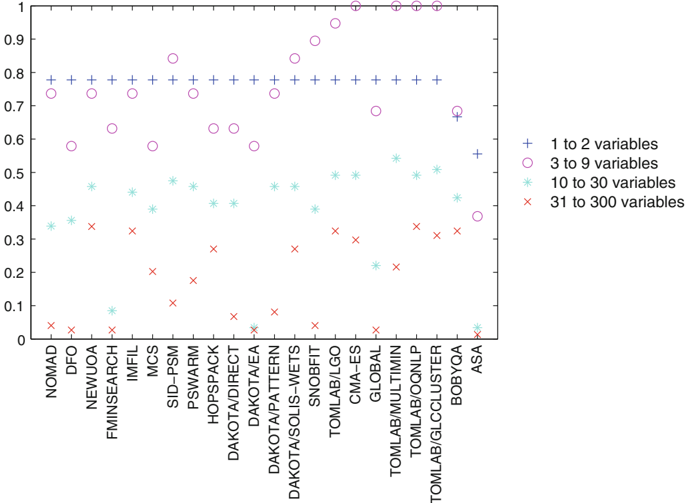
“Recent extensive review and experimental comparison of derivative-free algorithms in [41] revealed, that global solvers ( TOMLAB/MULTI-MIN , TOMLAB/GLCCLUSTER , MCS , and TOMLAB/LGO ) are better, on average, than other derivative-free solvers in terms of solution quality within 2,500 function…”
BackgroundAl, R., Behera, C. R., Gernaey, K. V., & Sin, G. (2020) · Computers & Chemical Engineering · doi:10.1016/j.compchemeng.2020.107118 · Cited by 39
“An extensive overview of different DFO solvers and their performance comparisons can be found elsewhere (Rios and Sahinidis, 2013).”
BackgroundBenchmarking variational quantum eigensolvers for the square-octagon-lattice Kitaev model
Li, A. C. Y., Alam, M. S., Iadecola, T., Jahin, A., Job, J., Kürkçüog̃lu, D. M., Li, R., Orth, P. P., Özgüler, A. B., Perdue, G., et al. (2023) · Physical Review Research · doi:10.1103/physrevresearch.5.033071 · Cited by 39
“Similar to optimizing other classical nonconvex cost functions, it is typically hard to decide on an efficient optimizer a priori [98].”
An efficient geometry-based optimization approach for well placement in oil fields
Hamida, Z., Azizi, F., & Saad, G. A. (2016) · Journal of Petroleum Science and Engineering · doi:10.1016/j.petrol.2016.10.055 · Cited by 37
Schwarz, H., Bertsch, V., & Fïchtner, W. (2017) · OR Spectrum · doi:10.1007/s00291-017-0500-4 · Cited by 46
Global convergence of neuron birth-death dynamicsPreprint
Rotskoff, G. M., Jelassi, S., Bruna, J., & Vanden‐Eijnden, E. (2019) · arXiv (Cornell University) · doi:10.48550/arxiv.1902.01843 · Cited by 51
“Derivative-free optimization [RS13] offers a general framework for optimizing complex non-convex functions using non-local search heuristics.”
MethodTime and Location Aware Mobile Data Pricing
Ma, Q., Liu, Y., & Huang, J. (2015) · IEEE Transactions on Mobile Computing · doi:10.1109/tmc.2015.2503763 · Cited by 36
Jenkinson, G., Abante, J., Feinberg, A. P., & Goutsias, J. I. (2018) · BMC Bioinformatics · doi:10.1186/s12859-018-2086-5 · Cited by 38
“, simulated annealing), in agreement with recent findings [33].”
ResultDetermination of a Building's balance point temperature as an energy characteristic
Krese, G., Lampret, Ž., Butala, V., & Prek, M. (2018) · Energy · doi:10.1016/j.energy.2018.10.025 · Cited by 37
Stochastic Revealed Preferences with Measurement Error
Aguiar, V. H., & Kashaev, N. (2020) · The Review of Economic Studies · doi:10.1093/restud/rdaa067 · Cited by 52
A Clustered Overflow Configuration of Inpatient Beds in Hospitals
Izady, N., & Mohamed, I. (2019) · Manufacturing & Service Operations Management · doi:10.1287/msom.2019.0820 · Cited by 46
Smart Nanoscopy: A Review of Computational Approaches to Achieve Super-Resolved Optical Microscopy
Kaderuppan, S. S., Wong, E. W. L., Sharma, A., & Woo, W. L. (2020) · IEEE Access · doi:10.1109/access.2020.3040319 · Cited by 38
Iwama, R., & Kaneko, H. (2021) · Journal of Advanced Manufacturing and Processing · doi:10.1002/amp2.10085 · Cited by 36
A comparison of optimisation algorithms for high-dimensional particle and astrophysics applications
The DarkMachines High Dimensional Sampling Group, Balázs, C., van Beekveld, M. C., Caron, S., Dillon, B. M., Farmer, B., Fowlie, A., Garrido‐Merchán, E. C., Handley, W. J., Hendriks, L., et al. (2021) · Journal of High Energy Physics · doi:10.1007/jhep05(2021)108 · Cited by 42
Optimization of Turbine Engine Cycle Analysis with Analytic Derivatives
Gray, J. S., Hendricks, E. S., Chin, J., Hearn, T. A., & Moore, K. T. (2016) · NASA STI Repository (National Aeronautics and Space Administration) · Cited by 36
Global optimization for accurate determination of EBSD pattern centers
Pang, E. L., Larsen, P. M., & Schuh, C. A. (2019) · Ultramicroscopy · doi:10.1016/j.ultramic.2019.112876 · Cited by 36
“Performance of the SNOBFIT algorithm We have selected the SNOBFIT (Stable Noisy Optimization by Branch and Fit) algorithm [48], which belongs to a class of derivative-free global optimization algorithms [46].”
MethodEfficient numerical methods for the optimisation of large kinetic reaction mechanisms
Goitom, S. K., Papp, M., Kovács, M., Nagy, T. Z., Zsély, I. G., Turányi, T., & Pál, L. (2022) · Combustion Theory and Modelling · doi:10.1080/13647830.2022.2110945 · Cited by 35
“The method appeared as a reference algorithm in many relevant articles and studies (Hansen et al. [80], Rios and Sahinidis [87]).”
BackgroundScalable Inference of Ordinary Differential Equation Models of Biochemical Processes
Fröhlich, F., Loos, C., & Hasenauer, J. (2018) · Methods in molecular biology · doi:10.1007/978-1-4939-8882-2_16 · Cited by 45
“rily close to 1, but might only do so after infinitely many function evaluations. In practice, many meta-heuristic algorithms even fail to work reliably for smooth, convex problems with few parameters [68]. In fact, for some algorithms, non-convergence can even be proven mathematically [69]. Eventually, even a rigorous…”
BackgroundOptimal design of boil-off gas reliquefaction process in LNG regasification terminals
Rao, H. N., & Karimi, I. A. (2018) · Computers & Chemical Engineering · doi:10.1016/j.compchemeng.2018.06.003 · Cited by 35
Combining Bayesian optimization and Lipschitz optimization
Ahmed, M. O., Vaswani, S., & Schmidt, M. (2019) · Machine Learning · doi:10.1007/s10994-019-05833-y · Cited by 36
DIRECTGO : A New DIRECT -Type MATLAB Toolbox for Derivative-Free Global Optimization
Stripinis, L., & Paulavičius, R. (2022) · ACM Transactions on Mathematical Software · doi:10.1145/3559755 · Cited by 40
“Moreover, a recent review and comparison in [75] revealed that, on average, DIRECT-type algorithms performance is one of the best among all tested state-of-the-art derivative-free global optimization approaches.”
BackgroundWeight and power optimization of steam bottoming cycle for offshore oil and gas installations
Nord, L. O., Martelli, E., & Bolland, O. (2014) · Energy · doi:10.1016/j.energy.2014.08.090 · Cited by 35
“A review and benchmarking of methods can be found in [10] for unconstrained and bound-constrained problems, and in [11] for nonlinearly constrained problems.”
BackgroundCoordinated distribution network control of tap changer transformers, capacitors and PV inverters
Ceylan, O., Liu, G., & Tomsovic, K. L. (2017) · Electrical Engineering · doi:10.1007/s00202-017-0563-x · Cited by 37
Equation-oriented optimization of reactive distillation systems using pseudo-transient models
Ma, Y., Luo, Y., & Yuan, X. (2018) · Chemical Engineering Science · doi:10.1016/j.ces.2018.09.036 · Cited by 35
A methodology for simulation-based, multiobjective gear design optimization
Artoni, A. (2018) · Mechanism and Machine Theory · doi:10.1016/j.mechmachtheory.2018.11.013 · Cited by 37
Optimal automatic detection of muscle activation intervals
Rashid, U., Niazi, I. K., Signal, N., Farina, D., & Taylor, D. (2019) · Journal of Electromyography and Kinesiology · doi:10.1016/j.jelekin.2019.06.010 · Cited by 34
Aghaei, V. T., Ağababaoğlu, A., Bawo, B., Naseradinmousavi, P., Yıldırım, S., Yeşilyurt, S., & Onat, A. (2023) · Applied Energy · doi:10.1016/j.apenergy.2023.121108 · Cited by 34
Heuristics for Quantum Compiling with a Continuous Gate SetPreprint
Davis, M., Smith, E., Tudor, A., Sen, K., Siddiqi, I. A., & Iancu, C. (2019) · arXiv (Cornell University) · doi:10.48550/arxiv.1912.02727 · Cited by 34
“[46] provide a very useful overview of derivative-free methods.”
BackgroundPyBADS: Fast and robust black-box optimization in Python
Singh, G. S., & Acerbi, L. (2024) · The Journal of Open Source Software · doi:10.21105/joss.05694 · Cited by 33
Optimization and Mathematical Modeling in Computer Architecture
Nowatzki, T., Ferris, M. C., Sankaralingam, K., Estan, C., Vaish, N., & Wood, D. (2013) · Synthesis lectures on computer architecture · doi:10.1007/978-3-031-01773-5 · Cited by 40
Concepts for lifetime efficient supply of power and heat to offshore installations in the North Sea
Riboldi, L., & Nord, L. O. (2017) · Energy Conversion and Management · doi:10.1016/j.enconman.2017.06.048 · Cited by 33
“Rios and Sahinidis [37] reviewed those for unconstrained and bound-constrained problems.”
BackgroundContaminant source localization via Bayesian global optimization
Pirot, G., Krityakierne, T., Ginsbourger, D., & Renard, P. (2019) · Hydrology and earth system sciences · doi:10.5194/hess-23-351-2019 · Cited by 33
“…are dedicated to specific classes of optimization problems (integer programming, mixed linear integer programming), and few seem to be available for nonlinear optimization over finite sets beyond metaheuristics used in combinatorial optimization (Rios and Sahinidis, 2013). the case of our contaminant”
BackgroundRafiei, V., Nejadhashemi, A. P., Mushtaq, S., Bailey, R. T., & An-Vo, D.-A. (2022) · Environmental Modelling & Software · doi:10.1016/j.envsoft.2022.105312 · Cited by 33
Maintenance cost minimization of manufacturing systems using PSO under reliability constraint
Loganathan, M. K., & Gandhi, O. P. (2015) · International Journal of Systems Assurance Engineering and Management · doi:10.1007/s13198-015-0374-2 · Cited by 33
“This can be achieved by employing meta-heuristic and derivative-free techniques (Rios and Sahinidis 2013), e.”
MethodDutta, A., Karimi, I. A., & Farooq, S. (2018) · Industrial & Engineering Chemistry Research · doi:10.1021/acs.iecr.7b04311 · Cited by 34
Kaya, M., & Hajimirza, S. (2018) · Solar Energy · doi:10.1016/j.solener.2018.02.062 · Cited by 34
MO-MCS, a Derivative-Free Algorithm for the Multiobjective Optimization of Adsorption Processes
Capra, F., Gazzani, M., Joss, L., Mazzotti, M., & Martelli, E. (2018) · Industrial & Engineering Chemistry Research · doi:10.1021/acs.iecr.8b00207 · Cited by 33
Pirhooshyaran, M., Scheinberg, K., & Snyder, L. (2020) · Energy · doi:10.1016/j.energy.2020.117136 · Cited by 35
“We refer the reader to [5, 31] for details on poisedness of X .”
BackgroundThe Response of Drug Expenditures to Non-Linear Contract Design: Evidence from Medicare Part D
Einav, L., Finkelstein, A. N., & Schrimpf, P. (2013) · National Bureau of Economic Research · doi:10.3386/w19393 · Cited by 40
Negrellos-Ortiz, I., Flores‐Tlacuahuac, A., & Gutiérrez‐Limón, M. A. (2017) · Computers & Chemical Engineering · doi:10.1016/j.compchemeng.2017.10.020 · Cited by 32
Tuning BARON using derivative-free optimization algorithms
Liu, J., Πλόσκας, Ν., & Sahinidis, N. V. (2018) · Journal of Global Optimization · doi:10.1007/s10898-018-0640-3 · Cited by 32
“Although extensive comparisons of various DFO methods, as well as their corresponding software implementations, have been made by Rios and Sahinidis [32], these comparisons were performed on algebraically available problems, i.e., not on true true black-box systems such as the solver tuning problem.”
BackgroundMethodResultInfluentialSelf-citationZhu, X., Bei, X., Chatwattanasiri, N., & Coit, D. W. (2018) · IEEE Transactions on Reliability · doi:10.1109/tr.2018.2798298 · Cited by 32
“Since the performance of NOMAD is affected by starting points [15], we use ten different starting points, which are randomly generated within [0, xmax j ].”
MethodData‐driven decision‐focused surrogate modeling
Gupta, R., & Zhang, Q. (2024) · AIChE Journal · doi:10.1002/aic.18338 · Cited by 41
Liu, Q., Chen, W., Deng, J. D., Gu, T., Zhang, H., Yu, Z., & Zhang, J. (2017) · IEEE Transactions on Cybernetics · doi:10.1109/tcyb.2017.2659659 · Cited by 34
Kaya, M., & Hajimirza, S. (2018) · Scientific Reports · doi:10.1038/s41598-018-26469-3 · Cited by 32
“Note that according to (1), EQE has two components: an optical component (ηA) which has a complicated tie to all geometry parameters and material choices, and can only be determined via solving the Maxwell’s equations.”
Open-source optimization algorithms for optical design
Sahin, F. E. (2018) · Optik · doi:10.1016/j.ijleo.2018.10.073 · Cited by 32
Optimising cargo loading and ship scheduling in tidal areas
Carrer, N. L., Ferson, S. A., & Green, P. L. (2019) · European Journal of Operational Research · doi:10.1016/j.ejor.2019.08.002 · Cited by 32
Optimization of black-box problems using Smolyak grids and polynomial approximations
Kieslich, C. A., Boukouvala, F., & Floudas, C. A. (2018) · Journal of Global Optimization · doi:10.1007/s10898-018-0643-0 · Cited by 31
“…one can find many contributions in the area of data-assisted optimization, such as direct-search[1],black-boxoptimization[2–5],derivative-freeoptimization[6–11],grey-box optimization[12],glass/black-boxoptimization[13],simulationoptimization[14–18]and evolutionaryorstochasticoptimization[19–21].”
BackgroundMethodInfluentialRamzanpour, M., Hosseini‐Farid, M., McLean, J., Ziejewski, M., & Karami, G. (2020) · Medical & Biological Engineering & Computing · doi:10.1007/s11517-020-02228-3 · Cited by 31
Suboptimal Nonlinear Moving Horizon Estimation
Schiller, J. D., & Müller, M. A. (2022) · IEEE Transactions on Automatic Control · doi:10.1109/tac.2022.3173937 · Cited by 32
“, by using derivative-free optimization methods [26].”
Numerical hybrid Taguchi-random coordinate search algorithm for path synthesis
Kim, J., Jeong, S., Kim, J., & Seo, T. (2016) · Mechanism and Machine Theory · doi:10.1016/j.mechmachtheory.2016.04.001 · Cited by 32
NOWPAC: A provably convergent derivative-free nonlinear optimizer with path-augmented constraintsPreprint
Augustin, F., & Marzouk, Y. (2014) · arXiv (Cornell University) · doi:10.48550/arxiv.1403.1931 · Cited by 31
“s in our feasibility requirement for every trial step; the trust-funnel approach, on the other hand, allows for constraint violations which are reduced while approaching a critical point. We refer to [37, 18, 53] for further overviews of derivative-free approaches. The main contributions of this paper are threefold. F…”
MethodXia, W., & Shoemaker, C. A. (2020) · Optimization and Engineering · doi:10.1007/s11081-020-09556-1 · Cited by 30
Ullah, Z., Yan, L., Rehman, A. U., Qazi, H. S., Wu, X., Li, J., & Hasanien, H. M. (2024) · IEEE Access · doi:10.1109/access.2024.3439019 · Cited by 29
“As DFO approach is supposed to be one of the well-known growth options for dealing with challenging situations [43].”
BackgroundOptimization by Adaptive Stochastic Descent
Kerr, C. C., Durá-Bernal, S., Smolinski, T. G., Chadderdon, G. L., & Wilson, D. P. (2018) · PLoS ONE · doi:10.1371/journal.pone.0192944 · Cited by 29
Hybrid Surrogate-Based Constrained Optimization With a New Constraint-Handling Method
Su, Y., Xu, L., & Goodman, E. D. (2020) · IEEE Transactions on Cybernetics · doi:10.1109/tcyb.2020.3031620 · Cited by 29
Kurtin, D. L., Giunchiglia, V., Vohryzek, J., Cabral, J., Skeldon, A. C., & Violante, I. R. (2023) · NeuroImage · doi:10.1016/j.neuroimage.2023.120042 · Cited by 33
A modified DIRECT algorithm with bilevel partition
Liu, Q., & Cheng, W. (2013) · Journal of Global Optimization · doi:10.1007/s10898-013-0119-1 · Cited by 29
“Moreover, in a recent comparison of derivative-free algorithms, two algorithms based on DIRECT (MCS and TOMLAB/GLCCLUSTER) performed very well [20].”
MethodIntegrated free‐form method for aerostructural optimization of wind turbine blades
Barrett, R., & Ning, A. (2018) · Wind Energy · doi:10.1002/we.2186 · Cited by 29
“corroborates this idea when they tested 502 optimization problems with 22 gradient-free solvers and showed that, generally speaking, the performance of the optimizer suffers when there are over 30 design variables [22].”
MethodA Machine Learning Approach to Correlation Development Applied to Fin-Tube Bundle Heat Exchangers
Lindqvist, K., Wilson, Z. T., Næss, E., & Sahinidis, N. V. (2018) · Energies · doi:10.3390/en11123450 · Cited by 29
Self-citationLightning Transient Analysis of Radio Base Stations
Chen, H., Du, Y., & Chen, M. (2017) · IEEE Transactions on Power Delivery · doi:10.1109/tpwrd.2017.2788039 · Cited by 28
“Circuit parameters in (10), (11) and (12) are determined by fitting the measured characteristic curve with the optimization method [27], [31] after removing parasitic inductance.”
MethodXue, F., Lu, W., Webster, C. J., & Chen, K. (2018) · ISPRS Journal of Photogrammetry and Remote Sensing · doi:10.1016/j.isprsjprs.2018.12.005 · Cited by 33
“3a, while five algorithms including DIRECT, sepaIPOP-CMA, ABC, CMAES, and MLSL-LDS have very close accuracy when k ≥ 5, 000.”
BackgroundMethodInfluentialYan, T., Wang, D., Hou, B., & Peng, Z. (2021) · IEEE Transactions on Reliability · doi:10.1109/tr.2021.3087698 · Cited by 28
“Finally, the quadratic programming problem formulated in (8) can be solved using the SNOPT solver developed in the TOMLAB [29].”
MethodCho, S., Kim, M., Lee, J., Han, A., Na, J., & Moon, I. (2022) · Engineering Applications of Artificial Intelligence · doi:10.1016/j.engappai.2022.105463 · Cited by 29
Gradient-Free Textual Inversion
Fei, Z., Fan, M., & Huang, J. (2023) · ACM International Conference on Multimedia (ACM MM) · doi:10.1145/3581783.3612599 · Cited by 40
“In general, GFO involves a kind of optimization algorithms that do not require gradients, but only rely on function values or fitness values of iteratively sampled solutions [41].”
BackgroundMethodBrookings, T., Goeritz, M. L., & Marder, E. E. (2014) · Journal of Neurophysiology · doi:10.1152/jn.00007.2014 · Cited by 31
Heuristic methods and performance bounds for photonic design
Angeris, G., Vučković, J., & Boyd, S. (2020) · Optics Express · doi:10.1364/oe.415052 · Cited by 41
CenPSO: A Novel Center-based Particle Swarm Optimization Algorithm for Large-scale Optimization
Mousavirad, S. J., & Rahnamayan, S. (2020) · Conference proceedings/Conference proceedings - IEEE International Conference on Systems, Man, and Cybernetics · doi:10.1109/smc42975.2020.9283143 · Cited by 28
Bias Mitigation in Federated Learning for Edge Computing
Djebrouni, Y., Benarba, N., Touat, O., Rosa, P. D., Bouchenak, S., Bonifati, A., Felber, P. A., Marangozova‐Martin, V., & Schiavoni, V. (2023) · Proceedings of the ACM on Interactive Mobile Wearable and Ubiquitous Technologies · doi:10.1145/3631455 · Cited by 33
“Thus, to find the best weights vector w , we apply a black-box optimization method, which does not require a specific type (convexity, continuity, etc .) of the studied function [56].”
MethodDerivative-Free Optimization for Low-Rank Adaptation in Large Language Models
Jin, F., Liu, Y., & Tan, Y. (2024) · IEEE/ACM Transactions on Audio Speech and Language Processing · doi:10.1109/taslp.2024.3477330 · Cited by 44
“Derivative-free optimization (DFO) algorithms (Wierstra et al., 2014; Rios and Sahinidis, 2013; Qian et al., 2016) are capable of tackling complex problems without relying on the back-propagation.”
BackgroundLLM-guided chemical process optimization with a multi-agent approach
Zeng, T., Badrinarayanan, S., Ock, J., Lai, C.-K., & Farimani, A. B. (2025) · Machine Learning Science and Technology · doi:10.1088/2632-2153/ae2382 · Cited by 40
“When these requirements cannot be met, alternative methods such as evolutionary algorithms [7], and derivative-free methods [8] provide viable solutions.”
Algorithm sensitivity analysis and parameter tuning for tissue image segmentation pipelines
Teodoro, G., Kurç, T., Taveira, L. F. R., de Melo, A. C. M. A., Gao, Y., Kong, J., & Saltz, J. H. (2016) · Bioinformatics · doi:10.1093/bioinformatics/btw749 · Cited by 32
“…optimization have been developed and successfully applied in several application domains (Campolongo et al. , 2007; Jones, 2001; Morris, 1991; Rios and Sahinidis, 2013; Saltelli et al. , 2004; Sareni and Kr € ahenbu¨hl, 1998; Snoek et al. , 2012; Tabatabaee et al. , 2005; Weirs et al. ,…”
BackgroundMethodInfluentialZhu, M., Piga, D., & Bemporad, A. (2021) · IEEE Transactions on Control Systems Technology · doi:10.1109/tcst.2021.3136711 · Cited by 33
“The next sample x N +1 to test is obtained by minimizing a ( x ) , i.e. , x Different optimization methods can be used to solve problem (21) efficiently either via derivative-free [39], or derivative based algorithms.”
MethodBriceno-Mena, L. A., Arges, C. G., & Romagnoli, J. A. (2023) · Computers & Chemical Engineering · doi:10.1016/j.compchemeng.2023.108159 · Cited by 27
A Tutorial on Derivative-Free Policy Learning Methods for Interpretable Controller Representations
Paulson, J. A., Sorourifar, F., & Mesbah, A. (2023) · Proceedings of the ... American Control Conference/Proceedings of the American Control Conference · doi:10.23919/acc55779.2023.10156412 · Cited by 39
“There has been a significant amount of work on DFO, with a comprehensive survey of methods provided in [20], [21].”
ParEGO extensions for multi-objective optimization of expensive evaluation functions
Davins-Valldaura, J., Moussaoui, S., Pita-Gil, G., & Plestan, F. (2016) · Journal of Global Optimization · doi:10.1007/s10898-016-0419-3 · Cited by 27
“DACE models used in multi-objective optimization problems [34,41] are based on Kriging [20,23,39], radial-basis functions [13,33], support vector machines [38], artificial neural networks [31] and multi-variate adaptive regression splines [12].”
BackgroundMethodA Direct Search Algorithm for Global Optimization
Baeyens, E., Herreros, A., & Perán, J. R. (2016) · Algorithms · doi:10.3390/a9020040 · Cited by 27
“Direct search optimization has been receiving increasing attention over recent years within the optimization community, including the establishment of solid mathematical foundations for many of the methods considered in practice [1,3–7].”
MethodMine Planning and Oil Field Development: A Survey and Research Potentials
Lamghari, A. (2017) · Mathematical Geosciences · doi:10.1007/s11004-017-9676-z · Cited by 27
“A more detailed discussion of these methods is given in Conn et al. (2009) and Rios and Sahinidis (2013).”
MethodMa, Y., Luo, Y., Ma, X., Tao, Y., Chen, D., & Yuan, X. (2018) · Industrial & Engineering Chemistry Research · doi:10.1021/acs.iecr.8b01461 · Cited by 27
An extension of golden section algorithm for n-variable functions with MATLAB code
Rani, G. S., Jayan, S., & Nagaraja, K. V. (2019) · IOP Conference Series Materials Science and Engineering · doi:10.1088/1757-899x/577/1/012175 · Cited by 27
Optimization of a dual mixed refrigerant process using a nonsmooth approach
Vikse, M., Watson, H. A. J., Kim, D., Barton, P. I., & Gundersen, T. (2020) · Energy · doi:10.1016/j.energy.2020.116999 · Cited by 27
“Consequently, no local optimawere obtained, and the PSO algorithm terminatedwith the best known solutionwithin 500 iterations.”
MethodInfluentialA survey of deep network techniques all classifiers can adopt
Ghods, A., & Cook, D. J. (2020) · Data Mining and Knowledge Discovery · doi:10.1007/s10618-020-00722-8 · Cited by 31
Faiçal, B. S., Pessin, G., Filho, G. P. R., de Carvalho, A. C. P. L. F., Gomes, P. H., & Ueyama, J. (2016) · International Journal of Artificial Intelligence Tools · doi:10.1142/s0218213016600034 · Cited by 26
Metadata
- Authors
- Rios, L. M., & Sahinidis, N. V.
- Affiliations
- Carnegie Mellon University (US)
- Corresponding author
- Sahinidis, Nikolaos V.
- Venue
- Journal of Global Optimization
- Published
- 2012-07-12
- Volume
- 56
- Issue
- 3
- Pages
- 1247-1293
- ISSN
- 0925-5001 (ISSN-L)
- 1573-2916
- OpenAlex
- W2160960847
- Cited by
- 1,276
- References
- 132
- Citations by year
- 2026: 57 · 2025: 65 · 2024: 79 · 2023: 99 · 2022: 114 · 2021: 138 · 2020: 167 · 2019: 125 · 2018: 108 · 2017: 93 · 2016: 87 · 2015: 57 · 2014: 58 · 2013: 15 · 2012: 8
- FWCI
- 52.92
- Type
- journal article
- Language
- en
- Open access
- hybrid
- doi.org
- Licence
- cc-by
- creativecommons.org/licenses/by/2.0 (tdm)
- creativecommons.org/licenses/by/2.0 (vor)
- Locations
- Journal of Global Optimization (publishedVersion, cc-by)
- RePEc: Research Papers in Economics (submittedVersion)
- Funders
- National Science Foundation (1033661, DE-FE-0004000)
- National Institutes of Health
- National Energy Technology Laboratory (DE-FE-0004000, 0004000)
- National Institute of General Medical Sciences (GM072023)
- Division of Chemical, Bioengineering, Environmental, and Transport Systems
- Topics
- Physical Sciences › Mathematics › Numerical Analysis › Advanced Optimization Algorithms Research
- Physical Sciences › Computer Science › Artificial Intelligence › Metaheuristic Optimization Algorithms Research
- Physical Sciences › Computer Science › Computational Theory and Mathematics › Optimization and Variational Analysis
- Keywords
- derivative-free optimization, bound-constrained optimization, global optimization, local optimization, solver comparison, non-convex optimization, nonsmooth optimization, convex optimization, solution refinement, function evaluations
About these checks
Registry, retraction, Cites and statistics results are computed, not judged, with one exception: a printed reference that no index lists is read once by a model before it counts as a citation error. Claims are extracted by a model and kept only when their quote appears verbatim in the text; each cited source is then checked, with a model’s help, for whether it says what the claim relies on. Those verdicts can be wrong — read the claim’s quote and the cited source before relying on one.
Statistics and arithmetic are recomputed, not judged.
Confidence bands are shown only for fields calibrated on our annotated test set. None is calibrated yet, so no band is shown.
What counts as a claim ›How we measure confidence ›How we check this ›
Are you an author, or do you see a problem with this page? Request a review
Data sources
Bibliographic data: Semantic Scholar, OpenAlex, Crossref.
Contains information from the Semantic Scholar Academic Graph Datasets, made available under the ODC Attribution License (ODC-BY 1.0).
Semantic Scholar’s data is described in: Kinney, R., et al. (2023). The Semantic Scholar Open Data Platform. arXiv:2301.10140.
