

Factors Affecting User’s Behavioral Intention and Use of a Mobile-Phone-Delivered Cognitive Behavioral Therapy for Insomnia: A Small-Scale UTAUT Analysis
Open accessThe DOI matches its Crossref record; 41 of the 41 references it cites were found in a registry or an index; 3 of the 19 sources its claims cite were checked for support.
Abstract
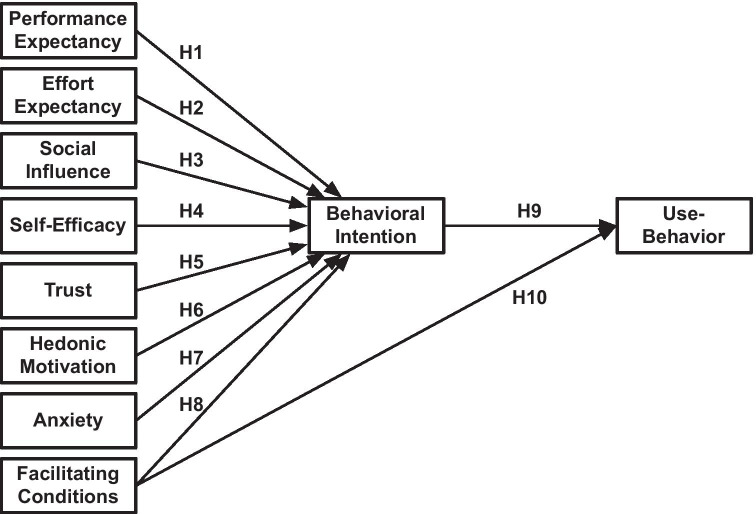
A mobile app could be a powerful medium for providing individual support for cognitive behavioral therapy (CBT), as well as facilitating therapy adherence. Little is known about factors that may explain the acceptance and uptake of such applications. This study, therefore, examines factors from an extended version of the Unified Theory of Acceptance and Use of Technology (UTAUT2) model to explain variation between people’s behavioral intention to use a CBT for insomnia (CBT-I) app and their use-behavior. The model includes eight aspects of behavioral intention: performance expectancy, effort expectancy, social influence, self-efficacy, trust, hedonic motivation, anxiety, and facilitating conditions, and investigates further the influence of the behavioral intention and facilitating conditions on app-usage behavior. Data were gathered from a field trial involving people (n = 89) with relatively mild insomnia using a CBT-I app. The analysis applied the Partial Least Squares-Structural Equation Modeling method. The results found that performance expectancy, effort expectancy, social influence, self-efficacy, trust, and facilitating conditions all explained part of the variation in behavioral intention, but not beyond the explanation provided by hedonic motivation, which accounted for R2 = 0.61. Both behavioral intention and facilitating conditions could explain the use-behavior (R2 = 0.32). We anticipate that the findings will help researchers and developers to focus on: (1) users’ positive feelings about the app as this was an indicator of their acceptance of the mobile app and usage; and (2) the availability of resources and support as this also correlated with the technology use. © 2021, The Author(s).
Overview
CoChat Summary
## TL;DR
This small-scale UTAUT2 analysis of a seven-week fully automated CBT-I mobile app found that hedonic motivation was the only determinant of behavioral intention in the multiple-path model, and that behavioral intention plus facilitating conditions explained use-behavior. The study used data from 89 participants with relatively mild insomnia from a randomized controlled trial.
## Key findings
- In the multiple-path model, hedonic motivation was the only significant determinant of behavioral intention; it accounted for R2 = 0.61 of the variance in behavioral intention.
- Behavioral intention and facilitating conditions were both significant determinants of use-behavior, together explaining R2 = 0.32 of the variance.
- In the single-path tests, performance expectancy, effort expectancy, social influence, self-efficacy, trust, hedonic motivation, and facilitating conditions were associated with behavioral intention with medium to large effect sizes; anxiety was not significant.
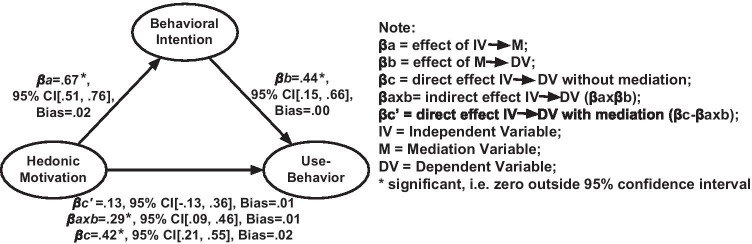
- Mediation analysis showed that behavioral intention fully mediated the relationship between hedonic motivation and use-behavior.
## Methods
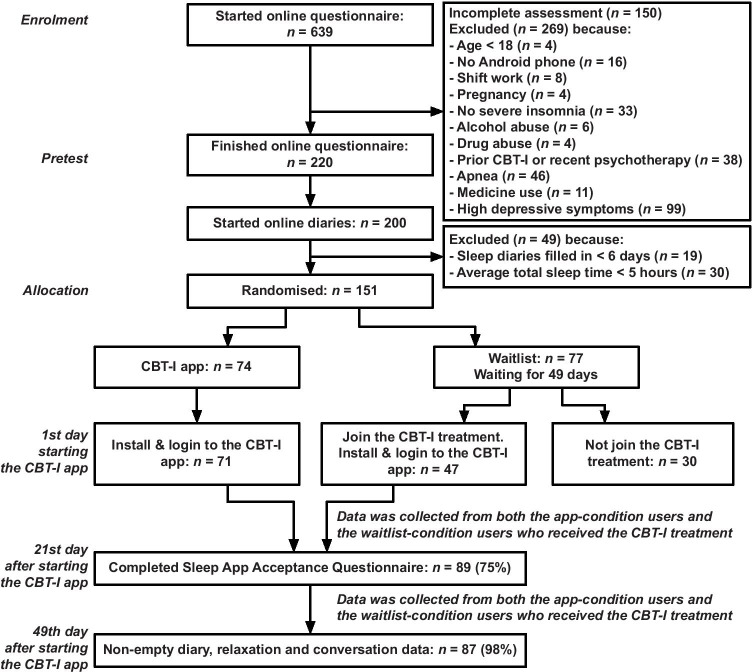
- The study analyzed data from a randomized controlled trial of the SleepCare app, but this paper used only the app-condition participants; the final analytic sample was n = 89.
- The app delivered a seven-week CBT-I program with sleep diary, relaxation, sleep-restriction, sleep hygiene, and sleep education components; participants had relatively mild insomnia and used the app for seven weeks.
- Analysis used Partial Least Squares Structural Equation Modeling (PLS-SEM) in SmartPLS 3.0, with single-path tests, multiple-path tests, and mediation analysis; significance was based on nonparametric bootstrapping-based 95% confidence intervals.
## Limitations
- The paper states the sample size was relatively small for the number of factors included, which limited use of confirmatory factor analysis and covariance-based SEM.
- The questionnaire data captured only a snapshot three weeks after app use; beliefs before downloading the app were not considered.
- The sample was Dutch and had a disproportionately large section of highly educated participants; the paper says this limits generalizability.
- The paper also notes that some participants rated items as “not applicable,” six negatively formulated questionnaire items were removed, and technical issues during the trial prevented some participants from continuing to the next conversation.
Model-written summary. Check it against the paper before relying on it.
Integrity signals
Registry
Cites
Statistics
Figures
Verification
Claims the paper makes
3 Valid · 1 Not valid · 12 Not checked · 20 Own results and interpretations
Every source the paper cites for this claim was checked and supports it.
In the paper
“self-efficacy, as it has a strong relationship with users’ intention to use healthcare technologies [19]”
§ Factors Affecting User’s Behavioral Intention and Use of a Mobile-Phone-Delivered Cognitive Behavioral Therapy for Insomnia: A Small-Scale UTAUT Analysis > Research model
What the sources say
- Supportedcites [19] Kohnke A, Cole ML, Bush RG. Incorporating UTAUT Predictors for Understanding Home Care Patients’ and Clinician’s Acceptance of Healthcare Telemedicine Equipment. J. of Tech. Management & Innovation, [S.l.] 9(2): 29–41 (2014). 10.4067/S0718-27242014000200003 source
The Limitations and Future Research section says the data suggest a strong relationship among UTAUT, self-efficacy, and behavioral intention to use the telehealth equipment. The Discussion also reports that self-efficacy significantly moderated the relationship between UTAUT and behavioral intention. The evidence concerns patients and clinicians using telehealth equipment. (LLM, conf=0.88)
boostedstates an association- Asserted: passes — The authors put it forward as true.
- Checkable: passes — It can be checked against evidence.
- Load-bearing: passes — The paper’s conclusions depend on it.
- Based: passes — The paper gives a reason why it holds.
- Supported
In the paper
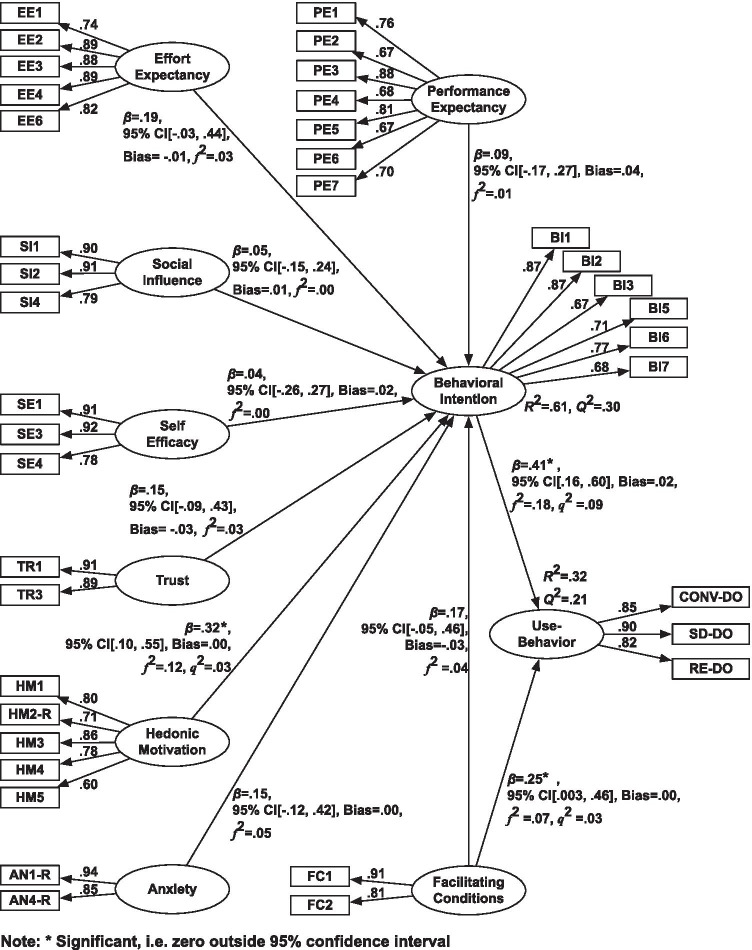
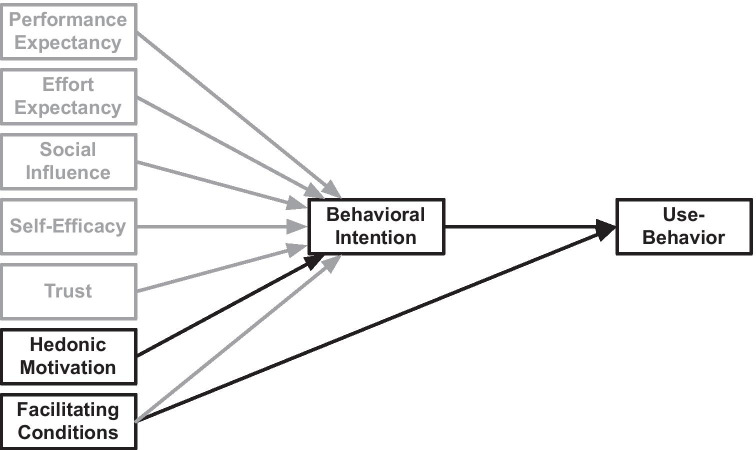
“The multiple-path test result in Fig. 3 shows only Hedonic Motivation was a significant determinant for Behavioral Intention (H6).”
- Also stated in: § Discussion · plain
“However, the related multiple-path test revealed that the explanatory power of these individual factors did not go beyond the Hedonic Motivation factor, i.e. people’s positive feelings about the app, which accounted for 61% of the variance in Behavioral Intention between individuals.”
§ Factors Affecting User’s Behavioral Intention and Use of a Mobile-Phone-Delivered Cognitive Behavioral Therapy for Insomnia: A Small-Scale UTAUT Analysis > Results > Multiple-path test
What the sources say
- Not matchedcites H6
This doesn’t read as a citation we can look up.
plainstates a cause- Asserted: passes — The authors put it forward as true.
- Checkable: passes — It can be checked against evidence.
- Load-bearing: passes — The paper’s conclusions depend on it.
- Based: passes — The paper gives a reason why it holds.
- Also stated in: § Discussion · plain
A result the paper reports from its own data — it cites no other source for it, so there is none to check. The quote shows it is in the paper.
In the paper
“Both behavioral intention and facilitating conditions could explain the use-behavior (R2 = 0.32).”
- Also stated in: § Discussion · plain
“The analysis also showed that Behavioral Intention (H9) and Facilitating Conditions (H10) were significantly associated with Use-Behavior, together accounting for 32% of the variance in people’s app interaction behavior.”
§ Factors Affecting User’s Behavioral Intention and Use of a Mobile-Phone-Delivered Cognitive Behavioral Therapy for Insomnia: A Small-Scale UTAUT Analysis > Abstract A mobile app could be a powerful medium for providing individual support for cognitive behavioral therapy (CBT), as well as facilitating therapy adherence. Little is known about factors that may explain the acceptance and uptake of such applications. This study, therefore, examines factors from an extended version of the Unified Theory of Acceptance and Use of Technology (UTAUT2) model to explain variation between people’s behavioral intention to use a CBT for insomnia (CBT-I) app and their use-behavior. The model includes eight aspects of behavioral intention: performance expectancy, effort expectancy, social influence, self-efficacy, trust, hedonic motivation, anxiety, and facilitating conditions, and investigates further the influence of the behavioral intention and facilitating conditions on app-usage behavior. Data were gathered from a field trial involving people (n = 89) with relatively mild insomnia using a CBT-I app. The analysis applied the Partial Least Squares-Structural Equation Modeling method. The results found that performance expectancy, effort expectancy, social influence, self-efficacy, trust, and facilitating conditions all explained part of the variation in behavioral intention, but not beyond the explanation provided by hedonic motivation, which accounted for R2 = 0.61. Both behavioral intention and facilitating conditions could explain the use-behavior (R2 = 0.32). We anticipate that the findings will help researchers and developers to focus on: (1) users’ positive feelings about the app as this was an indicator of their acceptance of the mobile app and usage; and (2) the availability of resources and support as this also correlated with the technology use.
plainstates an associationn = 89- Asserted: passes — The authors put it forward as true.
- Checkable: passes — It can be checked against evidence.
- Load-bearing: passes — The paper’s conclusions depend on it.
- Based: passes — The paper gives a reason why it holds.
- Also stated in: § Discussion · plain
A result the paper reports from its own data — it cites no other source for it, so there is none to check. The quote shows it is in the paper.
In the paper
“Furthermore, the cross-validated redundancy values provided support for the models’ predictive relevance (Q2 > 0).”
§ Factors Affecting User’s Behavioral Intention and Use of a Mobile-Phone-Delivered Cognitive Behavioral Therapy for Insomnia: A Small-Scale UTAUT Analysis > Results > Single path tests
plain- Asserted: passes — The authors put it forward as true.
- Checkable: passes — It can be checked against evidence.
- Load-bearing: unclear — It is unclear whether the paper’s conclusions depend on it.
- Based: passes — The paper gives a reason why it holds.
A result the paper reports from its own data — it cites no other source for it, so there is none to check. The quote shows it is in the paper.
In the paper
“which accounted for 61% of the variance in Behavioral Intention between individuals.”
- Also stated in: § Abstract A mobile app could be a powerful medium for providing individual support for cognitive behavioral therapy (CBT), as well as facilitating therapy adherence. Little is known about factors that may explain the acceptance and uptake of such applications. This study, therefore, examines factors from an extended version of the Unified Theory of Acceptance and Use of Technology (UTAUT2) model to explain variation between people’s behavioral intention to use a CBT for insomnia (CBT-I) app and their use-behavior. The model includes eight aspects of behavioral intention: performance expectancy, effort expectancy, social influence, self-efficacy, trust, hedonic motivation, anxiety, and facilitating conditions, and investigates further the influence of the behavioral intention and facilitating conditions on app-usage behavior. Data were gathered from a field trial involving people (n = 89) with relatively mild insomnia using a CBT-I app. The analysis applied the Partial Least Squares-Structural Equation Modeling method. The results found that performance expectancy, effort expectancy, social influence, self-efficacy, trust, and facilitating conditions all explained part of the variation in behavioral intention, but not beyond the explanation provided by hedonic motivation, which accounted for R2 = 0.61. Both behavioral intention and facilitating conditions could explain the use-behavior (R2 = 0.32). We anticipate that the findings will help researchers and developers to focus on: (1) users’ positive feelings about the app as this was an indicator of their acceptance of the mobile app and usage; and (2) the availability of resources and support as this also correlated with the technology use. · plain
“which accounted for R2 = 0.61.”
§ Factors Affecting User’s Behavioral Intention and Use of a Mobile-Phone-Delivered Cognitive Behavioral Therapy for Insomnia: A Small-Scale UTAUT Analysis > Discussion
plainstates an associationn = 89- Asserted: passes — The authors put it forward as true.
- Checkable: passes — It can be checked against evidence.
- Load-bearing: passes — The paper’s conclusions depend on it.
- Based: passes — The paper gives a reason why it holds.
- Also stated in: § Abstract A mobile app could be a powerful medium for providing individual support for cognitive behavioral therapy (CBT), as well as facilitating therapy adherence. Little is known about factors that may explain the acceptance and uptake of such applications. This study, therefore, examines factors from an extended version of the Unified Theory of Acceptance and Use of Technology (UTAUT2) model to explain variation between people’s behavioral intention to use a CBT for insomnia (CBT-I) app and their use-behavior. The model includes eight aspects of behavioral intention: performance expectancy, effort expectancy, social influence, self-efficacy, trust, hedonic motivation, anxiety, and facilitating conditions, and investigates further the influence of the behavioral intention and facilitating conditions on app-usage behavior. Data were gathered from a field trial involving people (n = 89) with relatively mild insomnia using a CBT-I app. The analysis applied the Partial Least Squares-Structural Equation Modeling method. The results found that performance expectancy, effort expectancy, social influence, self-efficacy, trust, and facilitating conditions all explained part of the variation in behavioral intention, but not beyond the explanation provided by hedonic motivation, which accounted for R2 = 0.61. Both behavioral intention and facilitating conditions could explain the use-behavior (R2 = 0.32). We anticipate that the findings will help researchers and developers to focus on: (1) users’ positive feelings about the app as this was an indicator of their acceptance of the mobile app and usage; and (2) the availability of resources and support as this also correlated with the technology use. · plain
9 more claims
Create a free account to see all 36 claims and to verify the 1 reference still open.
- It may state two separate claims as one. 10
- Probably not a substantial claim. 14
Claims other papers make about this one
Each is checked against this paper’s own text: does it say what the citing paper says it does?
The source backs part of the claim, not all of it — or backs it for a different population, condition or comparison.
In the citing paper
“The positive effects of FC are consistent with previous findings showing that technical and environmental support can improve users’ perceptions of usefulness and ease of use in psychological intervention and AR-related contexts [62,100].”
From Advancing Undergraduate Student Mental Healthcare of Social Anxiety Disorder: Evaluating the Acceptance of AR-Assisted Cognitive Behavioral Therapy Through TAM-Based Constructs. (2026) · cites this paper as [100]
Experimental — accuracy not yet measured
Citations
Cites
Diagnostic and Statistical Manual of Mental Disorders
American Psychiatric Association (2013) · doi:10.1176/appi.books.9780890425596 · Cited by 116,369
The CES-D Scale: A Self-Report Depression Scale for Research in the General Population
Radloff, L. S. (1977) · Applied Psychological Measurement · doi:10.1177/014662167700100306 · Cited by 53,267
User Acceptance of Information Technology: Toward A Unified View1
Venkatesh, V., Morris, M. G., Davis, G. B., & Davis, F. D. (2003) · MIS Quarterly · doi:10.2307/30036540 · Cited by 45,035 · cited 9×
“…i c h a n i nd i v i du a l p e r ce i v e s t h a t i m po r t a n t o t h e r s b e li e v e h e / s h e s hou l d u s e t h e n e w s y s t e m [ 2 ] T h e u s e r’ s p e r ce p t i on o f t h e s o c i a l p r e ss u r e s t o u s e t h e a pp S e l f-E ffi cac y A n i nd i v i du a l ’ s b e…”
BackgroundMethodInfluentialUser Acceptance of Computer Technology: A Comparison of Two Theoretical Models
Davis, F. D., Bagozzi, R. P., & Warshaw, P. R. (1989) · Management Science · doi:10.1287/mnsc.35.8.982 · Cited by 25,709 · cited 2×
“Without these aspects, as explained by Davis et al. [42], the expectations of the app’s performance and the social environment may influence people’s intention to use the technology for the first time.”
BackgroundResultPls-Sem: indeed a silver bullet
Hair, J. F., Ringle, C. M., & Sarstedt, M. (2011) · Journal of Marketing Theory and Practice · doi:10.2753/mtp1069-6679190202 · Cited by 21,631 · cited 2×
“10-times rules method [36] 80a Minimum R2 method [14] 84 Gamma-exponential method [37] 99b”
BackgroundVenkatesh, V., Thong, J. Y. L., & Xu, X. (2012) · MIS Quarterly · doi:10.2307/41410412 · Cited by 15,756
mice: Multivariate Imputation by Chained Equations in R
Buuren, S. V., & Groothuis-Oudshoorn, K. (2011) · Journal of Statistical Software · doi:10.18637/jss.v045.i03 · Cited by 13,870
(2014) · DigitalCommons - Kennesaw State University (Kennesaw State University) · Cited by 12,785
The use of partial least squares path modeling in international marketing
Henseler, J., Ringle, C. M., & Sinkovics, R. R. (2009) · Advances in International Marketing · doi:10.1108/s1474-7979(2009)0000020014 · Cited by 10,926
Computer Self-Efficacy: Development of a Measure and Initial Test
Compeau, D. R., & Higgins, C. A. (1995) · MIS Quarterly · doi:10.2307/249688 · Cited by 6,553 · cited 1×
“…t r ea t - m e n t o f i n s o m n i a H e don i c M o ti v a ti on A n i nd i v i du a l ’ s li k i ng f o r a p a r ti c u l a r b e h a v i o r [ 18 ] ; t h e f un o r p l ea s u r e d e r i v e d fr o m u s i ng a t ec hno l ogy [ 3 ] T h e u s e r’ s po s iti v e f ee li ng a bou t u s i ng t…”
Background
Research works printed but not linked: 2
- Yoo SJ, Huang W-HD. Comparison of Web 2.0 Technology Acceptance Level based on Cultural Differences. Educational Technology and Society. 14(4): 241–252 (2011).
- Morin C, Espie C. Insomnia: A Clinical Guide to Assessment and Treatment. New York: NY: Springer; 2003.
Cited by
Chan, Y. K., Tang, Y. M., & Teng, L. (2023) · International Journal of Medical Informatics · doi:10.1016/j.ijmedinf.2023.105042 · Cited by 53
The UTAUT approach to Indonesia’s behavioral intention to use mobile health apps
Candra, S., Frederica, E., Putri, H. A., & Loang, O. K. (2024) · Journal of Science and Technology Policy Management · doi:10.1108/jstpm-10-2022-0175 · Cited by 77
Liu, J., Dai, Q., & Chen, J. (2024) · Education and Information Technologies · doi:10.1007/s10639-024-13105-z · Cited by 52
“EE constitutes a crucial aspect of the UTAUT model and is frequently used in investigations of users’ intention to adopt new technologies (Almagrashi et al., 2023; Fitrianie et al., 2021).”
Misra, R., Mahajan, R., Singh, N., Khorana, S., & Rana, N. P. (2022) · Electronic Markets · doi:10.1007/s12525-022-00578-4 · Cited by 63
Schretzlmaier, P., Hecker, A., & Ammenwerth, E. (2022) · BMJ Health & Care Informatics · doi:10.1136/bmjhci-2022-100640 · Cited by 56
“Future research should investigate additional mHealth acceptance factors, including how patients perceive trust in mHealth applications.”
Human values and traveler behaviors: metaverse for conferences and meetings
Ariza‐Montes, A., Quan, W., Radić, A., Yu, J., & Han, H. (2023) · Journal of Travel & Tourism Marketing · doi:10.1080/10548408.2023.2263766 · Cited by 34
“Refer to Fitrianie et al. (2021) and Tan (2013) for a more in-depth analysis of this issue.”
BackgroundResultThe effects of religiosity and gender on attitudes and trust toward autonomous vehicles
Modliński, A., Gwiaździński, E., & Karpińska-Krakowiak, M. (2022) · The Journal of High Technology Management Research · doi:10.1016/j.hitech.2022.100426 · Cited by 34
Yuen, K. F., Koh, L. Y., Wong, Y. Q., & Wang, X. (2023) · Journal of Cleaner Production · doi:10.1016/j.jclepro.2023.137010 · Cited by 55
Understanding Arab social TV viewers’ perceptions of virtual reality acceptance
Habes, M., Elareshi, M., Safori, A. O., Ahmad, A. K., Al-Rahmi, W., & Cifuentes‐Faura, J. (2023) · Cogent Social Sciences · doi:10.1080/23311886.2023.2180145 · Cited by 41
Use intention of green financial security intelligence service based on UTAUT
Chen, H., & Zhao, X. (2022) · Environment Development and Sustainability · doi:10.1007/s10668-022-02501-5 · Cited by 18
“The UTAUT model has been widely used in the adoption of emerging information technology (Fitrianie et al., 2021; Tomić et al., 2022), and the new approach of intelligence service has broken the traditional way of green financial security management.”
MethodFactors affecting the acceptance of tele-psychiatry: a scoping study
Izadi, R., Bahrami, M. A., Khosravi, M., & Delavari, S. (2023) · Archives of Public Health · doi:10.1186/s13690-023-01146-8 · Cited by 21
Andijani, A., & Kang, K. (2022) · Sustainability · doi:10.3390/su141610213 · Cited by 22
Adoption of online crowdsourced logistics during the pandemic: a consumer-based approach
Koh, L. Y., Peh, Y. S., Wang, X., & Yuen, K. F. (2023) · The International Journal of Logistics Management · doi:10.1108/ijlm-05-2022-0213 · Cited by 21
AI-powered Human Digital Twins in Virtual Therapeutic Sessions
Ebnali, M., Ahmadi, N., Nabiyouni, E., & Karimi, H. (2023) · Proceedings of the International Symposium on Human Factors and Ergonomics in Health Care · doi:10.1177/2327857923121000 · Cited by 14
“Trust items were adopted from (Gupta et al. 2020; Fitrianie et al. 2021) and (Jian, Bisantz, and Drury 2000) and BI items were derived from (Fitrianie et al. 2021; Venkatesh and Davis 2000).”
MethodMa, Y., Zhou, M., Yu, W., Zou, Z., Ge, P., Feei, Z., Tong, Y., Li, W., Li, Q., Li, Y., et al. (2023) · BMC Public Health · doi:10.1186/s12889-023-15644-5 · Cited by 24
“A review of previous studies showed that the UTAUT was a good health behavior education model, which was widely used to study physical exercise [32], reasonable sleep [33], weight loss [34] and other health behaviors.”
Secondary school teachers’ perceptions of BYOD among learners within the classroom
Mawere, T., Manjeese, C., & Chigada, J. (2022) · South African Computer Journal · doi:10.18489/sacj.v34i1.952 · Cited by 21
“Fitrianie et al. (2021) and Menszh (2019) found that Effort Expectancy did not significantly predict Behavioural Intention.”
BackgroundResultHe, Q., Huang, C., Feng, Z., & Shen, H. (2025) · Journal of Nursing Management · doi:10.1155/jonm/7756343 · Cited by 22
The Mediating Role of e-Lifestyles to Use the Fitness Center App
Barbosa, H. F., Fernández, J. G., & Cepeda‐Carrión, G. (2023) · International Journal of Human-Computer Interaction · doi:10.1080/10447318.2023.2204273 · Cited by 25
“According to Fitrianie et al. (2021 It was also revealed that the relationship of intentions of behavioral usage with the satisfaction of members with the center through member e-Lifestyles is positive, supporting our third hypothesis.”
Amiri, P., Pirnejad, H., Bahaadinbeigy, K., ShojaeiBaghini, M., Khazaee, P. R., & Niazkhani, Z. (2023) · Health Science Reports · doi:10.1002/hsr2.1394 · Cited by 12
“” 64 Fitrianie et al. 65 showed that both “ behavioral intention ” and “ facilitating conditions ” can affect users' “ usage behavior ” in mobile applications.”
BackgroundAlbers, N., Neerincx, M. A., Penfornis, K. M., & Brinkman, W. (2022) · PeerJ · doi:10.7717/peerj.13824 · Cited by 19
“…is one of the predictors of the intention to perform a behavior according to the UTAUT ( Venkatesh et al., 2003 ), and several studies have con fi rmed this relationship in the context of eHealth tools ( e.g ., Boontarig et al. (2012) , Quaosar, Hoque & Bao (2018) , Fitrianie et al. (2021b) ).”
Self-citationSrijundaree, P., Yurayat, P., & Nipanan, P. (2024) · Islamic Guidance and Counseling Journal · doi:10.25217/0020247451200 · Cited by 16
Social Media Acceptance and e-Learning Post-Covid-19: New factors determine the extension of TAM
Alhumaid, K. F., Ayoubi, K., Habes, M., Elareshi, M., & Salloum, S. A. (2022) · International Conference on Social Networks Analysis, Management and Security (SNAMS) · doi:10.1109/snams58071.2022.10062756 · Cited by 12
“However, other scholars have added other crucial factors such as computer anxiety [11], [12], motivation [8], [11], [13], [14], normative pressure [15], digital literacy [16]–[18], self-efficacy [11], [19], [20], and other independent variables and moderators have been suggested / examined to…”
BackgroundHii, I. S. H., Ho, J. M., Zhong, Y., & Li, X. (2024) · Managerial Finance · doi:10.1108/mf-03-2024-0231 · Cited by 17
Anteneh, D. S., Kelkay, J. M., Wubneh, H. D., Beshir, M. A., & Gashu, K. D. (2025) · SAGE Open Medicine · doi:10.1177/20503121241307136 · Cited by 11
Mulyani, E. Y., Rakhmawati, T., Damayanti, S., Sumaedi, S., & Bakti, I. (2025) · Digital Health · doi:10.1177/20552076251392648 · Cited by 6
“24,53,56 Regarding the determinants of intention to use mobile-based pregnancy education applications, this study found that intention was directly and signi fi cantly shaped by three antecedents: IP, trust in the application, and EL.”
InfluentialInvestigating Social Commerce Factors: Motivation, Price Value, Habit, Risk and Attitude
Sarker, P., Dwivedi, Y. K., & Hughes, L. (2023) · Lecture notes in computer science · doi:10.1007/978-3-031-50040-4_16 · Cited by 7
Arachchige, A. C. H. N., Jusoh, M., & Tham, J. (2024) · Journal of Lifestyle and SDGs Review · doi:10.47172/2965-730x.sdgsreview.v5.n02.pe03479 · Cited by 5
“Researchers indicate that it’s BI that determines user behavior, and it is influenced by several factors (Fitrianie et al ., 2021).”
Learning English on Social Media: A Multi-Theoretical Approach to Exploring Continuance Behavior
Wang, Y.-Y., Chuang, Y.-W., & Chen, T.-Y. (2025) · International Journal of Human-Computer Interaction · doi:10.1080/10447318.2025.2466052 · Cited by 6
“Previous research has consistently shown a positive correlation between self-efficacy and continuance intention (e.g., Erdo � gan, 2023; Fitrianie et al., 2021; Gupta et al., 2020; Juvelin et al., 2018; Warkentin et al., 2016; Zha et al., 2022).”
InfluentialJiménez-Díaz, A., Pierantonelli, M., Coscolín, P. M., Uhalte, A. S., Quer-Palomas, S., Rivera-Romero, O., Herrero, R., Fernández-Luque, L., Baños, R., Berrios, R. C., et al. (2025) · JMIR Pediatrics and Parenting · doi:10.2196/55023 · Cited by 6
“Although there are quantitative questionnaires to measure the acceptability of digital solutions [37,38], we opted for a qualitative approach in order to get a more comprehensive understanding of the psychological burden experienced by caregivers of children undergoing growth hormone treatment, as…”
IDENTIFYING HEALTHCARE WORKERS’ INTENTION TOWARD TELEHEALTH IN INDONESIA DUE TO COVID-19 PANDEMIC
Fathurahman, M. R., Basri, M. H., & Belgiawan, P. F. (2022) · Jurnal Administrasi Kesehatan Indonesia · doi:10.20473/jaki.v10i2.2022.165-176 · Cited by 5
Rachmadi, F. W., Yuningtyas, I. H., & Candra, S. K. D. I. S. (2023) · International Journal of Business and Applied Social Science · doi:10.33642/ijbass.v9n9p3 · Cited by 1
Haqi, M. F., & Astuti, B. (2024) · Jurnal Informatika Ekonomi Bisnis · doi:10.37034/infeb.v6i1.805 · Cited by 2
Purwanto, H., & Setiawan, A. (2024) · AIP conference proceedings · doi:10.1063/5.0210296 · Cited by 1
Alshammri, W. S., Baharudin, S. M., & Khalid, N. F. (2024) · Cogent Education · doi:10.1080/2331186x.2024.2431951 · Cited by 1
“Behavioral intention has been determined to mediate how people utilize technology (Fitrianie et al., 2021; Rahmaningtyas et al., 2020).”
Promoting Digital Therapeutics in Japan: Understanding User Acceptance Through the UTAUT Model
Takahashi, M., & Katagiri, Y. (2025) · Lecture notes in computer science · doi:10.1007/978-3-031-93227-4_25 · Cited by 1
Hałabuda, Z., & Rynkiewicz, K. (2026) · International Journal of Innovative Technologies in Social Science · doi:10.31435/ijitss.1(49).2026.4925 · Cited by 1
Analysis of Salesperson Behavior on Using Retailer App (Case Study: Indosat Ooredoo Hutchison)
Aziz, R. A., & Napitupulu, T. A. (2022) · Journal of Information Systems and Informatics · doi:10.51519/journalisi.v4i2.265 · Cited by 1
El-Gayar, O., Al-Ramahi, M. A., Wahbeh, A., Elnoshokaty, A., & Nasralah, T. (2025) · Telemedicine Journal and e-Health · doi:10.1089/tmj.2024.0053 · Cited by 2
“20 They exhibit the potential to enhance depressive symptoms, anxiety symptoms, and overall psychological distress after the intervention and throughout the follow-up period.”
Priyastomo, P., Nimran, U., Prasetya, A., & Noerman, T. (2025) · Management · doi:10.62486/agma2025291 · Cited by 5
Zhou, Z., Zhou, Y., Ouyang, B., Man, S. S., & Chan, A. H. S. (2026) · Healthcare · doi:10.3390/healthcare14131978
“The positive effects of FC are consistent with previous findings showing that technical and environmental support can improve users’ perceptions of usefulness and ease of use in psychological intervention and AR-related contexts [62,100].”
Kurt, Ö. E. (2023) · OPUS Toplum Araştırmaları Dergisi · doi:10.26466/opusjsr.1160243 · Cited by 1
Arruejo, A. C., & Arruejo, R. C. (2023) · SSRN Electronic Journal · doi:10.2139/ssrn.4668429
Gamification of Basic Electronics using Crumb Circuit Simulator on Students Behavioral Intention
-, M. C. O. E., -, R. S. T., Rosales, V. S., Consolacion, R. A., & Baldonado, F. Q. (2023) · International Journal For Multidisciplinary Research · doi:10.36948/ijfmr.2023.v05i06.11268
“Facilitating condition, as defined in the UTAUT model, refers to the environmental factors that make it easier for a person to engage (Venkatesh et al., 2003), these factors could include the availability of the technology and the presence of supportive resources (Fitrianie et al., 2021).”
BackgroundUtilizing Digital Information for Personalized Cholesterol Management
Halim, E., Steven, Putri, A. N. S., Halim, D. D., & Syamsuar, D. (2024) · International Conference on Informatics and Computing (ICIC) · doi:10.1109/icic64337.2024.10956936
“Behavioral Intention (BI) is a concept that discusses a person's intention to behave and readiness to perform certain behaviours [7], [10], [5].”
InfluentialResearch on Spatial Digital Feedback of Smart Community for Elderly Living Alone Based on SOR Model
Zhang, Y., & Zhai, Y. (2025) · Lecture notes in computer science · doi:10.1007/978-3-031-92707-2_15
Kuhlengisa, M. M., & Eresia-Eke, C. (2025) · IJEBD (International Journal Of Entrepreneurship And Business Development) · doi:10.29138/ijebd.v8i2.3027
DÜLEK, B., Koçak, H., & YAŞAR, M. E. (2025) · Bingöl Üniversitesi Sosyal Bilimler Enstitüsü Dergisi · doi:10.29029/busbed.1689400 · Cited by 1
“Previous studies (Rodrigues et al., 2016; Mensah et al., 2020; Fitrianie et al., 2021; Avci et al., 2024)) have also revealed the existence of a similar effect.”
Training Child Helpline Counselors with Value-Integrated Chat Simulations
Owayyed, M. A., Brinkman, W., Guan, K., Keijsers, L., & Tielman, M. L. (2026) · International Journal of Human-Computer Interaction · doi:10.1080/10447318.2026.2645437
Self-citationShi, X., Su, M., & Park, K.-S. (2026) · Journal of theoretical and applied electronic commerce research · doi:10.3390/jtaer21060165 · Cited by 1
“Facilitating conditions refer to consumers’ perceptions of the availability of resources and support, such as stable network connectivity, digital payment tools, and relevant applications, that help them complete online transactions [33,59,60].”
Rahman, M. A., Emon, M. M. H., Khan, T., Ahmad, J., Jahan, S., Bukari, Z., & Hamid, A. B. A. (2026) · ReMark - Revista Brasileira de Marketing · doi:10.5585/2026.27263
Owayyed, M. A., Tielman, M. L., & Brinkman, W. (2026) · International Journal of Human-Computer Studies · doi:10.1016/j.ijhcs.2026.103923
Self-citationWang, Z., Dai, Q., Yang, M., Shi, S., Liao, J., Li, Z., Dai, X., & Tao, L. (2026) · JAMIA Open · doi:10.1093/jamiaopen/ooag154 · Cited by 1
Lezcano, M., Pasini, M., Romá, V. G., Palma, M., & Landuzzi, M. G. (2026) · Safety Science · doi:10.1016/j.ssci.2026.107453
Determinants of off-label drug acceptance in pregnancy: insights from an extended UTAUT model
Liang, C., Que, F., Peng, P., Zhou, L., Qiu, Q., Pang, Y., & Zhang, X. (2026) · Frontiers in Pharmacology · doi:10.3389/fphar.2026.1850058
Goyal, N., Walia, N., & Bandha, P. (2026) · European Journal of Management and Business Economics · doi:10.1108/ejmbe-12-2025-0483
Metadata
- Authors
- Fitrianie, S., Horsch, C., Beun, R. J., Griffioen-Both, F., & Brinkman, W.-P.
- Affiliations
- Delft University of Technology (NL)
- Utrecht University (NL)
- Corresponding author
- Fitrianie, Siska
- Venue
- Journal of Medical Systems
- Published
- 2021-11-12
- Volume
- 45
- Issue
- 12
- Pages
- 110-110
- ISSN
- 0148-5598 (ISSN-L)
- 1573-689X
- PMC
- PMC8589825
- OpenAlex
- W3214598677
- Cited by
- 57
- References
- 41
- Citations by year
- 2026: 11 · 2025: 10 · 2024: 11 · 2023: 15 · 2022: 10
- FWCI
- 7.69
- Type
- journal article
- Language
- en
- Open access
- hybrid
- doi.org
- Licence
- cc-by
- creativecommons.org/licenses/by/4.0 (tdm)
- creativecommons.org/licenses/by/4.0 (vor)
- Locations
- Journal of Medical Systems (publishedVersion, cc-by)
- PubMed Central (publishedVersion, cc-by)
- PubMed (publishedVersion)
- Utrecht University Repository (Utrecht University) (submittedVersion, other-oa)
- Research Repository (Delft University of Technology) (submittedVersion)
- Data Archiving and Networked Services (DANS) (submittedVersion, other-oa)
- Funders
- Stichting voor de Technische Wetenschappen
- Topics
- Social Sciences › Decision Sciences › Information Systems and Management › Technology Adoption and User Behaviour
- Social Sciences › Psychology › Applied Psychology › Digital Mental Health Interventions
- Health Sciences › Health Professions › General Health Professions › Mobile Health and mHealth Applications
- Keywords
- cognitive behavioral therapy for insomnia, mobile health apps, behavioral intention, UTAUT2, technology acceptance, facilitating conditions, self-efficacy, trust, social influence, hedonic motivation, performance expectancy, effort expectancy, insomnia, app usage behavior
- MeSH terms
- Humans, Sleep Initiation and Maintenance Disorders, Surveys and Questionnaires, Cognitive Behavioral Therapy, Intention, Mobile Applications
About these checks
Registry, retraction, Cites and statistics results are computed, not judged, with one exception: a printed reference that no index lists is read once by a model before it counts as a citation error. Claims are extracted by a model and kept only when their quote appears verbatim in the text; each cited source is then checked, with a model’s help, for whether it says what the claim relies on. Those verdicts can be wrong — read the claim’s quote and the cited source before relying on one.
The claim verdicts this report counts are experimental: their accuracy is not yet measured.
A language model drew the claims from the paper on 2026-10-11, under version 3 of the claim definition (model deepseek-v4.1-flash, prompt extract-v3).
A second model labelled each claim on 2026-10-11 (model jev-1.13-20260917, definition revision gold-guideline-v0.2).
Cited sources are checked with a language model’s help (gpt-6-sol).
Statistics and arithmetic are recomputed, not judged.
Confidence bands are shown only for fields calibrated on our annotated test set. None is calibrated yet, so no band is shown.
What counts as a claim ›How we measure confidence ›How we check this ›
Are you an author, or do you see a problem with this page? Request a review
Data sources
Bibliographic data: Semantic Scholar, OpenAlex, Crossref.
Contains information from the Semantic Scholar Academic Graph Datasets, made available under the ODC Attribution License (ODC-BY 1.0).
Semantic Scholar’s data is described in: Kinney, R., et al. (2023). The Semantic Scholar Open Data Platform. arXiv:2301.10140.
