

The Effectiveness of Rehabilitation Interventions on the Employment and Functioning of People with Intellectual Disabilities: A Systematic Review
Open accessThe DOI matches its Crossref record; 79 of the 79 references it cites were found in a registry or an index.
Abstract
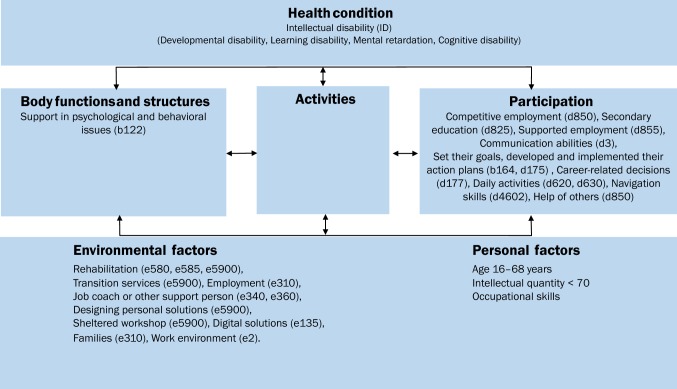
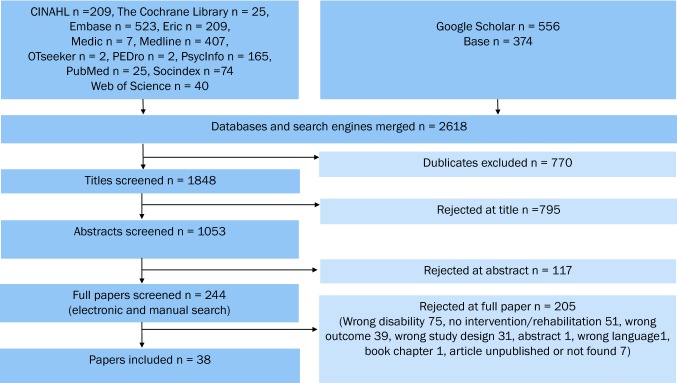
Purpose This systematic review analyzed the effectiveness of rehabilitation interventions on the employment and functioning of people with intellectual disabilities (ID), as well as barriers and facilitators of employment. Methods This was a systematic review of quantitative, qualitative, and mixed methods studies. The outcomes were employment, transition to the open labor market and functioning. The review included qualitative studies of employment barriers and facilitators. The population comprised people with ID aged 16-68 years. Peer-reviewed articles published in English between January 1990 and February 2019 were obtained from the databases Cinahl, the Cochrane Library, Embase, Eric, Medic, Medline, OTseeker, Pedro, PsycInfo, PubMed, Socindex, and the Web of Science. We also searched Google Scholar and Base. The modified selection instrument (PIOS: participants, intervention, outcome, and study design) used in the selection of the articles depended on the selection criteria. Results Ten quantitative (one randomized controlled, one concurrently controlled, and eight cohort studies), six qualitative studies, one multimethod study, and 21 case studies met the inclusion criteria. The quantitative studies showed that secondary education increases employment among people with ID when it includes work experience and personal support services. Supported employment also increased employment in the open labor market, which sheltered work did not. The barriers to employment were the use of sheltered work, discrimination in vocational experience, the use of class teaching, and deficient work experience while still at school. The facilitators of employment were one's own activity, the support of one's family, job coaching, a well-designed work environment, appreciation of one's work, support form one's employer and work organization, knowledge and experience of employment during secondary education, and for entrepreneurs, the use of a support person. Conclusions The employment of people with ID can be improved through secondary education including proper teaching methods and personal support services, the use of supported work, workplace accommodations and support from one's family and employer. These results can be utilized in the development of rehabilitation, education, and the employment of people with ID, to allow them the opportunity to work in the open labor market and participate in society.
Overview
The claims and statistics of this paper haven’t been checked yet.
Free: it reads the open-access text and checks the first 5 claims that cite a source we can check. Create a free account to check every claim.
Integrity signals
Registry
Cites
Statistics
Figures
Verification
Claims the paper makes
The claims and statistics of this paper haven’t been checked yet.
Free: it reads the open-access text and checks the first 5 claims that cite a source we can check. Create a free account to check every claim.
Claims other papers make about this one
Each is checked against this paper’s own text: does it say what the citing paper says it does?
The cited source says what the claim attributes to it.
In the citing paper
“Reviews of studies on interventions to support people into gaining work have also been published, covering intellectual disability, 110 autism, 111 severe mental health conditions, 112 and other mental health conditions.113”
From The Lancet Commission on ending stigma and discrimination in mental health (2022) · cites this paper as [110]
Self-check
Percentages, sums and reported differences re-computed from the paper’s own numbers.
The self-check needs the paper’s full text.
Citations
Cites
1 retracted
Notice of Redundant Publication
(2011) · Intellectual and developmental disabilities · doi:10.1352/1934-9556-49.4.221 · Cited by 26
RetractedCochrane Handbook for Systematic Reviews of Interventions: Cochrane Book Series
(2008) · doi:10.1002/9780470712184 · Cited by 25,048 · cited 2×
“We included quantitative, qualitative, and multimethod studies, because they provided different knowledge regarding this phenomenon [29, 30].”
Method(2014) · Medical Entomology and Zoology · Cited by 17,633
Grading quality of evidence and strength of recommendations
(2004) · BMJ · doi:10.1136/bmj.328.7454.1490 · Cited by 8,477
Updated Method Guidelines for Systematic Reviews in the Cochrane Collaboration Back Review Group
van Tulder, M., Furlan, A., Bombardier, C., & Bouter, L. (2003) · Spine · doi:10.1097/01.brs.0000065484.95996.af · Cited by 2,180 · cited 3×
“[32], which has also been used in other reviews concerning rehabilitation [28, 33, 34] and workplace accommodation [35].”
BackgroundResultPrevalence of intellectual disability: a meta-analysis of population-based studies
Maulik, P. K., Mascarenhas, M. N., Mathers, C. D., Dua, T., & Saxena, S. (2011) · Research in Developmental Disabilities · doi:10.1016/j.ridd.2010.12.018 · Cited by 1,770
Cieza, A., Fayed, N., Bickenbach, J., & Prodinger, B. (2019) · Disability and Rehabilitation · doi:10.3109/09638288.2016.1145258 · Cited by 594
Multi-disciplinary rehabilitation for acquired brain injury in adults of working age
Turner-Stokes, L., Pick, A., Nair, A., Disler, P. B., & Wade, D. T. (2015) · Cochrane Database of Systematic Reviews · doi:10.1002/14651858.cd004170.pub3 · Cited by 493 · cited 1×
“[32], which has also been used in other reviews concerning rehabilitation [28, 33, 34] and workplace accommodation [35].”
McKenzie, K., Milton, M., Smith, G., & Ouellette-Kuntz, H. (2016) · Current Developmental Disorders Reports · doi:10.1007/s40474-016-0085-7 · Cited by 453
Life expectancy of people with intellectual disability: a 35‐year follow‐up study
Patja, K., Iivanainen, M., Vesala, H., Oksanen, H., & Ruoppila, I. (2000) · Journal of Intellectual Disability Research · doi:10.1046/j.1365-2788.2000.00280.x · Cited by 409
Self-citation
Research works printed but not linked: 5
- Siperstein GN Parker RC Drascher M Natl Snapshot Adults Intellect Disabil Labor Force 2013 39 3 157 165
- Austin BS Lee C-L A structural equation model of vocational rehabilitation services Predict Employ Outcomes Clients Intellect Co-occurring Psychiatr Disabil 2014 80 8 11 20
- AAIDD. Intellectual disability. Definition, classification, and systems of supports. The 11th edition of the AAIDD definition manual. Washington D.C.: AAIDD, 2010.
- Higgins JPT, Green S, (Eds.) Cochrane handbook for systematic reviews of interventions. The Cochrane Collaboration, 2012. Available: http://onlinelibrary.wiley.com/doi/10.1002/9780470712184.fmatter/pdf. · doi:10.1002/9780470712184.fmatter/pdf
- Nevala N, Pehkonen I, Teittinen A, Vesala HT, Pörtfors P, Anttila H. Kuntoutuksen vaikuttavuus kehitysvammaisten toimintakykyyn ja työllistymiseen sekä sitä estävät ja edistävät tekijät (The effectiveness of rehabilitation on the functioning and employment of people with intellectual disabilities and barriers or facilitators: A systematic review). Järjestelmällinen kirjallisuuskatsaus. Kela, Työpapereita 133, 2018. Available: https://helda.helsinki.fi/bitstream/handle/10138/230842/Tyopapereita133.pdf?sequence=l.
Cited by
The Lancet Commission on ending stigma and discrimination in mental health
Thornicroft, G., Sunkel, C., Alikhon Aliev, A., Baker, S., Brohan, E., el Chammay, R., Davies, K., Demissie, M., Duncan, J., Fekadu, W., et al. (2022) · The Lancet · doi:10.1016/s0140-6736(22)01470-2 · Cited by 748
Employment for persons with intellectual disability in the Nordic countries: A scoping review
Garrels, V., & Sigstad, H. M. H. (2021) · Journal of Applied Research in Intellectual Disabilities · doi:10.1111/jar.12880 · Cited by 64
Algeo, N., Bennett, K., & Connolly, D. (2021) · BMC Cancer · doi:10.1186/s12885-021-08613-x · Cited by 59
Employment Sustainability for People with Intellectual Disability: A Systematic Review
Taubner, H., Tideman, M., & Nyman, C. S. (2021) · Journal of Occupational Rehabilitation · doi:10.1007/s10926-021-10020-9 · Cited by 61
“Two more recently published reviews [18, 19] addressed the issue of employment specifically for people with ID.”
BackgroundElectronic assistive technology use and supported employment
Heman, P., Rhodes, D. L., & Cox, C. (2022) · Journal of Applied Research in Intellectual Disabilities · doi:10.1111/jar.13005 · Cited by 26
Morris, R., Christianson‐Barker, J., Stainton, T., Mills, R., Rowley, C., Cox, J., Schroeder, M., & Hole, R. (2024) · Journal of Applied Research in Intellectual Disabilities · doi:10.1111/jar.13231 · Cited by 24
Collaborations to Support Employment Outcomes of Youth With Disabilities
Rios, Y. C., Park, S., Chen, X., & Tansey, T. N. (2023) · Rehabilitation counselors & educators journal · doi:10.52017/001c.72655 · Cited by 18
Readhead, A., & Owen, F. A. (2020) · Current Developmental Disorders Reports · doi:10.1007/s40474-020-00202-0 · Cited by 18
Barnard-Brak, L. M., Richman, D. M., Mutua, K., & Williamson, A. (2022) · Journal of Applied Research in Intellectual Disabilities · doi:10.1111/jar.13040 · Cited by 18
Roux, A. M., Miller, K. H. K., TAO, S., Rast, J. E., Ventimiglia, J. C., Shattuck, P. T., & Shea, L. (2023) · Milbank Quarterly · doi:10.1111/1468-0009.12666 · Cited by 23
Giachero, A., Quadrini, A., Pisano, F., Calati, M., Rugiero, C., Ferrero, L., Pia, L., & Marangolo, P. (2021) · Brain Sciences · doi:10.3390/brainsci11060766 · Cited by 16
“Accordingly, these persons manifest a loss of independence and autonomy in one or more aspects of daily life [14,15].”
BackgroundQiu, N., Zhang, T., & Cheng, J. (2023) · SSM - Population Health · doi:10.1016/j.ssmph.2023.101489 · Cited by 18
“Employment thus contributes to the rehabilitation of people with disability, especially those with intellectual disabilities (Nevala et al., 2019).”
BackgroundDeveloping a Work Accommodation Operating Model for Workplaces and Work Ability Support Services
Nevala, N., Pehkonen, I., Virtanen, M., Mattila‐Holappa, P., & Juvonen-Posti, P. (2024) · Journal of Occupational Rehabilitation · doi:10.1007/s10926-024-10193-z · Cited by 16
“In several cases, the process requires multisectoral collaboration between workplaces and health care, rehabilitation, or employment services [6, 13, 21].”
Self-citationAlmalky, H. A., & Alwadei, A. M. (2024) · Children and Youth Services Review · doi:10.1016/j.childyouth.2024.108003 · Cited by 15
Levack, W., & Fadyl, J. K. (2021) · BMJ Open · doi:10.1136/bmjopen-2021-049522 · Cited by 12
Hetzel, C., Leinberger, S., Kaluscha, R., Kranzmann, A., Schmidt, N., & Mitschele, A. (2023) · Journal for Labour Market Research · doi:10.1186/s12651-023-00330-1 · Cited by 12
“Other studies neglect to consider the regional labour market (International Social Security Association 2001; Celsing et al. 2012; Howard-Wilsher et al. 2016; Ervasti et al. 2017; Odgaard et al. 2018; Nevala et al. 2019).”
BackgroundEmployers’ perceptions of supports provided to their employees with disabilities
Almalky, H. A., & Alasmari, A. N. (2024) · Research in Developmental Disabilities · doi:10.1016/j.ridd.2024.104750 · Cited by 11
Soeker, M. S., Heyns, M., Kaapitirapi, P., Shoko, S., & Modise, W. (2021) · Work · doi:10.3233/wor-203372 · Cited by 12
“Typical barriers that identified could relate to the fact that many PWID may not have any vocational experience after leaving school or may lack work experience [13].”
BackgroundKundurthi, V., Reddy, S. K., & Angothu, H. (2023) · Journal of Family Medicine and Primary Care · doi:10.4103/jfmpc.jfmpc_433_23 · Cited by 10
“…health issues, poor attention span interfering with skill imparting; (3) level of education: poor or no ability to read and to learn from text resources; (4) the family support system of PID: poor family support and encouragement, family members awareness, misconceptions, and knowledge gaps; 2].”
BackgroundPhilips, G. R., Huang, M., & Bodine, C. (2023) · ACM Transactions on Accessible Computing · doi:10.1145/3628447 · Cited by 10
“In contrast, employment is facilitated by effective support services and accommodations, as well as other factors [15, 16], and such accommodations confer a variety of benefits on both employers and employees [17].”
BackgroundFostering employment for people with intellectual disability: the evidence to date
Wilson, E., & Campain, R. (2020) · Swinburne figshare (Swinburne University of Technology) · Cited by 9
Christianson‐Barker, J., Morris, R., Stainton, T., Cox, J., Rowley, C., Schroeder, M., Mills, R., & Hole, R. (2025) · Research and Practice in Intellectual and Developmental Disabilities · doi:10.1080/23297018.2025.2501261 · Cited by 8
Wong, J., Su, H., Kudla, A., Munsell, E. G. S., Ezeife, N., Crown, D., Trierweiler, R., Capraro, P., Tomazin, S. E., Park, M., et al. (2024) · Work · doi:10.3233/wor-220721 · Cited by 9
“Previous research on people with intellectual disabilities and general disabilities also found that a well-designed work environment and support from family and co-workers are critical for employment success [23, 49].”
Rehabilitation bei Menschen mit Behinderungen
Wulf, A., & Reutlinger, C. (2022) · Clinical Epileptology · doi:10.1007/s10309-022-00504-w · Cited by 9
Trajectories of Competitive Employment of Autistic Adults through Late Midlife
Hickey, E., DaWalt, L. S., Hong, J., Taylor, J. L., & Seltzer, M. M. (2024) · Healthcare · doi:10.3390/healthcare12020265 · Cited by 8
“Additionally, competitive employment reflects the goal of many supported employment agencies, namely, to phase out job support over time and transition into the open labor market [17].”
BackgroundOlsson, I. (2022) · Nordisk tidsskrift for pedagogikk og kritikk · doi:10.23865/ntpk.v8.3409 · Cited by 7
“Nevala et al. (2019) visar att erfa-renhet av yrkesarbete under gymnasietiden ökar möjligheten för att personer med IF har en anställning efter gymnasiet.”
Witte, I., Strandberg, T., Granberg, S., & Gustafsson, J. (2022) · Work · doi:10.3233/wor-211155 · Cited by 10
“The scientific evidence for the effectiveness of SE for persons with IDs or, for example, autism spectrum disorders (ASDs) is not as strong as the scientific evidence of IPS for persons with SMI, but evidence from recent reviews [92, 93] suggests that SE can be efficient for people with ASDs and IDs.”
BackgroundBillion, J., Sahut, J., Doussard, C., & Đặng, R. (2024) · Management international · doi:10.59876/a-c1st-75g0 · Cited by 9
Dorado, J., Rubio, A., Cantarero, R., Santofimia, M. J., García, X., Villanueva, F. J., & López, J. C. (2022) · IEEE Access · doi:10.1109/access.2022.3206008 · Cited by 6
“psycho-social and economic benefits [20].”
Kim, J., Baumunk, M. J., Park, S., & Tansey, T. N. (2024) · Rehabilitation counselors & educators journal · doi:10.52017/001c.124002 · Cited by 7
Diallo, A., Fonseca, L., & Holland, D. (2021) · Australian Journal of Rehabilitation Counselling · doi:10.1017/jrc.2021.8 · Cited by 6
“…and external or environmental factors (employers’ negative attitudes and paternalistic attitudes of guardians and professionals, including those making career decisions for persons with ID; transportation issues) (Adams et al., 2019; Kocman et al., 2018; Nevala et al., 2019; Trembath et al., 2010).”
BackgroundVocational training for livelihood and rehabilitation of persons with intellectual disabilities
Chithrangathan, C. (2022) · Tizard Learning Disability Review · doi:10.1108/tldr-11-2021-0030 · Cited by 6
Gutiérrez‐Cruz, C., Muñoz‐López, S., Rubio‐Cabeza, J., Raya-Castellano, P. E., & Román-Espinaco, A. (2023) · Journal of Intellectual Disabilities · doi:10.1177/17446295231168176 · Cited by 6
“However, employment accessibility of this collective constitutes one of the most complex challenges for advanced societies, with only a very reduced percentage of these individuals being able to access the free labour market (Nevala et al., 2019).”
Lancioni, G. E., Singh, N. N., O’Reilly, M. F., Sigafoos, J., Alberti, G., Chiariello, V., & Damiani, S. (2024) · Disabilities · doi:10.3390/disabilities4030039 · Cited by 6
“…that the complexity of the activities, the dimensions and structure of the setting (e.g., with the inclusion of one or more rooms), and the distances to walk need to be tailored to the participants’ characteristics, particularly to their motor and occupation skills and their motivation levels [59].”
Ammatillisesta koulutuksesta työelämään erityisen tuen avulla
Kotiranta, H., Pehkonen, L., & Hiekkala, S. (2023) · Kuntoutus · doi:10.37451/kuntoutus.127797 · Cited by 5
Selvakumaran, S., Thompson‐Hodgetts, S., Nicholas, D. B., Fan, L., Fang, H., & Rezze, B. D. (2020) · Current Developmental Disorders Reports · doi:10.1007/s40474-020-00211-z · Cited by 7
Title: Report on a survey of mobility disability among Syrian refugees living in Turkey
Abdulkerim, S., Albari, M., MacKenzie, A., & Thurston, A. (2021) · International Journal of Educational Research Open · doi:10.1016/j.ijedro.2021.100059 · Cited by 5
Landsiedel, K. M., Templeton, O., Washko, J. R., Floren, M., Kavanaugh, E. B., Maguire, C. B., Onoshko, E. A., Schmitter, K. E., & Sledziewski, M. M. (2024) · Journal of Occupational Therapy Schools & Early Intervention · doi:10.1080/19411243.2023.2283711 · Cited by 4
“These skills facilitate the OT practitioner to best align students’ abilities to their unique contexts to maximize current and potential skills for success via individualized program development and access to occupation-based opportunities in educational and community settings (Nevala et al., 2019).”
Alatawi, M. A. (2024) · Pakistan Journal of Life and Social Sciences (PJLSS) · doi:10.57239/pjlss-2024-22.1.00479 · Cited by 6
Pedro-Viejo, A. B., Suárez, G., & Gonzalez, M. D. (2023) · Journal of Intellectual Disabilities · doi:10.1177/17446295231178107 · Cited by 4
“In addition, when education (secondary or post-compulsory) includes work experience, it enhances the probability of employment in people with intellectual disabilities (Nevala et al., 2019).”
InfluentialEffective Vocational Rehabilitation Services for Transition-Aged Youth: Lessons From the Literature
Friedman, K. B., Rios, Y. C., Huang, Y., Wiegmann, S. M., & Tansey, T. N. (2023) · Rehabilitation Research Policy and Education · doi:10.1891/re-22-14 · Cited by 7
Salazar‐Méndez, J., Morales‐Verdugo, J., Lluch‐Girbés, E., Araya‐Quintanilla, F., Ribeiro, I. L., Mendoza‐Grau, R., Mellado‐Méndez, J., & Méndez-Rebolledo, G. (2023) · PM&R · doi:10.1002/pmrj.13089 · Cited by 5
“This review followed the PIOS approach (Population, Intervention, Outcomes, Study Design) used in previous review studies 22,23 : (1) Population: patients over 30 years old with diagnostic imaging of massive RC tear, without considering differences in gender, ethnicity, or race; (2) Intervention:…”
Frøyland, K., Bull, H. C., Skarpaas, L. S., Berget, G., Spjelkavik, Ø., & Lystad, J. U. (2024) · Social Policy and Administration · doi:10.1111/spol.13058 · Cited by 3
Refael, Y. B., Weiss, P. L., Press, Y. S., Gal, E., & Zlotnik, S. (2025) · Disabilities · doi:10.3390/disabilities5020034 · Cited by 3
Francescutti, C., Diminutto, M., & Zorzi, S. (2022) · Springer eBooks · doi:10.1007/978-3-319-95720-3_38 · Cited by 3
Cowan, H. J. K., Sheppard, L., & Harrington, R. (2024) · British Journal of Learning Disabilities · doi:10.1111/bld.12580 · Cited by 3
“Coaching approaches include person ‐ , family ‐ and occupation ‐ centred practice and encourage the individual to develop their own solutions to address challenges to participation (Graham, 2020; Nevala et al., 2019).”
Challenges and opportunities in adolescent intellectual disability care and rehabilitation
Malapela, R. G. (2024) · South African Family Practice · doi:10.4102/safp.v66i1.5798 · Cited by 3
“In a systematic review by Nevala et al., 4 ID is defined as a significantly below-average intellectual ability to understand and learn new and complex skills (impaired intelligence), and cope independently (restricted social functioning).”
Backgroundvan der Zwan, R. (2023) · Alter · doi:10.4000/9ifr · Cited by 4
Characteristics of Workplaces and Employers That Embrace Cognitive Diversity on the Work Floor
Sigstad, H. M. H., Garrels, V., Dean, E. E., & Wendelborg, C. (2025) · Intellectual and developmental disabilities · doi:10.1352/1934-9556-63.2.105 · Cited by 2
Predictors of Employers’ Intention to Hire People With Disability
Mahasneh, R., Randle, M., Gordon, R., Algie, J. A., & Connolly, A. M. (2025) · Social Marketing Quarterly · doi:10.1177/15245004251354829 · Cited by 2
“Inclusion of people with disability in society has garnered signi fi cant attention from a range of disciplines, including rehabilitation counselling (Nevala et al., 2019), special education (Mason-Williams et al., 2020) and social marketing (Makris et al., 2021; Vulevic et al., 2019).”
Employment readiness in adults with intellectual disabilities
Milanović‐Dobrota, B., Vidojković, S., Japundža‐Milisavljević, M., & Đurić-Zdravković, A. (2021) · Specijalna edukacija i rehabilitacija · doi:10.5937/specedreh20-30874 · Cited by 4
Rakitzi, S. (2023) · Springer eBooks · doi:10.1007/978-3-031-27837-2_2 · Cited by 3
Yu, X., Schiro‐Geist, C., Harmon, M. J., Zhang, X., Kansakar, Y., Krolik, P., Williams, M. C., Goodwill, M. E., & Cozort, S. (2023) · Journal of Applied Rehabilitation Counseling · doi:10.1891/jarc-2021-0020 · Cited by 2
Avcı, Ö. H. (2023) · Journal of Employment Counseling · doi:10.1002/joec.12219 · Cited by 2
Fernandes, A. C., Carvalho, P. H. S., Rodríguez‐Martín, D., & Montilha, R. D. C. I. (2023) · Revista Família Ciclos de Vida e Saúde no Contexto Social · doi:10.18554/refacs.v11i2.6818 · Cited by 2
Amarís, E. M., Ordóñez, J. S. M., & Andreu, G. R. (2022) · Editorial Universidad Santiago de Cali eBooks · doi:10.35985/9786287529465 · Cited by 2
Disability and Inclusion in the Workplace
Sacchi, F. (2024) · Springer eBooks · doi:10.1007/978-3-031-40858-8_171-1 · Cited by 2
Segregated Work or Very Minimal Community Employment for Job Workers with Disabilities
Osegueda, G. R. (2022) · Public Integrity · doi:10.1080/10999922.2021.2007674 · Cited by 1
Implementing employability interventions for workers with health conditions: A systematic review
Daniels, K., Fitzhugh, H., & Nooraya, R. (2025) · Social Science & Medicine · doi:10.1016/j.socscimed.2025.118597 · Cited by 1
Osorio, M. L., & del Castillo, E. (2025) · Journal of Service Research · doi:10.1177/10946705251391145 · Cited by 1
“Employment provides financial resources, a sense of purpose, and opportunities for social interaction, all of which are essential for fostering self-esteem, achievement, autonomy, and community connections (Holwerda et al. 2013; Nevala et al. 2019).”
InfluentialEffective Strategies for Enhancing Employment Outcomes: Individuals With Developmental Disabilities
Kayyali, M. (2026) · IGI Global eBooks · doi:10.4018/979-8-3693-9541-7.ch002 · Cited by 1
Rodriguez, L. S., & Bryson, S. A. (2026) · Qualitative Social Work · doi:10.1177/14733250261429175 · Cited by 1
“Employment for adults with cognitive disabilities (CD) can create the same economic and psychosocial bene fi ts that it creates for adults without CD (Nevala et al., 2019; Strnadov´a and Evans, 2015).”
Work ability, inclusion, and human resource development of disabled people
Futagami, S., Kettunen, E., & Jaussaud, J. (2026) · Human Resource Development International · doi:10.1080/13678868.2026.2622080 · Cited by 1
Entrepreneurship challenges for persons with disabilities: A bibliometric analysis
Azizana, F., Rahim, H. L., Marzuki, S., & Samat, M. F. (2026) · Journal of Emerging Economies and Islamic Research · doi:10.24191/jeeir.v14i2.8640 · Cited by 1
AlHeresh, R. A., Simpson, E. B., Allaire, S. H., & Keysor, J. J. (2023) · Work · doi:10.3233/wor-211147 · Cited by 1
Guruge, D. D. (2023) · Tizard Learning Disability Review · doi:10.1108/tldr-07-2022-0016 · Cited by 1
Factors Related to Employment of Transition-Age Youth With Intellectual Disability
Battle, T. R., Webb, K. R., Muhammad, A., Sierra, D., Moore, C., Eugene-Cross, K., Wang, N., Quamar, A. H., Lewis, A. N., & Manyibe, E. O. (2024) · Journal of Applied Rehabilitation Counseling · doi:10.1891/jarc-2024-0006 · Cited by 1
Devine, A. E., Rose, K. D., Jacobs, P. G., Dimov, S., White, B., Cassar, S., Jones, R., McLennan, A., Olney, S., Kavanagh, A. M., et al. (2024) · Disabilities · doi:10.3390/disabilities5010001 · Cited by 1
الزهراني, ه. م. س., & القصيرين, ا. م. (2021) · مجلة التربية الخاصة والتأهيل · doi:10.21608/sero.2021.146143
Dalki, T. B., Doran, M. C., King, T. P., Loy, P. M., Manos, A. W., Massaro, M. R., Medcalf, E. M., Walsh, A., & Bass, J. D. (2020) · SOPHIA (St. Catherine University)
Skarabis, N., Preissner, L., Faller, G., Walter-Klose, C., & Baumgart, V. (2024) · Public Health Forum · doi:10.1515/pubhef-2023-0133
Lee, C. (2024) · Journal of the Korean Society of Physical Medicine · doi:10.13066/kspm.2024.19.2.75
Tomaszewski, B. R., Perkins, Y., Loeb, H. M., & Marx, A. (2024) · International review of research in developmental disabilities · doi:10.1016/bs.irrdd.2024.09.005
Estrategias para asegurar la inclusión laboral de personas en situación de discapacidad en Colombia
de Cali, U. S., & Rada, L. C. G. (2022) · Editorial Universidad Santiago de Cali eBooks · doi:10.35985/9786287529465.6
Avrupa Birliği Ülkelerinde Yeni Trend: Engelli Emeklilik Sistemi Öncesinde Rehabilitasyon
Korkmaz, B. C. (2024) · Kırklareli Üniversitesi Sosyal Bilimler Dergisi · doi:10.47140/kusbder.1492227
Rehabilitation of Persons with Intellectual Disabilities: from Evaluation to Recruitment
Alrusaiyes, R. F., Albarrak, N., Alhussaini, S., & Alsuhaibani, H. (2024) · Journal of Umm Al-Qura University for Educational and Psychological Sciences · doi:10.54940/ep96216929
Germann, B. J., & Resch, D. (2025) · Journal of Vocational Rehabilitation · doi:10.1177/10522263251376309 · Cited by 1
“However, previous research in sheltered workshops has primarily focused on disabilities other than mental health issues, particularly intellectual disabilities (Kocman & Weber, 2018; Nevala et al., 2019; Taylor et al., 2021, 2023).”
Hua, R., Hou, Y., Li, Y., Gao, H., Yang, F., Liu, W., Jiang, J., Wang, B., & Wu, D. (2025) · Neuropsychiatric Disease and Treatment · doi:10.2147/ndt.s533262
Frerker, S., Stephenson, R., & Cox, C. (2025) · International Journal of Developmental Disabilities · doi:10.1080/20473869.2025.2565622
Ableist realism and inclusive education: theorising the cultural and atmospheric dimensions
Vaahtera, T., Kauppila, A., Niemi, A.-M., & Mietola, R. (2025) · International Journal of Inclusive Education · doi:10.1080/13603116.2025.2596974 · Cited by 1
Algeo, N., Bennett, K., & Connolly, D. (2021) · Figshare · doi:10.6084/m9.figshare.15123832
Algeo, N., Bennett, K., & Connolly, D. (2021) · Figshare · doi:10.6084/m9.figshare.15123829
Algeo, N., Bennett, K., & Connolly, D. (2021) · Figshare · doi:10.6084/m9.figshare.15123835
Witte, I. (2024) · Örebro University Library (Örebro University) · Cited by 4
Developing Postsecondary Education Programs for Individuals With Intellectual Disabilities
McGlynn, J. R. (2023) · ScholarWorks (Walden University)
(2023) · STM:n Hallinnonalan avoin julkaisuarkisto (Julkari)
Dejavniki vključevanja odraslih oseb z motnjami v duševnem razvoju v delo in zaposlitev
Primec, M. (2023) · Repository of the University of Ljubljana (University of Ljubljana) · Cited by 1
Identifying barriers in access to postsecondary education among students with disabilities
Nornor, G. J. N. (2023) · Victoria University Research Repository (Victoria University)
Muñoz López, S. (2023) · Institutional Repository of the University of Granada (University of Granada)
Kutvonen, M. (2025) · Theseus (Ammattikorkeakoulujen)
Recupero, M., Zagaria, T., Elia, F., Grasso, M., Caraci, F., Barone, C., Greco, D., Ferri, R., Serretti, A., & Buono, S. (2026) · L Encéphale · doi:10.1016/j.encep.2025.10.009
Lachapelle, Y., Lussier, Y. A., Godin-Tremblay, V., Ruel, R., & Ayotte, K. (2025) · Revue francophone de la déficience intellectuelle · doi:10.7202/1123948ar
ACADEMIC AND CAREER EMPOWERMENT FOR PORTUGUESE STUDENTS WITH SPECIFIC EDUCATIONAL NEEDS
Martins, E., Gomes, L., Silva, V., Fernandes, R., & Mendes, F. (2026) · International Journal of Modern Education · doi:10.35631/ijmoe.829016
Iacomini, S., Fabiani, M., Amici, M., & Vascelli, L. (2026) · Journal of Clinical & Developmental Psychology · doi:10.13129/2612-4033/0110-5385
Рябцев, М. В., Ponomarenko, G. N., SOKUROV, A. V., & Михайлишин, В. В. (2026) · Medical and Social Expert Evaluation and Rehabilitation · doi:10.17816/mser704964
Nieto, H. B., & Dymond, S. K. (2026) · Research and Practice for Persons with Severe Disabilities · doi:10.1177/15407969261438482
Strnadová, I., Danker, J., Willow, S. A., Dowse, L., Lowe, K., Tso, M., & Xavier, A. L. R. (2026) · Springer eBooks · doi:10.1007/978-3-032-11145-6_9
‘Don't Forget Me, I'm Important Too’: Amplifying Self‐Advocate Voice Through Disability Theatre
Schnellert, L., Christianson‐Barker, J., Hernandez, N. G., Chi, B., Co‐Creators, 1. S., & Hole, R. (2026) · British Journal of Learning Disabilities · doi:10.1111/bld.70062
Alhirsan, S. M. (2026) · Research Square · doi:10.21203/rs.3.rs-9457296/v1
Metadata
- Authors
- Nevala, N., Pehkonen, I., Teittinen, A., Vesala, H. T., Pörtfors, P., & Anttila, H.
- Affiliations
- Finnish Institute of Occupational Health (FI)
- Finnish Institute for Health and Welfare (FI)
- Corresponding author
- Nevala, Nina
- Venue
- Journal of Occupational Rehabilitation
- Published
- 2019-05-16
- Volume
- 29
- Issue
- 4
- Pages
- 773-802
- ISSN
- 1053-0487 (ISSN-L)
- 1573-3688
- PMC
- PMC6838041
- OpenAlex
- W2946481069
- Cited by
- 89
- References
- 79
- Citations by year
- 2026: 16 · 2025: 11 · 2024: 19 · 2023: 18 · 2022: 10 · 2021: 13 · 2020: 2
- FWCI
- 1.64
- Type
- journal article
- Language
- en
- Open access
- hybrid
- doi.org
- Licence
- cc-by
- creativecommons.org/licenses/by/4.0 (tdm)
- creativecommons.org/licenses/by/4.0 (vor)
- Locations
- Journal of Occupational Rehabilitation (publishedVersion, cc-by)
- PubMed Central (publishedVersion, cc-by)
- PubMed (publishedVersion)
- STM:n Hallinnonalan avoin julkaisuarkisto (Julkari) (submittedVersion)
- WOS
- Funders
- The Social Insurance Institution of Finland
- Topics
- Social Sciences › Education › Disability Education and Employment
- Health Sciences › Health Professions › Occupational Therapy › Occupational Therapy Practice and Research
- Health Sciences › Medicine › Public Health, Environmental and Occupational Health › Down syndrome and intellectual disability research
- Keywords
- intellectual disability, rehabilitation therapy, employment, supported employment, sheltered work, barriers to employment, facilitators of employment, secondary education, work experience, workplace coaching, workplace accommodations, family support, employer support
- MeSH terms
- Adolescent, Adult, Employment, Female, Disabled Persons, Persons with Disabilities, Humans, Male, Intellectual Disability, Middle Aged, Rehabilitation, Vocational, Employment, Supported, Qualitative Research, Young Adult
About these checks
Registry, retraction, Cites and statistics results are computed, not judged, with one exception: a printed reference that no index lists is read once by a model before it counts as a citation error. Claims are extracted by a model and kept only when their quote appears verbatim in the text; each cited source is then checked, with a model’s help, for whether it says what the claim relies on. Those verdicts can be wrong — read the claim’s quote and the cited source before relying on one.
Statistics and arithmetic are recomputed, not judged.
Confidence bands are shown only for fields calibrated on our annotated test set. None is calibrated yet, so no band is shown.
What counts as a claim ›How we measure confidence ›How we check this ›
Are you an author, or do you see a problem with this page? Request a review
Data sources
Bibliographic data: Semantic Scholar, OpenAlex, Crossref.
Contains information from the Semantic Scholar Academic Graph Datasets, made available under the ODC Attribution License (ODC-BY 1.0).
Semantic Scholar’s data is described in: Kinney, R., et al. (2023). The Semantic Scholar Open Data Platform. arXiv:2301.10140.
